MCQ 1511 Mark
The power of a lens is $+\ 2.0D$. Its focal length should be :
- A
$100\ cm$
- ✓
$50\ cm$
- C
$25\ cm$
- D
$40\ cm$
AnswerCorrect option: B. $50\ cm$
$\text{Focal length}=\frac{1}{\text{Power}}$
$=\frac{1}{2.0}=0.5\text{m}=50\text{ cm}$
View full question & answer→MCQ 1521 Mark
A ray of light from a denser medium strikes a rarer medium at an angle incidence as shown in figure. The reflected and refracted rays make an angle of $90$ with each other. The angles of reflection and refraction and $r$ and $r\ ’.$ The critical angle is
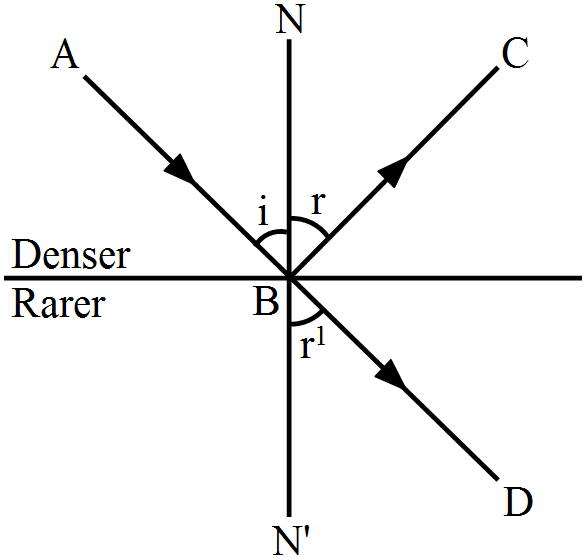
AnswerCorrect option: A. $\sin ^{-1}(\tan r)$
According to snell's law $\mu=\frac{\sin\text{r'}}{\sin\text{i}}$
$(\text{but i = r})=\frac{\sin(90^\circ-\text{r)}}{\sin\text{r}}$
$=\frac{\cos\text{r}}{\sin\text{r}}$
$=\frac{1}{\tan\text{r}}$
$\mu=\frac{1}{\sin\text{i}_{\text{c}}}$
$\Rightarrow\sin \text{i}_{\text{c}}=\tan\text{r}$
$\text{i}_{\text{c}}=\sin^{-1}(\tan\text{r})$
View full question & answer→MCQ 1531 Mark
A ray of light is incident on a plane mirror making an angle of $90^\circ$ with the mirror surface. The angle of reflection for this ray of light will be :
- A
$45^\circ$
- B
$90^\circ$
- ✓
$0^\circ$
- D
$60^\circ$
AnswerCorrect option: C. $0^\circ$
Angle of incidence $= 0^\circ $
According to the first law of reflection, the angle of incidence is equal to the angle of reflection.
View full question & answer→MCQ 1541 Mark
The focal length of a spherical mirror of radius of curvature $30\ cm$ is :
- A
$10\ cm$
- ✓
$15\ cm$
- C
$20\ cm$
- D
$30\ cm$
AnswerCorrect option: B. $15\ cm$
The focal length of a spherical mirror is half of its radius of curvature.
View full question & answer→MCQ 1551 Mark
Linear magnification produced by a concave mirror may be :
- A
Less than $1$ or equal to $1.$
- B
More than $1$ or equal than $1.$
- ✓
Less than $1,$ more than $1$ or equal to $1.$
- D
Less than $1$ or more than $1.$
AnswerCorrect option: C. Less than $1,$ more than $1$ or equal to $1.$
Magnification $,\text{m}=\frac{\text{v}}{\text{u}}$
View full question & answer→MCQ 1561 Mark
No matter how far you stand from a mirror, your image appears erect. The mirror is likely to be
MCQ 1571 Mark
A ray of light passes from a medium $X$ to another medium $Y$. No refraction of light occurs if the ray of light hits the boundary of medium $Y$ at an angle of :
- A
$0^\circ$
- B
$45^\circ$
- ✓
$90^\circ$
- D
$120^\circ$
AnswerCorrect option: C. $90^\circ$
If a ray of light travels along the normal, it is not refracted.
View full question & answer→MCQ 1581 Mark
The refractive index of lens flint glass is $1.65$ and for alcohol, it is $1.36$ with respect to air, then the refractive index of the dens flint glass with respect to alcohol is :
- A
$1.31$
- ✓
$1.21$
- C
$1.11$
- D
$1.01$
AnswerCorrect option: B. $1.21$
air $n$ flint glass $=\frac{\text{Speed of light in air (c)}}{\text{Speed of light in flint glass (Vg)}}=1.65$
air $n$ alcohol $=\frac{\text{Speed of light in air (c)}}{\text{Speed of light alcohol (Val)}}=1.36$
alcohol $n$ flint glass $=\frac{\text{Speed of light in alcohol (Val)}}{\text{Speed of light in flint glass (Vg)}}$
$=\frac{\text{air n flint glass}}{\frac{1}{\text{air n alcohol}}}$
$=\frac{1.65}{1.36}=1.213$
View full question & answer→MCQ 1591 Mark
In a convex spherical mirror, reflection of light takes place at :
AnswerCorrect option: C. A bulging $-$ our surface.
In a convex spherical mirror, reflection of light takes place at the bulged $-$ out surface.
View full question & answer→MCQ 1601 Mark
A concave mirror cannot be used as :
AnswerA concave mirror cannot be used as a rear view mirror because it forms inverted images of distant objects.
View full question & answer→MCQ 1611 Mark
A piece of paper is placed at the focus of a convex lens focussing sunlight. The paper will :
AnswerA convex lens can burn a piece of paper using sunlight.
View full question & answer→MCQ 1621 Mark
An object is placed $20\ cm$ in front of a plane mirror. The mirror is moved $2\ cm$ towards the object. The distance between the positions of the positions of the original and final images seen in the mirror is :
- A
$2\ cm.$
- ✓
$4\ cm.$
- C
$10\ cm.$
- D
$22\ cm$
AnswerCorrect option: B. $4\ cm.$
Distance between original image and final image $=$ distance the mirror moved $+$ same distance the image moved $= 2 + 2 = 4c.$
View full question & answer→MCQ 1631 Mark
You are given water mustard oil, glycerine and kerosene. In which of these media a ray of light incident obliquely at same angle would bend the most?
AnswerThe given material having their refractive index as kerosene is $1.44,$ water is $1.33,$ musterd oil is $1.46$ and glycerine is $1.74.$ Thus, glycerine is most optically denser and hence have the largest refractive index. Therefore, ray of light bend most in glycerine.
View full question & answer→MCQ 1641 Mark
Consider two statements $A$ and $B$ given below :
- Real image is always inverted.
- Virtual image is always erect.
Out of these two statements :
AnswerCorrect option: C. Both $A$ and $B$ are true.
A real image is always inverted and a virtual image is always erect.
View full question & answer→MCQ 1651 Mark
A real image of an object is to be obtained. The mirror required for this purpose is :
- A
- ✓
- C
- D
Either convex or concave.
AnswerA concave mirror forms a real image of an object.
View full question & answer→MCQ 1661 Mark
A spherical mirror and a thin spherical lens have each a focal length of $-15 \ cm.$ The mirror and the lens are likely to be.
- ✓
- B
- C
The mirror is concave and the lens is convex.
- D
the mirror is convex, but the lens is concave.
View full question & answer→MCQ 1671 Mark
An illuminated object is placed at a distance of $20\ cm$ from a converging lens of focal length $15\ cm$. The image obtained on the screen is :
AnswerFor an object placed between the focal length and twice the focal length of a converging lens, the image formed is real, inverted and magnified.
View full question & answer→MCQ 1681 Mark
A concave lens produces an image $20\ cm$ from the lens of an object placed $30\ cm$ from the lens. The focal length of the lens is :
- A
$50\ cm$
- B
$40\ cm$
- ✓
$60\ cm$
- D
$30\ cm$
AnswerCorrect option: C. $60\ cm$
Object distance from the lens $, u = -30\ cm$
Image distance from the lens $, v = -20\ cm$
Using the lens formula, we get,
$\frac{1}{\text{f}}=\frac{1}{\text{v}}-\frac{1}{\text{u}}$
$\frac{1}{\text{f}}=\frac{1}{-20}-\frac{1}{-30}$
$\frac{1}{\text{f}}=\frac{1}{-20}+\frac{1}{30}$
$\frac{1}{\text{f}}=\frac{-3+2}{60}=-\frac{1}{60}$
$\therefore\ \text{f}=-60\text{ cm}$
Therefore, the focal length of the lens is $60\ cm.$
View full question & answer→MCQ 1691 Mark
The real image formed by a concave mirror is larger than the object when object is :
- A
At a distance equal to radius of curvature.
- B
At a distance less than the focal length.
- ✓
Between focus and centre of curvature.
- D
At a distance greater than radius of curvature.
AnswerCorrect option: C. Between focus and centre of curvature.
For an object placed between the focus and the centre of curvature, the real image formed by a concave mirror is larger than the object.
View full question & answer→MCQ 1701 Mark
An object is placed at the centre of curvature of a concave mirror. The distance between its image and the pole is:
- A
Equal to $f.$
- B
Between $f$ and $2f$.
- ✓
Equal to $2f.$
- D
Greater than $2f.$
AnswerCorrect option: C. Equal to $2f.$
An object is placed at the centre of curvature of a concave mirror. The image will be formed at the centre of curvature so the distance will be $2f \ \Big(\text{f}=\frac{1}{2}$ of radius of curvature $\Big)$
View full question & answer→MCQ 1711 Mark
To obtain a magnification of $,-2$ with a convex lens of focal length $10\ cm,$ the object should be placed :
AnswerCorrect option: B. Between $10\ cm$ and $20\ cm.$
The magnification is $-2,$ which means that the image is real, inverted and magnified. A convex mirror forms a.
View full question & answer→MCQ 1721 Mark
A converging lens has a focal length of $50\ cm$. The power of this lens is :
- A
$+0.2D$
- B
$-2.0D$
- ✓
$+2.0D$
- D
$-0.2D$
AnswerCorrect option: C. $+2.0D$
$\text{Power}=\frac{1}{\text{Focal length}}=\frac{1}{0.5\text{m}}=+2\text{D}$
View full question & answer→MCQ 1731 Mark
An object is placed in front of a screen and a convex lens is placed at a position such that the size of the image formed is $9\ cm$. when the lens is shifted through a distance of $20\ cm,$ the size of the image becomes $1\ cm.$ The focal length of the lens and the size of the object are respectively.
- A
$7.5\ cm$ and $3.5\ cm$
- B
$7.5\ cm$ and $4.5\ cm$
- C
$6\ cm , 3\ cm$
- ✓
$7.5\ cm$ and $3\ cm$
AnswerCorrect option: D. $7.5\ cm$ and $3\ cm$
If $\mathrm{h}_1$ and $\mathrm{h}_2$ are the sizes of the images formed in two conjugate positions, then, the size of object is given as
$\text{h}=\sqrt{\text{h}_1\text{h}_2}$
$=\sqrt{9\times1}=3\text{ cm}$
The size of the image in the two conjugate positions is
In the first case, if the image is formed, the magnification is given as $\frac{\text{v}}{\text{u}}=\frac{9}{3}$ Such that $, v = 3u$
Also $, v = 20 + u,$ since $"v\ ”$ and $"u\ ”$ interchange the conjugate positions.
$\therefore 3u = 20 + u$
Or $2u = 20$
Or $u = 10$
And, $v = 20 + u = 20 + 10 = 30\ cm$
Now, focal length is calculated as :
$\frac{1}{\text{f}}=\frac{1}{\text{v}}+\frac{1}{\text{u}}$
$=\frac{1}{30}+\frac{1}{10}$
$=\frac{10+30}{300}$
$=\frac{40}{300}=7.5$
Thus, correct answer is option $(d).$
View full question & answer→MCQ 1741 Mark
Under which of the following conditions a concave mirror can form an image larger than the actual object?
- A
When the object is kept at a distance equal its radius of curvature.
- B
When object is kept at a distance less than its focal length.
- ✓
When object is placed between the focus and centre of curvature.
- D
When object is kept at a distance greater than its radius of curvature.
AnswerCorrect option: C. When object is placed between the focus and centre of curvature.
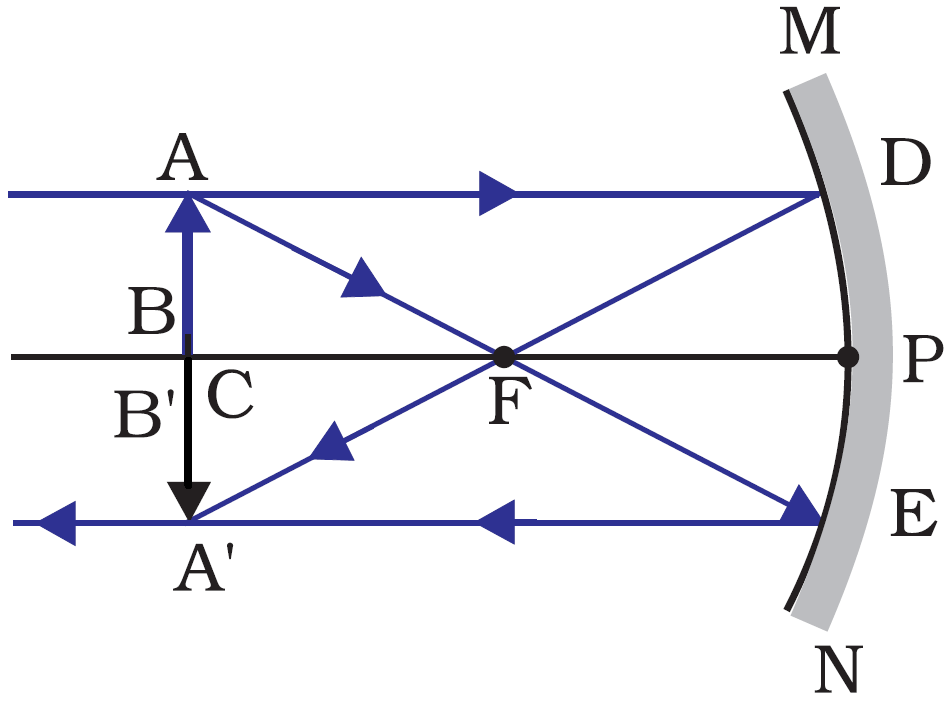
A concave mirror can form an image larger than the actual object when the object is placed between the focus and centre of curvature. Image formation is shown below, where object $(AB)$ is placed between the focus and centre of curvature for which image $(A\ 'B\ ')$ is obtained behind the mirror.
View full question & answer→MCQ 1751 Mark
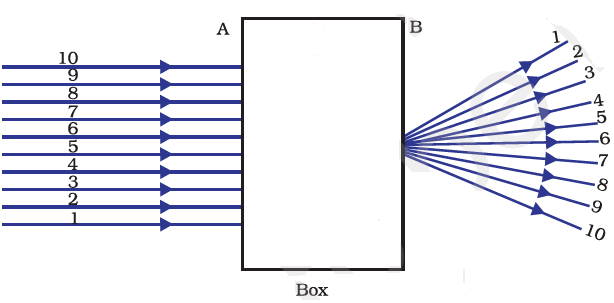
A beam of light is incident through the holes on side A and emerges out of the holes on the other face of the box as shown in the Figure. Which of the following could be inside the box?
MCQ 1761 Mark
If the image formed is always virtual, the mirror can be :
AnswerBoth convex and plane mirrors always form virtual images.
View full question & answer→MCQ 1771 Mark
The mirror which can form a magnified image of an object is :
- A
- B
- ✓
- D
Both convex and concave mirror.
AnswerA concave mirror forms a magnified image of an object.
View full question & answer→MCQ 1781 Mark
The angle between an incident ray and the plane mirror is $30^\circ$ . The total angle between the incident ray and reflected ray will be :
- A
$30^\circ$
- B
$60^\circ$
- ✓
$90^\circ$
- D
$120^\circ$
AnswerCorrect option: C. $90^\circ$
Since, angle of incidence $= 90^\circ - $ angle between plane mirror and incident ray $= 90^\circ - 30^\circ = 60^\circ $ and according to first law of reflection, angle of incidence $=$ angle of reflection $= 60^\circ $
Total angle between incident ray and reflected ray $= 60^\circ + 60^\circ = 120^\circ $
View full question & answer→MCQ 1791 Mark
A convex lens $A$ of focal length $20\ cm$ and a concave lens $B$ of focal length $5\ cm$ are kept along the same axis with a distance d between them. If a parallel beam of light falling on $A$ leaves $B$ as a parallel beam, then the distance $d$ in $\ cm$ will be :
AnswerAs the incident beam is parallel, in the absence of concave lens it will form image at a distance $v$ from it such that
$\frac{1}{\text{v}}-\frac{1}{-\infty}=\frac{1}{+20}$
i.e., $\text{v}=+20\text{ cm}(=\text{f})$
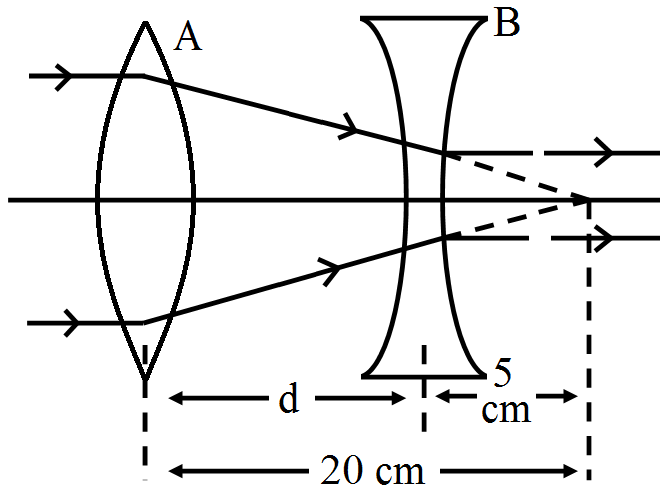
Now if $d$ is the distance between convex and concave lens, the distance of image $I$ from concave lens $B$ will be $= (20 - d)$
As image $I$ will act as object for concave lens which forms its image at infinity.
$\frac{1}{\infty}-\frac{1}{+(20-\text{d})}=\frac{1}{-5}$
i.e. $20-\text{d}=5$
or, $\text{d}=15\text{ cm} \ ($as show above$)$ View full question & answer→MCQ 1801 Mark
A ray of light passes from glass into air. The angle of refraction will be :
- A
Equal to the angle of incidence.
- ✓
Greater than the angle of incidence.
- C
Smaller than the angle of incidence.
- D
$45^\circ$
AnswerCorrect option: B. Greater than the angle of incidence.
Because when a light ray passes from denser medium to a rarer medium, it bends away from the normal.
View full question & answer→MCQ 1811 Mark
The magnification produced by a spherical mirror and a spherical lens is $+\ 0.8.$
- A
The mirror and lens are both convex.
- B
The mirror and lens are both concave.
- C
The mirror is concave but the lens is convex.
- ✓
The mirror is convex but the lens is concave.
AnswerCorrect option: D. The mirror is convex but the lens is concave.
Because both convex mirror and concave lens have positive magnification.
View full question & answer→MCQ 1821 Mark
Linear magnification produced by a convex lens can be :
- A
Less than $1$ or more than $1.$
- B
Less than $1$ or equal to $1.$
- C
More than $1$ or equal to $1.$
- ✓
Less than $1,$ equal to $1$ or more than $1.$
AnswerCorrect option: D. Less than $1,$ equal to $1$ or more than $1.$
The size of the image formed by a convex lens may be less than, equal to or greater than the size of the object.
View full question & answer→MCQ 1831 Mark
Refractive index of diamond with respect to glass is $1.6$. If the absolute refractive index of glass is $1.5,$ then the absolute refractive index of diamond is :
AnswerAbsolute refractive index of glass $=\frac{\text{refractive index of glass}}{\text{refractive index of air}}=\frac{\mu_{\text{glass}}}{\mu_{\text{air}}}=1.5$
Since $\mu_{\text{air}}=1,\mu_{\text{glass}}=1.5$
refractive index of diamond with respect to glass $=\frac{\mu_{\text{diamond}}}{\mu_{\text{glass}}}=1.6$
$\mu_{\text{diamond}}=1.6\times\mu_{\text{glass}}=1.6\times1.5=2.4$
absolute refractive index of diamond $=\frac{\mu_{\text{diamond}}}{\mu_{\text{air}}}=\frac{2.4}{1}=2.4$
View full question & answer→MCQ 1841 Mark
A convex lens produces a magnification of $+\ 5$. The object is placed :
- A
- B
Between $f$ and $2f.$
- ✓
At less than $f.$
- D
Beyond $2f.$
AnswerCorrect option: C. At less than $f.$
Since the magnification is positive, the image formed is virtual, erect and enlarged. This is the case when an object is placed at a distance of less than $f$ of the lens.
View full question & answer→MCQ 1851 Mark
AnswerA convex mirror diverges the rays of light incident on it; hence, it acts as a diverging mirror.
View full question & answer→MCQ 1861 Mark
The image formed by a concave mirror is observed to be virtual, erect and larger than the object. Where should be the position of the object?
- A
Between the principal focus and the centre of curvature.
- B
At the centre of curvature.
- C
Beyond the centre of curvature.
- ✓
Between the pole of the mirror and its principal focus.
AnswerCorrect option: D. Between the pole of the mirror and its principal focus.
View full question & answer→MCQ 1871 Mark
Light travelling from a denser medium to a rarer medium along a normal to the boundary :
- A
Is refracted towards the normal.
- B
Is refracted away from the normal.
- C
- ✓
AnswerWhen a ray of light travels along the normal incident on the surface, it is not refracted.
View full question & answer→MCQ 1881 Mark
A ray of light strikes a plane mirror $PQ$ at an angle of incidence of $30^\circ ,$ is reflected from the plane mirror and then strikes a second plane mirror $QR$ placed at right angles to the first mirror. The angle of reflection at the second mirror is :
AnswerCorrect option: C. $60^\circ$
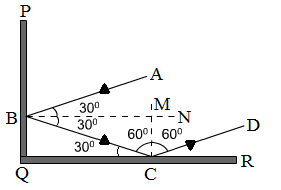
Here.
$\angle\text{A}\text{B}\text{N}= \angle\text{N}\text{B}\text{C} \ ($angle of incidence $=$ angle of reflection$)$
$\angle\text{B}\text{C}\text{O}=\angle\text{N}\text{B}\text{C} \ ($alternate angles$)$
$\angle\text{M}\text{C}\text{B}=90^\circ-\angle\text{B}\text{C}\text{O}$
$\big(\angle\text{M}\text{C}\text{B}=$ angle of incident for mirror $QR\big)$
$= 60^\circ$
Now
$\big(\angle\text{M}\text{C}\text{B}=\angle\text{M}\text{C}\text{D}=60^\circ $ angle of reflection from mirror $QR$ and angle of incidence $=$ angle of reflection$\big)$ View full question & answer→MCQ 1891 Mark
The refractive indexes of four substances $\ce{P, Q, R}$ and $S$ are $1.77, 1.50, 2.42$ and $1.31$ respectively. When light travelling in air is incident on these substances at equal angles, the angle of refraction will be the maximum in :
- A
Substance $P.$
- B
Substance $Q.$
- C
Substance $R.$
- ✓
Substance $S.$
AnswerCorrect option: D. Substance $S.$
$\text{Refractive index}=\frac{\sin\text{i}}{\sin\text{r}}$
The value of $(\sin i)$ is same in all the cases; therefore, the value of $(\sin r)$ will be maximum for minimum refractive index. This means that the angle of refraction will be maximum for minimum refractive index and substance $S$ has minimum refractive index.
View full question & answer→MCQ 1901 Mark
A ray of light travelling in water falls at right angles to the boundary of a parallel $-$ sided glass block. The ray of light :
- A
Is refracted towards the normal.
- B
Is refracted away from the normal.
- ✓
- D
Is reflected along the same path.
AnswerWhen a ray of light travels along the normal incident on the boundary separating two mediums, it is not refracted.
View full question & answer→MCQ 1911 Mark
In order to obtain a real image twice the size of the object with a convex lens of focal length $15 \ cm,$ the object distance should be :
- A
More than $5\ cm$ but less than $10\ cm.$
- B
More than $10\ cm$ but less than $15\ cm.$
- ✓
More than $15\ cm$ but less than $30\ cm.$
- D
More than $30\ cm$ but less than $60\ cm.$
AnswerCorrect option: C. More than $15\ cm$ but less than $30\ cm.$
For an object placed between $F$ and $2F$ of a convex lens, the image formed is real and enlarged.
View full question & answer→MCQ 1921 Mark
In torches, search lights and headlights of vehicles the bulb is placed :
- A
Between the pole and the focus of the reflector.
- ✓
Very near to the focus of the reflector.
- C
Between the focus and centre of curvature of the reflector.
- D
At the centre of curvature of the reflector.
AnswerCorrect option: B. Very near to the focus of the reflector.
View full question & answer→MCQ 1931 Mark
If a magnification of $, -1\ ($minus $1)$ is obtained by using a converging lens, then the object has to be placed :
- A
Within $f.$
- ✓
At $2f.$
- C
Beyond $2f.$
- D
AnswerCorrect option: B. At $2f.$
When an object is placed at $2f,$ the size of the image formed will be equal to the size of the object. Therefore, we get a magnification of $1.$
View full question & answer→MCQ 1941 Mark
Which of the following lens will diverge the ray of light more?
- A
$2D$
- B
$1D$
- C
$-0.4D$
- ✓
$-0.8D$
AnswerCorrect option: D. $-0.8D$
The diverging lens is signified by negative sign. Also, more is the magnitude of the lens more is the more is the diverging power.
View full question & answer→MCQ 1951 Mark
In order to determine focal length of a concave mirror by obtaining the image of distant object on screen, you need to measure the distance between :
- A
- ✓
- C
- D
Mirror and screen also between object and screen.
AnswerAs the distance between the pole $0$ of the concave mirror and the focus $F$ is the focal length of the concave mirror. Thus, the focal length of a concave mirror can be estimated by obtaining a real image of a distant object at its focus.
View full question & answer→MCQ 1961 Mark
If $R$ is the radius of curvature of a spherical mirror and $f$ is its focal length, then :
AnswerCorrect option: B. $R = 2$
If $R$ is the radius of curvature of a spherical mirror and $f$ is its focal length, then $R = 2f.$
View full question & answer→MCQ 1971 Mark
In which of the following, the image of an object placed at infinity will be highly diminished and point sized?
- A
- B
- C
- ✓
Concave mirror, convex mirror, concave lens and convex lens.
AnswerCorrect option: D. Concave mirror, convex mirror, concave lens and convex lens.
In case of all of the above, when an object is at infinity, image is highly diminished and point sized.
View full question & answer→MCQ 1981 Mark
A virtual image three times the size of the object is obtained with a concave mirror of radius of curvature $36\ cm.$ The distance of the object from the mirror is :
- A
$20\ cm$
- B
$10\ cm$
- ✓
$12\ cm$
- D
$5\ cm$
AnswerCorrect option: C. $12\ cm$
$m = 3$
$R = 36$
Then $,\text{F}=\frac{\text{R}}{2}=18$
$\text{m}=\frac{\text{v}}{\text{u}}$
$3=\frac{\text{v}}{\text{u}}$
$\text{v}=3\text{u}$
then $,\frac{1}{\text{f}}=\frac{1}{\frac{\text{v}+1}{\text{u}}}$
$\frac{1}{18}=\frac{1}{\frac{34+1}{\text{u}}}$
$\frac{1}{18}=\frac{2}{3\text{u}}$
$\frac{3\text{u}}{18}=2$
$3\text{u}=36$
$\text{u}=12$
View full question & answer→MCQ 1991 Mark
Magnification produced by a rear view mirror fitted in vehicles :
- ✓
- B
- C
- D
Can be more than or less than one depending upon the position of the object in front of it.
Answer$\text{m}=\frac{\text{size of image}}{\text{size of object}}$
Rear view mirror is a convex mirror, which always forms an image whose size is less than the size of the object.
View full question & answer→MCQ 2001 Mark
A beam of light is incident through the holes on one side of a box and emerges out through the holes on its opposite side as shown in the following figure :
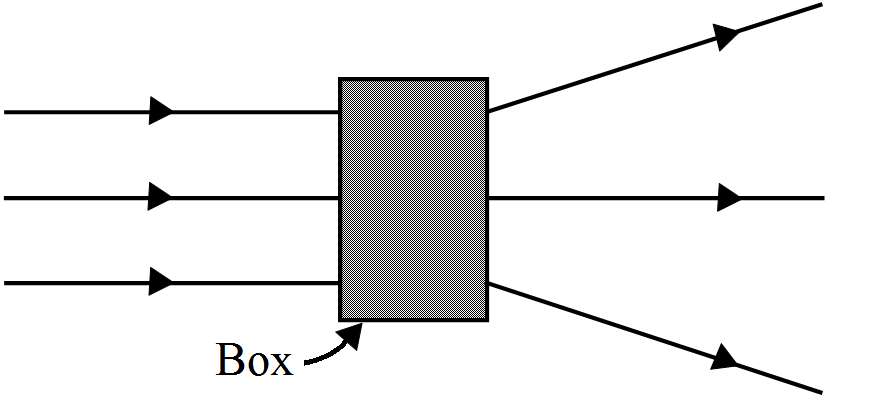
The box contains:
AnswerThis is because the emergent rays of light are diverging.
View full question & answer→