Questions · Page 5 of 5

M.C.Q

MCQ 2011 Mark
The speed of light in substance $X$ is $1.25 \times 10^8 \mathrm{~m} / \mathrm{s}$ and that in air is $3 \times 10^8 \mathrm{~m} / \mathrm{s}$. The refractive index of this substance will be :
  • $2.4$
  • B
    $0.4$
  • C
    $4.2$
  • D
    $3.75$
Answer
Correct option: A.
$2.4$
$\text{Refractive index}=\frac{\text{Speed of light in air}}{\text{Speed of light in the substance}}$
$=\frac{3\times10^8\text{m}/ \text{s}}{1.25\times10^8\text{m}/ \text{s}}$
View full question & answer
MCQ 2021 Mark
To determine the focal length of a concave mirror by forming image of a distant object, the screen should be placed :
  • A
    In any direction.
  • B
    Inclined at angle of $45^\circ .$
  • At right angle to the plane of mirror.
  • D
    Parallel to the plane of mirror.
Answer
Correct option: C.
At right angle to the plane of mirror.
Rays from a distant object are parallel. When they hit a concave mirror, they converge to a point known as the focus.
View full question & answer
MCQ 2031 Mark
The image of an object formed by a plane mirror is :
  • Virtual.
  • B
    Real.
  • C
    Diminished.
  • D
    Upside $-$ down.
Answer
Correct option: A.
Virtual.
The reason being, the image cannot be projected on a screen.
View full question & answer
MCQ 2041 Mark
In the concave reflector of a torch, the bulb is placed :
  • A
    Between the pole and focus of reflector.
  • At the focus of reflector.
  • C
    Between focus and centre of curvature of reflector.
  • D
    At the centre of curvature of reflector.
Answer
Correct option: B.
At the focus of reflector.
When a light bulb is placed at the focus of a concave mirror reflector, the diverging light rays of the bulbare collected by the reflector and then reflected, to produce a strong, parallel-sided beam of light.
View full question & answer
MCQ 2051 Mark
$n$ order to obtain a magnification of $, −0.6 \ ($minus $0.6)$ with a concave mirror, the object must be placed :
  • A
    At the focus.
  • B
    Between pole and focus.
  • C
    Between focus and centre of curvature.
  • Beyond the centre of curvature.
Answer
Correct option: D.
Beyond the centre of curvature.
In order to obtain a magnification of $−0.6\ ($minus $0.6)$ with a concave mirror, the object needs to be placed beyond the centre of curvature, as at this point a diminished image will be formed.
View full question & answer
MCQ 2061 Mark
Which of the following statements is true?
  • A convex lens has $4$ dioptre power having a focal length $0.25m.$
  • B
    A convex lens has $-4$ dioptre power having a focal length $0.25m.$
  • C
    A concave lens has $4$ dioptre power having a focal length $0.25m.$
  • D
    A concave lens has $-4$ dioptre power having a focal length $0.25m.$
Answer
Correct option: A.
A convex lens has $4$ dioptre power having a focal length $0.25m.$
The positive sign with the focal length indicates that it is a convex lens.
View full question & answer
MCQ 2071 Mark
The mirror used by a dentist to examine the teeth of a person is :
  • A
    Convex.
  • Concave.
  • C
    Plane.
  • D
    Any one of the above.
Answer
Correct option: B.
Concave.
A concave mirror is used by a dentist to examine the teeth of a person.
View full question & answer
MCQ 2081 Mark
Refractive indices of water, sulphuric acid, glass and carbon disulphide are $1.33, 1.43, 1.53$ and $1.63$ respectively. the light travels slowest in :
  • A
    Sulphuric acid.
  • B
    Glass.
  • C
    Water.
  • Carbon disulphide.
Answer
Correct option: D.
Carbon disulphide.
$\text{Refractive index}=\frac{\text{Speed of light in air}}{\text{Speed of light in medium}}$
Speed of light in the medium is slowest, therefore refractive index will be maximum as the speed of light in air is constant. Thus, light will travel slowest in the substance with refractive index $1.63$
View full question & answer
MCQ 2091 Mark
Which of the following can make a parallel beam of light when light from a point source is incident on it?
  • Concave mirror as well as convex lens.
  • B
    Convex mirror as well as concave lens.
  • C
    Two plane mirrors placed at $90^\circ$ to each other.
  • D
    Concave mirror as well as concave lens.
Answer
Correct option: A.
Concave mirror as well as convex lens.
When a point source of light is at the focus of a concave mirror or a convex lens, then emergent rays of light make a parallel beam of light. This is the reason; concave mirror is used as reflector of headlights.
View full question & answer
MCQ 2101 Mark
The speed of light in air is :
  • A
    $3 \times 10^8 \mathrm{~cm} / \mathrm{s}$
  • B
    $3 \times 10^8 \mathrm{~mm} / \mathrm{s}$
  • C
    $3 \times 10^8 \mathrm{~km} / \mathrm{s}$
  • $3 \times 10^8 \mathrm{~m} / \mathrm{s}$
Answer
Correct option: D.
$3 \times 10^8 \mathrm{~m} / \mathrm{s}$
View full question & answer
MCQ 2111 Mark
Which of the following can make a parallel beam of light from a bulb falls on it?
  • A
    Concave mirror as well as concave lens.
  • B
    Convex mirror as well as concave lens.
  • Concave mirror as well as convex lens.
  • D
    Concave mirror as well as convex lens.
Answer
Correct option: C.
Concave mirror as well as convex lens.
When an object is placed at the focus of a concave mirror $($convex lens$),$ the reflected $($refracted$)$ light rays are always parallel to each other and to the principal axis.
View full question & answer
MCQ 2121 Mark
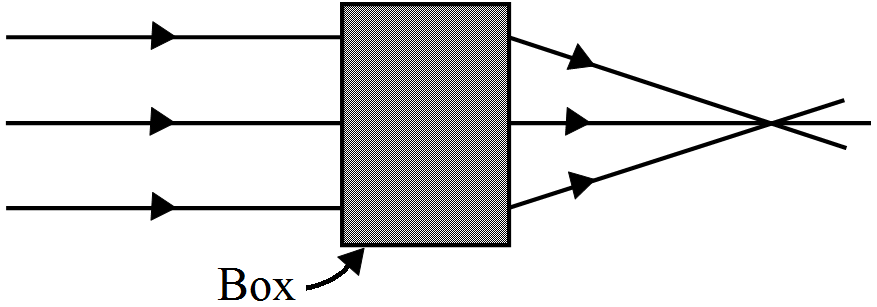
A beam of parallel light rays is incident through the holes on one side of a box and emerges out through the holes on its opposite side as shown in the diagram below : Which of the following could be inside the box?
  • A
    A rectangular glass block.
  • B
    A concave lens.
  • A convex lens.
  • D
    A glass prism.
Answer
Correct option: C.
A convex lens.
The beam of light is converging when it is coming out of the box therefore, there should be a convex lens inside the box.
View full question & answer
MCQ 2131 Mark
A ray of light travelling in air goes into water. The angle of refraction will be :
  • A
    $90^\circ$
  • Smaller than the angle of incidence.
  • C
    Equal to the angle of incidence.
  • D
    Greater than the angle of incidence.
Answer
Correct option: B.
Smaller than the angle of incidence.
Because when a light ray passes from a rarer medium to a denser medium, it bends towards the normal.
View full question & answer
MCQ 2141 Mark
A full length image of a distant tall building can definitely be seen by using :
  • A
    A concave mirror.
  • A convex mirror.
  • C
    A plane mirror.
  • D
    Both concave as well as plane mirror.
Answer
Correct option: B.
A convex mirror.
A convex mirror forms virtual, erect and diminished image of the objects. So, out of given options, distant tall building can definitely be seen by using a convex mirror.
View full question & answer
MCQ 2151 Mark
An object is placed at a large distance in front of a concave mirror of radius of curvature $40\ cm$. The image will be formed in front of the mirror at a distance :
  • $20\ cm$
  • B
    $30\ cm$
  • C
    $40\ cm$
  • D
    $50\ cm$
Answer
Correct option: A.
$20\ cm$
An object is placed at a large distance but in front of a concave mirror with a radius of curvature of $40\ cm.$ The image of this object will be formed at the focus that is $20\ cm$ away
View full question & answer
MCQ 2161 Mark
When an object is kept at any distance in front of a concave lens, the image formed is always :
  • A
    Virtual, erect and magnified.
  • B
    Virtual, inverted and diminished.
  • Virtual, erect and diminished.
  • D
    Virtual, erect and same size as object.
Answer
Correct option: C.
Virtual, erect and diminished.
A concave lens always forms a virtual, erect and diminished image.
View full question & answer
MCQ 2171 Mark
In order to obtain a magnification of $, -0.75$ with a convex lens of focal length $8\ cm,$ the object should be placed :
  • A
    At less than $8\ cm.$
  • B
    Between $8\ cm$ and $16\ cm.$
  • Beyond $16\ cm.$
  • D
    At $16\ cm.$
Answer
Correct option: C.
Beyond $16\ cm.$
For an object placed beyond $2f $of a convex lens, the image formed is real, inverted and smaller than the object.
View full question & answer
MCQ 2181 Mark
A convex lens of focal length $8\ cm$ forms a real image of the same size as the object. The distance between object and its image will be :
  • A
    $8\ cm$
  • B
    $16\ cm$
  • C
    $24\ cm$
  • $32\ cm$
Answer
Correct option: D.
$32\ cm$
A convex lens forms a real image at $2f$ on the right side of the lens. The size of the image is equal to that of the object if the object is placed at $2f.$
$\therefore$ Distance between the image and the object $= 2f + 2f = 4f = 4 \times 8 = 32\ cm.$
View full question & answer
MCQ 2191 Mark
Which mirror is to be used to obtain parallel beam of light from a small bulb?
  • Concave mirror.
  • B
    Convex mirror.
  • C
    Plane mirror.
  • D
    None of these.
Answer
Correct option: A.
Concave mirror.
Concave mirror to be used ti obtain a parallel beam of light from a small lamp.
View full question & answer
MCQ 2201 Mark
A converging lens is used to produce an image of an object on a screen,object on a screen. What change is needed for the image to be formed nearer to the lens?
  • A
    Increase the focal length of the lens.
  • B
    Insert a diverging lens between the lens and the screen.
  • Increase the distance of the object from the lens.
  • D
    Move the object closer to the lens.
Answer
Correct option: C.
Increase the distance of the object from the lens.
As the object moves away from the lens, the image gets closer to the lens.
View full question & answer
MCQ 2211 Mark
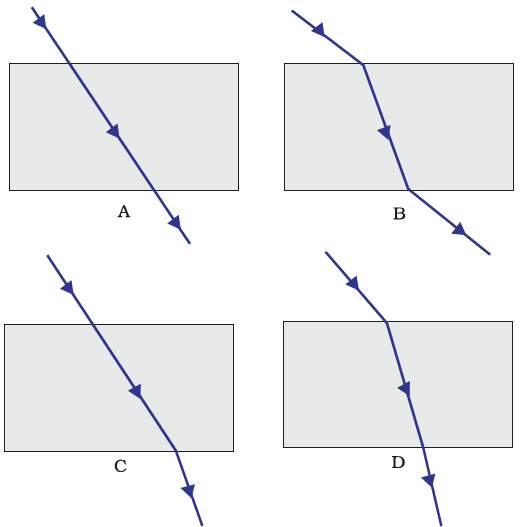
The path of a ray of light coming from air passing through a rectangular glass slab traced by four students are shown as $\ce{A, B, C}$ and $D$ in Figure. Which one of them is correct?
  • A
    $A.$
  • $B.$
  • C
    $C.$
  • D
    $D.$
Answer
Correct option: B.
$B.$
When a light ray is passed through a glass slab obliquely then, emergent ray will be parallel to the direction of the incident ray.
View full question & answer
MCQ 2221 Mark
The angle of incidence for of light passing through the centre of curvature of a concave mirror is :
  • A
    $45^\circ$
  • B
    $90^\circ$
  • $0^\circ$
  • D
    $180^\circ$
Answer
Correct option: C.
$0^\circ$
The reason being, a ray of light passing through the centre of curvature of a concave mirror strikes the mirror normally or perpendicularly.
View full question & answer
MCQ 2231 Mark
Magnification produced by a concave lens is always :
  • A
    More than $1.$
  • B
    Equal to $1.$
  • Less than $1.$
  • D
    More than $1$ or less than $1.$
Answer
Correct option: C.
Less than $1.$
$\text{Magnification}=\frac{\text{Size of the image}}{\text{Size of the object}}$
From the formula, it is clear that the magnification varies directly with the size of the image. The image formed by a concave mirror is always smaller than the size of the object. Therefore, the magnification of a concave mirror is always less than $1.$
View full question & answer
MCQ 2241 Mark
A child is standing in front of a magic mirror. She finds the image of her head bigger, the middle portion of her body of the same size and that of the legs smaller. The following is the order of combinations for the magic mirror from the top.
  • A
    Plane, convex and concave.
  • B
    Convex, concave and plane.
  • Concave, plane and convex.
  • D
    Convex, plane and concave.
Answer
Correct option: C.
Concave, plane and convex.
Concave mirrors $($of large focal length$)$ can be used to see a larger image of the head, the plane mirror for middle portion to see her body of the same size and convex mirror to see the diminished image of leg. Hence, the combinations for magic mirror from the top is concave mirror, plane mirror and convex mirror.
View full question & answer
MCQ 2251 Mark
The image formed by a plane mirror is :
  • A
    Virtual, behind the mirror and enlarged.
  • Virtual, behind the mirror and of the same size as the object.
  • C
    Real, at the surface of the mirror and enlarged.
  • D
    Real, behind the mirror and of the same size as the object.
Answer
Correct option: B.
Virtual, behind the mirror and of the same size as the object.
The image formed by a plane mirror is virtual, behind the mirror and of the same size because it cannot be projected on a screen.
View full question & answer
MCQ 2261 Mark
The refractive indices of four media $\ce{A, B, C}$ and $D$ are $1.44, 1.52, 1.65$ and $1.36$ respectively. When light travelling in air is incident in these media at equal angles, the angle of refraction will be the minimum :
  • A
    In medium $A.$
  • B
    In medium $B.$
  • In medium $C.$
  • D
    In medium $D.$
Answer
Correct option: C.
In medium $C.$
$\text{Refractive index}=\frac{\sin\text{i}}{\sin\text{r}}$
The angle of incidence is equal in all the cases therefore, the refractive index will be maximum in the case of minimum angle of refraction. According to this argument, medium $C$ will have minimum angle of refraction because it has maximum refractive index.
View full question & answer
MCQ 2271 Mark
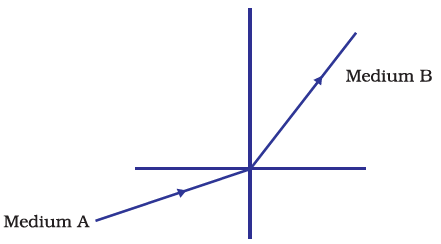
A light ray enters from medium $A$ to medium $B$ as shown in Figure. The refractive index of medium $B$ relative to $A$ will be :
  • Greater than unity.
  • B
    Less than unity.
  • C
    Equal to unity.
  • D
    Zero.
Answer
Correct option: A.
Greater than unity.
Since light rays in medium $B$ goes towards normal. So it has greater restrictive index and lesser velocity of light with respect to medium $A$. So refractive index of medium $B$ with respect to medium $A$ is greater than unity.
View full question & answer
MCQ 2281 Mark
Rays from Sun converge at a point $15\ cm$ in front of a concave mirror. Where should an object be placed so that size of its image is equal to the size of the object?
  • A
    $15\ cm$ in front of the mirror.
  • $30\ cm$ in front of the mirror.
  • C
    Between $15\ cm$ and $30\ cm$ in front of the mirror.
  • D
    More than $30\ cm$ in front of the mirror.
Answer
Correct option: B.
$30\ cm$ in front of the mirror.
In this case $, f = -15\ cm$ and hence $c = -30\ cm ;$ because radius of curvature is double the focal length. When and object is placed on $C,$ its image is of the same size, inverted and is formed on $C.$
View full question & answer
MCQ 2291 Mark
The real image formed by a concave mirror is smaller than the object if the object is :
  • A
    Between centre of curvature and focus.
  • At a distance greater than radius of curvature.
  • C
    At a distance equal to radius of curvature.
  • D
    At a distance equal to focal length.
Answer
Correct option: B.
At a distance greater than radius of curvature.
The reason being, the image formed by a concave mirror is virtual, erect and magnified. The position of the object is between the pole and the focus.
View full question & answer
MCQ 2301 Mark
The image formed by a concave mirror is real, inverted and highly diminished $($much smaller than the object$).$ The object must be :
  • A
    Between pole and focus.
  • B
    At focus.
  • C
    At the centre of curvature.
  • At infinity.
Answer
Correct option: D.
At infinity.
The reason being, the image formed by a concave mirror is real, inverted and highly diminished $($much smaller than the object$).$ Therefore, the object must be at infinity.
View full question & answer
MCQ 2311 Mark
Magnification produced by a plane mirror is :
  • A
    Less than one.
  • B
    Greater than one.
  • C
    Zero.
  • Equal to one.
Answer
Correct option: D.
Equal to one.
Magnification produced by a plane mirror is equal to one. This is because the size of the image formed by a plane mirror is same as the size of the object.
View full question & answer
MCQ 2321 Mark
If the focal length of a spherical mirror is $12.5\ cm,$ its radius of curvature will be :
  • $25\ cm$
  • B
    $15\ cm$
  • C
    $20\ cm$
  • D
    $35\ cm$
Answer
Correct option: A.
$25\ cm$
Radius of curvature $'R\ ' = 2f$
$R = 2 \times 12.5$
$= 25\ cm$
View full question & answer
MCQ 2331 Mark
Where should an object be placed in front of a convex lens to get a real image of the size of the object?
  • A
    At the principal focus of the lens.
  • At twice the focal length.
  • C
    At infinity.
  • D
    Between the optical centre of the lens and its principal focus.
Answer
Correct option: B.
At twice the focal length.
View full question & answer
MCQ 2341 Mark
If a spherical lens has a power of $, -0.25D,$ the focal length of this lens will be :
  • A
    $-4\ cm$
  • B
    $-400\ mm$
  • $-4m$
  • D
    $-40\ cm$
Answer
Correct option: C.
$-4m$
$\text{Focal length}=\frac{1}{\text{Power}}$
$=\frac{1}{-0.25}=\frac{-100}{25}=-4\text{m}$
View full question & answer
MCQ 2351 Mark
One of the following does not apply to a concave mirror. This is :
  • A
    Focal length is negative.
  • B
    Image distance can be positive or negative.
  • Image distance is always positive.
  • D
    Height of image can be positive or negative.
Answer
Correct option: C.
Image distance is always positive.
The image distance is always positive with the exception of one case, when the object is placed between the pole and the focus. In all other cases, the image is formed in front of the mirror and on the left side.
View full question & answer
MCQ 2361 Mark
An object is $100\ mm$ in front of a concave mirror which produces an upright $($erect image$).$ The radius of curvature of the mirror is:
  • A
    Less than $100\ mm.$
  • B
    Between $100\ mm$ and $200\ mm.$
  • C
    Exactly $200\ mm.$
  • More than $200\ mm$
Answer
Correct option: D.
More than $200\ mm$
The reason being, a concave mirror forms an erect image when an object is placed between the focus and the pole. Further, the radius of curvature is twice the distance between the focus and the pole. This gives a radius of curvature greater than $200\ mm.$
View full question & answer
MCQ 2371 Mark
A virtual, erect and magnified image of an object is to be produced with a concave mirror of focal length $12\ cm.$ Which of the following object distance should be chosen for this purpose?
  • $10\ cm$
  • B
    $15\ cm$
  • C
    $20\ cm$
  • D
    Give reason for your choice
Answer
Correct option: A.
$10\ cm$
The object must be kept at a distance of $10\ cm$ from the concave mirror in order to produce a virtual, erect and magnified image. The reason being, a concave mirror forms a virtual, erect and magnified image when an object is placed between the focus and the pole
View full question & answer
MCQ 2381 Mark
A concave mirror has a focal length of $25\ cm.$ At which of the following distance should a person hold his face from this concave mirror so that it may act as a shaving mirror?
  • A
    $45\ cm$
  • B
    $20\ cm$
  • $25\ cm$
  • D
    $30\ cm$ Give reason for your choice.
Answer
Correct option: C.
$25\ cm$
A person must hold his face at a distance of $20\ cm,$ away from the concave mirror. A concave mirror forms an erect, virtual and magnified image when an object is placed between the focus and the pole. Therefore, it acts as a shaving mirror.
View full question & answer
MCQ 2391 Mark
An object is placed at the following distances from a concave mirror of focal length $15\ cm,$ turn by turn :
  1. $35\ cm$
  2. $30\ cm$
  3. $20\ cm$
  4. $10\ cm$
Which position of the object will produce :
  • A
    A magnified real image?
  • B
    A magnified virtual image?
  • C
    A diminished real image?
  • D
    An image of same size as the object?
Answer
Here, radius of curvature $= 2 \ \times $ focal length $= 2 \times 15\ cm = 30\ cm$
  1. At position $(c),$ i.e., $20\ cm$ from the concave mirror, the image formed will be magnified and real. The reason being, a real and magnified image is formed by the concave mirror when an object is placed between the focus and the centre of curvature.
  2. At position $(d),$ i.e., $10\ cm$ from the concave mirror, the image formed will be magnified and virtual. The reason being, a virtual and magnified image is formed by the concave mirror when an object is placed between the focus and the pole.
  3. At position $(a),$ i.e., $35\ cm$ from the concave mirror, the image formed will be diminished and real. The reason being, a diminished and real image is formed by the concave mirror when an object is placed beyond the centre of curvature.
  4. At position $(b),$ i.e., $30\ cm$ from the concave mirror, the image formed will be of the same size as the object. The reason being, an image of the same size as the object is formed by the concave mirror when the object is placed at the centre of curvature.
View full question & answer