Questions · Page 2 of 2

2 Marks Questions

Question 512 Marks
0.35g of an organic compound was Kjeldahlised. The ammonia evolved on distilling the Kjeldahlised extract with 100ml of $\frac{\text{M}}{10\text{ H}_2\text{SO}_4}$ The residual acid required 154ml of $\frac{\text{M}}{10\text{ NaOH}}$ for complete neutralization. Calculate the percentage of nitrogen in organic compound.
Answer
$2\text{M}_1\text{V}_1=\text{M}_2\text{V}_2\$\text{H}_2\text{SO}_4)\ \ \ (\text{NaOH})$
[$\because$ $\mathrm{H}_2 \mathrm{SO}_4$ is dibasic acid]
$2\times\frac{1}{10}\times\text{V}_1=\frac{1}{10}\times154$
$\text{V}_1=77\text{ml}$
Volume of neutralised with $\mathrm{NH}_3$
$=100-77=23\text{ml}$
$\%\text{ of N}=\frac{2.8\times\text{M}_\times\text{V}_1}{\text{W}}$
$=\frac{2.8}{0.35}\times\frac{1}{10}\times23=18.4\%$
View full question & answer
Question 522 Marks
An alkane has a molecular mass of 72. Draw all its possible chain isomers and write their IUPAC names.
Answer
First of all, we will derive the molecular formula.
Molecular formula of alkane is $\mathrm{C}_n \mathrm{H}_{2 n+2}$.
$\because$ Molecular mass $=72$
$\therefore 12 n+2 n+2=72$
$n=5$
The alkane is $\mathrm{C}_5 \mathrm{H}_{12}$. The possible chain isomers are,
  1. $\text{CH}_3-\text{CH}_2-\text{CH}_2-\text{CH}_2-\text{CH}_3\\ \ \ \ \ \ \ \ \ \ \ \ \ \ \ \ \ \ \ \ \ _{\text{Pentane}}$
  2. $\text{CH}_3-\text{CH}-\text{CH}_2-\text{CH}_3\\ \ \ \ \ \ \ \ \ \ \ \ \ \ |\\ \ \ \ \ \ \ \ \ \ \ \ \ \text{CH}_3\\ \ \ \ \ \ \ _{2-\text{methylbutane}}$
  3. $ \ \ \ \ \ \ \ \ \ \ \ \ \text{CH}_3\\ \ \ \ \ \ \ \ \ \ \ \ \ \ |\\\text{CH}_3-\text{C}-\text{CH}_3\\ \ \ \ \ \ \ \ \ \ \ \ \ \ |\\ \ \ \ \ \ \ \ \ \ \ \ \ \text{CH}_3\\\ \ \ _{2,2-\text{dimethyl propane}}$
View full question & answer
Question 532 Marks

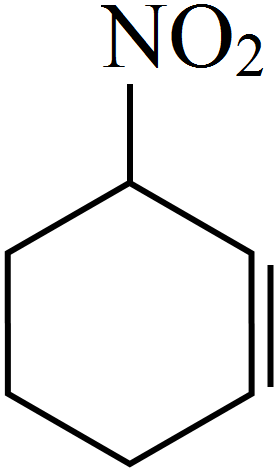
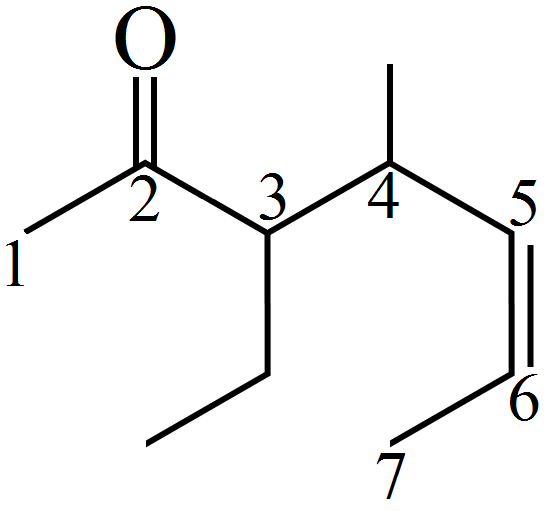
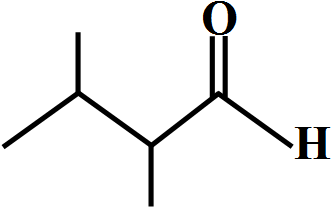
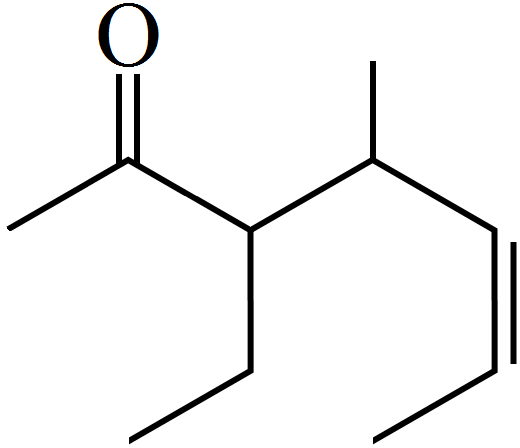
Name the compounds whose line formulae are given below.
  1.  
  1.  
Answer
  1.  

3-ethyl-4-methylhept-5-en-2-one (C-atoms of the longest possible chain are numbered in such a way that the functional group, > C = 0, gets the lowest possible locant)
  1.  

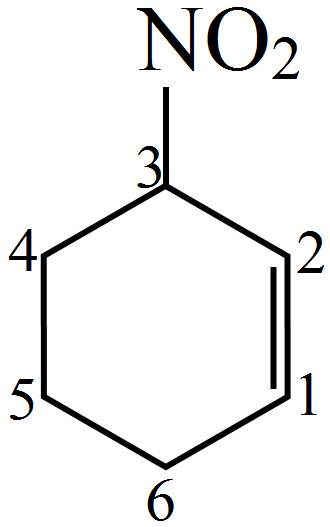
3-nitrocyclohex-1-ene (C-atoms of the ring are numbered in such a manner that double bond gets the lowest possible locant followed by the - $\text{NO}_2$ group)
View full question & answer
Question 542 Marks
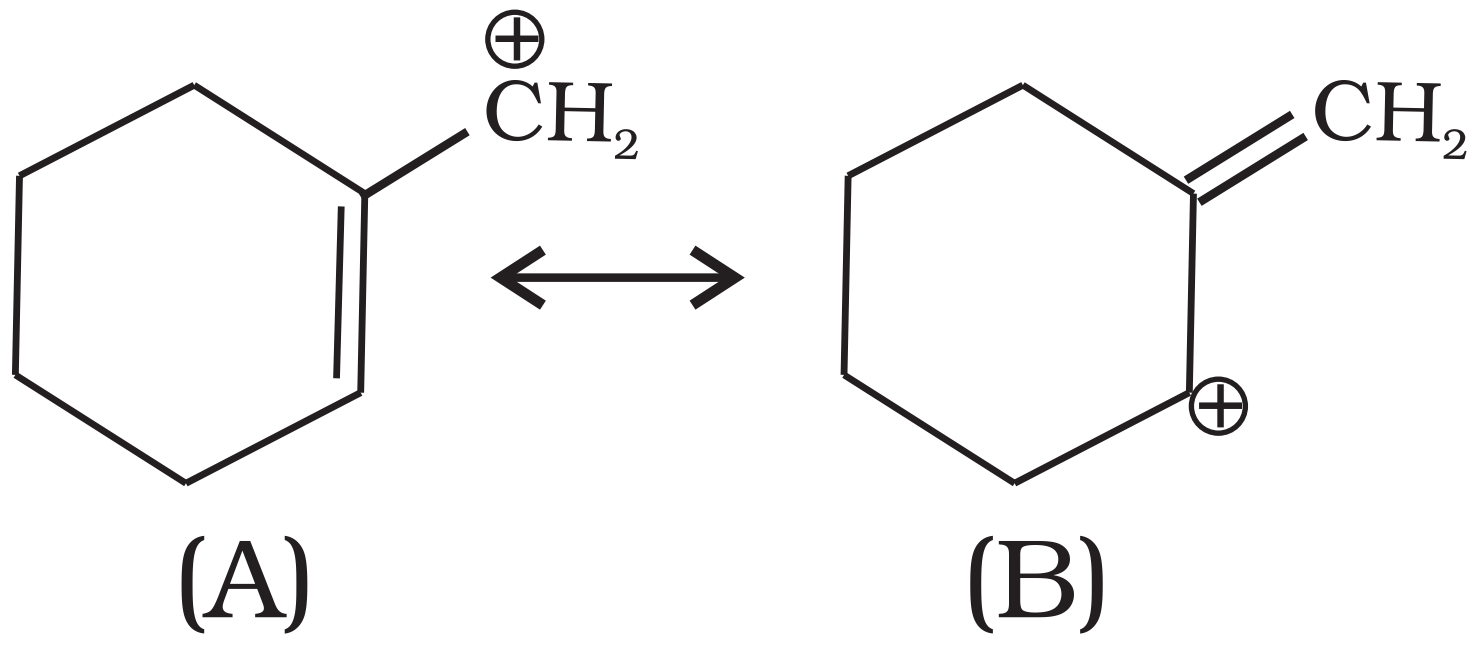
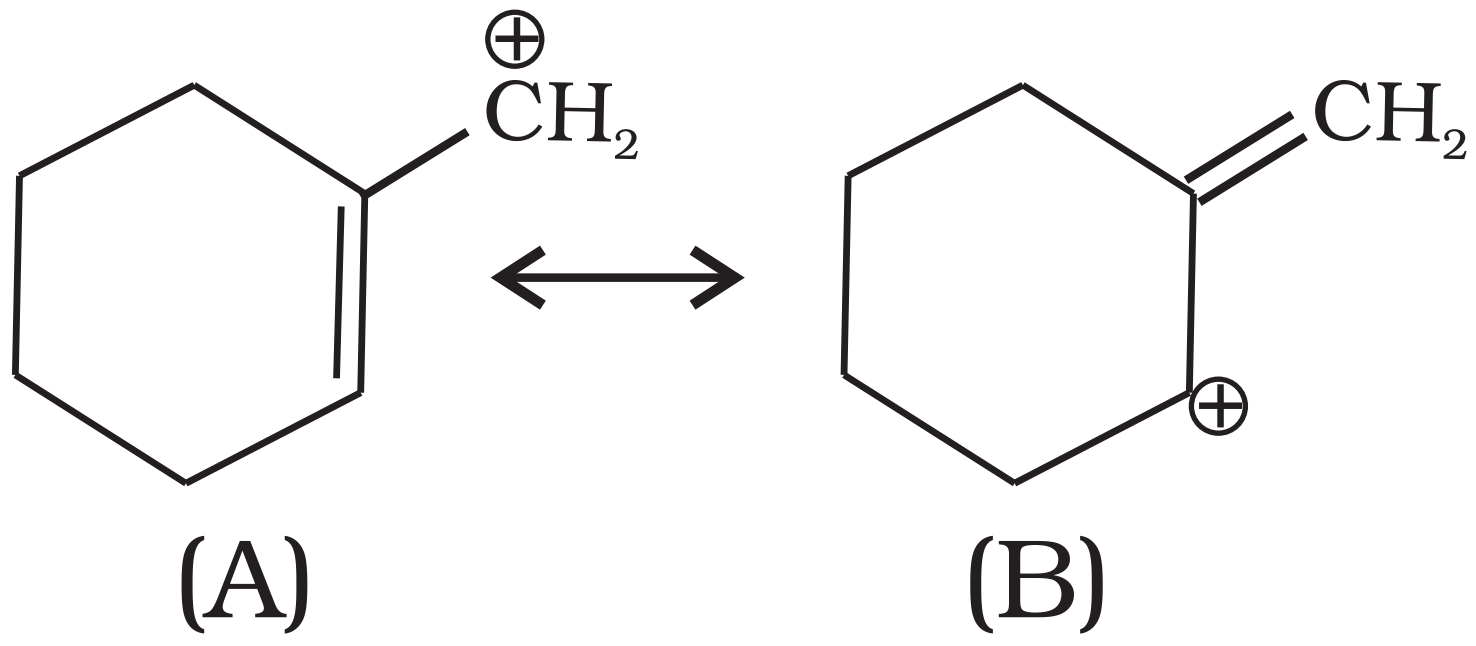
“Stability of carbocations depends upon the electron releasing inductive effect of groups adjacent to positively charged carbon atom involvement of neighbouring groups in hyperconjugation and resonance.”
Which of the following ions is more stable? Use resonance to explain your answer.
Answer


Structure A is more stable than B. Carbocation A is more Planar and electrons from the ring shift to side group $\text{CH}_2^+$and stabilized by resonance. Structure (B) is non-planar and does not undergo resonance. Double bond is more stable with in the ring as compared to side chain.
View full question & answer
Question 552 Marks
Why is staggered conformation of ethane more stable than eclipsed conformation?
Answer
It is because staggered conformation has no torsional strain. It has less repulsion between C-H bonds as these are far away,
$\therefore$ more stable.
View full question & answer
Question 562 Marks
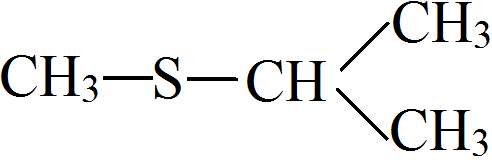
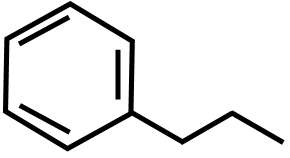
Compounds with same molecular formula but differing in their structures are said to be structural isomers. What type of structural isomerism is shown by $\mathrm{CH}_3-\mathrm{S}-\mathrm{CH}_2-\mathrm{CH}_2-\mathrm{CH}_3$ and
Answer

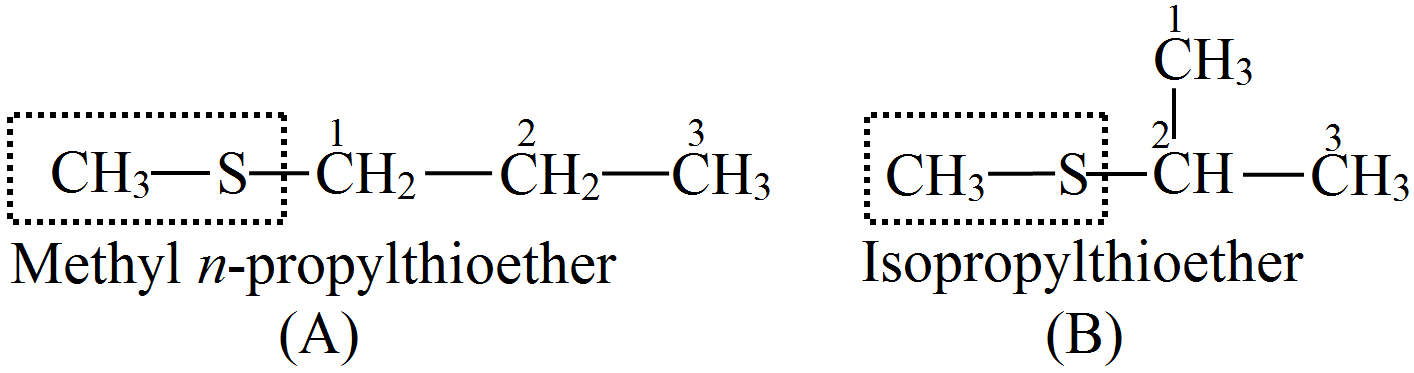
The two isomers which differ in the position of the functional group on the carbon skeleton are called position isomers and the phenomenon is known as position isomerism. Thus, A and B may be regarded as position isomers but they are not considered as metamers since metamers are those isomers which have different number of carbon atoms on either side of the functional group. But here, the number of carbon atoms on either side of sulphur atom (functional group) is the same, i.e. 1 and 3.
View full question & answer
Question 572 Marks
Draw structure of all isomeric ethers having molecular formula $\mathrm{C}_5 \mathrm{H}_{12} \mathrm{O}$.
Answer
Six different structural isomers of ethers can be drawn from molecular formula $\mathrm{C}_5 \mathrm{H}_{12} \mathrm{O}$.
  1. $\text{CH}_3-\text{CH}_2-\text{CH}_2-\text{CH}_2-\text{O}-\text{CH}_3$
  2. $\text{CH}_3-\text{CH}_2-\text{CH}-\text{CH}_3\\ \ \ \ \ \ \ \ \ \ \ \ \ \ \ \ \ \ \ \ \ \ \ \ \ \ \ |\\\ \ \ \ \ \ \ \ \ \ \ \ \ \ \ \ \ \ \ \ \ \ \ \ \ \text{OCH}_3$
  3. $\text{CH}_3-\text{CH}_2-\text{CH}_2-\text{OCH}_3\\ \ \ \ \ \ \ \ \ \ \ \ \ \ \ \ \ \ \ \ \ \ \ \ \ \ \ |\\ \ \ \ \ \ \ \ \ \ \ \ \ \ \ \ \ \ \ \ \ \ \ \ \ \ \text{CH}_3$
  4. $ \ \ \ \ \ \ \ \ \ \ \ \ \text{CH}_3\\ \ \ \ \ \ \ \ \ \ \ \ \ \ |\\\text{CH}_3-\text{C}-\text{CH}_3\\ \ \ \ \ \ \ \ \ \ \ \ \ \ |\\ \ \ \ \ \ \ \ \ \ \ \ \ \text{OCH}_3$
  5. $\text{CH}_3-\text{CH}_2-\text{CH}_2-\text{O}-\text{C}_2\text{H}_5$
  6. $\text{CH}_3-\text{CH}-\text{CH}_3\\ \ \ \ \ \ \ \ \ \ \ \ \ \ |\\ \ \ \ \ \ \ \ \ \ \ \ \ \text{OC}_2\text{H}_5$
View full question & answer
Question 582 Marks
What is the correct order of priority for following functional groups of organic compound in IUPAC nomenclature?
$\ \ \ \ \ \ \ \ \ \ \ \ \ \ \ \ \ \ \ \ \ \ \ \ \ \ \ \ \ \ \ \ \ \ \ \ \ \ \ \ \ \ \ \ \ \ \ \ {\text{ O}}\\ \ \ \ \ \ \ \ \ \ \ \ \ \ \ \ \ \ \ \ \ \ \ \ \ \ \ \ \ \ \ \ \ \ \ \ \ \ \ \ \ \ \ \ \ \ \ \ \ \ \|\\-\text{COOH}-,-\text{OH},-\text{CHO},-\text{C}-$
Answer
$\ \ \ \ \ \ \ \ \ \ \ \ \ \ \ \ \ \ \ \text{O}\ \ \ \ \ \ \ \ \ \ \ \text{O}\ \ \ \ \ \ \ \ \ \ \ \ \ \ \ \ \text{O}\\\ \ \ \ \ \ \ \ \ \ \ \ \ \ \ \ \ \ \ \|\ \ \ \ \ \ \ \ \ \ \ \ \ \|\ \ \ \ \ \ \ \ \ \ \ \ \ \ \ \ \ \|\\-\text{OH}<-\text{C}-<-\text{C}-\text{H}<-\text{C}-\text{OH}$ is order of preference.
View full question & answer
Question 592 Marks
Give the common name of:
  1. Methanol olido.
  2. Ethanol.
  3. Ethoxyethane.
  4. Ethanoic acid.
  5. 1, 4-dimethyl benzene.
Answer
  1. Methyl alcohol.
  2. Ethyl alcohol.
  3. Diethyl ether.
  4. Acetic acid.
  5. P-xylene.
View full question & answer
Question 602 Marks
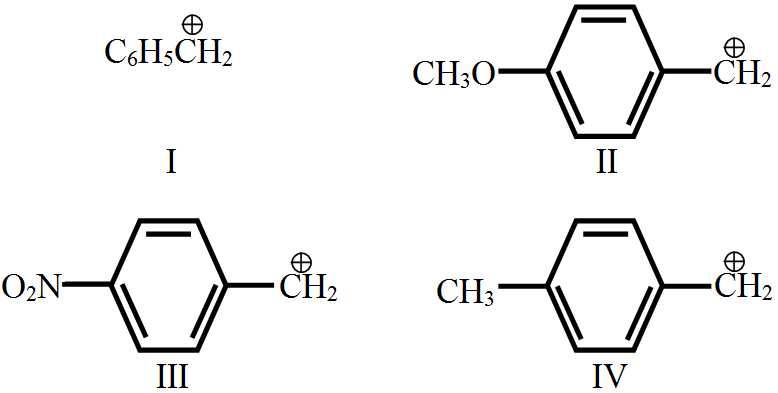
Arrange the following in decreasing order of stability:
Answer
II > IV > I > III.
$\because \mathrm{OCH}_3$ group has +R effect, $\mathrm{CH}_3$ is electron releasing will destabilize carbocation where $-\mathrm{NO}_2$ group is electron withdrawing, will destabilize carbocation.
View full question & answer
Question 612 Marks
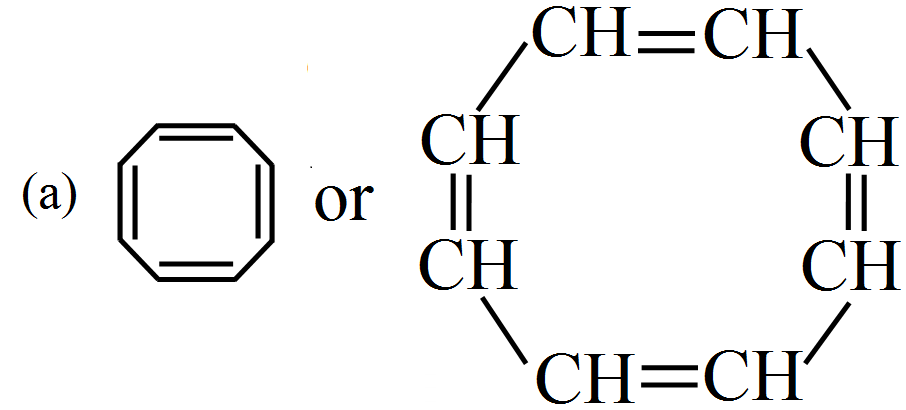
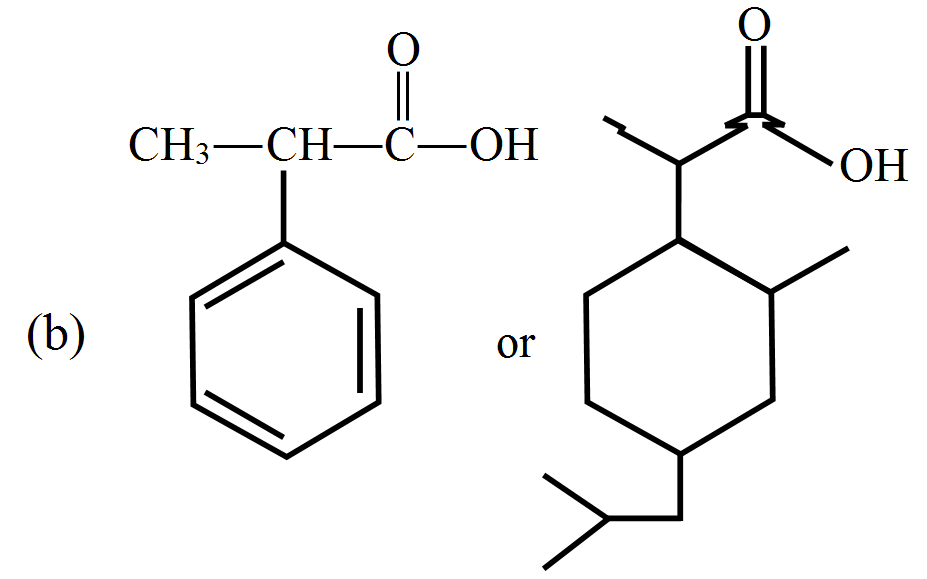
  1. Give condensed and bond line structural formulae of the following:
  1. Cyclo octa-1,5-diene.
  2. 2(4-iso butyl phenyl) propanoic.
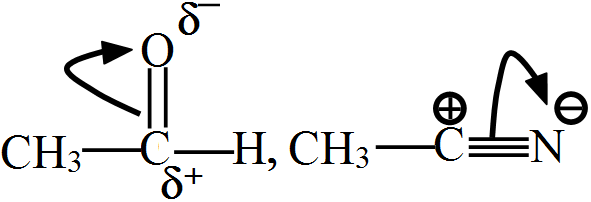
  1. Identify electrophilic centre in the following $\mathrm{CH}_3 \mathrm{CHO}$ and $\mathrm{CH}_3 \mathrm{CN}$.
Answer
  1.  

  1.  

In both these molecules, carbon acquiring +ve charge is the electrophilic centre.
View full question & answer
Question 622 Marks
How many o and it bonds are present in each of the following molecules?
  1. $\text{CH}_3\text{CH}_2\text{C}\equiv\text{N}$
  2. $\text{CH}_3-\text{CH}=\text{CH}-\text{CH}_2-\text{C}\equiv\text{CH}$
  3. $\text{CH}_2=\text{C}=\text{CH}_2$
Answer
  1. $\sigma_{\text{C}-\text{C}}=2,$
$\sigma_{\text{C}-\text{H}}=5,$
$\sigma_{\text{C}-\text{N}}=1,$
$\pi_{\text{C}-\text{N}}=2$
  1. $\text{CH}_3\text{CH}=\text{CHCH}_2\text{C}\equiv\text{CH}$
$\sigma_{\text{C}-\text{C}}=5,$
$\sigma_{\text{C}-\text{H}}=8,$
$\pi_{\text{C}-\text{C}}=3$
  1. $\text{CH}_2=\text{CH}=\text{CH}_2$
$\sigma_{\text{C}-\text{C}}=2,$
$\sigma_{\text{C}-\text{C}}=4,$
$\pi_{\text{C}-\text{H}}=2,$
View full question & answer
Question 632 Marks
Classify the following pairs as position, chain, functional isomers or metamers:
  1. Diethylamine and Methylpropylamine.
  2. Ethanol and Dimethylether.
Answer
  1. They are metamers.
  2. They are functional isomers.
View full question & answer
Question 642 Marks
  1. Mention the type of hybridisation of each carbon in the compound $\mathrm{CH}_3-\mathrm{CN}$.
  2. Draw the structure of 2-methylpropan-2-ol.
Answer
  1. 1st carbon is ‘sp' and 2nd carbon is $\mathrm{sp}^3$ hybridised.
$\ \ \ \ \ \ \ \ \ \ \ \ \ | \\\stackrel{2}{\text{CH}_3}-\text{C}\equiv\text{N}$
  1. $\ \ \ \ \ \ \ \ \ \ \ \ \text{CH}_3\\\ \ \ \ \ \ \ \ \ \ \ \ \ |\\\text{CH}_3-\text{C}-\text{CH}_3\\\ \ \ \ \ \ \ \ \ \ \ \ \ |\\ \ \ \ \ \ \ \ \ \ \ \ \text{OH}\\ 2-\text{Methylpropan-2-ol}$
View full question & answer
Question 662 Marks
Benzoic acid is a organic compound. Its crude sample can be purified by crystallisation from hot water. What characteristic differences in the properties of benzoic acid and the impurity make this process of purification suitable?
Answer
Benzoic acid is sparingly soluble in water at room temperature but appreciably soluble at higher temperature. The solution is concentrated to get a nearly saturated solution. On cooling the solution, pure compound crystallises out.
View full question & answer
Question 672 Marks
Which of the two structures A and B given below is more stabilised by resonance. Explain $\text{CH}_3\text{COOH}\\ \ \ \ \ \ \ \ \ \text{A}$ and $\text{CH}_3\stackrel{ \ \ \ \ \ \ \ \ \ \ominus}{\text{COO}}\\ \ \ \ \ \ \ \ \ \text{B}$
Answer

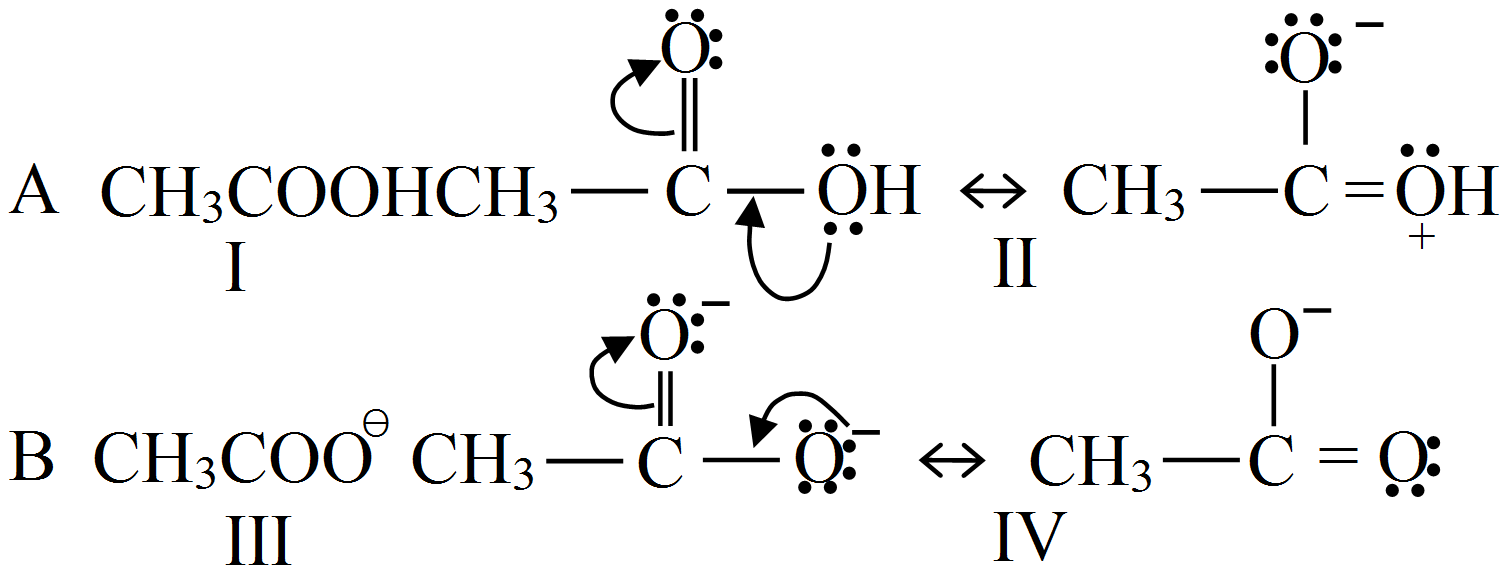
Resonating structures of A and B are as follows:

Structure (II) is less stable than structure (I) because later carries separation of positive and negative charges. Therefore, contribution of structure (II) is less than that of (1) towards the resonance hybrid of compound (A), i.e. $\text{CH}_3\text{COOH}_3$ On contrary, structure (III) and (IV) are of equal energy and hence contribute equally towards the resonance hybrid of compound (B). Therefore, structure (B) is more stable than structure (A) i.e. $\text{CH}_3\stackrel{ \ \ \ \ \ \ \ \ \ \ominus}{\text{COO}}.$
View full question & answer
2 Marks Questions - Page 2 - Chemistry STD 11 Science Questions - Vidyadip