MCQ 11 Mark
The mass number of a nucleus is :
- A
Always less than its atomic number.
- B
Always more than its atomic number.
- ✓
Sometimes equal to its atomic number.
- D
Sometimes equal and sometimes more than its atomic number.
AnswerCorrect option: C. Sometimes equal to its atomic number.
View full question & answer→MCQ 21 Mark
Number of angular nodes for $4d$ orbital is $ .........$
View full question & answer→MCQ 31 Mark
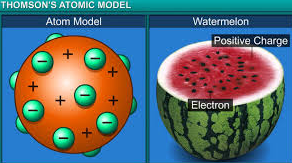
Who was the first scientist to propose a model for the structure of an atom?
AnswerJ.J. Thomson was the first one to propose a model for the structure of an atom
View full question & answer→MCQ 41 Mark
The value of $'h\ ' = 6.63 \times 10^{-34}$ Js. The speed of light is $3 \times 10^{17}nm/ s^{-1}$. Which value is closer to the wavelength in nanometer of a quantum of light with frequency $6 \times 10^{15} s^{-1}$.
Answer$\text{v}=\frac{\text{c}}{\lambda}$
$\Rightarrow\frac{\text{c}}{\text{v}}=\frac{3\times10^{17}\text{m/ ms}^{-1}}{6\times10^{15}\text{n/ ms}^{-1}}=50\text{ nm}.$
View full question & answer→MCQ 51 Mark
Total number of orbitals associated with third shell will be $ .........$
AnswerNo of orbitals in $3^{rd}$ shell $\ce{(n = 3) = n^2 = 3^2 = 9.}$
View full question & answer→MCQ 61 Mark
The radius of second Bohr's orbits for hydrogen atoms is :
$\text{h}=6.6262\times10^{-34}\text{Js},\text{m}_\text{e}$
$=9.109\times10^{-31}\text{kg},\text{e}_{\text{change}}$
$=1.6021\times10^{19\text{C}}$
- A
$1.65\mathring{\text{A}}$
- B
$4.76\mathring{\text{A}}$
- C
$0.529\mathring{\text{A}}$
- ✓
$2.12\mathring{\text{A}}$
AnswerCorrect option: D. $2.12\mathring{\text{A}}$
$\text{r}_\text{n}=\frac{\text{n}^2\text{h}^2}{4\pi^2\text{me}^2\text{Z}}$
We get, $\text{r}_\text{n}=\frac{0.529\mathring{\text{A}}\times2^2}{\text{z}}=\frac{0.529\mathring{\text{A}}\times2^2}{4}$
$=2.12\mathring{\text{A}}$
View full question & answer→MCQ 71 Mark
The mass number is same as $ ..........$
AnswerThe mass number should also not be confused with the relative atomic mass $($also called atomic weight$)$ of an element, which is the ratio of the average atomic mass of the different isotopes of that element $($weighted by abundance$)$ to the unified atomic mass unit.
View full question & answer→MCQ 81 Mark
Protons and neutrons are also called $ ..........$
AnswerProtons and neutrons are also called nucleons.
View full question & answer→MCQ 91 Mark
Thomson proposed the model of an atom similar to :
AnswerThomson proposed the model of an atom be similar to that of a Christmas pudding. The electrons in a sphere of positive charge were like currants $($dry fruits$)$ in a spherical Christmas pudding.
View full question & answer→MCQ 101 Mark
The number of radial nodes for $3p$ orbital is $ ..........$
AnswerFor a hydrogen atom wave function, there are $\ce{n - l - 1}$ radial nodes and $(n - 1)$ total nodes.
Number of radial nodes for $3p$ orbital $= \ce{n - l - 1}$
$= 3 - 1 - 1 = 1$
View full question & answer→MCQ 111 Mark
Thomson showed that the stream of particles in cathode ray tube is made up of small particles which are a component of the atom and is :
AnswerThomson discovered electrons using the cathode ray tube. It has been previously seen that if a electric current is passed through a vacuum tube, a glowing stream is formed. Thomson found that the mysterious glowing stream would bend toward a positively charged electric plate. He concluded that the stream is negatively charged. He also concluded based on his experiments that the negative stream has negatively charged particles that he called corpuscles $($later renamed electrons$).$
View full question & answer→MCQ 121 Mark
The radius of which of the following orbit is same as that of first orbit of hydrogen atom?
- A
$\ce{He^+(n = 2)}$
- B
$\ce{L^{2+}(n = 2)}$
- C
$\ce{Li^{2+}(n = 3)}$
- ✓
$\ce{Be^{3+}(n = 2)}$
AnswerCorrect option: D. $\ce{Be^{3+}(n = 2)}$
$\text{r}_\text{n}=\frac{0.529\mathring{\text{A}}\times\text{n}^2}{\text{z}}=\frac{0.529\times1^2}{1}$
$=0.529\mathring{\text{A}}$ for $H-$ atom
$\text{Be}^{3+}=\frac{0.529\mathring{\text{A}}\times2^2}{\text{z}}=\frac{0.529\mathring{\text{A}}\times2^2}{4}$
$=0.529\mathring{\text{A}}$
View full question & answer→MCQ 131 Mark
What tool was Thomson using when he discovered the electron?
MCQ 141 Mark
Atomic number of an atom is equal to the $ .........$
- A
- B
- ✓
Both $a$ and $b$.
- D
Sum of proton and electron.
AnswerCorrect option: C. Both $a$ and $b$.
Atomic number $(Z)$ is the number of protons in an atom. It is also equal to the number of electrons in the atom.
Atomic number $=$ number of protons
Example : the atomic number of an element is $12,$ then, its atom contains $12$ protons and $12$ electrons.
View full question & answer→MCQ 151 Mark
On bombarding a beam of a $-$ particles on the atom of the gold sheet, a few particles get deflected whereas most of them go straight and remains undeflected. This is due to :
- ✓
The nucleus occupy much smaller volume as compared to the volume of atom.
- B
The force of repulsion on fast moving a $-$ particles is very small.
- C
The neutrons in the nucleus do not have any effect on a $-$ particles.
- D
The force of attraction on a $-$ particles by the oppositely charged electron is not sufficient.
AnswerCorrect option: A. The nucleus occupy much smaller volume as compared to the volume of atom.
On bombarding a beam of a $-$ particles on the atom of the gold sheet, a few particles get deflected whereas most of them go straight and remains undeflected because the nucleus occupy much smaller volume as compared to the volume of atom.
View full question & answer→MCQ 161 Mark
Electronic configuration of five elements $\ce{I, II, III, IV, V}$ is mentioned below. In the above configuration element $\ce{I, II, III, IV}$ and $\ce{V}$ represent as :
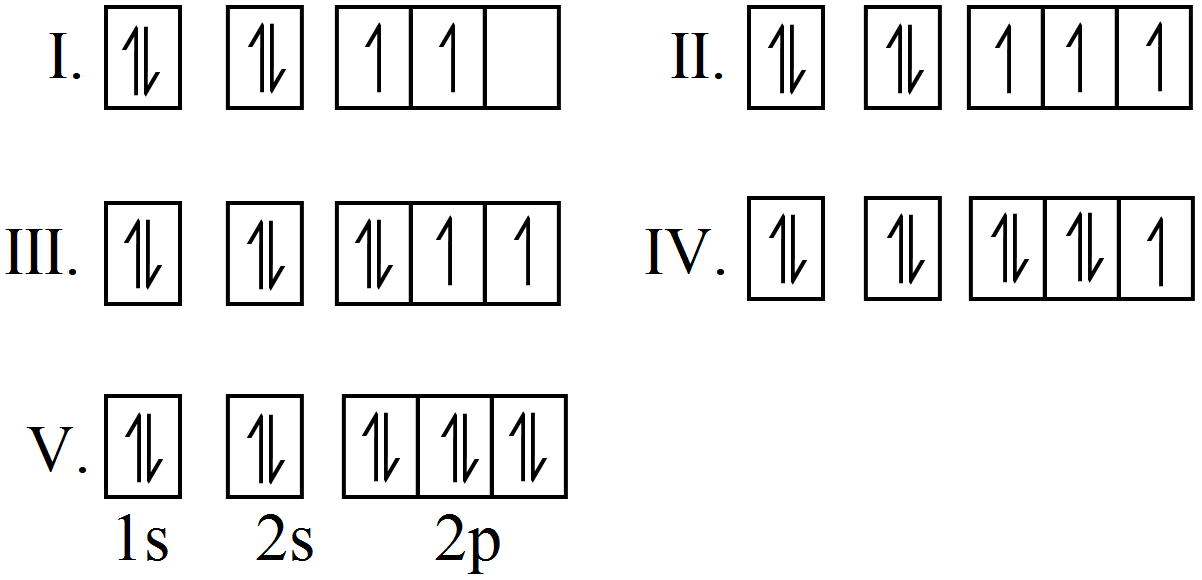
- ✓
$\ce{C, N, O, F, Ne}$
- B
$\ce{Ne, F, O, N, C}$
- C
$\ce{C, O, N, Ne, F}$
- D
$\ce{O, C, F, Ne, V}$
AnswerCorrect option: A. $\ce{C, N, O, F, Ne}$
View full question & answer→MCQ 171 Mark
How will you find out the maximum number of electrons in the main energy level?
AnswerCorrect option: D. $2n^2$
The maximum number of electrons in an energy level is given by $2(n^2).$
View full question & answer→MCQ 181 Mark
The probability density plots of $1s$ and $2s$ orbitals are given in figure.
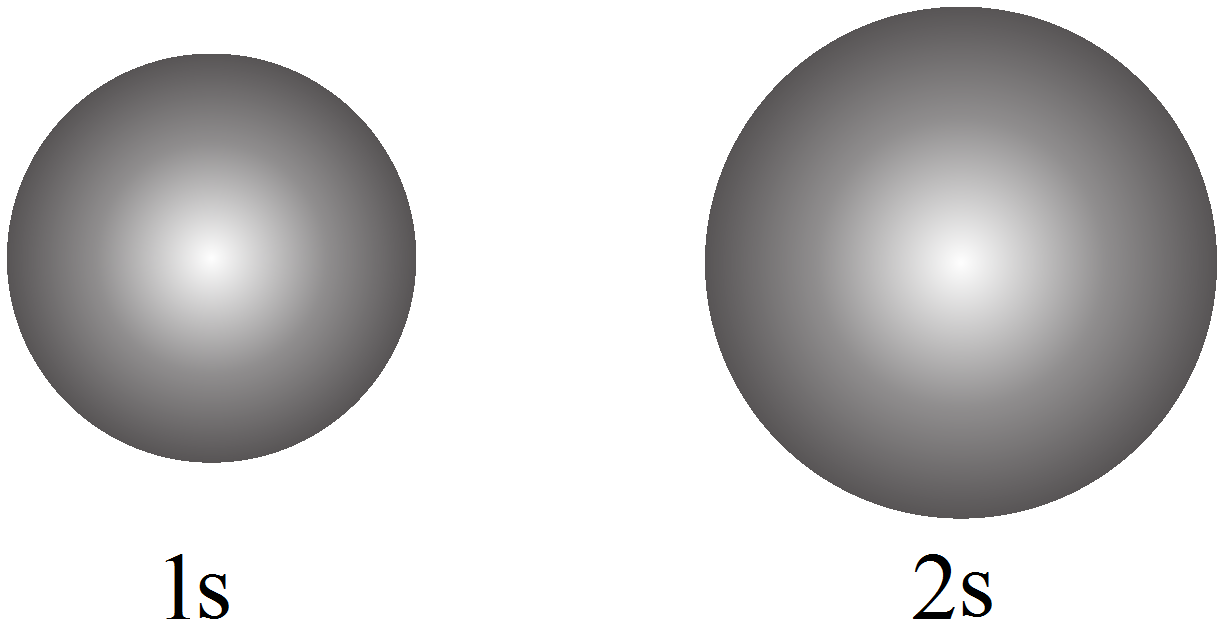
The density of dots in a region represents the probability density of finding electrons in the region.
On the basis of above diagram which of the following statements is incorrect? AnswerCorrect option: D. The probability density of electrons for $2s$ orbital decreases uniformly as distance from the nucleus increases.
The probability density of electrons in $2s$ orbital first increases then decreases and after that it begins to increases again as distance increases from nucleus.
View full question & answer→MCQ 191 Mark
Thomson's atomic model concluded that $ ......... $ is the constituent particle of all kinds of atoms.
AnswerThomson experiments with cathode $-$ ray tubes showed that all atoms contain tiny negatively charged subatomic particles or electrons.
View full question & answer→MCQ 201 Mark
The correct set of four quantum numbers for the valence electrons of rubidium atom $(Z = 37)$ is :
- ✓
$5,0,0+\frac{1}{2}$
- B
$5,1,0+\frac{1}{2}$
- C
$5,1,1+\frac{1}{2}$
- D
$5,0,1+\frac{1}{2}$
AnswerCorrect option: A. $5,0,0+\frac{1}{2}$
Given, atomic number of $Rb, Z = 37$ stress
Thus, its electronic configuration is $[Kr]^5 \ s^1$.
Since, the last electron or valence electron enter in $5\ s$ subshell.
So, the quantum numbers are $n = 5, l = 0, ($for $s-$ orbital$)$
$\text{m}=0(\because\text{m}=+\text{l}\ \text{to }-\text{l}),$
$\text{s}=+\frac{1}{2}$ or $-\frac{1}{2}.$
View full question & answer→MCQ 211 Mark
Which of the following is responsible to rule out the existence of definite paths or trajectories of electrons?
- A
Pauli's exclusion principle.
- ✓
Heisenberg's uncertainty principle.
- C
Hund's rule of maximum multiplicity.
- D
AnswerCorrect option: B. Heisenberg's uncertainty principle.
Werner Heisenberg, a German physicist in $1927,$ stated uncertainty principle which states that it is impossible to determine simultaneously, the exact position and exact momentum of an electron.
Mathematically, $\Delta\text{x}\times\Delta\text{p}\geq\frac{\text{h}}{4\pi}$
The important implications of the Heisenberg uncertainty principle is that it rules out existence of definite paths or trajectories of electrons and other similar particles.
View full question & answer→MCQ 221 Mark
In atom, an electron is moving with a speed of $600m/ s$ with an accuracy of $0.005\%$. Certainty with which the position of the electron can be located is : $\left(\mathrm{h}=6.6 \times 10^{-34} \mathrm{~kg} / \mathrm{m}^2 \mathrm{~s}^{-1}\right.,$ mass of electron, em $= 6.6 \times 10^{-31}kg)$
- A
$1.52 \times 10^{-4}m$
- B
$5.10 \times 10^{-3}m$
- ✓
$1.92 \times 10^{-3}m$
- D
$3.84 \times 10^{-3}m$
AnswerCorrect option: C. $1.92 \times 10^{-3}m$
By Heisenberg's uncertainty principle,
$\Delta\text{x}.\text{m}\Delta\text{v}=\frac{\text{h}}{4\pi}$
$\Delta\text{v}=0.005\%$ or $600\text{ms}=\frac{600\times0.005}{100}=0.03$
$\Delta\text{x}\times9.1\times10^{-31}\times0.03=\frac{6.6\times10^{-34}}{4\times3.14}$
Hence, $\Delta\text{x}=\frac{6.6\times10^{-34}}{4\times3.14\times0.03\times9.1\times10^{-31}}$
$=1.92\times10^{-3}\text{m}$
View full question & answer→MCQ 231 Mark
A ray of white light is spread out into a series of coloured bands of visible light are called :
MCQ 241 Mark
What is the atomic number of Krypton?
AnswerThe atomic number is the number of protons in an atom of an element. An atom of Krypton has $36$ protons in its nucleus.
View full question & answer→MCQ 251 Mark
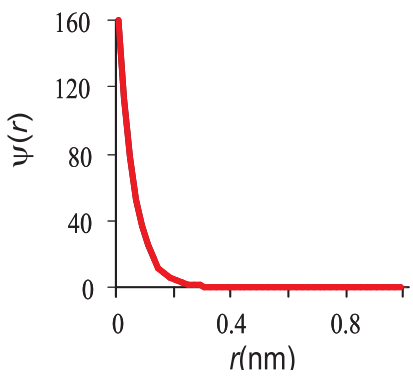
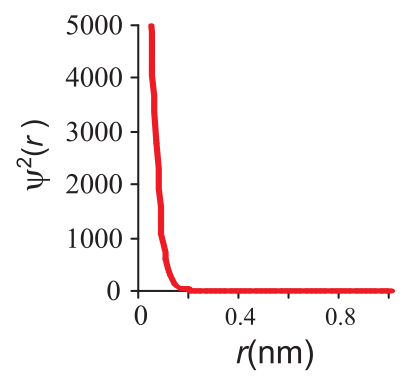
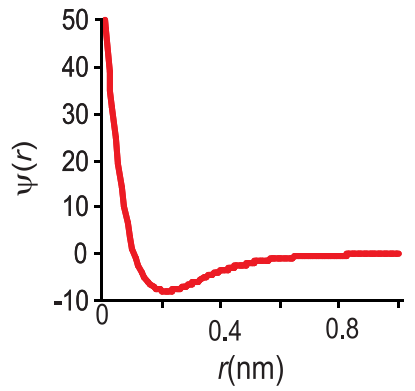
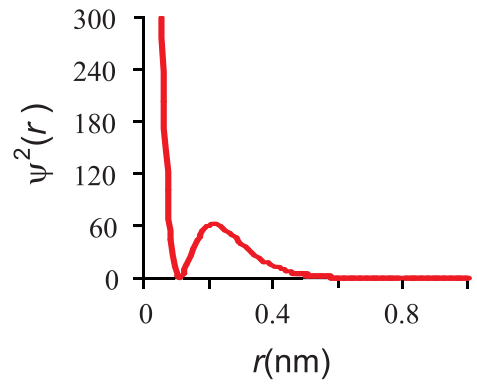
The plot of orbital wave function $\psi(\text{r})$ as a function of distance $r$ of the electron from the nucleus for $2\ s$ orbital is :
AnswerPlots of $(a)$ and $(c)$ are the variation of orbital wave function $\psi(\text{r})$ with $r(nm)$ while $(b)$ and $(d)$ are the variation of probability density $\psi^2(\text{r})$ as a function of distance $(r)$ of the electron from the nucleus for $1s$ and $2s$ orbital.
For $1s$ orbital the probability density is maximum at the nucleus and it decreased sharply as we move away from it. For $2s$ orbital the probability density first decreases sharply to zero and then starts increasing. After reaching maxima it decreases again and approaches zero as the value of $r$ increases further.
View full question & answer→MCQ 261 Mark
The pair of ions having same electronic configuration is $ .........$
- A
$\mathrm{Cr}^{3+}, \mathrm{Fe}^{3+}$
- ✓
$\mathrm{Fe}^{3+}, \mathrm{Mn}^{2+}+$
- C
$\mathrm{Fe}^{3+}, \mathrm{CO}^{3+}$
- D
$\mathrm{Sc}^{3+}, \mathrm{Cr}^{3+}$
AnswerCorrect option: B. $\mathrm{Fe}^{3+}, \mathrm{Mn}^{2+}+$
$ { }_{26} \mathrm{Fe}=[\mathrm{Ae}] 3 \mathrm{d}^6, 4 \mathrm{s}^2{ }_{26} \mathrm{Fe}^{3+}=[\mathrm{Ar}] 3 \mathrm{d}^5 $
$ { }_{25} \mathrm{Mn}=[\mathrm{Ar}] 3 \mathrm{d}^5, 4 \mathrm{s}^2{ }_{25} \mathrm{Mn}^{2+}=[\mathrm{Ar}] 3 \mathrm{d}_5$
View full question & answer→MCQ 271 Mark
Mass number is also called as $ .........$
AnswerThe mass number $(A),$ also called atomic mass number or nucleon number, is the total number of protons and neutrons $($together known as nucleons$)$ in an atomic nucleus. It determines the atomic mass of atoms.
View full question & answer→MCQ 281 Mark
Atomic number of elements represent :
- ✓
Number of protons in the nucleus.
- B
Number of neutrons in the nucleus.
- C
Number of protons an neutrons in the nucleus.
- D
The valency of an element.
AnswerCorrect option: A. Number of protons in the nucleus.
Atomic number is the number of protons in nucleus of an atom.
View full question & answer→MCQ 291 Mark
Identify the pairs which are not of isotopes?
- A
$^{13}_6\text{X},\ ^{13}_6\text{Y}.$
- B
$^{35}_{17}\text{X},\ ^{37}_{17}\text{Y}.$
- ✓
$^{14}_6\text{X},\ ^{14}_7\text{Y}.$
- D
$^{8}_5\text{X},\ ^{8}_5\text{Y}.$
AnswerCorrect option: C. $^{14}_6\text{X},\ ^{14}_7\text{Y}.$
Isotopes have the same atomic number but different mass number.
$\therefore\ \Big(\ ^{14}_{6}\text{X},\ ^{14}_{7}\text{Y}\Big)$ and $\Big(\ ^8_4\text{X},\ ^8_5\text{Y}\Big)$ are not isotopes.
View full question & answer→MCQ 301 Mark
By knowing the number of protons in a neutral atom, one can determine :
- ✓
The identity of the element.
- B
The number of neutrons in the atom.
- C
The number of common isotopes of the element.
- D
AnswerCorrect option: A. The identity of the element.
In a neutral atom, the number of protons is always the atomic number of the element and uniquely identifies the element. and in this, the number of positive protons and negative electrons is always equal.
View full question & answer→MCQ 311 Mark
Thomson's atomic model concluded that $ ........ $ is the constituent particle of all kinds of atoms.
AnswerThomson experiments with cathode $-$ ray tubes showed that all atoms contain tiny negatively charged subatomic particles or electrons.
View full question & answer→MCQ 321 Mark
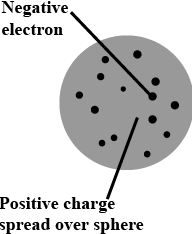
The first model of an atom was given by $ ..........$
AnswerSir J.J Thomson gave the first model of atom.
He by means of cathode $-$ ray experiment discovered the existence of negatively charged particles in an atom which led to the discovery of electrons.
He gave the plum $-$ pudding model of an atom in which electrons are embedded in atom $-$ like currants.
Positive electrons are distributed all over the atom.
View full question & answer→MCQ 331 Mark
Which of the following is responsible to rule out the existence of definite paths or trajectories of electrons?
- A
Pauli’s exclusion principle.
- ✓
Heisenberg’s uncertainty principle.
- C
Hund’s rule of maximum multiplicity.
- D
AnswerCorrect option: B. Heisenberg’s uncertainty principle.
According to Heisenberg’s uncertainty principle, the position and velocity of an electron cannot be determined simultaneously with accuracy which rules out the existence of fixed paths.
View full question & answer→MCQ 341 Mark
If $\ce{E_A, E_B}$ and $\ce{E_C}$ represent kinetic energies of an electron, alpha particle and proton respectively and each moving with same de $-$ Broglie wavelength, then choose the correct increasing representation,
AnswerCorrect option: D. $\ce{E_A < E_C < E_B}$
View full question & answer→MCQ 351 Mark
Who is regarded as father of modern chemistry ?
AnswerAntoine Lavoisier $(1743-1794)$. He was a French chemist who made important contributions to the science. He is considered the father of modern chemistry. He recognized and named oxygen and isolated the major components of air. Antoine-Laurent de Lavoisier is known as "the father of modern chemistry."
View full question & answer→MCQ 361 Mark
Which of the following is the energy of a possible excited state of hydrogen?
- A
$+\ \ce{13.6eV}$
- B
$-\ \ce{6.8eV}$
- ✓
$-\ \ce{3.4eV}$
- D
$+\ \ce{6.8eV}$
AnswerCorrect option: C. $-\ \ce{3.4eV}$
View full question & answer→MCQ 371 Mark
The electronic configuration of element with atomic no. $14$ is :
- A
$(2, 6, 6)$
- B
$(4, 6, 4)$
- C
$(2, 4, 8)$
- ✓
$(2, 8, 4)$
AnswerCorrect option: D. $(2, 8, 4)$
Electronic configuration of element with atomic number with $14$ is $2, 8, 4$
View full question & answer→MCQ 381 Mark
The number of neutrons in the dispositive zinc ion is : $($mass number of $Zn = 65)$
View full question & answer→MCQ 391 Mark
Pauli exclusion principle states that :
- A
No two electrons in an atom can have the same set of four quantum numbers.
- B
Only two electrons may exist in the same orbital and these electrons must have opposite spin.
- ✓
Both $(a)$ and $(b)$.
- D
AnswerCorrect option: C. Both $(a)$ and $(b)$.
View full question & answer→MCQ 401 Mark
The number of radial nodes for $3p$ orbital is $ ..........$
AnswerNumber of radial nodes $= n - 1 - 1$
For $3p$ orbital, $n = 3 - 1 - 1 = 1$
Number of radial nodes $= 3 - 1 - 1 = 1.$
View full question & answer→MCQ 411 Mark
Which of the following properties of atom could be explained correctly by Thomson model of atom?
- ✓
Overall neutrality of atom.
- B
Spectra of hydrogen atom.
- C
Position of electrons, protons and neutrons in atom.
- D
AnswerCorrect option: A. Overall neutrality of atom.
View full question & answer→MCQ 421 Mark
Which of the following statement is not correct about the characteristics of cathode rays?
- A
They start from the cathode and move towards the anode.
- B
They travel in straight line in the absence of an external electrical or magnetic field.
- C
Characteristics of cathode rays do not depend upon the material of electrodes in cathode ray tube.
- ✓
Characteristics of cathode rays depend upon the nature of gas present in the cathode ray tube.
AnswerCorrect option: D. Characteristics of cathode rays depend upon the nature of gas present in the cathode ray tube.
Characteristics of cathode rays depend upon the nature of gas present in the cathode ray tube. Because Characteristics of cathode rays does not depend upon the nature of gas present in the cathode ray tube.
View full question & answer→MCQ 431 Mark
The principal quantum number increases, the difference of energy between consecutive energy levels :
- ✓
- B
- C
- D
Ometimes increases and sometimes decreases.
AnswerDifference in energy is given as; $\triangle\text{E}=\frac{\text{Z}^2\text{R}}{\text{n}^2}$
Therefore, as principal quantum number $(n)$ increases the energy of transition decreases.
View full question & answer→MCQ 441 Mark
In the line spectrum of hydrogen, the lines described by the formula $\overline{\text{v}}=109.677\Big(\frac{1}{2^2}-\frac{1}{\text{n}^2}\Big)\text{cm}^{-1}$ where, $n =$ integer, $\text{n}\geq3.$
Constitutes :
View full question & answer→MCQ 451 Mark
Magnetic moment $\ce{2.83BM}$ is given by which of the following ions? $[$Atomic number $\ce{Ti = 22, Cr = 24, Mn = 25, Ni = 28].}$
- A
$\ce{Ti}^{3+}$
- ✓
$\ce{Ni}^{2+}$
- C
$\ce{Cr}^{2+}$
- D
$\ce{Mn}^{2+}$
AnswerCorrect option: B. $\ce{Ni}^{2+}$
$4s^03d^8$ has $3$ unpaired electon,
$\mu=\sqrt{\text{n}(\text{n}+2)}=\sqrt{3\times5}=\sqrt{15}$
$=3.83\text{BM}.$
View full question & answer→MCQ 461 Mark
Which of the following options does not represent ground state electronic configuration of an atom?
- A
$\ce{1 s^2 2 s^2 2 p^6 3 s^2 3 p^6 3 d^8 4 s^2} $
- B
$\ce{1 s^2 2 p^6 3 s^2 3 p^6 3 d^9 4 s^2 }$
- C
$\ce{ 1 s^2 2 s^2 2 p^6 3 s^2 3 p^6 3 d^{10} 4 s^1} $
- ✓
$\ce{1 s^2 2 s^2 2 p^6 3 s^2 3 p^6 3 d^5 4 s^1}$
AnswerCorrect option: D. $\ce{1 s^2 2 s^2 2 p^6 3 s^2 3 p^6 3 d^5 4 s^1}$
Correct configuration should be $\ce{1 s^2 2 s^2 2 p^6 3 s^2 3 p^6 3 d^{10} 4 s^1}$ for the copper which has atomic number $\ce{29(29Cu)}$. Due to extra stability of full filled orbital of $d-$ subshell, the last electron enter into $d-$ orbital instead of $s-$ orbital.
View full question & answer→MCQ 471 Mark
Atomic mass number is same as $ .........$
AnswerThe mass number $(A),$ also called atomic mass number or nucleon number, is the total number of protons and neutrons $($together known as nucleons$)$ in an atomic nucleus. This is not the same as the atomic number $(Z)$ which denotes the number of protons in a nucleus, and thus uniquely identifies an element.
View full question & answer→MCQ 481 Mark
Aufbau principle does not give the correct arrangement of filling up of the atomic orbitals in :
- A
$\ce{Cu}$ and $\ce{Zn}$
- B
$\ce{Co}$ and $\ce{Zn}$
- C
$\ce{Mn}$ and $\ce{Cr}$
- ✓
$\ce{Cu}$ and $\ce{Cr}$
AnswerCorrect option: D. $\ce{Cu}$ and $\ce{Cr}$
Aufbau principle does not give the correct arrangement of filling up of atomic orbitals in copper and chromium because half $-$ filled and completely filled electronic configuration of $\ce{Cr}$ and $\ce{Cu}$ have lower energy and therefore, more stable.
$\ce{Cr(Z = 24) = 1 s^2, 2 s^2 2 p^6, 3 s^2 3 p^6 3 d^5, 4 s^1}$
$\ce{Cu(Z = 29) = $1 s^2, 1 s^2 2 p^6, 3 s^2 3 p^6 3 d^{10}, 4 s^1}$
View full question & answer→MCQ 491 Mark
While revolving in discrete orbits, the electrons do not radiate energy. These orbits or shells are called $ .........$
AnswerWhile revolving in discrete orbits, the electrons do not radiate energy.
These orbits or shells are called energy levels.
View full question & answer→MCQ 501 Mark
How many lines does a spectrum contain in an electronic transition from $n = 1$ to $n = 5$ in hydrogen atom?
AnswerThe no. of spectral lines produced in a spectrum $=\frac{(\text{n}_2-\text{n}_1)(\text{n}_2-\text{n}_1+1)}{2}$
Given that $\ce{n_2 = 5}$ and $\ce{n_1= 1}$ ; the no. of spectral lines $=\frac{4\times5}{2}$
$= 10.$
View full question & answer→