Questions · Page 2 of 2

1 Marks Question

Question 511 Mark
Why does gallium undergo disproportionation reactions?
Answer
Gallium shows both +1 and +3 oxidation states due to inert pair effect. However, its +3 oxidation state is more stable than +1 oxidation state, hence undergoes disproportionation to form gallium and more stable +3 gallium ions in aqueous solution as shown below.
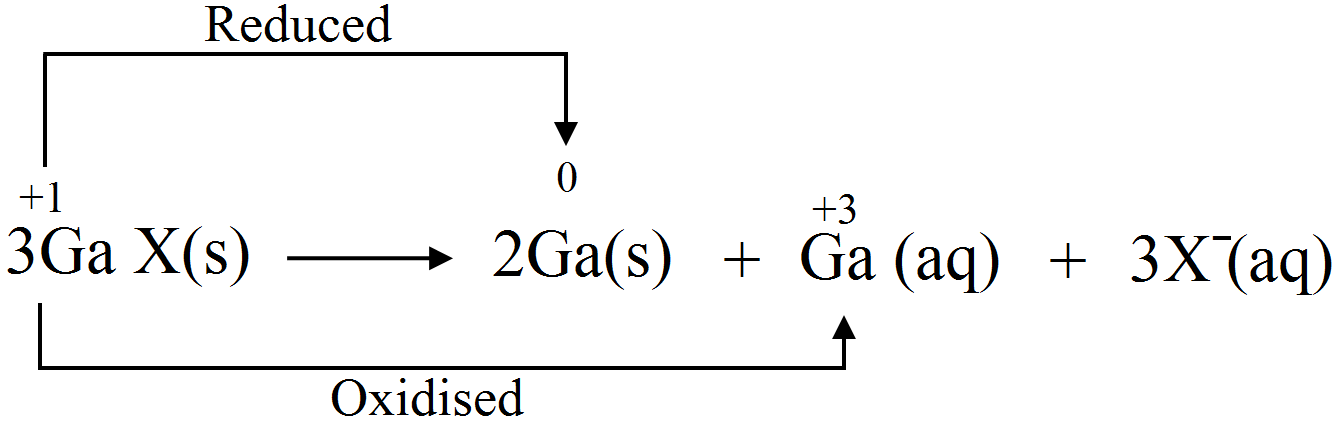
or $3\text{Ga}^+(\text{aq})\xrightarrow{\ \ \ \ \ \ \ \ \ }2\text{Ga}(\text{s})+\text{Ga}^{3+}(\text{aq})$
View full question & answer
Question 521 Mark
Silicones are used for making waterproof fabrics. Give reason.
Answer
Silicones are synthetic polymers containing repeated units of $\mathrm{R}_2 \mathrm{SiO}$ where R is alkyl group.Therefore, these are water repellants i.e. do not absorb water and are used for making waterproof fabrics.
View full question & answer
Question 531 Mark
  1. Why is $\mathrm{PCl}_5$ known but $\mathrm{Pl}_5$ is not?
  2. Red phosphorus is denser than white phosphorus, why?
Answer
  1. $'Cl'$ is small in size as compared to $I$, therefore fire $CI$ atoms can be easily accommodated around $‘P\ '$ atom but five bigger $I$ atoms can not be accommodate due to stearic henderace. $P-I$ bond is weaker than $P-Cl$ bond.
  2. Red phosphorus has polymeric structure and more inter molecular force of attraction as compared to white phosphorus $($monomeric$)$, therefore, it is denser.
View full question & answer
Question 541 Mark
Give one example of zeolite.
Answer
Feldspar $\left(\mathrm{KAISi}_3 \mathrm{O}_8\right)$, Zeolite $\left(\mathrm{NaAlSi}_2 \mathrm{O}_6 \cdot \mathrm{H}_2 \mathrm{O}\right)$
View full question & answer
Question 551 Mark
Why is $\mathrm{B}-\mathrm{X}$ bond distance in $\mathrm{BX}_3$ shorter than the theoretically expected value?
Answer
This is due to pπ-pπ back bonding of the completely filled p-orbital of halogen X into the empty p-orbital of boron.
View full question & answer
Question 561 Mark
Why the tri halide of group 13 elements fume in moist air?
Answer
Boron forms only covalent compounds because it does not form $\text{B}^{3+}$ ion. High energy is required to remove 3 electrons.
View full question & answer
Question 571 Mark
$\mathrm{AlF}_3$ is high melting solid but $\mathrm{AlCl}_3$ is low melting. Explain.
Answer
$\mathrm{AlF}_3$ is high melting solid because it is ionic in nature. On the other hand, $\mathrm{AICI}_3$ is covalent in nature and hence is a low melting solid.
View full question & answer
Question 581 Mark
  1. Why is electron gain enthalpy of group $15$ less than group $16$ ?
  2. Nitric oxide becomes brown when released in air, why?
Answer
  1. It is because group $15$ have outer electronic configuration $\ce{ns^2 np^3}$ i.e. half filled p-orbitals which are more stable, therefore, have least tendency to gain electron as compared to group $\ce{16 (ns^2 - np^4)}$
  2. Nitric oxide reacts with air to form nitrogen dioxide which is brown in colour.
$2\text{NO}(\text{g})+\text{O}_2(\text{g})\xrightarrow{\ \ \ \ \ \ \ \ \ }2\text{NO}_2(\text{g})$
View full question & answer
Question 591 Mark
a. $\mathrm{Bi}_2 \mathrm{O}_3$ is treated with $\mathrm{HNO}_3$. Write balanced equation for the reaction.
b. Why does Bismuth not form pentahalide?
Answer
  1. $\text{BI}_2\text{O}_3+6\text{HNO}_3\xrightarrow{\ \ \ \ \ \ \ \ \ \ }2\text{Bi}(\text{NO}_3)_3+3\text{H}_2\text{O}$
  2. $\mathrm{Bi}^{3+}$ is more stable than $\mathrm{Bi}^{5+}$, therefore Bismuth does not penta$-$halide.
View full question & answer
Question 601 Mark
Although pure silicon is an insulator, then how does it behave as semiconductor on heating?
Answer
Silicon becomes semiconductor on heating because electrons become free to move.
View full question & answer
Question 611 Mark
Name the elements of group 13 which forms only covalent compounds.
Answer
Boron forms only covalent compounds because it does not form $\text{B}^{3+}$ ion. High energy is required to remove 3 electrons.
View full question & answer
Question 621 Mark
Why is $\mathrm{BF}_3$ weaker Lewis acid than $\mathrm{BCI}_3$ ?
Answer
$\mathrm{BF}_3$ is weaker Lewis acid than $\mathrm{BCl}_3$ because of more effective back bonding in case of F due to smaller size than Cl.
View full question & answer
Question 631 Mark
Why $\mathrm{SnCl}_4$ is more covalent than $\mathrm{SnCl}_2$ ?
Answer
It is because $\mathrm{Sn}^{4+}$ has more polarizing power, therefore, more tendency to form covalent bond than $\mathrm{Sn}^{2+}$.
View full question & answer
Question 641 Mark
$\mathrm{NaCl}_3$ gets hydrolysed while $\mathrm{NF}_3$ does not, why?
Answer
In $\mathrm{NCl}_3$, 'Cl' has vacan d-orbitals to accept a lone pair of electrons Donated by O of $\mathrm{H}_2 \mathrm{O}$, molecule but in $\mathrm{NF}_3$, 'F' does not d-orbitals.
$\text{NCl}_3+3\text{H}_2\text{O}\xrightarrow{\ \ \ \ \ }\text{NH}_3+3\text{HCl}$
$\text{NF}_3+\text{H}_2\text{O}\xrightarrow{\ \ \ \ \ \ \ \ }\text{No reaction}$.
View full question & answer
Question 651 Mark
  1. Why does tendency to show catenation decreases down the group?
  2. Why is $\mathrm{N}_2 \mathrm{O}$, more acidic than $\mathrm{N}_2 \mathrm{O}_3$ ?
Answer
  1. It is because bond dissociation enthalpy decreases due to increase in bond length with the increase in atomic size of element.
  2. Higher the oxidation state, more will be acidic character, that is why $\mathrm{N}^2 \mathrm{O}^5$ is more acidic than $\mathrm{N}_2 \mathrm{O}_3$.
View full question & answer
Question 661 Mark
Write the formula of dry ice.
Answer
Dry ice is solid $\mathrm{CO}_2$ in which there are van der Wall's forces of attraction.
View full question & answer
Question 671 Mark
Why does boron trifluoride behave as Lewis acid?
Answer
It is because 'B' shares three electrons with fluorine and its octet is not complete, therefore, it behaves as Lewis acid.
View full question & answer
Question 681 Mark
Which of the following is acidic and why?
$\mathrm{SiO}_2, \mathrm{Al}_2 \mathrm{O}_3, \mathrm{PbO}_2, \mathrm{SnO}_2$
Answer
$\mathrm{SiO}_2$ is acidic oxide because Si shows non-metallic properties. $\mathrm{Al}_2 \mathrm{O}_3, \mathrm{PbO}_2$ and $\mathrm{SnO}_2$ are amphoteric.
View full question & answer
Question 701 Mark
Why does boron not form $\text{B}^{3+}$ ion?
Answer
Boron does not form $\text{B}^{3+}$ ion due to smallest atomic size and highest ionisation enthalpy.
View full question & answer
Question 711 Mark
What are germanes and plumbares?
Answer
Boron resembles both with metals and non-metals, therefore, it is metalloid.
View full question & answer
Question 721 Mark
Why is diamond a bad conductor of electricity but a good conductor of heat?
Answer
Conduction of electricity essentially requires movement of electrons while conduction of heat does not necessarily require movement of electrons.
View full question & answer
Question 731 Mark
$\mathrm{TI}\left(\mathrm{NO}_3\right)_3$ acts as an oxidising agent Explain.
Answer
Due to inert pair effect, Tl in +1 oxidation state is more stable than that of +3 oxidation state. Therefore, $\mathrm{TI}\left(\mathrm{NO}_3\right)_3$ acts as an oxidising agent and readily reduced to $\mathrm{TINO}_3$.
View full question & answer
Question 741 Mark
Which of the following are Lewis acids:
$\text{PH}_3,\text{BCl}_3,\text{AlCl}_3,\text{SiCl}_4.$
Answer
$\mathrm{BCl}_3$ and $\mathrm{AlCl}_3$ are Lewis acid because their octet is not complete.
View full question & answer
1 Marks Question - Page 2 - Chemistry STD 11 Science Questions - Vidyadip