MCQ 511 Mark
$\text{x} + 2\text{y}\leq8$
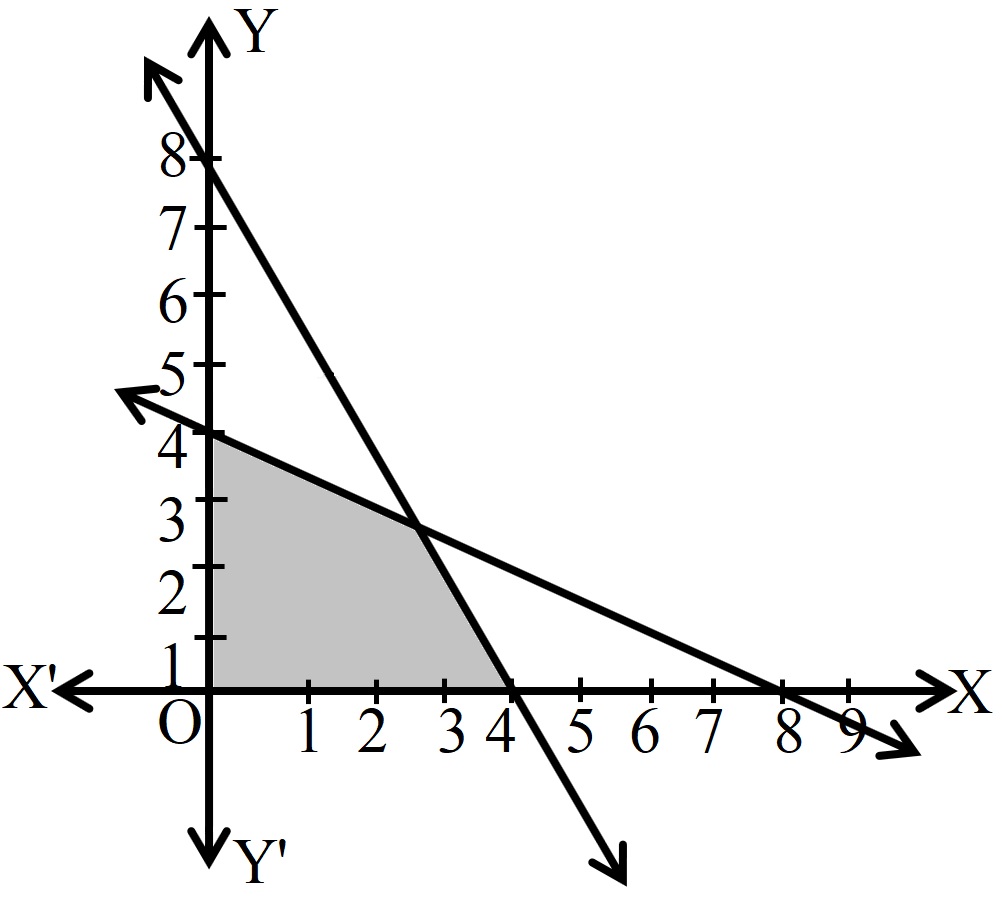
$\text{x}\geq0, \text{y}\geq0$
$\text{x}\leq0,\text{y}\leq0$
$ 2\text{x} + \text{y}\leq8$
$4\text{x}+5\text{y}\geq40$ - A
$(i), (iii)$ and $(v)$
- B
$(i), (iv)$ and $(v)$
- C
$(i), (iii)$ and $(iv)$
- ✓
$(i), (ii)$ and $(iv)$
AnswerCorrect option: D. $(i), (ii)$ and $(iv)$
View full question & answer→MCQ 521 Mark
The solution of the inequality $\frac{\text{x}}{4}>\frac{\text{x}}{2}+1$ will be:
- A
$\text{x}>4$
- B
$\text{x}>-4$
- ✓
$\text{x}<-4$
- D
$-4 <\text{ x} >4$
AnswerCorrect option: C. $\text{x}<-4$
Given: $\frac{\text{x}}{4}>\frac{\text{x}}{2}+1$
$\Rightarrow\frac{\text{x}}{4}-\frac{\text{x}}{2}>1$
$\Rightarrow\frac{\text{x}-2\text{x}}{4}>1$
$\Rightarrow\frac{\text{-x}}{4}>1$
$\Rightarrow-\text{x}>4$
$\Rightarrow\text{x}<-4$
View full question & answer→MCQ 531 Mark
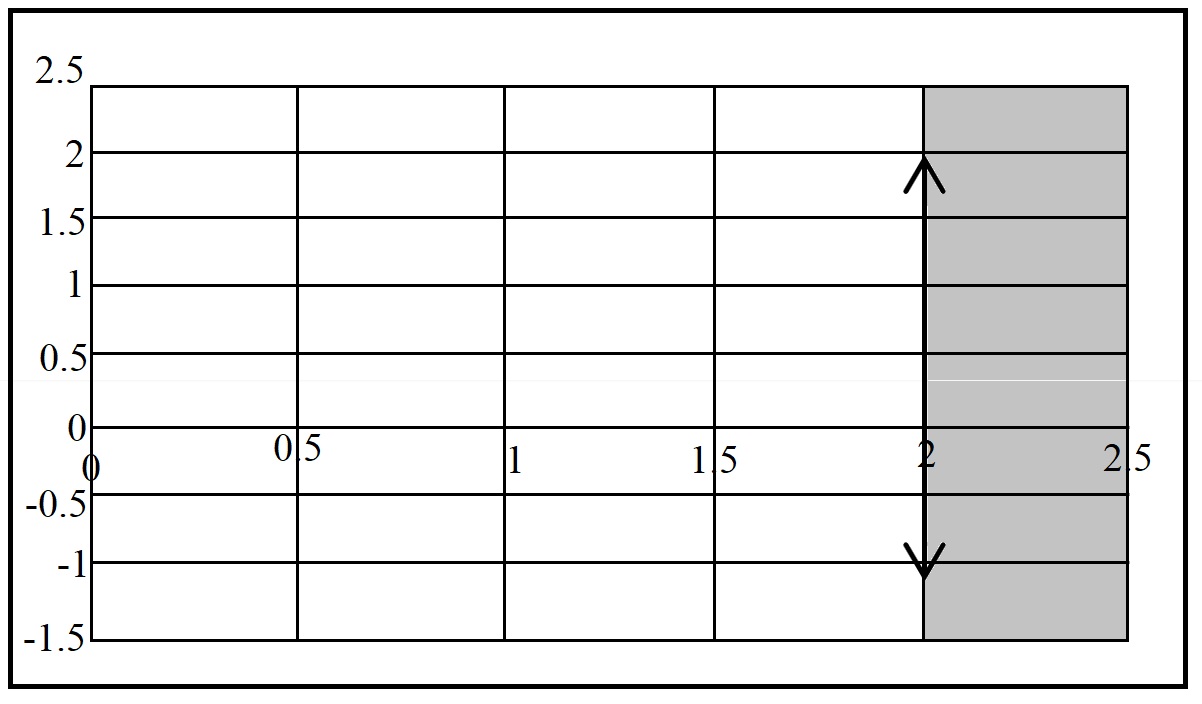
$3\text{x}-6\geq0$ are, $...........?$
- A
right side with dotted $x = 2$
- B
left side with dotted $x = 2$
- ✓
right side with complete line $x = 2$
- D
left side with complete line $x = 2$
AnswerCorrect option: C. right side with complete line $x = 2$
$3\text{x}-6\geq0$
$\Rightarrow\text{x}\geq2.$
$(0, 0)$ does not satisfy te equation so region is right side of $x = 2$ with complete line $x = 2$ due to presence of equality sign along with inequality sign.
View full question & answer→MCQ 541 Mark
The value of $x$ for which $|\text{x} + 1|+\sqrt{(\text{x} – 1)} = 0$
- A
$0$
- B
$1$
- C
$-1$
- ✓
No value of $x$
AnswerCorrect option: D. No value of $x$
Given, $|\text{x} + 1| +\sqrt{(\text{x} – 1)}= 0, $where each term is non $-$ negative.
So, $ |\text{x} + 1| = 0 $ and $\sqrt{\text{(x-1})}=0$ should be zero simultaneously.
$\text{i}.\text{e}. \text{x} = -1$ and $\text{x}=1,$ which is not possible.
So, there is no value of $x$ for which each term is zero simultaneously.
View full question & answer→MCQ 551 Mark
Solution of $ |\text{x}^2 – 10|\leq6$ is:
- A
$\big(2, 4\big)$
- B
$\big(– 4, – 2\big)$
- C
$\big(– 4, – 2\big)\cup\big(2, 4\big)$
- ✓
$\big[– 4, – 2\big]\cup\big[2, 4\big]$
AnswerCorrect option: D. $\big[– 4, – 2\big]\cup\big[2, 4\big]$
View full question & answer→MCQ 561 Mark
Sum of two rational numbers is, $.............$ number:
AnswerThe sum of two rational numbers is a rational number.
Ex: Let two rational numbers are $\frac{1}{2}$ and $\frac{1}{3}$
Now, $\frac{1}{2}+\frac{1}{3}=\frac{5}{6}$ which is a rational number:
View full question & answer→MCQ 571 Mark
Solution of $2\text{x}-\frac{3}{3\text{x}}-5\geq3$ is:
- A
$\big[1,\frac{12}{7}\big]$
- ✓
$\big(\frac{5}{3},\frac{12}{7}\big]$
- C
$\big(-\infty,\frac{5}{3}\big)$
- D
$\big[\frac{2}{7},\infty\big)$
AnswerCorrect option: B. $\big(\frac{5}{3},\frac{12}{7}\big]$
View full question & answer→MCQ 581 Mark
If $|2\text{x} – 3|<|\text{x} + 5|,$ then $x$ belongs to:
- A
$\big(–3, 5\big)$
- B
$\big(5, 9\big)$
- ✓
$\big(\frac{-2}{3} ,8\big)$
- D
$\big(\frac{-8}{2} ,3\big)$
AnswerCorrect option: C. $\big(\frac{-2}{3} ,8\big)$
View full question & answer→MCQ 591 Mark
If $\alpha $ and $\beta$ are the roots of the equation $\text{x}^2-\text{x}+1=0,$ then a $2009+\beta^{2009}$ is equal to:
View full question & answer→MCQ 601 Mark
Solution of $\bigg|\text{x}+\frac{1}{\text{x}}\bigg|>2$ is:
- A
$R – (0)$
- ✓
$R – (–1, 0, 1)$
- C
$R – (1)$
- D
$R – (–1, 1)$
AnswerCorrect option: B. $R – (–1, 0, 1)$
View full question & answer→MCQ 611 Mark
If the cube roots of unity are $1,\omega$ and $\omega^2$, then the roots of the equation $(\text{x} -1)3+8=0,$ are:
- A
$-1,1+2\omega,1+2\omega^2$
- ✓
$-1,1+2\omega,1-2\omega^2$
- C
$-1,-1,-1$
- D
$-1,-1+2\omega-1-2\omega^2$
AnswerCorrect option: B. $-1,1+2\omega,1-2\omega^2$
View full question & answer→MCQ 621 Mark
Solve: $|\text{x}-1|\leq 5, |\text{x}|\geq2$
- A
$[2, 6]$
- B
$[-4, -2]$
- ✓
$[-4, -2]\cup[2, 6]$
- D
$\text{None of these}$
AnswerCorrect option: C. $[-4, -2]\cup[2, 6]$
Given, $|\text{x}-1|\leq 5, |\text{x}|\geq2$
$\Rightarrow-(5\leq(\text{x} – 1)\leq5), (\text{x}\leq -2 \text{or} \text{x} \geq 2)$
$\Rightarrow-(4\leq\text{x}\leq6), (\text{x}\leq-2 \text{or}\text{x}\geq 2)$
Now, required solution is.
$\text{x}\in[-4, -2]\cup[2, 6]$
View full question & answer→MCQ 631 Mark
Ordered pair that satisfy the equation $x + y + 1 < 0$ is:
- A
$(0, -1)$
- B
$(-2,0)$
- ✓
$(2, -4)$
- D
Both $(B)$ and $(C)$
AnswerCorrect option: C. $(2, -4)$
Given inequation is $x + y + 1 < 0$
From option $A, 0 + (-1) + 1 < 0$
$\Rightarrow 0 < 0$ which is false
Hence, $(0, -1)$ is not a solution.
From option $B, -2 + 0 + 1 < 0$
$\Rightarrow -1 < 0$ which is true
Hence, $(-2,0)$ there is a solution.
From option $C, 2 - 4 + 1 < 0$
$\Rightarrow -1 < 0$ which is true.
Hence, $(2,-4)$ is a solution.
View full question & answer→MCQ 641 Mark
Find all pairs of consecutive odd natural numbers, both of which are larger than $10,$ such that their sum is less than $40.$
- ✓
$(11, 13), (13, 15), (15, 17), (17, 19)$
- B
$(11, 13), (13, 15), (15, 17)$
- C
$(21, 23), (23, 25), (25, 27), (27, 29)$
- D
$(15, 17), (17, 19), (19, 21), (21, 23)$
AnswerCorrect option: A. $(11, 13), (13, 15), (15, 17), (17, 19)$
View full question & answer→MCQ 651 Mark
Observe the figure given below:

The interval at which the value of $x$ lies is: - A
$\text{x}\in(-\infty,-2)$
- ✓
$\text{x}\in(-\infty,-2\big]$
- C
$\text{x}\in(-2,\infty\big]$
- D
$\text{x}\in\big[-2,\infty)$
AnswerCorrect option: B. $\text{x}\in(-\infty,-2\big]$
In the given figure, the circle is filled with dark colour at $-2$ which means $-2$ is included and the highlighted is towards the left of $-2.$
So, $\text{x}\in(-\infty,-2\big]$
View full question & answer→MCQ 661 Mark
If $a$ is an irrational number which is divisible by $b$ then the number $b:$
- A
- ✓
- C
May be rational or irrational
- D
AnswerIf $a$ is an irrational number which is divisible by $b$ then the number $b$ must be irrational.
Ex: Let the two irrational numbers are $\sqrt{2}$ and $\sqrt{3}$ Now, $\sqrt{2}\sqrt{3}=\sqrt{\Big(\frac{2}{3}}\Big)$
View full question & answer→MCQ 671 Mark
If $x > 7$ then which is impossible?
- A
$x > 4$
- ✓
$x < 6$
- C
$x > 9$
- D
$x < 14$
AnswerCorrect option: B. $x < 6$
$x > 7$ and $7 > 4$
$\Rightarrow x > 7 > 4$
$\Rightarrow x > 4.$
If $x > 7$ then $x$ cannot be less than $6.$
If $x = 11$ then $x > 7$ and $x > 9.$
If $x = 11$ then $x > 7$ and $x < 14.$
View full question & answer→MCQ 681 Mark
Choose the correct answer. If $|\text{x}+2|\leq9,$ then:
- A
$\text{x}\in(-7,11)$
- ✓
$\text{x}\in[-11, 7]$
- C
$\text{x}\in[-\infty,-7)\cup(11,\infty) $
- D
$\text{x}\in(-\infty,-7)\cup[11,\infty) $
AnswerCorrect option: B. $\text{x}\in[-11, 7]$
Given that $|\text{x}+2|\leq9$
$\Rightarrow-9\leq\text{x}+2\leq9$
$\Rightarrow-9-2\leq\text{x}\leq9-2[|\text{x}\leq\text{a}|]$
$\Rightarrow-11\leq\text{x}\leq7$
$\Rightarrow\text{x}\in[-11, 7]$
View full question & answer→MCQ 691 Mark
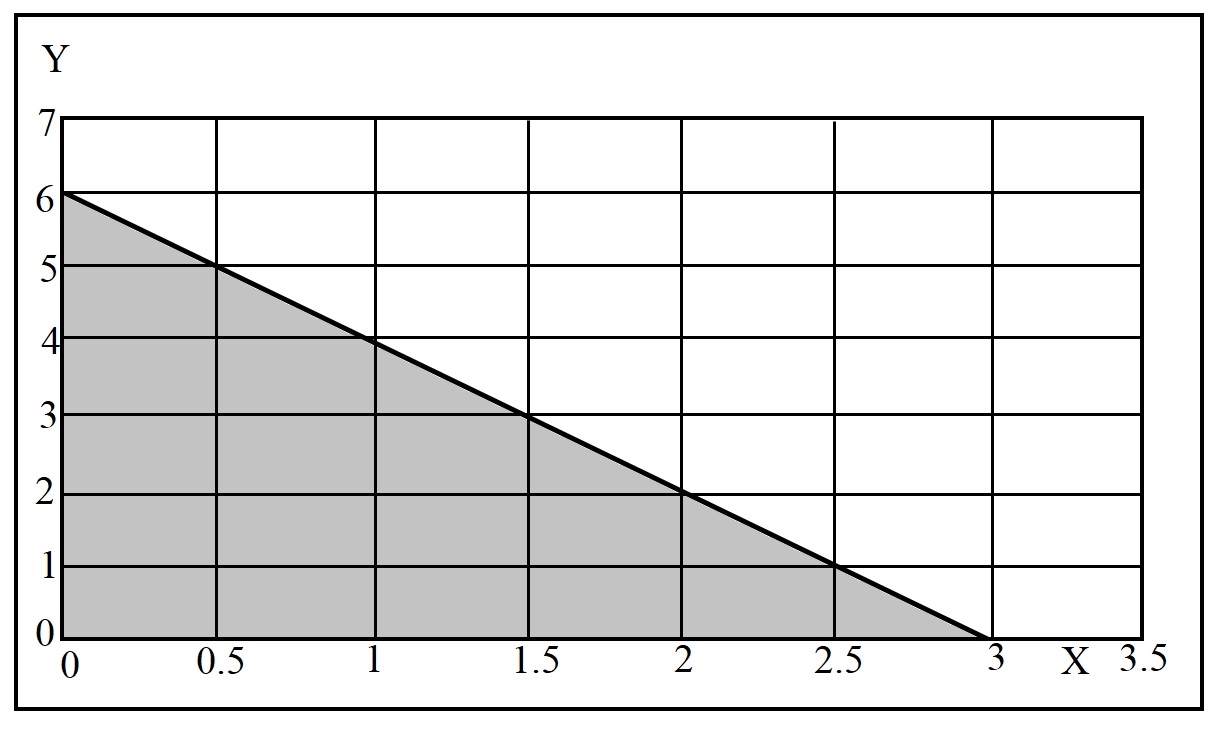
Inequations involved in the given region are$...........?$
- A
$2\text{x}+\text{y}\geq6,\text{x}\geq0,\text{y}\geq0$
- B
$2\text{x}+\text{y}>,\text{x}\geq0,\text{y}\geq0$
- C
$2\text{x}+\text{y}<6,\text{x}\geq0,\text{y}\geq0$
- ✓
$2\text{x}+\text{y}\leq6,\text{x}\geq0,\text{y}\geq0$
AnswerCorrect option: D. $2\text{x}+\text{y}\leq6,\text{x}\geq0,\text{y}\geq0$
Since region involves $1^{st}$ quadrant so $\text{x}\geq0,\text{y}\geq0.$
Two points on line are $(0,6)$ and $(3,0)$
$\frac{(\text{y}-6)}{(0-6)} =\frac{(\text{x}-0)}{(3-0)}$
$\Rightarrow\frac{(\text{y}-6)}{(-6)}=\frac{\text{x}}{3}$
$\Rightarrow\text{y}-6=2\text{x}$
$\Rightarrow2\text{x}+\text{y}=6$
$2\text{x}+\text{y}\leq6$ since $(0,0) $ should also satisfy.
So, $ 2\text{x}+\text{y}\leq6, \text{x}\geq0, \text{y}\geq0.$
View full question & answer→MCQ 701 Mark
If the expression $\big(\text{mx} – 1 +\frac{1}{\text{x}}\big)$ is always nonnegative, then the minimum value of $m$ must be:
- A
$\frac{-1}{2}$
- B
$0$
- ✓
$\frac{1}{4}$
- D
$\frac{1}{2}$
AnswerCorrect option: C. $\frac{1}{4}$
View full question & answer→MCQ 711 Mark
The solution of the function $f(x) = |x| > 0$ is:
- A
$R$
- ✓
$R – (0)$
- C
$R – (1)$
- D
$R – (-1)$
AnswerCorrect option: B. $R – (0)$
Given, $f(x) = |x| > 0$
We know that modulus is non negative quantity.
So, $x \in R$ except that $x = 0$
$\Rightarrow\text{x}\in\text{R}-(0)$
This is the required solution
View full question & answer→MCQ 721 Mark
The point which does not belong to the feasible region of the $\text{LPP:}$
Minimize: $\text{Z}=60\text{x}+10\text{y}$
subject to $3\text{x}+\text{y}\geq18$
$2\text{x}+2\text{y}\geq12$
$\text{x}+2\text{y}\geq10$
$\text{x,y}\geq0$ is.
- A
$(0,8)$
- ✓
$(4,2)$
- C
$(6,2)$
- D
$(10,0)$
AnswerCorrect option: B. $(4,2)$
We test whether the inequalities are satishfied or not
$(0,8),3(0)+8\geq 83(0)+8\geq8 8\geq8$ is true.
$2(0)+2(8)=16\geq12$ is true.
$0+2(8)=16\geq10$ is true.
$\therefore(0,8)$ is in the feasible region.
$(4,2), 3(4)+2=14\geq 83(4)+2=14\geq8$
$2(4)+2(2)=16\geq12$
$4+2(2)=8\geq10$ is not true.
$\therefore(4,2)$ is not a point in the feasible region.
$\therefore(2)$ is correct.
View full question & answer→MCQ 731 Mark
If $|\text{x} – 1| > 5$ then:
- A
$\text{x}\in(-4,6)$
- B
$\text{x}\in\big[-4,6\big]$
- ✓
$\text{x}\in(-\infty,-4)\cup(6,\infty)$
- D
$\text{x}\in\big[-\infty,-4)\cup\big[6,\infty)$
AnswerCorrect option: C. $\text{x}\in(-\infty,-4)\cup(6,\infty)$
$|\text{x} – 1| > 5$
$\text{x} – 1 < - 5 $ and $\text{x} – 1 > - 5 $
$\text{x} < -4 $ and $\text{x} > 6 $
$\therefore\text{x}\in(-\infty,-4)\cup(6,\infty)$
View full question & answer→MCQ 741 Mark
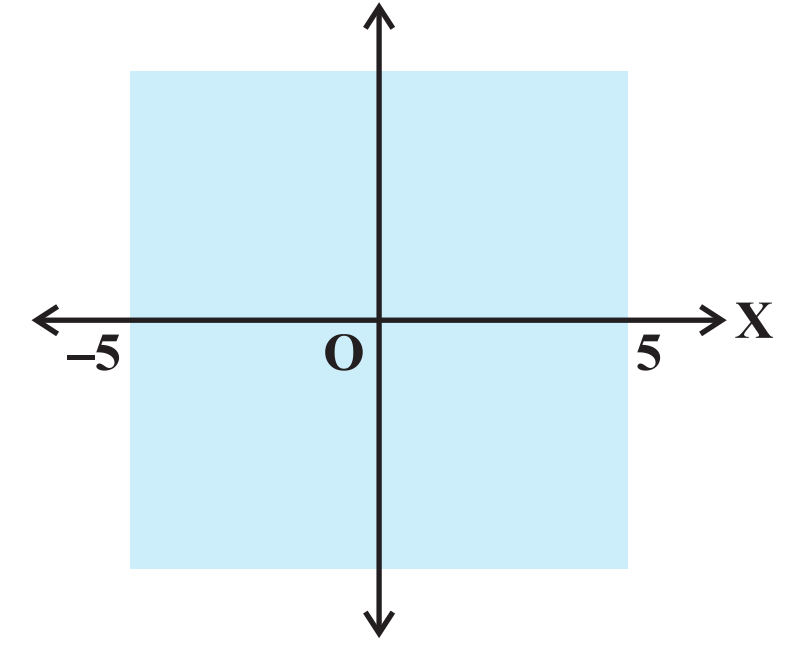
Choose the correct answer. The inequality representing the following graph is:
- ✓
$|\text{x}|>5$
- B
$|\text{x}|\leq5$
- C
$|\text{x}|>5$
- D
$|\text{x}|\geq5$
AnswerCorrect option: A. $|\text{x}|>5$
The given graph represents
$x > -5$ and $x < 5$
Combining the two inequalities
$|x| > 5.$
View full question & answer→MCQ 751 Mark
If $4\text{x}+3<6\text{x}+7$ then $x$ belongs to the interval:
- A
$(2,\infty)$
- ✓
$(-2,\infty)$
- C
$(-\infty, 2)$
- D
$(-4,\infty)$
AnswerCorrect option: B. $(-2,\infty)$
$4\text{x}+3<6\text{x}+7$
Subtracting $3$ from both sides,
$4\text{x}+3<6\text{x}+7-3$
$\Rightarrow4\text{x}<6\text{x}+4$
Subtracting $6x$ from both sides,
$4\text{x} – 6\text{x} <6\text{x} + 4 – 6\text{x}$
$\Rightarrow– 2\text{x}<4$ or
$\Rightarrow\text{x}>-2$
$\text{ i.e..,}$ all the real numbers greater than $–2,$ are the solutions of the given inequality.
Hence, the solution set is $(–2,\infty),$
$\text{i}.\text{e}.\text{x}\in(-2,\infty)$
View full question & answer→MCQ 761 Mark
If $x$ and $a$ are real numbers such that $a > 0$ and $|x| > a$, then:
- A
$\text{x}\in(-\text{a},\infty)$
- B
$\text{x}\in[-\infty,\text{a}]$
- C
$\text{x}\in(-\text{a},\text{a})$
- ✓
$\text{x}\in(-\infty,-\text{a})\cup(\text{a},\infty)$
AnswerCorrect option: D. $\text{x}\in(-\infty,-\text{a})\cup(\text{a},\infty)$
If $x$ and a are real numbers such that $a > 0.$
$|x| > a$
$\Rightarrow x > a$ or $x < −a$
$\Rightarrow\text{x}\in(-\infty,-\text{a})\cup(\text{a},\infty)$
View full question & answer→MCQ 771 Mark
If $|x| < -5$ then the value of $x$ lies in the interval:
- A
$(-\infty,-5)$
- B
$(\infty,5)$
- C
$(-5,\infty)$
- ✓
$\text{No Solution}$
AnswerCorrect option: D. $\text{No Solution}$
Given, $|x| < -5$
Now, $\text{LHS} ≥ 0$ and $\text{RHS} < 0$
Since $\text{LHS}$ is non$-$negative and $\text{RHS}$ is negative
So, $|x| < -5$ does not posses any solution
View full question & answer→MCQ 781 Mark
If $(\text{x} – 1)(\text{x}^2 – 5\text{x} + 7)<(\text{x} – 1), $ then $x$ belongs to:
- A
$\big(1, 2\big)\cup\big(3,\infty\big)$
- B
$\big(2, 3\big)$
- ✓
$\big(-\infty,1)\cup\big(2, 3\big)$
- D
$\text{None of these}$
AnswerCorrect option: C. $\big(-\infty,1)\cup\big(2, 3\big)$
View full question & answer→MCQ 791 Mark
The value of a for which one root of the quadratic equation $(\text{a}^2-5\text{a}+3) \text{x}^2+3\text{a}-1)\text{x}+2$ is twice as large as the other, is:
- ✓
$\frac{2}{3}$
- B
$\frac{-2}{3}$
- C
$\frac{1}{3}$
- D
$\frac{-1}{3}$
AnswerCorrect option: A. $\frac{2}{3}$
View full question & answer→MCQ 801 Mark
The linear inequality representing the solution set given in Fig. is:

- A
$\text{|x|}<5$
- B
$\text{|x|}>5$
- ✓
$\text{|x|}\geq5$
- D
$\text{|x|}\geq5$
AnswerCorrect option: C. $\text{|x|}\geq5$
As according to the graph,
$x$ lies between $(-\infty,-5]$ and $[5,\infty)$
$\Rightarrow\text{x}\geq5$ or $\text{x}\leq-5$
$\Rightarrow|\text{x}|\geq5$
View full question & answer→MCQ 811 Mark
Solve: $1\leq|\text{x} – 1|\leq3$
AnswerCorrect option: C. $\big[-2,0\big]\cup\big[2,4\big]$
Given, $ 1\leq|\text{x} – 1|\leq3$
$\Rightarrow-3\leq(\text{x} – 1)\leq-1 $ or $1\leq(\text{x}-1)\leq3$
i.e. the distance covered is between $1$ unit to $3$ unit.
$\Rightarrow-2\leq \text{x}\leq0$ or $2\leq\text{x}\leq4$
Hence, the solution set of the given inequality is
$\text{x}\in\big[-2, 0\big]\cup\big[2, 4\big]$
View full question & answer→MCQ 821 Mark
If $|\text{x} + 2|\leq9,$ then:
- A
$\text{x}\in\big(–7, 11\big)$
- ✓
$\text{x}\in\big[–11, 7\big]$
- C
$\text{x}\in\big(-\infty, –7\big)\cup\big(11,\infty\big)$
- D
$\text{x}\in\big(-\infty, -7\big)\cup\big[11,\infty\big)$
AnswerCorrect option: B. $\text{x}\in\big[–11, 7\big]$
View full question & answer→MCQ 831 Mark
Given that $x, y$ and $b$ are real numbers and $x < y, b < 0,$ then:
- ✓
$\frac{\text{x}}{\text{b}}<\frac{\text{y}}{\text{b}}$
- B
$\frac{\text{x}}{\text{b}}\leq\frac{\text{y}}{\text{b}}$
- C
$\frac{\text{x}}{\text{b}}>\frac{\text{y}}{\text{b}}$
- D
$\frac{\text{x}}{\text{b}}\geq\frac{\text{y}}{\text{b}}$
AnswerCorrect option: A. $\frac{\text{x}}{\text{b}}<\frac{\text{y}}{\text{b}}$
Given that $x, y$ and $b$ are real numbers and $x < y, b < 0.$
Consider, $x < y$
Divide both sides of the inequality by $“b”$
$\frac{\text{x}}{\text{b}}<\frac{\text{y}}{\text{b}}(\text{since, b<0})$
View full question & answer→MCQ 841 Mark
Solution of $\frac{\text{x}-7}{\text{x}+3}>2$ is:
- A
$(– 3,\infty)$
- B
$\big(-\infty, –13\big)$
- ✓
$(-13, –3)$
- D
$(– 13, 3)$
AnswerCorrect option: C. $(-13, –3)$
View full question & answer→MCQ 851 Mark
What is the solution set for $0<−\frac{\text{x}}{2} < 3$
- A
$(−6, 6)$
- ✓
$(−6, 0)$
- C
$(0, 6)$
- D
$(-\infty, -6)$
AnswerCorrect option: B. $(−6, 0)$
Given: $0<−\frac{\text{x}}{2} < 3$
Multiply by $2$ in above inequality $($Here $2$ is a positive number so the direction of the inequality does not change$)$
$\Rightarrow0 <-\text{x}<6$
$\Rightarrow−6 <\text{x}<0$
$\therefore\text{x}$ lies in $(−6, 0)$
View full question & answer→MCQ 861 Mark
If $\text{x}\in\text{l},$ the solution set of the inequation $-2\leq\text{x}<3$ is:
- ✓
$−2, −1, 0, 1, 2$
- B
$−1, 0, 1, 2, 3$
- C
$0, 1, 2, 3$
- D
AnswerCorrect option: A. $−2, −1, 0, 1, 2$
$\text{x}\in\text{l},$ solution set $-2\leq\text{x}<3$
$= −2, −1, 0, 1, 2$
View full question & answer→MCQ 871 Mark
Solve the following in equations $\frac{2\text{x}+4}{\text{x}-1}\geq5$
- A
$\big(1,2\big]$
- B
$\big(1,3\big)$
- ✓
$\big(1,3\big]$
- D
$\big(1,4\big]$
AnswerCorrect option: C. $\big(1,3\big]$
$\frac{2\text{x}+4}{\text{x}-1}\geq5$
$\Rightarrow\frac{2\text{x}+4}{\text{x}-1}-5\geq0$
$\Rightarrow\frac{2\text{x}+4-5(\text{x-1})}{\text{x-1}}\geq0$
$\Rightarrow\frac{2\text{x}+4-\text{5x+5}}{\text{x-1}}\geq0$
$\Rightarrow\frac{9-3\text{x}}{\text{x-1}}\geq0$
$\Rightarrow\frac{-3\text{(x-3)}}{\text{x}-1}\geq0$
Multiplying each side of an inequality by a negative number $\big(\frac{-1}{3}\big)$ reverses the direction of the inequality symbol.
$\Rightarrow\frac{(\text{x}-3)}{\text{x}-1}\leq0$ Here $\text{x}-1\neq0$
$\Rightarrow\text{x}\neq1$
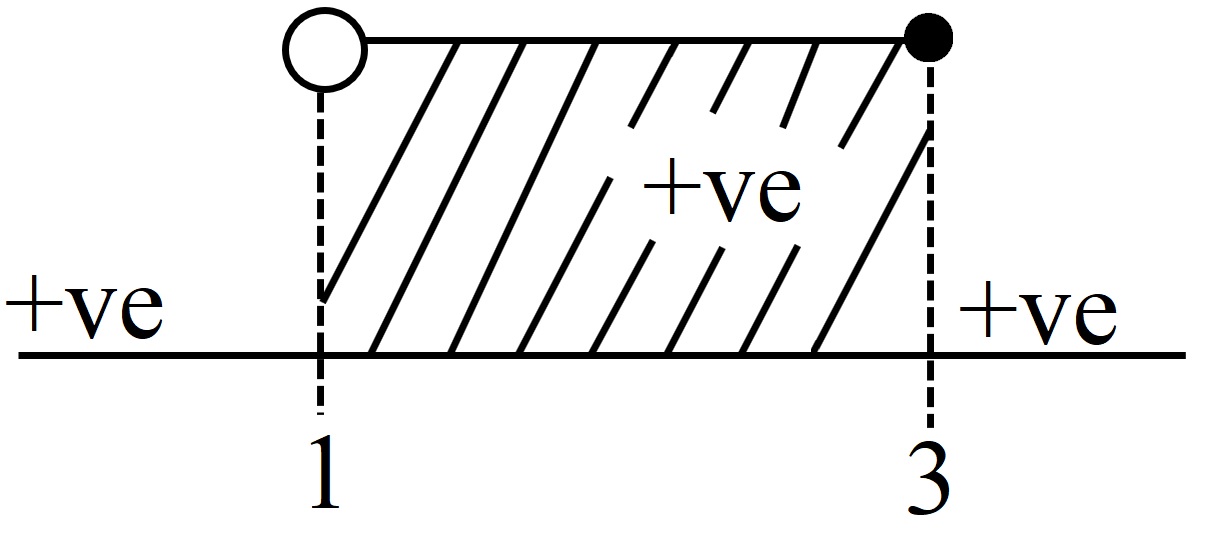
Hence the solution set of the given in equations is $\big(1, 3\big]$ View full question & answer→MCQ 881 Mark
Solution of $2x – 1 = |x + 7|$ is:
View full question & answer→MCQ 891 Mark
Let two numbers have arithmetic mean $9$ and geometric mean $4$.Then, these numbers are the roots of the quadratic equation:
- A
$x^2+ 18x + 16 = 0$
- ✓
$x^2- 18x + 16 = 0$
- C
$x^2+ 18x - 16 = 0$
- D
$x^2- 18x - 16 = 0$
AnswerCorrect option: B. $x^2- 18x + 16 = 0$
View full question & answer→MCQ 901 Mark
Find all pairs of consecutive odd positive integers both of which are smaller than $8$ such that their sum is more than $10.$
- ✓
$(5, 7)$
- B
$(3, 5), (5, 7)$
- C
$(3, 5), (5, 7), (7, 9)$
- D
$(5, 7), (7, 9)$
AnswerCorrect option: A. $(5, 7)$
Let two numbers be $x$ and $x + 2.$
$x + x + 2 > 10$
$\Rightarrow 2x > 8$
$\Rightarrow x > 4$ and $x < 8$ and $x + 2 < 8$
$\Rightarrow x < 6.$
$4 < x < 6$
$\Rightarrow x$ can be $5.$
For $x = 5, x + 2 = 7$
So, Pairs of odd consecutive positive integers are $(5, 7).$
View full question & answer→MCQ 911 Mark
The quantity of $A$ and $B$ in one day for which profit will be maximum is:
- A
$25, 30$
- B
$30, 35$
- C
$25, 25$
- ✓
$30, 30$
AnswerCorrect option: D. $30, 30$
View full question & answer→MCQ 921 Mark
If both the roots of the quadratic equation $\text{x}^2 -2\text{kx}+\text{k}^2-5=0 $ are less than $5,$ than $k$ lies in the interval:
- A
$\big[4,5\big]$
- ✓
$\big(-\infty,4\big)$
- C
$\big(6,\infty\big)$
- D
$\big(5,6\big]$
AnswerCorrect option: B. $\big(-\infty,4\big)$
View full question & answer→MCQ 931 Mark
Given that $x, y$ and $b$ are real numbers and $x < y, b > 0,$ then:
- ✓
$\frac{\text{x}}{\text{b}}<\frac{\text{y}}{\text{b}}$
- B
$\frac{\text{x}}{\text{b}}\leq\frac{\text{y}}{\text{b}}$
- C
$\frac{\text{x}}{\text{b}}>\frac{\text{y}}{\text{b}}$
- D
$\frac{\text{x}}{\text{b}}\geq\frac{\text{y}}{\text{b}}$
AnswerCorrect option: A. $\frac{\text{x}}{\text{b}}<\frac{\text{y}}{\text{b}}$
Given that $x, y$ and $b$ are real numbers and $x < y, b > 0.$
Both sides of an inequality can be multiplied or divided by the same positive number.
$\therefore\frac{\text{x}}{\text{b}}<\frac{\text{y}}{\text{b}}$
View full question & answer→MCQ 941 Mark
If $– 3x + 17 < – 13,$ then:
- ✓
$\text{x}\in(10,\infty)$
- B
$\text{x}\in\big[10,\infty)$
- C
$\text{x}\in(-\infty,10\big]$
- D
$\text{x}\in\big[-10,10)$
AnswerCorrect option: A. $\text{x}\in(10,\infty)$
Given,
$-3x + 17 < -13$
Subtracting $17$ from both sides,
$-3x + 17 – 17 < -13 – 17$
$\Rightarrow -3x < -30$
$\Rightarrow x > 10 ($since the division by negative number inverts the inequality sign$)$
$\Rightarrow\text{x}\in(10,\infty)$
View full question & answer→MCQ 951 Mark
All the values of $m$ for which both roots of the equation $x^2-2mx + m^2-1 = 0$ are greater than $-2$
but less than $4$ lie in the interval:
- A
$m > 3$
- ✓
$-1 < m < 3$
- C
$1 < m < 4$
- D
$– 2 < m < 0$
AnswerCorrect option: B. $-1 < m < 3$
View full question & answer→MCQ 961 Mark
A pack of coffee powder contains a mixture of $x$ gms of coffee and y gms of choco. The amount of coffee powder is greater than that of chocolate and each pack weights at least $10g$. Which of the followinginequalities describe the given condition?
AnswerCorrect option: B. $\text{x}+\text{y}\geq10$
The coffee powder is greater than choco.
hence, $\text{x}>\text{y}$
each pack is at least $10gm.$
View full question & answer→MCQ 971 Mark
Solution of $|3-\text{x}| = 3-\text{x} $ is:
- A
$\text{x}<3$
- B
$\text{x}>3$
- C
$\text{x}\geq3$
- ✓
$\text{x}\leq3$
AnswerCorrect option: D. $\text{x}\leq3$
View full question & answer→MCQ 981 Mark
If $x - 1 > -x + 7$ then which is true?
- ✓
$x > 4$
- B
$x < 4$
- C
$x > 2$
- D
$x < 2$
AnswerCorrect option: A. $x > 4$
$x - 1 > -x + 7$
$\Rightarrow 2x > 8$
$\Rightarrow x > 4.$
View full question & answer→MCQ 991 Mark
$x$ and $b$ are real numbers.If $\text{b}>0$ and $|\text{x}|>\text{b},$ then:
- A
$\text{x}\in\big(–\text{b},\infty\big)$
- B
$\text{x}\in\big(-\infty,\text{b}\big)$
- C
$\text{x}\in\big(–\text{b}, \text{b}\big)$
- ✓
$\text{x}\in(-\infty, –\text{b}\big)\cup\big(\text{b},\infty\big)$
AnswerCorrect option: D. $\text{x}\in(-\infty, –\text{b}\big)\cup\big(\text{b},\infty\big)$
View full question & answer→MCQ 1001 Mark
If $–8\leq5\text{x} – 3<7,$ then $\text{x}\in$
- A
$\big(–1, 2\big)$
- ✓
$\big[–1, 2\big)$
- C
$\big[–2,\infty\big)$
- D
$\big[-2,0\big)$
AnswerCorrect option: B. $\big[–1, 2\big)$
View full question & answer→