MCQ 11 Mark
Choose the correct answer. If $x$ is a real number and $|x| < 3,$ then:
- A
$\text{x}\geq3$
- ✓
$-3<\text{x}<3$
- C
$\text{x}\leq-3$
- D
$-3\leq\text{x}\leq3$
AnswerCorrect option: B. $-3<\text{x}<3$
Given that $|x| < 3$
$\Rightarrow -3 < x < 3 | x | < a$
$\Rightarrow -a < x < a.$
View full question & answer→MCQ 21 Mark
If $−5\leq\frac{5 – 3\text{x}}{2}\leq8, $ then $\text{x}\in$
- ✓
$\big[\frac{11}{3},5\big]$
- B
$\big[-5,5\big]$
- C
$\big[\frac{-11}{3},\infty\big]$
- D
$\big(-\infty,\infty\big)$
AnswerCorrect option: A. $\big[\frac{11}{3},5\big]$
View full question & answer→MCQ 31 Mark
The solution of $\Big|\frac{2}{(\text{x} – 4)}\Big|>1$ where $\text{x}\neq4$ is:
- A
$(2, 6)$
- ✓
$(2, 4)\cup(4, 6)$
- C
$(2, 4)\cup(4,\infty)$
- D
$(-\infty, 4)\cup(4, 6)$
AnswerCorrect option: B. $(2, 4)\cup(4, 6)$
Given,$\Big|\frac{2}{(\text{x} – 4)}\Big|>1$
$\Rightarrow2 > |\text{x} – 4|$
$\Rightarrow |\text{x} – 4|<2$
$\Rightarrow-2<\text{x}-4<2$
$\Rightarrow-2+4 < \text{x} < 2+4$
$\Rightarrow2<\text{x}<6$
$\Rightarrow\text{x}\in(2, 6),$
where $\text{x}\neq4$
$\Rightarrow\text{x}\in(2, 4)\cup(4, 6)$
View full question & answer→MCQ 41 Mark
Write the solution of inequality $\frac{1}{5}\bigg(\frac{3\text{x}}{5}+4\bigg)\geq\frac{1}{3}(\text{x}-6).$
AnswerCorrect option: A. $\text{x}\leq\frac{105}{8}$
$\frac{1}{5}\big(\frac{3\text{x}}{5}+4\big)\geq\frac{1}{3}(\text{x}-6).$
$\Rightarrow3\big(\frac{3\text{x}}{5}+4\big)\geq5\big(\text{x}-6\big)$
$\Rightarrow\big(\frac{9\text{x}}{5}+12\big)\geq5\text{x}-6$
$\Rightarrow(30+12)\geq-\frac{9\text{x}}{5}+5\text{x}$
$\Rightarrow42\geq\frac{-9\text{x}+25\text{x}}{5}$
$\Rightarrow42\geq\frac{16\text{x}}{5}$
$\Rightarrow\frac{42\times5}{16}\geq\text{x}$
$\text{x}\leq\frac{105}{8}$
Therefore option $(1)$ is the correct answere.
View full question & answer→MCQ 51 Mark
If the roots of the equation $x^2- bx + c = 0$ be two consecutive integers, then $b^2 - 4c$ equals:
View full question & answer→MCQ 61 Mark
The length of a rectangle is three times the breadth.If the minimum perimeter of the rectangle is $160\ cm,$ then:
- A
breadth $> 20\ cm$
- B
length $< 20\ cm$
- ✓
breadth $x \geq 20\ cm$
- D
length $\leq 20\ cm$
AnswerCorrect option: C. breadth $x \geq 20\ cm$
Let $x$ be the breadth of a rectangle.
So, length $= 3x$
Given that the minimum perimeter of a rectangle is $160\ cm.$
Thus, $2(3\text{x}+\text{x})\geq160$
$\Rightarrow4\text{x}\geq80$
$\Rightarrow\text{x}\geq20$
View full question & answer→MCQ 71 Mark
Which of the following points lie in the solution set?
- A
$(1, 1)$
- ✓
$(1, 2)$
- C
$(2, 1)$
- D
$(3, 2)$
AnswerCorrect option: B. $(1, 2)$
View full question & answer→MCQ 81 Mark
The value of a for which the sum of the squares of the roots of the equation $x^2- (a - 2)x - a - 1 = 0$ the least value is:
View full question & answer→MCQ 91 Mark
If $x$ is a whole number and $10\text{x}\leq50$ then find solution set of $x.$
- ✓
$\{0,1, 2, 3, 4, 5\}$
- B
$\{1, 2, 3, 4, 5\}$
- C
$\{1, 2, 3, 4\}$
- D
$\{0, 1, 2, 3, 4\}$
AnswerCorrect option: A. $\{0,1, 2, 3, 4, 5\}$
$10\text{x}\leq50$
Dividing by $10$ on both sides, $\text{x}\leq\Big(\frac{50}{10}\Big)$
$\Rightarrow\text{x}\leq5$
Since $x$ is a whole number
so, $x = 0, 1, 2, 3, 4, 5.$
View full question & answer→MCQ 101 Mark
If the sum of the roots of the quadratic equation $ \text{ax}^2+\text{bx}+\text{c}=0$ is equal to the sum of the squares of their reciprocals, then $\frac{\text{a}}{\text{c}}, \frac{\text{b}}{\text{a}}$ and $\frac{\text{c}}{\text{b}}$ are in:
- A
- B
- ✓
- D
arithmetico-geometric progression
View full question & answer→MCQ 111 Mark
The quadratic equations $x^2- 6x + a = 0$ and $x^2- cx + 6 = 0$ have one root in common. The other roots of the first and second equations are integers in the ratio $4 : 3.$Then, the common root is:
View full question & answer→MCQ 121 Mark
Solution of $|3\text{x}+2| <1$ is:
- A
$\big[-1,\frac{-1}{3}\big]$
- B
$\big(\frac{-1}{3},-1\big)$
- ✓
$\big(-1,\frac{-1}{3}\big)$
- D
$\text{None of these}$
AnswerCorrect option: C. $\big(-1,\frac{-1}{3}\big)$
View full question & answer→MCQ 131 Mark
A solution is to be kept between $77^\circ F$ and $86^\circ F.$ What is the range in temperature in degree Celsius $(C)$ if the $\frac{\text{Celsius}}{\text{Fahrenheit}}(F) $conversion formula is given by $\text{F}=\frac{9}{5\text{c}}+32^\circ$
- A
$\big[15^\circ, 20^\circ\big]$
- B
$\big[20^\circ, 25^\circ\big]$
- ✓
$\big[25^\circ, 30^\circ\big]$
- D
$\big[30^\circ, 35^\circ\big]$
AnswerCorrect option: C. $\big[25^\circ, 30^\circ\big]$
$\text{F}=\frac{9}{5\text{c}}+32^\circ$
$\text{C}=\text{F}-32^\circ\times\frac{5}{9}$
$77^\circ\leq\text{F}\leq86^\circ$
$\Rightarrow77^\circ-32^\circ\leq\text{F}-32^\circ\leq86^\circ -32^\circ$
$\Rightarrow45^\circ\leq\text{F}-32^\circ\leq54^\circ$
$\Rightarrow45^\circ\times\frac{5}{9}\leq(\text{F}-32^\circ)\times\frac{5}{9}\leq54^\circ\times\frac{5}{9}$
$\Rightarrow25^\circ\leq\text{C}\leq30^\circ$
View full question & answer→MCQ 141 Mark
The graph of the inequations $x ≤ 0, y ≤ 0,$ and $2x + y + 6 ≥ 0$ is:
AnswerCorrect option: B. a triangular region in the $3^{rd}$ quadrant
Given inequalities $x ≥ 0, y ≥ 0, 2x + y + 6 ≥ 0$
Now take $x = 0, y = 0$ and $2x + y + 6 = 0$
when $x = 0, y = -6$
when $y = 0, x = -3$
So, the points are $A(0, 0), B(0, -6)$ and $C(-3, 0)$
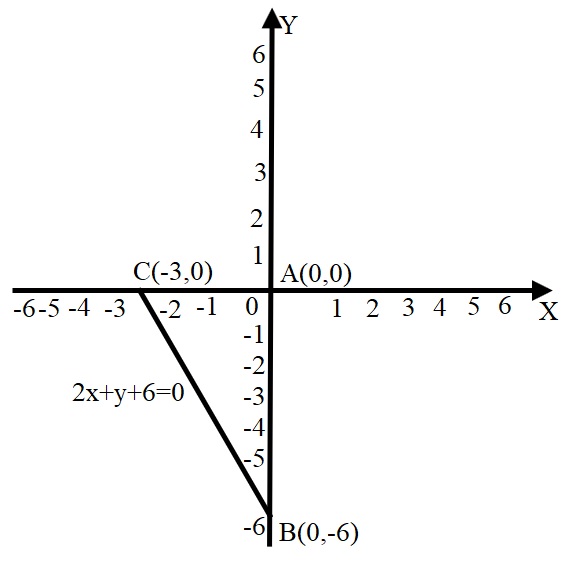
So, the graph of the inequations $x ≤ 0, y ≤ 0,$ and $2x + y + 6 ≥ 0$ is a triangular region in the $3^{rd}$ quadrant. View full question & answer→MCQ 151 Mark
If $4\text{x} + 3<6\text{x} + 7$, then$\text{ x}\in$
AnswerCorrect option: B. $\big(-2,\infty\big)$
View full question & answer→MCQ 161 Mark
If $|x−1| x - 1 > 5,$ then:
- A
$\text{x}\in(-4,6)$
- B
$\text{x}\in[-4,6]$
- ✓
$\text{x}\in(-\infty,-4)\cup(6,\infty)$
- D
$\text{x}\in(-\infty,-4)\cup[6,\infty)$
AnswerCorrect option: C. $\text{x}\in(-\infty,-4)\cup(6,\infty)$
$|x−1| > 5$
$\Rightarrow x − 1 > 5$ or $x − 1 < −5$
$\Rightarrow x > 5 + 1$ or $x < −5 + 1$
$\Rightarrow x > 6$ or $x < −4$
$\Rightarrow\text{x}\in(-\infty,-4)\cup(6,\infty)$
View full question & answer→MCQ 171 Mark
If $x$ is a natural number and $20\text{x}\leq100$ then find solution set of $x.$
- A
$\{0, 1, 2, 3, 4, 5\}$
- ✓
$\{1, 2, 3, 4, 5\}$
- C
$\{1, 2, 3, 4\}$
- D
$\{0, 1, 2, 3, 4\}$
AnswerCorrect option: B. $\{1, 2, 3, 4, 5\}$
$20\text{x}\leq100$
Dividing by $20$ on both sides,
$\text{x}\leq\frac{100}{20}$
$\Rightarrow\text{x}\leq5$
Since $x$ is a natural number.
so $x = 1, 2, 3, 4, 5.$
View full question & answer→MCQ 181 Mark
If $− 3x + 17 < -13,$ then:
AnswerCorrect option: A. $\text{x}\in(10,\infty)$
$− 3x + 17 < −13$
Subtracting $17$ on both sides, we get
$\Rightarrow −3x + 17 − 17 < −13 − 17$
$\Rightarrow −3x < − 30$
Dividing $−3$ on both sides, we get
$\Rightarrow\frac{-3\text{x}}{-3}>\frac{-30}{-3}$
$\Rightarrow\text{x}>10$
$\Rightarrow\text{x}\in(10,\infty)$
View full question & answer→MCQ 191 Mark
The graph of the inequalities $x ≥ 0, y ≥ 0, 2x + y + 6 ≤ 0$ is:
AnswerCorrect option: C. $\{\}$
Given inequalities $x ≥ 0, y ≥ 0, 2x + y + 6 ≤ 0$
Now take $x = 0, y = 0$ and $2x + y + 6 = 0$
when $x = 0, y = -6$
when $y = 0, x = -3$
So, the points are $A(0, 0), B(0, -6)$ and $C(-3, 0)$
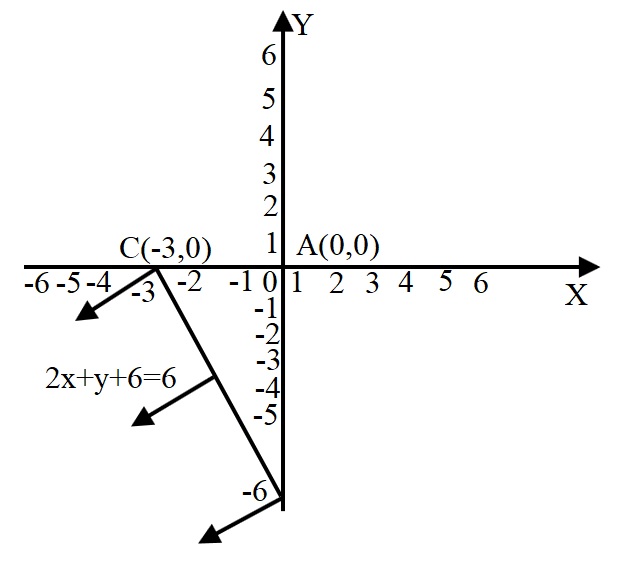
Since region is outside from the line $2x + y + 6 = 0$
So, it does not represent any figure. View full question & answer→MCQ 201 Mark
If $x$ is a real number and $|x| < 5,$ then:
- A
$\text{x}\geq5$
- ✓
$-5<\text{x}<5$
- C
$\text{x}\leq-5$
- D
$-5\leq\text{x}\leq5$
AnswerCorrect option: B. $-5<\text{x}<5$
If $x$ is a real number.
$|x| < 5$
$\Rightarrow -5 < x < 5$
View full question & answer→MCQ 211 Mark
If $|\text{x} + 3|\geq10,$ then:
- A
$\text{x}\in\big(-13, 7\big] $
- B
$\text{x}\in\big(–13, 7\big)$
- ✓
$\text{x}\in\big(-\infty,-13\big]\cup\big[7,\infty\big)$
- D
$\text{x}\in\big(-\infty,-13\big)\cup\big[7,\infty\big)$
AnswerCorrect option: C. $\text{x}\in\big(-\infty,-13\big]\cup\big[7,\infty\big)$
View full question & answer→MCQ 221 Mark
The solution of the inequality $\frac{3(\text{x}-2)}{5}\geq\frac{5(2-\text{x})}{3}$ is:
- A
$\text{x}\in(2,\infty)$
- B
$\text{x}\in\big[-2,\infty)$
- C
$\text{x}\in\big[\infty,2)$
- ✓
$\text{x}\in\big[2,\infty)$
AnswerCorrect option: D. $\text{x}\in\big[2,\infty)$
Given, $\frac{3(\text{x}-2)}{5}\geq\frac{5(2-\text{x})}{3}$
$\Rightarrow3(\text{x} – 2)\times3\geq5(2 – \text{x})\times5$
$\Rightarrow9(\text{x} – 2)\geq25(2 – \text{x})$
$\Rightarrow9\text{x} – 18\geq50 – 25\text{x}$
$\Rightarrow9\text{x} – 18 + 25\text{x}\geq50$
$\Rightarrow34\text{x}-18\geq50$
$\Rightarrow34\text{x}\geq50+18$
$\Rightarrow34\geq68$
$\Rightarrow\text{x}\geq\frac{68}{34}$
$\Rightarrow\text{x}\geq2$
$\Rightarrow\text{x}\in\big[2,\infty)$
View full question & answer→MCQ 231 Mark
If the equstion $\text{a}_\text{n}\text{x}^\text{n}+\text{a}_\text{n-1}\text{x}^\text{n-1}+...+\text{a}_1\text{x}=0,$
$\text{a}_1\neq0,\text{n}\geq2,$ has positive root $\text{x}=\alpha$ then the eqestions
$\text{na}_\text{n}\text{x}^\text{n-1}+(\text{n-1})\text{a}_\text{n-1}\text{x}^\text{n-2}+...+\text{a}_1=0$ has a positive root, which is:
AnswerCorrect option: C. smaller than $\alpha$
View full question & answer→MCQ 241 Mark
Question: If one root of the equation $\text{x}^2+\text{px}+12=0$ is $4,$ while the equation $\text{x}^2+\text{px}+\text{q}=0$ has equal roots, then the value of $q$ is:
- ✓
$\frac{49}{4}$
- B
$12$
- C
$3$
- D
$4$
AnswerCorrect option: A. $\frac{49}{4}$
View full question & answer→MCQ 251 Mark
Solution of $\bigg|\text{x}+\frac{1}{\text{x}}\bigg|<4$ is:
- ✓
$\big(2-3, 2+3\big)\cup\big(-2-3-2+3\big)$
- B
$\text{R}\big(2-3, 2+3\big)$
- C
$\text{R}-\big(-2-3-2 + 3\big)$
- D
$\text{None of these}$
AnswerCorrect option: A. $\big(2-3, 2+3\big)\cup\big(-2-3-2+3\big)$
View full question & answer→MCQ 261 Mark
The number of the real solutions of the equation $x^2-3 |x| + 2 = 0$ is:
View full question & answer→MCQ 271 Mark
If the difference between the roots of the equation $\text{x}^2 +\text{ax}+1=0$ is less than $\sqrt{5},$ then the set of possible values of $a$ is:
- ✓
$(-3,3)$
- B
$(-3,\infty)$
- C
$(3,\infty)$
- D
$(-\infty,-3)$
AnswerCorrect option: A. $(-3,3)$
View full question & answer→MCQ 281 Mark
All the values of $m$ for which both roots of the equation $x^2-2mx + m^2-1 = 0$ are greater than $-2$
but less than $4$ lie in the interval:
- A
$m > 3$
- ✓
$-1 < m < 3$
- C
$1 < m < 4$
- D
$– 2 < m < 0$
AnswerCorrect option: B. $-1 < m < 3$
View full question & answer→MCQ 291 Mark
If $7\text{x} + 3 < 5\text{x} + 9$ then $\text{x}\in$
AnswerCorrect option: C. $\big(-\infty,3\big)$
View full question & answer→MCQ 301 Mark
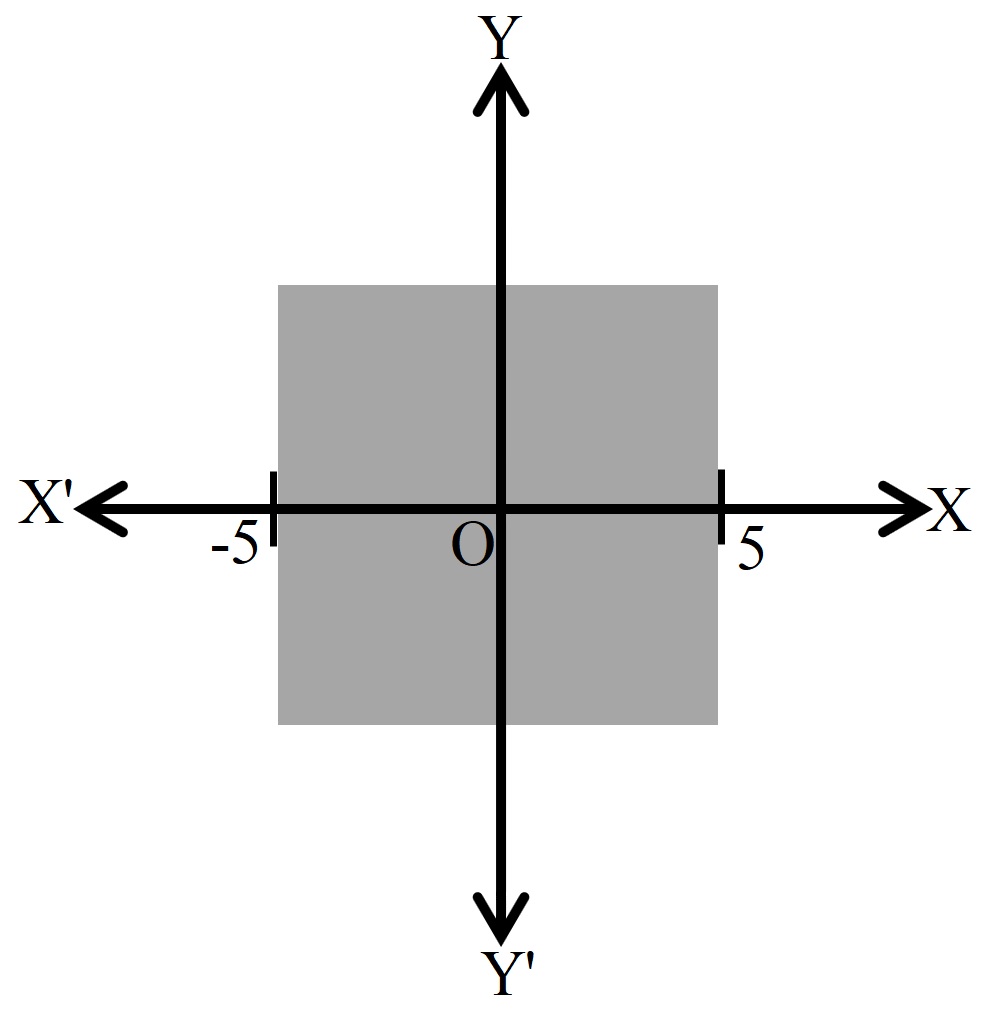
The inequality representing the following graph is:
- ✓
$|\text{x}|<5$
- B
$|\text{x}|\leq5$
- C
$|\text{x}|>5$
- D
$|\text{x}|\geq5$
AnswerCorrect option: A. $|\text{x}|<5$
View full question & answer→MCQ 311 Mark
$ax + b > 0$ is, $.............?$
AnswerSince it has highest power of $x\ '1\ '$ and has inequality sign
so, it is called linear inequality.
It is not numerical inequality as it does not have numbers on both sides of inequality.
It does not have two inequality signs so it is not double inequality.
View full question & answer→MCQ 321 Mark
If $\text{|x}+2|\leq9,$ then:
- A
$\text{x}\in(-7,11)$
- ✓
$\text{x}\in[-11,7]$
- C
$\text{x}\in(-\infty,-7)\cup(11,\infty)$
- D
$\text{x}\in(-\infty,-7)\cup[11,\infty)$
AnswerCorrect option: B. $\text{x}\in[-11,7]$
$|\text{x}+2|\leq9$
$\Rightarrow-9\leq\text{x}+2\leq9$
$\Rightarrow-9-2\leq\text{x}+2-2\leq9-2$
$\Rightarrow-11\leq\text{x}\leq7$
$\Rightarrow\text{x}\in[-11,7]$
View full question & answer→MCQ 331 Mark
$ax^2+ bx + c > 0$ is, $............?$
AnswerSince it has highest power of $x\ '2\ '$ and has inequality sign
so, it is called quadratic inequality.
It is not numerical inequality as it does not have numbers on both sides of inequality.
It does not have two inequality signs.
so it is not double inequality.
View full question & answer→MCQ 341 Mark
Solution of $|\text{x} – 1|\geq|\text{x}-3| $ is:
- A
$\text{x}\leq2$
- ✓
$\text{x}\geq2$
- C
$\big[1, 3\big]$
- D
$\text{None of these}$
AnswerCorrect option: B. $\text{x}\geq2$
View full question & answer→MCQ 351 Mark
If $(1 – p)$ is a root of quadratic equation $x^2+ px + (1-p) = 0$, then its roots are:
- A
$0, 1$
- B
$– 1, 1$
- ✓
$0, -1$
- D
$– 1, 2$
AnswerCorrect option: C. $0, -1$
View full question & answer→MCQ 361 Mark
If $–3\text{x}+17<-13, $ then:
- ✓
$\text{x}\in\big(10,\infty\big)$
- B
$\text{x}\in\big[10,\infty\big)$
- C
$\text{x}\in\big(-\infty,10\big)$
- D
$\text{x}\in\big[-10,10\big)$
AnswerCorrect option: A. $\text{x}\in\big(10,\infty\big)$
View full question & answer→MCQ 371 Mark
If $|\text{x}+3|\geq10,$ then:
- A
$\text{x}\in(-12,7]$
- B
$\text{x}\in(-13,7)$
- C
$\text{x}\in(\infty,-13)\cup(7,\infty)$
- ✓
$\text{x}\in(-\infty,-13]\cup[7,\infty)$
AnswerCorrect option: D. $\text{x}\in(-\infty,-13]\cup[7,\infty)$
$|\text{x}+3|\geq10$
$\Rightarrow\text{x}+3\geq10$ or $\text{x}+3;\leq-10$
$\Rightarrow\text{x}\geq10-3$ or $\text{x}\leq-10-3$
$\Rightarrow\text{x}\geq7$ or $\text{x}\leq-13$
$\Rightarrow\text{x}\in(-\infty,-13)\cup[7,\infty)$
View full question & answer→MCQ 381 Mark
Choose the correct answer. If $x < 5,$ then.
- A
$-\text{x} < – 5$
- B
$-\text{x}\leq-5$
- ✓
$-\text{x} > – 5$
- D
$-\text{x}\leq-5$
AnswerCorrect option: C. $-\text{x} > – 5$
If $x > 5$ then $- x > - 5.$
View full question & answer→MCQ 391 Mark
If $|\text{x} – 1|>5,$ then
- A
$\text{x}\in\big(-4, 6\big)$
- B
$\text{x}\in\big[–4, 6\big]$
- ✓
$\text{x}\in\big(-\infty, –4\big)\cup\big(6,\infty\big)$
- D
$\text{x}\in\big(-\infty, –4\big)\cup\big[6,\infty\big)$
AnswerCorrect option: C. $\text{x}\in\big(-\infty, –4\big)\cup\big(6,\infty\big)$
View full question & answer→MCQ 401 Mark
The solution set of the inequation $|\text{x}+2|\leq5$ is:
- A
$(-7, 5)$
- ✓
$[-7, 3]$
- C
$[-5, 5]$
- D
$(-7, 3)$
AnswerCorrect option: B. $[-7, 3]$
$|\text{x}+2|\leq5$
$\Rightarrow-5\leq\text{x}+2\leq5$
$\Rightarrow-5-2\leq\text{x}+2-2\leq5-2$
$\Rightarrow-7\leq\text{x}\leq3$
$\Rightarrow\text{x}\in[-7,3]$
View full question & answer→MCQ 411 Mark
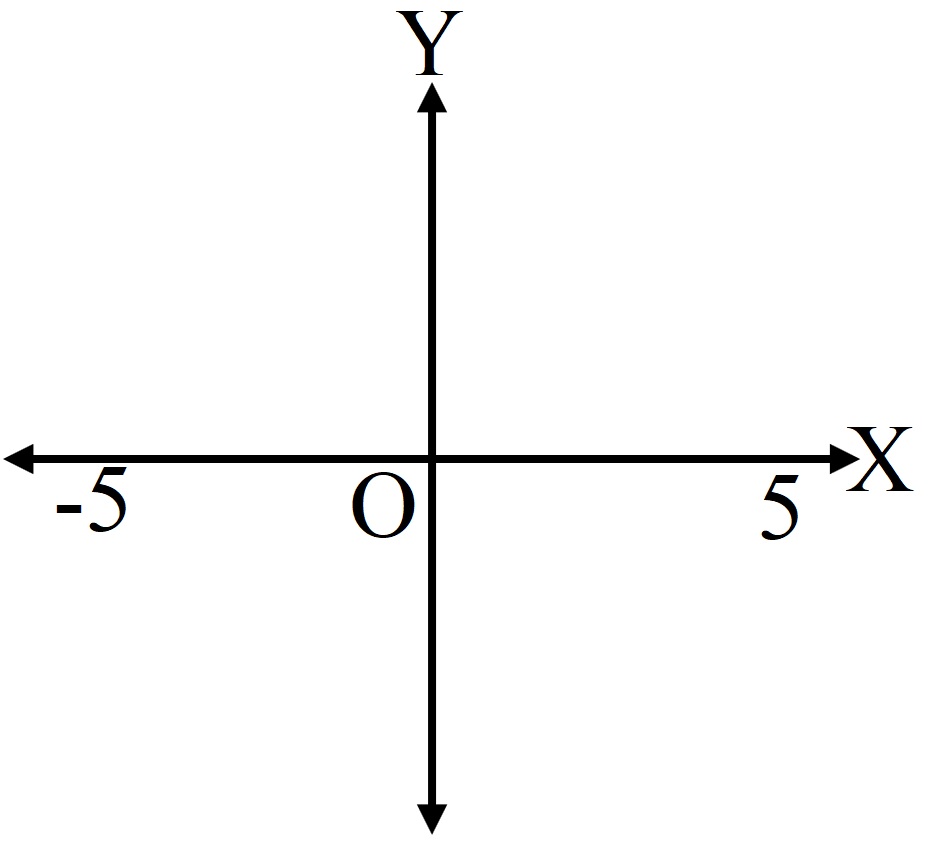
The inequality representing the following graph is:
- ✓
$|x| < 5$
- B
$|x| ≤ 5$
- C
$|x| > 5$
- D
$|x| ≥ 5$
AnswerCorrect option: A. $|x| < 5$
The given graph shows the shaded region corresponding to $x > – 5$ and $x < 5.$
Therefore, by combining the above two inequalities, we get $|x| < 5.$
View full question & answer→MCQ 421 Mark
Choose correct option which suitably represents value of $\text{x.x}<5,\text{x}\in\text{N}$
- A
$\{0, 1, 2, 3, 4\}$
- ✓
$\{1, 2, 3, 4\}$
- C
$\{1, 2, 3, 4, 5\}$
- D
AnswerCorrect option: B. $\{1, 2, 3, 4\}$
Given, $\text{x}<5$ and $\text{x}\in\text{N}$ Natural numbers are counting numbers whose set is.
$N = \{1, 2, 3, ..\}$
Therefore, $\{1, 2, 3, 4\}$ represents $\text{x}<5$
View full question & answer→MCQ 431 Mark
Solutions of the inequalities comprising a system in variable $x$ are represented on number lines as given below, then $36$
- A
$\text{x}\in\big(-\infty,-4\big]\cup\big[3,\infty\big)$
- ✓
$\text{x}\in\big[–3, 1\big]$
- C
$\text{x}\in\big(-\infty, -4\big)\cup\big[3,\infty\big)$
- D
$\text{x}\in\big[–4, 3\big]$
AnswerCorrect option: B. $\text{x}\in\big[–3, 1\big]$
View full question & answer→MCQ 441 Mark
Solution of $(\text{x}-1) 2 (\text{x}+4)<0$ is:
- A
$(-\infty, 1)$
- ✓
$(\infty, –4)$
- C
$(– 1, 4)$
- D
$(1, 4)$
AnswerCorrect option: B. $(\infty, –4)$
View full question & answer→MCQ 451 Mark
If $x < 7,$ then:
- A
$-\text{x}<-7$
- B
$-\text{x}\leq-7$
- ✓
$-\text{x}>-7$
- D
$-\text{x}\geq-7$
AnswerCorrect option: C. $-\text{x}>-7$
subtracting $x$ on both sides, we get
$\Rightarrow x − x < 7 − x$
$\Rightarrow 0 < 7 − x$
subtracting $7$ on both sides, we get
$\Rightarrow 0 − 7 < 7 − x − 7$
$\Rightarrow −7 < − x$
$\Rightarrow − x > −7$
View full question & answer→MCQ 461 Mark
If the roots of the equation $bx^2+ cx + a = 0$ be imaginary, then for all real values of $x,$ the expression $3b^2x^2+ 6bcx + 2c^2$
- A
greater than $4ab$
- B
less than $4ab$
- ✓
greater than $-4ab$
- D
less than $-4ab$
AnswerCorrect option: C. greater than $-4ab$
View full question & answer→MCQ 471 Mark
$\text{IQ}$ of a person is given by the formula.
$\text{IQ}=\Big(\frac{\text{MA}}{\text{CA}}\Big)\times100$ where $\text{MA}$ is mental age and $\text{CA}$ is chronological age.
If $40\leq\text{IQ}\leq120$ for a group of $10$ years old children, find the range of their mental age.
- A
$\big(9,16\big)$
- B
$\big[9,16\big]$
- C
$\big(4,12\big)$
- ✓
$\big[4,12\big]$
AnswerCorrect option: D. $\big[4,12\big]$
$\text{IQ}=\Big(\frac{\text{MA}}{\text{CA}}\Big)\times100$
$\Rightarrow\text{MA}=\text{IQ}\times\frac{\text{CA}}{100}$ Given, $\text{CA}=10$ years
$40\leq\text{IQ}\leq120$
$\Rightarrow40\times\text{CA}\leq\text{IQ}\times\text{CA}\leq120\times\text{CA}$
$\Rightarrow40\times10\leq\text{IQ}\times\text{CA}\leq120\times10$
$\Rightarrow40\times10100\leq\text{Q}\times\text{CA}100\leq120\times10100$
$\Rightarrow40\leq\text{MA}\leq120$
View full question & answer→MCQ 481 Mark
If $|3 – 4\text{x}|\geq9,$ then $\text{x}\in$
- A
$\big(-\infty –3\big)\cup\big(3,\infty\big)$
- B
$\big(\infty,\frac{ -3}{2}\big]\cup\big(3 ,\infty\big)$
- C
$\big(−\infty ,\frac{-3}{2}\big]\cup\big(0,\infty\big)$
- ✓
$\big(-\infty,\frac{-3}{2}\big]\cup\big[3,\infty\big)$
AnswerCorrect option: D. $\big(-\infty,\frac{-3}{2}\big]\cup\big[3,\infty\big)$
View full question & answer→MCQ 491 Mark
The solution of the $15<\frac{3(\text{x} – 2)}{5}<0$ is:
- ✓
$27 < x < 2$
- B
$27 < x < -2$
- C
$-27 < x < 2$
- D
$27 < x < -2$
AnswerCorrect option: A. $27 < x < 2$
Given inequality is:
$15<\frac{3(\text{x} – 2)}{5}<0$
$\Rightarrow15\times5<3(\text{x} – 2)<0 × 5$
$\Rightarrow75<3(\text{x} – 2)<0$
$\Rightarrow\frac{75}{3}<\text{x} – 2<0$
$\Rightarrow25<\text{x}-2<0$
$\Rightarrow25 + 2 <\text{x}<0 + 2$
$\Rightarrow27 < x < 2$
View full question & answer→MCQ 501 Mark
The longest side of a triangle is $2$ times the shortest side and the third side is $4\ cm$ shorter than the longest side.If the perimeter of the triangle is at least $61\ cm,$ find the minimum length of the shortest side.
AnswerLet shortest side be $x.$
Then longest side $=2\text{x}.$
Third side $=2\text{x}-4.$
Given, perimeter of triangle is at least $61\ cm$
$\Rightarrow\text{x}+2\text{x}+2\text{x} - 4\geq61$
$\Rightarrow5\text{x}\geq65=\text{x}\geq13.$
Minimum length of the shortest side is $13\ cm.$
View full question & answer→