Questions

Case study (4 Marks)

🎯

Test yourself on this topic

10 questions · timed · auto-graded

Question 14 Marks
What can be said about the centre of mass of a uniform hemisphere without making any calculation? Will its distance from the centre be more than $\frac{\text{r}}{2}$ or less than $\frac{\text{r}}{2}?$
Answer
It would be less than $\frac{\text{r}}{2}$ as more of the mass is concentrated near center of the sphere so center of mass should be less than $\frac{\text{r}}{2}$.
View full question & answer
Question 24 Marks
A fat person is standing on a light plank floating on a calm lake. The person walks from one end to the other on the plank. His friend sitting on the shore watches him and finds that the person hardly moves any distance because the plank moves backward about the same distance as the person moves on the plank. Explain.
Answer
As the fat person moves on the plank he applies a force on plank to move forward as friction is more between feet of man and plank but lesser than plank and water, so as newton's third law as man moves the plank moves back as the plank is not feeling any friction from water the plank moves instead. so actually the man is not moving forward he is pushing the plank backward and remains nealry at his own position.
View full question & answer
Question 34 Marks
Two fat astronauts each of mass 120kg are travelling in a closed spaceship moving at a speed of 15km/s in the outer space far removed from all other material objects. The total mass of the spaceship and its contents including the astronauts is 660kg. If the astronauts do slimming exercise and thereby reduce their masses to 90kg each, with what velocity will the spaceship move?
Answer
Since the spaceship is removed from any material object & totally isolated from surrounding, the missions by astronauts couldn’t slip away from the spaceship. So the total mass of the spaceship remain unchanged and also its velocity.
View full question & answer
Question 44 Marks
You are holding a cage containing a bird. Do you have to make less effort if the bird flies from its position in the cage and manages to stay in the middle without touching the walls of the cage? Does it make a difference whether the cage is completely closed or it has rods to let air pass?
Answer
In case the cage is made of rods to let air pass the air displaced by bird to fly would pass and the weight of cage will be reduced in case of closed cage the air displaced by bird would remain inside the cage so cage would weigh same as it was before.
View full question & answer
Question 54 Marks
A collision experiment is done on a horizontal table kept in an elevator. Do you expect a change in the results if the elevator is accelerated up or down because of the noninertial character of the frame?
Answer
Velocity and mass are only two components that affect collision between two bodies so in this change in acceleration due to gravity will not affect the collision between two bodies. (if kept horizontally)
View full question & answer
Question 64 Marks
You are waiting for a train on a railway platform. Your three year old niece is standing on your iron trunk containing the luggage. Why does the trunk not recoil as she jumps off on the platform?
Answer
As the mass of iron trunk containing luggage would eventually be more than nearly equal to mass of 3 year old kid.
So when kid jumps on the platform the force required to move trunk backward (recoil) is not enough. so the trunk doesn't recoil.
View full question & answer
Question 74 Marks
A van is standing on a frictionless portion of a horizontal road. To start the engine, the vehicle must be set in motion in the forward direction. How can the persons sitting inside the van do it without coming out and pushing from behind?
Answer
As the car is on friction-less part of road so the road would not offer any friction but the person inside the car have some friction w.r.t. car so if the person would move in backward direction due to Newton's third law of motion the car will move forward as recoil of motion of person and the engine will start.
View full question & answer
Question 84 Marks
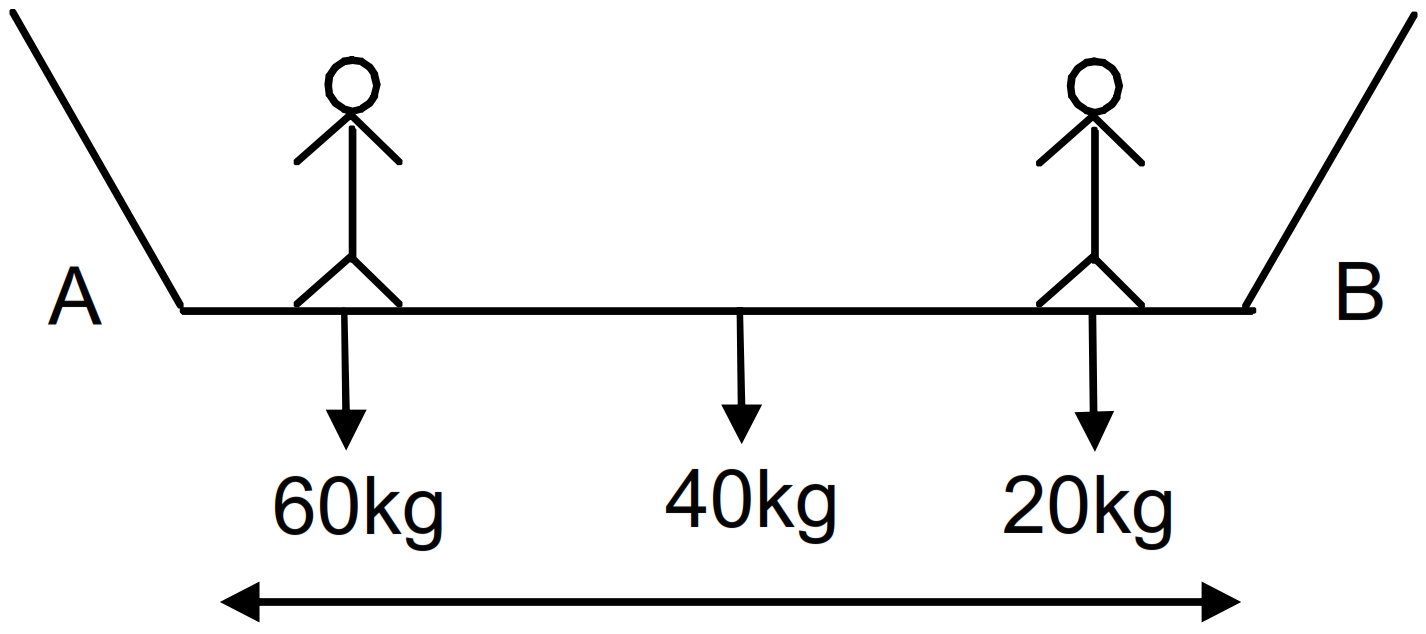
Mr. Verma $(50kg)$ and Mr. Mathur $(60kg)$ are sitting at the two extremes of a $4m$ long boat $(40kg)$ standing still in water. To discuss a mechanics problem, they come to the middle of the boat. Neglecting friction with water, how far does the boat move on the water during the process?
Answer
$m_1 = 60kg, m_2 = 40kg , m_3 = 50kg$, Let A be the origin of the system. Initially Mr. Verma & Mr. Mathur are at extreme position of the boat.
$\therefore$ The centre of mass will be at a distance
$=\frac{60\times0+40\times2+50\times4}{150}=\frac{280}{150}=1.87\text{m}$ from ‘A’

When they come to the mid point of the boat the CM lies at 2m from ‘A’.
$\therefore$ The shift in CM = 2 - 1.87 = 0.13m towards right.
But, as there is no external force in longitudinal direction their CM would not shift. So, the boat moves 0.13m or 13cm towards right.
View full question & answer
Question 94 Marks
The weight Mg of an extended body is generally shown in a diagram to act through the centre of mass. Does it mean that the earth does not attract other particles?
Answer
In order to simplify the situation, we consider that the weight Mg of an extended body acts through its centre of mass.
Although the earth attracts all the particles, the net effect can be assumed to be at the center of mass.
View full question & answer
Question 104 Marks
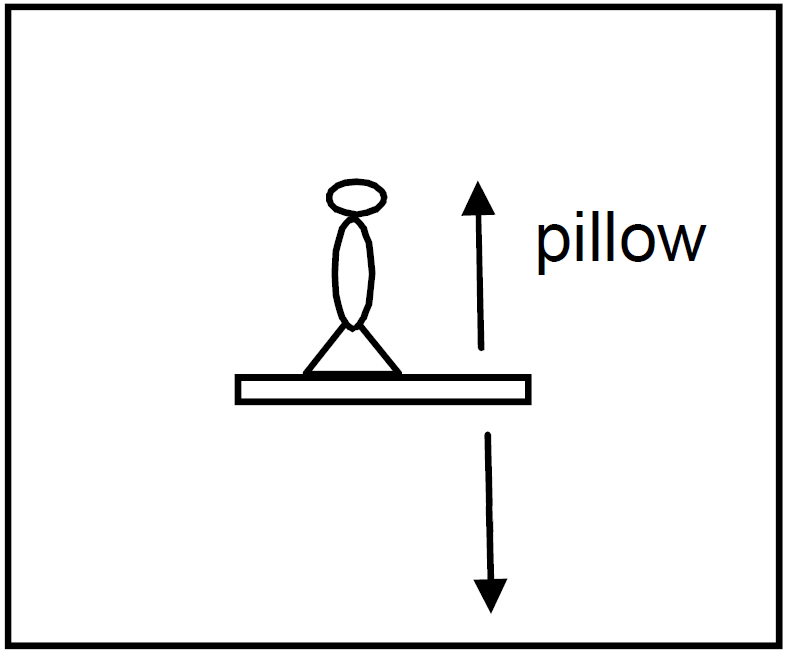
Consider a gravity-free hall in which an experimenter of mass $50kg$ is resting on a $5kg$ pillow, 8ft above the floor of the hall. He pushes the pillow down so that it starts falling at a speed of $8ft/s$. The pillow makes a perfectly elastic collision with the floor, rebounds and reaches the experimenter's head. Find the time elapsed in the process.
Answer
Mass of the man $(M_m)$ is $50kg$. Mass of the pillow $(M_p)$ is $5kg$.

When the pillow is pushed by the man, the pillow will go down while the man goes up. It becomes the external force on the system which is zero. ⇒ Acceleration of centre of mass is zero ⇒ Velocity of centre of mass is constant $\therefore$ As the initial velocity of the system is zero.$\therefore\text{M}_{\text{m}}\times\text{V}_{\text{m}}=\text{M}_{\text{p}}\times\text{V}_{\text{p}}\ \dots(1)$
Given the velocity of pillow is 80ft/s. Which is relative velocity of pillow w.r.t. man.$\overrightarrow{\text{V}}_{\frac{\text{p}}{\text{m}}}=\overrightarrow{\text{V}}_{\text{p}}-\overrightarrow{\text{V}}_{\text{m}}$
$={\text{V}}_{\text{p}}-(-{\text{V}}_{\text{m}})={\text{V}}_{\text{p}}+{\text{V}}_{\text{m}}$
$\Rightarrow{\text{V}}_{\text{p}}=\text{V}_{\frac{\text{p}}{\text{m}}}-\text{V}_\text{m}$
Putting in equation (1)$\text{M}_{\text{m}}\times\text{V}_{\text{m}}=\text{M}_{\text{p}}\Big(\text{V}_{\frac{\text{p}}{\text{m}}}-\text{V}_{\text{m}}\Big)$
$\Rightarrow50\times\text{V}_{\text{m}}=5\times(8-\text{V}_{\text{m}})$
$\Rightarrow10\times\text{V}_{\text{m}}=8-\text{V}_{\text{m}}$
$\Rightarrow\text{V}_{\text{m}}=\frac{8}{11}=0.727\text{m/s}$
$\therefore$ Absolute velocity of pillow = 8 - 0.727 = 7.2ft/sec
$\therefore$ Time taken to reach the floor $=\frac{\text{S}}{\text{v}}=\frac{8}{7.2}=1.1\text{sec}.$
As the mass of wall >>> then pillow The velocity of block before the collision = velocity after the collision. ⇒ Times of ascent = 1.11sec.$\therefore$ Total time taken = 1.11 + 1.11 = 2.22sec
View full question & answer
Case study (4 Marks) - Physics STD 11 Science Questions - Vidyadip