Question
A collision experiment is done on a horizontal table kept in an elevator. Do you expect a change in the results if the elevator is accelerated up or down because of the noninertial character of the frame?

Answer

Velocity and mass are only two components that affect collision between two bodies so in this change in acceleration due to gravity will not affect the collision between two bodies. (if kept horizontally)

Need a full question paper?

Generate a complete, print-ready paper with questions like this in minutes — across 16+ boards, with answer keys.
Start Generating Free

Similar questions

Read the passage given below and answer the following questions from 1 to 5. The impact and deformation during collision may generate heat and sound. Part of the initial kinetic energy is transformed into other forms of energy. A useful way to visualize the deformation during collision is in terms of a ‘compressed spring’. If the ‘spring’ connecting the two masses regains its original shape without loss in energy, then the initial kinetic energy is equal to the final kinetic energy but the kinetic energy during the collision time Δt is not constant. Such a collision is called an elastic collision. On the other hand the deformation may not be relieved and the two bodies could move together after the collision. A collision in which the two particles move together after the collision is called a completely inelastic collision. The intermediate case where the deformation is partly relieved and some of the initial kinetic energy is lost is more common and is appropriately called an inelastic collision. If the initial velocities and final velocities of both the bodies are along the same straight line, then it is called a one-dimensional collision, or head-on collision. When two equal masses undergo a glancing elastic collision with one of them at rest, after the collision, they will move at right angles to each other.
  1. After collision when two particles moves together then collision is:
  1. Elastic collision
  2. Completely inelastic collision
  3. Both a and b
  4. None of these
  1. In elastic collision, loss in kinetic energy is:
  1. Zero
  2. Positive
  3. Negative
  4. None of these
  1. What is head on collision?
  1. What is elastic collision?
  1. What is inelastic collision?
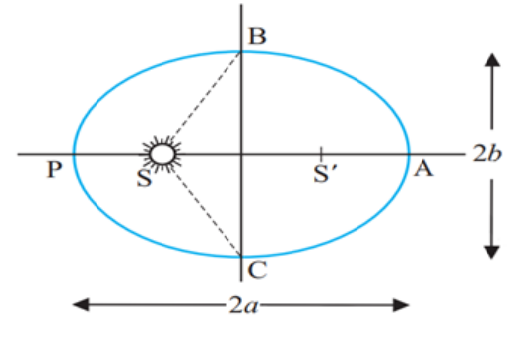
Read the passage given below and answer the following questions from 1 to 5. LAW OF ORBIT: The orbit of every planet is an ellipse around the sun with sun at one of the two foci of ellipse.
LAW OF AREAS: The line that joins a planet to the sun sweeps out equal areas in equal intervals of time. Area covered by the planet while revolving around the sun will be equal in equal intervals of time. This means the rate of change of area with time is constant. LAW OF PERIOD: According to this law the square of time period of a planet is directly proportional to the cube of the semi-major axis of its orbit. Suppose earth is revolving around the sun then the square of the time period (time taken to complete one revolution around sun) is directly proportional to the cube of the semi major axis. It is known as Law of Periods as it is dependent on the time period of planets. Answer the following.
  1. Keplers second law is knows as:
  1. Law of period
  2. Law of area
  3. Law of gravity
  4. None of these
  1. Keplers third law is knows as:
  1. Law of period
  2. Law of area
  3. Law of gravity
  4. None of these
  1. The velocity of a planet is constant throughout its elliptical trajectory in an orbit.
  1. True
  2. False
  3. None of these
  1. State Kepler’s second law of planetary motion.
  1. Two objects of masses $5kg$ and $10 kg$ separated by distance 10m. What is gravitational force between them?
A discharge tube contains helium at low pressure. A large potential difference is applied across the tube. Consider a helium atom that has just been ionised due to the detachment of an atomic electron. Find the ratio of the distance travelled by the free electron to that by the positive ion in a short time dt after ionisation.
You are holding a cage containing a bird. Do you have to make less effort if the bird flies from its position in the cage and manages to stay in the middle without touching the walls of the cage? Does it make a difference whether the cage is completely closed or it has rods to let air pass?
To keep valuable instruments away from the earth's magnetic field, they are enclosed in iron boxes. Explain.
No part of India is situated on the equator. Is it possible to have a geostationary satellite which always remains over New Delhi?
A plumb bob is hung from the ceiling of a train compartment. If the train moves with an acceleration 'a' along a straight horizontal track, the string supporting the bob makes an angle $\tan^{-1}\Big(\frac{\text{a}}{\text{g}}\Big)$ with the normal to the ceiling. Suppose the train moves on an inclined straight track with uniform velocity. If the angle of incline is $\tan^{-1}\Big(\frac{\text{a}}{\text{g}}\Big),$ the string again makes the same angle with the normal to the ceiling. Can a person sitting inside the compartment tell by looking at the plumb line whether the train is accelerated on a horizontal straight track or it is going on an incline? If yes, how? If no, suggest a method to do so.
Read the passage given below and answer the following questions from (i) to (v). Maximum absolute error in the sum or difference of two quantities is equal to sum of the absolute error in the individual quantities, i.e. Z = A + B, then, $\pm\triangle\text{Z}=\pm\triangle\text{A}\pm\text{B}$ Maximum fractional error in a product or division of quantities is equal to the sum of fractional errors in the individual quantities i.e. AB or $\frac{\text{A}}{\text{B}},$ then, $\frac{\triangle\text{Z}}{\text{Z}}=\pm\frac{\triangle\text{A}}{\text{A}}+\frac{\triangle\text{B}}{\text{B}}$ Two resistors of resistances $\text{R}_1=100\pm3\Omega$ are connected (a) in series and (b) in parallel.
  1. The percentage error in the value of $R_1$ is:
  1. 3%
  2. 4%
  3. 6%
  4. 0.3%
  1. The fractional error in the value of $R_2$ is:
  1. $\frac{1}{40}$
  2. $\frac{1}{50}$
  3. $\frac{1}{100}$
  4. $\frac{1}{200}$
  1. Find the equivalent resistance of the series combination.
  1. $(250\pm7)\Omega$
  2. $(320\pm6)\Omega$
  3. $(300\pm7)\Omega$
  4. $(300\pm1)\Omega$
  1. The percentage error in equivalent resistance in series combination is:
  1. 2%
  2. 2.3%
  3. 2.5
  4. 3%
  1. Find the equivalent resistance of the parallel combination having error of $1.8\Omega.$
  1. $(66\pm1)\Omega$
  2. $(66.7\pm1.18)\Omega$
  3. $(66.3\pm2)\Omega$
  4. $(67\pm3)\Omega$
A bird while flying takes a left turn, where does it get the centripetal force from?
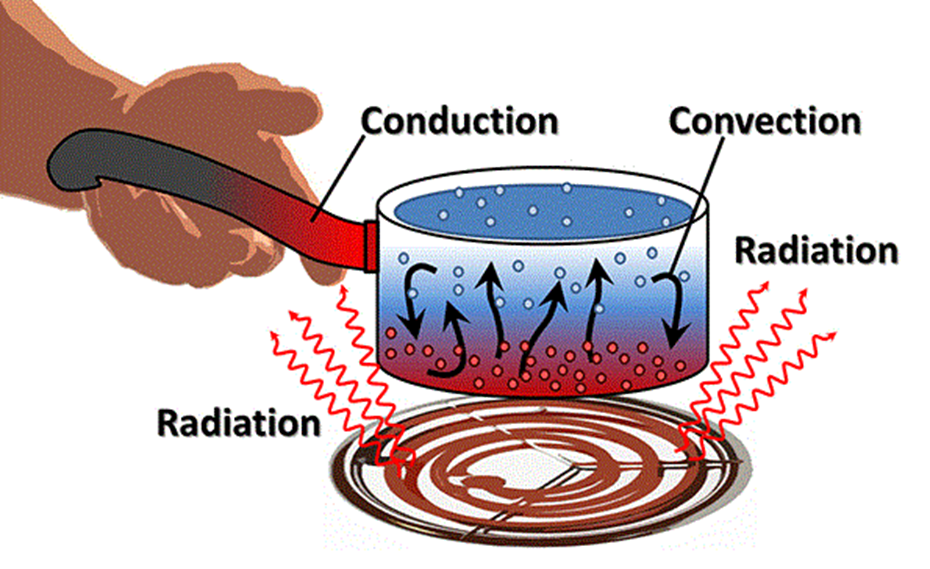
Read the passage given below and answer the following questions from (i) to (v). The figure shows the different modes of transfer of heat, heat transfer is defined as the movement of heat across the border of the system due to a difference in temperature between the system and its surroundings. The temperature difference exists between the two systems, heat will find a way to transfer from the higher to the lower system.
  1. The sea breeze is caused by:
    1. conduction
    2. convection
    3. radiation
    4. none of these
  2. At what factor heat absorbed on radiation by the body depends on?
    1. distance between body
    2. source of heat
    3. its color
    4. all of the above
  3. When heat is transferred by molecular collision, it is referred to as heat transfer by:
    1. convection
    2. conduction
    3. radiation
    4. convection and radiation
  4. Thermal conductivity of air with rise in temperature:
    1. increase
    2. decrease
    3. constant
    4. none of these
  5. Mass transfer does not take place in:
    1. conduction
    2. convection
    3. radiation
    4. none of these