Question 513 Marks
Calculate the temperature at which r.m.s. velocity of a gas molecule is same as that of a molecule of another gas at $47°C$. Molecular weight of first and second gases are $64$ and $32$ respectively.
AnswerAs $\text{P}=\frac{1}{3}\frac{\text{M}_{\text{m}}}{\text{V}}\text{v}^2_{\text{rms}}$ or $\text{PV}=\frac{1}{2}\text{M}_{\text{m}}\text{v}^2_{\text{rms}}$ or $\text{RT}=\frac{1}3{}\text{M}_{\text{m}}\text{v}^2_{\text{rms}}$ or $\frac{\text{M}_{\text{m}}\text{v}^2_{\text{rms}}}{\text{T}}=3\text{R}=\text{Constant}$ If $(\text{M}_{\text{m}})_1$ and $(\text{M}_{\text{m}})_2$ be the molecular weights of the two gases, $\text{v}_{\text{rms}}=\text{C}^2_1\text{ and }\text{C}^2_2,$ the mean square velocities of two gases and $T_1$ and $T_2$ are the absolute temperatures of the two gases, then$\frac{(\text{M}_{\text{m}})_1\text{C}^2_1}{\text{T}_1}=\frac{(\text{M}_{\text{m}})_2\text{C}^2_2}{\text{T}_2}$
According to the given problem$\sqrt{\text{C}^2_1}=\sqrt{\text{C}^2_2}$ or $\text{C}^2_1=\text{C}^2_2$
$\therefore\frac{(\text{M}_{\text{m}})_1}{\text{T}_1}=\frac{(\text{M}_\text{m})_2}{\text{T}_2}$ or $\frac{64}{\text{T}_1}=\frac{32}{320}$ $[\because\text{T}_2=47^{\circ}\text{C}=320\text{K}]$
$\text{T}_1=640^{\circ}=267^{\circ}\text{C}$
View full question & answer→Question 523 Marks
A vessel is filled with a gas at a pressure of $76cm$ of Hg at a certain temperature. The mass of the gas is increased by $50\%$ by introducing more gas in the vessel at the same temperature. Find out the resultant pressure of the gas.
AnswerAccording to kinetic theory of gases, the pressure exerted by a gas is$\text{P}=\frac{1}{3}\rho\text{c}^2=\frac{1}{3}\frac{\text{M}}{\text{V}}\text{c}^2$
As temperature T is kept constant, therefore, $c^2$ is constant. Also, V is constant.
$\therefore\text{P}\propto\text{M}$ or $\frac{{\text{P}_2}}{\text{P}_1}=\frac{\text{M}_2}{\text{M}_1}$
$\frac{\text{P}_2}{76}=\frac{\Big(\text{M}_1+\frac{50}{100}\text{M}_1\Big)}{\text{M}_1}=\frac{3}{2}$
$\text{P}_2=\frac{3}{2}\times76=144\text{cm}$ of mercury (Hg).
View full question & answer→Question 533 Marks
Estimate the total number of air molecules (inclusive of oxygen, nitrogen, water vapour and other constituents) in a room of capacity $25.0m^3$ at a temperature of $27°C$ and $1$ atm pressure.
AnswerVolume of the room, $\mathrm{V}=25.0 \mathrm{~m}^3$ Temperature of the room, $\mathrm{T}=27^{\circ} \mathrm{C}=300 \mathrm{~K}$ Pressure in the room, $\mathrm{P}=1 \mathrm{~atm}=1 \times$ $1.013 \times 10^5 \mathrm{~Pa}$ The ideal gas equation relating pressure $(\mathrm{P})$, Volume $(\mathrm{V})$, and absolute temperature $(\mathrm{T})$ can be written as, $\mathrm{PV}=\mathrm{k}_{\mathrm{B}} \mathrm{NT}$ Where, $\mathrm{K}_{\mathrm{B}}$ is Boltzmann constant $=1.38 \times 10^{-23} \mathrm{~m}^2 \mathrm{~kg} \mathrm{~s}^{-2} \mathrm{k}^{-1} \mathrm{~N}$ is the number of air molecules in the room. $\therefore \mathrm{N}=\frac{\mathrm{PV}}{\mathrm{K}_{\mathrm{B}} \mathrm{T}}$
$=\frac{1.013 \times 10^5 \times 25}{\left(1.38 \times 10^{23} \times 300\right)}$
$=6.11 \times 10^{26}$ molecules Therefore, the total number of air molecules in the given room is $6.11 \times 10^{26}$
View full question & answer→Question 543 Marks
Calculate (i) r.m.s. velocity and (ii) mean kinetic energy of one gram molecule of hydrogen at S.T.P. Given density of hydrogen at S.T.P. is $0.09kg-m^{-3}$.
AnswerHere, $\rho=0.09\text{kg-m}^{-3}$ At S.T.P., pressure $\text{P}=1.01\times10^5\text{Pa}$ According to kinetic theory of gases.$\text{P}=\frac{1}{3}\rho\text{C}^2$
$\text{C}=\sqrt{\frac{3\text{P}}{\rho}}$
$=\sqrt{\frac{3\times1.01\times10^5}{0.09}}=1837.5\text{ms}^{-1}$
Volume occupied by one mole of hydrogen at $S.T.P. = 22.4 liters = 22.4 \times 10^{-3} m^3$
$\therefore$ Mass of hydrogen, M = volume x density
$= 22.4 × 10^{-3} × 0.09$
$= 2.016 × 10^{-3}\text{kg}$
Average K.E./ mole $=\frac{1}2{}\text{MC}^2$$=\frac{1}{2}\times(2.016\times10^{-3})\\\times(1837.5)^2=3403.4\text{J}$
View full question & answer→Question 553 Marks
Three moles of a diatomic gas is mixed with two moles of monoatomic gas. What will be the molecular specific heat of the mixture at constant volume? [given, $R = 8.31J-mol^{-1}K^{-1}$]
AnswerFor a monoatomic gas, i e. $\gamma=\frac{5}{3}$$\text{C}_{\text{V}_{\gamma}}=\frac{\text{R}}{\gamma-1}=\frac{\text{R}}{\frac{5}{3}-1}=\frac{3}{2}\text{R}$
For a diatomic gas, i.e. $\gamma=\frac{7}{5}$$\text{C}_{\text{V}}=\frac{\text{R}}{\frac{7}{5}-1}=\frac{5}{2}\text{R}$
By conservation of energy,$\text{C}_{\text{V}_{\text{mixture}}}=\frac{\mu_1\text{C}_{\text{V}_1}+\mu_2\text{C}_{\text{V}_2}}{\mu_1+\mu_2}$
$=\frac{2\times\frac{3}{2}\text{R}+3\times\frac{5}{2}\text{R}}{2+3}$
$=\frac{3\text{R}+7.5\text{R}}{5}=2.1\text{R}$
View full question & answer→Question 563 Marks
An electric bulb of volume $250cm^3$ was sealed off during manufacture at a pressure of $10^{-3} mm$ of Hg at $27^\circ C$. Find the number of air molecules in the bulb.
AnswerLet N be the number of air molecules in the bulb. It is given that $\mathrm{P}=10^{-3} \mathrm{~mm}$ of $\mathrm{Hg}=10^{-4} \mathrm{~cm}$ of $\mathrm{Hg} \mathrm{V}=250 \mathrm{~cm}^3 \mathrm{~T}=$ $273+27=300 \mathrm{~K}$ Now PV $=$ NkT We know that at STP, one mole of a gas occupies a volume $\mathrm{V}_0=22400 \mathrm{~cm}^3$ and contains $\mathrm{N}_0=6.02 \times 10^{23}$ molecules ( $\mathrm{N}_0$ is the Avogadro's number) and the pressure $\mathrm{P}_0=76 \mathrm{~cm}$ of Hg and $T_0=$ 273K. Also $\mathrm{P}_0 \mathrm{~V}_0=\mathrm{N}_0 \mathrm{~K} T_0 \ldots$ (ii) Dividing eqn. (i) and (ii), we getN $=\mathrm{N}_0 \times \frac{\mathrm{T}_0}{\mathrm{~T}} \times \frac{\mathrm{P}}{\mathrm{P}_0} \times \frac{\mathrm{V}}{\mathrm{V}_0}$
$=(6.02\times10^{23})\times\Big(\frac{273}{300}\Big)\\\times\Big(\frac{10^{-4}}{76}\Big)\times\Big(\frac{250}{22400}\Big)$
$=8.045\times10^{15}\text{molecules.}$
View full question & answer→Question 573 Marks
Explain why. There is fall in temperature with increase in altitude.
AnswerThe temperature of atmosphere is due to the kinetic energy of air molecule. Due to lower atmospheric pressure at higher altitude molecules of air rises up so their potential energy increase in turn the kinetic energy decrease results the decrease in temperature. Due to lower atmospheric pressure at higher altitude the gas expands and gives cooling effect and so decrease the temperature.
View full question & answer→Question 583 Marks
State ideal gas equation. Draw graph to check whether a real gas obeys this equation. What is the conclusion drawn?
AnswerAccording to the ideal gas equation, we have PV $=\pi\text{RT}$
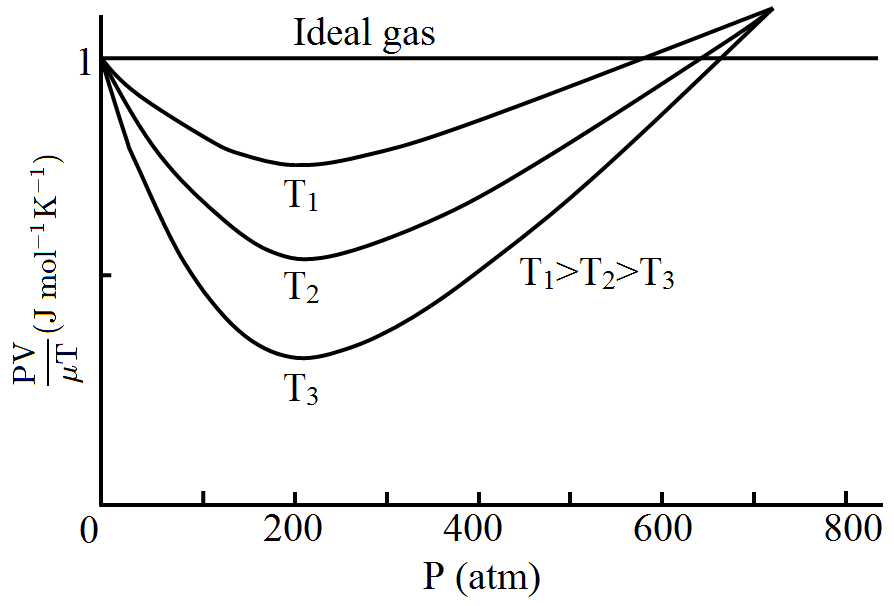
Thus, according to this equation $\frac{\text{PV}}{\pi\text{T}}=\text{R}$ i.e., value of $\frac{\text{PV}}{\pi\text{T}}$ must be a constant having a value $8.31J-mol^{-1}K^{-1}$. Experimentally value of $\frac{\text{PV}}{\pi\text{T}}$ for real gases was calculated by altering the pressure of gas at different temperatures. The graphs obtained have been shown in the figure. Here, for the purpose of comparison, graph for an ideal gas has also been drawn, which is a straight line parallel to pressure axis. From the graphs it is clear that behaviour of real gases differ from an ideal gas. However, at high temperatures and low pressures behaviour is nearly same as that of an ideal gas. View full question & answer→Question 593 Marks
Find the kinetic energy of $1g$ of nitrogen gas at $77°C$. Given, $R = 8.31J-mol^{-1}K^{-1}$.
AnswerFor, nitrogen, $M = 28 T = 77 + 273 = 350K R = 8.31J-mol^{-1}K^{-1} K.E$. of $1g$ of nitrogen$=\frac{3}{2}\frac{\text{RT}}{\text{M}}=\frac{3\times8.31\times350}{2\times50}=155.8\text{J}$
View full question & answer→Question 603 Marks
The condition of air in a cloeed room is described as follows. Temperature $=25^{\circ} \mathrm{C}$, relative humidity $=60 \%$, pressure $=104 \mathrm{kPa}$. If all the water vapour is removed from the room without changing the temperature, what will be the new pressure? The saturation vapour pressure at $25^{\circ} \mathrm{C}=3.2 \mathrm{kPa}$.
Answer$\mathrm{T}=25^{\circ} \mathrm{CP}=104 \mathrm{KPaRH}=\frac{\mathrm{VP}}{\mathrm{SVP}}[\mathrm{SVP}=3.2 \mathrm{KPa}, \mathrm{RH}=0.6]$
$\mathrm{VP}=0.6 \times 3.2 \times 10^3=1.92 \times 10^3 \approx 2 \times 10^3$
When vapours are removed VP reduces to zero Net pressure inside the room now $=104 \times 10^3-2 \times 10^3=102 \times 10^3$ $=102 \mathrm{KPa}$.
View full question & answer→Question 613 Marks
Molar volume is the volume occupied by $1$ mol of any (ideal) gas at standard temperature and pressure: (STP: 1 atmospheric pressure, $0^\circ C$). Show that it is 22.4 litres.
AnswerThe ideal gas equation relating pressure (P), volume (V), and absolute temperature (T) is given as: PV = nRT Where, R is the universal gas constant = $8.314J mol^{-1}K^{-1}$ n = Number of moles = 1 T = Standard temperature = 273K P = Standard pressure $= 1atm = 1.013 \times 10^5Nm^{-2}$
$\therefore\ \text {V}=\frac{\text{nRT}}{\text{P}}$
$=\frac{1\times8.314\times273}{(1.013\times10^{5})}$
$= 0.0224m^3 = 22.4$ litres Hence, the molar volume of a gas at STP is 22.4 litres.
View full question & answer→Question 623 Marks
The temperature and the relative humidity are $300K$ and $20\%$ in a room of volume $50m^3$. The floor is washed with water, $500g$ of water sticking on the floor. Assuming no communication with the surrounding, find the relative humidity when the floor dries. The changes in temperature and pressure may be neglected. Saturation vapour pressure at $300K = 3.3kPa$.
Answer$\text{RH}=\frac{\text{VP}}{\text{SVP}}\Rightarrow0.20=\frac{\text{VP}}{303\times10^3}$$\Rightarrow\text{VP}=0.2\times3.3\times10^3=660$
$\text{PV}=\text{nRT}\Rightarrow\text{P}=\frac{\text{nRT}}{\text{V}}=\frac{\text{m}}{\text{M}}\times\frac{\text{RT}}{\text{V}}$
$=\frac{500}{18}\times\frac{8.3\times300}{50}=1383.3$
Net, $\text{P}=1383.3+660=2043.3$
Now, $\text{RH}=\frac{2034.3}{3300}=0.619\approx62\%$
View full question & answer→Question 633 Marks
Prove that the average kinetic energy of a molecule of an ideal gas is directly proportional to the absolute temperature of the gas.
AnswerPressure, $\text{P}=\frac{1}{3}\frac{\text{nmc}^2}{\text{V}}$ Multiplying and dividing the right side by 2,$\text{PV}=\frac{2}{3}\frac{1}{2}\text{nmc}^2=\frac{2}{3}\text{E}$
where E is the average kinetic energy. Also, PV = RT for 1 mole of a gas$\therefore\text{RT}=\frac{2}{3}\text{E}$
$\therefore$ Kinetic energy (average) is directly proportional to the absolute temperature.
View full question & answer→Question 643 Marks
What do you mean by the rms speed of the molecules of the gas? Is rms speed same as the average speed at given temperature?
AnswerThe square root of the mean of the squares of the random velocities of individual molecules of a gas is called rms speed of the molecules of the gas. R.M.S. speed of the molecules of the gas.$\text{r}_{\text{ms}}=\sqrt{\frac{\text{c}^2_1+\text{c}^2_2+...+\text{c}^2_{\text{n}}}{\text{n}}}=\sqrt{\frac{3\text{K}_{\text{B}}\text{T}}{\text{m}}}$
where n = number of molecules of the gas, m = mass of each molecule $K_B$ = Boltzmann constant, T = absolute temperature Average speed is the speed with which a molecule of the gas moves.$\text{c}_{\text{av}}=\frac{\text{c}_1+\text{c}_2+...+\text{c}_{\text{n}}}{\text{n}}=\sqrt{\frac{8\text{K}_{\text{B}}\text{T}}{\text{m}\pi}}$
where m is the mass of each molecule.
View full question & answer→Question 653 Marks
The volume of air bubble increases $15$ times when it rises from bottom to the top of a lake. Calculate the depth of the lake if density of lake water is $1.02 \times 10^3 \mathrm{~kg} / \mathrm{m}^3$ and atmospheric pressure is $75$ cm of mercury.
AnswerAccording to Boyle's law, $\mathrm{P}_1 \mathrm{~V}_1=\mathrm{P}_2 \mathrm{~V}_2 \ldots$ (1) Here $\mathrm{P}_1=75 \mathrm{~cm}$ of $\mathrm{Hg}=75 \mathrm{~m}$ of $\mathrm{Hg}=0.75 \times 13.6 \times 10^3 \times 9.8=99.96 \times$ $10^3 \mathrm{Nm}^{-2}$ Let volume of bubble at depth $\mathrm{h}=\mathrm{x}$ i.e., $\mathrm{V}_2=\mathrm{x} \therefore \mathrm{V}_1=16 \times \mathrm{P}_2=75 \mathrm{~cm}$ of $\mathrm{Hg}+\mathrm{hp}_{\text {water }} \mathrm{g}=99.96 \times 10^3+\mathrm{h}$ $\times 10^3 \times 9.8$ Using eqn. (1), we get $99.96 \times 10^3 \times 16 \mathrm{x}=\left(99.96 \times 10^3+\mathrm{h} \times 10^3 \times 9.8\right) \times 9.8 \mathrm{~h}=99.96 \times 16-99.96=$ $99.96 \times 15 . \therefore \mathrm{h}=\frac{99.96 \times 15}{9.8}=153 \mathrm{~m}$
View full question & answer→Question 663 Marks
Two perfect gases at absolute temperatures $T_1$ and $T_2$ are mixed. There is no loss of energy. Find the temperature of the mixture if the masses of the molecules are $m_1$ and $m_2$ and the number of the molecules in the gases are $n_1$ and $n_2$ respectively.
AnswerAccording to kinetic theory, the average kinetic energy per molecule of a gas $=\frac{3}{2}\text{k}_{\text{B}}\text{T}$ Before mixing, the two gases, the average K.E. of all the molecules of two gases$=\frac{3}{2}\text{k}_{\text{B}}\text{n}_1\text{T}_1+\frac{3}{2}\text{k}_{\text{B}}\text{n}_2\text{T}_2$
After mixing, the average K.E. of both the gases $=\frac{3}2{}\text{k}_{\text{B}}(\text{n}_1+\text{n}_2)\text{T}$ where T is the temperature of mixture. Since there is no loss of energy, Hence, $\frac{3}{2}\text{k}_{\text{B}}(\text{n}_1+\text{n}_2)\text{T}$$=\frac{3}{2}\text{k}_{\text{B}}\text{n}_1\text{T}_1+\frac{3}2{}\text{k}_{\text{B}}\text{n}_2\text{T}_2$
$\text{T}=\frac{\text{n}_1\text{T}_1+\text{n}_2\text{T}_2}{(\text{n}_1+\text{n}_2)}$
View full question & answer→Question 673 Marks
Uranium has two isotopes of masses 235 and 238 units. If both are present in Uranium hexafluoride gas which would have the larger average speed ? If atomic mass of fluorine is 19 units, estimate the percentage difference in speeds at any temperature.
AnswerAt a fixed temperature the average energy $=1 / 2 m\left\langle v^2\right\rangle$ is constant. So smaller the mass of the molecule, faster will be the speed. The ratio of speeds is inversely proportional to the square root of the ratio of the masses. The masses are 349 and 352 units. So
$
v_{349} / v_{352}=(352 / 349)^{1 / 2}=1.0044 .
$
Hence difference $\frac{\Delta V}{V}=0.44 \%$.
$\left[{ }^{235} U\right.$ is the isotope needed for nuclear fission. To separate it from the more abundant isotope ${ }^{238} U$, the mixture is surrounded by a porous cylinder. The porous cylinder must be thick and narrow, so that the molecule wanders through individually, colliding with the walls of the long pore. The faster molecule will leak out more than the slower one and so there is more of the lighter molecule (enrichment) outside the porous cylinder (Fig. 12.5). The method is not very efficient and has to be repeated several times for sufficient enrichment.].
View full question & answer→Question 683 Marks
A flask contains argon and chlorine in the ratio of $2: 1$ by mass. The temperature of the mixture is $27 C$. Obtain the ratio of (i) average kinetic energy per molecule, and (ii) root mean square speed $V_{\text {rms }}$ of the molecules of the two gases. Atomic mass of argon $=39.9 u$; Molecular mass of chlorine $=70.9 u$.
AnswerThe important point to remember is that the average kinetic energy (per molecule) of any (ideal) gas (be it monatomic like argon, diatomic like chlorine or polyatomic) is always equal to $(3 / 2) k_B T$. It depends only on temperature, and is independent of the nature of the gas.
(i) Since argon and chlorine both have the same temperature in the flask, the ratio of average kinetic energy (per molecule) of the two gases is $1: 1$.
(ii) Now $1 / 2 m v_{ rms }^2=$ average kinetic energy per molecule $=(3 / 2)) k_{ B } T$ where $m$ is the mass of a molecule of the gas. Therefore,
$
\frac{\left( v _{r m s}^2\right)_{ Ar }}{\left( v _{r m s}^2\right)_{ Cl }}=\frac{(m)_{ Cl }}{(m)_{ Ar }}=\frac{(M)_{ Cl }}{(M)_{ Ar }}=\frac{70.9}{39.9}=1.77
$
where $M$ denotes the molecular mass of the gas. (For argon, a molecule is just an atom of argon.) Taking square root of both sides,
$
\frac{\left( v _{r m s}\right)_{ Ar }}{\left( v _{r m s}\right)_{ Cl }}=1.33
$
You should note that the composition of the mixture by mass is quite irrelevant to the above calculation. Any other proportion by mass of argon and chlorine would give the same answers to (i) and (ii), provided the temperature remains unaltered.
View full question & answer→Question 693 Marks
A vessel contains two nonreactive gases : neon $($monatomic$)$ and oxygen $($diatomic$).$ The ratio of their partial pressures is $3:2.$ Estimate the ratio of $(i)$ number of molecules and $(ii)$ mass density of neon and oxygen in the vessel. Atomic mass of $Ne = 20.2 u,$ molecular mass of $O_2= 32.0 u.$
AnswerPartial pressure of a gas in a mixture is the pressure it would have for the same volume and temperature if it alone occupied the vessel. $($The total pressure of a mixture of non-reactive gases is the sum of partial pressures due to its constituent gases.$)$ Each gas (assumed ideal) obeys the gas law. Since $V$ and $T$ are common to the two gases,
we have $P_1 V=\mu_1 R T$ and $P_2 V= \mu_2 R T$,
i.e. $\left(P_1 / P_2\right)=\left(\mu_1 / \mu_2\right)$.
Here $1$ and $2$ refer to neon and oxygen respectively.
Since $\left(P_1 / P_2\right)=$ $(3/2) ($given$)$, $\left(\mu_1 / \mu_2\right)=3 / 2$.
$(i)$ By definition $\mu_1=\left(N_1 / N_{ A }\right)$ and $\mu_2=\left(N_2 / N_{ A }\right)$
where $N_1$ and $N_2$ are the number of molecules of $1$ and $2 $, and $N_{ A }$ is the Avogadro's number.
Therefore, $\left(N_1 / N_2\right)=\left(\mu_1 / \mu_2\right)=3 / 2$.
$(ii)$ We can also write $\mu_1=\left(m_1 / M_1\right)$ and $\mu_2=$
$\left(m_2 / M_2\right)$ where $m_1$ and $m_2$ are the masses of $1$ and $2;$ and $M_1$ and $M_2$ are their molecular masses. $($Both $m_1$ and $M_1$; as well as $m_2$ and $M_2$ should be expressed in the same units$).$
If $\rho_1$ and $\rho_2$ are the mass densities of $1$ and $2$ respectively, we have
$\frac{\rho_1}{\rho_2}=\frac{m_1 / V}{m_2 / V}=\frac{m_1}{m_2}=\frac{\mu_1}{\mu_2} \times\left(\frac{M_1}{M_2}\right)$
$=\frac{3}{2} \times \frac{20.2}{32.0}=0.947$
View full question & answer→Question 703 Marks
The density of water is 1000 $kg m ^{-3}$. The density of water vapour at $100^{\circ} C$ and $1 atm$ pressure is $0.6 kg m ^{-3}$. The volume of a molecule multiplied by the total number gives , what is called, molecular volume. The ratio (or fraction) of the molecular volume to the total volume occupied by the water vapour under the above conditions of temperature and pressure is $6 \times 10^{-4}$. Estimate the volume of a water molecule using this data.
AnswerIn the liquid (or solid) phase, the molecules of water are quite closely packed. The density of water molecule may therefore, be regarded as roughly equal to the density of bulk water $=1000 kg m ^{-3}$. To estimate the volume of a water molecule, we need to know the mass of a single water molecule. We know that 1 mole of water has a mass approximately equal to
$
(2+16) g =18 g =0.018 kg \text {. }
$
Since 1 mole contains about $6 \times 10^{23}$ molecules (Avogadro's number), the mass of a molecule of water is $(0.018) /\left(6 \times 10^{23}\right) kg =$ $3 \times 10^{-26} kg$. Therefore, a rough estimate of the volume of a water molecule is as follows :
Volume of a water molecule
$=\left(3 \times 10^{-26} kg \right) /\left(1000 kg m ^{-3}\right)$
$=3 \times 10^{-29} m ^3$
$=(4 / 3) \pi$ (Radius $^3$
Hence, Radius $\approx 2 \times 10^{-10} m =2 \mathring A$
View full question & answer→