Questions

M.C.Q (1 Marks)

🎯

Test yourself on this topic

15 questions · timed · auto-graded

MCQ 11 Mark
Two billiard balls $A$ and $B,$ each of mass $50g$ and moving in opposite directions with speed of $5m s^{–1}$ each, collide and rebound with the same speed. If the collision lasts for $10^{–3}s$, which of the following statements are true?
  • A
    The impulse imparted to each ball is $0.25\ kg m s^{–1}$ and the force on each ball is $250N.$
  • B
    The impulse and the force on each ball are equal in magnitude and opposite in direction.
  • C
    The impulse imparted to each ball is $0.5Ns.$
  • Both $B$ and $C$
Answer
Correct option: D.
Both $B$ and $C$
Mass of each ball, $m = 0.005\ kg$
speed fo each ball $v= 5m/ s$
$\vec{\text{p}}_\text{t}= (0.005)(5)$
$=0.25\text{kg}\ \text{ms}^{-1}$
$= 0.25N-s (1)$
As after collision, the direction of the velocity of each ball is reversed on rebounding.
$\therefore$ Final momentum of each ball $\vec{\text{p}}=\text{m}(-\vec{\text{v}})$
$\vec{\text{p}}_\text{f}=0.005\times(-5)$
$=0.25\text{kg}\ \text{ms}^{-1}$
$=-0.25\ \text{N}-\text{s}$
Eqns $(1)$ and $(2)$ verifoes option$(d).$
$\therefore$ Impulse imparted to each ball $=$ change in momentam of each ball
$= \text{p}_\text{f}-\text{p}_\text{t}$
$=-0.25-(0.25)$
$=-0.50\text{kg}\ \text{ms}^{-1}$
$=-0.50\ \text{N-s}$
Euation $(3)$ verifies option $(c).$
i.e., the magnitude of impulse imparted by one ball due to collsion with the other ball $=0.50 \ kg ms ^{-5}$. these two impulse are opposite to each other.
View full question & answer
MCQ 21 Mark
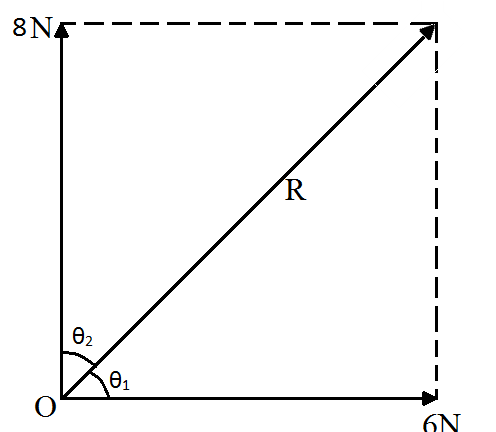
A body of mass $10\ kg$ is acted upon by two perpendicular forces, $6N$ and $8N$. The resultant acceleration of the body is:
  • A
    $1ms^{–2}$ at an angle of $14 \tan^{-1}\Big(\frac{4}{3}\Big)$ w.r.t. $6N$ force.
  • B
    $0.2ms^{–2}$ at an angle of $\tan^{-1}\Big(\frac{4}{3}\Big)$ w.r.t. $6N$ force.
  • C
    $1ms^{–2}$ at an angle of $\tan^{-1}\Big(\frac{4}{3}\Big)$ w.r.t. $8N$ force.
  • Both $A$ and $C$
Answer
Correct option: D.
Both $A$ and $C$

$\text{R}=\sqrt{8^2+6^2}=\sqrt{64+36}=\sqrt{100}$
$\text{R}=10\ \text{N}$
$\text{F}=\text{ma}\Rightarrow\alpha=\frac{\text{F}}{\text{m}}=\frac{\text{R}}{\text{m}}=\frac{10}{10}=1\text{ms}-2\ ...(\text{i})$
$\tan\theta_1=\frac{8}{6}=\frac{4}{3}\Rightarrow\theta_1=\tan^{-1}\Big(\frac{4}{3}\Big)\ ...(\text{ii})$
$\tan\theta_2=\frac{6}{8}=\frac{3}{4}\Rightarrow\theta_2=\tan^{-1}\Big(\frac{3}{4}\Big)\ ...(\text{iii})$
$(i),(ii)$ verifies option $(a)$ and $(i),(iii)$ verifies option $(c).$
Acceleration $\alpha \not=0.2\ \text{ms}^{-2},$ rejects the option $(b)$ and $(d).$
View full question & answer
MCQ 31 Mark
A metre scale is moving with uniform velocity. This implies:
  • A
    The force acting on the scale is zero, but a torque about the centre of mass can act on the scale.
  • The force acting on the scale is zero and the torque acting about centre of mass of the scale is also zero.
  • C
    The total force acting on it need not be zero but the torque on it is zero.
  • D
    Neither the force nor the torque need to be zero.
Answer
Correct option: B.
The force acting on the scale is zero and the torque acting about centre of mass of the scale is also zero.
Key concept: To solve these types of problem we have to apply Newton’s second law of motion! Newton’s Second Law of Motion
According to this law: The rate of change of linear momentum of a body is directly proportional to the external force applied on the body and this change takes place always in the direction of the force applied.
View full question & answer
MCQ 41 Mark
A ball is travelling with uniform translatory motion. This means that:
  • A
    It is at rest.
  • B
    The path can be a straight line or circular and the ball travels with uniform speed.
  • All parts of the ball have the same velocity (magnitude and direction) and the velocity is constant.
  • D
    The centre of the ball moves with constant velocity and the ball spins about its centre uniformly.
Answer
Correct option: C.
All parts of the ball have the same velocity (magnitude and direction) and the velocity is constant.
If all the particles of the body move with the same velocity in same straight line, then the motion is called uniform motion or uniform translatory motion.
View full question & answer
MCQ 51 Mark
In the previous problem $(5.3),$ the magnitude of the momentum transferred during the hit is:
  • A
    Zero
  • B
    $0.75 \mathrm{~kg} \mathrm{~m} \mathrm{~s}^{-1}$
  • $1.5 \mathrm{~kg} \mathrm{~m} \mathrm{~s}^{-1}$
  • D
    $14 \mathrm{~kg} \mathrm{~m} \mathrm{~s}^{-1}$
Answer
Correct option: C.
$1.5 \mathrm{~kg} \mathrm{~m} \mathrm{~s}^{-1}$
$\Delta\overrightarrow{\text{p}}=-(0.9\hat{\text{i}}+1.2\hat{\text{j}})$
Magnitude $\Big|\Delta\overrightarrow{\text{p}}\Big|$
$=\sqrt{(0.9)^2+(1.2)^2}$
$=\sqrt{0.81+1.44}$
$=\sqrt{2.25}$
$=1.5\text{kg}\ \text{m s}^{-1}$
View full question & answer
MCQ 61 Mark
The motion of a particle of mass $m$ is given by $\text{x}=0$ for $\text{t} < 0\ \text{s},$
$\text{x}(\text{t})=\text{A}\sin4\text{p}\ \text{t}$ for $0<\text{t}<(1/ 4)\ \text{s}(\text{A}>\text{o}),$ and $\text{x}=0$ for $\text{t}>(1/4)\ \text{s}.$ Which of the following statements is true?
  • A
    The force at $t = (1/8) s$ on the particle is $–16\pi^2 \text{A m.}$
  • B
    The particle is acted upon by on impulse of magnitude $4\pi ^2\text{A m}$ at $\text{t} = 0 s$ and $t = (1/4) s.$
  • C
    The particle is not acted upon by a constant force.
  • All of the above
Answer
Correct option: D.
All of the above
For different time intervals position of the particle is given. Hence, we have to find velocity and acceleration corresponding to the intervals.
Givan, $x = 0$ ; for $t < 0 s.$
$\text{x}\text({t})=\text{A}\sin4\pi\text{t};$ For $0<\text{t}<\frac{1}{4}\text{s}$
By differentiating this equation $\text{W.R.T}$. time, we get velocity of the particle as function of time.
For, $0<\text{t}<\frac{1}{4}\text{s},$ $\text{v}(\text{t})=\frac{\text{dx}}{\text{dt}}=4\pi\text{A}\cos4\pi\text{t}$
If we again Differntiate this eqation w.r.t. time we well get acceleration the particle as a function of time $($at a particular time$).$
$\text{a(t)}=\frac{\text{dv(t)}}{\text{dt}}=-16\pi^2\text{A}\sin4\pi\text{t}$
At $\text{t}=\frac{1}{8}\text{s}.\text{a(t)}=-16\pi^2\text{A}\sin4\pi\times\frac{1}{8}=-16\pi^2\text{A}$
$\text{F}=\text{m}[\text{a(t)}]=-16\pi^2\text{A}\times\text{m}=-16\pi^2\text{mA}$
Hence option $(a)$ is correct.
Impulse $=$ change in linear momentum
$=\text{F}\times\text{t}=(-16\pi^2\text{Am})\times\frac{1}{4}=-4\pi^2\text{Am}$
The impulse $($Change in linear momentum$)$ at $t = 0$ is same as $\text{t}=\frac{1}{4}\text{s}.$
Hence, option $(b)$ is correct.
We know that, force depends upon acceleration and which is not constant here.
Hence, force is also not constant.
Hence, option $(d)$ is correct.
Important point: We have to keep in mind that the force is varying for different time intervals. Hence, we should apply differential formulae for each interval separately.
View full question & answer
MCQ 71 Mark
Conservation of momentum in a collision between particles can be understood from:
  • A
    Conservation of energy.
  • B
    Newton’s first law only.
  • C
    Newton’s second law only.
  • Both Newton’s second and third law.
Answer
Correct option: D.
Both Newton’s second and third law.
By newton's second law $\frac{\vec{\text{dp}}}{\text{dt}}=\vec{\text{f}}_\text{ext}$
As $\vec{\text{F}}_\text{ext}$ on law of conservation of momentam is zero.
$\text{i.e},\vec{\text{f}}_\text{ext}=0$
$\frac{\vec{\text{dp}}}{\text{dt}}=0$
$\Rightarrow\vec{\text{p}}$ is constant.
By netton's third law action force is equal to reaction force in magnitude but in opposite direction.
$\therefore\vec{\text{F}}_12=-\vec{\text{F}}_21(\vec{\text{F}_\text{ext}}=0)$
$\frac{\vec{\text{dp}_{12}}}{\text{dt}}=\frac{\vec{\text{- dp}_{21}}}{\text{dt}}$ or $\vec{\text{dp}_{12}}=-\vec{\text{dp}_{21}}$
$\vec{\text{dp}}_{12}+\vec{\text{dp}_{21}}=0.$
View full question & answer
MCQ 81 Mark
A body with mass 5kg is acted upon by a force $\text{F}=(-3\hat{\text{i}}+4\hat{\text{j}})\text{N.}$ If its initial velocity at t = 0 is $\text{v}=(6\hat{\text{i}}-12\hat{\text{j}})\text{m s}^{-1},$ the time at which it will just have a velocity along the y-axis is:
  • A
    never
  • 10s
  • C
    2s
  • D
    15s
Answer
Correct option: B.
10s
According to the problam, mass m = 5kg
Force which is acting uppon the block $\vec{\text{F}}=(-3\hat{\text{i}}+4\hat{\text{j}})\text{N}$
Inital velocity at $\text{t}=0,\ \vec{\text{u}}=(6\vec{\text{i}}-12\vec{\text{j}})\text{m/s}$
Retardation, $\vec{\text{a}}=\frac{\vec{\text{F}}}{\text{m}}=\Big(-\frac{3\vec{\text{i}}}{5}+\frac{4\vec{\text{j}}}{5}\Big)\text{m/s}^2$
And when final veocity is along y-axis only, its x-componet must be zero.
We have to apply kinematic wquations seprately for x-component only. then we get $\text{v}_\text{x}=\text{u}_\text{x}+\text{a}_\text{x}\text{t}$
$0= 6\vec{\text{i}}-\frac{3\vec{\text{i}}}{5}\text{t}$
$\text{t}=\frac{5\times6}{3}=10\ \text{s}$
View full question & answer
MCQ 91 Mark
A hockey player is moving northward and suddenly turns westward with the same speed to avoid an opponent. The force that acts on the player is:
  • A
    Frictional force along westward.
  • B
    Muscle force along southward.
  • Frictional force along south-west.
  • D
    Muscle force along south-west.
Answer
Correct option: C.
Frictional force along south-west.
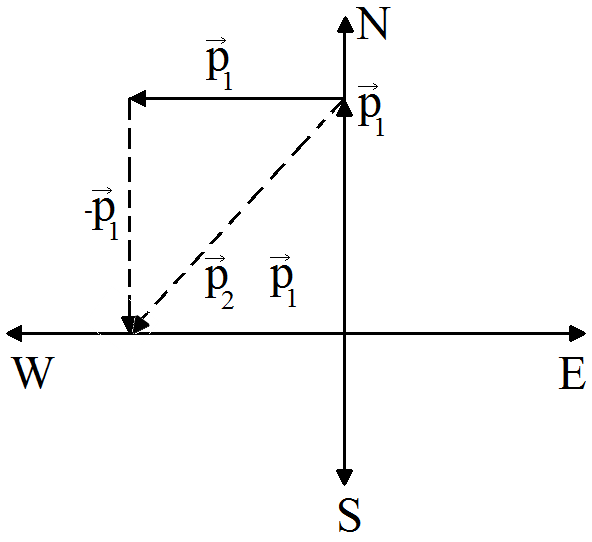
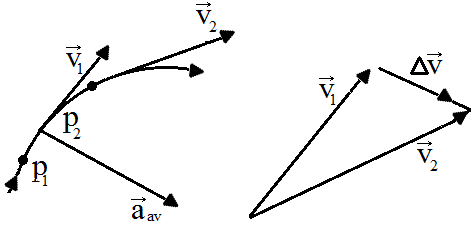
The force on the player will be due to the rate of change of momentum. The direction of force acting on player will be the same as the direction of change in $\text{momentum}\ \ \vec{\text{p}}_2-\vec{\text{p}}_1.$


It is clear from the figure. The direction $\vec{\text{p}}_2-\vec{\text{p}}_1$ of is towards the south-west. It will be the direction of the force on the player.
View full question & answer
MCQ 101 Mark
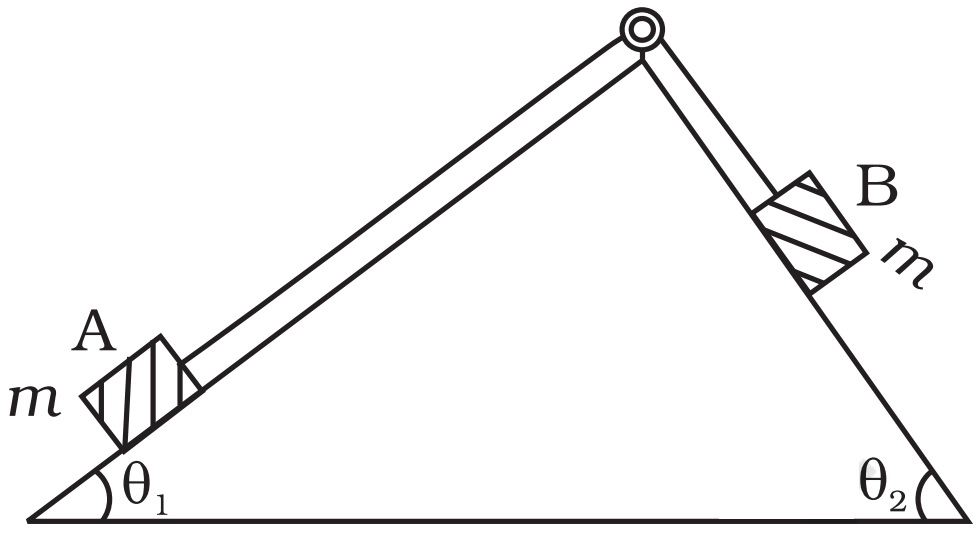
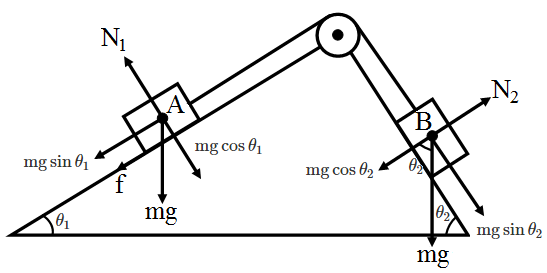
In a body A of mass m slides on plane inclined at angle $\theta_2$ to the horizontal and $\mu_1$ is the coefficent of friction between A and the plane. A is connected by a light string passing over a frictionless pulley to another body B, also of mass m, sliding on a frictionless plane inclined at angle $\theta_2$ to the horizontal. Which of the following statements are true?
  • A
    A will never move up the plane.
  • B
    A will just start moving up the plane when
    $\mu=\frac{\sin \theta_2-\sin \theta_1}{\cos \theta_1}$
  • C
    For A to move up the plane, $\theta_2 $ must always be greater than $\theta_1$.
  • D
    B will always slide down with constant speed.
Answer
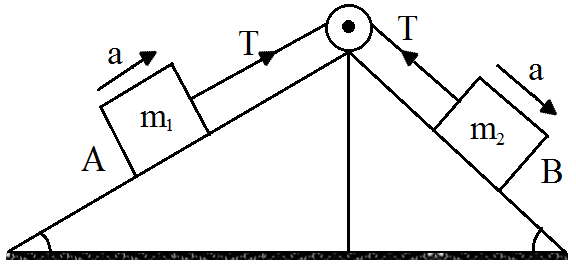
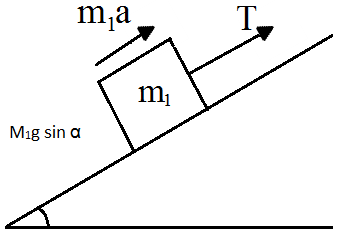
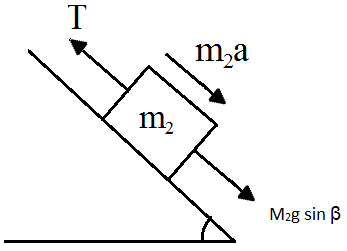
Condition Free boby diagrams
Equation Tension and acceleration
$\text{T}-\text{m}_1\text{g}\sin\alpha=\text{m}_1\text{a}$ $\text{a}=\frac{(\text{m}_2\sin\beta-\text{m}_1\sin\alpha)}{\text{m}_1+\text{m}_2}\text{g}$
$\text{m}_2\text{a}=\text{m}_2\text{g}\sin\beta-\text{T}$ $\text{T}=\frac{(\text{m}_1\text{m}_2\sin\beta+\text{m}_1\sin\alpha)}{\text{m}_1+\text{m}_2}\text{g}$
In this problem first we have to decide the direction of motion. Let block A moves up the plane friction force on A will be downward (along the plane) as shown.

The block A moves upwards
$\text{f}=\text{mg}\sin\theta_2-\text{mg}\sin\theta_1>\theta_1$
$\sin\theta_2>\sin\theta_1\Rightarrow\theta_2>\theta_1$
View full question & answer
MCQ 111 Mark
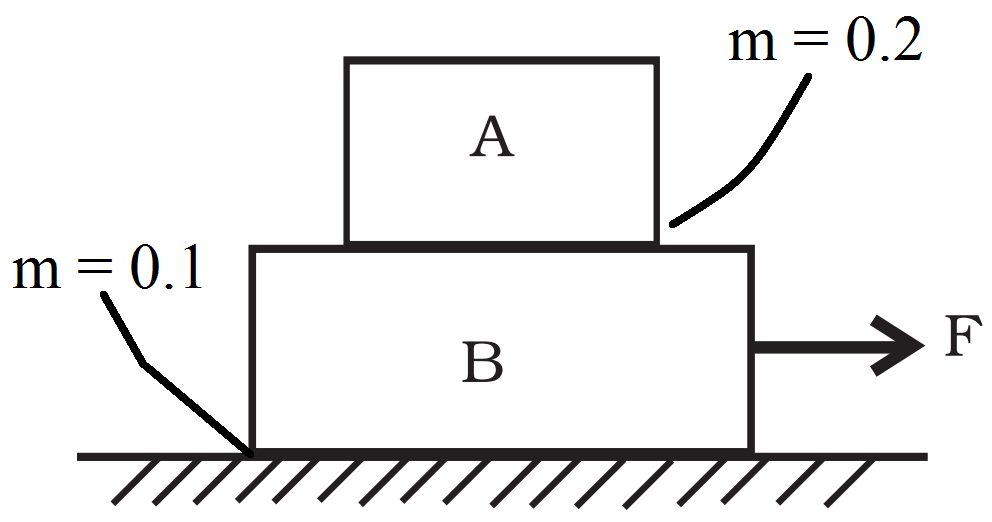
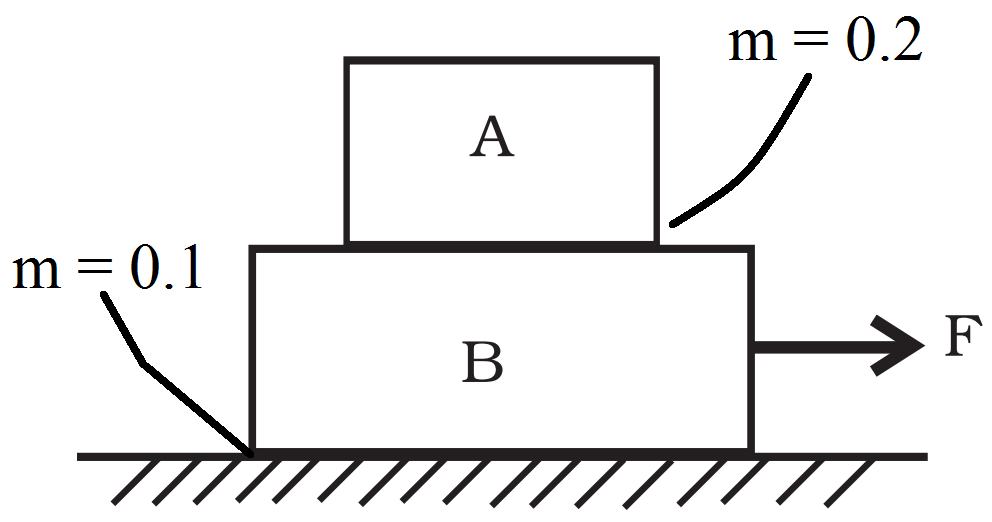
In the co$-$efficient of friction between the floor and the body $B$ is $0.1$ . The co$-$efficient of friction between the bodies $B$ and $A$ is $0.2 .$ A force $F$ is applied as shown on $B$. The mass of $A$ is $m / 2$ and of $B$ is $m$. Which of the following statements are true?
  • A
    The bodies will move together if $F = 0.25mg.$
  • B
    The body $A$ will slip with respect to $B$ if $F = 0.5mg.$
  • C
    The bodies will move together if $F = 0.5mg.$
  • All of the above
Answer
Correct option: D.
All of the above
  1. When there is no friction
  1. $B$ will move with acceleration $(F/M)$ while $A$ will remin at rest $($relative to ground$)$ as there is no pulling force on $A.$
$\text{a}_\text{B}=\Big(\frac{\text{F}}{\text{M}}\Big)$ And $\text{a}_\text{A}=0$
  1. As relative to $B, A$ will move backwards with acceleration $(F/M)$ and so will fall from it in time $t.$
$\therefore\ \text{t}=\sqrt{\frac{2\text{ML}}{\text{F}}}=\sqrt{\frac{2\text{ML}}{\text{F}}}$
  1. If friction is present between $A$ ans $B$ only and $F' < F_1$
  1. Pseudo force on the body $A,$
$\text{F}'=\text{ma}=\frac{\text{mF}}{\text{m+M}}$ and $\text{F}_\text{I}=\mu_\text{s}\ \text{mg}$
  1. $\text{F}'<\text{F}_\text{I}\Rightarrow\frac{\text{m}\text{F}}{\text{m}+\text{M}}<\mu_s\text{mg}$
$\Rightarrow \text{F}<\mu_\text{s}(\text{m}+\text{M})\text{g}$
So both bodies will move together with acceleretion $\text{a}_\text{A}=\text{a}_\text{B}$
$=\frac{\text{F}}{\text{m}+\text{M}}$ if $\text{F}<\mu_\text{s}[\text{m}+\text{M}]\text{g}$
  1. If friction is present betveen $A$ and $B$ only and $f > F'_I ($whrre $\text{F}_I'= \mu_\text{s}\text{mg}=$ limiting friction between body $A$ and $B)$
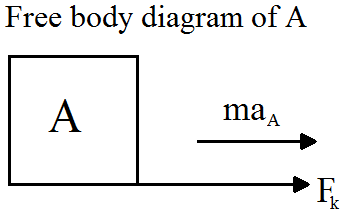
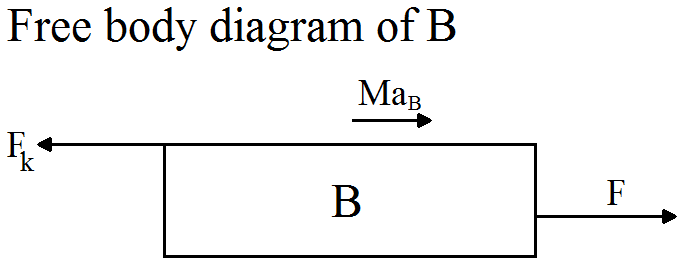
Both the body will move with different acceleratio. here force of kinetic frition $\mu_\text{k}\text{mg}$ will oppose the motion of $B$ which will cause the motion of $A.$
$\text{ma}_\text{A}=\mu_\text{k}{\text{mg}}$
$\text{i.e.}\text{a}_\text{A}=\mu_\text{k}\text{g}$
$\text{F}-\text{F}_\text{k}=\text{Ma}_\text{B}$
$\text{i.e.}\ \text{a}_\text{B}=\frac{[\text{F}-\mu_\text{k}\text{mg}]}{\text{M}}$
Note: As both the bodies are moving are moving the same direction, Acceleration of body $A$ relative to $B$ will be:
$​\text{a}=\text{a}_\text{A}-\text{a}_\text{B}=-\Big[\frac{\text{F}-\mu_\text{k}\text{g}(\text{m}+\text{M})}{\text{M}}\Big]$
Negative sign implies thet relative to $B, A$ will move backword and will fall it after time $t.$
$=\sqrt{\frac{2\text{L}}{\text{a}}}=\sqrt{\frac{2\text{ML}}{\text{F}-\mu_\text{k}\text{g}(\text{m}+\text{M})}}$
  1. If there is friction between $B$ and floor and $F > F_1 ''$
$($where $\text{F}_\text{1}'' =\mu_\text{s}(\text{m}+\text{M})\text{g}=$ limiting friction between body $B$ and surface$)$
The system will move only if $F > F_1 ''$ then replacing $F$ by $F > F_1 ''$
the entrire case $(iii)$ will be valid.
However if $F > F_1 ''$  the system will not move and friction between $B$ and floor will be $F$ while between $A$ and $B$ is zero.
To here first we have to find first frictional forces on each surface and accordingly we will decide maximum force.
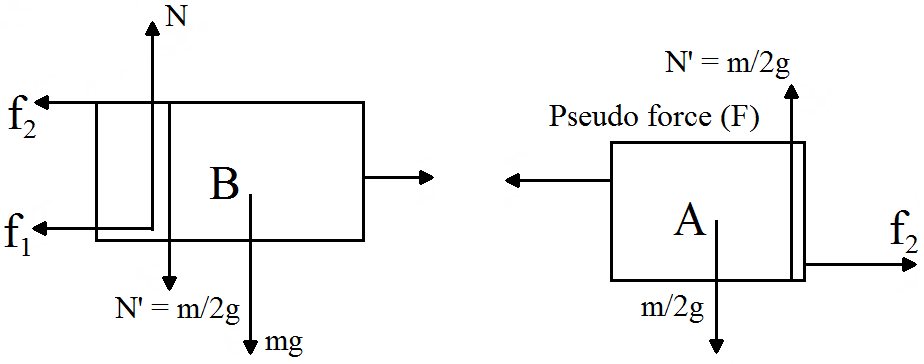
The friction force always have tendency to oppose the motion. In the given diagram, let the frictional force between floor and block $B$ is $(f_1)$​​​​​​​ and frictional force between block $B$ and $A$ is $(f_2​​​​​​​​​​​​​​)$ will be as shown.
‘ Let $A$ and $B$ are moving together.
$\text{a}_{\text{common}}=\frac{\text{F}-\text{f}_1}{\text{M}_\text{A}+\text{M}_\text{B}}=\frac{\text{F}-\text{f}_1}{(\text{m}/2)+\text{m}}=\frac{2(\text{F}-\text{f}_1)}{3\text{m}}$
Pseudo force on $\text{A}=(\text{m}_\text{A})\times\text{a}_\text{common}$
$=\text{m}_\text{A}\times\frac{2(\text{F}-\text{f}_1)}{3\text{m}}=\frac{\text{m}}{2}\times\frac{2(F-\text{f}_1)}{3\text{m}}=\frac{(\text{F}-\text{f}_1)}{3}$

The force $(F)$ will be maximam when the blocks are moved together, then pseudo force on $A =$ fritional force on $A$
$\frac{\text{F}_\text{max}-\text{f}_1}{3}=\mu\text{m}_\text{A}\text{g}=0.2\times\frac{\text{m}}{2}\times\text{g}=0.1\text{mg}$
$\Rightarrow\ \text{F}_\text{max}=0.3\text{mg}+\text{f}_1$
$=0.3\text{mg}=(0.1)\frac{3}{3}\text{mg}=0.45\ \text{mg}$
Similarly, we can find up towgich bodies will move together is $\text{F}_\text{max}=0.45 \text{mg}$
  1. Hence, for $\text{F}=0.25\ \text{mg}< \text{F}_\text{max}$ bodies will move together.
  2. For $\text{F}=0.5\ \text{mg}>\text{F}_\text{max},$ body $A$ will slip with respecct to $B.$
  3. For $\text{F}=0.5\ \text{mg}>\text{F}_\text{max},$ bodies slip.
$(\text{f}_1)_\text{max}=\mu_\text{B}\text{g}=(0.1)\times\frac{3}{2}\times\text{m}\times\text{g}=0.15\ \text{mg}$
$(\text{f}_2)_\text{max}=\mu_\text{A}\text{g}=(0.2)\Big(\frac{\text{m}}{2}\Big)(\text{g})=0.1\ \text{mg}$
Hence, minimum force required, so that both the blocks will move together,
$\text{F}_\text{min}=(\text{f}_1)_\text{max}+(\text{f}_2)_\text{max}$
$=0.15 \ \text{mg}+0.1\ \text{mg}=0.25\ \text{mg}$
  1. According to the problam, force $\text{F}=0.1\ \text{mg}<\text{F}_\text{min}$
Hence, the bodies will be at rest.
  1. Maximum force for combined movement $\text{F}_\text{max}=0.45\ \text{mg.}$
View full question & answer
MCQ 121 Mark
A body of mass $2 \ kg$ travels according to the law $\mathrm{x}(\mathrm{t})=\mathrm{pt}+\mathrm{qt}^2 \mathrm{rt}^3$ where $\mathrm{p}=3 \mathrm{~m} \mathrm{~s}^{-1}, \mathrm{q}=4 \mathrm{~m} \mathrm{~s}^{-2}$ and $\mathrm{r}=5 \mathrm{~m} \mathrm{~s}^{-3}$. The force acting on the body at $t=2$ seconds is.
  • $136N$
  • B
    $134N$
  • C
    $158N$
  • D
    $68N$
Answer
Correct option: A.
$136N$
$\vec{\text{F}}=\text{m}\vec{\text{a}}=\text{m.}\frac{\text{d}^2\text{x}}{\text{dt}^2}$
$\because\ \text{x}(\text{t})=\text{pt}+\text{qt}^2+\text{rt}^3,\ \text{p}=3\text{ms}^{-1},\ \text{q}=4\text{ms}^{-2},\ \text{r}=5\text{ms}^{-3}$
$\text{x(t)}= 3\text{t}+4\text{t}^2+5\text{t}^3$
$\frac{\text{dx(t)}}{\text{dt}}=3+8\text{t}+15\text{t}^2$
$\frac{\text{d}^2\text{x(t)}}{\text{dt}^2}=0+8+30\text{}t$
$\begin{bmatrix}\frac{\text{d}^2\text{x(t)}}{\text{dt}^2}\end{bmatrix}_\text{t-2}=8+30\times2=68\text{ms}^{-2}$
$\therefore\ \vec{\text{F}}=2\times68=136\text{N.}$
View full question & answer
MCQ 131 Mark
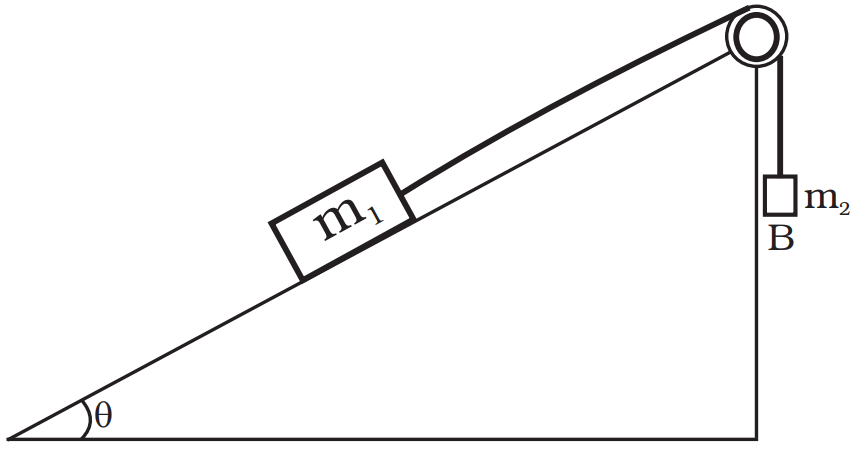
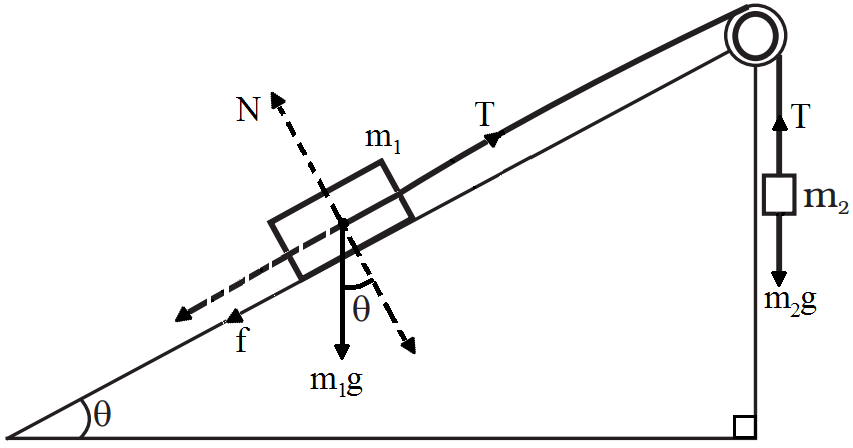
Mass $m_1$ moves on a slope making an angle $\theta$ with the horizontal and is attached to mass $m_2$ by a string passing over a frictionless pulley as shown in The co$-$efficient of friction between $m_1$ and the sloping surface is $\mu$.
Which of the following statements are true?
  • A
    If $m_2 > m_1\ \sin\theta,$ the body will move up the plane.
  • B
    If $m_2 > m_1\ (\sin\theta+\mu\cos\theta),$ the body will move up the plane.
  • C
    If $m_2 > m_1\ (\sin\theta-\mu\cos\theta),$ the body will move down the plane.
  • $B$ and $C$
Answer
Correct option: D.
$B$ and $C$
Case I: Normal reaction $\text{N}=\text{m}_1\text{g}\cos\theta$
$\text{f}=\mu\text{N}=\mu\text{m}_1\text{g}\cos\theta$
$\therefore $ Above equation becomes $\text{T}-\text{m}_1\text{g}\sin\theta-\text{m}_1\text{g}\cos\theta= \text{m}_1\text{g}$
$m_1$ will up and $m_2$ down when $\text{m}_2\text{g}-(\text{m}_1\text{g})\cos\theta+\text{f}>0$
$\text{m}_2\text{g}-\text{m}_1\text{g}\sin\theta-\text{g}\mu\text{m}_1\text{g}\cos\text{g}\theta>0$
$\text{m}_2\text{g}>\text{m}_1\text{g}(\sin\theta+\mu\cos\theta)$
or $\text{m}_2>\text{m}_1(\sin\theta+\mu\cos\theta)$

Case II: If body $m_1$ moves down and $m_2$ up then, direct of $f$ becomes upward$($opp. tomotion$).$
$-\text{f}+\text{m}_1\text{g}\sin \theta>\text{m}_2\text{g}$
$=\mu \text{m}_1\text{g}\cos\theta+\text{m}_1\text{g}\sin\theta>\text{m}_2\text{g}$
$\text{m}_1(-\mu\cos\theta+\sin\theta)>\text{m}_2$
$\text{m}_2<\text{m}_1(\sin\theta-\mu\cos\theta)$
View full question & answer
MCQ 141 Mark
A car of mass m starts from rest and acquires a velocity along east $\text{v}=\text{v}\hat{\text{i}}(\text{v}>\text{0})$ in two seconds. Assuming the car moves with uniform acceleration, the force exerted on the car is:
  • A
    $\frac{\text{mv}}{2}$ Eastward and is exerted by the car engine.
  • $\frac{\text{mv}}{2}$ Eastward and is due to the friction on the tyres exerted by.
  • C
    More than $\frac{\text{mv}}{2}$ eastward exerted due to the engine and overcomes the friction of the road.
  • D
    $\frac{\text{mv}}{2}$ Exerted by the engine.
Answer
Correct option: B.
$\frac{\text{mv}}{2}$ Eastward and is due to the friction on the tyres exerted by.
$\text{u}=0,\ \vec{\text{v}}=\text{vi},\ \text{t}=2,\ \text{m}=\text{m}$
$\text{v}=\text{u}+\text{at}$
$\vec{\text{v}}\hat{\text{i}}=0+\vec{\text{a}}\times2$
$\vec{\text{a}}=\frac{\vec{\text{v}}\hat{\text{i}}}{2}$
$\vec{\text{F}}=\text{m}\vec{\text{a}}=\frac{\text{m}\vec{\text{v}}}{2}\vec{\text{i}}$
Force by the engine is an internal froce.
Hence, the force $\frac{\text{m}\vec{\text{v}}}{2}\hat{\text{i}}$ acting on a car is due to force of friction is $\frac{\text{m}\vec{\text{v}}}{2}\hat{\text{i}}$towards the east, which moves the car in the eastward direction.
View full question & answer
MCQ 151 Mark
A cricket ball of mass $150g$ has an initial velocity $\text{u}=(3\hat{\text{i}}+4\hat{\text{j}})\text{m s}^{-1}$ and a final velocity $\text{v}=-(3\hat{\text{i}}+4\hat{\text{j}})\text{m s}^{-1}$ after being hit. The change in momentum $($final momentum$-$initial momentum$)$ is $($in $kg m s^1):$
  • A
    $\text{zero}$
  • B
    $-(0.45\hat{\text{i}}+0.6\hat{\text{j}})$
  • $-(0.9\hat{\text{i}}+1.2\hat{\text{j}})$
  • D
    $-5(\hat{\text{i}}+\hat{\text{j}})$
Answer
Correct option: C.
$-(0.9\hat{\text{i}}+1.2\hat{\text{j}})$
According to the problam, $\text{u}=(3\hat{\text{i}}+4\hat{\text{j}})\text{m s}^{-1}$ and $\text{v}=-(3\hat{\text{i}}+4\hat{\text{j}})\text{m s}^{-1}$ mass of the ball $= 150g = 0.15\ kg.$
Chang in momentum will be
$\overrightarrow{\Delta{\text{p}}}=\overrightarrow{\text{p}_\text{f}}-\overrightarrow{\text{p}_\text{I}}$
$=\text{m}\vec{\text{v}}-\text{m}\vec{\text{u}}$
$=\text{m}\hat{\text{v}}-\text{m}\hat{\text{u}}$
$=(0.15)[-3\text{i}+4\text{j}-(3\hat{\text{i}}+4\hat{\text{j}})]$
$=(0.15)[-6\hat{\text{i}}-8\hat{\text{j}}]$
$=-[0.15\times6\hat{\text{i}}+0.15\times8\hat{\text{j}}]$
$=-[0.9\hat{\text{i}}+1.2\hat{\text{j}}]$
Hence, $\overrightarrow{\Delta\text{p}}= -[0.9\hat{\text{i}}+1.2\hat{\text{j}}]$

View full question & answer
M.C.Q (1 Marks) - Physics STD 11 Science Questions - Vidyadip