Questions · Page 2 of 2

3 Marks Question

Question 513 Marks
A capillary tube is attached horizontally to a constant head arrangement. If the radius of the capillary tube is increased by 10% then by what percentage the rate of flow of liquid will change.
Answer
Since, $\text{V}=\frac{\pi\text{p}\text{r}^4}{8\eta\text{l}}$$\text{r}'=\text{r}+\frac{10}{100}\text{r}=\frac{110}{100}\text{r}=1.1\text{r}$
$\therefore\text{V}'=\frac{\pi\text{p}(1.1\text{r})^4}{8\eta\text{l}}=\frac{1.464\pi\text{pr}^4}{8\eta\text{l}}=1.464\text{V}$
$\therefore$ % increase in rate of flow of liquid $=\frac{\text{V}'-\text{V}}{\text{V}}\times100=\Big(\frac{1.464\text{V}-\text{V}}{\text{V}}\Big)\times100=46.4\%$
View full question & answer
Question 523 Marks
A U-shaped wire is dipped in a soap solution, and removed. The thin soap film formed between the wire and the light slider supports a weight of $1.5 × 10⁻²N$ (which includes the small weight of the slider). The length of the slider is $30cm$. What is the surface tension of the film?
Answer
The weight that the soap film supports, $\mathrm{W}=1.5 \times 10^{-2} \mathrm{~N}$ Length of the slider, $\mathrm{I}=30 \mathrm{~cm}=0.3 \mathrm{~mA}$ soap film has two free surfaces.
$\therefore$ Total length $=2 \mathrm{l}=2 \times 0.3=0.6 \mathrm{~m}$
Surface tension, $S=\frac{\text { Force of Weight }}{21}=1.5 \times \frac{10^{-2}}{0.6}=2.5 \times 10-2 \mathrm{~N} / \mathrm{m}$
Therefore, the surface tension of the film is $2.5 \times 10-2 \mathrm{~N} \mathrm{~m}^{-1}$.
View full question & answer
Question 533 Marks
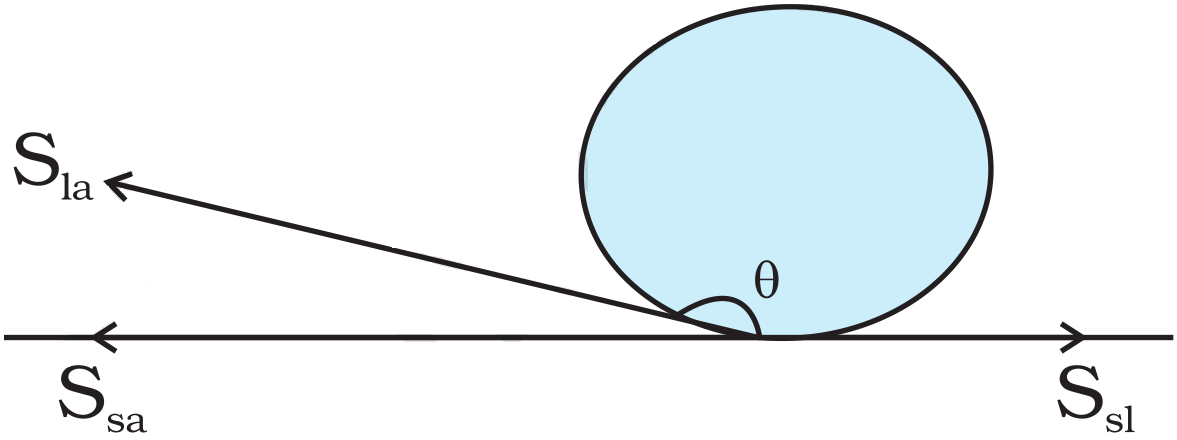
Explain why The angle of contact of mercury with glass is obtuse, while that of water with glass is acute.
Answer
The angle between the tangent to the liquid surface at the point of contact and the surface inside the liquid is called the angle of contact $(\theta)$, as shown in the given figure.

$ S_{la}, S_{sa}$, and $S_{sl}$ are the respective interfacial tensions between the liquid-air, solid-air, and solid-liquid interfaces. At the line of contact, the surface forces between the three media must be in equilibrium, i.e.,$\cos\theta=\text{(Ssa}–\text{Sla})/\text{Sla}$
The angle of contact $\theta$ , is obtuse if $S_{sa}< S_{la}$ (as in the case of mercury on glass). This angle is acute if $S_{sl} < S_{la}$ (as in the case of water on glass).
View full question & answer
Question 543 Marks
A fully loaded Boeing aircraft has a mass of $3.3 \times 10^5 \ kg$. Its total wing area is $500 m ^2$. It is in level flight with a speed of $960 \ km / h. (a)$ Estimate the pressure difference between the lower and upper surfaces of the wings (b) Estimate the fractional increase in the speed of the air on the upper surface of the wing relative to the lower surface. [The density of air is $p =1.2 \ kg m ^3 J$
Answer
$(a)$ The weight of the Boeing aircraft is balanced by the upward force due to the pressure difference
$\Delta P A=3.3 \times 10^5 \ kg \times 9.8$
$\Delta P =\left(3.3 \times 10^5 \ kg \times 9.8 m s ^{-2}\right) / 500 m ^2$
$ =6.5 \times 10^3 Nm ^2$
$(b)$ We ignore the small height difference between the top and bottom sides in Eq. $(9.12)$.
The pressure difference between them is then
$\Delta P=\frac{\rho}{2}\left(v_2^2-v_1^2\right) $
where $V_2$ is the speed of air over the upper surface and $V_1$ is the speed under the bottom surface.
$\left(v_2-v_1\right)=\frac{2 \Delta P}{\rho\left(v_2+v_1\right)}$
Taking the average speed
$V_{ aw }=\left(V_2+V_1\right) / 2=960 \ km / h =267 m s ^{-1} \text {, }$
we have
$\left(v_2-v_1\right) / v_{ av }=\frac{\Delta P}{\rho v_{ av }^2} \approx 0.08$
The speed above the wing needs to be only $8 \%$ higher than that below.
View full question & answer
Question 553 Marks
At a depth of $\text{1000 m}$ in an ocean $(a)$ what is the absolute pressure? $(b)$ What is the gauge pressure? $(c)$ Find the force acting on the window of area $\text{20 cm} \times \text{20 cm}$ of a submarine at this depth. the interior of which is maintained at sealevel atmospheric pressure. $($ The density of sea water is $1.03 \times 10^3 kg m ^{-3}$, $g=10 m s ^{-2}.)$
Answer
Here $h=1000 m$ and $\rho=1.03 \times 10^3 \ kg m ^3$.
$(a)$ From Eq. $(9.6),$ absolute pressure
$P= P+\rho g h$
$= 1.01 \times 10^5 Pa$
$ +1.03 \times 10^3 \ kg m ^{-3} \times 10 m s ^{-2} \times 1000 m$
$= 104.01 \times 10^5 Pa$
$\approx 104 atm$
$(b)$ Gauge pressure is $P-P_{ a }=\rho g h=P$
$P_{ g }=1.03 \times 10^3 \ kg m ^{-3} \times 10 ms ^2 \times 1000 m$
$=103 \times 10^5 Pa$
$\approx 103 atm$
$(c)$ The pressure outside the submarine is $P=P_{ a }+\rho g h$ and the pressure inside it is $P_{ a }$.
Hence, the net pressure acting on the window is gauge pressure, $P_{ tg }=\rho g h$.
Since the area of the window is $A=0.04 m ^2$, the force acting on it is
$F=P_{ g } A=103 \times 10^5 Pa \times 0.04 m ^2=4.12 \times 10^5 N$
View full question & answer
Question 563 Marks
The lower end of a capillary tube of diameter $2.00 mm$ is dipped 8.00 $cm$ below the surface of water in a beaker. What is the pressure required in the tube in order to blow a hemispherical bubble at Its end in water? The surface tension of water at temperature of the experiments is $7.30 \times 10^{-2} Nm ^{-1} .1$ atmospheric pressure $=$ $1.01 \times 10^5 Pa$, density of water $=1000 kg / m ^3$. $g =9.80 m s ^2$. Also calculate the excess pressure.
Answer
The excess pressure in a bubble of gas in a liquid is given by $2 S / r$, where $S$ is the surface tension of the liquid-gas interface. You should note there is only one liquid surface in this case. (For a bubble of liquid in a gas, there are two liquid surfaces, so the formula for excess pressure in that case is $4 S / r$.) The radius of the bubble is $r$. Now the pressure outside the bubble $P_o$ equals atmospheric pressure plus the pressure due to $8.00 cm$ of water column. That is
$
\begin{aligned}
P_o & =\left(1.01 \times 10^5 Pa +0.08 m \times 1000 kg m ^{-3} \times\text{9.80 m s}^{-2} \right) \\
& =1.01784 \times 10^5 Pa
\end{aligned}
$

Therefore, the pressure inside the bubble is
$
\begin{aligned}
P_1 & =P_{ o }+2 S / r \\
& =1.01784 \times 10^5 Pa +\left(2 \times 7.3 \times 10^2 Pam / 10^3 m \right) \\
& =(1.01784+0.00146) \times 10^5 Pa \\
& =1.02 \times 10^5 Pa
\end{aligned}
$
where the radius of the bubble is taken to be equal to the radius of the capillary tube, since the bubble is hemispherical! (The answer has been rounded off to three significant figures.) The excess pressure in the bubble is $146 Pa$.
View full question & answer
3 Marks Question - Page 2 - Physics STD 11 Science Questions - Vidyadip