Questions

M.C.Q (1 Marks)

🎯

Test yourself on this topic

10 questions · timed · auto-graded

MCQ 11 Mark
Streamline flow is more likely for liquids with:
  • A
    High density.
  • High viscosity.
  • C
    Low density.
  • D
    Low viscosity.
Answer
Correct option: B.
High viscosity.

Streamline flow is more likely for liquids having low density. We know that greater the coefficient of viscosity of a liquid more will be the velocity gradient, hence each line of flow can be easily differentiated. Streamline flow is related with critical velocity. The critical velocity is that velocity of liquid flow up to which its flow is streamlined and above which its flow becomes turbulent.
As the critical velocity is related to viscosity $(\eta)$ and density $(\rho)$ of the liquid as,
$(\text{V}_\text{c})\ \alpha\ \frac{\eta}{\rho}$
Hence if the density will be low and viscosity will be high, the value of critical velocity will be more.
View full question & answer
MCQ 21 Mark
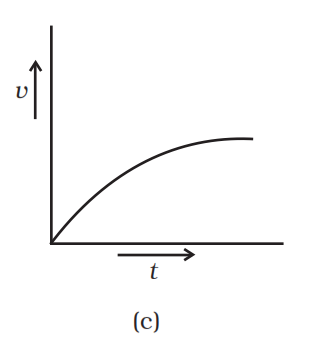
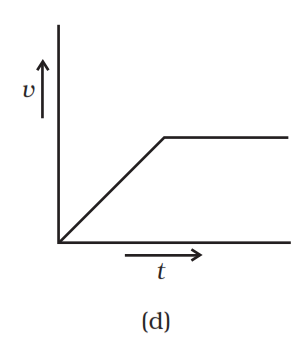
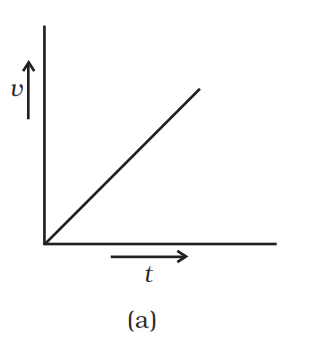
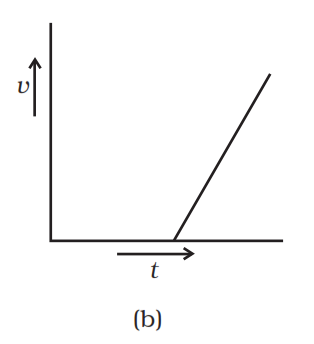
A tall cylinder is filled with viscous oil. A round pebble is dropped from the top with zero initial velocity. From the plot shown in indicate the one that represents the velocity $(v)$ of the pebble as a function of time $(t):$
 
  • A
  • B
  • D
Answer
Correct option: C.
In fluids, when the pebble is dropped from the top of a tall cylinder filled with viscous oil, a variable force called viscous force will act which increases with increase in speed. And at equilibrium this velocity becomes constant, that constant velocity is called terminal velocity.
When the pebble is falling through the viscous oil, the viscous force is $\text{F}= 6\pi\eta\text{rv}$ where r is the radius of the pebble, v is instantaneous speed, $\eta$ is coefficient of viscosity. As the force is variable, hence acceleration is also variable so v-t graph will not be a straight line. First velocity increases and then becomes constant known as terminal velocity.
View full question & answer
MCQ 31 Mark
Pressure is a scalar quantity because:
  • A
    it is the ratio of force to area and both force and area are vectors.
  • B
    It is the ratio of the magnitude of the force to area.
  • It is the ratio of the component of the force normal to the area.
  • D
    It does not depend on the size of the area chosen.
Answer
Correct option: C.
It is the ratio of the component of the force normal to the area.
What makes pressure a scalar quantity is the fact that it is the component of force along the direction of area that is taken into account while defining pressure. Thus the direction of quantities involved remain fixed and pressure becomes a scalar quantity.
View full question & answer
MCQ 41 Mark
An ideal fluid flows through a pipe of circular cross-section made of two sections with diameters 2.5cm and 3.75cm. The ratio of the velocities in the two pipes is:
  • $9:4$
  • B
    $3:2$
  • C
    $\sqrt{3}:\sqrt{2}$
  • D
    $\sqrt{2}:\sqrt{3}$
Answer
Correct option: A.
$9:4$
According to continuity equation (Law of Conservation of mass)
$\text{a}_1\text{v}_1=\text{a}_2\text{v}_2$
$\frac{\text{v}_1}{\text{v}_2}=\frac{\text{a}_2}{\text{a}_1}=\frac{\pi\big(\frac{\text{d}_2}{2}\big)^2}{\pi\big(\frac{\text{d}_1}{2}\big)^2}=\frac{\text{d}^2_2}{4}\cdot\frac{4}{\text{d}^2_1}=\frac{\text{d}^2_2}{\text{d}^2_1}$
$\frac{\text{v}_1}{\text{v}_2}=\frac{(3.75)^2}{(2.50)^2}=\Big[\frac{3}{2}\Big]^2$
$\frac{\text{v}_1}{\text{v}_2}=\frac{9}{4}$
or ${\text{v}_1}:{\text{v}_2}:9:4$
View full question & answer
MCQ 51 Mark
The angle of contact at the interface of water-glass is 0°, Ethylalcohol-glass is 0°, Mercury-glass is 140° and Methyliodideglass is 30°. A glass capillary is put in a trough containing one of these four liquids. It is observed that the meniscus is convex. The liquid in the trough is:
  • A
    Water
  • B
    Ethylalcohol
  • Mercury
  • D
    Methyliodide
Answer
Correct option: C.
Mercury
Meniscus of liquid is convex so angle of contact will be obtuse angle which happens in case of mercury-glass.
View full question & answer
MCQ 61 Mark
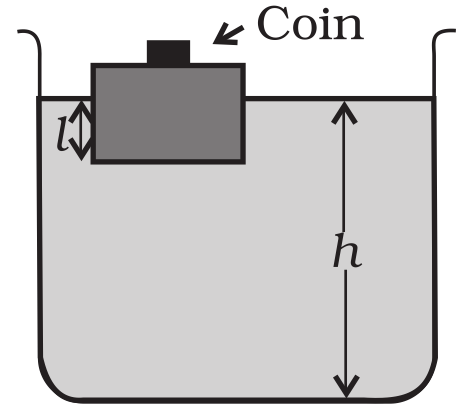
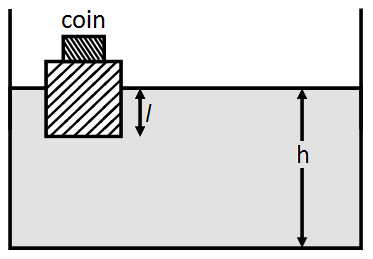
A wooden block with a coin placed on its top, floats in water as shown in the distance $l$ and $h$ are shown in the figure. After some time the coin falls into the water. Then:
  1. l decreases.
  2. h decreases.
  3. l increases.
  4. h increase.
  • $a, b$
  • B
    $b, c$
  • C
    $b, d$
  • D
    $a, b$
Answer
Correct option: A.
$a, b$
According to law of floatation weight of floating body is equal to weight of displaced fluid. When coin falls into the water, net weight of floating body is decreased so the floating body will displace less amount of water so block rises up and I will decreases. But height $h$ of water will decrease as less water is displaced now.
View full question & answer
MCQ 71 Mark
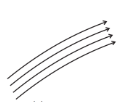
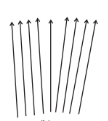
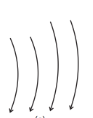
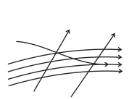
Which of the following diagrams does not represent a streamline flow?
  • A
  • B
  • C
Answer
Correct option: D.
​​​​​​In streamlined flow the velocity of fluid at any given point remains constant (at a particular line) across any cross-sectional area. Hence is streamline flow layers do not cross each other. Hence option (d) is not streamline.
View full question & answer
MCQ 81 Mark
With increase in temperature, the viscosity of:
  • A
    Gases decreases.
  • B
    liquids decreases.
  • C
    Gases increases.
  • Both $C$ and $D$
Answer
Correct option: D.
Both $C$ and $D$
The viscosity of gases increases with increase of temperature, because on increasing temperature the rate of diffusion increases.
The viscosity of liquid decreases with increase of temperature, because the cohesive force between the liquid molecules decreases with increase of temperature.
Relation between coefficient of viscosity and temperature $($Andrade formula$)$
$\eta=\frac{\text{Ae}^{\frac{\text{C}\rho}{\text{T}}}}{\rho^{\frac{-1}{3}}}$
where $T =$ Absolute temperature of liquid, $p =$ density of liquid, $A$ and $C$ are constants.
Important point: With increase in temperature, the coefficient of viscosity of liquids decreases but that of gases increases. The reason is that as temperature rises, the atoms of the liquid become more mobile, whereas in case of a gas, the collision frequency of atoms increases as their motion becomes more random.
View full question & answer
MCQ 91 Mark
For a surface molecule:
  • A
    The net force on it is zero.
  • B
    There is a net downward force.
  • C
    The potential energy is more than that of a molecule inside.
  • Both $B$ and $D$
Answer
Correct option: D.
Both $B$ and $D$
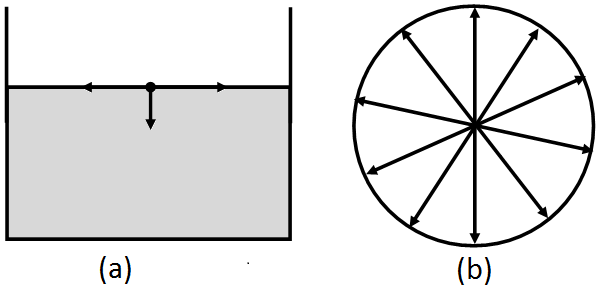
A molecule viewed from the top to surface of the fluid. Force exerted on a molecule by all nearby molecule are equal and opposite, so net horizontal component of force is zero. as a molecule is viewed horizontally to the surface of fluid a vertically downward force acts on molecule due to which it does not escape from surface.

There is a net attractive force on molecules at surface acting downwards.
So the $P.E$ of molecules at the surface is negative to lower ones but in magnitude $\text{PE(mgh)}$ is more than that of the lower or inside molecules.
View full question & answer
MCQ 101 Mark
Along a streamline:
  • A
    The velocity of a fluid particle remains constant.
  • The velocity of all fluid particles crossing a given position is constant.
  • C
    The velocity of all fluid particles at a given instant is constant.
  • D
    The speed of a fluid particle remains constant.
Answer
Correct option: B.
The velocity of all fluid particles crossing a given position is constant.
As discussed above for a streamline flow of a liquid velocity of each particle at a particular cross-section is constant, because Av = constant (law of continuity) between two cross-section of a tube of flow. So we can say that along a streamline, the velocity of every fluid particle while crossing a given position is the same.
View full question & answer
M.C.Q (1 Marks) - Physics STD 11 Science Questions - Vidyadip