Questions · Page 1 of 2

1 Marks Question

🎯

Test yourself on this topic

50 questions · timed · auto-graded

Question 11 Mark
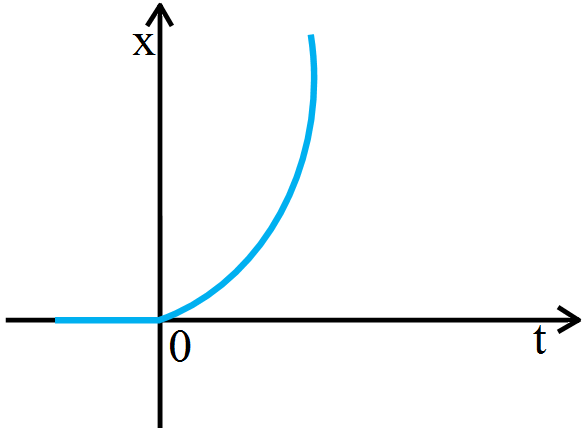
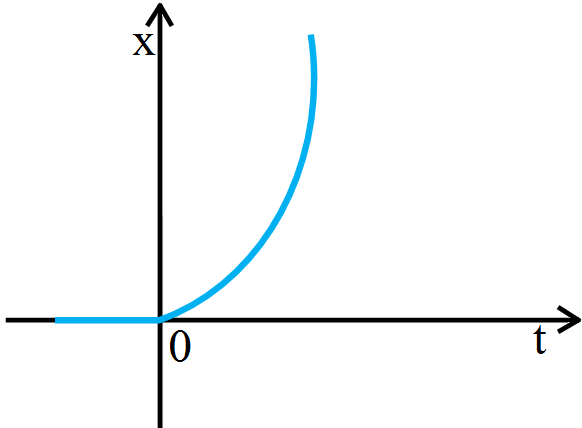
Shows the x-t plot of one-dimensional motion of a particle. Is it correct to say from the graph that the particle moves in a straight line for t < 0 and on a parabolic path for t > 0? If not, suggest a suitable physical context for this graph.
Answer
No, because the x-t graph does not represent the trajectory of the path followed by a particles. From the graph, it is noted that at t = 0, x = 0.
View full question & answer
Question 21 Mark
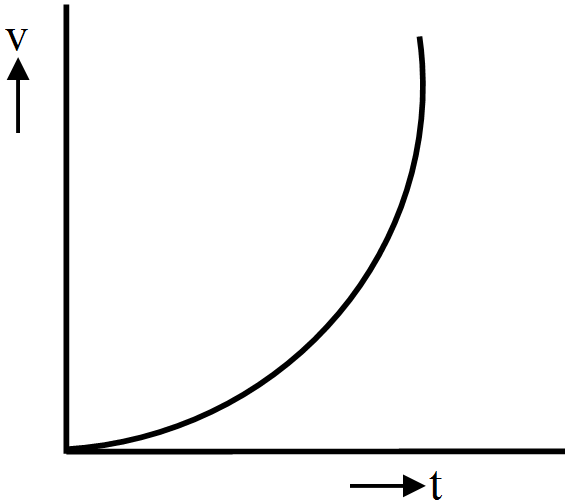
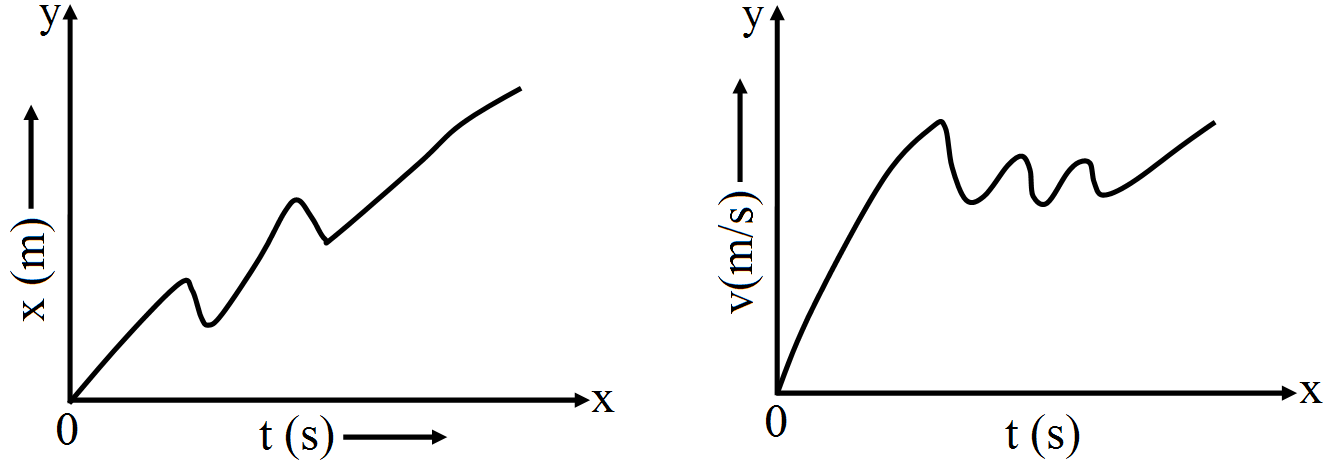
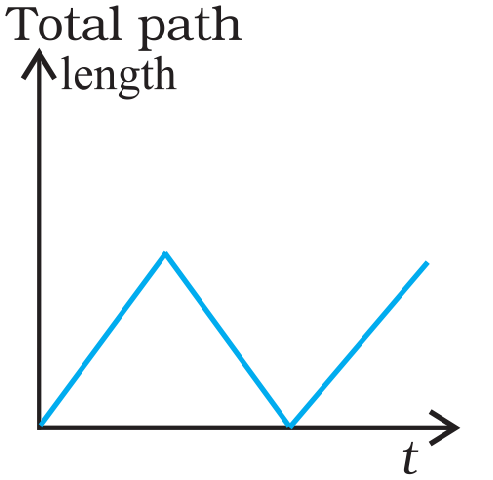
Look at the graphs carefully and state, with reasons, which of these cannot possibly represent one-dimensional motion of a particle.
Answer
The given v-t graph, shown in (d), does not represent one-dimensional motion of the particle. This is because the total path length travelled by the particle cannot decrease with time.
View full question & answer
Question 31 Mark
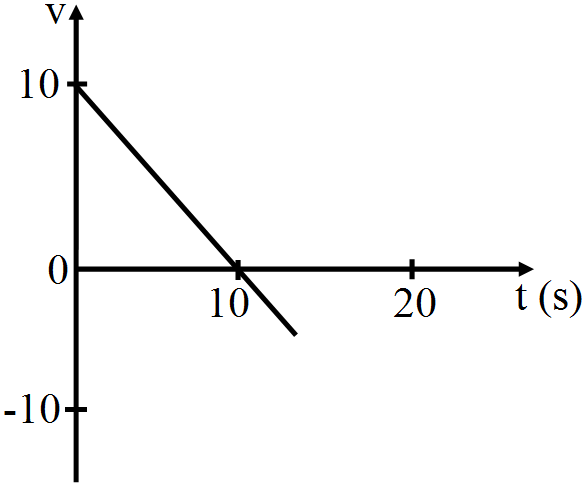
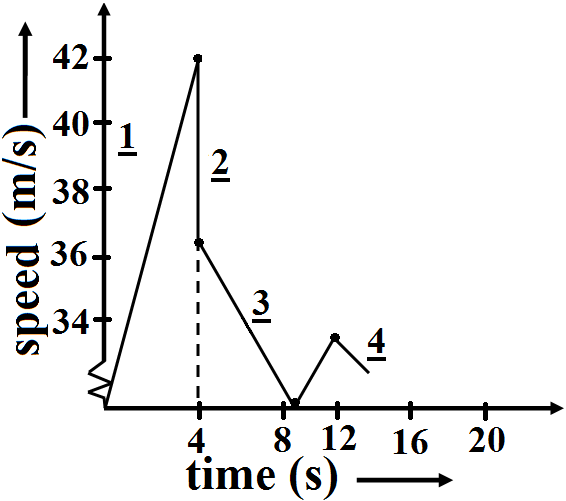
A ball is dropped from a height of $90m$ on a floor. At each collision with the floor, the ball loses one tenth of its speed. Plot the speed$-$time graph of its motion between $t = 0$ to $12s$.
Answer
  1. Downward motion of Ball
Ball is dropped from a height, $s=90 \mathrm{~m}$
Initial velocity of the ball, $\mathrm{u}=0$
Acceleration, $a=g=9.8 \mathrm{~m} / \mathrm{s}^2$
Final velocity of the ball $=\mathrm{v}$
From second equation of motion, time $(t)$ taken by the ball to hit the ground can be obtained as:
$\mathrm{s}=\mathrm{ut}+(1 / 2) \mathrm{at}^2$
$90=0+(1 / 2) \times 9.8 \mathrm{t}^2$
$\mathrm{t}=\sqrt{18.38}=4.29 \mathrm{~s}$
From first equation of motion, final velocity is given as:
$v=u+a t$
$=0+9.8 \times 4.29=42.04 \mathrm{~m} / \mathrm{s}$
Here we see that $\mathrm{v}=\mathrm{at}$, so velocity varies linearly with downward motion of ball.
This part of motion is represented by first line $(1)$ in the below graph
  1. First rebound
Now Rebound velocity of the ball, $u_r=v(1-1 / 10)=9 \mathrm{v} / 10=9 \times 42.04 / 10=37.84 \mathrm{~m} / \mathrm{s}$
This is represented the line $(2)$ in the graph. We are assumed negligible time of collision between ball and floor
  1. Upward motion of ball
Time $\left(t_1\right)$ taken by the ball to reach maximum height is obtained with the help of first equation of motion as:
$\mathrm{v}=\mathrm{u}+\mathrm{at}_1$
$0=37.84+(-9.8) \mathrm{t}_1$
$\mathrm{t}_1=-37.84 /-9.8=3.86 \mathrm{~s}$
Total time taken by the ball $=\mathrm{t}+\mathrm{t}_1=4.29+3.86=8.15 \mathrm{~s}$
This is represented by line $(3)$ in the graph
  1. Second descent of ball
As the time of ascent is equal to the time of descent, the ball takes $3.86 s$ to strike back on the floor for the second time.
The velocity with which the ball rebounds from the floor $=9 \times 37.84 / 10=34.05 \mathrm{~m} / \mathrm{s}$
Total time taken by the ball for second rebound $=8.15+3.86=12.01 \mathrm{~s}$
This is represented by line $(4)$ in the graph
View full question & answer
Question 41 Mark
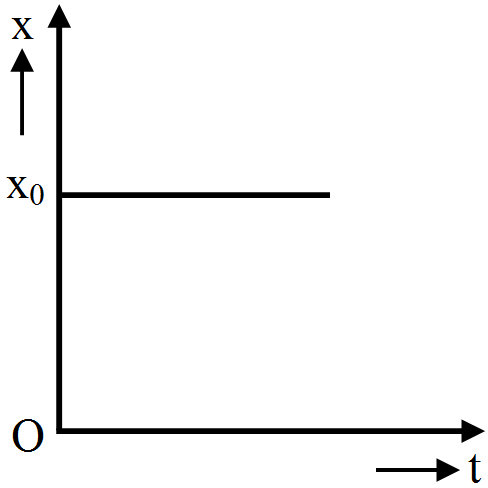
Draw position-time graph for a body at rest.
Answer

In the above x-t graph, body is at rest at position $x_o$.
View full question & answer
Question 51 Mark
Is it possible to have negative value in speed and displacement?
Answer
Speed is always +ve. Displacement can have -ve, 0 or +ve values.
View full question & answer
Question 61 Mark
Why the speed of an object can never be negative?
Answer
Speed is distance covered per unit time. Since distance cannot be negative therefore speed cannot be negative.
View full question & answer
Question 71 Mark
Write an expression for distance covered in $n^{th}$ second for a uniformly accelerated motion.
Answer
If a is the uniform acceleration, then $\text{s(n}^{\text{th}})=\text{u}+\frac{1}{2}\text{a}(2\text{n}-1)$ where, s ($n^{th}$) is the distance covered in $n^{th}$ second, u is the initial velocity.
View full question & answer
Question 81 Mark
The length covered by a body is found to be directly proportional to the square of time. What is the nature of acceleration?
Answer
$\text{x}\propto\text{t}_2\therefore\text{v}\propto\text{t}$ and $\text{a}\propto\text{t}^0$ (i. e.) acceleration is constant.
View full question & answer
Question 101 Mark
A car moving at a speed of 10m/s is accelerated at the rate of $2m/s^2$. Find out the velocity after 6 sec.
Answer
Velocity after 6 seconds $=10+2 \times 6=22 \mathrm{~ms}^{-1}$.
View full question & answer
Question 111 Mark
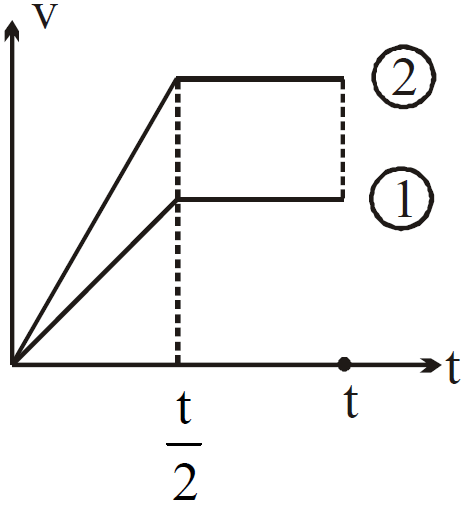
Two particles A and B start from rest and move for equal time on a straight line. The particle A has an acceleration a for the first half of the total time and 2a for the second half. The particle B has an acceleration 2a for the first half and a for the second half. Which particle has covered larger distance?
Answer
Second particle Area under (v, t) graph gives displacement. For graph (2) area is more.
View full question & answer
Question 121 Mark
Speed of a particle cannot be negative. Why?
Answer
Speed is the distance travelled in unit time and distance cannot be negative. negative.
View full question & answer
Question 131 Mark
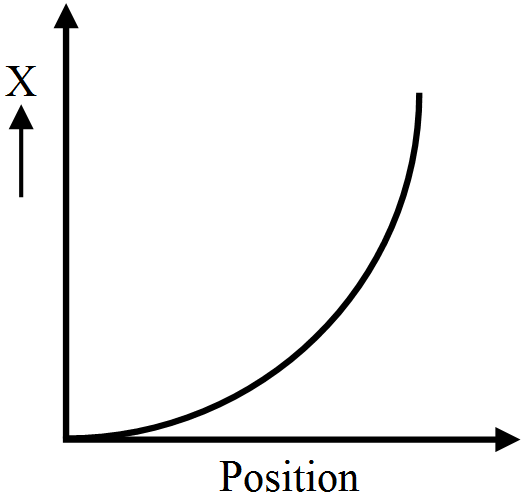
Draw position-time graph for a non-uniform motion, when body starts from origin with increasing velocity.
Answer
In the above x-t graph, the slope of x-t graph is increasing, it means that the velocity is increasing.
View full question & answer
Question 151 Mark
It is a common observation that rain clouds can be at about a kilometre altitude above the ground. Rate of change of momentum is force. Estimate how much force such a drop would exert on you.
Answer
Key concept: This problem can be solved by kinematic equations of motion and Newton’s second law that $\text{F}_\text{ext}=\frac{\text{dp}}{\text{dt}}$ will be used, where dp is change in momentum over time dt. Force exerted by a rain drop is $\text{F}=\frac{\text{Change in momentum}}{\text{Time}}=\frac{\text{p}-0}{\text{t}}$ $=\frac{4.7\times10^{-3}}{2.8\times10^{-5}}=168\text{N}$
View full question & answer
Question 161 Mark
Is it possible that a body could have constant speed but varying velocity?
Answer
Yes, a body could have constant speed but varying velocity if only the direction of motion changes.
View full question & answer
Question 171 Mark
Which speed is measured by speedometer of your scooter?
Answer
Instantaneous speed of the scooter is measured by the speedometer.
View full question & answer
Question 181 Mark
What can you say about the nature of acceleration, associated with a mass whose y-t graph is shown?
Answer
Slope covers the same magnitude. So acceleration is constant.
View full question & answer
Question 191 Mark
Does the displacement of an object depend on the choice of the position of origin of the coordinate system?
Answer
No, the displacement of the object does not depend on the choice of the position of the origin.
View full question & answer
Question 201 Mark
When a body accelerates by $\alpha \text{ t},$ what is the velocity after time 't', when it starts from rest?
Answer
$\text{a}=\alpha\text{t}\text{ i.e.}, \int\text{dv}=\alpha\int\text{t dt}$$\nu=\frac{\alpha \text{ t}^2}{2}.$
View full question & answer
Question 211 Mark
Write the expression for distance covered in $n^{th}$ the second by a uniformly accelerated body.
Answer
If a is the uniform acceleration then, $\text{s}=\text{u}+\frac{1}{2}\text{a}(2\text{n}-1)$
View full question & answer
Question 221 Mark
Consider that the acceleration of a moving body varies with time. What does the area under acceleration-time graph for any time interval represent?
Answer
The area under acceleration-time graph for any time interval represents the change of velocity of the body during that time interval.
View full question & answer
Question 231 Mark
What is the significance of the slope of x-t graph.
Answer
Slope of x-t graph provides velocity of motion. The nature of motion is identified by the shape of the graph.
View full question & answer
Question 241 Mark
Find the acceleration and velocity of a ball at the instant it reaches its highest point if it was thrown up with velocity v.
Answer
Acceleration is $9.8m/s^2$ (downwards) and velocity is zero at the highest point.
View full question & answer
Question 251 Mark
When a ball hits a wall with a velocity of 50m/s and bounces back with the same speed, what is the change in velocity of the ball?
Answer
$\Delta \text{p}=-2\text{mv}=-100\text{m}$ $\therefore\text{m}\Delta\text{v}'=-100\text{m}$ $\Rightarrow \text{v}'=-100\text{m/s}$
View full question & answer
Question 261 Mark
What is the ratio of the time taken to go up and come down by a body thrown vertically up?
Answer
1 : 1 in the absence of air resistance.
View full question & answer
Question 271 Mark
Two masses in the ratio 1 : 2 are thrown vertically up with the same speed. What is the effect on the time by the mass?
Answer
Mass does not influence time.
View full question & answer
Question 281 Mark
What is the condition for an object to be considered as a point object?
Answer
An object can be considered as a point object, if the distance travelled by it is very large than its size.
View full question & answer
Question 291 Mark
Can Earth be regarded as a 'point object' if only the orbital motion of Earth around the sun is considered?
Answer
Yes. This is because the size of the Earth is very small as compared to the size of the orbit of the Earth around the sun.
View full question & answer
Question 301 Mark
A monkey climbs up a slippery pole for 3 seconds and subsequently slips for 3 seconds. Its velocity at time t is given by v(t) = 2t(3 - t); 0 < t < 3 and v(t) = -(t - 3)(6 - t) for 3 < t < 6s in m/s. It repeats this cycle till it reaches the height of 20m. At what time is its acceleration maximum in magnitude?
Answer
Given velocity $\text{v}(\text{t})=2\text{t}(3-\text{t})=6\text{t}-2\text{t}^2$ In a periodic motion when velocity is zero acceleration will be maximum putting v = 0 in Eq. (i). $0=6\text{t}-2\text{t}^2\Rightarrow0=\text{t}(6-2\text{t})$ $=\text{t}\times2(3-\text{t})=0\Rightarrow\text{t}=0\ \ \text{or}\ \ 3\text{s}$
View full question & answer
Question 311 Mark
Can a body have constant speed but a varying velocity?
Answer
Yes, it is possible only if direction changes.
View full question & answer
Question 321 Mark
Do the following two graphs represent same type of motion? Name the motion.
Answer
Both the graphs represent the non-uniform type of motion.
View full question & answer
Question 341 Mark
Give an example of a body possessing zero velocity and still accelerating.
Answer
A body thrown up vertically has zero velocity at the top-most point, but has acceleration of g.
View full question & answer
Question 351 Mark
The displacement-time graph for two particles X and Y are straight lines making angles of 30° and 60° with the time axis. What is the ratio of the velocities of Y and X?
Answer
$\frac{\text{v}_\text{Y}}{\text{v}_\text{X}}=\frac{\tan60^\circ}{\tan30^\circ}$ $=\frac{\sqrt{3}}{\frac{1}{\sqrt{3}}}=3:1$
View full question & answer
Question 361 Mark
For which condition, the magnitude of average velocity is equal to the average speed for a particular motion?
Answer
When a particle is moving along a straight line with the fixed direction.
View full question & answer
Question 371 Mark
The position coordinate of a moving particle is given by $\mathrm{x}=6+18 \mathrm{t}+9 \mathrm{t}^2$, where x is in metres and t in seconds. What is the velocity at $\mathrm{t}=2 \mathrm{~s}$ ?
Answer
Given, $\text{x}=6+18\text{t}+9\text{t}^2$ $\text{v}_\text{t}=\frac{\text{dx}}{\text{dt}}=18+18\text{t}$ At t = 2, $\text{v}_2=18+18\times2$ $=54\text{m/s}$
View full question & answer
Question 381 Mark
Two particles A and B are moving along the same straight line. Bis ahead of A. Velocities remaining unchanged, what would be effect on the magnitude of relative velocity if A ahead of B?
Answer
There will be no effect on the magnitude of relative velocity.
View full question & answer
Question 401 Mark
What is the ratio of SI to CGS unit of acceleration?
Answer
Ratio of SI to CGS unit of acceleration is $10^2$.
View full question & answer
Question 411 Mark
When a body accelerates by $\beta \text{t},$ what is the velocity after time t, when it starts from rest?
Answer
Given, acceleration $\text{a}=\beta \text{}t$ It can be written as $\int\text{dv}=\int \beta\text{tdt}$ On intergrating, we get $\text{v}=\frac{\beta\text{t}^2}{2}+\text{C}=\frac{\beta\text{t}^2}{2}$ [$\because$ C = 0]
View full question & answer
Question 421 Mark
A mass is dropped from certain height. At the same time another equal mass is thrown with a horizontal velocity of u m/s. Which one of the two will reach the ground first?
Answer
Both of them will reach the ground at the same time.
View full question & answer
Question 431 Mark
Shows the x-t plot of one-dimensional motion of a particle. Is it correct to say from the graph that the particle moves in a straight line for t < 0 and on a parabolic path for t > 0? If not, suggest a suitable physical context for this graph.
Answer
No, because the x-t graph does not represent the trajectory of the path followed by a particles. From the graph, it is noted that at t = 0, x = 0.
View full question & answer
Question 441 Mark
The position coordinate of a moving particle is given by $x=6+18 t+9 t^2$ ( $x$ in metres and $t$ in seconds). What is its velocity at $\mathrm{t}=2 \mathrm{sec}$ ?
Answer
$\mathrm{x}=6+18 \mathrm{t}+9 \mathrm{t}^2, \mathrm{v}=18+18 \mathrm{t} \mathrm{~v}_{\mathrm{t}}=2=18+18 \times 2=54 \mathrm{~ms}^{-1}$
View full question & answer
Question 451 Mark
Write the expression for distance covered in $n^{th}$ second by a uniformly accelerated body.
Answer
If a is the uniform acceleration, then $\text{s}=\text{u}+\frac{\text{a}}{2}(2\text{n}-1),$ where u is the initial velocity.
View full question & answer
Question 461 Mark
The displacement-time graph of a particle is parallel to time-axis, what is the velocity of the particle?
Answer
The velocity of the particle is zero because the slope of (x-t) graph is zero.
View full question & answer
Question 471 Mark
Is it possible that a body have a constant velocity but varying speed?
Answer
No, because velocity is a speed with direction. Therefore, a body having constant velocity cannot have a varying speed.
View full question & answer
Question 481 Mark
What does speedometer record: the average speed or the instantaneous speed?
Answer
The speedometer measures the instantaneous speed.
View full question & answer
Question 491 Mark
Which vector can be associated with a plane area? And what is its direction?
Answer
Area vector, outward drawn Normal to the plane will be its direction.
View full question & answer
Question 501 Mark
Write two uses of $v-t$ graph?
Answer
  1. Slope of $v-t$ graph gives acceleration.
  2. Area under $v-t$ graph gives displacement.
View full question & answer
1 Marks Question - Physics STD 11 Science Questions - Vidyadip