Questions

1 Marks Question

🎯

Test yourself on this topic

3 questions · timed · auto-graded

Question 11 Mark
It is a common observation that rain clouds can be at about a kilometre altitude above the ground.
Rate of change of momentum is force. Estimate how much force such a drop would exert on you.
Answer
Key concept: This problem can be solved by kinematic equations of motion and Newton’s second law that $\text{F}_\text{ext}=\frac{\text{dp}}{\text{dt}}$ will be used, where dp is change in momentum over time dt. Force exerted by a rain drop is$\text{F}=\frac{\text{Change in momentum}}{\text{Time}}=\frac{\text{p}-0}{\text{t}}$
$=\frac{4.7\times10^{-3}}{2.8\times10^{-5}}=168\text{N}$
View full question & answer
Question 21 Mark
A monkey climbs up a slippery pole for 3 seconds and subsequently slips for 3 seconds. Its velocity at time t is given by v(t) = 2t(3 - t); 0 < t < 3 and v(t) = -(t - 3)(6 - t) for 3 < t < 6s in m/s. It repeats this cycle till it reaches the height of 20m.
At what time is its acceleration maximum in magnitude?
Answer
Given velocity$\text{v}(\text{t})=2\text{t}(3-\text{t})=6\text{t}-2\text{t}^2$
In a periodic motion when velocity is zero acceleration will be maximum putting v = 0 in Eq. (i).$0=6\text{t}-2\text{t}^2\Rightarrow0=\text{t}(6-2\text{t})$
$=\text{t}\times2(3-\text{t})=0\Rightarrow\text{t}=0\ \ \text{or}\ \ 3\text{s}$
View full question & answer
Question 31 Mark
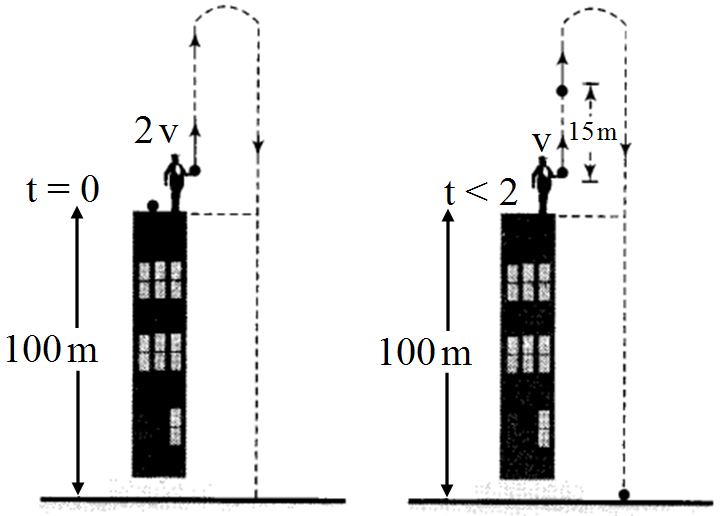
A man is standing on top of a building $100m$ high. He throws two balls vertically, one at $t = 0$ and other after a time interval $($less than $2$ seconds$).$ The later ball is thrown at a velocity of half the first. The vertical gap between first and second ball is $+15m$ at $t = 2s$. The gap is found to remain constant. Calculate the velocity with which the balls were thrown and the exact time interval between their throw.
Answer
We solve this problem by using kinematic equations with proper sign convention and to calculate time interval we will take We solve this problem by using kinematic equations with proper sign convention and to calculate time interval we will take difference of displacements.

 Let the speeds of the two balls $(1$ and $2)$ be $v_1$ and $v_2$ where: if $\text{v}_1=2\text{v},\text{v}_2=\text{v}$ if $y_1$ and $y_2$ and the displacement covered by the balls $1$ and $2$, respectively, beforecoming to rest,
then,$\text{y}_1=\frac{\text{v}_1^2}{2\text{g}}=\frac{4\text{v}^2}{2\text{g}}$ and $\text{y}_2=\frac{\text{v}_2^2}{2\text{g}}=\frac{\text{v}^2}{2\text{g}}$
Since $\text{y}_1-\text{y}_2=15\text{m},\frac{4\text{v}^2}{2\text{g}}-\frac{\text{v}^2}{2\text{g}}$
$=15\text{m or }\frac{3\text{v}^2}{2\text{g}}=15\text{m}$
or $\text{v}^2=\sqrt{5\text{m}\times(2\times10)}\text{m/s}^2$ or $\text{v}=10\text{m/s}$ Clearly, $v_1 = 20m/s$ and $v_2 = 10m/s$ as $\text{y}_1=\frac{\text{v}_1^2}{2\text{g}}=\frac{(20\text{m})^2}{2\times10\text{m}}=20\text{m}$
$\text{y}_2=\text{y}_1-15\text{m}=5\text{m}$
If $t_2$ is the time taken by the ball $2$ to cover a displacement of $5m,$ then from$\text{y}_2=\text{v}_2\text{t}-\frac{1}{2}\text{gt}^2_2$
$5=10\text{t}_2-5\text{t}^2_2\ \text{or}\ \text{t}^2_2-2\text{t}_2+1=0$
where $\text{t}_2=1\text{s}$ Since $t_1 ($time taken by ball $1$ to cover distance of $20m)$ is $2s,$ time interval between the two throws$=\text{t}_1-\text{t}_2=2\text{s}-1\text{s}=1\text{s}$
Important note: We should be very careful when we are applying the equation of rectilinear motion. These equations are applicable only in case of constant acceleration. Some important observations for motion under gravity:
  • The motion is independent of the mass of the body, as in any equation of motion, mass is not involved.
That is why a heavy and light body when released from the same height, reach the ground simultaneously and with same velocity, i.e., $\text{t}=\sqrt{\frac{2\text{h}}{\text{g}}}$ and $\text{v}=\sqrt{2\text{gh}}.$
  • In case of motion under gravity time taken to go up is equal to the time taken to fall down through the same distance.
Time of descent $(t_1) =$ time of ascent $(\text{t}_2)=\frac{\text{u}}{\text{g}}$
Total time of flight $\text{T}=\text{t}_\text{x}+\text{t}_2=\frac{2\text{u}}{\text{g}}$
  • In case of motion under gravity, the speed with which a body is projected up is equal to the speed with which it comes back to the point of projection.
As well as the magnitude of velocity at any point on the path is same whether the body is moving in upwards or downward direction.
  • A body is thrown vertically upwards. If air resistance is to be taken into account, then the time of ascent is less than the time of descent $t_2> t_1​​​​​​​$
Let $u$ be the initial velocity of body, then time of ascent $\text{t}_1=\frac{\text{u}}{\text{g}+\text{a}}$ and $\text{h}=\frac{\text{u}^2}{2(\text{g}+\text{a})}$
where $g$ is acceleration due to gravity and $a$ is retardation by air resistance and for upward motion both will act vertically downward.
For downward ‘motion $a$ and $g$ will act in opposite direction because a always act in direction opposite to motion and g always act vertically downward.
So, $\text{h}=\frac{1}{2}(\text{g}-\text{a})\text{t}^2_2$
$\Rightarrow\frac{\text{u}^2}{2(\text{g}+\text{a})}=\frac{1}{2}(\text{g}-\text{a})\text{t}^2_2$
$\Rightarrow\text{t}_2=\frac{\text{u}}{\sqrt{(\text{g}+\text{a})(\text{g}-\text{a})}}$
Comparing $t_1$ and $t_2$ we can say that $\text{t}_2 > \text{t}_1,$
since $(\text{g}+\text{a})>(\text{g}-\text{a})$
View full question & answer