Questions

M.C.Q (1 Marks)

🎯

Test yourself on this topic

12 questions · timed · auto-graded

MCQ 11 Mark
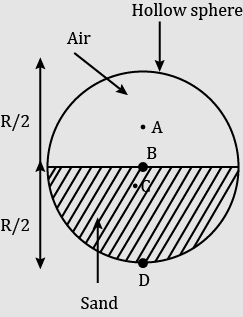
Which of the following points is the likely position of the centre of mass of the system shown in the figure ?
Image
  • A
    A
  • B
    B
  • C
  • D
    D
Answer
Correct option: C.
C
As the air and sand is half the volume of sphere, so the volume of sand is equal to the volume of air. The pressure of air region is less than pressure of sand region I.e.
$\text{P}_\text{air}<<\text{P}_\text{sand}$
$\therefore\ \text{M}_\text{sand}>>\text{M}_\text{air}$ inside the sphere.
As mass of sand is larger than air so the center of mass will shift towards sand from centre of sphere B i.e., centre mass of the system is at C. verifies the option (c).
View full question & answer
MCQ 21 Mark
In problem 7.5, the CM of the plate is now in the following quadrant of x - y plane:
  • A
    I
  • B
    II
  • III
  • D
    IV
Answer
Correct option: C.
III
As the mass at Q is decreased and placed at centre of mass so new C.M. will shift towards other side of Q on the line joining QP. So new C.M. Will lie in III quadrant.
View full question & answer
MCQ 31 Mark
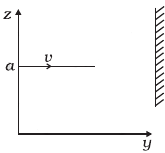
A particle of mass $m$ is moving in $yz-$ plane with a uniform velocity $v$ with its trajectory running parallel to $+ve\  y-$ axis and intersecting $z-$ axis at $z = a$. The change in its angular momentum about the origin as it bounces elastically from a wall at $y$ = constant is:
Image
  • A
    ${mva}\hat{e}_{x}$
  • $2{mva}\hat{e}_{x}$
  • C
    ${ymv}\hat{e}_{x}$
  • D
    $2{ymv}\hat{e}_{x}$
Answer
Correct option: B.
$2{mva}\hat{e}_{x}$
Key concept : Angular momentum is an axial vector, i.e. always directed.
perpendicular to the plane of rotation and along the axis of rotation.
In cartesian co-ordinates if $\vec{r}={x}\hat{i}+{y}\hat{j}+{z}\hat{k}$ and $\vec{{P}}={P}_{x}\hat{i}+{P}_{y}\hat{j}+{P}_{z}\hat{k}$
Then $\vec{L}=\vec{r}\times\vec{P}=\begin{vmatrix}\hat{i}&\hat{j} &\hat{k}\\{x}&{y}&{z}\\{P}_{y}&{P}_{x}&{P}_{z}\end{vmatrix}$
$=\big({y}{P}_{z}-{z}{P}_{y}\big)\hat{i}-\big({x}{P}_{z}-{z}{P}_{x}\big)\hat{j}+\big({x}{P}_{y}-{y}{P}_{x}\big)\hat{k}$
$KE$ of the system remains conserved, in elastic collision.
So, the ball will bounce back with the same speed $v$ but in opposite direction, i.e. along $-ve\ y-$ axis,
The initial velocity is $\vec{{v}_{i}}={v}\hat{{e}_{y}}$ and after reflection from the wall, the final velocity is $\vec{{v}}_{f}=-{v}\hat{e}_{y}$ The trajectory is described as position vector
$\vec{r}={y}\hat{e}_{y}+{a}\hat{e}_{z}$
Hence, the change in angular momentum is
$\Delta\vec{L}=\vec{r}\times\Delta\vec{{P}}=\Delta\vec{L}=\vec{r}\times{m}\big(\vec{{v}}_{f}-\vec{{v}}_{j}\big)$
$=\big({y}\hat{e}_{y}+{a}\hat{e}_{z}\big)\times\big(-{mv}\hat{{e}_{y}}-{mv}\hat{e}_{y}\big)$
$=\big({y}\hat{e}_{y}+{a}\hat{e}_{z}\big)\times\big(-2{mv}\hat{e}_{y}\big)$
$\big[\because\ \hat{e}_{y}\times\hat{e}_{z}=0{\ \text{and} \ }\hat{e}_{z}\times\hat{e}_{y}=-\hat{e}_{x}\big]$
$=-2{mav}(-\hat{{e}_{x}})$
$=2{mav}\hat{e}_{x}$
View full question & answer
MCQ 41 Mark
Choose the correct alternatives:
  1. For a general rotational motion, angular momentum $L$ and angular velocity $\omega$ need not be parallel.
  2. For a rotational motion about a fixed axis, angular momentum $L \omega$ are always parallel.
  3. For a general translational motion, momentum $P$ and velocity $v$ are aways parallel.
  4. For a general translational motion, acceleration $a$ and velocity $v$ are always parallel.
  • A
    $a$ and $b$
  • $a$ and $c$
  • C
    $b$ and $d$
  • D
    All of the above
Answer
Correct option: B.
$a$ and $c$
  1. For a general rotational motion where axis of rotation is not symmetric. Angular momentum $Z$ and angular velocity $0.$ need not be parallel. The wobbly motion of a wheel rotating about an axis inclined at a small angle to the symmetry axis of the wheel represents a situation where angular momentum and angular velocity are not parallel.
  2. Fixed axis should pass through $CM$ of the body, so it is not necessary angular momentum $Z$ and angular velocity $\omega$ are always parallel.
  3. As we know in a general translational motion linear momentum is given by, $p = mv$ , hence, direction of $p$ is always along $v .$
  4. In projectile motion, $v$ and $a$ are not always parallel.
View full question & answer
MCQ 51 Mark
For which of the following does the centre of mass lie outside the body?
  • A
    A pencil
  • B
    A shotput
  • C
    A dice
  • A bangle
Answer
Correct option: D.
A bangle
Key concept: Center of mass of a system (body) is a point that moves as though all the mass were concentrated there and all external forces were applied there.
Important Points about Center of Mass:
The position of center of mass is independent of the co-ordinate system chosen.
The position of center of mass depends upon the shape of the body and distribution of mass.
Example: The center of mass of a circular disc is within the material of the body while that of a circular ring is outside the material of the body.
We can imagine a rigid body also as a system of masses and hence every rigid body has a center of mass. In case of a regularly shaped uniform rigid body, center of mass is simply the geometric centre of the body. A bangle is in the form of a ring as shown in the diagram below. We know that the position of center of mass depends upon the shape of the body and distribution of mass. So, out of four given bodies, the centre of mass lies at the centre, which is outside the body (boundary) whereas in all other three bodies it lies within the body because they are completely solid.

View full question & answer
MCQ 61 Mark
The density of a non-uniform rod of length 1m is given by $\rho(\text{x})=\alpha(1+\text{b}\text{x}^2)$ where a and b are constants and $0\leq\text{x}\leq1$ The centre of mass of the rod will be at:
  • $\frac{3(2+\text{b})}{4(3+\text{b})}$
  • B
    $\frac{4(2+\text{b})}{3(3+\text{b})}$
  • C
    $\frac{3(3+\text{b})}{4(2+\text{b})}$
  • D
    $\frac{4(3+\text{b})}{3(2+\text{b})}$
Answer
Correct option: A.
$\frac{3(2+\text{b})}{4(3+\text{b})}$
According to the problem, density is given as $\rho(\text{x})=\alpha(1+\text{b}\text{x}^2)$ where a and b are constants and $0\leq\text{x}\leq1$

Let us first consider a small element of the rod at a distance x from one end of length dx.
So, mass of this element is
$\text{dm}=\rho(\text{dx})=\text{a}\big(1+\text{bx}^2\big)\text{dx}$
The centre of mass of the rod is,
$\text{X}_\text{cm}=\frac{\int\limits^1_0\text{x dm}}{\int\limits^1_0\text{dm}}=\frac{\int\limits^1_0\text{xa}(1+\text{bx}^2)}{\int\limits^1_0(1+\text{bx}^2)\text{dx}}$
$=\frac{\int\limits^1_0{(\text{x}+\text{bx}^3)\text{dx}}}{\int\limits^1_0\text{a}(1+\text{bx}^2)\text{dx}}=\frac{\Big[\frac{\text{x}^2}{2}+\frac{\text{bx}^4}{4}\Big]^1_0}{\Big[\text{x}+\frac{\text{bx}^3}{3}\Big]^1_0}$
$=\frac{\big[\frac{1}{2}+\frac{\text{b}}{4}\big]}{\big[1+\frac{\text{b}}{3}\big]}=\frac{3(2+\text{b})}{4(3+\text{b})}$
View full question & answer
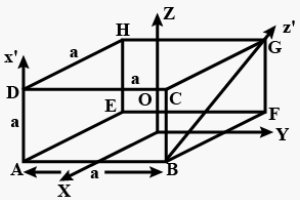
MCQ 71 Mark
With reference to of a cube of edge a and mass $m,$ state whether the following are true or false. $(O$ is the centre of the cube.$)$
Image
  1. The moment of inertia of cube about $z-$axis is $\text{I}_\text{x}=\text{I}_\text{x}+\text{I}_\text{y}$
  2. The moment of inertia of cube about $z′$ is $\text{I}'_\text{z}=\text{I}_\text{z}+\frac{\text{ma}^2}{2}$
  3. The moment of inertia of cube about $z"$ is $\text{I}{''}_{\text{z}}=\text{I}_2+\frac{\text{ma}^2}{2}$
  4. $\text{I}_\text{x}=\text{I}_\text{y}$
  • $2$ and $4$
  • B
    $1$ and $4$
  • C
    $2$ and $3$
  • D
    $1$ and $2$
Answer
Correct option: A.
$2$ and $4$
We can apply the concept of symmetry to calculate the net moment of inertia. Moment of inertia about two symmetrical axes are same.
Theorem of perpendicular axes is applicable only for laminar $($like plane sheet$)$ object. Therefore, option $(a)$ is false.
As $'z$ and $z$ are parallel and distance between tham $=\text{a}\frac{\sqrt{2}}{2}=\frac{\text{a}}{\sqrt{2}}$
Now, by theorem of parallel axes.
$\text{I}'_{\text{z}}=\text{I}_\text{z}+\text{m}\Big(\frac{\text{a}}{\sqrt{2}}\Big)^2=\text{I}_\text{z}+\frac{\text{ma}^2}{2}$
Hence, choice $(b)$ is true.
$z"$ and $z$ are not parallel. Hence, theorem of parallel axis cannot be appicable here. Thus, option $(c)$ is false.
$x-$axis and $y-$axis are symmetrical for the cube, $Ix = Iy.$ Therefore, option $(d)$ is true.
View full question & answer
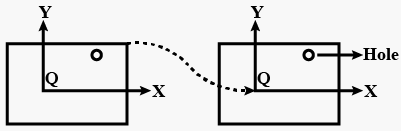
MCQ 81 Mark
A uniform square plate has a small piece $Q$ of an irregular shape removed and glued to the centre of the plate leaving a hole behind. The moment of inertia about the $z-$axis is then:
Image
  • A
    Increased
  • Decreased
  • C
    The same
  • D
    Changed in unpredicted manner.
Answer
Correct option: B.
Decreased
View full question & answer
MCQ 91 Mark
A Merry-go-round, made of a ring-like platform of radius R and mass M, is revolving with angular speed $\omega$ A person of mass M is standing on it. At one instant, the person jumps off the round, radially away from the centre of the round (as seen from the round). The speed of the round afterwards is:
  • A
    $2\omega$
  • $\omega$
  • C
    $\frac{\omega}{2}$
  • D
    $0$
Answer
Correct option: B.
$\omega$
As no torque is exerted by the person jumping, radially away from the centre of the round (as seen from the round), let the total moment of inertia of the system is 2I (round + Person (because the total mass is 2M) and the round is revolving with angular speed $\omega$ Since the angular momentum of the person when it jumps off the round is $\text{I}\omega$ the actual momentum of round seen from ground is $2\text{I}\omega-\text{I}\omega=\text{I}\omega$ So we conclude that the angular speed remains same, i.e., $\omega$

View full question & answer
MCQ 101 Mark
When a disc rotates with uniform angular velocity, which of the following is not true?
  • A
    The sense of rotation remains same.
  • B
    The orientation of the axis of rotation remains same.
  • C
    The speed of rotation is non-zero and remains same.
  • The angular acceleration is non-zero and remains same.
Answer
Correct option: D.
The angular acceleration is non-zero and remains same.
$\because\ \omega$ is uniform or constant
$\therefore\ \alpha=\frac{\text{d}\omega}{\text{dt}}$
$\Rightarrow\alpha=0$
Hence, angular acceleration is zero, not non zero.
View full question & answer
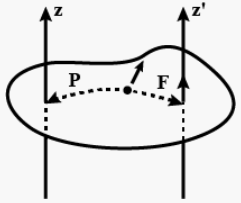
MCQ 111 Mark
Shows a lamina in $x-y$ plane. Two axes $z$ and $z′$ pass perpendicular to its plane. A force $F$ acts in the plane of lamina at point $P$ as shown. Which of the following are true? $($The point $P$ is closer to $z′-$axis than the $z-$axis$)$
Image
  1. Torque $\tau$ caused by $F$ about $z-$axis is along $-\hat{\text{k}}.$
  2. Torque $\tau'$ caused by $F$ about $z'$ axis is along $-\hat{\text{k}}.$
  3. Torque $\tau$ caused by $F$ about $z-$axis is greater in magnitude than that about $z$ axis.
  4. Total torque is given be $\tau=\tau+\tau'$
  • A
    $A$ and $B$
  • $B$ and $C$
  • C
    $A$ and $D$
  • D
    All of the above
Answer
Correct option: B.
$B$ and $C$
$\text{r}'<\text{r} ($given$)$
$\vec{\tau}_\text{z}=\vec{\text{r}}\times\vec{\text{F}}$
$\tau_\text{z}=\text{rF}\sin\theta'(+\hat{\text{k}})$
As $\vec{\text{r}}$ and $\vec{\text{F}}$ are $x-y$ plane.
So, $\vec{\text{r}}\times\vec{\text{F}}$ will be $+\hat{\text{k}}$ direction by Right Hand Grip Thumb Rule.
$\vec{\tau}=\vec{\text{r}}\times\vec{\text{F}}=\text{r}\text{F}\sin\theta(-\hat{\text{K}})$
Reason same as in part $(a)$ verifies the obtion $(b).$
$\because\ \text{r}>\tau'$ and $\theta>\theta'$
$\sin\theta>\sin\theta'$
$\text{rF}\sin\theta>\text{r}'\text{F}\sin\theta'$
$\tau_\text{z}>\tau_\text{z}$
Hence, verifies the obtion $(c).$
$\tau=\tau_\text{z}+\tau_\text{z},$ will be true if $\tau_\text{z}$ and $\tau_\text{z},$ are along the same axis but here the axis are different $z$ and $Z'.$
So, $\tau\neq\tau_\text{z}+\tau_\text{z}$ rejects the option $(d).$
View full question & answer
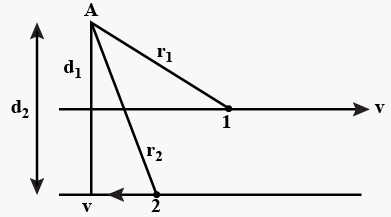
MCQ 121 Mark
Shows two identical particles $1$ and $2$, each of mass $m$, moving in opposite directions with same speed $v$ along parallel lines. At a particular instant, $r_1$ and $r_2$ are their respective position vectors drawn from point A which is in the plane of the parallel lines. Choose the correct options:
Image
  • A
    Angular momentum $I_1$ of particle $1$ about A is $I = mvd_{1.}$
  • B
    Angular momentum $I_2$ of particle $2$ about A is $I_2= mvr_{2.}$
  • C
    Total angular momentum of the system about A is $\text{I}=\text{mv}(\text{r}_1+\text{r}_2)$
  • Total angular momentum of the system about A is $\text{I}=\text{mv}(\text{d}_2-\text{d}_1)\otimes$ represents a unit vector coming out of the page. $\otimes$ represents a unit vector going into the page.
Answer
Correct option: D.
Total angular momentum of the system about A is $\text{I}=\text{mv}(\text{d}_2-\text{d}_1)\otimes$ represents a unit vector coming out of the page. $\otimes$ represents a unit vector going into the page.
For particle 1, $\vec{\text{L}}_{-1}=\vec{\text{r}}_1\times\vec{\text{p}}\odot$
$\vec{\text{L}}=\vec{\text{r}_1}\times\text{m}\vec{\text{v}}\odot$
$\otimes=\vec{\text{r}}_1\times\text{m}\vec{\text{v}}\odot=\text{m}\vec{\text{v}}\text{d}_1\odot$
$\vec{\text{L}}_2=\vec{\text{r}}_1\times\text{m}(-\vec{\text{v}})\otimes=\text{m}\vec{\text{v}}\text{d}_2\otimes$
Hence, option (a) is verifies and (b) rejected.
Total Angular momentum $\vec{\text{L}}-=-\vec{\text{L}}_1+\vec{\text{L}}_2$
$\vec{\text{L}}-=\text{m}\vec{\text{v}}\text{d}_1\odot-\text{m}\vec{\text{v}}\text{d}_2\otimes$
As $\text{d}_2>\text{d}_1\ \ \therefore\big|\vec{\text{L}}_2\big|>\big|\vec{\text{L}}_1\big|$
(-) Sign shows (only) the direction of L.
$\therefore\ \vec{\text{L}}=\text{m}\vec{\text{v}}\big(-\text{d}_2-\text{d}_1\big)\otimes$
Verifies option $(d).$
View full question & answer
M.C.Q (1 Marks) - Physics STD 11 Science Questions - Vidyadip