Questions

1 Marks Question

🎯

Test yourself on this topic

15 questions · timed · auto-graded

MCQ 11 Mark
Consider the following statement regarding a thermocouple:
  1. The neutral temperature does not depend on the temperature of the cold junction.
  2. The inversion temperature does not depend on the temperature of the cold juhction.
  • A
    Both $A$ and $B$ are correct.
  • $A$ is correct but a is wrong.
  • C
    $B$ is correct but $A$ is wrong.
  • D
    Both $A$ and $B$ are wrong.
Answer
Correct option: B.
$A$ is correct but a is wrong.
At cold function:
$Q_n-Q_c=Q_i-Q_n$
where $\mathrm{Q}_{\mathrm{n}}$ Þ neutral temperture
$\mathrm{Q}_{\mathrm{i}}$ Þ inversion temperature
$\mathrm{Q}_{\mathrm{CÞ}}$ thermo-couple temperature.
$Þ$ The neutral temperature does not depend on the temperature of the cold function.
$Þ$ The inversion temperature does depend on the temperature of the cold function.
View full question & answer
Question 21 Mark
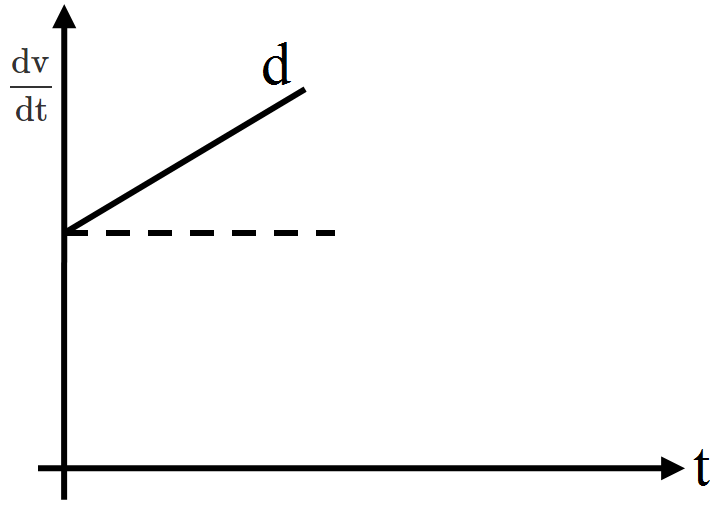
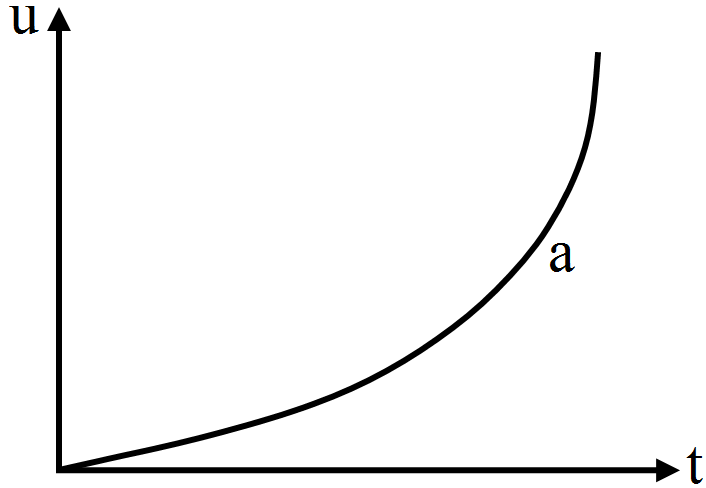
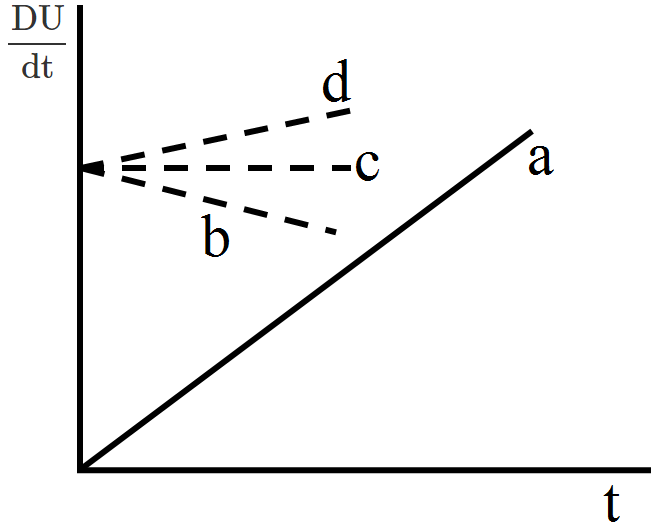
A constant current i is passed through a resistor. Taking the temperature coefficient of resistance into account, indicate which of the plots shown in figure best represents the rate of production of thermal energy in the resistor.
Answer
  1.  

Explanation:
$\text{U}_{\text{AB}}=\text{a}_{\text{AB}}\theta+\frac{1}{2}\text{b}_{\text{AB}}\theta^2$
$\text{q}\times\text{t}$
$\text{dq}\times\text{dt}$
$Þ \ \frac{\text{du}_{\text{AB}}}{\text{du}}\propto\text{a}_{\text{AB}+\text{b}_{\text{AB}}}\text{t}$
View full question & answer
Question 31 Mark
Do the electrodes in an electrolytic cell have fixed polarity like a battery?
Answer
Yes, polarity of electrolytic cell is fixed.
View full question & answer
Question 41 Mark
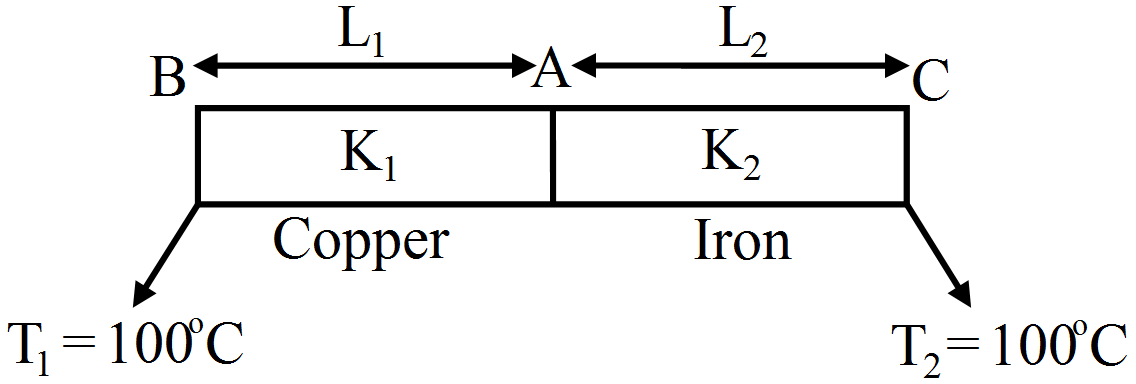
A copper strip $AB$ and an iron strip $AC$ are joined at $A$. The junction $A$ is maintained at $0^{\circ}C$ and the free ends $B$ and $C$ are maintained at $100^{\circ}C$. There is a potential difference between:
  1. The two ends of the copper strip.
  2. The copper end and the iron end at the junction.
  3. The two ends of the iron strip.
  4. The free ends $B$ and $C$.
Answer
  1. The two ends of the copper strip.
  2. The copper end and the iron end at the junction.
  3. The two ends of the iron strip.
  4. The free ends $B$ and $C$.

Explanation:
In steady state the rate of flow of that in both rods in the same.
$Þ\Big(\frac{\text{Q}}{\text{t}}\Big)_1=\Big(\frac{\text{Q}}{\text{t}}\Big)_2$
$\frac{\text{K}_1\text{A}(\text{T}_1-\text{T})}{\text{L}_1}$
$=\frac{\text{K}_2\text{A}(\text{T}-\text{T}_2)}{\text{L}_2}$
"$K_1 K_2$ is the conductivity of the metals".
So, potential is different in different end $($Because conductivity of metals are different$)$.
View full question & answer
MCQ 51 Mark
The heat developed in a system is proportional to the current through it:
  • A
    It cannot be Thomson heat.
  • B
    It cannot be Peltier heat.
  • It cannot be Joule heat.
  • D
    It can be any of the three heats mentioned above.
Answer
Correct option: C.
It cannot be Joule heat.
Joule heat is directly proportional to the square of the current passing through the resistor. Peltier heat is directly proportional to the current passing through the junction. Thomson heat is also directly proportional to the current passing through the section of the wire. Thus, the heat developed can be either Thomson heat or Peltier heat. But it cannot be Joule heat.
View full question & answer
MCQ 61 Mark
An electrolysis experiment is stopped and the battery terminals are reversed:
  • A
    The electrolysis will stop.
  • B
    The rate of liberation of material at the electrodes will increase.
  • The rate of liberation of material will remain the same.
  • D
    Heat will be produced at a greater rate.
Answer
Correct option: C.
The rate of liberation of material will remain the same.
An electrolysis experiment is stopped and the battery terminals are reversed. But the rate of liberation of meterial will remain the same.
View full question & answer
Question 71 Mark
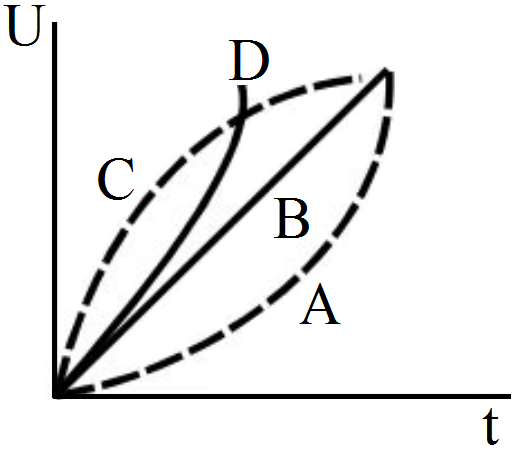
Which of the following plots may represent the thermal energy produced in a resistor in a given time as a function of the electric current?
Answer
  1.  

Explanation:
$\text{U}_\text{AB}=\text{O}_{\text{AB}}\text{q}+\frac{1}{2}\text{b}_\text{AB}\theta^2$
$\theta\propto\text{t}$
$\text{U}_{\text{AB}}\propto\text{a}_{\text{AB}}\text{t}+\frac{1}{2}\text{b}_{\text{AB}}\text{t}^2$
View full question & answer
MCQ 81 Mark
Two resistors having equal resistances are joined in series and a current is passed through the combination. Neglect any variation in resistance as the temperature changes. In a given time interval:
  • A
    Equal amounts of thermal energy must be produced in the resistors.
  • B
    Unequal amounts of thermal energy may be produced.
  • C
    The temperature must rise equally in the resistors.
  • D
    The temperature may rise equally in the resistors.
Answer
  1. Equal amounts of thermal energy must be produced in the resistors.
  1. The temperature may rise equally in the resistors.
Explanation:
In a resistor of resistance $R$, current i is passed for time t then the thermal energy produced in the resistor will be given by $H = i^2Rt$
As the resistors are in series, the current through them will be same. Thus, the amount of thermal energy produced in the resistors is same. The rise in the temperature of the resistance will depend on the shape and size of the resistor. Thus, the rise in the temperature of the two resistances may be equal.
View full question & answer
MCQ 91 Mark
The electrochemical equivalent of a material depends on:
  • The nature of the material.
  • B
    The current through the electrolyte containing the material.
  • C
    The amount of charge passed through the electrolyte.
  • D
    The amount of this material present in the electrolyte.
Answer
Correct option: A.
The nature of the material.
The electro chemical equivalent ofa material depends on the nature of the material.
Electro chemical equivalent of a substance is equal to its relative atomic mass divided by its valency.
View full question & answer
MCQ 101 Mark
The constants a and b for the pair silver-lead are $2.50\mu\text{V}\ ^\circ\text{C}$ and $​​​​0.012\mu\text{V}\ (^\circ\text{C})^2$respectively. For a silver$-$lead thermocouple with colder junction at $0^{\circ} C:\ $
  1. There will be no neutral temperature.
  2. There will be no inversion temperature.
  3. There will not be any thermo-emf even if the junctions are kept at different temperatures.
  4. There will be no current in the thermocouple even if the junctions are kept at different temperatures.
​​​​​​​
  • $a$ and $b$
  • B
    $b$ and $c$
  • C
    $c$ and $d$
  • D
    $a$ and $d$
Answer
Correct option: A.
$a$ and $b$
The temperature of the hot junction at which the thermo-emf in the thermocouple becomes maximum is called neutral temperature for that thermocouple. The signs of the constants a and b are same.
Therefore from the relation, $\theta_\text{n}=-\frac{\text{a}}{\text{b}}$ the neutral temperature will be less than the temperature of the cold junction of thermocouple.
Hence, there will be no neutral or inversion temperature, as the temperature of the hot junction cannot be less than the temperature of the cold junction.
View full question & answer
MCQ 111 Mark
Faraday constant:
  • A
    Depends on the amount of the electrolyte.
  • B
    Depends on the current in the electrolyte.
  • Is a universal constant.
  • D
    Depends on the amount of charge passed through the electrolyte.
Answer
Correct option: C.
Is a universal constant.
Faraday constant is universal constant.
View full question & answer
MCQ 121 Mark
Consider the following two statements:
  1. Free$-$electron density is different in different metals.
  2. Free$-$electron density in a metal depends on temperature.
Seebeck effect is caused
  • Due to both $A$ and $B.$
  • B
    Due to $A$ but not due to $B$.
  • C
    Due to $B$ but not due to $A$.
  • D
    Neither due to $A$ nor due to $B.$
Answer
Correct option: A.
Due to both $A$ and $B.$
See back effect is caused due to free electron density is different in different metals or free electron density in a metal depends on temperature.
View full question & answer
MCQ 131 Mark
Consider the statements $A$ and $B$ in the previous question. Peltier eftect is caused:
  • A
    Due to both $A$ and $B.$
  • Due to $A$ but not due to $B.$
  • C
    Due to $B$ but not due to $A.$
  • D
    Neither due to $A$ nor due to $B$.
Answer
Correct option: B.
Due to $A$ but not due to $B.$
Pelties effect is caused due to free electron density is different in different metals.
View full question & answer
MCQ 141 Mark
Consider the statements $A$ And $B$ in question $5$. Thomson effect is caused:
  • A
    Due to Both $A$ And $B$.
  • B
    Due to $A$ But not due to $B$.
  • Due to $B$ But not due to $A$.
  • D
    Neither due to $A$ nor due to $B$.
Answer
Correct option: C.
Due to $B$ But not due to $A$.
Thomson effect is caused due to free electron density in a metal depends on temperature.
View full question & answer
Question 151 Mark
When a current passes through a resistor, its temperature increases. Is it an adiabatic process?
Answer
Yes, it is adiabatic process.
View full question & answer
1 Marks Question - Physics STD 11 Science Questions - Vidyadip