Question types

Thermal and Chemical Effect of Current question types

46 questions across 4 question groups — pick any mix to generate a Physics paper with step-by-step answer keys.

46
Questions
4
Question groups
5
Question types
Sample Questions

Thermal and Chemical Effect of Current questions

One sample from each question group in this chapter. Select any group above to see the full set with answer keys.

Consider the following statement regarding a thermocouple:
  1. The neutral temperature does not depend on the temperature of the cold junction.
  2. The inversion temperature does not depend on the temperature of the cold juhction.
  • A
    Both $A$ and $B$ are correct.
  • $A$ is correct but a is wrong.
  • C
    $B$ is correct but $A$ is wrong.
  • D
    Both $A$ and $B$ are wrong.

Answer: B.

View full solution
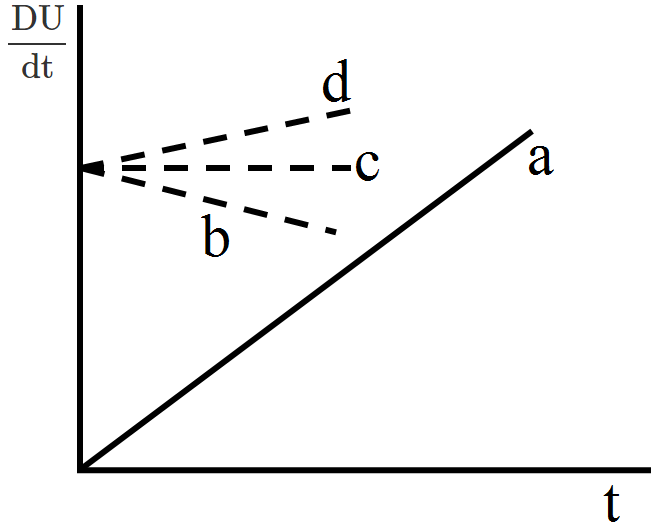
A constant current i is passed through a resistor. Taking the temperature coefficient of resistance into account, indicate which of the plots shown in figure best represents the rate of production of thermal energy in the resistor.
View full solution
A copper strip $AB$ and an iron strip $AC$ are joined at $A$. The junction $A$ is maintained at $0^{\circ}C$ and the free ends $B$ and $C$ are maintained at $100^{\circ}C$. There is a potential difference between:
  1. The two ends of the copper strip.
  2. The copper end and the iron end at the junction.
  3. The two ends of the iron strip.
  4. The free ends $B$ and $C$.
View full solution
The heat developed in a system is proportional to the current through it:
  • A
    It cannot be Thomson heat.
  • B
    It cannot be Peltier heat.
  • It cannot be Joule heat.
  • D
    It can be any of the three heats mentioned above.

Answer: C.

View full solution
A brass plate having surface area $200cm^2$ on one side is electroplated with $0·10mm$ thick silver layers on both sides using a $15A$ current. Find the time taken to do the job. The specific gravity of silver is $10.5$ and its atomic weight is $107.9 g/mol$.
View full solution
Is neutral temperature always the arithmetic mean of inversion temperature and the temperature of the cold junction? Does the unit of temperature have an effect in deciding this question?
View full solution
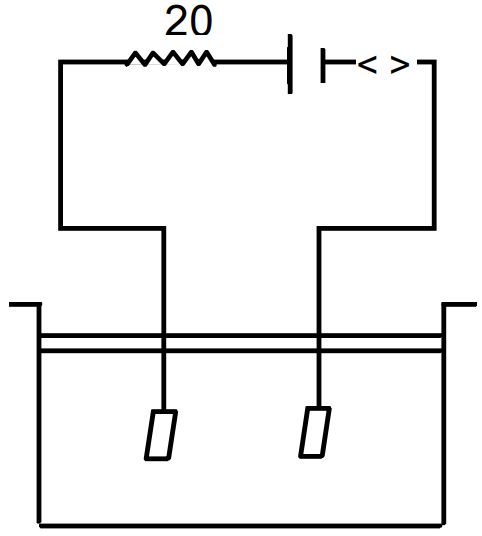
Figure shows an electrolyte of AgCl through which a current is passed. It is observed that 2.68g of silver is deposited in 10 minutes on the cathode. Find the heat developed in the $20\Omega$ resistor during this period. Atomic weight of silver is 107.9g/mole.
View full solution
An electroplating unit plates $3.0g$ of silver on a brass plate in $3.0\ minutes$. Find the current used by the unit. The electrochemical equivalent of silver is $1.12 \times 10^6kg C^{-1}$.
View full solution
Q 123 Marks Question3 Marks
The specification on a heater coil is $250V, 500W.$ Calculate the resistance of the coil. What will be the resistance of a coil of $1000W$ to operate at the same voltage?
View full solution
Q 143 Marks Question3 Marks
An electric bulb, when connected across a power supply of $220V,$ consumes a power of $60W.$ If the supply drops to $180V,$ what will be the power consumed? If the supply is suddenly increased to $240V,$ what will be the power consumed?
View full solution
Q 153 Marks Question3 Marks
A plate of area $10cm^2$ is to be electroplated with copper (density $9000kg/m^3$) to a thickness of 10 micrometres on both sides, using a cell of 12V. Calculate the energy spent by the cell in the process of deposition. If this energy is used to heat 100g of water, calculate the rise in the temperature of the water. ECE of copper = $3 \times 10^{-7}kg C^{-1}$ and specific heat capacity of water = $4200Jkg^{-1}$.
View full solution
The coil of an electric bulb takes 40 watts to start glowing. If more than 40W is supplied, 60% of the extra power is converted into light and the remaining into heat. The bulb consumes 100W at 220V. Find the percentage drop in the light intensity at a point if the supply voltage changes from 220V to 200V.
View full solution
A heater coil is to be constructed with a nichrome wire $(\rho=1.0\times10^{-6}\Omega-\text{m})$which can operate at 500W when connected to a 250V supply.
  1. What would be the resistance of the coil?
  2. If the cross-sectional area of the wire $0.5mm^2$, what length of the wire will be needed?
  3. If the radius of each turn is 4.0mm, how many turns will be there in the coil?
View full solution
A bulb with rating 250V, 100W is connected to a power supply of 220V situated 10m away using a copper wire of area of cross-section $5mm^2$. How much power will be consumed by the connecting wires? Resistivity of copper $1.7\times10^{-8}\Omega-\text{m}$.
View full solution
A servo voltage stabiliser restricts the voltage output to $220V ± 1\%$. If an electric bulb rated at $220V, 100W$ is connected to it, what will be the minimum and maximum power consumed by it?
View full solution

Generate a Thermal and Chemical Effect of Current paper free

Pick question groups from the list above, set marks and difficulty, and export a branded PDF with step-by-step answer keys. First 3 chapters free — no signup.

Download App