What is a thermostat? Briefly explain its principle.
Answer
It is a device that helps in maintaining a constant temperature. It consists of a bi-metallic strip which comprises of two thin strips of different materials (such as brass and invar) welded together along their lengths. On heating, this combination bends into an arc. It happens because brass has a higher coefficient of expansion than invar.
Heat is being supplied to a system but the system does not perform any external work. Is it possible? If yes, how?
Answer
Yes, it is possible. If total quantity of heat $\Delta\text{Q}$ supplied to a system is retained by it as its increase in internal energy $\Delta\text{U}$ i.e., $\Delta\text{Q}-\Delta\text{U,}$ then the external work done by the system AW is zero. Isochoric process is an example of this type of process.
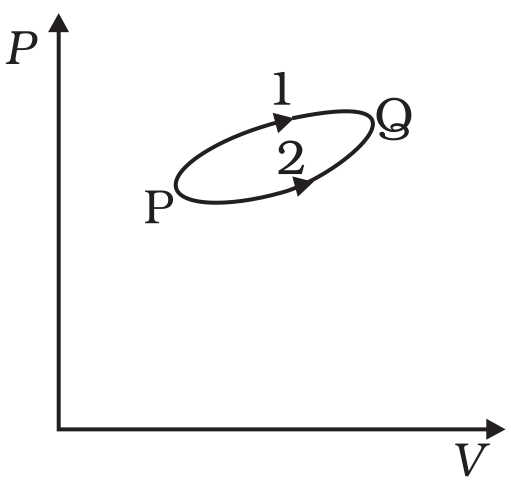
A system goes from P to Q by two different paths in the P-V diagram as shown in Fig. Heat given to the system in path 1 is 1000J. The work done by the system along path 1 is more than path 2 by 100J. What is the heat exchanged by the system in path 2?
Answer
For path (1) $Q_1=+1000 \mathrm{~J} W \cdot \mathrm{D}=\mathrm{W}_1 . \mathrm{W}_2=100 \mathrm{~W}_1=\mathrm{WD}$ through path $1 \mathrm{~W}_2=\mathrm{WD}$ through path $2 \therefore \mathrm{~W}_2=\mathrm{W}_1-100$ As change in internal energy by path 1 and 2 are same $\Delta \mathrm{U}=\mathrm{Q}_1-\mathrm{W}_1=\mathrm{Q}_2-\mathrm{W}_2 1000-\mathrm{W}_1=\mathrm{Q}_2-\left(\mathrm{W}_1-100\right)$ $1000=Q_2+100 Q_2=900 \mathrm{~J}$.
An indicator diagram is a graphical representation of the state of a system with the help of two thermodynamic variables (generally pressure and volume). Work done by a system is numerically equal to area under the P-V indicator diagram.
What is the nature of P-V diagram for isobaric and isochoric processes?
Answer
The P-V diagram for an isobaric process is a straight line parallel to volume axis while that for an isochoric process, it is a straight line parallel to pressure axis.
What is the change in internal energy of an ideal gas which is compressed/ expanded isothermally? Why?
Answer
Zero, because for an ideal gas internal energy is wholly kinetic and it is a function of temperature. As temperature remains constant in an isothermal process, hence, internal energy of an ideal gas remains constant.
A sample of an ideal gas in a cylinder is compressed adiabatically to $\frac13\text{rd}$ of its volume. Will the final pressure be more or less than 3 times the initial pressure?
Answer
Change in pressure will be more than 3 times the initial pressure.
Three stars A, B, C appear as green, red and blue respectively. Which star has minimum temperature?
Answer
As $\text{T}\propto\frac{1}{\lambda_\text{m}}$ and $\lambda_\text{m}$ for red colour is maximum, therefore temperature T is minimum for star B emitting red colour.
If a gas is suddenly compressed, its temperature increases, why?
Answer
Because sudden compression of a gas is an adiabatic process. According to the first law of thermodynamics, $\Delta\text{Q}=\Delta\text{U}+\Delta\text{W}$ $\because\Delta\text{Q}=0$ $\therefore\Delta\text{U}=-\Delta\text{W}$ $\because\Delta\text{W}=$ negative because work done on the gas Thus, $\Delta\text{U}$ increases and gas temperature rises.
A cloudy night is hotter than a clear sky night. Why?
Answer
This is because in the cloudy night, heat radiated out from earth is reflected by the clouds back to earth. Hence, temperature of the earth does not fall.
Apply first law of thermodynamics for isothermal expansion of an ideal gas.
Answer
First law of thermodynamics gives, $\Delta\text{Q}=\Delta\text{U}+\Delta\text{W}$ For an isothermal expansion, $\Delta\text{U}=0$ So, $\Delta\text{Q}=\Delta\text{W}$ For an isothermal expansion of the ideal gas work done by the gas is equal to the heat given to the ideal gas.
What is the value of $\gamma$ for a gas having 'n' degrees of freedom?
Answer
For n degrees of freedom, $\text{C}_\text{v}=\frac{\text{n}}{2}\text{R},\text{C}_\text{P}=\Big(\frac{\text{n}}{2}+1\Big)\text{R}$ $\therefore\gamma=\frac{\text{C}_\text{P}}{\text{C}_\text{V}}=\frac{\frac{\text{n}}{2}+1}{\frac{\text{n}}{2}}=\frac{2+\text{n}}{\text{n}}$
What is the specific heat of a gas in an isothermal process and in an adiabatic process?
Answer
Since $\text{s}=\frac{\text{Q}}{\text{m}\Delta\text{t}}$ For isothermal process, $\text{s}=\infty(\because\Delta\text{t}=0)$ For adiabatic process, $\text{s}=0.(\because\Delta\text{Q}=0)$