Question
What is an indicator diagram?

Answer

An indicator diagram is a graphical representation of the state of a system with the help of two thermodynamic variables (generally pressure and volume). Work done by a system is numerically equal to area under the P-V indicator diagram.

Need a full question paper?

Generate a complete, print-ready paper with questions like this in minutes — across 16+ boards, with answer keys.
Start Generating Free

Similar questions

In a real gas the internal energy depends on temperature and also on volume. The energy increases when the gas expands isothermally. Looking into the derivation of $C_P - C_v = R$, find whether $C_P - C_v$ will be more than R, less than R or equal to R for a real gas.
The increase in the speed of a car is proportional to the additional petrol put into the engine. Is it possible to accelerate a car without putting more petrol or less petrol into the engine?
A converging lens of focal length 12cm and a diverging mirror of focal length 7.5cm are placed 5.0cm apart with their principal axes coinciding. Where should an object be placed so that its image falls on itself?
It it possible for an object to have energy without momentum?
Between the first and fifth nodes is 40 cm then find wavelength of wave?
Explain this statement clearly: “To call a dimensional quantity ‘large’ or ‘small’ is meaningless without specifying a standard for comparison”. In view of this, reframe the following statements wherever necessary:
  1. Atoms are very small objects
  2. A jet plane moves with great speed
  3. The mass of Jupiter is very large
  4. The air inside this room contains a large number of molecules
  5. A proton is much more massive than an electron
  6. The speed of sound is much smaller than the speed of light.
If $f=x^2$, relative error in $f$, then how many times the relative error would be in $x$ ?
What will be the speed of sound in a perfectly rigid rod?
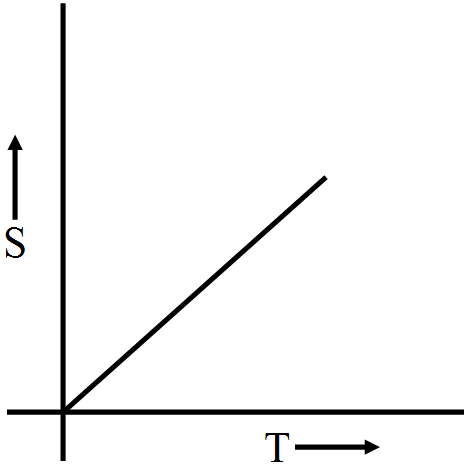
Displacement-time (S-T) graph of any object is shown in figure. Draw velocity-time graph for this motion.
A cylinder of mass $10\ kg$ and radius $15\ cm$ is rolling perfectly on a plane of inclination $30^\circ$ . The coefficient of static friction $\mu_\text{s}= 0.25$
  1. How much is the force of friction acting on the cylinder?
  2. What is the work done against friction during rolling?
  3. If the inclination $\theta$ of the plane is increased, at what value of $\theta$ does the cylinder begin to skid, and not roll perfectly?