Questions · Page 2 of 2

3 Marks Question

Question 513 Marks
What will happen to an ecosystem if:
All organisms of herbivore level are eliminated.
Answer
If all herbivores are eliminated from an ecosystem, there will be no food for the carnivores. Eventually, all the carnivores would be finished because of lack of food. Absence of herbivores will also result in exponential growth in plant population. But lack of other biotic factors will stop biogeochemical cycle. This will finally finish the ecosystem.
View full question & answer
Question 523 Marks
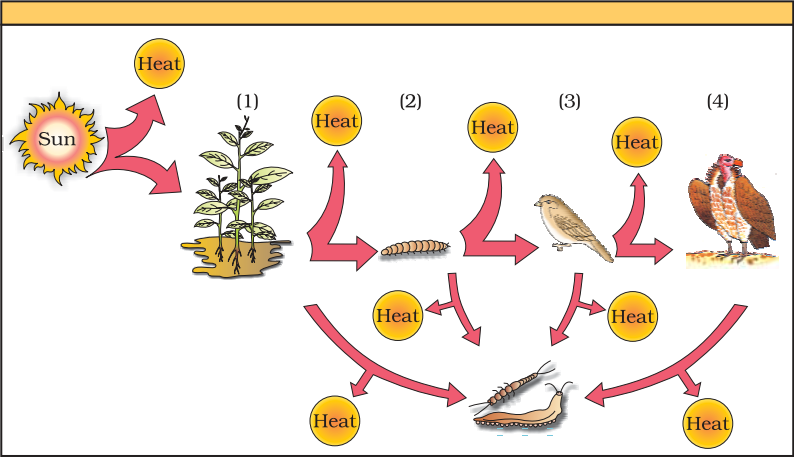
According to the 10% law given by Lindeman, only 10% of the energy is transferred to the next trophic level.
  1. Name the process by which an organism produces energy.
  2. What is the most common substrate used in this pathway?
  3. Which biomolecule is also known as energy currency of the cell?
Answer
  1. The process of harvesting chemical energy for metabolic activities by oxidising the food molecules is called respiration.
  2. The most common substrate used in the process is glucose.
  3. ATP or Adenosine Triphosphate is also known as energy currency of the cell.
View full question & answer
Question 543 Marks
What is eltonian pyramid?
Answer
Eltonian pyramid or ecological pyramid is graphic representation of an ecological parameter such as number of individuals, biomass or energy present in various trophic levels of a food chain with producers forming the base and carnivores the top.
View full question & answer
Question 553 Marks
Explain pyramid of numbers with the help of an example.
Answer

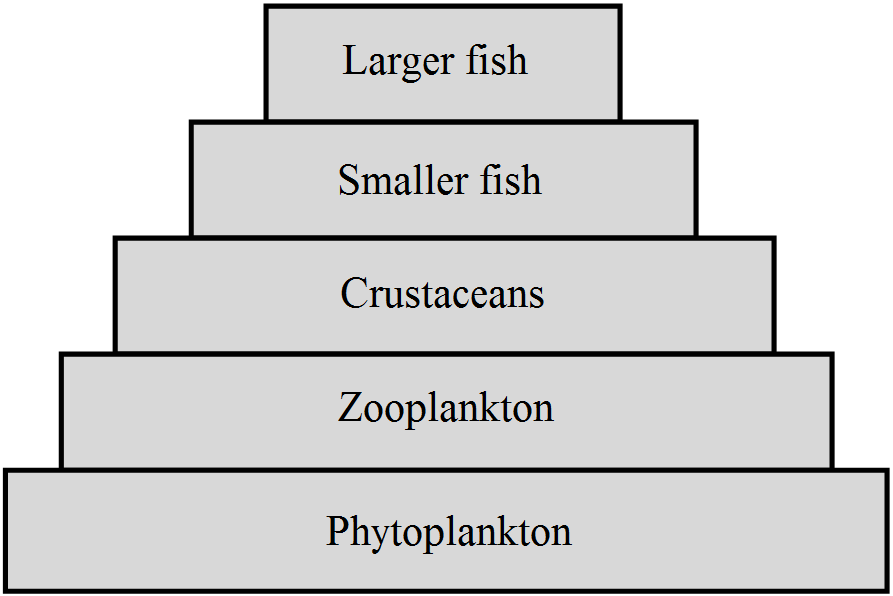
It is a graphic presentation of aquatic food chain in terms of numbers of producers and consumers at each level.
View full question & answer
Question 563 Marks
Name the kind of organisms which constitute the pioneer community of xerarch and hydrarch successions respectively.
Answer
The pioneer community of xerarch is usually lichens in the temperate regions and blue green algae in tropical region, whereas phytoplanktons (diatoms, green flagellates, green algae) followed by the zooplankton in the hydrarch succession.
View full question & answer
Question 573 Marks
How do you distinguish between humification and mineralisation?
Answer
Humification leads to accumulation of a dark coloured amorphous substance called humus that is highly resistant to microbial action and undergoes decomposition at an extremely slow rate. Being colloidal in nature it serves as a reservoir of nutrients. The humus is further degraded by some microbes and release of inorganic nutrients occurs by the process known as mineralisation.
View full question & answer
Question 583 Marks
The rate of decomposition of detritus is affected by the abiotic factors like availability of oxygen, pH of the soil substratum, temperature etc. Discuss.
Answer
The decomposition of detritus is due to activities of micro-organisms. The rate of growth of microbes is affected by temperature. The pH of substratum affects the composition of microbes (acidophiles/ basophiles) which degrade the dead organic matter. If oxygen is present, aerobic degradation occurs. In the absence of oxygen anaerobiosis sets in and there will be incomplete degradation. Also, the degradation is due to activity of exoenzymes secreted by the microbes and the activity of enzyme is affected by factors such as temperature etc.
View full question & answer
Question 593 Marks
In relation to energy transfer in ecosystem, explain the statement "10kg of deer's meat is equivalent to 1kg of lion's flesh".
Answer
We know that just 10% of energy consumed at a trophic level is available for the next trophic level. Here; 10kg of deer’s meat means 10kg of biomass at the level of primary consumer. Out of this, 90% is utilized by the deer for its own needs. Rest 10%, i.e. just 1kg is available for the lion. Hence, it is correct to say that 10kg of deer’s meat is equivalent to 1kg of lion’s flesh.
View full question & answer
Question 603 Marks
What are the limitations of ecological pyramids?
Answer
Limitations of ecological pyramids:
  1. It never takes into account the same species belonging to two or more trophic levels.
  2. It assumes a simple food chain, which never exists in nature.
  3. In spite of the vital role played by saprophytes/ decomposers, they are not given any position in ecological pyramids.
View full question & answer
Question 613 Marks
Is an aquarium a complete ecosystem?
Answer
Aquarium is man-made ecosystem and it has its own limitations. The confined space of aquarium cannot have endless supply of inorganic materials for producers. For supporting even a small number of consumers, there is a need for a large number of producers which is not possible in a small space of aquarium. One needs to provides food for the fish in the aquarium and regular cleaning of aquarium is also necessary. This shows that an aquarium is not a complete ecosystem because it is not self-sustainable.
View full question & answer
Question 623 Marks
Name the two forms of reservoir of carbon that regulate the ecosystem carbon cycle.
Answer
Oceans and atmosphere.
View full question & answer
Question 633 Marks
What are decomposers? What is their function in ecosystem?
Answer
Decomposers are saprophagous/ saprotrophs, which feed on dead bodies of organisms and organic wastes of living organisms.
They bring about decomposition and mineralisation of the dead matter to release them back for reuse by the autotrophs.
View full question & answer
Question 643 Marks
How does a detritivore differ from a decomposer? Explain with an example each.
Answer
Detritivore
Decomposer
Detritivore is an organism that breaks down the detritus into smaller particles in the process, called fragmentation, e.g. Earthworm.
Decomposer is an organism which by secreting enzymes degrades the detritus into simpler inorganic substances, e.g. Some bacteria and some fungi.
View full question & answer
Question 653 Marks
What is an incomplete ecosystem? Explain with the help of suitable example.
Answer
An ecosystem is a functional unit with biotic and abiotic factors interacting with one another resulting in a physical structure. Absence of any component will make an ecosystem incomplete as it will hinder the functioning of the ecosystem. Examples of such an ecosystem can be a fish tank or deep aphotic zone of the oceans where producers are absent.
View full question & answer
Question 663 Marks
Fill in the missing stages in the given primary hydrarch succession.
Phytoplankton → (a) → (b) → (c) → Submerged free-floating → (d) → Forest plant stage.
What is common between hydrarch and xerarch succession?
Answer
  1. Reed-swamp stage.
  2. Submerged plant stage.
  3. Marsh-meadow stage.
  4. Scrub stage.
Both the hydrarch and xerarch lead to mesic conditions of forest.
View full question & answer
Question 673 Marks
Distinguish between gross primary productivity and net primary productivity.
Answer
Gross primary productivity (GPP) is the rate of production of organic matter during photosynthesis.
GPP - Respiration losses (R) = Net primary productivity (NPP).
View full question & answer
Question 683 Marks
Construct an ideal pyramid of energy, where 1,000,000 joules of sunlight is available. Label all its trophic level.
View full question & answer
Question 693 Marks
What will happen to an ecosystem if:
  1. All producers are removed;
  2. All organisms of herbivore level are eliminated;
  3. All top carnivore population is removed.
Answer
  1. Reduction in primary productivity. No biomass available for consumption by higher trophic levels/ heterotrophs and hence heterotrophs also die of starvation.
  2. Increase in primary productivity and biomass of producers. Carnivore population will subsequently dwindle due to food shortage.
  3. Increase in number of herbivores which leads to over-grazing by herbivores, finally resulting in desertification.
View full question & answer
Question 703 Marks
What is sere? Which species can be named as dominant species?
Answer
The entire sequence of development stages of biotic succession from pioneer to a climax community is called sere.
Dominant species is that species which represent most numerous population in a seral or climax community.
View full question & answer
Question 713 Marks
Poaching of tiger is a burning issue in today's world. What implication would this activity have on the functioning of the ecosystem of which the tigers are an integral part?
Answer
Poaching (hunting) of tiger disturbs the ecological balance in ecosystem. Tigers are important predator of forest. Predator keeps prey population under control. Due to hunting of tiger its population decreases, hence the population of deer (prey) increases and interspecific competition occurs between them. Due to increase in prey population (that feeds on vegetation/ grass), vegetation destroyed rapidly which causes ecological disturbance.
View full question & answer
Question 723 Marks
Describe the different classes of consumers.
Answer
The consumers may be of following types:
  1. Primary consumers: The consumers that feed on plants direcdy, are called primary consumers or herbivores.
  2. Secondary consumers: Those animals, which ear other animals, who ear plants are called secondary consumers. These are also referred ro as primary carnivores.
  3. Tertiary consumers: These are animals who feeds on secondary consumers for their nutrition. These are also referred to as secondary carnivores.
Therefore, due to this interdependence of food/energy between organisms, the chains or webs are formed in the ecosystem.
View full question & answer