MCQ 11 Mark
The value of Henry’s constant $K_H$ is $.......$
- A
Greater for gases with higher solubility.
- ✓
Greater for gases with lower solubility.
- C
- D
Not related to the solubility of gases.
AnswerCorrect option: B. Greater for gases with lower solubility.
The value of Henry's constant $K_H$ is greater for gases with lower solubility because of the mathematical relation.
$\text{P}=\text{K}_\text{H}\times\text{x}$
$\text{K}_\text{H}=\frac{\text{P}}{\text{x}}$
where$, K_H$ represents Henry's constant$, p$ is partial pressure of the gas in vapour phase, and $x$ denotes mole fraction of the gas in solution. Thus $K_H$ is inversely proportional to mole fraction of gas in solution $($representing its solubility$).$
View full question & answer→MCQ 21 Mark
Which of the following options is not a viable option?
AnswerA solid solution is a one $-$ or more $-$ solute solid $-$ state solution in a solvent. Solid solutions include brass, bronze, and hydrated salts. Liquid solutions include aerated beverages.
View full question & answer→MCQ 31 Mark
Among the following substances the lowest vapour pressure is exerted by:
MCQ 41 Mark
Which of the following statements is false?
- ✓
Two different solutions of sucrose of same molality prepared in different solvents will have the same depression in freezing point.
- B
The osmotic pressure of a solution is given by the equation $\pi=\text{CRT}\ ($where $C$ is the molarity of the solution$).$
- C
Decreasing order of osmotic pressure for $0.01M$ aqueous solutions of barium chloride, potassium chloride, acetic acid and sucrose is $\mathrm{BaCl}_2 > \mathrm{KCl} > \mathrm{CH}_3 \mathrm{COOH} > $ sucrose.
- D
According to Raoult's law, the vapour pressure exerted by a volatile component of a solution is directly proportional to its mole fraction in the solution.
AnswerCorrect option: A. Two different solutions of sucrose of same molality prepared in different solvents will have the same depression in freezing point.
$\text{Tf = Kfm}$ Since $Kf$ values depend upon the nature of solvent, the depression in freezing point of the solution would not be the same.
View full question & answer→MCQ 51 Mark
What is an example of camphor in $N_2$ gas?
AnswerSolid in gaseous solution is an example of camphor in $N_2$ gas. Gaseous solution refers to a solution in which the solvent is gaseous. Other gaseous solutions include air $(O_2 + N_2),$ iodine vapors in air, humidity in air, and so on.
View full question & answer→MCQ 61 Mark
The correct statement among the following is:
- ✓
Smoke is carbon dispersed in air.
- B
Butter is water dispersed in fat.
- C
Greater is the valency of ion more will be its coagulating power.
- D
More is the gold number of a lyophobic sot, more is protecting power.
AnswerCorrect option: A. Smoke is carbon dispersed in air.
Smoke is carbon $($solid particle$)$ dispersed in air. It is the type of solid in gas type of solution.
View full question & answer→MCQ 71 Mark
A solution of benzene and toluene is an example of $.......$ solution.
AnswerDue to absence of polarity, benzene and toluene dont have any interaction forces so they dont show any deviation and forms ideal solutions.
View full question & answer→MCQ 81 Mark
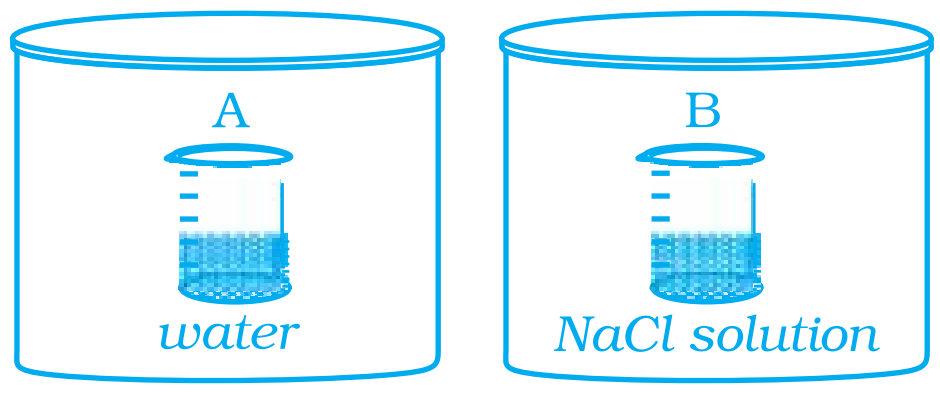
Two beakers of capacity $500\ mL$ were taken. One of these beakers, labelled as $“A\ ”,$ was filled with $400\ mL$ water whereas the beaker labelled $“B\ ”$ was filled with $400\ mL$ of $2M$ solution of $\text{NaCl}.$ At the same temperature both the beakers were placed in closed containers of same material and same capacity as shown in. At a given temperature, which of the following statement is correct about the vapour pressure of pure water and that of $\text{NaCl}$ solution.
AnswerCorrect option: A. vapour pressure in container $(A)$ is more than that in container $(B).$
Since $\text{NaCl}$ is a non$-$volatile solute, it will reduce vapour pressure of the solution. Hence, vapour pressure of pure water in container $A$ is more than in container $B.$
View full question & answer→MCQ 91 Mark
The rate of vapourisation of water depends upon:
- A
- B
Surface area of container
- C
kinetic energy of liquid molecules
- ✓
AnswerThe rate of vapourization of water depends on the temperature and surface area.
The kinetic energy of molecules depends on the temperature of the water.
Increasing temperature or surface area increases the rate of evaporation and vice$-$versa.
View full question & answer→MCQ 101 Mark
The atmospheric pollution is generally measured in the units of:
AnswerCorrect option: D. $\text{ppm}$
View full question & answer→MCQ 111 Mark
The possible van't Hoff factor for sodium chloride in water assuming sodium chloride is partially ionized:
- A
$0.5$
- B
$0.75$
- C
$2.5$
- ✓
$1.5$
View full question & answer→MCQ 121 Mark
Out of molality $(m),$ molarity $(M),$ formality $(F)$ and mole fraction $(x),$ those which are independent of temperature are:
- A
$M, m$
- B
$F, x$
- ✓
$m, x$
- D
$M, x$
AnswerCorrect option: C. $m, x$
View full question & answer→MCQ 131 Mark
The incorrect statement is:
AnswerCorrect option: B. Vapour pressure only depends on temperature and not on the nature of substance.
The vapour pressure depends on the temperature and the nature of substance.
View full question & answer→MCQ 141 Mark
When a solution containing non $-$ volatile solute is diluted with water,
- A
Its vapour pressure increases.
- B
Its osmotic pressure increases.
- ✓
Its boiling point increases.
- D
Its freezing point increases.
AnswerCorrect option: C. Its boiling point increases.
View full question & answer→MCQ 151 Mark
Which of the following is a true solution?
- ✓
Sugar$-$water mixture
- B
- C
- D
AnswerCorrect option: A. Sugar$-$water mixture
View full question & answer→MCQ 161 Mark
On the basis of information given below mark the correct option.Information: On adding acetone to methanol some of the hydrogen bonds between methanol molecules break.
- ✓
At specific composition methanol$-$acetone mixture will form minimum boiling azeotrope and will show positive deviation from Raoult’s law.
- B
At specific composition methanol$-$acetone mixture forms maximum boiling azeotrope and will show positive deviation from Raoult’s law.
- C
At specific composition methanol$-$acetone mixture will form minimum boiling azeotrope and will show negative deviation from Raoult’s law.
- D
At specific composition methanol$-$acetone mixture will form maximum boiling azeotrope and will show negative deviation from Raoult’s law.
AnswerCorrect option: A. At specific composition methanol$-$acetone mixture will form minimum boiling azeotrope and will show positive deviation from Raoult’s law.
At specific composition methanol$-$acetone mixture will show positive deviation from Raoulfs law as it has lesser interactions than methanol$-$methanol and acetone$-$acetone interactions. Hence it forms minimum boiling azeotrope.
View full question & answer→MCQ 171 Mark
To determine the solubility of a solute in water, a solution must be prepared that is $......$
AnswerThe maximum number of moles of solute that can be dissolved in a given volume of solution represents the solubility of solution.
A solution with the maximum possible amount of solute is saturated.
Hence a saturated solution must be prepared to determine the solubility of a solute in water,
View full question & answer→MCQ 181 Mark
$18g$ glucose $(C_6H_{12}O_6)$ is added to $178.2g$ of water. The vapour pressure of this aqueous solution at $100^\circ C$ in torr is:
- A
$7.60$
- B
$76.00$
- ✓
$752.40$
- D
$759.00$
AnswerCorrect option: C. $752.40$
Molecular mass of water $= (2 \times 1) + (1 \times 16) = 18g$
For $178.2g$ water$, \text{n}_\text{A}=\frac{178.2}{18}=9.9\text{ mol}$
Molecular mass of glucose $= (6)(12) + (12)(1) + 6(16) = 180g.$
For $18g$ glucose$, \text{n}_\text{B}=\frac{18}{180}=0.1\text{ mol}$
$\text{X}_{\text{B}}=\frac{0.1}{(0.1+9.9)}=0.01$
$\text{X}_{\text{A}}=1-0.01=0.99$
For lowering of vapour pressure,
$\text{P}=\text{P}^0_\text{A}\text{x}^{\text{A}}=\text{P}^0_\text{A}(1-\text{X}_\text{B})$
$\text{P}=760(1-0.01)$
$\text{P}=760-7.6$
$\text{P}=752.40\ \text{torr}$
Vapour pressure of water is $752.40\ \text{torr}.$
View full question & answer→MCQ 191 Mark
When $1$ mole of a substance is present in $1L$ of the solution, it is known as :
AnswerMolar concentration is a measure of the concentration of a solute in a solution and its unit is mol $L^{-1}$. Molarity is a method to express the concentration of a solution. It is defined as the number of moles of solute dissolved per liter of solution.
Hence, when $1$ mole of a substance is present in $1L$ of the solution, it is known as a molar solution.
View full question & answer→MCQ 201 Mark
A solution containing $10.2g$ glycerine per litre is isotonic with a $2\%$ solution of glucose. What is the molecular mass of glycerine?
- ✓
$91.8g$
- B
$1198g$
- C
$83.9g$
- D
$890.3g$
AnswerCorrect option: A. $91.8g$
View full question & answer→MCQ 211 Mark
Which of the following solutions does not show positive deviation?
AnswerToluene and Benzene are very similar molecules and hence are ideal solution, others are solutions showing positive deviation $($Theory based. To be memorized$.)$
View full question & answer→MCQ 221 Mark
$3$ moles of $P$ and $2$ moles of $Q$ are mixed, what will be their total vapour pressure in the solution if their partial vapour pressures are $80$ and $60$ torr respectively?
- A
$80$ torr
- B
$140$ torr
- ✓
$72$ torr
- D
$70$ torr
AnswerCorrect option: C. $72$ torr
View full question & answer→MCQ 231 Mark
Most of the processes in our body occur in:
MCQ 241 Mark
If $\text{PCl}_5$ is $80\%$ dissociated at $250$ then its vapour density at room temperature will be:
- A
$56.5$
- ✓
$104.25$
- C
$101.2$
- D
$52.7$
AnswerCorrect option: B. $104.25$
View full question & answer→MCQ 251 Mark
The vapour pressure of the solution containing $30g.$ of non $-$ volatile solute of molecular weight $60$ in $360\ gm$ of water approximately at $30^\circ c$ is$:\ ($vapour pressure of water at $30^\circ c = 24\ mm$ of $Hg)$
- A
$26.8\ mm$
- B
$25.8\ mm$
- ✓
$23.40\ mm$
- D
$29.4\ mm$
AnswerCorrect option: C. $23.40\ mm$
Given,
mass of solute $30g$
mass of solvent $360g$
the molecular mass of solute $60g$
the molecular mass of solvent that is water is $18g$
The pressure of pure water is $24\ mm\ Hg$
$\frac{\text{p}_0-\text{p}}{\text{P}} =$ moles of solute/ total no. of moles
$\frac{\text{p}_0-\text{p}}{\text{P}}=\frac{\frac{30}{60}}{\frac{30}{60}+\frac{360}{180}}$
$\frac{\text{p}_0-\text{p}}{\text{P}}=\frac{1}{41}$
$\text{P}=23.4\text{ mm Hg}$
View full question & answer→MCQ 261 Mark
The values of Van’t Hoff factors for $\text{KCl, NaCl}$ and $\mathrm{K}_2 \mathrm{SO}_4,$ respectively, are $.......$
- A
$2, 2$ and $2$
- ✓
$2, 2$ and $3$
- C
$1, 1$ and $2$
- D
$1, 1$ and $1$
AnswerCorrect option: B. $2, 2$ and $3$
$\mathrm{KCl}\left(\mathrm{K}^{+}+\mathrm{Cl}\right)$ and $\mathrm{NaCl}\left(\mathrm{Na}^{+}+\mathrm{Cl}\right)$ ionize to give $2$ ions and $\mathrm{K}_2 \mathrm{SO}_4\left(2 \mathrm{~K}^{+}+\mathrm{SO}^{-}_4\right)$ionizes to give $3$ ions thus, van't Hoff factors for $\mathrm{KCl}, \mathrm{NaCl}$ and $\mathrm{K}_2 \mathrm{SO}_4$ are $2, 2$ and $3$ respectively.
View full question & answer→MCQ 271 Mark
The molal elevation constant depends upon:
- A
- ✓
- C
Vapour pressure of the solution.
- D
View full question & answer→MCQ 281 Mark
In which case van't Hoff factor is maximum $($assuming no hydrolysis$)\ ?$
- A
$\text{KCl}, 50\%$ ionised
- B
$\mathrm{K}_2 \mathrm{SO}_4, 40\%$ ionised
- ✓
$\mathrm{FeCI}_3, 30\%$ ionised
- D
$\mathrm{SnCI}_4, 20\%$ ionised
AnswerCorrect option: C. $\mathrm{FeCI}_3, 30\%$ ionised
Soluten $a_ i = [1 + (n -1)a]$
$\text{KCl}\ 20.51.5$
$\mathrm{K}_2 \mathrm{SO}_4\ 30.41.8$
$\mathrm{FeCI}_3\ 40.31.9$
$\mathrm{SnCI}_4\ 50.21.8$
View full question & answer→MCQ 291 Mark
A solution made up of numerous components in which each component’s property is the weighted sum of its separate properties. The answer is:
- ✓
- B
Non $-$ Ideal solution
- C
- D
AnswerAn ideal solution is made up of numerous components, each of which has a property that is the weighted sum of the attributes of the others.
View full question & answer→MCQ 301 Mark
$12g$ of a non $-$ volatile solute dissolved in $108g$ of water produces the relative lowering of the vapour pressure of $0.1.$ The molecular mass of the solute is:
Answer$12g$ of a non $-$ volatile solute dissolved in $108g$ of water produces the relative lowering of vapour pressure of $0.1.$
The molecular mass of the solute is $20.$
$\frac{\triangle\text{P}}{\text{P}^0}=0.1$
$\frac{\triangle\text{P}}{\text{P}^0}=\frac{\text{W}_2\text{M}_1}{\text{W}_1\text{M}_2}$
$0.1=\frac{12\text{g}\times18\text{g}/\text{mol}}{108\text{g}\times\text{M}_2}$
$\text{M}_2=20\text{g}/\text{mol}$
Note$:\ W_1$ and $W_2$ are weights of water and solute respectively.
$M_1$ and $M_2$ are molecular weights of water and solute respectively.
View full question & answer→MCQ 311 Mark
Colligative properties are observed when $.......$
$a.$ A non volatile solid is dissolved in a volatile liquid.
$b.$ A non volatile liquid is dissolved in another volatile liquid.
$c.$ A gas is dissolved in non volatile liquid.
$d.$ A volatile liquid is dissolved in another volatile liquid.
- A
$a$ and $c$
- ✓
$a$ and $b$
- C
$b$ and $c$
- D
$a$ and $d$
AnswerCorrect option: B. $a$ and $b$
Colligative properties are observed when a non$-$volatile solid or liquid are dissolved in a volatile liquid.
View full question & answer→MCQ 321 Mark
Sprinkling of salt helps in clearing the snow covered roads in hills. The phenomenon involved in the process is:
- A
Lowering in vapour pressure of snow.
- ✓
Depression in freezing point of snow.
- C
Melting of ice due to increase in temperature by putting salt.
- D
Increase in freezing point of snow.
AnswerCorrect option: B. Depression in freezing point of snow.
View full question & answer→MCQ 331 Mark
Raoult's law is obeyed by each constituent of a binary liquid solution when:
- A
The forces of attractions between like molecules are greater than those between unlike molecules.
- B
The forces of attractions between like molecules are smaller than those between unlike molecules.
- ✓
The forces of attractions between like molecules are identical with those between unlike molecules.
- D
The volume occupied by unlike molecules are different.
AnswerCorrect option: C. The forces of attractions between like molecules are identical with those between unlike molecules.
When the forces of attractions between like molecules are identical with those between unlike molecules, Raoult's law is obeyed by each constituent of a binary liquid solution.
In such case, the total vapour pressure of the solution is the sum of the partial vapour pressures of components of the solution.
View full question & answer→MCQ 341 Mark
The boiling point of an azeotropic mixture of water and ethanol is less than that of water and ethanol. The mixture shows:
- A
No deviation from Raoult’s Law.
- ✓
Positive deviation from Raoult’s Law.
- C
Negative deviation from Raoult’s Law.
- D
That the solution is unsaturated.
AnswerCorrect option: B. Positive deviation from Raoult’s Law.
View full question & answer→MCQ 351 Mark
A concentrated solution contains high amount of $.......:$
AnswerA concentrated solution contains the maximum amount of solute that can be dissolved because solubility depends on temperature, a solution that is concentrated at one temperature may not be concentrated at a higher temperature.
View full question & answer→MCQ 361 Mark
The vapour pressure of a dilute solution of a solute is not influenced by:
- A
- ✓
- C
- D
Degree of dissociation of solute
AnswerVapour pressure of a dilute solution depends upon the temperature, mole fraction, and degree of dissociation of solute and independent of the melting point of solute.
View full question & answer→MCQ 371 Mark
People add sodium chloride to water while boiling eggs. This is to:
- A
Decrease the boiling point.
- ✓
Increase the boiling point.
- C
Prevent the breaking of eggs.
- D
AnswerCorrect option: B. Increase the boiling point.
View full question & answer→MCQ 381 Mark
Which of the following statements is false?
- A
Units of atmospheric pressure and osmotic pressure are the same.
- ✓
In reverse osmosis, solvent molecules move through a semipermeable membrane from a region of lower concentration of solute to a region of higher concentration.
- C
The value of molal depression constant depends on nature of solvent.
- D
Relative lowering of vapour pressure, is a dimensionless quantity.
AnswerCorrect option: B. In reverse osmosis, solvent molecules move through a semipermeable membrane from a region of lower concentration of solute to a region of higher concentration.
In reverse osmosis solvent molecules move through a semipermeable membrane from a region of higher concentration of solute to a region of lower concentration, therefore the given statement at $(ii)$ is false.
View full question & answer→MCQ 391 Mark
The value of observed and calculated molecular weight of silver nitrate are $92.64$ and $170$ respectively. The degree of dissociation of silver nitrate is:
- A
$60\%$
- ✓
$83.5\%$
- C
$46.7\%$
- D
$60.23\%$
AnswerCorrect option: B. $83.5\%$
View full question & answer→MCQ 401 Mark
The ratio of the actual value of a colligative property to the value calculated, assuming the substance to be a nonelectrolyte, is referred to as $.........$
AnswerThe van't Hoff factor is the ratio of the actual value of a colligative property to the value calculated. It is assumed that the substance is a nonelectroyte.
It can also be represented as the ratio of actual number of particles to the number of particles for no ionization.
View full question & answer→MCQ 411 Mark
Which of the following fluoride is used as rat poison?
- A
$\mathrm{CaF}_2$
- B
$KF$
- ✓
$\text{NaF}$
- D
$\mathrm{MgF}_2$
AnswerCorrect option: C. $\text{NaF}$
View full question & answer→MCQ 421 Mark
Which one of the following is a primary standard?
AnswerThe primary standard is a compound of sufficient purity from which standard solutions of known normalities can be prepared by direct weighing of it and diluting to a defined volume of solution.
Potassium Dichromate $(K_2Cr_2O_7)$ is suitable to be used as a primary standard. It cannot be obtained in very pure form. It readily reacts with any traces of organic material or any other reducing substance in wate
View full question & answer→MCQ 431 Mark
Calculate the vapour pressure of aqueous $0.1m$ glucose solution at $300K$ temperature, the vapour pressure of water is $0.03$ bar at $4$ temperature.
- A
$0.5$ bar
- B
$0.29$ bar
- C
$0.3$ bar
- ✓
$0.03$ bar
AnswerCorrect option: D. $0.03$ bar
View full question & answer→MCQ 441 Mark
Two containers$, X$ and $Y$ at $300K$ and $350K$ with water vapour pressures $22\ mm$ and $40\ mm$ respectively a are connected, initially closed with a valve. If the valves opened.
- ✓
The final pressure in each container is $31\ mm.$
- B
The final pressure in each container is $40\ mm.$
- C
Mass of $\text{H2O}\ (l)$ in $X$ increases.
- D
Mass of $H_2O(l)$ in $Y$ decreases roar.
AnswerCorrect option: A. The final pressure in each container is $31\ mm.$
View full question & answer→MCQ 451 Mark
Which of the following aqueous solutions should have the highest boiling point?
- A
$\text{1.0M NaOH}$
- ✓
$\ce{1.0M Na_2SO_4}$
- C
$\ce{1.0M NH_4NO_3}$
- D
$\ce{1.0M KNO_3}$
AnswerCorrect option: B. $\ce{1.0M Na_2SO_4}$
In $\ce{1.0M Na_2SO}_4$ solution vant $H$ off factor$, i > 1$ and is maximum when compared with the other three given electrolytes. So, the extent of dissociation in case of $\ce{1.0M Na_2SO_4}$ would be highest yielding maximum no. of ions as compared to the other given electrolytes in their $1.0M$ solutions.
View full question & answer→MCQ 461 Mark
On dissolving sugar in water at room temperature solution feels cool to touch. Under which of the following cases dissolution of sugar will be most rapid?
- A
Sugar crystals in cold water.
- B
Sugar crystals in hot water.
- C
Powdered sugar in cold water.
- ✓
Powdered sugar in hot water.
AnswerCorrect option: D. Powdered sugar in hot water.
Since the solution is cool to touch, the dissolution is endothermic. Therefore, high temperature will favour dissolution. Further, powdered sugar has large surface area and is favourable for dissolution.
View full question & answer→MCQ 471 Mark
Value of Henry’s constant $K_H ......$
- ✓
Increases with increase in temperature.
- B
Decreases with increase in temperature.
- C
- D
First increases then decreases.
AnswerCorrect option: A. Increases with increase in temperature.
Value of Henry’s constant increases with increase in temperature.
View full question & answer→MCQ 481 Mark
The following substances were all dissolved in $100$ grams of water at $290K$ to produce saturated solutions.If the solution is heated to $310K,$ which substance will have a decrease in its solubility:
- A
$\text{NaCI}$
- B
$KI$
- C
$\text{CaCl}_2$
- ✓
$\text{HCI}$
AnswerCorrect option: D. $\text{HCI}$
The following substances were all dissolved in $100$ grams of water at $290K$ to produce saturated solutions. If the solution is heated to $310K, \text{HCl}$ will have a decrease in its solubility$. \text{HCl}$ is a gas. The solubility of a gas in a solution is inversely proportional to the absolute temperature. With increase in the temperature, the solubility of a gas decreases.
View full question & answer→MCQ 491 Mark
Which of the following solutions shows positive deviation from Raoult’s law?
- A
Acetone $+$ Aniline
- ✓
Acetone $+$ Ethanol
- C
Water $+$ Nitric acid
- D
Chloroform $+$ Benzene
AnswerCorrect option: B. Acetone $+$ Ethanol
View full question & answer→MCQ 501 Mark
A cylinder filled with a movable piston contains liquid water in equilibrium with water vapour at $25^\circ C.$ Which one of the following operations results in a decrease in the equilibrium vapour pressure?
- A
Moving piston downward a short distance
- B
Removing a small amount of vapour
- C
Removing a small amount of the liquid water
- ✓
Dissolving salt in the water
AnswerCorrect option: D. Dissolving salt in the water
Vapour pressure is a surface phenomenon, when the surface area is more, vapour pressure will be more. When we add solute, what we do is we decrease the vapour pressure of solvent because same of the salt ions will be present at the solvent surface, thus taking place of same of the solvent particles which were actively participating in maintain, that previous high value of vapour pressure. So, the equilibrium vapour pressure value decreases. Thus, dissolving salt in water results in decreasing of equilibrium vapour pressure.
View full question & answer→