Question 15 Marks
Solve the differential equation: $(x + 1)\frac{dy}{dx} -y = e^{3x} (x + 1)^{3}$
AnswerThe given differential equation can be written as
$\frac{dy}{dx} - \frac{1}{x + 1} y = (x + 1) . e^{3x}$
Here, integrating factor = $e^{\int - \frac{1}{x + 1} dx} = \frac{1}{x + 1}$
$\therefore \text{Solution is} \frac{1}{x + 1} = \int(x + 1) e^{3x} dx$
$\therefore \frac{y}{x + 1} = (x + 1)\frac{e^{3x}}{3} - \frac{e^{3x}}{9} + \text{C}$
or $\text y = \bigg[\frac{1}{3}(x + 1)^{2} - \frac{x + 1}{9}\bigg]e^{3x} + \text{C }(x + 1)$
View full question & answer→Question 25 Marks
Give that vectors $\overrightarrow{\text{a}}, \overrightarrow{\text{b}}, \overrightarrow{\text{c}}.$ form a triangle such that $\overrightarrow{\text{a}} = \overrightarrow{\text{b}} + \overrightarrow{\text{c}}.$ Find p, q, r, s such that area of triangle is $5\sqrt{6}$ where $\overrightarrow{\text{a}} = \text{p }\hat{i} + \text{q }\hat{j} + \text{r }\hat{k} = \overrightarrow{\text{b}} = \text{s }\hat{i} + \text{3 }\hat{j} + \text{4 }\hat{k} \text{ and} \overrightarrow{\text{c}} = \text{3 }\hat{i} + \hat{j} - \text{2}\hat{k}.$
Answer$\overrightarrow{a} = \overrightarrow{b} +\overrightarrow{c} \Rightarrow p\hat{i} + q\hat{j} + r\hat{k} = (s + 3) \hat{i} + 4\hat{j} + 2\hat{k}$
$p = s + 3, q = 4, r = 2$
$\text{area} = \frac{1}{2} |\overrightarrow{b} \times\overrightarrow{c}| = 5\sqrt{6}$
$\overrightarrow{b}\times\overrightarrow{c} = \begin{vmatrix} \hat{i} & \hat{j} & \hat{k} \\ s & 3 & 4 \\ 3 & 1 & -2 \end{vmatrix} = -10\hat{i} + (2s + 12)\hat{j} + (s - 9) \hat{k} $
$\therefore 100 +(2s + 12)^{2} +(s - 9)^{2} = (10\sqrt{6})^{2} = 600$
$\Rightarrow s^{2} + 6s + 55 = 0\Rightarrow s = -11, p = -8, \text{or } s = 5, p = 8$
View full question & answer→Question 35 Marks
Differentiate $(\sin 2x)^{x} + \sin^{-1}\sqrt{3x}$ with respect to $x.$
Answer$\text{y} = (\sin 2{x})^{x} + \sin^{-1}(\sqrt{3x)} = u + v$
$\therefore\frac{dy}{dx} = \frac{du}{dx}+ \frac{dv}{dx}$
$u = (\sin 2x)^{x}\Rightarrow \log u = x\log \sin^{2}x$
$\frac{1}{u}\frac{du}{dx} = 2x. \cot 2x + \log \sin 2x$
$\therefore\frac{du}{dx} = (\sin 2x)^{x}[2x \cot 2x + \log \sin 2x]$
$\frac{dv}{dx} = \frac{1}{\sqrt{1 - 3x}}\frac{\sqrt{3}}{2\sqrt{x}}$
$\therefore\frac{dy}{dx} = (\sin 2x)^x[2x \cot 2x + \log \sin 2x] +\frac{\sqrt{3}}{2\sqrt{x} \sqrt{1 - 3x}}$
View full question & answer→Question 45 Marks
$\text{Find k, if}\ f(x) = \begin{cases} k\sin\frac{\pi}{2}(x + 1), & x\leq0 \\ \frac{\tan x - \sin x}{x^{3}}, & x\geq0 \end{cases}$ is continuous at $x = 0.$
Answer$\text{LHL} = \lim\limits_{x\rightarrow \overline0} k.\sin \frac{\pi}{2}(x + 1) = k$
$\text{RHL} = \lim\limits_{x\rightarrow0^{+}} \frac{\tan x(1 - \cos x)}{x^{3}}$
$= \lim\limits_{x\rightarrow0^+}\frac{\tan x}{x}.2\bigg(\frac{\sin x/2}{2x/2}\bigg)^{2} = \frac{1}{2}$
$\Rightarrow k = \frac{1}{2}$
View full question & answer→Question 55 Marks
Using elementary row operations, find the inverse of the following matrix:
$\text{A} = \begin{pmatrix} 2 & -1 & 3 \\ -5 & 3 & 1 \\ -3 & 2 & 3 \end{pmatrix}$
Answer$\text{A = IA}\therefore \begin{pmatrix} 2 & -1 & 3 \\ -5 & 3 & 1 \\ -3 & 2 & 3 \end{pmatrix} = \begin{pmatrix} 1 & 0 & 0 \\ 0 & 1 & 0 \\ 0 & 0 & 1 \end{pmatrix}\text{A}$
$\text{R}_{2}\rightarrow\text{R}_{2} -2\text{R}_{3}\Rightarrow \begin{pmatrix} 2 & -1 & 3 \\ 1 & -1 & -5 \\ -3 & 2 & 3 \end{pmatrix} = \begin{pmatrix} 1 & 0 & 0 \\ 0 & 1 & -2 \\ 0 & 0 & 1 \end{pmatrix}\text{A}$
$\begin{matrix} \text{R}_{1}\rightarrow\text{R}_{1} -2\text{R}_{2} \\ \text{R} {3}\rightarrow\text{R}_{3} +3\text{R}_{2} \\ \end{matrix}\Rightarrow \begin{pmatrix} 0 & 1 & 13 \\ 1 & -1 & -5 \\ 0 & -1 & -12 \end{pmatrix} = \begin{pmatrix} 1 & -2 & 4 \\ 0 & 1 & -2 \\ 0 & 3 & -5 \end{pmatrix}\text{A} $
$\text{R}_{1}\leftrightarrow\text{R}_{2} \Rightarrow \begin{pmatrix} 1 & -1 & -5 \\ 0 & 1 & 13 \\ 0 & -1 & -12 \end{pmatrix} = \begin{pmatrix} 0 & 1 & -2 \\ 1 & -2 & 4 \\ 0 & 3 & -5 \end{pmatrix}\text{A} $
$ \begin{matrix} \text{R}_{1}\rightarrow\text{R}_{1} + \text{R}_{2} \\ \text{R}_{3}\rightarrow\text{R}_{3} + \text{R}_{2} \\ \end{matrix}\Rightarrow \begin{pmatrix} 1 & 0 & 8 \\ 0 & 1 & 13 \\ 0 & 0 & 1 \end{pmatrix} = \begin{pmatrix} 1 & -1 & 2 \\ 1 & -2 & 4 \\ 1 & 1 & -5 \end{pmatrix}\text{A} $
$ \begin{matrix} \text{R}_{1}\rightarrow\text{R}_{1} - \text{8R}_{3} \\ \text{R}_{2}\rightarrow\text{R}_{2} - \text{13R}_{3} \\ \end{matrix}\Rightarrow \begin{pmatrix} 1 & 0 & 0 \\ 0 & 1 & 0 \\ 0 & 0 & 1 \end{pmatrix} = \begin{pmatrix} -7 & -9 & 10 \\ -12 & -15 & 17 \\ 1 & 1 & -1 \end{pmatrix}\text{A} $
$\Rightarrow\text{A}^{-1} = \begin{pmatrix} -7 & -9 & 10 \\ -12 & -15 & 17 \\ 1 & 1 & -1 \end{pmatrix}$
View full question & answer→Question 65 Marks
Using properties of determinants, prove that:
$\begin{vmatrix} \text{(b + c)}^{2} & \text{a}^{2} & \text{bc} \\ \text{(c + a)}^{2} & \text{b}^{2} & \text{ca} \\ \text{(a + b)}^{2} & \text{c}^{2} & \text{ab} \end{vmatrix} = {(a - b) (b - c) (c - a) (a + b + c)}\text{(a}^{2} + \text{b}^{2} + \text{c}^{2}) $
Answer$\text{Let}\Delta = \begin{vmatrix} (b + c)^{2} & a^{2} & bc \\ (c + a)^{2} & b^{2} & ca \\ (a + b)^{2} & c^{2} & ab \end{vmatrix}$
$\text{C}_{1}\rightarrow\text{C}_{1} + \text{C}_{2} - \text{2C}_{3} \Rightarrow \Delta = (a^{2} + b^{2} + c^{2}) \begin{vmatrix} 1 & a^{2} & bc \\ 1 & b^{2} & ca \\ 1 & c^{2} & ab \end{vmatrix}$
$\text{R}_{1}\rightarrow\text{R}_{1} + \text{R}_{2}, \text{and } \text{R}_{2} \rightarrow\text{R}_{2} - \text{R}_{3} \Rightarrow \Delta = (a^{2} + b^{2} + c^{2}) \begin{vmatrix} 0 & a^{2} - b^{2} & c(b - a) \\ 0 & b^{2} - c^{2} & a(c - b) \\ 1 & c^{2} & ab \end{vmatrix} $
$= (a^{2} + b^{2} + c^{2})(a - b)(b - c) \begin{vmatrix} 0 & a + b & -c \\ 0 & b + c & -a \\ 1 & c^{2} & ab \end{vmatrix} $
$\text{R}_{1}\rightarrow\text{R}_{2} - \text{R}_{1}\Rightarrow\Delta= (a^{2} + b^{2} + c^{2})(a - b)(b - c) \begin{vmatrix} 0 & a + b & -c \\ 0 & c -a & c -a\\ 1 & c^{2} & ab \end{vmatrix} $
$\therefore\Delta= (a^{2} + b^{2} + c^{2})(a - b)(b - c)(c - a) \begin{vmatrix} 0 & a + b & -c \\ 0 & 1 & 1 \\ 1 & c^{2} & ab \end{vmatrix} $
$\text{Expanding by C}_{1} \text{ to get } \Delta = (a^{2} + b^{2} + c^{2})(a - b)(b - c)(c - a)(a + b + c) $
View full question & answer→Question 75 Marks
A die is thrown three times. Events A and B are defined as below:
A: 5 on the first and 6 on the second thrown.
B: 3 or 4 on the third throw.
Find the probability of B, given that A already occurred.
Answer$\text{A = {(5, 6, 1), (5, 6, 2), (5, 6, 3), (5, 6, 4), (5, 6, 5), (5, 6, 6),}}$
$\text{P(A)} = \frac{6}{6\times6\times6} = \frac{1}{36},\text{P(B) = P}$ (getting 3 or 4 on the third throw)
$\text{A}\cap\text{B} = \text{{(5, 6, 3), (5, 6, 4)}} \Rightarrow\text{P(A}\cap\text{B)} = \frac{2}{6\times6\times6} = \frac{1}{108}$
$\text{P(B/A)} =\frac{\text{P(A}\cap\text{B)}}{\text{P(A)}} = \frac{1}{3}$
View full question & answer→Question 85 Marks
Show that four points A, B, C and D whose position vectors are $4\hat{\text{i}} + 5\hat{\text{j}} + \hat{\text{k}}, -\hat{\text{j}} - \hat{\text{k}}, 3\hat{\text{i}} + 9\hat{\text{j}} + \hat{\text{k}}$ and $4(-\hat{\text{i}} + \hat{\text{j}} + \hat{\text{k}})$ respectively are coplanar.
AnswerHere
$\begin{matrix} \overrightarrow{\text{AB}} & = & -4\hat{\text{i}} - 6\hat{\text{j}} - 2\hat{\text{k}} \\ \overrightarrow{\text{AC}} & = & -\hat{\text{i}} + 4\hat{\text{j}} + 3\hat{\text{k}} \\ \overrightarrow{\text{AD}} & = & -8\hat{\text{i}} - \hat{\text{j}} + 3\hat{\text{k}} \end{matrix}$
For them to be coplanar, $\bigg[\overrightarrow{\text{AB}} \overrightarrow{\text{ AC }}\overrightarrow{\text{AD}}\bigg] = 0$
$\text{i.e}\begin{vmatrix} -4 & -6 & -2 \\ -1 & 4 & 3 \\ -8 & -1 & 3 \end{vmatrix} = -60 + 126 - 66 = 0 $
$\therefore$ Points A, B, C and D are coplanar.
View full question & answer→Question 95 Marks
Evaluate:
$\int\limits^{\pi/2}_{0} \frac{2^{\sin\text{x}}}{2^{\sin\text{x}} + 2^{\cos \text{x}}}\text{dx}$
Answer$\text{I} = \int\limits^{\pi/2}_{0} \frac{2^{\sin\text{x}}}{2^{\sin\text{x}} + 2^{\cos \text{x}}}\text{dx}\dots\dots\dots\dots\dots\text{(i)}$
$ = \int\limits^{\pi/2}_{0}\frac{2^{\sin\bigg(\frac{\pi}{2} - \text{x}\bigg)}}{2^{\sin\bigg(\frac{\pi}{2} - \text{x}\bigg)} + 2^{\cos\bigg(\frac{\pi}{2} - \text{x}\bigg)}} \text{dx}\Bigg[\text{using}\int\limits^{\text{a}}_{0}\text{f (a - x) dx}\Bigg]$
$ = \int\limits^{\pi/2}_{0}\frac{2^{\cos\text{x}}}{2^{\sin \text{x}} + 2^{\cos \text{x}}}\text{dx}\dots\dots\dots\dots\dots\dots\dots\text{(ii)}$
$\text{Adding (i) and (ii),}$
$\text{2 I} \int\limits^{\pi/2}_{0}1 \text{dx} = [\text{x}]^{\pi/2}_{0} = \frac{\pi}{2}$
$\Rightarrow\text{I} = \frac{\pi}{4}$
View full question & answer→Question 105 Marks
To raise money for an orphanage, students of three schools A, B and C organised an exhibition in their locality, where they sold paper bags, scrap-books and pastel sheets made by them using recycled paper, at the rate of ₹ 20, ₹ 15 and ₹ 5 per unit respectively. School A sold 25 paper bags, 12 scrap-books and 34 pastel sheets. School B sold 22 paper bags, 15 scrap-books and 28 pastel sheets while School C sold 26 paper bags, 18 scrap-books and 36 pastel sheets. Using matrices, find the total amount raised by each school.
By such exhibition, which values are generated in the students?
Answer$ \begin{matrix} \text{A} \\ \text{B} \\ \text{C} \end{matrix} \begin{bmatrix} 25 & 12 & 34 \\ 22 & 15 & 28 \\ 26 & 18 & 36 \end{bmatrix} \begin{bmatrix} 20 \\ 15 \\ 5 \end{bmatrix} $
$= \begin{bmatrix} 850 \\ 805 \\ 970 \end{bmatrix} $
View full question & answer→Question 115 Marks
$\text{If x}^{\text{x}} + \text{x}^{\text{y}} + \text{y}^{\text{x}} = \text{a}^{\text{b}}, \text{then find }\frac{\text{dy}}{\text{dx}}.$
Answer${\text{x}}^{\text{x}} + \text{x}^{\text{y}} + \text{y}^{\text{x}} = \text{a}^{\text{b}}$
$\text{Let u = x}^{\text{x}},\text{v = x}^{\text{y}}, \text{w = y}^{\text{x}}, \frac{\text{du}}{\text{dx}} + \frac{\text{dv}}{\text{dx}} + \frac{\text{dw}}{\text{dx}} = 0$
$\frac{\text{du}}{\text{dx}} = \text{x}^{\text{x}} (1 + \log \text{x})$
$\frac{\text{dv}}{\text{dx}} = \text{x}^{\text{y}} \bigg(\frac{\text{y}}{\text{x}} + \frac{\text{dy}}{\text{dx}}\log \text{x}\bigg)$
$\frac{\text{dw}}{\text{dx}} = \text{y}^{\text{x}}\bigg(\frac{\text{x}}{\text{y}}. \frac{\text{dy}}{\text{dx}} + \log \text{y}\bigg)$
$\frac{\text{dy}}{\text{dx}} = \bigg(\frac{\text{x}^{\text{x}}( 1 + \log \text{x}) + \text{y x}^{\text{y} - 1} + \text{y}^{\text{x}} \log \text{y}}{\text{x}^{\text{y}} \log \text{x} + \text{x y}^{\text{x} - 1}}\bigg)$
View full question & answer→Question 125 Marks
Show that the lines:
$\overrightarrow{\text{r}} = \hat{\text{i}} + \hat{\text{j}} + \hat{\text{k}} + \lambda(\hat{\text{i}} - \hat{\text{j}} + \hat{\text{k}})$
$\overrightarrow{\text{r}} = \hat{\text{i}} + \hat{\text{j}} + \hat{\text{k}} + \mu(2\hat{\text{i}} - \hat{\text{j}} + 3\hat{\text{k}})$ are coplanar. Also, find the equation of the plane containing these lines.
AnswerTwo lines $ \overrightarrow{\text{r}} = \overrightarrow{\text{a}_{1}} + \lambda \overrightarrow {\text{b}_{1}}$ and $ \overrightarrow{\text{r}} = \overrightarrow{\text{a}_{2}} + \mu \overrightarrow{\text{b}_{2}}$ are coplanar
if $= (\overrightarrow{\text{a}_{2}} + \overrightarrow{\text{a}_{1}}). (\overrightarrow{\text{b}_{1}} \times \overrightarrow{\text{b}_{2}}).$
Here $(-\hat{\text{i}} + 3\hat{\text{j}} + \hat{\text{k}}). [(\hat{\text{i}} - \hat{\text{j}} + \hat{\text{k}})\times(2\hat{\text{i}} - \hat{\text{j}} + 3\hat{\text{k}})] = 0$
Equation of plane is
$(\overrightarrow{\text{r}}- \overrightarrow{\text{a}_{1}}).(\overrightarrow{\text{b}_{1}}\times \overrightarrow{\text{b}_{2}}). = 0$
$\bigg[\overrightarrow{\text{r}} - (\hat{\text{i}} + \hat{\text{j}} + \hat{\text{k}})\bigg]. [(\hat{\text{i}} -\hat{\text{j}} + \hat{\text{k}}) \times(2\hat{\text{i}} - \hat{\text{j}} + 3\hat{\text{k}})] = 0$
$\overrightarrow{\text{r}}. (-2\hat{\text{i}} - \hat{\text{j}} + \hat{\text{k}}) + 2 = 0$
View full question & answer→Question 135 Marks
Find the particular solution of the differential equation $(1 + \text{x}^{2}) \frac{\text{dy}}{\text{dx}} = \text{(e}^{\text{m}\tan^{-1}\text{x}} -\text{y}),$ given that $\text{y = 1 when x = 0}$
AnswerGiven differential equation can be written as
$\frac{\text{dy}}{\text{dx}} + \frac{1}{1 + \text{x}^{2}}\text{y} = \frac{\text{e}^{\text{m}\tan^{-1}\text{x}}}{1 + \text{x}^{2}}$
Intergrating factor is ${\text{e}^{\text{m}\tan{-1}\text{x}}} $
Solution is $\text{y}.{\text{e}^{\tan^{-1}\text{x}}} = \int\frac{\text{e}^{\text{m}\tan^{-1}\text{x}}}{1 + \text{x}^{2}} .{\text{e}^{\tan^{-1}\text{x}}} \text{dx}$
$\Rightarrow\text{y e}^{\tan^{-1}}\text{x} = \int\text{e}^{(\text{m + 1 )t}}\text{dt}, \text{where} \tan^{-1}\text{x = t} $
$= \frac{\text{e}^{(\text{m + 1) t}}}{\text{m} + 1} = \frac{\text{e}^{(\text{m} + 1)\tan^{-1} \text{x}}}{\text{m + 1}} + \text{c}$
$\text{y = 1, x = 0}\Rightarrow\text{c} = \frac{\text{m}}{\text{m + 1}}$
$\text{y e}^{\tan^{-1}\text{x}} = \frac{\text{e}^{(\text{m} + 1)\tan^{-1} \text{x}}}{\text{m + 1}} + \frac{\text{m}}{\text{m + 1}}$
View full question & answer→Question 145 Marks
$\text{If } x \cos\text{( a + y)} = \cos\text{y}$ then prove that $\frac{\text{dy}}{\text{dx}} = \frac{\cos^{2}\text{(a + y)}}{\sin\text{a}}.$
$\sin\text{a}\frac{\text{d}^{2}{\text{y}}}{\text{dx}^{2}} + \sin2\text{(a + y)}\frac{\text{dy}}{\text{dx}} = 0.$
Answer$\frac{\text{dx}}{\text{dy}} = \frac{\sin\text{a}}{\cos^{2}\text{(a + y)}}$
$\Rightarrow\frac{\text{dy}}{\text{dx}} = \frac{\cos^{2}\text{(a + y)}}{\sin\text{a}}$
$\frac{\text{d}^{2}\text{y}}{\text{dx}^{2}} = \frac{-2\cos\text{(a + y)}\sin\text{(a + y)}}{\sin\text{a}} \frac{\text{dy}}{\text{dx}}$
$= \frac{-\sin 2\text{(a + y)}}{\sin\text{a}}\frac{\text{dy}}{\text{dx}}$
$\Rightarrow\sin\text{a}\frac{\text{d}^{2}\text{y}}{\text{dx}^{2}} + \sin\text{2(a + y)}\frac{\text{dy}}{\text{dx}} = 0$
View full question & answer→Question 155 Marks
Evaluate: $\int\limits^{2}_{-2} \frac{{x}^{2}}{1 + 5^{x}} dx. $
AnswerUsing property$:\int\limits^{\text{b}}_{a}\text{f(x) dx} = \int\limits^{\text{b}}_{\text{a}} \text{f(a + b }{-}{\text{x}) \text{dx}}$
$\text{I} = \int\limits^{2}_{-2}\bigg(\frac{\text{x}^{2}}{\text{1 + 5}^{\text{x}}}\bigg) \text{dx} = \int\limits^{2}_{-2}\bigg(\frac{\text{x}^{2}}{\text{1 + 5}^{\text{-x}}}\bigg) \text{dx}$
$\text{2I} = \int\limits^{2}_{-2}\text{x}^{2}\text{dx}$
$\text{2I} = \frac{16}{3} \text{or I} = \frac{8}{3}$
View full question & answer→Question 165 Marks
Solve for $x: \tan^{-1}(x - 1) + \tan^{-1}x + \tan^{-1}(x + 1) = \tan^{-1} 3x.$
Answer$\tan^{-1}(\text{x - 1)} + \tan^{-1} \text{(x + 1)} = \tan^{-1} \text{3x} - \tan^{-1} \text{x}$
$\Rightarrow\tan^{-1}\bigg(\frac{\text{2x}}{\text{2 - x}^{2}}\bigg) = \tan^{-1}\bigg(\frac{\text{2x}}{\text{1 + 3x}^{2}}\bigg)$
$\frac{\text{2x}}{\text{2 - x}^{2}} = \frac{\text{2x}}{\text{1 + 3x}^{2}}$
$\text{2x(1 + 3x}^{2} - 2 + \text{x}^{2}) = 0$
$\text{x} = 0, \frac{1}{2}, \frac{1}{2}$
View full question & answer→Question 175 Marks
Find the equation of tangents to the curve $y = x^{3} + 2x - 4,$ which are perpendicular to line $x + 14y + 3 = 0.$
AnswerSlope of the tangent $= 3\text{x}^{2} + 2 = 14$
Points of contact (2,8) and (-2, -16)
Equations of tangent
$\text{14x - y - 20 = 0}$
$\text{and 14x - y + 12 = 0}$
View full question & answer→Question 185 Marks
Using properties of determinants, prove that
$\begin{vmatrix} (x + y)^{2} & zx & zy \\ zx & (z + y)^{2} & xy \\ zy & xy & (z + x)^{2} \end{vmatrix} = 2xyz(x + y + z)^{3} $
Answer$\triangle = \begin{vmatrix} \text{(x + y)}^{2} & \text{zx} & \text{zy} \\ \text{zx} & \text{(z + y)}^{2} & \text{xy} \\ \text{zy} & \text{xy} & \text{(z + x)}^{2} \end{vmatrix}$
$\text{R}_{1}\rightarrow \text{zR}_{1}, \text{R}_{2}\rightarrow\text{xR}_{2},\text{R}_{3}\rightarrow\text{yR}_{3}$
$\triangle = \frac{1}{\text{xyz}}\begin{vmatrix} \text{z(x + y)}^{2} & \text{z}^{2}\text{x} & \text{z}^{2}\text{y} \\ \text{x}^{2}\text{z} &\text{x(z + y)}^{2} & \text{x}^{2}\text{y} \\ \text{y}^{2}\text{z} & \text{y}^{2}\text{x} & \text{y(z + x)}^{2} \end{vmatrix}$
$ =\frac{\text{xyz}}{\text{xyz}}\begin{vmatrix} \text{(x + y)}^{2} & \text{z}^{2} & \text{z}^{2} \\ \text{x}^{2} & \text{(z + y)}^{2} & \text{x}^{2} \\ \text{y}^{2} & \text{y}^{2} & \text{y(z + x)}^{2} \end{vmatrix} $
$\text{C}_{1}\rightarrow\text{C}_{1} - \text{C}_{3} \text{ and}\text{ C}_{2} - \text{C}_{3}$
$\triangle = \begin{vmatrix} \text{(x + y)}^{2} - \text{z}^{2} & 0 & \text{z}^{2} \\ 0 & \text{(z + y)}^{2} - \text{x}^{2} & \text{x}^{2} \\ \text{y}^{2} {- }(\text{z}{ + }\text{x)}^2 & \text{y}^{2} {-}(\text{ z}{ +}\text{ x)}^2 & \text{(z + x)}^{2} \end{vmatrix} $
$= \text{(x + y + z)}^{2} \begin{vmatrix} \text{x + y - z} & 0 & \text{z}^{2} \\ 0 & \text{z + y - x} & \text{x}^{2} \\ \text{y - z - x} & \text{y - z - x} & \text{(z + x)}^{2} \end{vmatrix} $
$\text{R}_{3}\rightarrow\text{R}_{3} - \text{R}_{1} - \text{R}_{2} \text{ we get}$
$=\text{(x + y + z)}^{2} \begin{vmatrix} \text{x + y - z} & 0 & \text{z}^{2} \\ 0 & \text{z + y - x} & \text{x}^{2} \\ \text{-2x} & \text{-2z} & \text{2xz} \end{vmatrix} $
$\text{C}_{1}\rightarrow\text{C}_{1} + \frac{\text{C}_{3}}{\text{z}}, \text{C}_{2}\rightarrow\text{C}_{2} + \frac{\text{C}_{3}}{\text{x}} \text{ we get}$
$\triangle= \text{(x + y + z)}^{2} \begin{vmatrix} \text{x + y} & \frac{\text{z}^{2}}{\text{x}} & \text{z}^{2} \\ \frac{\text{x}^{2}}{\text{z}} & \text{z + y} & \text{x}^{2} \\ 0 & 0 & \text{2xz} \end{vmatrix} $
$= \text{2 xyz (x + y + z)}^{3}$
View full question & answer→Question 195 Marks
A retired person wants to invest an amount of ₹ 50,000. His broker recommends investing in two type of bonds 'A' and 'B' yielding 10% and 9% return respectively on the invested on the amount. He decides to invest at least ₹ 20,000 in bond 'A' and at least ₹ 10,000 in bond 'B'. He also wants to invest at least as much in bond 'A' as in bond 'B'. Solve this linear programming problem graphically to maximise his returns.
Answer
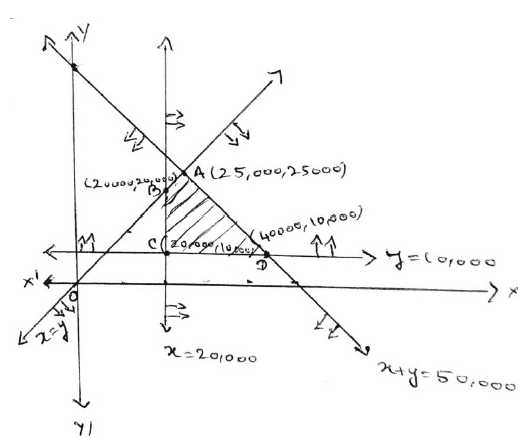 Let the investment in bond A be ₹ x and in bond B be ₹ y
Objective function is $\text{Z} = \frac{\text{x}}{10} + \frac{9}{100}\text{y}$
Subject to constraints
$\text{x + y+} \geq 50,000;\ \text{x} \geq20,000; \text{y}\geq10,000\text{x}\geq\text{y}(\ast)$
Correct Figure
Vertices of feasible region are A, B, C, and D
| Point |
$\text{Z} = \frac{\text{x}}{10} + \frac{9}{100}\text{y}$ |
Value |
| A(25,000 25,000) |
2500 + 2250 |
4750 |
| B(20,000 20,000) |
2000 + 1800 |
3800 |
| C(20,000, 10,000) |
2000 + 900 |
2900 |
| D(40,000, 10,000) |
4000 + 900 |
4900 |
Return is maximum when ₹ 40000 are invested in Bond A and ₹ 10000 in Bond B
Maximum return is ₹ 4900. View full question & answer→Question 205 Marks
Find the equations of the tangent and the normal to the curve $\text{y} = \frac{\text{x} - 7}{(\text{x} -2) (\text{x} -3)}$ at the point where it cuts the x-axis.
AnswerGiven curve cust the x - axis when y = 0
when y = 0, x = 7, hence point is (7, 0)
$\frac{\text{dy}}{\text{dx}} = \frac{1 - \text{y ( 2x - 5})}{\text{x}^{2} -\text{5 x + 6}} $
$\frac{\text{dy}}{\text{dx}}\bigg]_{(7, 0)} = \frac{1}{20}$
Equation of the tangent is $\text{y - 0} = \frac{1}{20} \text{(x - 7)}$
$\Rightarrow \text{x - 20y = 7}$
Equation of the normal is $\text{y - 0 = - 20 (x - 7)} $
$\Rightarrow\text{20x + y = - 7}$
View full question & answer→Question 215 Marks
The standard weight of a special purpose brick is 5 kg and it must contain two basic ingredients costs ₹ 5 per kg and $\text{B}_{2}$ costs ₹ 8 per kg. Strength considerations dictate that the brick should contain not more than 4 kg of and minimum 2 kg of $\text{B}_{2}$. Since the demand for the product is likely to be related to the price of the brick, find the minimum cost of brick satisfying the above conditions. Formulate this situation as an LPP and solve it graphically.
Answer$\text{Let x kg of B}_{1} \text{y kg of B}_{2} \text{is taken}$ $\text{then to minimize Z = 5x + 8y}$ subject to the following constraints $\text{x + y = 5, x}\leq 4, \text{y}\geq 2$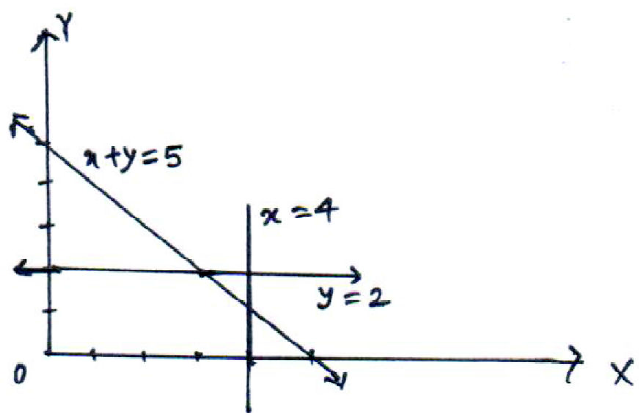
View full question & answer→Question 225 Marks
Check whether the $\ast$ operation defined on the set $ \text{A = R} \times \text{R as} $
$\text{(a, b)} \ast \text{(c, d)} = \text{(a + c, b + d)}$
is a binary operation or not, where R is the set of all real numbers. If it is a binary operation, is it commutative and associative too? Also find the identity element of $\ast$.
Answer$\text{(a, b)} \ast \text{(c, d)} = \text{(a + c, b + d)} \ \forall \ \text{a, b, c, d}\in \text{R}$
Since $\text{a + c}\in \text{R}$ and $\text{b + d}\in \text{R} \Rightarrow \text{(a + c, b+ d)} \in \text{R}\times\text{R}$
$\text{i.e} \ast \text{is binary operation}$
For commutative
$\text{consider (c, d)}\ast\text{(a, b}) = \text{(c + a, d + b)}$
$=\text{(a + c, b + d)}$
$\Rightarrow'\ast' \text{is commutative}$
For Associateive
$\text{(a, b), (c, d), (e, f)}\in \text{R}\times\text{R = A}$
$\text{[(a, b)}\ast \text{(c, d)}\ast\text{(e, f)} = \text{(a + c, b + d)}\ast \text{(e, f)} $
$= \text{(a + c + e, b + d + f)}\dots\dots\dots\dots\text{(i)}$
$\text{again (a, b)}\ast \text{[(c, d)]}\ast\text{(e, f)]} = \text{(a, b)}\ast \text{(c + e, d + f)}$
$= \text{(a + c + e, b + d + f)}\dots\dots\dots\text{(ii)}$
$\text{(i)} \&\text{(ii)} \Rightarrow '\ast' \text{is associtative}$
$\text{For identity element}$
$\text{Let (e}_1,\text{e}_{2}) \in \text{R}\times\text{R}$ be the identity element (if exists)
then $\text{a , b)}\ast \text{(e}_{1}, \text{e}_{2}) = \text{(a, b)} = \text{(e}_{1}, \text{e}_{2})\ast\text{(a, b)}$
$\Rightarrow\text({e}_{1}, \text{e}_{2}) = \text{0 , 0)} \in \text{R}\times\text{R} $
View full question & answer→Question 235 Marks
Find: $\int\frac{2x + 1}{(x^{2} + 1) (x^{2} + 4)}dx$
Answer$\text{Let I} = \int\frac{\text{2x} + 1}{(\text{x}^{2} + 1) (\text{x}^{2} + 4)}\text{dx}$
$\text{Let}\frac{\text{2x} + 1}{(\text{x}^{2} + 1) (\text{x}^{2} + 4)} = \frac{\text{Ax + B}}{\text{x}^{2} + 1} + \frac{\text{Cx + D}}{\text{x}^{2} + 4}$
$\text{Getting A} = \frac{2}{3}, \text{B} = \frac{1}{3}, \text{C} = \frac{-2}{3} ,\text{D} = \frac{-1}{3}$
$\therefore\text{I} = \frac{2}{3}\int\frac{\text{x}}{\text{x}^{2} + 1}\text{dx}+\frac{1}{3}\int\frac{\text{1}}{\text{x}^{2} + 1}\text{dx}+ \frac{-2}{3}\int\frac{\text{xdx}}{\text{x}^{2} + 4}\text{dx} + \frac{-1}{3}\int\frac{\text{dx}}{\text{x}^{2} + 4}$
$= \frac{1}{3}\log|\text{x}^{2} + 1| + \frac{1}{3} \tan^{-1} \text{x} -\frac{1}{3}\log|\text{x}^{2} + 4| -\frac{1}{6}\tan^{-1}\frac{\text{x}}{2} + \text{C}$
View full question & answer→Question 245 Marks
Find: $\int(\text{3x + 5)}\sqrt{5+4x-2x^2}\text{dx}$
Answer$\text{(3x + 5)}\sqrt{5 + \text{4x} - \text{2x}^{2}} \text{ dx}$
$\text{let 3x + 5 = A (4 - 4x) + B}$
$\Rightarrow\text{A} = -\frac{3}{4},\text{B} = 8$
$\text{I} = -\frac{3}{4}(4 - \text{4x)}\sqrt{5 + \text{4x - 2x}^{2}} \text{ dx} + 8 \sqrt{5 + 4\text{x - 2x}^{2}}\text{ dx}$
$= -\frac{3}{4}\text{I}_{1} + 8\text{I}_{2}(\text{let)}$
$\text{For I}_{1}, \text{put} 5 + \text{4x - 2x}^{2} = \text{t}$
$\Rightarrow(4 - \text{4x) dx = dt}$
$-\frac{3}{4}\text{I}_{1} = -\frac{3}{4}\sqrt{\text{t}}\text{ dt} = -\frac{3}{4}\times\frac{2}{4}\text{t}^{3/2}$
$= -\frac{1}{2}(5 + \text{4x}{ - }{{2x}^{2})^{3/2}}$
$\text{8I}_{2} = 8\sqrt{2}\sqrt{\frac{7}{2} - \text({x - 1)}^{2}}\text{ dx}$
$ = 8\sqrt{2}\bigg[\frac{\text{x - 1}}{2}\sqrt{\frac{5}{2} + \text{2x - x}^{2}} + \frac{7}{4}\sin^{-1} \frac{\sqrt{2}(\text{x - 1)}}{\sqrt{7}}\bigg]$
$\text{I} =- \frac{1}{2}(5 + \text{4x - 2x}^{2})^{3/2} + 4\sqrt{2}(\text{x - 1)}{\sqrt{\frac{5}{2} + \text{2x - x}^{2}}} + 14\sqrt{2}\sin^{-1}\frac{\sqrt{2}\text{(x - 1)}}{\sqrt{7}} + \text{C}$
View full question & answer→Question 255 Marks
Find the intervals in which the function $f(x) = \frac{4\sin x}{2 + \sin x} -x, 0\leq x\geq2\pi$ is strictly increasing or strictly decreasing.
Answer$\text{y} = \frac{4\sin\text{x}}{2 + \cos \text{x}} - \text{x, x} \in [0, 2\pi] $
$\frac{\text{dy}}{\text{dx}} = \frac{(2 + \cos\text{x)}4\cos\text{x} - 4\sin\text{x} (- \sin \text{x)}}{(2 + \cos\text{x})^{2}} - 1$
$\frac{\text{dy}}{\text{dx}} = \frac{\cos\text{x}(4 - \cos\text{x})}{(2 + \cos\text{x})^{2}}$
$\text{f(x) is strictly increasing for f'(x) > 0}$
$\text{i.e.}\ \ \ \cos \text{x} > 0 \Rightarrow\text{x} \in\bigg[0, \frac{\pi}{2}\bigg)\cup\bigg(\frac{3\pi}{2}, 2\pi\bigg]$
$\text{and f(x) is strictly decreasing for f'(x) < 0}$
$\text{i.e}\cos\text{x}<0\Rightarrow\text{x}\in\bigg(\frac{\pi}{2},\frac{3\pi}{2}\bigg)$
View full question & answer→Question 265 Marks
A, B and C throw a pair of dice in that order alternately till one of them gets a total of 9 and wins the game. Find their respective probabilities of winning, if A starts first.
AnswerP (winning) $= \frac{1}{9}$
P (not winning)$=\frac{8}{9}$
P(A winning) $= \text{P(A) + P}(\overline{\text{A}}\text{ }\overline{\text{B}}\text{ }\overline{\text{C}}\text{ }\overline{\text{A}}) + \text{P}(\overline{\text{A}}\text{ }\overline{\text{B}}\text{ }\overline{\text{C}}\text{ }\overline{\text{A}}\text{ }\overline{\text{B}}\text{ }\overline{\text{C}}\text{ }{\text{A}}) +\dots\dots$
$=\frac{1}{9} +\bigg(\frac{8}{9}\bigg)^{3} \frac{1}{9}+\bigg(\frac{8}{9}\bigg)^{6}\frac{1}{9}+\dots\dots$
$=\frac{\frac{1}{9}}{1 - \frac{512}{729}} = \frac{81}{217}$
P(B writing) $\text{P}(\overline{\text{A}}\text{B}) + \text{P}(\overline{\text{A}}\text{ }\overline{\text{B}}\text{ }\overline{\text{C}}\text{ }\overline{\text{A}}\text{ }{\text{B}}) + \text{P}(\overline{\text{A}}\text{ }\overline{\text{B}}\text{ }\overline{\text{C}}\text{ }\overline{\text{A}}\text{ }\overline{\text{B}}\text{ }\overline{\text{C}}\text{ }\overline{\text{A}}\text{B})+\dots\dots$
$=\frac{8}{9}\times\frac{1}{9}+\bigg(\frac{8}{9}\bigg)^{4}\times\frac{1}{9}+\bigg(\frac{8}{9}\bigg)^{7}\times\frac{1}{9}+\dots\dots$
$=\frac{\frac{8}{9}\times\frac{1}{9}}{1 - \frac{512}{729}} = \frac{72}{217}$
P(C winning) = 1 – [P(A winning) + P(B winning)]
$ = 1 - \bigg[\frac{81}{217} + \frac{72}{217}\bigg]$
$=1 - \frac{153}{217} = \frac{64}{217}$
View full question & answer→Question 275 Marks
Show that the relation R defined by (a, b) R (c, d) $\Rightarrow \text{a + d = b + c on the A}\times\text{A},$ where $\text{A} = \text({1, 2, 3,} \dots\dots\dots\dots10)$ is an equivalence relation. Hence write the equivalence class [(3, 4)]; a, b, c, d $\in$ A.
Answer$\text{(a, b)R(c, d)}\Rightarrow\text{a + d = b + c}$
$\therefore\text{a + b = b + a}$
$\Rightarrow\text{(a, b) R (a, b)}\forall \text{(a. b)}\in \text{A}\times\text{A}$
$\Rightarrow\text{R is reflexive}$
$\text{(a, b) R(c, d)} \Rightarrow\text{a + d = b + c}$
$\Rightarrow \text{b + c = a + d}$
$\Rightarrow\text{c + b = d + a}$
$\Rightarrow\text{(c, d )R( a, b)}$
$\Rightarrow\text{R is symmetric}$
$\text{For (a, b) (c, d) }\& \text{ e, f)} \in \text{A}\times\text{A}$
$\text{(a, b) R (c, d)}\Rightarrow\text{a + d = b + c } \dots\dots(1)$
$\text{(c, d) R (e, f)}\Rightarrow\text{xc + f = d + e } \dots\dots\dots(2)$
adding (1) & (2), we get
$\text{a + d + c + f = b + c + d + e}$
$\Rightarrow\text{a + f = b + e}$
$\Rightarrow\text{(a, b) R(e, f)}$
$\therefore\text{R is transistive.}$
Hence R is an equivalence relation.
Now [3, 4] = {(1, 2), (2, 3), (3, 4), (4, 5), (5, 6), (6, 7), (7, 8), (8, 9), (9, 10)}
View full question & answer→Question 285 Marks
$\text{If}\overrightarrow{\text{a}} = \hat{\text{i}} + 2\hat{\text{j}} + \hat{\text{k}}, \overrightarrow{\text{b}} = 2\hat{\text{i}} + \hat{\text{j}}$ and $\overrightarrow{\text{c}} = 3\hat{\text{i}} - 4\hat{\text{j}} - 5\hat{\text{k}},$ then find a unit vector perpendicular to both of the vectors $(\overrightarrow{\text{a}} - \overrightarrow{\text{b}}) \text{and} \overrightarrow{\text{(c}} - \overrightarrow{\text{b}}). $
Answer$\overrightarrow{\text{a}} - \overrightarrow{\text{b}} = -\hat{\text{-i}} + \hat{\text{j}} + \hat{\text{k}}; \overrightarrow{\text{c}} - \overrightarrow{\text{b}} = \hat{\text{i}} - 5\hat{\text{j}} - 5\hat{\text{k}}$
$(\overrightarrow{\text{a}} - \overrightarrow{\text{b}}) \times(\overrightarrow{\text{c}} - \overrightarrow{\text{b}}) = \begin{vmatrix} \hat{\text{i}} & \hat{\text{j}} & \hat{\text{k}} \\ -1 & 1 & 1 \\ 1 & -5 & -5 \end{vmatrix} = - 4\hat{\text{j}} + 4\hat{\text{k}} $
$\therefore$ Unit vector perpendicular to both of the vectors $ = \frac{\hat{\text{j}}}{\sqrt{2}} + \frac{\hat{\text{k}}}{\sqrt{2}}$
View full question & answer→Question 295 Marks
Find the inverse of matrix $ \text{A} = \begin{bmatrix} 3 & -1 & 1 \\ -15 & 6 & -5 \\ 5 & -2 & 2 \end{bmatrix} $ and hence show that $\text{A}^{-1}. \text{A = I}.$
Answer$\text{A} = \begin{bmatrix} 3 & -1 & 1 \\ -15 & 6 & -5 \\ 5 & -2 & 2 \end{bmatrix} $
$\text{|A|} = 1 \neq 0, \text{A}^{-1}\text{will exist}$
$\text{adj. A} = \begin{bmatrix} 2 & 0 & -1 \\ 5 & 1 & 0 \\ 0 & 1 & 3 \end{bmatrix} $
$\text{A}^{-1} = \frac{\text{adj A}}{\text{|A|}} = \begin{bmatrix} 2 & 0 & -1 \\ 5 & 1 & 0 \\ 0 & 1 & 3 \end{bmatrix} $
$\text{A}^{-1}\text{A} = \begin{bmatrix} 2 & 0 & -1 \\ 5 & 1 & 0 \\ 0 & 1 & 3 \end{bmatrix}\begin{bmatrix} 3 & -1 & 1 \\ -15 & 6 & -5 \\ 5 & -2 & 2 \end{bmatrix} $
$ = \begin{bmatrix} 1 & 0 & 0 \\ 0 & 1 & 0 \\ 0 & 0 & 1 \end{bmatrix} $
View full question & answer→Question 305 Marks
Find $\int\limits(\text{x}^{2} + e^{\text{2x}} + 1) \text{dx}$ as the limit of a sum.
Answer$\int\limits^{2}_{0}(\text{x}^{2} + \text{e}^{2\text{x} + 1})\text{dx}$
$\text{h} = \frac{2}{\text{h}}$
$\int\limits^{2}_{0}(\text{x}^{2} + \text{e}^{2\text{x} + 1})\text{dx} = \lim\limits_{x \rightarrow 0}\text{[h(0) + f (0 + h) + f( 0 + 2h)}+ \dots\dots\dots\dots$
$+\dots\dots\dots\dots\text{f(0 + n - 1) h ]}$
$= \lim\limits_{x \rightarrow 0}\text{h} [\text{h}^{2}( 1^{2} + 2^{2} + \dots\dots\dots \text{+} (\text{n} - 1)^{2}$
$+ \text{e}(1 + \text{e}^{2\text{h}} + \text{e}^{4\text{h}} + \dots\dots\dots\text{e}^{2(\text{n -1)h}})\bigg] $
$= \lim\limits_{\text{h} \rightarrow 0} \frac{\text{(nh)(nh - h)(2nh - h)}}{6} + \lim\limits_{\text{h} \rightarrow 0}\text{e.h}\bigg(\frac{\text{e}^{\text{2nh}} - 1}{\text{e}^{\text{2h}} - 1}\bigg)$
$= \frac{8}{3} + \frac{(\text{e}^{4} - 1)\text{e}}{2} = \frac{8}{3} + \frac{\text{e}^{5} - \text{e}}{2}$
View full question & answer→Question 315 Marks
Find the general solution of the differential equation $\frac{\text{dy}}{\text{dx}} = \frac{\text{y}^{2}}{\text{xy - x}^{2}}.$
Answer$\frac{\text{dy}}{\text{dx}} = \frac{\text{y}^{2}}{\text{xy - x}^{2}}$
$\text{Let y = vx}, \frac{\text{dy}}{\text{dx}} = \text{v + x} \frac{\text{dv}}{\text{dx}}$
$\text{v + x} \frac{\text{dv}}{\text{dx}} = \frac{\text{v}^{2}}{\text{v - 1}}$
$\text{x} \frac{\text{dv}}{\text{dx}} = \frac{\text{v}}{\text{v - 1}}$
$\frac{\text{dx}}{\text{x}} = \bigg(\frac{\text{v - 1}}{\text{v}}\bigg)\text{dv}$
$\int\frac{\text{dx}}{\text{x}} = \int\bigg({1 - \frac{1}{\text{v}}}\bigg)\text{dv}$
$\log\text{x = v} - \log \text{v + c}$
$\log\text{y} = \frac{\text{y}}{\text{x}} + \text{c or x} \log \text{y - y = c x}$
View full question & answer→Question 325 Marks
A dietician wants to develop a special diet using two foods X and Y. Each packet (contains 30 g) of food X contains 12 units of calcium, 4 units of iron, 6 units of cholesterol and 6 units of vitamin A. Each packet of the same quantity of food Y contains 3 units of calcium, 20 units of iron, 4 units of cholesterol and 3 units of vitamin A. The diet requires at least 240 units of calcium, at least 460 units of iron and at most 300 units of cholesterol. Make an LPP to find how many packets of each food should be used to minimise the amount of vitamin A in the diet, and solve it graphically.
AnswerLet the no. of packets of food X = x
Let the no. of packets of food Y = y (Minimize) $\text{P} = \text{(6x + 3y)}$ Subject to $\text{12x + 3y}\geq 240$ $\text{4x + 20y}\geq460$ $\text{6x + 4y} \leq 300, \text{x, y}\geq0$or
$\text{4x+ y} \geq80$ $\text{x + 5y}\geq115$ $\text{3x + 2y}\leq150$ $\text{x, y}\geq 0$ Correct points of feasible region:- 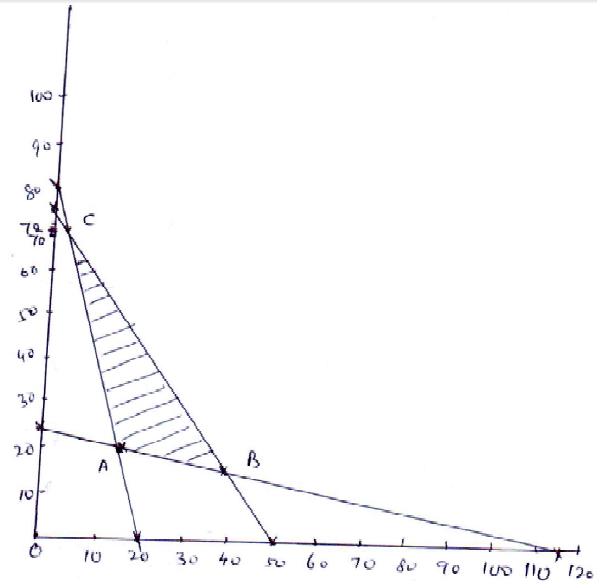 $\text{A (15, 20), B (40, 15),}$ $\text{C (2, 72)}$ $\text{So P (15, 20) = 150}$ $\text{P (40, 15) = 285}$ $\text{P (2, 72) = 228}$ Graph minimum amount of vitamin A = 150 units when 15 packets of food X and
20 packets of food Y are used. View full question & answer→Question 335 Marks
Find the point on the curve $\text{y =} \frac{\text{x}}{1 + \text{x}^{2}}, $ where the tangent to the curve has the greatest slope.
Answer$\text{y} = \frac{\text{x}}{1 + \text{x}^{2}}$
$\frac{\text{dy}}{\text{dx}} = \frac{1 - \text{x}^{2}}{(\text{1 + x}^{2})^{2}}$
$\text{Let f (x) } = \frac{1 - \text{x}^{2}}{(1 + \text{x}^{2})^{2}}$
$\text{f}{'}\text{(x)} = 0\ \ \Rightarrow\frac{\text{-2x(3 - x}^{2})}{(\text{1 + x}^{2})^{3}}$
$\text{For max or min x}\text{(3 - x})^{2} = 0 \Rightarrow\text{x = 0 or x} = \pm \sqrt{3}$
$\text{Calculating}\frac{\text{d}^{2}\text{f(x)}}{\text{dx}^{2}}\text{at x = 0 < 0}$
$\text{at x = }\pm \sqrt{3} > 0$
$\Rightarrow\text{x = 0 is the point of local maxima}$
$\Rightarrow \text{the required pt is (0, 0)}$
View full question & answer→Question 345 Marks
A dealer deals in two items only – item A and item B. He has ₹ 50,000 to invest and a space to store at most 60 items. An item A costs ₹ 2,500 and an item B costs ₹ 500. A net profit to him on item A is ₹ 500 and on item B ₹ 150. If he can sell all the items that he purchases, how should he invest his amount to have maximum profit Formulate an LPP and solve it graphically.
Answer
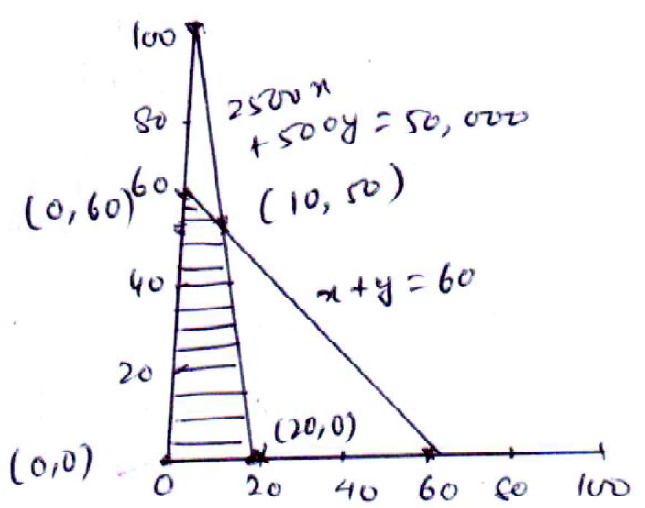 Let the no. of items in the item A = x
Let the no. of items in the item B = y
(Maximize) $\text{ z = 500 x + 150 y}$
$\text{x + y}\leq 60$
$\text{2500x + 500y}\leq50,000$
$\text{z (0, 0) = 0}$
$\text{z(10, 50) = 12,500}$
$\text{z (20, 0) = 10,000}$
$\text{z(0, 60) = 9,000}$
$\text{Max. profit = Rs. 12,500}$ View full question & answer→Question 355 Marks
If the sum of lengths of hypotenuse and a side of a right-angled triangle is given, show that area of triangle is maximum, when the angle between them is $\frac{\pi }{3}$
Answer
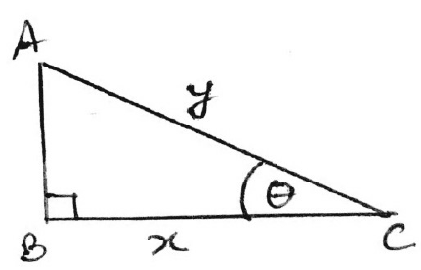 let ABC be the right triangle with $\angle\text{B} = 90^{0}$
$\angle\text{ACB} = \theta, \text{AC = Y, BC = x, x + y = k (constant)}$
$\text{A(Area of triangle)} = \frac{1}{2}.\text{BC.AB} = \frac{1}{2}.\text{x} \sqrt{\text{y}^{2} - \text{x}^{2}}$
$\text{let z A}^{2} = \frac{1}{4}\text{x}^{2}(\text{y}^{2} - \text{x}^{2}) = \frac{1}{4}\text{x}^{2} \left\{\text{(k}{ - }{\text{x)}^{2}} - \text{x}^{2}\right\} = \frac{1}{4} (\text{x}^{2}\text{k}^{2} - \text{2kx}^{3})$
$\frac{\text{dz}}{\text{dx}}= \frac{1}{4}\text{(2xk}^{2} - \text{6kx}^{2}) \text{ and } \frac{\text{dz}}{\text{dx}} = 0 \Rightarrow\text{x} = \frac{\text{k}}{3}, \text{y = k} {- \text{x}} = \frac{\text{2k}}{3} $
$\frac{\text{d}^{2}\text{z}}{\text{dx}^{2}}\bigg]_{\text{x} = \frac{\text{k}}{3}}= \frac{1}{4}\text{(2k}^{2} {- 12}{\text{kx}})\bigg]_{\text{x} = \frac{\text{k}}{3}}= -\frac{\text{k}^{2}}{2}<0$
$\therefore \text{z and area of } \triangle\text{ABC is max at x} = \frac{\text{k}}{3} $
and, $\cos\theta = \frac{\text{x}}{\text{y}} = \frac{\text{k}}{3}. \frac{3}{\text{2k}} = \frac{1}{2}\Rightarrow\theta = \frac{\pi}{3}$ View full question & answer→Question 365 Marks
$\text{Let f(x) = x - |x - x}^{2}|, \text{x|} \in [ -1, 1].$ Find the point of discontinuity, (if any), of this function on $\text{[– 1, 1].}$
Answer$\text{f (x) = x - |x - x}^{2}| = \text{|x - x (1 - x)|} = \begin{cases} \text{2x - x}^{2} & , & -1\leq \text{x} < 0\\\ 0 & , & \text{x} = 0 \\ \text{x}^{2} & , & 0 <\text{x}\leq1 \end{cases}$
$\text{f(x)}$ being a polynomial is continuous on $[-1, 0] \cup [ 0, 1]$
$\DeclareMathOperator*{\median}{{\text{It}}} \median_{{\text{x}\rightarrow0^{-}}} \text{f(x)}\DeclareMathOperator*{\median}{{\text{It}}} \median_{{\text{x}\rightarrow0^{-}}}(2\text{x - x})^{2} = 0$
$\DeclareMathOperator*{\median}{{\text{It}}} \median_{{\text{x}\rightarrow0^{+}}} \text{f(x)}\DeclareMathOperator*{\median}{{\text{It}}} \median_{{\text{x}\rightarrow0^{+}}}(\text{ x})^{2} = 0$
$\text{Also, f (0) = 0}$
$\therefore \lim\limits_{\triangle x \rightarrow 0^{-}}\text{f(x) = f (0)} = \lim\limits_{\triangle x \rightarrow 0^{+}}\text{f(x)}$
$\Rightarrow \text{There is no point of discontinuity on[ -1, 1]}$
View full question & answer→Question 375 Marks
$\text{If y =} \log\bigg(\frac{\text{x}}{\text{a + bx}}\bigg)^{\text{x}}, \text{prove that x}^{3} \frac{\text{d}^{2}\text{y}}{\text{dx}^{2}} = \bigg(\text{x}\frac{\text{dy}}{\text{dx}} - \text{y}\bigg)^{2}.$
Answer$\frac{\text{y}}{\text{x}} = [\log\text{x} - \log\text{(a + b x)}]$
$\Rightarrow \frac{\text{x}\frac{\text{dy}}{\text{dx}} - \text{y}}{\text{x}^{2}} = \frac{1}{\text{x}} - \frac{\text{b}}{\text{a + bx}}$
$\Rightarrow \text{x}\frac{\text{dy}}{\text{dx}} - \text{y} = \frac{\text{ax}}{\text{a + bx}} \dots\dots\dots\dots\dots\dots\text{(i)}$
Differentiating again,
$\text{x}\frac{\text{d}^{2}\text{y}}{\text{dx}^{2}} = \frac{\text{a}^{2}}{(\text{a + bx)}^{2}}$
$\text{x}^{3}. \frac{\text{d}^{2}\text{y}}{\text{dx}^{2}} = \bigg(\frac{\text{ax}}{\text{a + bx}}\bigg)^{2} = \bigg(\text{x}\frac{\text{dy}}{\text{dx}}-y\bigg)^{2} \text{(using (i))}$
View full question & answer→Question 385 Marks
$\text{(x}^{2} + \text{y}^{2})\text{dy = xy dx. If y (1) = 1 and y (x}_{0}) = \text{e then find the value of x}_{0}.$
Answer$\frac{\text{dy}}{\text{dx}} = \frac{\text{xy}}{\text{x}^{2} + \text{y}^{2}}$
$\text{put y = v x} \Rightarrow \frac{\text{dy}}{\text{dx}} = \text{v + x}\frac{\text{dv}}{\text{dx}}$
$\Rightarrow \frac{1 + \text{v}^{2}}{\text{v}^{3}} = -\frac{\text{dx}}{\text{x}}$
Intergrating both sides
$-\frac{1}{2\text{v}^{2}} + \log \text{v} = -\log \text{x + c}$
$\Rightarrow - \frac{\text{x}^{2}}{\text{2y}^{2}} + \log \text{y = c} $
$\text{When x = 1, y = 1} \Rightarrow \text{c} = -\frac{1}{2}$
$\Rightarrow \log\text{y} = \frac{\text{x}^{2} - \text{y}^{2}}{2\text{y}^{2}}$
$\text{When x = x}_{0}, \text{y = c} \Rightarrow \text{x}_{0} = \sqrt{3} e$
View full question & answer→Question 395 Marks
A dealer in a rural area wishes to purchase some sewing machines. He has only to invest and has space for at most 20 items. An electronic machine costs him ₹ 3,600 and a manually operated machine costs ₹ 2,400. He can sell an electronic machine at a profit of ₹ 220 and a manually operated machine at a profit of ₹ 180. Assuming that he can sell all the machines that he buys, how should he invest his money in order to maximise his profit? Make it as a LPP and solve it graphically.
AnswerLet us consider the man invested on x Electronic and y manually operated machines, $\text{Maximise P = 220 x + 180 y}\dots\dots\dots\dots\dots\dots\text{(i)}$ subject to $\text{x + y}\leq20$ $\text{3600 x + 2400 y}\leq 57600 \Rightarrow \text{3x + 2y}\leq48$ $\text{x + y}\geq 0$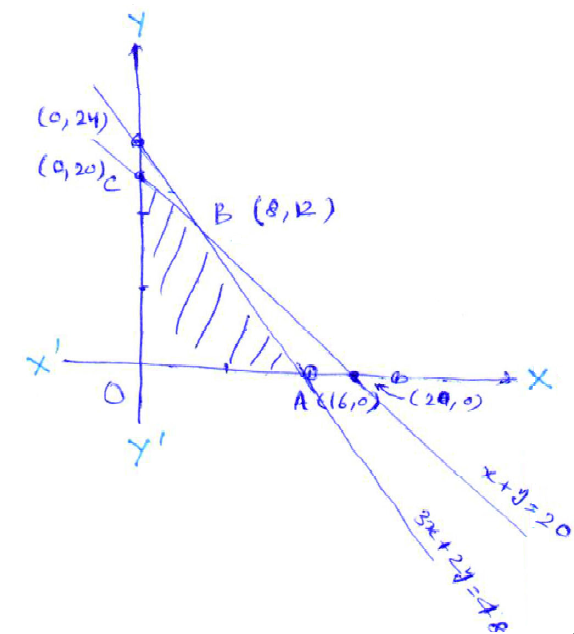
$\text{P}\bigg|_{\text{A}(16, 0)} = 3520 \text{Rs.}$ $\text{P}\bigg|_{\text{B}(8, 12)} = 3920\text{Rs.}$ $\text{P}\bigg|_{\text{C}(0, 20)} = 3600\text{Rs.} $ $\text{Maximum profit is Rs. 3920 at x = 8, y = 12}$ View full question & answer→Question 405 Marks
A window is in the form of a rectangle surmounted by a semicircular opening. The total perimeter of the window is 10 m. Find the dimensions of the window to admit maximum light through the whole opening.
Answer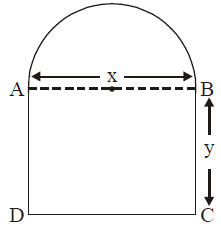
Let dimensions of the rectangle be x and y (as shown)
$\therefore\ $Perimeter of window p $=2\text{y}+\text{x}+\pi\frac{\text{x}}{2}=10\text{m}\dots(\text{i})$
Area of window A = $\text{x}\text{y}+\frac{\text{1}}{2}\pi\frac{\text{x}^2}{4}$
$\text{A}=\text{x}\Big[5-\frac{\text{x}}{2}-\pi\frac{\text{x}}{4}\Big]+\frac{\text{1}}{2}\pi\frac{\text{x}^2}{4}$
$=5\text{x}-\frac{\text{x}^2}{2}-\pi\frac{\text{x}^2}{8}$
$\frac{\text{dA}}{\text{dx}}=5-\text{x}-\pi\frac{\text{x}}{\text{4}}=0\Rightarrow\text{x}=\frac{20}{4+\pi}$
$\frac{\text{d}^2\text{A}}{\text{dx}^2}=\Big(-1-\frac{\pi}{4}\Big)<0$
$\Rightarrow\ \text{x}=\frac{20}{4+\pi},\text{y}=\frac{10}{4+\pi}$will give maximum light. View full question & answer→Question 415 Marks
If the sum of the lengths of the hypotenuse and a side of a right triangle is given, show that the area of the triangle is maximum, when the angle between them is $60^\circ$.
Answer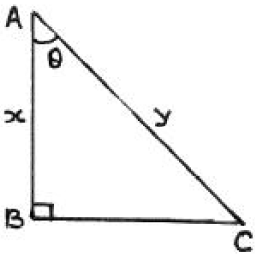 let the length of the side AB of rt.$\triangle$ ABC be x andthat of hypotenuse AC be y, and
x + y = k (given)
Area of $\triangle$ABC $=\frac1 2\sqrt{\text{y}^2-\text{x}^2}.\text{x}$
$\text{let S}=\frac1 4\text{x}^2(\text{y}^2-\text{x}^2)$
$=\frac1 4\text{x}^2[(\text{k}-\text{x})^2-\text{x}^2]$
$=\frac1 4[\text{k}^2\text{x}^2-2\text{k}\ \text{x}^3]$
$\frac{\text{ds}}{\text{dx}}=0\Rightarrow\frac1 4[2\text{k}^2\text{x}-6\text{k}\text{x}^2]=0\Rightarrow\text{x}=\frac{\text{k}}{3}$
$\text{and}\ \frac{\text{d}^2\text{s}}{\text{dx}^2}=\frac1 4[2\text{k}^2-12\text{k}\text{x}]=\frac1 4(2\text{k}^2-4\text{k}^2)<0$
$\therefore\ $area of $\triangle$ is maximum for x = k/3 and y = k – k/3 = 2k/3
$\therefore\ $$\cos\theta=\frac{\text{x}}{\text{y}}=\frac1 2\text {hence}\theta=\frac{\pi}{3}$ View full question & answer→Question 425 Marks
Ishan wants to donate a rectangular plot of land for a school in his village. When he was asked to give dimensions of the plot, he told that if its length is decreased by 50 m and breadth is increased by 50 m, then its area will remain same, but if length is decreased by 10 m and breadth is decreased by 20 m, then its area will decrease by $5300 \text{ m}^{2}.$ Using matrices, find the dimensions of the plot. Also give reason why he wants to donate the plot for a school.
AnswerLet length be x m and breadth be y m
$\therefore(x\ – \ 50)(y + 50) = xy⇒ 50x\ – \ 50y = 2500 \ \ or\ \ x\ –\ y = 50$
and $(x \ – \ 10)(y\ – \ 20) = xy\ – \ 5300 \Rightarrow 2x + y = 550$
$ \begin{pmatrix} 1 & -1 \\ 2 & 1 \\ \end{pmatrix} \begin{pmatrix} x \\ y \\ \end{pmatrix} = \begin{pmatrix} 50 \\ 550 \\ \end{pmatrix} \Rightarrow \begin{pmatrix} x \\ y \\ \end{pmatrix} =\frac{1} 3{} \begin{pmatrix} 1 & 1 \\ -2 & 1 \\ \end{pmatrix} \begin{pmatrix} 50 \\ 550 \\ \end{pmatrix} $
$\Rightarrow x = \frac{1}{3}(600) =200\text{ m}, y = \frac{1}{3}(450) = 150 \text{ m}$
View full question & answer→Question 435 Marks
Evaluate: $\int\limits^{1}_{0}\cot^{-1}(1 - x + x^{2}) dx$
Answer$\text{I} = \int\limits^{1}_{0} \cot^{-1}(1 - x + x^{2}) dx = \int\limits^{1}_{0}\tan^{-1}\bigg( \frac{1}{1 - x + x^{2}}\bigg)dx$
$=\int\limits^{1}_{0} \tan^{-1}\bigg(\frac{x + (1 - x)}{1 - x (1 - x)}\bigg)dx = \int\limits^{1}_{0}\tan^{-1}x\text{ }dx + \int\limits^{1}_{0}\tan^{-1}(1 - x) dx$
$ = 2\int\limits^{1}_{0}\tan^{-1} x\text{ }dx$
$= 2\Bigg[\bigg(\tan^{-1}x.x\bigg)^{1}_{0} - \int\limits^{1}_{0}\frac{x}{1 + x^{2}}dx\Bigg]$
$=2\bigg[x \tan^{-1} x - \frac{1} {2}\log|1 + x^{2}|\bigg]^{1}_{0}$
$= 2\bigg[\frac{\pi}{4}-\frac{1}{2} \log 2\bigg] \text{or} \frac{\pi}{2}-\log 2$
View full question & answer→Question 445 Marks
Determine the intervals in which the function $f (x) = x^4 - 8x^3 + 22x^2 - 24x + 21$is strictly increasing or strictly decreasing.
Answer$f' (x) = 4x^3 - 24x^2 + 44x - 24$
$= 4(x^{3} - 6x^{2} + 11x - 6) = 4(x-1(x - 2) (x - 3)$
$f'(x) = 0 \Rightarrow x = 1, x = 2, x = 3$
The invertible are $(- \infty, 1), (1, 2) (2, 3), (3, \infty)$
$\text{since} f' (x) > 0 \text{ in} (1, 2) \text{and} (3, \infty)$
$\therefore f(x)$ is strictly increasing in $(1, 2) \cup(3, \infty)$
and strictly decreasing in $(-\infty, 1) \cup(2, 3)$
View full question & answer→Question 455 Marks
To raise money for an orphanage, students of three schools A, B and C organised an exhibition in their locality, where they sold paper bags, scrap-books and pastel sheets made by them using recycled paper, at the rate of ₹ 20, ₹ 15 and ₹ 5 per unit respectively. School A sold 25 paper bags, 12 scrap-books and 34 pastel sheets. School B sold 22 paper bags, 15 scrap-books and 28 pastel sheets while School C sold 26 paper bags, 18 scrap-books and 36 pastel sheets. Using matrices, find the total amount raised by each school.
By such exhibition, which values are generated in the students?
Answer$ \begin{matrix} \text{A} \\ \text{B} \\ \text{C} \end{matrix} \begin{bmatrix} 25 & 12 & 34 \\ 22 & 15 & 28 \\ 26 & 18 & 36 \end{bmatrix} \begin{bmatrix} 20 \\ 15 \\ 5 \end{bmatrix} $
$= \begin{bmatrix} 850 \\ 805 \\ 970 \end{bmatrix} $
View full question & answer→Question 465 Marks
Find the direction ratios of the normal to the plane, which passes through the points $\text{(1, 0, 0) and (0, 1, 0)}$and makes angle $\frac{\pi}{4}$ with the plane $\text{x + y = 3.}$ Also find the equation of the plane.
AnswerEquation of plane passing through (1, 0, 0)
$\text{a (x – 1) + b (y – 0) + c (z – 0) = 0}$
$\text{or a x + b y + c z – a = 0} \dots\dots\dots\dots\dots\dots\text{(i)}$
Plane (i) passes throgh (0, 1, 0)
$\text{b – a = 0}\dots\dots\dots\dots\dots\dots\dots\dots\text{(ii)}$
Angle between plane (i) and plane $\text{x + y = 3 is}\frac{\pi}{4}$
$\therefore\cos\frac{\pi}{4} = \frac{\text{a + b}}{\sqrt{\text{a}^{2} + \text{b}^{2} + \text{c}^{2} \sqrt{2}}}$
$\Rightarrow\frac{1}{\sqrt{2}} = \frac{\text{a + b}}{\sqrt{\text{a}^{2} + \text{b}^{2} + \text{c}^{2} \sqrt{2}}}$
$ \Rightarrow \text{a + b} = \sqrt{\text{a}^{2}+ \text{b}^{2} + \text{c}^{2}}$
$\Rightarrow \text{2a} = \sqrt{\text{2a}^{2} + \text{c}^{2}} \text{ (using ii)}$
$\Rightarrow \text{c} = \pm \sqrt{2}\text{ a}\dots\dots\dots\dots\dots\dots\text{(iii)}$
$\therefore\text{Equation (i) becomes}$
$\text{a(x - 1) + a (y - 0)}\pm \sqrt{2} \text{a(z - 0) = 0}$
$\Rightarrow \text{x + y}\pm\sqrt{2}\text{ z - 1 = 0}$
$\text{D.R}'^{s} \text{of the normal is 1, 1,}\pm \sqrt{2}$
View full question & answer→Question 475 Marks
Evaluate $\int\limits^{2}_{-1}(\text{e}^{3\text{x}} + 7\text{x} - 5) \text{dx}$ as a limits of sum.
Answer$\int\limits^{2}_{-1}(\text{e}^{3\text{x}} + 7\text{x} - 5) \text{dx}$ $\text{here h} = \frac{3}{\text{n}}$
$\lim\limits_{h \rightarrow 0}\text{h}[f (-1) + \text{f} ( -1 + \text{h} + \dots\dots\dots]$
$\lim\limits_{h \rightarrow 0} \text{h}[(\text{e}^{-3} - 12) + e^{-3 + 3\text{h}} + 7\text{h} - 12) + \dots\dots\text{+}(\text{e}^{-3 + \overline{\text{n} - 1}\text{h}} + 7 (\text{n - 1) h -12)}]$
$\lim\limits_{h \rightarrow 0}\text{h}[\text{e}^{-3}(1 + \text{e}^{\text{3h}} + \text{e}^{\text{6h}} + \dots\dots\text{+}\text{e}^{\text{3(n - 1)h}}) + \text{7h} ( 1 + 2 + 3 + \dots\dots\overline{\text{n - 1}}) -\text{12 nh}]$
$= \lim\limits_{h \rightarrow 0}\text{h} \bigg[\frac{\text{e}^{-3(\text{e}^{\text{3nh}} - 1) \text{h}}}{\text{e}^{\text{3 h}}-1}+ \frac{\text{ 7(nh) (nh - h)}}{2} - \text{12nh}\bigg]$
$ = \frac{\text{e}^{-3}(\text{e}^{9 - 1})}{3} + \frac{63}{2} - 36 = \frac{\text{e}^{9} - 1}{3\text{ e}^{3}} - \frac{9}{2}$
View full question & answer→Question 485 Marks
Three schools X, Y and Z organized a fete (mela) for collecting funds for flood victims in which they sold hand-held fans, mats and toys made from recycled material, the sale price of each being
₹ 25,
₹ 100 and
₹ 50 respectively. The following table shows the number of articles of each type sold:
| School |
X |
Y |
Z |
| Article |
| Hand - held fans |
30 |
40 |
35 |
| Mats |
12 |
15 |
20 |
| Toys |
70 |
55 |
75 |
Using matrices, find the funds collected by each school by selling the above articles and the total funds collected. Also write any one value generated by the above situation.
Answer
| $ \begin{matrix} \text{x} \\ \text{y} \\ \text{z} \end{matrix} $ |
$\begin{bmatrix} \text{F} & \text{M} & \text{T}\\ 30 & 12 & 70 \\40 & 15 & 55 \\ 35 & 20 & 75 \end{bmatrix}$ |
$ \begin{bmatrix} 25 \\ 100 \\ 50 \end{bmatrix} $ |
= |
$ \begin{bmatrix} 5450 \\ 5250 \\ 6625 \end{bmatrix} $ |
Funds collected by school x: ₹ 5450, school y = ₹ 5250
school z = ₹ 6625
Total collected funds = ₹ 17325
for writing any value. View full question & answer→Question 495 Marks
Sketch the region bounded by the curves $\text{y =}\sqrt{5 - \text{x}^{2}} \text{and y = |x - 1| }$ and find its area using integration.
Answer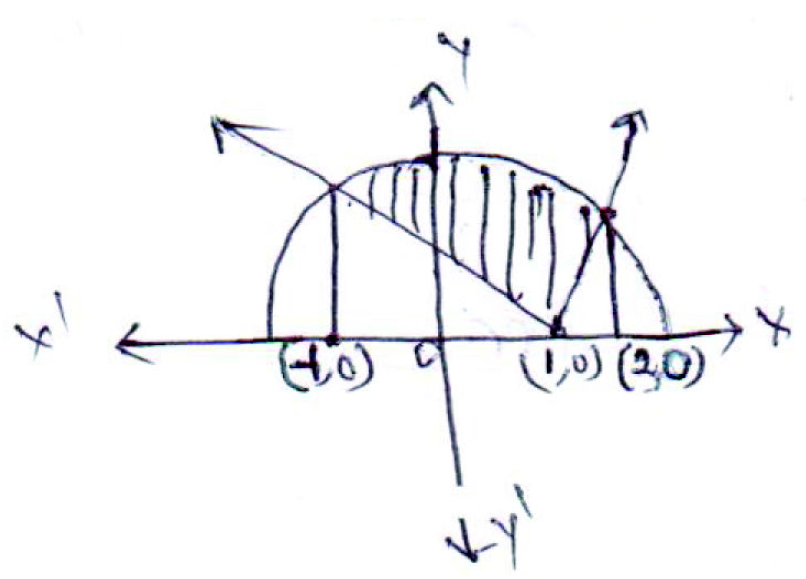
$\text{For finding (– 1, 0) , (1, 0) (2, 0)}$
$\text{Area} = \int\limits^{2}_{-1}\sqrt{5 - \text{x}^{2}}\text{ dx}-\int\limits^{1}_{-1}- \text{(x - 1) dx}\int\limits^{2}_{-1}\text{(x - 1)dx}$
$= \bigg[\frac{\text{x}}{2}\sqrt{5 - \text{x}^{2}} + \frac{5}{2}\sin^{-1}\frac{\text{x}}{\sqrt{5}}\bigg]^{2}_{-1} + \bigg[\frac{\text{(x - 1)}^{2}}{2}\bigg]^{1}_{-1} - \bigg[\frac{\text{(x - 1)}^{2}}{2}\bigg]^{2}_{1}$
$= \bigg(1 + \frac{5}{2}\sin^{-1}\frac{2}{\sqrt{5}}\bigg) + \bigg(1 + \frac{5}{2}\sin^{-1}\frac{1}{\sqrt{5}}\bigg) - \frac{1}{2}\times 4 - \frac{1}{2}\times1 $
$= \frac{5}{2}\bigg(\sin^{-1}\frac{2}{\sqrt{5}} + \sin^{-1}\frac{1}{\sqrt{5}}\bigg) - \frac{1}{2}\text{sq. units}$ View full question & answer→Question 505 Marks
Let $\text{f : W}\rightarrow\text{W}$ be defined as
$\text{f(n)} = \begin{cases} \text{n -1}, & \text{if n is odd} \\ \text{n+1}, &\text{if n is even} \end{cases}$
Show that f is invertible and find the inverse of f. Here, W is the set of all whole numbers.
Answer$\text{One - One : - Case I : when x and y are even}$
$\text{f(x) = f(y)}\Rightarrow \text{x + 1 = y + 1} \Rightarrow\text{x = y}$
$\text{Case II : when x and y are odd}$
$\text{f(x) = f(y)} \Rightarrow \text{x - 1 =y - 1} \Rightarrow \text{x = y}$
$\text{Case III : one of them is even and one of hem is odd}$
$\text{f(x)}\neq \text{f(y)} \Rightarrow \text{x + 1}\neq \text{y - 1} \Rightarrow \text{x}\neq\text{y}$
$\text{Onto : Let y}\in \text{W}$
$\text{f(y - 1) = y if y is odd}$
$\text{f(y + 1) = y if y is even}$
$\text{So}\forall \text{y} \in \text{W, there exist some element vin domain of f}$
$\Rightarrow \text{f is invertible}$
$\text{f}^{-1}{(\text{x})} = \begin{cases} \text{x -1}, & \text{x is odd} \\ \text{x+1}, &\text{x is even}\end{cases}$
View full question & answer→