Question 515 Marks
Solve the differential equation $x\frac{\text{dy}}{\text{d}x} + \text{y} = x \cos x + \sin x,$ given that y = 1 when $x = \frac{\pi}{2}.$
AnswerThe given equation can be written as
$\frac{\text{dy}}{\text{dx}} + \frac{\text{y}}{\text{x}} = \cos \text{x} + \frac{\sin \text{x}}{\text{x}}$
$\text{I.F.} = \text{e}^{\int \frac{1}{\text{x}} \text{dx}} = \text{e}^{\log \text{x}} = \text{x}$
$\therefore$ Solution is
$\text{y. x} = \int \text{(x} \cos \text{x} + \sin \text{x}) \text{dx + c}$
$\Rightarrow \text{x . y} = \text{x } \sin \text{x + c}$
$\text{or} \text{ y} = \sin \text{x} + \frac{\text{c}}{\text{x}}$
$\text{when x} = \frac{\pi}{2}, \text{y} = 1, \text{we get c = 0}$
Required solution is $\text{y} = \sin \text{x}$
View full question & answer→Question 525 Marks
Find the general solution of the following differential equation:
$( 1 + \text{y}^{2}) + x - e^{\tan-1}\text{y}) \frac{\text{dy}}{dx} = 0$
AnswerGiven differential equation can be written as
$\frac{\text{dx}}{\text{dy}} + \frac{1}{1 + \text{y}^{2}}\text{x} = \frac{e^{\tan-1}\text{y}}{1 + \text{y}^{2}}$
Integrating factor is $e^{\tan^{-1}}\text{y}$
$\therefore \text{Solution is x}.e^{\tan -1}\text{y} = \int\text{e}^{2\tan^{-1}\text{y}}\frac{1}{1 + \text{y}^{2}}\text{dy}$
$\therefore\text{x}e^{\tan -1}\text{y} = \frac{1}{2}e^{\tan-1}\text{y}\text{+C}$
View full question & answer→Question 535 Marks
Solve the differential equation:
$(\tan^{-1}\text{y} - x) \text{dy} = ( 1 + \text{y}^{2}) \text{dx}$
AnswerGiven differential equation can be writen as
$\frac{\text{dx}}{\text{dy}} + \frac{1}{1 + \text{y}^{2}} . \text{x} = \frac{\tan^{-1}\text{y}}{1 + \text{y}^{2}}$
$\therefore$ Intergrating factor is $e^{\tan^{-1}} \text{y}$
$\therefore$ Solution is: $\text{x}. e^{\tan^{-1}}\text{y} = \int \frac{\tan^{-1}{\text{y}}.e^{\tan^{-1}}\text{y}}{1 + \text{y}^{2}}\text{dy}$
$\Rightarrow \text{x .e}^{\tan^{-1}\text{y}} = \int \text{t}\text{ e}^{\text{t}}\text{ dt where } \tan^{-1}\text{y} = \text{t}$
$= \text{t e' - e' + c = e}^{\tan^{-1}\text{y}} (\tan^{-1}\text{y} - 1) + \text{c}$
$\text{or x} = \tan^{-1}\text{y} - 1 + \text{c e}^{-\tan^{-1}}\text{y}$
View full question & answer→Question 545 Marks
Find the particular solution of the differential equation$\text{e}^{x}\sqrt{1 - \text{y}^{2}} \text{ dx} + \frac{\text{y}}{\text{x}}\text{dy } = 0 $ given that y= 1 when x=0.
Answer$\text{e}^{x}\sqrt{1 - \text{y}^{2}}\text{ dx} = \frac{-\text{y}}{\text{x}}\text{ dy } \Rightarrow\text{xe}^{x}\text{dx} = \frac{-\text{y}}{\sqrt{1 - \text{y}^{2}}}\text{ dy }$
Integrating both sides
$\int\text{xe}^{x}\text{ dx} = \frac{1}{2}\int-\frac{-2\text{y}}{\sqrt{1- \text{y}^{2}}}\text{ dy}$
$\Rightarrow\text{xe}^{x} - \text{e}^{x} =\sqrt{1 - \text{y}^{2}}+\text{c}$
For x = 0, y = 1, c = – 1 $\therefore\text{ solution is: } \text{ e}^{x} (\text{x} - 1 ) = \sqrt{1 - \text{y}^{2}} - 1 .$
View full question & answer→Question 555 Marks
Show that the differential equation $2ye^{x/y} dx + (y - 2xe^{x/y} ) dy = 0$ is homogeneous. Find the particular solution of this differential equation, given that $x = 0$ when $y = 1.$
AnswerGiven: $2y. e^{x/y} dx +(y – 2x e^{x/y} ) dy = 0$
$\Rightarrow\frac{\text{dx}}{\text{dy}} = - \frac{\text{y} - 2\text{xe}^{\text{x/y}}}{2\text{y}.\text{e}^{x/y}}\Rightarrow\frac{\text{dx}}{\text{dy}} =\frac{2\text{xe}^{x/y} - \text{y}}{2\text{y.e}^{x/y}}$
Let $\text{F}(\text{x,y}) = \frac{2\text{x.e}^{x/y} - \text{y}}{2\text{y.e}^{x/y}}$
$\therefore\text{F}(\lambda\text{x},\lambda\text{y}) = \frac{2\lambda\text{x.e}^{\lambda\text{x}/\lambda\text{y}} - \lambda\text{y}}{2\lambda\text{y.e}^{\lambda\text{ x}/\lambda\text{ y}}} = \lambda^{0}\frac{2\text{xe}^{x/y} - \text{y}}{2\text{y.e}^{x/y}} = \lambda^{0}.\text{F}(\text{x,y})$
Hence, given differential equation is homogeneous.
Now, $\frac{\text{dx}}{\text{dy}} = \frac{2\text{x.e}^{x/y} - \text{y}}{2\text{y.e}^{x/y}} - - - - - - (i)$
Let $x =vy \Rightarrow\frac{\text{dx}}{\text{dy}} = v + \text{y}.\frac{\text{d}v}{\text{dy}}$
$\therefore\text{(i)}\Rightarrow v + \text{y}.\frac{\text{d}v}{\text{dy}} = \frac{2\text{vy}.\text{e}^{\frac{\text{vy} }{\text{y}} }- \text{y}}{2\text{y.e}^{\frac{\text{vy}}{\text{y}}}}$
$\Rightarrow\text{y}.\frac{\text{dv}}{\text{dy}} =\frac{\text{y}(2v\text{e}^{v} - 1 )}{2\text{y.e}^{v}} - v\Rightarrow\text{y}.\frac{\text{d}v}{\text{dy}} = \frac{2v.\text{e}^{v} - 1}{2\text{e}^{v}} - {v}$
$\Rightarrow\text{y}.\frac{\text{d}v}{\text{dy}} = - \frac{1}{2\text{e}^{v}}\Rightarrow2\text{y.e}^{v}\text{d}v = -\text{dy}$
$\Rightarrow2\int\text{e}^{v}\text{d}v = -\int\frac{\text{dy}}{\text{y}}\Rightarrow2\text{e}^{v} = -\log\text{ y + C}$
$\Rightarrow2\text{e}^{\frac{\text{x}}{\text{y}}} = \log\text{y= C}$
When $x = 0, y =1$
$\therefore2\text{e}^{0} + \log 1 =\text{C}\text{ or } \text{C} = 2 $
Hence, the required solution is
$2\text{e}^{x/y} + \log\text{ y} = 2 \Rightarrow\log\text{ C} = 2 .$
View full question & answer→Question 565 Marks
Find the particular solution of the following differential equation;
$\frac{\text{dx}}{\text{dy}} = 1 + x^2 + y^2 + x^2y^2, $ given that $y = 1$ when $x = 0$.
Answer$\frac{\text{dx}}{\text{dy}}= 1 + x^2 + y^2 + x^2y^2= (1 + x^2)(1 + y^2)$
$\Rightarrow\int\frac{\text{dy}}{\text{1+y}^{2}}=\int{\text{(1 + x}^{2})}\text{dx}$
$\Rightarrow\text{tan}^{-1}\text{y}=\text{x}+\frac{\text{x}^{3}}{3}+\text{c}$
$x = 0, y = 1 \Rightarrow c = \frac{\pi}{4}$
$\therefore\text{ tan}^{-1}\text{y}=\text{x}+\frac{\text{x}^{3}}{3}+\frac{\pi}{4}$ OR $y = \text{tan}\Bigg(\frac{\pi}{4}+\text{x}\frac{\text{x}^{3}}{{3}}\Bigg)$
View full question & answer→Question 575 Marks
If $y = (\tan^{–1}x)^2,$ show that $\text{(x}^{2}+\text{1})^{2}\frac{\text{d}^{2}\text{y}}{\text{dx}^{2}}+\text{2x}(\text{x}^{2}+{1)}\frac{\text{dy}}{\text{dx}}=2.$
Answer$\text{y}=(\tan^{-1}\text{x})^{2}\Rightarrow\frac{\text{dy}}{\text{dx}}=2\tan^{-1}\text{x}\cdot\frac{\text{1}}{\text{1+x}^{2}}.$
$\Rightarrow{(1}+\text{x}^{2})\frac{\text{dy}}{\text{dx}}=\text{2 tan}^{-1}\text{x}$
$\therefore\text{(1+x}^{2})\frac{\text{d}^{2}\text{y}}{\text{dx}^{2}}+\text{2x}\cdot\frac{\text{dy}}{\text{dx}}=\frac{\text{2}}{\text{1+x}^{2}}$
$\Rightarrow\text{(1+x}^{2})\frac{\text{d}^{2}\text{y}}{\text{dx}^{2}}+\text{2x}\text{ (1+x}^{2})\frac{\text{dy}}{\text{dx}}=2.$
View full question & answer→Question 585 Marks
Solve the following differential equation:
$\text{2x}^{2}\frac{\text{dy}}{\text{dx}}-\text{2 xy + y}^{2}=0$
Answer$\text{2x}^{2}\frac{\text{dy}}{\text{dx}}-\text{2 xy + y}^{2}=0\Rightarrow\frac{\text{dy}}{\text{dx}}=\frac{\text{2 xy - y}^{2}}{\text{2x}^{2}}=\frac{\text{2}\frac{\text{y}}{\text{x}}-\frac{\text{y}^{2}}{\text{x}^{2}}}{\text{2}}$Putting $\frac{\text{y}}{\text{x}}$ v so that y = vx and $\frac{\text{dy}}{\text{dx}}=\text{v} + \text{x}\ \frac{\text{dv}}{\text{dx}}$
$\therefore\text{v + x }\frac{\text{dv}}{\text{dx}}=\text{v}-\frac{1}{2}\text{v}^{2}\therefore \text{x}\frac{\text{dv}}{\text{dx}}=-\frac{1}{2}\text{v}^{2}$
$\Rightarrow 2\int\frac{\text{dv}}{\text{v}^{2}} = -\int\frac{\text{dx}}{\text{x}}\Rightarrow\frac{2}{\text{v}}=\log\text{ x + c}$
$\therefore 2 \frac{\text{x}}{\text{y}}=\log\text{ x + c or y}=\frac{\text{2x}}{\text{log x + c}}.$
View full question & answer→Question 595 Marks
If x = a ( θ – sin θ ), y = a (1 + cos θ ), find $\frac{\text{d}^{2}\text{y}}{\text{dx}^{2}}$.
Answer$\therefore\frac{\text{dx}}{\text{d}\theta}=\text{a(1 - cos}\theta)\text{ and }\frac{\text{dy}}{d\theta}=-\text{a sin}\theta$$\Rightarrow\frac{\text{dy}}{\text{dx}}=\frac{-\sin\theta}{(1-\cos\theta)}$
$\frac{\text{d}^{2}\text{y}}{\text{dx}^{2}}=\frac{\text{(1-cos}\theta)\text{(-cos}\theta)+\sin\theta(\sin\theta)}{(1-\cos\theta)^{2}}\cdot\frac{\text{d}\theta}{\text{dx}}$
= $\frac{(\text{1-cos}\theta)}{\text{(1 - cos}\theta)^{2}}\cdot\frac{1}{\text{a(1 - cos}\theta)}$
$= \frac{1}{\text{a(1- cos}\theta)^{2}}\text{ or }\frac{1}{\text{4a}}\text{cosec}^{4}\frac{\theta}{2}$
View full question & answer→Question 605 Marks
Solve the following differential equation:
$e^x \tan y\ dx + (1 – e^x) \sec^2 y\ dy = 0.$
AnswerGiven differential equation can be written as
$\frac{\text{e}^{\text{x}}}{\text{1-e}^{\text{x}}}\text{ dx}+\frac{\sec^{2}\text{y}}{\tan\text{y}}\text{ dy}=0$
Integrating to get -$ \log |1 - e^x|+\log|\tan y| = \log |c|$
$\log |\tan y| = \log|c (1-e^x)$
$\therefore \tan y = c (1 - e^x).$
View full question & answer→Question 615 Marks
Solve the following differential equation:
$\cos^{2}\text{x}\frac{\text{dy}}{\text{dx}}+\text{y}=\tan\text{x}.$
AnswerGiven differential equation can be written as
$\frac{\text{dy}}{\text{dx}}+\text{sec}^{2}\text{x}\cdot\text{y}=\tan\text{x}\cdot\sec^{2}\text{x}$
$\text{I.F.}=\text{e}^{\int{\text{sec}^{2}\text{x dx}}}=\text{e}^{\tan\text{x}}$
$\therefore$ The Solution is $\text{y}\cdot\text{e}^{\text{tan x}}=\int\tan\text{x }\cdot\text{e}^{\text{tan x}}\text{sec}^{2}\text{ x}\text{ dx}$
$=\int\text{t.e}^\text{t}\text{dt},$ where tan $x = 1.$
$\Rightarrow\text{y}\cdot\text{e}^{\text{tan x}}= (t - 1) e^t+ c$
$\Rightarrow\text{y}\cdot\text{e}^{\text{tan x}}= (\tan x - 1) e^{\tan x} + c.$
Alternate Answer
$y = (\tan x - 1) + \text{c}\cdot\text{c}^{\text{-tan x}}$.
View full question & answer→Question 625 Marks
Find the particular solution of the differential equation satisfying the given conditions:
$\frac{\text{dy}}{\text{dx}}$= y tan x, given that y = 1 when x = 0.
AnswerGiven differential equation can be written as
$\int\frac{\text{dy}}{\text{y}}=\int\tan\text{x dx}$
OR, log y = log sec x + c
when, x = 0, y = 1 $\Rightarrow$ c = 0
[Note : c = 1, if constant is taken as log c]
$\therefore$ log y = log sec x
OR y = sec x.
View full question & answer→Question 635 Marks
Find $\frac{\text{dy}}{\text{dx}},\text{if y = sin}^{-1}[\text{x}\sqrt{1 - x}-\sqrt{x}\sqrt{1 - x^{2}}]$.
Answer$\text{y}=\sin^{-1}\text[{x}\sqrt{1-x}-\sqrt{x}\sqrt{1 - x^{2}}]............(i)$
Let $x = \sin\alpha\text{ and }\sqrt{x}=\sin\theta$
$\therefore$ (i) Becomes $y = \sin^{-1}[\sin\alpha\cos\theta-\cos\alpha\sin\theta]$.
$=\sin^{-1}[\sin(\alpha-\theta)]=\alpha-\theta$
$=\sin^{-1}\text{x}-\sin^{-1}\sqrt{x}$
$\therefore\frac{\text{dy}}{\text{dx}}=\frac{1}{\sqrt{1}-x^2}-\frac{1}{2\sqrt{x}\sqrt{1-x}}$
View full question & answer→Question 645 Marks
Find the general solution of the differential equation
$\text{x}\log\text{x}.\frac{\text{dy}}{\text{dx}}+\text{y}=\frac{2}{\text{x}}\cdot\log\text{x}$.
AnswerThe given differential equation can be written as
$\frac{\text{dy}}{\text{dx}}+\frac{1}{\text{x log x}}\text{y}=\frac{2}{\text{x}^{2}}$
$\text{I.F.}=\text{e}^{\int\frac{1}{\text{x log x}}\text{dx}}=\text{e}^{\log(\log x)}=\log\text{x}$
The solution is $y . \log x = \int\frac{2}{\text{x}^{2}}\cdot\log\text{x dx + c}$
OR, $y . \log x = 2$
$\Bigg[\log\text{x}\cdot\Big(\frac{-1}{\text{x}}\Big)+\int\frac{\text{dx}}{{\text{x}}^{2}}\Bigg]+\text{c}=2\Bigg[\frac{-\log\text{x}}{\text{x}}-\frac{\text{1}}{\text{x}}\Bigg]+\text{c}$
$\Rightarrow\text{y}\cdot\log\text{x}=-\frac{2}{\text{x}}[1+\log\text{x}]+\text{c}$
View full question & answer→Question 655 Marks
Find the particular solution of the differential equation satisfying the given conditions:
$x^2dy + (xy + y^2) dx = 0 ; y = 1$ when $x = 1.$
AnswerThe given differential equation can be written as
$\frac{\text{dy}}{\text{dx}}+\frac{\text{xy+y}^{2}}{\text{x}^{2}}=0\text{ }\cdot\text{ }\text{Let y = vx}\Rightarrow\frac{\text{dy}}{\text{dx}}=\text{v + x}\frac{\text{dv}}{\text{dx}}$
$\Rightarrow\text{v + x}\frac{\text{dv}}{\text{dx}}+\text{(v + v}^{2})=0$
$\Rightarrow\text{x}\frac{\text{dv}}{\text{dx}}=-\text{ v (2 + v)}$
$\text{OR }\frac{\text{dv}}{\text{v(2+v)}}=-\frac{\text{dx}}{\text{x}}$
$\text{OR }\int\Bigg(\frac{1}{\text{v}}-\frac{1}{\text{2 + v}}\Bigg)\text{dx}=-2\int\frac{\text{dx}}{\text{x}}$
$\Rightarrow\log\frac{\text{v}}{\text{v+2}}=\log\frac{\text{c}}{\text{x}^{2}}$
$\text{OR }\frac{\text{y}}{\text{y+2}}=\frac{\text{c}}{\text{x}^{2}}$
when $x = 1, y = 1 \Rightarrow\text{c}=\frac{1}{3}$
$\therefore$ The solution becomes
$y + 2x = 3x^2y.$
View full question & answer→Question 665 Marks
Solve the following differential equation:$+ y = \cos x - \sin x.$
AnswerGetting integrating factor $ = e \int^{1 dx} = e^{x}$$\therefore \text{Solution is y.} e^{x} = \int(\cos x- \sin x) e^{x} dx$
$\text{Unsing} \int\text{[f(x) +f'(x)]} e^{x} + \text{c we get }$
$y.e^{x} = \cos \text{x e}^{x} + c$
$\text{or y} = \cos x + \text{c e}^{-x} $
View full question & answer→Question 675 Marks
Find the particular solution, satisfying the given condition, for the following differential equation:$\frac{\text{dy}}{\text{dx}} - \frac{\text{y}}{\text{x}} + \text{cosec} \bigg(\frac{\text{y}}{\text{x}}\bigg) = \text {0; y = 0 when x} = 1.$
Answer$\text{Putting} \frac{\text{y}}{\text{x}} = \text{v}\Rightarrow \text{y = vx} \Rightarrow \frac{\text{dy}}{\text{dx}} = \text{v + x} \frac{\text{dv}}{\text{dx}}$$\therefore \text{we get v + x} \frac{\text{dv}}{\text{dx}} -\text{v} + \text{cosec} \text{v} = \text{o}$
$\Rightarrow \sin \text{v dv} + \frac{\text{dx}}{\text{x}} = \text{o}$
$\Rightarrow - \cos \text{v} + \log|\text{x}| = \text{c}_{1} \text{or} \cos \frac{\text{y}}{\text{x}} = \log|\text{x}| + \text{c}$
$\text{When x = 1, y = o} \Rightarrow \text{c} = 1$
$\text{Hence the solution is} \cos \frac{y}{x} = 1 + \log|x|$
View full question & answer→Question 685 Marks
Solve the following differential equation: $\frac{\text{dy}}{\text{dx}} = \frac{\text{x}(\text{2y - x})}{\text{x}(\text{2y+ x)}}\text{If, y = 1 when x = 1} $
Answer$\frac{\text{dy}}{\text{dx}} = \frac{\text{x}(\text{2y - x})}{\text{x}(\text{2y+ x)}}$$\text{y = vx} \Rightarrow \frac{\text{dy}}{\text{dx}} = \text{v + x} \frac{\text{dv}}{\text{dx}}$
$\therefore \text{v + x} \frac{\text{dv}}{\text{dx}} = \frac{\text{x[2v - 1]}}{\text{x[2v + 1]}}$
$\Rightarrow x \frac{\text{dv}}{\text{dx}} = \frac{\text{2v -1}}{\text{2v + 1}} \text{- v} = \frac{\text{2v - 1 - 2v}^{2} \text{-v}}{\text{2v + 1}}$
$= - \frac{\text{2v}^{2} \text{- v + 1}}{\text{2v + 1}}$
$\frac{\text{2v + 1}}{\text{2v}^{2} \text{- v + 1}} \text{dv} = - \frac{\text{dx}}{\text{x}}$
$\frac{1}{2} \frac{\text{4v - 1 + 3}}{\text{2v}^{2}\text{ - v+ 1}} \text{dv} = \frac{\text{-dx}}{\text{x}}$
$\frac{1}{2} \frac{\text{4v - 1 + 3}}{\text{2v}^{2}\text{ - v+ 1}} \text{dv} + \frac{3}{4} \frac{\text{dv}}{\text{v}^{2}- \frac{1}{2} \text{v} + \frac{1}{2}} = -\frac{\text{dx}}{\text{x}}$
$\frac{1}{2} \log | \text{2v}^{2} \text{- v + 1}| + \frac{3}{4} \times \frac{4}{\sqrt{7}} \tan^{-1} \frac{\text{v}-\frac{1}{4}}{{\frac{\sqrt{7}}{4}}} = -\log\text{x + c}$
$\frac{1}{2} \log\bigg|\frac{\text{2y}^{2} \text{- xy} + \text{x}^{2}}{\text{x}^{2}}\bigg| + \frac{3}{\sqrt{7}} \tan^{-1} \frac{\text{4y - x}}{\sqrt{7}\text{x}} = -\log \text{x + c}$
$\text{when x = 1, y = 1} \Rightarrow \text{c}= \frac{1}{2} \log 2 + \frac{3}{\sqrt{7}} \tan^{-1} \frac{3}{\sqrt{7}} $
View full question & answer→Question 695 Marks
Solve the following differential equation: $\cos^{2} x \frac{dy}{dx} + y = \tan x$
AnswerThe given differential equation can be written as$\frac{\text{dy}}{\text{dx}} + \sec^{2} \text{x y} = \tan \text{x}.\sec^{2}\text{x}$
$\text{I.F} = \text{e}^{\int\text{pdx}}=\text{e}^{\int\sec^2\text{x dx}}=e^{\tan\text{x}}$
$\therefore$ The solution is
$\text{y} .e^{\tan{\text{x}}} = \int e^{\tan\text{x}} . \tan\text{x}.\sec^{2}\text{x dx + c}$
$\text{Let} \tan{\text{x}} = \text{z} \Rightarrow \sec^{2}\text{x dx = dz}$
$\therefore \int e^{\tan \text{x}} \tan \text{x} \sec^{2}\text{x dx} = \int {\text{z e}^{\text{z}} } \text{dz + c} $
$= \text{z}.e^{\text{z}} - e^{\text{z}} + \text{c} = e^{\text{z}} (\text(z - 1) + \text{c}$
$\text{y e}^{\tan\text{x}} = e^{\tan\text{x}} ( \tan{\text{x}} - 1) + \text{c}e^{-\tan\text{x}} $
View full question & answer→Question 705 Marks
Solve the following differential equation: $(\text{x}^{2} - \text{y}^{2}) \text{dx} + \text{2xy dy =0}$ given that $y = 1$ when $x = 1$
Answer$(\text{x}^{2} - \text{y}^{2}) \text{dx} + \text{2xy dy =0}$$\frac{\text{dy}}{\text{dx}} = \frac{\text{y}^{2} - \text{x}^{2}}{\text{2xy}}$
This is a homogeneous differential equation
$\text{Let y = vx} \Rightarrow \frac{\text{dy}}{\text{dx}} = \text{v + x} \frac{\text{dv}}{\text{dx}}$
$= \text{v + x} \frac{\text{dv}}{\text{dx}} = \frac{\text x^{2}(\text v^{2}-1)}{2\text v \text x^{2}} = \frac{\text v^{2} - 1}{2\text v}$
$\text{x}\frac{\text{dv}}{\text{dx}} = \frac{\text{v}^{2} - 1 - 2\text{v}^{2}}{2\text v} = \frac{1 + \text{v}^{2}}{2\text{v}}$
$\Rightarrow \frac{2\text{v}}{1 + \text{v}^{2}} \text{dv} = - \frac{\text{dx}}{\text{x}}$
$\log | 1 + \text{v}^{2}| = -\log| \text{x}| + \log \text{c} = \log\frac{\text{c}}{\text{x}}$
$1 + \text v^{2} = \frac{\text{c}}{\text{x}} \Rightarrow 1 + \frac{\text{y}^{2}}{\text{x}^{2}}= \frac{\text{c}}{\text{x}}$
$\Rightarrow \text{x}^{2} + \text{y}^{2} = \text{cx}$
$\text{when x = 1, y = 1,} \Rightarrow \text{c} = 2$
$\therefore \text{x}^{2} + \text{y}^{2} = \text{2x}$
View full question & answer→Question 715 Marks
Find the particular solution of the differential equation $\text{e}^\text{x}\tan\text{y dx}+(2-\text{e}^\text{x})\text{sec}^2\text{y dy}=0,$ given that $\text{y}=\frac{\pi}{4}\ \text{x} = 0.$
Answer$\text{e}^\text{x}\tan\text{y dx}+(2-\text{e}^\text{x})\text{sec}^2\text{y dy}=0$
$\text{e}^\text{x}\tan\text{y dx}+(\text{e}^\text{x}-2)\text{sec}^2\text{y dy}$
$\frac{\text{dy}}{\text{dx}}=\frac{\text{e}^\text{x}\tan\text{y}}{\text{e}^\text{x}\text{sec}^2\text{y}-2\text{sec}^2\text{y}}$
$\frac{\text{dx}}{\text{dy}}=\frac{\text{e}^\text{x}\text{sec}^2\text{y}-2\text{sec}^2\text{y}}{\text{e}^\text{x}\tan\text{y}}$
$\frac{\text{dx}}{\text{dy}}=\frac{\text{sec}^2\text{y}}{\tan\text{y}}-\frac{2\text{sec}^2\text{y}}{\tan\text{y}}\text{e}^{\text{-x}}$
$\frac{\text{dx}}{\text{dy}}=\frac{\text{sec}^2\text{y}}{\tan\text{y}}\big[1-2\text{e}^{-\text{x}}\big]$
$\int\frac{\text{sec}^2\text{y}}{\tan\text{y}}\text{dy}=\int\frac{1}{1-2\text{e}^{-\text{x}}}\text{dx}$
$\tan\text{y}=\text{t}$
$\text{sec}^2\text{y dy}=\text{dt}$
$\int\frac{\text{dt}}{\text{t}}=\int\frac{\text{e}^\text{x}}{\text{e}^\text{x}-2}\text{dx}$
$\text{e}^\text{x}-2=\text{u}$
$\text{e}^\text{x}\text{dx}=\text{du}$
$\log\text{t}=\log\text{u}+\log\text{C}$
$\log(\tan\text{y})=\log(\text{e}^\text{x}-2)\text{C}$
$\tan\text{y}=\text{C}(\text{e}^\text{x}-2)$
$\text{Put y }=\frac{\pi}{4},\ \text{x}=0\ \ \ \tan\frac{\pi}{4}=\text{C}(1-2)$
$\text{C}=-1$
$\tan\text{y}=-(\text{e}^\text{x}-2)$
View full question & answer→Question 725 Marks
Find the particular solution of the differential equation $\frac{\text{dy}}{\text{dx}}+2\text{y}\ \tan\text{x}=\sin\text{x},$ given that $\text{y}=0\ \text{when x}=\frac{\pi}{3}.$
Answer$\frac{\text{dy}}{\text{dx}}+2\text{y}\ \tan\text{x}=\sin\text{x}$
Differential equation is of the form
$\frac{\text{dy}}{\text{dx}}+\text{py}=\text{Q}$
$\frac{\text{dy}}{\text{dx}}+2\text{y}\ \tan\text{x}=\sin\text{x}\ \ ....(1 )$
$\text{Where P}=2\tan\text{x}\ \&\ \text{Q}=\sin\text{x}$
$\text{IF}=\text{e}^{\int\text{p dx}}$
$\text{IF}=\text{e}^{\int2\tan\text{x dx}}$
$\text{IF}=\text{e}^{2\log\sec\text{x}}$
$\text{IF}=\text{e}^{\log\sec^2\text{x}}$
$\text{IF}=\sec^2\text{x}$
$\text{y}(\text{IF})=\int(\text{Q}\times\text{IF})\text{dx}+\text{c}$
$\text{y}(\sec^2\text{x})=\int\sin\text{x}\sec^2\text{x dx}+\text{c}$
$\text{y}\sec^2\text{x}=\int\sin\text{x}\frac{1}{\cos^2\text{x}}\text{dx}+\text{C}$
$\text{y}\sec^2\text{x}=\int\frac{\sin\text{x}}{\cos\text{x}}\times\frac{1}{\cos\text{x}}\text{dx}+\text{C}$
$\text{y}\sec^2\text{x}=\int\tan\text{x}\sec\text{x dx}+\text{C}$
$\text{y}\sec^2\text{x}=\sec\text{x}+\text{C}$
$\text{y}=\frac{\sec\text{x}}{\sec^2\text{x}}+\frac{\text{c}}{\sec^2\text{x}}$
$\text{y}=\cos\text{x}+\text{C}\cos^2\text{x}\ \ ....(2)$
$\text{Putting x}=\frac{\pi}{3}\ \&\ \text{y}=0$
$0=\cos\frac{\pi}{3}+\text{C}\cos^2\frac{\pi}{3}$
$0=\frac{1}{2}+\text{C}\Big(\frac{1}{4}\Big)^2$
$\frac{-1}{2}=\text{C}\Big(\frac{1}{4}\Big)$
$\frac{-4}{2}=\text{C}$
$\text{C}=-2$
Putting value of C in (1)
$\text{y}=\cos\text{x}+\text{C}\cos^2\text{x}$
$\text{y}=\cos\text{x}-2\cos^2\text{x}$
View full question & answer→Question 735 Marks
$\text{If}\ \text{y}=\sin(\sin\text{x}),\ \text{prove that}\frac{\text{d}^2\text{y}}{\text{dx}^2}+\tan\text{x}\frac{\text{dy}}{\text{dx}}+\text{y}\cos^2\text{x}=0.$
Answer$\text{y}=\sin(\sin\text{x})$
$\frac{\text{dy}}{\text{dx}}=\cos(\sin\text{x})\cos\text{x}$
$\frac{\text{d}^2\text{y}}{\text{dx}^2}=\cos(\sin\text{x})(-\sin\text{x})+\cos^2\text{x}[-\sin(\sin\text{x})]$
$\frac{\text{d}^2\text{y}}{\text{dx}^2}=-\sin\text{x}\cos(\sin\text{x})-\cos^2\text{x}\sin(\sin\text{x})$
$\text{L.H.S}=\frac{\text{d}^2\text{y}}{\text{dx}^2}+\tan\text{x}\frac{\text{dy}}{\text{dx}}+\text{y}\cos^2\text{x}$
$=-\sin\text{x}\cos(\sin\text{x})-\cos^2\text{x}\sin(\sin\text{x})\\+\tan\text{x}\cos\text{x}\cos(\sin\text{x})+\cos^2\text{x}\sin\text{x}(\sin\text{x})$
$=-\sin\text{x}\cos(\sin\text{x})+\frac{\sin\text{x}}{\cos\text{x}}\cos\text{x}\cos(\sin\text{x})$
$=-\sin\text{x}\cos(\sin\text{x})+\sin\text{x}\cos(\sin\text{x})$
$=0=\text{R.H.S.}$
View full question & answer→Question 745 Marks
Solve the differential equation: $\frac{\text{dy}}{\text{dx}}-\frac{2\text{x}}{1+\text{x}^2}\text{y}=\text{x}^2+2$
AnswerThe given differential equation is
$\frac{\text{dy}}{\text{dx}}-\frac{2\text{x}}{1+\text{x}^2}\text{y}=\text{x}^2+2$
This equation is of the form $\frac{\text{dy}}{\text{dx}}+\text{Py}=\text{Q},$
where $\text{P}=\frac{-2\text{x}}{1+\text{x}^2}$ and $\text{Q}=\text{x}^2+2$
Now, $\text{l.F}=\text{e}^{\int\frac{2\text{x}}{1+\text{x}^2}\text{dx}}$
$=\text{e}^{-\log\Big(\frac{1}{1+\text{x}^2}\Big)}=\frac{1}{1+\text{x}^2}$
The general solution of the given differential equation is
$\text{y}\times\text{l.F}.=\int(\text{Q}\times\text{l.F.})\text{dx}+\text{C},$ where C is an aribatry contant
$\Rightarrow\frac{\text{y}}{1+\text{x}^2}=\int\frac{\text{x}^2+2}{1+\text{x}^2}\text{dx}+\text{C}$
$=\int\Big(1+\frac{1}{\text{x}^2+1}\Big)\text{dx}+\text{C}$
$=\int\text{dx}+\int\frac{1}{\text{x}^2+1}\text{dx}+\text{C}$
$=\text{x}+\tan^{-1}\text{x}+\text{C}$
$\text{y}=(1+\text{x}^2)(\text{x}+\tan^{-1})\text{x}+\text{C}$
View full question & answer→Question 755 Marks
Solve the differential equation: $(\text{x}+1)\frac{\text{dy}}{\text{dx}}=2\text{e}^{-\text{y}}-1;\ \text{y(0)}=0.$
Answer$(\text{x}+1)\frac{\text{dy}}{\text{dx}}=2\text{e}^{-\text{y}}-1$
$\Rightarrow\frac{\text{dy}}{2\text{e}^{-\text{y}}-1}=\frac{\text{dx}}{\text{x}+1}$
$\Rightarrow\frac{\text{e}^\text{y}\text{dy}}{2-\text{e}^\text{y}}=\frac{\text{dx}}{\text{x}+1}$
Integrating both sides, we get:
$\int\frac{\text{e}^\text{y}\text{dy}}{2-\text{e}^\text{y}}=\log|\text{x}+1|+\log\text{C}\ \dots(1)$
Let $2-\text{e}^\text{y}=\text{t}.$
$\therefore\frac{\text{d}}{\text{dy}}(2-\text{e}^{\text{y}})=\frac{\text{dt}}{\text{dy}}$
$\Rightarrow-\text{e}^\text{y}=\frac{\text{dt}}{\text{dy}}$
$\Rightarrow\text{e}^\text{y}\text{dy}=-\text{dt}$
Substituting this value in equation (1), we get
$\int\frac{-\text{dt}}{\text{t}}=\log|\text{x}+1|+\log\text{C}$
$\Rightarrow-\log|\text{t}|=\log|\text{C}(\text{x}+1)|$
$\Rightarrow-\log|2-\text{e}^\text{y}|=\log|\text{C}(\text{x}+1)|$
$\Rightarrow\frac{1}{2-\text{e}^\text{y}}=\text{C}(\text{x}+1)$
$\Rightarrow2-\text{e}^\text{y}=\frac{1}{\text{C}(\text{x}+1)}\ \dots(2)$
Now, at x = 0 and y = 0, equation (2) becames:
$\Rightarrow2-1=\frac{1}{\text{C}}$
$\Rightarrow\text{c}=1$
Substituting C = 1 in equation (2) we get:
$2-\text{e}^\text{y}=\frac{1}{\text{x}+1}$
$\Rightarrow\text{e}^\text{y}=2-\frac{1}{\text{x}+1}$
$\Rightarrow\text{e}^\text{y}=\frac{2\text{x}+2-1}{\text{x}+1}$
$\Rightarrow\text{e}^\text{y}=\frac{2\text{x}+1}{\text{x}+1}$
$\Rightarrow\text{y}=\log\Big|\frac{2\text{x}+1}{\text{x}+1}\Big|,(\text{x}\neq-1)$
This is the required particular solution of the given differential equaion.
View full question & answer→Question 765 Marks
Solve the differential equation: $\text{xdy}-\text{ydx}=\sqrt{\text{x}^2+\text{y}^2}\text{ dx},$ given that $\text{y}=0$ when $\text{x}=1.$
Answer$\text{xdy}-\text{ydx}=\sqrt{\text{x}^2+\text{y}^2}\text{ dx}$
$\Rightarrow\text{xdy}=\Big[\text{y}+\sqrt{\text{x}^2+\text{y}^2}\Big]\text{ dx}$
$\frac{\text{dy}}{\text{dx}}=\frac{\text{y}+\sqrt{\text{x}^2+\text{y}^2}}{\text{x}}\ \dots(1)$
Let $\text{F}(\text{x, y})=\frac{\text{y}+\sqrt{\text{x}^2+\text{y}^2}}{\text{x}}$
$\therefore\text{F}(\lambda\text{x},\lambda\text{y})=\frac{\lambda\text{x}\sqrt{(\lambda\text{x})^2+(\lambda\text{y}^2)}}{\lambda\text{x}}=\frac{\text{y}+\sqrt{\text{x}^2+\text{y}^2}}{\text{x}}=\lambda^0.\text{F}(\text{x},\ \text{y})$
Therefore, the given differential equation is a homogeneous equation.
To solve it, we make the substitution as:
$\text{y}=\text{vx}$
$\Rightarrow\frac{\text{d}}{\text{dx}}(\text{y})=\frac{\text{d}}{\text{dx}}(\text{vx})$
$\Rightarrow\frac{\text{dy}}{\text{dx}}=\text{v}+\text{x}\frac{\text{dv}}{\text{dx}}$
Substitution the values of v and $\frac{\text{dy}}{\text{dx}}$ in equation (1), we get
$\text{v}+\text{x}\frac{\text{dv}}{\text{dx}}=\frac{\text{vx}+\sqrt{\text{x}^2+(\text{vx})^2}}{\text{x}}$
$\Rightarrow\text{v}+\text{x}\frac{\text{dv}}{\text{dx}}=\text{v}+\sqrt{1+\text{v}^2}$
$\Rightarrow\frac{\text{dv}}{\sqrt{1+\text{v}^2}}=\frac{\text{dx}}{\text{x}}$
Integrating both sides, we get:
$\log\Big|\text{v}+\sqrt{1+\text{v}^2}\Big|=\log|\text{x}|+\log\text{C}$
$\Rightarrow\log\Bigg|\frac{\text{y}}{\text{x}}+\sqrt{1+\frac{\text{y}^2}{\text{x}^2}}\Bigg|=\log|\text{Cx}|$
$\Rightarrow\log\Bigg|\frac{\text{y}+\sqrt{\text{x}^2+\text{y}^2}}{\text{x}}\Bigg|=\log|\text{Cx}|$
$\Rightarrow\text{y}+\sqrt{\text{x}^2+\text{y}^2}=\text{Cx}^2$
This is the required solution of the given differential equation.
View full question & answer→Question 775 Marks
Solve the differential equation: $(1+\text{x}^2)\frac{\text{dy}}{\text{dx}}+2\text{xy}-4\text{x}^2+0,$ subject to the initial condition $\text{y}(0)=0.$
AnswerThe given differential equation can be written as:
$\frac{\text{dy}}{\text{dx}}+\frac{2\text{x}}{1+\text{x}^2}\text{y}=\frac{4\text{x}^2}{1+\text{x}^2}\ \dots(1)$
This is a linear differential equation of the form $\frac{\text{dy}}{\text{dx}}+\text{Py}=\text{Q}$
$\text{P}=\frac{2\text{x}}{1+\text{x}^2}$ and $\text{Q}=\frac{4\text{x}}{1+\text{x}^2}$
$\text{I.F}=\text{e}^{{\int}\text{Pdx}}=\text{e}^{{\int}\frac{2\text{x}}{1+\text{x}^2}\text{dx}}=\text{e}^{{\log}(1+\text{x}^2)}=1+\text{x}^2$
Multipying both sides of (1) by $\text{I.F}.=(1+\text{x}^2),$ we get
$(1+\text{x}^2)\frac{\text{dy}}{\text{dx}}+2\text{xy}=4\text{x}^2$
Integrating both sides with respect to x, we get
$\text{y}(1+\text{x}^2)=\int4\text{x}^2\text{dx}+\text{C}$
$\text{y}(1+\text{x}^2)=\frac{4\text{x}^3}{3}+\text{C}\ \dots(2)$
Given $\text{y}=0,$ when $\text{x}=0$
Substituting $\text{x}=0$ and $\text{y}=0$ in (1), we get
$0=0+\text{C}\Rightarrow\text{C}=0$
Substituting $\text{C}=0$ in (2), we get $\text{y}=\frac{4\text{x}^3}{3(1+\text{x}^2)},$ which is the required solution.
View full question & answer→Question 785 Marks
For the following differntial equations verify that the accompanying function is a solution:
| Differential equation |
Function |
| $\text{y}=\Big(\frac{\text{dy}}{\text{dx}}\Big)^2$ |
$\text{y}=\frac{1}{4}(\text{x}\pm\text{a})^2$ |
AnswerWe have
$\text{y}=\frac{1}{4}(\text{x}\pm\text{a})^2\ ...(1)$
Differentiating both sides of (1) with respect to x, we get
$\frac{\text{dy}}{\text{dx}}=\frac{1}{4}\times2(\text{x}\pm\text{a})$
$\Rightarrow\frac{\text{dy}}{\text{dx}}=\frac{1}{2}(\text{x}\pm\text{a})$
Squaring both sides we get
$\Rightarrow\Big(\frac{\text{dy}}{\text{dx}}\Big) ^2=\Big[\frac{1}{2}(\text{x}\pm\text{a})\Big]^2$
$\Rightarrow\Big(\frac{\text{d}\text{y}}{\text{dx}}\Big)=\frac{1}{4}(\text{x}\pm\text{a})^2$
$\Rightarrow\Big(\frac{\text{d}\text{y}}{\text{dx}}\Big)^2=\text{y}$
$\therefore\text{y}=\Big(\frac{\text{dy}}{\text{dx}}\Big)^2$
Hence, the given function is the solution to the given differential equation.
View full question & answer→Question 795 Marks
Find one-parameter families of solution curves of the following differential equation: (or solve the following differential equation)$\frac{\text{dy}}{\text{dx}}-\text{y}=\cos2\text{x}$
AnswerHere,
$\frac{\text{dy}}{\text{dx}}-\text{y}=\cos2\text{x}$
It is a linear differential equation. Comparing it with,
$\frac{\text{dy}}{\text{dx}}+\text{Py = Q}$
$\text{P}=-1,\text{Q}=\cos2\text{x}$
I.F. $=\text{e}^{\int\text{Pdx}}$
$=\text{e}^{-\int\text{dx}}$
$=\text{e}^{-\text{x}}$
Solution of the equation is given by,
$\text{y}\times(\text{I.F.})=\int\text{Q}\times(\text{I.F.})\text{dx + C}$
$\text{y}\times\text{e}^{-\text{x}}=\int\cos2\text{x}\times\text{e}^{-\text{x}}\text{dx + C}\ \dots(\text{i})$
$\text{I}=\int\cos2\text{x}\text{e}^{-\text{x}}\text{dx}=\cos2\text{x}\times(-\text{e}^{-\text{x}})-\int\Big(\frac{\sin2\text{x}}{2}\Big)\text{e}^{-\text{x}}\text{dx}$ [Using integration by parts]
$\text{I}=-\text{e}^{-\text{x}}\cos2\text{x}-\frac{1}2\Big[\big(-\sin2\text{x}\text{e}^{-\text{x}}\big)+\int\frac{\cos2\text{x}}{2}\text{e}^{-\text{x}}\text{dx}\Big]$
$\text{I}=-\text{e}^{-\text{x}}\cos2\text{x}+\frac{1}2\sin2\text{x}\text{e}^{-\text{x}}-\frac{1}4\text{I}$
$\frac{5}4\text{I}=\frac{\text{e}^{-\text{x}}}{2}(\sin2\text{x}-2\cos2\text{x})$
$\text{I}=\frac{2}5\text{e}^{-\text{x}}(\sin2\text{x}-2\cos2\text{x})$
So, solution of the equation is given by
$\text{y}=\frac{2}5(\sin2\text{x}-2\cos2\text{x})+\text{C}\text{e}^{-\text{x}}$
View full question & answer→Question 805 Marks
Solve the following differential equation:
$(\text{x + y})(\text{dx}-\text{dy})=\text{dx + dy}$
AnswerWe have,
$(\text{x + y})(\text{dx}-\text{dy})=\text{dx + dy}$
$\Rightarrow\text{x dx + y dx}-\text{x dy}-\text{y dy}=\text{dx + dy}$
$\Rightarrow(\text{x + y}-1)\text{dx}=(\text{x + y}+1)\text{dy}$
$\Rightarrow \frac{\text{dy}}{\text{dx}} = \frac{\text{x}+\text{y}-1}{\text{x}+\text{y}+1}$
Let $\text{ x} + \text{y} = \text{v}$
$\therefore 1+ \frac{\text{dy}}{\text{dx}} = \frac{\text{dv}}{\text{dx}}$
$\Rightarrow \frac{\text{dy}}{\text{dx}} = \frac{\text{dv}}{\text{dx}} - 1$
$\therefore\frac{\text{dv}}{\text{dx}}-1 = \frac{\text{v}-1}{\text{v}+1}$
$\Rightarrow \frac{\text{dv}}{\text{dx}} = \frac{\text{v}-1}{\text{v}+1}+1$
$\Rightarrow \frac{\text{dv}}{\text{dx}} = \frac{\text{v}-1+\text{v}+1}{\text{v}+1}$
$\Rightarrow \frac{\text{dv}}{\text{dx}} = \frac{2\text{v}}{\text{v}+1}$
$\Rightarrow \frac{\text{v}+1}{2\text{v}}\text{dv} = \text{dx}$
Integrating both sides, we get
$\int \frac{\text{v}+1}{2\text{v}}\text{dv} = \int\text{dx}$
$\Rightarrow \frac{1}{2}\int\text{dv}+\frac{1}{2}\int\frac{1}{\text{v}}\text{dv} = \int\text{dx}$
$\Rightarrow \frac{1}{2}\text{v}+\frac{1}{2}\log|\text{v}| = \text{x}+\text{C}$
$\Rightarrow \frac{1}{2}(\text{x}+\text{y})+\frac{1}{2}\log|\text{x}+\text{y}| = \text{x}+\text{C}$
$\Rightarrow \frac{1}{2}(\text{y}-\text{x})+\frac{1}{2}\log|\text{x}+\text{y}| = \text{C}$
View full question & answer→Question 815 Marks
Solve the following differential equations:$\cos\text{y}\frac{\text{dy}}{\text{dx}}=\text{e}^{\text{x}},\text{y}(0)=\frac{\pi}{2}$
Answer$\cos\text{y}\frac{\text{dy}}{\text{dx}}=\text{e}^{\text{x}},\text{y}(0)=\frac{\pi}{2}$
$\Rightarrow\cos\text{y dy = e}^{\text{x}}\text{ dx}$
Integrating both sides, we get
$\int\cos\text{y dy}=\int\text{e}^{\text{x}}\text{ dx}$
$\Rightarrow\sin\text{y}=\text{e}^{\text{x}}+\text{C}...(1)$
We know that at $\text{x}=0,\text{y}=\frac{\pi}{2}.$
Substituting the valuse of x and y in (1), we get
$1=1+\text{C}$
$\Rightarrow\text{C}=0$
Substituting the value of C in (1), we get
$\sin\text{y}=\text{e}^{\text{x}}$
$\Rightarrow\text{y}=\sin^{-1}(\text{e}^{\text{x}})$
Hence, $\text{y}=\sin^{-1}(\text{e}^{\text{x}})$ is the required solution.
View full question & answer→Question 825 Marks
Solve the following equation
$\text{x}\cos^2\text{y dx}=\text{y}\cos^2\text{x dx}$
AnswerWe have,$\text{x}\cos^2\text{y dx}=\text{y}\cos^2\text{x dx}$
$\Rightarrow\frac{\text{x}}{\cos^2\text{x}}\ \text{dx}=\frac{\text{y}}{\cos^2\text{y}}\ \text{dy}$
$\Rightarrow\text{x}\sec^2\text{x dx}=\text{y}\sec^2\text{y dy}$
Integrating both sides, we get
$\int\text{x}\sec^2\text{x dx}=\int\text{y}\sec^2\text{y dy}$
$\Rightarrow\text{x}\int\sec\text{x dx}-\int\Big\{\frac{\text{d}}{\text{dx}}(\text{x})\int\sec^2\text{x dx}\Big\}\text{dx}\\=\text{y}\int\sec^2\text{y dy}-\int\Big\{\frac{\text{d}}{\text{dy}}(\text{y})\int\sec^2\text{y dy}\Big\}\text{dy}$
$\Rightarrow\text{x}\tan\text{x}-\int\int\tan\text{x dx}=\text{y}\tan\text{y}-\int\tan\text{y dy}$
$\Rightarrow\text{x}\tan\text{x}-\log|\sec\text{x}|=\text{y}\tan\text{y}-\log|\sec\text{y}|+\text{C}$
$\Rightarrow\text{x}\tan\text{x}-\text{y}\tan\text{y}=\log|\sec\text{x}|-\log|\sec\text{y}|+\text{C}$
Hence, $\text{x}\tan\text{x}-\text{y}\tan\text{y}=\log|\sec\text{x}|-\log|\sec\text{y}|+\text{C}$ is the required solution.
View full question & answer→Question 835 Marks
Solve the following differential equation:
$\frac{\text{dy}}{\text{dx}}=\frac{\text{y}}{\text{x}}+\sin\Big(\frac{\text{y}}{\text{x}}\Big)$
Answer$\frac{\text{dy}}{\text{dx}}=\frac{\text{y}}{\text{x}}+\sin\Big(\frac{\text{y}}{\text{x}}\Big)$
This is a homogeneous differential equation.
Putting y = vx and $\frac{\text{dy}}{\text{dx}}=\text{v + x}\frac{\text{dv}}{\text{dx}}$, we get
$\text{v + x}\frac{\text{dv}}{\text{dx}}=\text{v}+\sin\text{v}$
$\Rightarrow\ \text{x}\frac{\text{dv}}{\text{dx}}=\text{v}+\sin\text{v}-\text{v}$
$\Rightarrow\ \frac{1}{\sin\text{v}}\text{dv}=\frac{1}{\text{x}}\text{dx}$
Integrating both sides, we get
$\int\frac{1}{\sin\text{v}}\text{dv}=\int\frac{1}{\text{x}}\text{dx}$
$\Rightarrow\ \int\text{cosec v dv}=\int\frac{1}{\text{x}}\text{dx}$
$\Rightarrow\ \log\Big|\tan\frac{\text{v}}{2}\Big|=\log|\text{x}|+\log\text{C}$
$\Rightarrow\ \log\Big|\tan\frac{\text{v}}{2}\Big|=\log|\text{Cx}|$
$\Rightarrow\ \tan\frac{\text{v}}{2}=\text{Cx}$
Putting $\text{v}=\frac{\text{y}}{\text{x}}$, we get
$\Rightarrow\ \tan\Big(\frac{\text{y}}{2\text{x}}\Big)=\text{Cx}$
Hence, $\tan\Big(\frac{\text{y}}{2\text{x}}\Big)=\text{Cx}$ is the required solution.
View full question & answer→Question 845 Marks
Find the particular solution of the differential equation $(\text{x}-\text{y})\frac{\text{dy}}{\text{dx}}=\text{x +2y},$ given that when x = 1, y = 0.
AnswerConsider the given equation $(\text{x}-\text{y})\frac{\text{dy}}{\text{dx}}=\text{x +2y}$ This is a homogeneous equation. Substituting y = vx and $\frac{\text{dy}}{\text{dx}}=\Big(\text{v + x}\frac{\text{dv}}{\text{dx}}\Big)$In the above equation, we have,
$(\text{x}-\text{vx})\Big(\text{v + x}\frac{\text{dv}}{\text{dx}}\Big)=\text{x +2vx}$ $\Rightarrow\ (1-\text{v})\Big(\text{v + x}\frac{\text{dv}}{\text{dx}}\Big)=1+2\text{v}$ $\Rightarrow\ \text{v + x}\frac{\text{dv}}{\text{dx}}=\frac{1+2\text{v}}{1-\text{v}}$ $\Rightarrow\ \text{x}\frac{\text{dv}}{\text{dx}}=\frac{1+2\text{v}}{1-\text{v}}-\text{v}$ $\Rightarrow\ \text{x}\frac{\text{dv}}{\text{dx}}=\frac{1+2\text{v}-\text{v}(1-\text{v})}{1-\text{v}}$ $\Rightarrow\ \text{x}\frac{\text{dv}}{\text{dx}}=\frac{1+2\text{v}-\text{v}+\text{v}^2}{1-\text{v}}$ $\Rightarrow\ \text{x}\frac{\text{dv}}{\text{dx}}=\frac{1+\text{v}+\text{v}^2}{1-\text{v}}$ $\Rightarrow\ \frac{(1-\text{v})\text{dv}}{(1+\text{v}+\text{v}^2)}=\frac{\text{dx}}{\text{x}}$ Integrating both sides, we have, $\Rightarrow\ \int\frac{(1-\text{v})\text{dv}}{(1+\text{v}+\text{v}^2)}=\int\frac{\text{dx}}{\text{x}}$ $\Rightarrow\ \frac{3}2\int\frac{\text{dv}}{(1+\text{v}+\text{v}^2)}-\int\frac{1}2\frac{(2\text{v}+1)\text{dv}}{(1+\text{v}+\text{v}^2)}=\int\frac{\text{dx}}{\text{x}}$ $\Rightarrow\ \frac{3}2\int\frac{\text{dv}}{\text{v}^2+\frac{1}4+\text{v}+\frac{3}4}-\int\frac{1}2\frac{(2\text{v}+1)\text{dv}}{(1+\text{v}+\text{v}^2)}=\int\frac{\text{dx}}{\text{x}}$ $\Rightarrow\ \frac{3}2\int\frac{\text{dv}}{\big(\text{v}+\frac{1}2\big)^2+\big(\frac{\sqrt3}2\big)^2}-\int\frac{1}2\frac{(2\text{v}+1)\text{dv}}{(1+\text{v}+\text{v}^2)}=\int\frac{\text{dx}}{\text{x}}$ $\Rightarrow\ \frac{3}2\times\frac{1}{\frac{\sqrt3}{2}}\tan^{-1}\frac{\text{v}+\frac{1}{2}}{\frac{\sqrt3}{2}}-\frac{1}2\log(1+\text{v}+\text{v}^2)=\log\text{x}+\text{C}$ $\Rightarrow\ \sqrt3\tan^{-1}\frac{2\text{v}+1}{\sqrt3}-\frac{1}2\log(1+\text{v}+\text{v}^2)=\log\text{x}+\text{C}$ $\Rightarrow\ \sqrt3\tan^{-1}\frac{2\big(\frac{\text{y}}{\text{x}}\big)+1}{\sqrt3}-\frac{1}{2}\log\Big(1+\Big(\frac{\text{y}}{\text{x}}\Big)+\Big(\frac{\text{y}}{\text{x}}\Big)^2\Big)=\log\text{x}+\text{C}\ \dots(1)$ Given that when x = 1, y = 0 Substituting the values, in the above equation, we get, $\Rightarrow\ \sqrt3\tan^{-1}\frac{2\times0+1}{\sqrt3}-\frac{1}2\log(1+0+0^2)=\log1+\text{C}$ $\Rightarrow\ \sqrt3\tan^{-1}\frac{1}{\sqrt3}-\frac{1}{2}\times0=0+\text{C}$ $\Rightarrow\ \text{C}=\sqrt3\times\frac{\pi}{6}$ $\Rightarrow\ \text{C}=\frac{\pi}{2\sqrt3}$ Thus equation (1) becomes, $\sqrt3\tan^{-1}\frac{2\big(\frac{\text{y}}{\text{x}}\big)+1}{\sqrt3}-\frac{1}2\log\Big(1+\Big(\frac{\text{y}}{\text{x}}\Big)+\Big(\frac{\text{y}}{\text{x}}\Big)^2\Big)=\log\text{x}+\frac{\pi}{2\sqrt3}$ $\Rightarrow\ \sqrt3\tan^{-1}\frac{2\text{y + x}}{\text{x}\sqrt3}-\frac{\pi}{2\sqrt3}=\log\text{x}+\frac{1}2\log\Big(1+\Big(\frac{\text{y}}{\text{x}}\Big)+\Big(\frac{\text{y}}{\text{x}}\Big)^2\Big)$ $\Rightarrow\ 2\sqrt3\tan^{-1}\frac{2\text{y + x}}{\text{x}\sqrt3}-\frac{\pi}{\sqrt3}=\log\text{x}^2+\log\Big(\frac{\text{x}^2+\text{xy}+\text{y}^2}{\text{x}^2}\Big)$ $\Rightarrow\ 2\sqrt3\tan^{-1}\frac{2\text{y + x}}{\text{x}\sqrt3}-\frac{\pi}{\sqrt3}=\log(\text{x}^2+\text{xy}+\text{y}^2)$
View full question & answer→Question 855 Marks
Solve the following differential equations:$(1+\text{x})(1+\text{y}^2)\text{dx}+(1+\text{y})(1+\text{x}^2)\text{dy}=0$
AnswerWe have,
$(1+\text{x})(1+\text{y}^2)\text{dx}+(1+\text{y})(1+\text{x}^2)\text{dy}=0$
$\Rightarrow(1+\text{x})(1+\text{y}^2)\text{dx}=-(1+\text{y})(1+\text{x}^2)\text{dy}$
$\Rightarrow\frac{1+\text{x}}{1+\text{x}^2}\text{dx}=-\frac{1+\text{y}}{1+\text{y}^2}\text{dy}$
Integrating both sides, we get
$\Rightarrow\frac{1+\text{x}}{1+\text{x}^2}\text{dx}=-\frac{1+\text{y}}{1+\text{y}^2}\text{dy}$
$\Rightarrow\int\frac{1}{1+\text{x}^2}\text{dx}+\int\frac{\text{x}}{1+\text{x}^2}\text{dx}=-\int\frac{1}{1+\text{y}^2}\text{dy}-\int\frac{\text{y}}{1+\text{y}^2}\text{dy}$
Substituting $1+\text{x}^2=\text{t}$ in the second integral of LHS and $1+\text{y}^2=\text{u}$ in the second integral of RHS, we get
$2\text{x dx = dt}$ and $2\text{y dy = du}$
$\therefore\int \frac{1}{1+\text{x}^2}\text{dx}+\frac{1}{2}\int\text{dt}=-\int\frac{1}{1+\text{y}^2}\text{dy}-\frac{1}{2}\int\frac{1}{\text{u}}\text{du}$
$\Rightarrow\tan^{-1}\text{x}+\frac{1}{2}\log|\text{t}|=-\tan^{-1}\text{y}-\frac{1}{2}\log|\text{u}|+\text{C}$
$\Rightarrow\tan^{-1}\text{x}+\frac{1}{2}\log|1+\text{x}^2|=-\tan^{-1}\text{y}-\frac{1}{2}\log|1+\text{y}^2|+\text{C}$
$\Rightarrow\tan^{-1}\text{x}+\tan^{-1}\text{y}+\frac{1}{2}\log|1+\text{x}^2|+\frac{1}{2}\log|1+\text{y}^2|=\text{C}$
$\Rightarrow\tan^{-1}\text{x}+\tan^{-1}\text{y}+\frac{1}{2}\log\big|(1+\text{x}^2)(1+\text{y}^2)\big|=\text{C}$
Hence, $\tan^{-1}\text{x}+\tan^{-1}\text{y}+\frac{1}{2}\log\big|(1+\text{x}^2)(1+\text{y}^2)\big|=\text{C}$ is the required solution.
View full question & answer→Question 865 Marks
The decay rate of radium at any time t is proportional to its mass at that time. Find the time when the mass will be halved of its intial mass.
AnswerLet A be the quantity of mass at any time t, So
$\frac{\text{dA}}{\text{dt}}\propto\text{A}$
$\frac{\text{dA}}{\text{dt}}=-\lambda\text{A}$
$\frac{\text{dA}}{\text{A}}=-\lambda\text{dt}$
$\int \frac{\text{dA}}{\text{A}}=-\lambda\int\text{dt}$
$\log\text{A}=-\lambda\text{t}+\text{C}\ ...(\text{i})$
Let intial of mass be A, So
$\log\text{A}_{0}=-\lambda(0)+\text{C}$
$\log(\text{A}_{0})=\text{C}$
Now, eq. (i),
$\log\text{A}=-\lambda\text{t}+\log\text{A}_{0}$
$\log\frac{\text{A}}{\text{A}_{0}}=-\lambda\text{t}$
Let be the time to half the mass $\text{A}=\frac{1}{2}\text{A}_{0}$
$\log\frac{\text{A}}{\text{A}_{0}}=-\lambda\text{t}$
$\log\frac{\text{A}}{\text{2A}}=-\lambda\text{t}$
$-\log2=-\lambda\text{t}$
$\frac{1}{\lambda}\log2=\text{t}$
Required time is $\frac{1}{\lambda}\log2$ units of proportion.
View full question & answer→Question 875 Marks
Solve the following differential equation
$\sin^4\text{x}\frac{\text{dy}}{\text{dx}}=\cos\text{x}$
AnswerWe have,
$\sin^4\text{x}\frac{\text{dy}}{\text{dx}}=\cos\text{x}$
$\Rightarrow\text{dy}=\frac{\cos\text{x}}{\sin^4\text{x}}\ \text{dx}$
Integrating both sides, we get
$\Rightarrow\int\text{dy}=\int\frac{\cos\text{x}}{\sin^4\text{x}}\ \text{dx}$
$\Rightarrow\text{y}=\int\frac{\cos\text{x}}{\sin^4\text{x}}\ \text{dx}$
Putting $\sin\text{x}=\text{t}$
$\Rightarrow\cos\text{x dx}=\text{dt}$
$\therefore\text{y}=\int\frac{1}{\text{t}^4}\ \text{dt}$
$=\frac{\text{t}^{-3}}{-3}+\text{C}$
$=\frac{-\sin^{-3}}{3}+\text{C}$
$=-\frac{1}{3}\text{cosec}^3\text{x}+\text{C}$
hence, $\text{y}=-\frac{1}{3}\text{cosec}^3\text{x}+\text{C}$ is the solution to the given differential equation.
View full question & answer→Question 885 Marks
Solve the following differential equation:$\frac{\text{dy}}{\text{dx}}+\frac{4\text{x}}{\text{x}^2+1}\text{y}+\frac{1}{(\text{x}^2+1)^2}=0$
AnswerWe have,
$\frac{\text{dy}}{\text{dx}}+\frac{4\text{x}}{\text{x}^2+1}\text{y}+\frac{1}{(\text{x}^2+1)^2}=0$
$\frac{\text{dy}}{\text{dx}}+\frac{4\text{x}}{\text{x}^2+1}\text{y}=-\frac{1}{(\text{x}^2+1)^2}\ \dots(1)$
Clearly, it is a linear differential equation of the form
$\frac{\text{dy}}{\text{dx}}+\text{Py}=\text{Q}$
where
$\text{P}=\frac{4\text{x}}{\text{x}^2+1}$
$\text{Q}=-\frac{1}{(\text{x}^2+1)^2}$
$\therefore$ I.F. $=\text{e}^{\int\text{Pdx}}$
$=\text{e}^{2\int\frac{2\text{x}}{\text{x}^2+1}\text{dx}}$
$=\text{e}^{2\log|\text{x}^2+1|}$
$=(\text{x}^2+1)^2$
Multiplying both sides of $(1)$ by $(x^2 + 1)^2,$ we get
$(\text{x}^2+1)^2\Big(\frac{\text{dy}}{\text{dx}}+\frac{4\text{x}}{\text{x}^2+1}\text{y}\Big)=(\text{x}^2+1)^2\Big[-\frac{1}{(\text{x}^2+1)^2}\Big]$
$\Rightarrow\ (\text{x}^2+1)^2\frac{\text{dy}}{\text{dx}}+4\text{x}(\text{x}^2+1)\text{y}=-1$
Integrating both sides with respect to x, we get
$(\text{x}^2+1)^2\text{y}=-\int\text{dx + C}$
$\Rightarrow\ (\text{x}^2+1)^2\text{y}=-\text{x + C}$
Hence, $(\text{x}^2+1)^2\text{y}=-\text{x + C}$ is the required solution.
View full question & answer→Question 895 Marks
Solve the following differential equations:
$\text{x}\frac{\text{dy}}{\text{dx}}+\cot\text{y}=0,$ given that $\text{y}=\frac{\pi}{4},$ when $\text{x}=\sqrt{2}.$
AnswerWe have,
$\text{x}\frac{\text{dy}}{\text{dx}}+\cot\text{y}=0$
$\Rightarrow\text{x}\frac{\text{dy}}{\text{dx}}=-\cot\text{y}$
$\Rightarrow\tan\text{y dy}=-\frac{1}{\text{x}}\text{dx}$
Integrating both sides, we get
$\int\tan\text{y dy}=-\int\frac{1}{\text{x}}\text{dx}$
$\Rightarrow\log|\sec\text{y}|=-\log|\text{x}|+\log\text{C}$
$\Rightarrow\log(|\text{x}||\sec\text{y}|)=\log\text{C}$
$\Rightarrow\text{x}\sec\text{y = C}...(1)$
Given: $\text{x}=\sqrt{2},\text{y}=\frac{\pi}{4}.$
Substituting the values of x and y in (1), we get
$\sqrt{2}\sec\frac{\pi}{4}=\text{C}$
$\Rightarrow\text{C}=2$
Substituting the value of C in (1), we get
$\text{x}\sec\text{y}=2$
$\Rightarrow\text{x}=2\cos\text{y}$
Hence, $\text{x}=2\cos\text{y}$ is the required solution.
View full question & answer→Question 905 Marks
Find the equation of the curve such that the portion of the x-axis cut off between the origin and the tangent at a point is twice the abscissa and which passes through the point (1, 2).
Answer
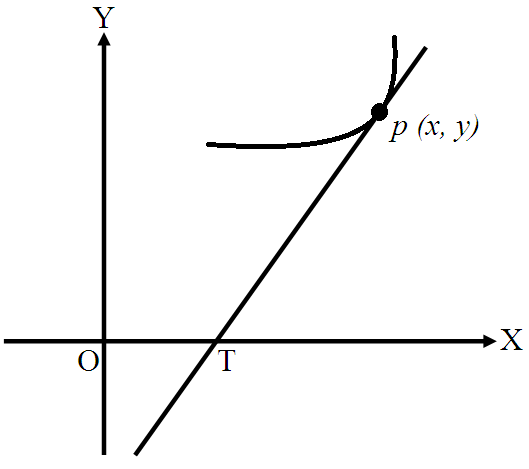 Portion of the x-axis cut off between the origin and tangent at a point $=\text{x}-\text{y}\frac{\text{dx}}{\text{dy}}=\text{OT}$
It is given, $\text{OT}=2\text{x}$
$\therefore \ \text{x}-\text{y}\frac{\text{dx}}{\text{dy}}=2\text{x}$
$-\text{x}=\text{y}\frac{\text{dx}}{\text{dy}}$
$-\int\frac{\text{dx}}{\text{dy}}=\int\frac{\text{dy}}{\text{y}}$
$\therefore\ \text{xy}=\text{k}$
Since the curve passes through the point (1, 2)
at $\text{x}=1, \text{y}=2$
$\therefore \text{k}=2$
$\therefore \text{xy}=2$ View full question & answer→Question 915 Marks
The normal to a given curve at each point (x, y) on the curve passes through the point (3, 0). If the curve contains the point (3, 4), find its equation.
AnswerEquation of normal on point (x, y) on the curve
$\text{y}-\text{y}=\frac{-\text{dx}}{\text{dy}}(\text{x}-\text{x})$
Its passing through (3, 0)
$\Rightarrow\text{0}-\text{y}=\frac{-\text{dx}}{\text{dy}}(3-\text{x})$
$\Rightarrow \text{y}=\frac{\text{dx}}{\text{dy}}(3-\text{x})$
$\Rightarrow \text{y}\ \text{dy}=(3-\text{x})\text{dx}$
$\Rightarrow \int\text{y}\ \text{dy}=\int(3-\text{x})\text{dx}$
$\Rightarrow \frac{\text{y}^{2}}{2}=3\text{x}-\frac{\text{x}^{2}}{2}+\text{C}\ ...(\text{i})$
It passing through (3, 4),
$\frac{16}{2}=9-\frac{9}{2}+\text{C}$
$\frac{16}{2}=\frac{9}{2}+\text{C}$
$\text{C}=7$
Put $\text{C}=7$ is equation (i)
$\frac{\text{y}^{2}}{2}=3\text{x}-\frac{\text{x}^{2}}{2}+\frac{7}{2}$
$\text{y}^{2}=6\text{x}-\text{x}^{2}+{7}$
View full question & answer→Question 925 Marks
Solve the following initial value problems:
$\text{x}\frac{\text{dy}}{\text{dx}}-\text{y}=\log\text{x},\text{ y}(1)=0$
AnswerWe have,
$\text{x}\frac{\text{dy}}{\text{dx}}-\text{y}=\log\text{x}$
$\Rightarrow\frac{\text{dy}}{\text{dx}}-\frac{\text{y}}{\text{x}}=\frac{\log\text{x}}{\text{x}}\ ...(\text{1})$
Clearly, it is a linear differential equation of the form
$\frac{\text{dy}}{\text{dx}}+\text{Py}=\text{Q}$
Where $\text{P}=-\frac{1}{\text{x}}$ and $\text{Q}=\frac{\log\text{x}}{\text{x}}$
$\therefore\text{I.F.}=\text{e}^{\int\text{Pdx}}$
$=\text{e}{-\int\frac{1}{\text{x}}}\text{ dx}$
$=\text{e}^{-\log\text{x}}$
$=\frac{1}{\text{x}}$
Multiplying both sides of (1) by $\text{I.F.}=\frac{1}{\text{x}},$ we get
$\frac{1}{\text{x}}\Big(\frac{\text{dy}}{\text{dx}}-\frac{1}{\text{x}}\text{y}\Big)=\frac{1}{\text{x}}\times\frac{\log\text{x}}{\text{x}}$
$\Rightarrow\frac{1}{\text{x}}\frac{\text{dy}}{\text{dx}}-\frac{1}{\text{x}^2}\text{y}=\frac{\log\text{x}}{\text{x}^2}$
Integrsting both sides with respect to x, we get
$\text{y}\frac{1}{\text{x}}=\int\frac{1}{\text{x}^2}\times\log\text{x dx}+\text{C}$
$\Rightarrow\frac{\text{y}}{\text{x}}=\log\text{x}\int\frac{1}{\text{x}^2}\text{dx}-\int\Big[\frac{\text{d}}{\text{dx}}(\log\text{x})\int\frac{1}{\text{x}^2}\text{dx}\Big]\text{dx}+\text{C}$
$\Rightarrow\frac{\text{y}}{\text{x}}=-\frac{\log\text{x}}{\text{x}}+\int\frac{1}{\text{x}^2}\text{dx}+\text{C}$
$\Rightarrow\frac{\text{y}}{\text{x}}=-\frac{\log\text{x}}{\text{x}}-\frac{1}{\text{x}}+\text{C}$
$\Rightarrow\text{y}=-\log\text{x}-1+\text{Cx}\ ...(\text{ii})$
Now,
$\text{y}(1)=0$
$\therefore\ 0=-0-1+\text{C}(1)$
$\Rightarrow\text{C}=1$
Putting the value of C in (2) we get
$\text{y}=-\log\text{x}-1+\text{x}$
$\Rightarrow\text{y}=\text{x}-1-\log\text{x}$
Hence, $\text{y}=\text{x}-1-\log\text{x}$ is the required solution.
View full question & answer→Question 935 Marks
Show that aii curve for which the slope at any point (x, y) on its is $\frac{\text{x}^{2}+\text{y}^{2}}{\text{2xy}}$ are rectangular hyperbola.
AnswerWe have,
$\frac{\text{dy}}{\text{dx}}=\frac{\text{x}^{2}+\text{y}^{2}}{\text{2xy}}$
Let y = vx
$\frac{\text{dy}}{\text{dx}}=\text{v}+\text{x}\frac{\text{dv}}{\text{dx}}$
$\therefore \text{v}+\text{x}\frac{\text{dv}}{\text{dx}}=\frac{\text{x}^{2}+\text{v}^{2}\text{x}^{2}}{2\text{vx}^{2}}$
$\Rightarrow \text{x}\frac{\text{dv}}{\text{dx}}=\frac{\text{1}+\text{v}^{2}}{2\text{v}}-\text{v}$
$\Rightarrow \text{x}\frac{\text{dv}}{\text{dx}}=\frac{\text{1}+\text{v}^{2}-2\text{v}^{2}}{2\text{v}}$
$\Rightarrow \text{x}\frac{\text{dv}}{\text{dx}}=\frac{\text{1}+\text{v}^{2}}{2\text{v}}$
$\Rightarrow\frac{2\text{v}}{1-\text{v}^{2}}\text{dv}=\frac{1}{\text{x}}\text{dx}$
Integrating both sides, we get
$\int\frac{2\text{v}}{1-\text{v}^{2}}\text{dv}=\int\frac{1}{\text{x}}\text{dx}$
$\Rightarrow-\log|1-\text{v}^{2}|=\log|\text{x}|-\log|\text{C}|$
$\Rightarrow-\log\Big|\frac{1-\text{v}^{2}}{\text{C}}\Big|=-\log|\text{x}|$
$\Rightarrow 1-\text{v}^{2}=\frac{\text{C}}{\text{x}}$
$\Rightarrow \frac{\text{x}^{2}-\text{y}^{2}}{\text{x}^{2}}=\frac{\text{C}}{\text{x}}$
$\Rightarrow \text{x}^{2}-\text{y}^{2}=\text{Cx}$
View full question & answer→Question 945 Marks
The volume of spherical balloon being inflated changes at a constant rate. If initially its radius is 3 units and after 3 seconds it is 6 units. Find the radius of balloon after t seconds.
AnswerLet v be volume of spherical balloon of radius r. $\therefore\ \text{v}=\frac{4}{3}\pi\text{r}^3\ ...(1)$From give condition,
$\frac{\text{dv}}{\text{dt}}=\text{k}\ \text{or}\ \frac{\text{d}}{\text{dt}}\bigg[\frac{4}{3}\pi\text{r}^3\bigg]=\text{k}\ \ [\because \text{of}\ (1)]$$\therefore\frac{4\pi}{3}.\ 3\ \text{r}^2\ \frac{\text{dr}}{\text{dt}}=\text{k}\ \ \text{or}\ \ 4\pi\text{r}^2\ \frac{\text{dr}}{\text{dt}}=\text{k}$
Separating the variables and integrating, we get.
$4\pi\int\text{r}^2\text{dr}=\text{k}\int\text{dt}\ \ \text{or}\ \ 4\pi \frac{\text{r}^3}{3}$ $=\text{k}\ \text{t}+\text{c}\ ...(2)$
Now t = 0 when r = 3 $\therefore\ 4\pi\frac{(3)^3}{3}=\text{k}\times0 +\text{c}\ \ \Rightarrow\ \ \text{c}=36\pi\ ...(3)$Again t = 3 when r = 6
$\therefore\ 4\pi\frac{(3)^3}{3}(6)^3=3\ \text{k}+36\pi\ \ [\because\ \text{of}\ (3)]$
$\therefore\ 288\pi=3\text{k}+36\pi\ \text{or}\ 3\text{k}=252\pi$
$\therefore\ \text{k}=84\pi$
$\text{Putting k}=84\pi,\ \text{c}=36\pi\ \text{in (2), we get}$
$\frac{4\pi}{3}\text{r}^3=84\pi\ \text{t}+36\pi\ \text{or}\ \frac{\text{r}^3}{3}=21\ \text{t}+9$
$\therefore\ \text{r}^3=63\ \text{t}+27\ \ \Rightarrow\ \ \text{r}=[9(7 \text{t}+3)]^\frac{1}{3}$
View full question & answer→Question 955 Marks
Solve the following differential equation
$\text{x}\frac{\text{dy}}{\text{dx}}+1=0;\text{y}(-1)=0$
Answer$\text{x}\frac{\text{dy}}{\text{dx}}+1=0,\text{y}(-1)=0$
$\text{x}\frac{\text{dy}}{\text{dx}}=-1$
$\text{dy}=-\frac{\text{dx}}{\text{x}}$
$\int\text{dy}=\int-\frac{\text{dx}}{\text{x}}$
$\text{y}=-\log|\text{x}|+\text{C}$
Put x = -1 and y = 0
0 = 0 + c
c = 0
put c = 0 in equation (1),
$\text{y}=-\log|\text{x}|,\text{x}<0$
View full question & answer→Question 965 Marks
Solve the following differential equation:
$\frac{\text{dy}}{\text{dx}}+\text{y}=\sin\text{x}$
AnswerWe have,
$\frac{\text{dy}}{\text{dx}}+\text{y}=\sin\text{x}\ \dots(1)$
Clearly, it is a linear differential equation of the form
$\frac{\text{dy}}{\text{dx}}+\text{Py}=\text{Q}$
where
$\text{P}=1$
$\text{Q}=\sin\text{x}$
$\therefore\ \text{I.F.}=\text{e}^{\int\text{Pdx}}=\text{e}^{\int\text{dx}}=\text{e}^{\text{x}}$
Multiplying both sides of (1) by $e^x,$ we get
$\text{e}^\text{x}\Big(\frac{\text{dy}}{\text{dx}}+\text{y}\Big)=\text{e}^\text{x}\sin \text{x}$
$\Rightarrow\ \text{e}^\text{x}\frac{\text{dy}}{\text{dx}}+\text{e}^{\text{x}}\text{y}=\text{e}^\text{x}\sin\text{x}$
Integrating both sides with respect to $x$, we get
$\text{y}\text{e}^{\text{x}}=\int\text{e}^{\text{x}}\sin\text{x dx + C}$
$\Rightarrow\ \text{y}\text{e}^{\text{x}}=\frac{\text{e}^{\text{x}}}{2}(\sin\text{x}-\cos{\text{x}})+\text{C}$
$\Rightarrow\ \text{y}=\text{Ce}^{-\text{x}}+\frac{1}{2}(\sin\text{x}-\cos{\text{x}})$
Hence, $\text{y}=\text{Ce}^{-\text{x}}+\frac{1}{2}(\sin\text{x}-\cos{\text{x}})$ is the required solution.
View full question & answer→Question 975 Marks
verify that $\text{y}^2=4\text{a}(\text{x}+\text{a})$ is a solution of the differential equation $\Big\{1-\Big(\frac{\text{dy}}{\text{dx}}\Big)^2\Big\}=2\text{x}\frac{\text{dy}}{\text{dx}}.$
Answer$\text{y}^2=4\text{a}(\text{x}+\text{a})\ ...(1)$
Differentiating both sides of (1) with respect to x, we get
$2\text{y}\frac{\text{dy}}{\text{dx}}=4\text{a}$
$\frac{\text{dy}}{\text{dx}}=\frac{2\text{a}}{\text{y}}\ ...(2)$
Now,
$\text{y}\Big\{1-\Big(\frac{\text{dy}}{\text{dx}}\Big)^2\Big\}$
$=\Big[\text{y}^2\Big\{1-\Big(\frac{\text{dy}}{\text{dx}}\Big)^2\Big\}\Big]\frac{1}{\text{y}}$
$=\Big[4\text{a}(\text{x}+\text{a})-4\text{a}(\text{x}+\text{a})\Big(\frac{2\text{a}}{\text{y}}\Big)^2\Big]\frac{1}{\text{y}}$
Using equation (1) and (2)
$=\Big[4\text{ax}+4\text{a}^2-\frac{16\text{a}3\text{x}}{\text{y}^2}-\frac{16\text{a}^4}{\text{y}^2}\Big]\frac{1}{\text{y}}$
$=\frac{4\text{a}}{\text{y}^3}[\text{xy}^2+\text{ay}^2-4\text{a}^2\text{x}-4\text{a}^3\Big]$
$=\frac{4\text{a}}{\text{y}^3}[\text{y}^2(\text{a}+\text{x})-4\text{a}^2(\text{x}+\text{a})]$
$\frac{4\text{a}}{\text{y}^3}(\text{a}+\text{x})(\text{y}^2-4\text{a}^2)$
View full question & answer→Question 985 Marks
Solve the following differential equation:
$\text{x}\frac{\text{dy}}{\text{dx}}=\text{y}-\text{x}\cos^2\Big(\frac{\text{y}}{\text{x}}\Big)$
AnswerHere, $\text{x}\frac{\text{dy}}{\text{dx}}=\text{y}-\text{x}\cos^2\Big(\frac{\text{y}}{\text{x}}\Big)$
$\Rightarrow\ \frac{\text{dy}}{\text{dx}}=\frac{\text{y}-\text{x}\cos^2\Big(\frac{\text{y}}{\text{x}}\Big)}{\text{x}}$
It is a homogeneous equation.
Put x = vy
and $\frac{\text{dy}}{\text{dx}}=\text{v + x}\frac{\text{dv}}{\text{dx}}$
So,
$\text{v + x}\frac{\text{dv}}{\text{dx}}=\frac{\text{vx}-\text{x}\cos^2\big(\frac{\text{vx}}{\text{x}}\big)}{\text{x}}$
$\text{v + x}\frac{\text{dv}}{\text{dx}}=\text{v}-\cos^2\text{v}$
$\text{x}\frac{\text{dv}}{\text{dx}}=\text{v}-\cos^2\text{v}-\text{v}$
$\text{x}\frac{\text{dv}}{\text{dx}}=-\cos^2\text{v}$
$\frac{\text{dv}}{\cos^2\text{v}}=-\frac{\text{dx}}{\text{x}}$
$\int\sec^2\text{vdv}=-\int\frac{\text{dx}}{\text{x}}$
$\tan\text{v}=-\log|\text{x}|+\log\text{C}$
$\tan\frac{\text{y}}{\text{x}}=\log\Big|\frac{\text{C}}{\text{x}}\Big|$
View full question & answer→Question 995 Marks
Solve the following differential equation:
$\text{y dx}+\Big\{\text{x}\log\Big(\frac{\text{y}}{\text{x}}\Big)\Big\}\text{dy}-2\text{x dy}=0$
AnswerWe have, $\text{y dx}+\Big\{\text{x}\log\Big(\frac{\text{y}}{\text{x}}\Big)\Big\}\text{dy}-2\text{x dy}=0$ $\Rightarrow\ \Big\{2\text{x}-\text{x}\log\Big(\frac{\text{y}}{\text{x}}\Big)\Big\}\text{dy}=\text{y dx}$ $\Rightarrow\ \frac{\text{dy}}{\text{dx}}=\frac{\text{y}}{2\text{x}-\text{x}\log\big(\frac{\text{y}}{\text{x}}\big)}$ This is a homogeneous differential equation. Put y = vx and $\frac{\text{dy}}{\text{dx}}=\text{v + x}\frac{\text{dv}}{\text{dx}},$ we get$\text{v + x}\frac{\text{dv}}{\text{dx}}=\frac{\text{vx}}{2\text{x}-\text{x}\log\text{v}}$
$\Rightarrow\ \text{v + x}\frac{\text{dv}}{\text{dx}}=\frac{\text{v}}{2-\log\text{v}}$ $\Rightarrow\ \text{x}\frac{\text{dv}}{\text{dx}}=\frac{\text{v}}{2-\log\text{v}}-\text{v}$ $\Rightarrow\ \text{x}\frac{\text{dv}}{\text{dx}}=\frac{\text{v}-2\text{v + v}\log\text{v}}{2-\log\text{v}}$ $\Rightarrow\ \text{x}\frac{\text{dv}}{\text{dx}}=\frac{\text{v}\log\text{v}-\text{v}}{2-\log\text{v}}$ $\Rightarrow\ \frac{2-\log\text{v}}{\text{v}\log\text{v}-\text{v}}\text{dv}=\frac{1}{\text{x}}\text{dx}$ integrating both sides, we get $\int\frac{2-\log\text{v}}{\text{v}\log\text{v}-\text{v}}\text{dv}=\int\frac{1}{\text{x}}\text{dx}$ $\Rightarrow\ \int\frac{1-(\log\text{v}-1)}{\text{v}(\log\text{v}-1)}\text{dv}=\int\frac{1}{\text{x}}\text{dx}$ Putting $\log\text{v}-1=\text{t}$ $\Rightarrow\ \frac{1}{\text{v}}\text{dv}=\text{dt}$ $\therefore\ \int\frac{1-\text{t}}{\text{t}}\text{dt}=\int\frac{1}{\text{x}}\text{dx}$ $\Rightarrow\ \int\Big(\frac{1}{\text{t}}-1\Big)\text{dt}=\int\frac{1}{\text{x}}\text{dx}$ $\Rightarrow\ \log|\text{t}|-\text{t}=\log|\text{x}|+\log\text{C}$ $\Rightarrow\ \log|\log\text{v}-1|-(\log\text{v}-1)=\log|\text{x}|+\log\text{C}$ $\Rightarrow\ \log|\log\text{v}-1|-\log\text{v}=\log|\text{x}|+\log\text{C}$ $\big($where, $\log\text{C}_1=\log\text{C}-1\big)$ $\Rightarrow\ \log\Big|\frac{\log\text{v}-1}{\text{v}}\Big|=\log|\text{C}_1\text{x}|$ $\Rightarrow\ \frac{\log\text{v}-1}{\text{v}}=\text{C}_1\text{x}$ $\Rightarrow\ \log\text{v}-1=\text{C}_1\text{xv}$ Putting $\text{v}=\frac{\text{y}}{\text{x}},$ we get $\log\frac{\text{y}}{\text{x}}-1=\text{C}_1\text{x}\times\frac{\text{y}}{\text{x}}$ $\Rightarrow\ \log\frac{\text{y}}{\text{x}}-1=\text{C}_1\text{y}$ Hence, $\log\frac{\text{y}}{\text{x}}-1=\text{C}_1\text{y}$ is the required solution.
View full question & answer→Question 1005 Marks
Solve the following differential equations:$\text{y}(1-\text{x}^2)\frac{\text{dy}}{\text{dx}}=\text{x}(1+\text{y}^2)$
AnswerWe have,
$\text{y}(1-\text{x}^2)\frac{\text{dy}}{\text{dx}}=\text{x}(1+\text{y}^2)$
$\Rightarrow\frac{\text{y}}{1+\text{y}^2}\text{dy}=\frac{\text{x}}{1-\text{x}^2}\text{dx}$
Integrating both sides,
$\int\frac{\text{y}}{1+\text{y}^2}\text{dy}=\int\frac{\text{x}}{1-\text{x}^2}\text{dx}$
Substituting $1+\text{y}^2=\text{t}$ and $1-\text{x}^2=\text{u}$
$2\text{ydy = dt}$ and $-2\text{x dx = du}$
$\therefore\frac{1}{2}\int\frac{1}{\text{t}}=\frac{-1}{2}\int\frac{1}{\text{u}}\text{du}$
$\Rightarrow\frac{1}2{}\log|\text{t}|=-\frac{1}{2}\log|\text{u}|+\log\text{C}$
$\Rightarrow\frac{1}{2}|1+\text{y}^2|=-\frac{1}{2}\log|1-\text{x}^2|+\log\text{C}$
$\Rightarrow\frac{1}{2}\big[\log|1+\text{y}^2|+\log|1-\text{x}^2|\big]=\log\text{C}$
$\Rightarrow\log(|1+\text{y}^2||1-\text{x}^2|)=2\log\text{C}$
$\Rightarrow(1+\text{y}^2)(1-\text{x}^2)=\text{C}^2$
$\Rightarrow(1+\text{y}^2)(1-\text{x}^2)=\text{C}_1,$ where $\text{C}_1=\text{C}^2$
Hence, $(1+\text{y}^2)(1-\text{x}^2)=\text{C}_1$ is the required solution.
View full question & answer→