Question 1015 Marks
Solve the differential equation $\frac{\text{dy}}{\text{dx}}+2\text{xy}=\text{y}.$
AnswerWe have $\frac{\text{dy}}{\text{dx}}+2\text{xy}=\text{y}$
$\Rightarrow\frac{\text{dy}}{\text{dx}}+2\text{xy}-\text{y}=0$
$\Rightarrow\frac{\text{dy}}{\text{dx}}+(2\text{x}-1)\text{y}=0$
$\Rightarrow\frac{\text{dy}}{\text{dx}}=\text{y}(1-2\text{x})\text{dx}$
$\Rightarrow\frac{\text{dy}}{\text{y}}=(1-2\text{x})\text{dx}$
Integrating both sides we get,
$\int\frac{\text{dy}}{\text{y}}=\int(1-2\text{x})\text{dx}$
$\Rightarrow\log\text{y}=\text{x}-\text{x}^2+\log\text{C}$
$\Rightarrow\log\text{y}-\log\text{C}=\text{x}-\text{x}^2$
$\Rightarrow\log\frac{\text{y}}{\text{C}}=\text{x}-\text{x}^2$
$\Rightarrow\frac{\text{y}}{\text{C}}=\text{e}^{\text{x}-\text{x}^2}$
$\Rightarrow\text{y}=\text{C}\text{e}^{\text{x}-\text{x}^2}$
View full question & answer→Question 1025 Marks
Solve the following differential equation:
$\frac{\text{dy}}{\text{dx}}=\frac{\text{y}}{\text{x}}\{\log\text{y}-\log\text{x}+1\}$
AnswerHere, $\frac{\text{dy}}{\text{dx}}=\frac{\text{y}}{\text{x}}\{\log\text{y}-\log\text{x}+1\}$
$\Rightarrow\ \frac{\text{dy}}{\text{dx}}=\frac{\text{y}}{\text{x}}-\Big\{\log\Big(\frac{\text{y}}{\text{x}}\Big)+1\Big\}$
It is a homogeneous equation.
Put y = vx and $\frac{\text{dy}}{\text{dx}}=\text{v + x}\frac{\text{dv}}{\text{dx}}$
So,
$\text{v + x}\frac{\text{dv}}{\text{dx}}=\frac{\text{vx}}{\text{x}}\Big\{\log\Big(\frac{\text{vx}}{\text{x}}\Big)+1\Big\}$
$\text{v + x}\frac{\text{dv}}{\text{dx}}=\text{v}\log\text{v + v}$
$\text{x}\frac{\text{dv}}{\text{dx}}=\text{v}\log\text{v}$
$\int\frac{1}{\text{v}\log\text{v}}\text{dv}=\int\frac{\text{dx}}{\text{x}}$
$\log\log\text{v}=\log|\text{x}|+\log\text{C}$
$\log\text{v}=\text{xC}$
$\log\frac{\text{y}}{\text{x}}=\text{xC}$
$\frac{\text{y}}{\text{x}}=\text{e}^{\text{xC}}$
$\text{y}=\text{xe}^{\text{xC}}$
View full question & answer→Question 1035 Marks
Find the equation of the curve which passes through the point (2, 2) and satisfies the differential equation $\text{y}-\text{x}\frac{\text{dy}}{\text{dx}}=\text{y}^{2}+\frac{\text{dy}}{\text{dx}}.$
Answer$\text{y}-\text{x}\frac{\text{dy}}{\text{dx}}=\text{y}^{2}+\frac{\text{dy}}{\text{dx}}$
$\frac{\text{dy}}{\text{dx}}+\text{x}\frac{\text{dy}}{\text{dx}}=\text{y}-\text{y}^{2}$
$(1-\text{x})\frac{\text{dy}}{\text{dx}}=\text{y}-\text{y}^{2}$
$\frac{\text{dy}}{\text{y}-\text{y}^{2}}=\frac{\text{dx}}{1+\text{x}}$
$\frac{\text{dy}}{\text{y}(1-\text{y})}=\frac{\text{dx}}{1+\text{x}}$
$\int\Big(\frac{1}{\text{y}}+\frac{1}{1-\text{y}}\Big)\text{dx}=\int\frac{\text{dx}}{1+\text{x}}$
$\log|\text{y}|-\log|1-\text{y}|=\log|1+\text{x}|+\log|\text{c}|$
$\frac{\text{y}}{1-\text{y}}=\text{c}(1+\text{x})$
$\text{y}=(1-\text{y})\text{c}(1+\text{x})\ ...(\text{i})$
It is passing through (2, 2) so,
$2=(1-2)\text{c}(1+2)$
$2=-3\text{c}$
$\text{c}=-\frac{2}{3}$
from eq.(i)
$\text{y}=-\frac{2}{3}(1-\text{y})(1+\text{x})$
$3\text{y}=-2(1+\text{x}-\text{y}-\text{xy})$
$3\text{y}+2+2\text{x}-2\text{y}-2\text{xy}=0$
$\text{y}+2\text{y}-2\text{xy}+2=0$
$2\text{xy}+2\text{x}-2-\text{y}=0$
Chapter 22 Differential eq.
It is passing through $\Big(1, \frac{\pi}{4}\Big)$,
$\tan\Big(\frac{\pi}{4}\Big)=-\log|1|+\text{C}$
$1-0+\text{C}$
$\text{C}=1$
Now, eq. (i) become
$\tan\Big(\frac{\text{y}}{\text{x}}\Big)=-\log|\text{x}|+\text{1}$
Therefore,
$\tan\Big(\frac{\text{y}}{\text{x}}\Big)=\log|\frac{\text{e}}{\text{x}}|$
View full question & answer→Question 1045 Marks
Solve the following initial value problems:
$\frac{\text{dy}}{\text{dx}}+2\text{y}\tan\text{x}=\sin\text{x},\text{ y}=0,\text{ when x}=\frac{\pi}{3}$
AnswerWe have,
$\frac{\text{dy}}{\text{dx}}+2\text{y}\tan\text{x}=\sin\text{x}\ ...(1)$
Clearly, it is a linear differential equation of the form
$\frac{\text{dy}}{\text{dx}}+\text{Py}=\text{Q}$
Where $\text{P}=2\tan\text{x}$ and $\text{Q}=\sin\text{x}$
$\therefore\text{ I.F.}=\text{e}^{\int\text{Pdx}}$
$=\text{e}^{2\int\tan\text{x dx}}$
$=\text{e}^{2\log|\sec\text{x}|}$
$=\sec^2\text{x}$
Multiplying both sides of (1) by $\text{I.F.}=\sec^2\text{x},$ we get
$\sec^2\text{x}\Big(\frac{\text{dy}}{\text{dx}}+2\text{y}\tan\text{x}\Big)=\sec^2\text{x}\times\sin\text{x}$
$\sec^2\text{x}\Big(\frac{\text{dy}}{\text{dx}}+2\text{y}\tan\text{x}\Big)=\tan\text{x }\sec\text{x}$
Integrating both sides with respect to x, we get
$\text{y}\sec^2\text{x}=\int\tan\text{x}\sec\text{x dx}+\text{C}$
$\text{y}\sec^2\text{x}=\sec{\text{x}}+\text{C}\ ...(2)$
Now,
$\text{y}\Big(\frac{\pi}{3}\Big)=0$
$\therefore\ 0\Big(\sec\frac{\pi}{3}\Big)^2=\sec\frac{\pi}{3}+\text{C}$
$\Rightarrow\text{C}=-2$
Putting the value of C in (2), we get
$\text{y}\sec^2\text{x}=\sec\text{x}-2$
$\Rightarrow\text{y}=\cos\text{x}-2\cos^2\text{x}$
Hence, $\text{y}=\cos\text{x}-2\cos^2\text{x}$ is the required solution.
View full question & answer→Question 1055 Marks
Solve the following differential equations:$(1+\text{y}^2)\tan^{-1}\text{xdx}+2\text{y}(1+\text{x}^2)\text{dy}=0$
Answer$(1+\text{y}^2)\tan^{-1}\text{xdx}+2\text{y}(1+\text{x}^2)\text{dy}=0$
$(1+\text{y}^2)\tan^{-1}\text{xdx}=-2\text{y}(1+\text{x}^2)\text{dy}$
$-\frac{\tan^{-1}}{2(1+\text{x}^2)}\text{dx}=\frac{\text{y}}{(1+\text{y}^2)}\text{dy}$
Integrating on both the sides
$\int-\frac{\tan^{-1}\text{x}}{2(1+\text{x}^2)}\text{dx}=\int\frac{\text{y}}{(1+\text{y}^2)}\text{dy}$
$-\Big(\tan^{-1}\text{x}\Big(\frac{1}{2}\tan^{-1}\text{x}\Big)-\int\frac{1}{(1+\text{x}^2)}\Big(\frac{1}{2}\tan^{-1}\text{x}\Big)\text{dx}\Big)=\frac{1}{2}\ln(\text{y}^2+1)+\text{C}$
$-\frac{1}{4}(\tan^{-1}\text{x})^2=\frac{1}{2}\ln(\text{y}^2+1)+\text{C}_1$
$\frac{1}{2}(\tan^{-1}\text{x})^2+\ln(\text{y}^2+1)=\text{C}$
View full question & answer→Question 1065 Marks
Solve the following differential equations:$\frac{\text{dy}}{\text{dx}}=2\text{e}^{2\text{x}}\text{y}^2,\text{y}(0)=-1$
Answer$\frac{\text{dy}}{\text{dx}}=2\text{e}^{2\text{x}}\text{y}^2,\text{y}(0)=-1$
$\Rightarrow\frac{1}{\text{y}^2}\text{dy}=2\text{e}^{2\text{x}}\text{dx}$
Integrating both sides, we get
$\int\frac{1}{\text{y}^2}\text{dy}=2\int\text{e}^{2\text{x}}\text{dx}$
$\Rightarrow\frac{-1}{\text{y}}=\text{e}^{2\text{x}}+\text{C}...(1)$
We know that at $\text{x}=0,\text{y}=-1.$
Substituting the values of x and y in (1), we get
$1=1+\text{C}$
$\Rightarrow\text{C}=0$
Substituting the value of C in (1), we get
$-\frac{1}{\text{y}}=\text{e}^{2\text{x}}$
$\Rightarrow\text{y}=-\text{e}^{-2\text{x}}$
Hence, $\text{y}=-\text{e}^{-2\text{x}}$ is the required soluton.
View full question & answer→Question 1075 Marks
Find the equation of a curve passing through the point (0, 0) and whose differential equation is $\frac{\text{dy}}{\text{dx}}=\text{e}^{\text{x}}\sin\text{x.}$
AnswerThe differential equation of the curve is:
$\text{y}'=\text{e}^{\text{x}}\sin\text{x}$
$\Rightarrow\frac{\text{dy}}{\text{dx}}=\text{e}^{\text{x}}\sin\text{x}$
$\Rightarrow\text{dy}=\text{e}^{\text{x}}\sin\text{x}$
Integrating both sides, we get:
$\int\text{dy}=\int\text{e}^{\text{x}}\sin\text{x dx }...(1)$
Let $\text{I}=\int\text{e}^{\text{x}}\sin\text{x dx}.$
$\Rightarrow\text{I}=\sin\text{x}\int\text{e}^{\text{x}}\text{dx}-\int\Big(\frac{\text{d}}{\text{dx}}(\sin\text{x}).\int\text{e}^{\text{x}}\text{dx}\Big)\text{dx}$
$\Rightarrow\text{I}=\sin\text{x}\cdot\text{e}^{\text{x}}-\int\cos\text{x}\cdot\text{e}^{\text{x}}\text{dx}$
$\Rightarrow\text{I}=\sin\text{x}\cdot\text{e}^{\text{x}}-\Big[\cos\text{x}\cdot\int\text{e}^{\text{x}}\text{dx}-\int\Big(\frac{\text{d}}{\text{dx}}(\cos\text{x})\cdot\int\text{e}^{\text{x}}\text{dx}\Big)\text{dx}\Big]$
$\Rightarrow\text{I}=\sin\text{x}\cdot\text{e}^{\text{x}}-\big[\cos\text{x}\cdot\text{e}^{\text{x}}-\int(-\sin\text{x})\cdot\text{e}^{\text{x}}\text{dx}\big]$
$\Rightarrow\text{I}=\text{e}^{\text{x}}\sin\text{x}-\text{e}^{\text{x}}\cos\text{x}-\text{I}$
$\Rightarrow2\text{I}=\text{e}^{\text{x}}(\sin\text{x}-\cos\text{x})$
$\Rightarrow\text{I}=\frac{\text{e}^{\text{x}}(\sin\text{x}-\cos\text{x})}{2}$
View full question & answer→Question 1085 Marks
The x-intercept of the tangent line to a curve is equal to the ordinate of the point of contact. Find the particular curve through the point (1, 1).
AnswerLet P(x, y) be the point on the curve y = f(x) such that tangent at P cuts the coordinate axes at A and B.
The quation of tangent is,
$\text{y}-\text{y}=\frac{\text{dy}}{\text{dx}}(\text{x}-\text{x})$
Put y = 0
$-\text{y}=\frac{\text{dy}}{\text{dx}}(\text{x}-\text{x})$
$-\text{y}\frac{\text{dy}}{\text{dx}}+\text{x}=\text{x}$
Coording of $\text{B}=\Big(-\text{y}\frac{\text{dy}}{\text{dx}}+\text{x}, 0\Big)$
Here, x intercept of tangent = y
$-\text{y}\frac{\text{dy}}{\text{dx}}+\text{x}=\text{y}$
$\frac{\text{dy}}{\text{dx}}-\frac{\text{x}}{\text{y}}=-1$
It is a differential equation on it with $\text{P}=\frac{1}{\text{y}}, \text{Q}=-1$
$\text{I.F}=\text{e}^{\int\frac{1}{\text{y}}\text{dy}}$
$=\text{e}^{\log\text{y}}$
$=\frac{1}{\text{y}}$
Solution of the equation is given by,
$\text{x}(\text{I.F})=\int\text{Q}(\text{I.F})\text{dy}+\text{C}$
$\text{x}(\frac{1}{\text{y}})=\int\text{(-1)}(\frac{1}{\text{y}})\text{dy}+\text{C}$
$\text{x}(\frac{1}{\text{y}})=-\log\text{y}+\text{C}\ ...(\text{i})$
It is passing through (1, 1)
$\frac{1}{\text{1}}=-\log\text{1}+\text{C}$
$\text{C}=1$
Put C = 1 is equation (i)
$\frac{\text{x}}{\text{y}}=-\log\text{y}+\text{1}$
$\text{x}={\text{y}}-\text{y}\log\text{y}$
$\text{x}+\text{y}\log\text{y}=\text{y}$
View full question & answer→Question 1095 Marks
Solve the following differential equation:
$(\text{x}^2-2\text{xy})\text{dy}+(\text{x}^2-3\text{xy}+2\text{y}^2)\text{dx}=0$
AnswerHere, $(\text{x}^2-2\text{xy})\text{dy}+(\text{x}^2-3\text{xy}+2\text{y}^2)\text{dx}=0$
$\Rightarrow\ \frac{\text{dy}}{\text{dx}}=\frac{\text{x}^2-3\text{xy}+2\text{y}^2}{2\text{xy}-\text{x}^2}$
It is a homogeneous equation.
Put x = vy
and $\frac{\text{dy}}{\text{dx}}=\text{v + x}\frac{\text{dv}}{\text{dx}}$
So,
$\text{v + x}\frac{\text{dv}}{\text{dx}}=\frac{\text{x}^2-3\text{xvx}+2\text{v}^2\text{x}^2}{2\text{xvx}-\text{x}^2}$
$\text{x}\frac{\text{dv}}{\text{dx}}=\frac{1-3\text{v}+2\text{v}^2}{2\text{v}-1}-\text{v}$
$\text{x}\frac{\text{dv}}{\text{dx}}=\frac{1-3\text{v}+2\text{v}^2-2\text{v}^2+\text{v}}{2\text{v}-1}$
$\text{x}\frac{\text{dv}}{\text{dx}}=\frac{1-2\text{v}}{2\text{v}-1}$
$\frac{2\text{v}-1}{1-2\text{v}}\text{dv}=\frac{\text{dx}}{\text{x}}$
$\frac{1-2\text{v}}{1-2\text{v}}\text{dv}=-\int\frac{\text{dx}}{\text{x}}$
$\int\text{dv}=-\int\frac{\text{dx}}{\text{x}}$
$\text{v}=-\log|\text{x}|+\text{C}$
$\frac{\text{y}}{\text{x}}+\log\text{x}=\text{C}$
View full question & answer→Question 1105 Marks
Solve the following differential equation:
$\text{xy}\log\Big(\frac{\text{y}}{\text{x}}\Big)\text{dx}+\Big\{\text{y}^2-\text{x}^2\log\Big(\frac{\text{y}}{\text{x}}\Big)\Big\}\text{dy}=0$
Answer$\text{xy}\log\Big(\frac{\text{y}}{\text{x}}\Big)\text{dx}+\Big\{\text{y}^2-\text{x}^2\log\Big(\frac{\text{y}}{\text{x}}\Big)\Big\}\text{dy}=0$ $\Rightarrow\ \text{xy}\log\Big(\frac{\text{y}}{\text{x}}\Big)\text{dx}=-\Big\{\text{y}^2-\text{x}^2\log\Big(\frac{\text{y}}{\text{x}}\Big)\Big\}\text{dy}$$\Rightarrow\ \frac{\text{dx}}{\text{dy}}=\frac{-\big\{\text{y}^2-\text{x}^2\log\big(\frac{\text{y}}{\text{x}}\big)\big\}}{\text{xy}\log\big(\frac{\text{x}}{\text{y}}\big)}$
$=\frac{\text{x}^2\log\big(\frac{\text{x}}{\text{y}}\big)-\text{y}^2}{\text{xy}\log\big(\frac{\text{x}}{\text{y}}\big)}$
It is a homogeneous equation. We put x = vy $\frac{\text{dx}}{\text{dy}}=\text{v + y}\frac{\text{dv}}{\text{dy}}$ So, $\text{v + y}\frac{\text{dv}}{\text{dy}}=\frac{\text{v}^2\text{y}^2\log(\text{v})-\text{y}^2}{\text{vy}^2\log(\text{v})}$ $\text{v + y}\frac{\text{dv}}{\text{dy}}=\frac{\text{v}^2\log(\text{v})-1}{\text{v}\log(\text{v})}$ $\Rightarrow\ \text{y}\frac{\text{dv}}{\text{dy}}=\frac{\text{v}^2\log(\text{v})-1}{\text{v}\log(\text{v})}-\text{v}$ $\Rightarrow\ \text{y}\frac{\text{dv}}{\text{dy}}=\frac{\text{v}^2\log(\text{v})-1-\text{v}^2\log(\text{v})}{\text{v}\log(\text{v})}$ $\Rightarrow\ \text{y}\frac{\text{dv}}{\text{dy}}=\frac{-1}{\text{v}\log(\text{v})}$ $\Rightarrow\ \text{v}\log(\text{v})\text{dv}=\frac{-1}{\text{y}}\text{dy}$ On integrating both sides we get, $\int\text{v}\log(\text{v})\text{dv}=-\int\frac{1}{\text{y}}\text{dy}$ $\Rightarrow\ \frac{\text{v}^2}2\log(\text{v})-\int\frac{\text{v}}2\text{dv}=-\log\text{y + C}$ $\Rightarrow\ \frac{\text{v}^2}2\log(\text{v})-\frac{\text{v}^2}4=-\log\text{y + C}$ $\Rightarrow\ \frac{\text{v}^2}2\Big[\log(\text{v})-\frac{1}2\Big]=-\log\text{y + C}$ $\Rightarrow\ \text{v}^2\Big[\log(\text{v})-\frac{1}2\Big]=-2\log\text{y + C}$ Now putting back the values of v as $\frac{\text{x}}{\text{y}}$ we get, $\frac{\text{x}^2}{\text{y}^2}\Big[\log(\text{v})-\frac{1}2\Big]+\log\text{y}^2=\text{C}$
View full question & answer→Question 1115 Marks
Solve the following initial value problems:
$(\text{x}^2+\text{y}^2)\text{dx}=2\text{xy dy, y}(1)=0$
Answer$(\text{x}^2+\text{y}^2)\text{dx}=2\text{xy dy, y}(1)=0$ $\frac{\text{dy}}{\text{dx}}=\frac{\text{x}^2+\text{y}^2}{2\text{xy}}$ It is a homogeneous equation. Put y = vx
and $\frac{\text{dy}}{\text{dx}}=\text{v + x}\frac{\text{dv}}{\text{dx}},$ So,$\text{v + x}\frac{\text{dv}}{\text{dx}}=\frac{\text{x}^2+\text{v}^2\text{x}^2}{2\text{xvx}}$
$\text{x}\frac{\text{dv}}{\text{dx}}=\frac{1+\text{v}^2}{2\text{v}}-\text{v}$ $\text{x}\frac{\text{dv}}{\text{dx}}=\frac{1+\text{v}^2-2\text{v}^2}{2\text{v}}$ $\text{x}\frac{\text{dv}}{\text{dx}}=\frac{1-\text{v}^2}{2\text{v}}$ $\int\frac{2\text{v}}{1-\text{v}^2}=\int\frac{\text{dx}}{\text{x}}$ $\log|1-\text{v}^2|=-\log|\text{x}|+\log|\text{C}|$ $\log|1-\text{v}^2|=\log\Big|\frac{\text{C}}{\text{x}}\Big|$ $\Big|\frac{\text{x}^2-\text{y}^2}{\text{x}^2}\Big|=\Big|\frac{\text{C}}{\text{x}}\Big|$ $|\text{x}^2-\text{y}^2|=|\text{Cx}|\ \dots(\text{i})$ Put y = 0, x = 1 1 - 0 = C C = 1 Put the value of C in equation (i), $|\text{x}^2-\text{y}^2|=|\text{x}|$ $(\text{x}^2-\text{y}^2)^2=\text{x}^2$
View full question & answer→Question 1125 Marks
In each of the show that the given differential equation is homogeneous and solve each of them.
$\text{x}\frac{\text{dy}}{\text{dx}}-\text{y}+\text{x}\sin\bigg(\frac{\text{y}}{\text{x}}\bigg)=0$
AnswerGiven: Differential equation $\text{x}\frac{\text{dy}}{\text{dx}}-\text{y}+\text{x}\sin\bigg(\frac{\text{y}}{\text{x}}\bigg)=0$
$\Rightarrow\ \ \text{x}\frac{\text{dy}}{\text{dx}}-\text{y}+\text{x}\sin=0\bigg(\frac{\text{y}}{\text{x}}\bigg)$ $\Rightarrow\ \ \frac{\text{dy}}{\text{dx}}=\frac{\text{y}}{\text{x}}-\sin\bigg(\frac{\text{y}}{\text{x}}\bigg)=f\bigg(\frac{\text{y}}{\text{x}}\bigg)\ \ ...(\text{i})$
Therefore, the given differential equation is homogeneous.
$\text{Putting}\frac{\text{y}}{\text{x}}=\text{v}\ \ \Rightarrow\ \ \text{y}=\text{vx}\ \ $ $\Rightarrow\ \ \frac{\text{dy}}{\text{dx}}=\text{v}.1+\text{x}\frac{\text{dv}}{\text{dx}}=\text{v}+\text{x}\frac{\text{dv}}{\text{dx}}$
$\text{Putting these values of}\ \frac{\text{y}}{\text{x}}\ \text{and}\ \frac{\text{dy}}{\text{dx}}\ \text{in eq. (i), we get}$
$\text{v}+\text{x}\frac{\text{dv}}{\text{dx}}=\text{v}-\sin\text{v}\ \ \Rightarrow\ \ \text{x}\frac{\text{dv}}{\text{dx}}=-\sin\text{v}$ $\ \ \Rightarrow\ \ \text{x dv}=-\sin\text{v dx}$
$\Rightarrow\ \ \frac{\text{dv}}{\sin\text{v}}=\frac{-\text{dx}}{\text{x}}\ \ \Rightarrow\ \ \cos\text{ec v dv}=\frac{-\text{dx}}{\text{x}}$
$\text{Integrating both sides},\ \ \int\cos\text{ec v dv}=-\int\frac{1}{\text{x}}\text{dx}$
$\Rightarrow\ \ \log|\cos\text{ec v}-\cot\text{v}|=-\log|\text{x}|+\log|\text{c}|\ \ $$\Rightarrow\ \ \log|\cos\text{ec v}-\cot\text{v}|=\log\bigg|\frac{\text{c}}{\text{x}}\bigg|$
$\Rightarrow\ \ \cos\text{ec v}-\cot\text{v}=\pm\frac{\text{c}}{\text{x}}$ $\Rightarrow\ \ \cos\text{ec}\ \frac{\text{y}}{\text{x}}-\cot\frac{\text{y}}{\text{x}}=\pm\frac{\text{c}}{\text{x}}\ \ \big[\text{putting v}=\frac{\text{y}}{\text{x}}\big]$
$\Rightarrow\ \ \frac{1}{\sin\frac{\text{y}}{\text{x}}}-\frac{\cos\frac{\text{y}}{\text{x}}}{\sin\frac{\text{y}}{\text{x}}}=\frac{\text{C}}{\text{x}}$ $\Rightarrow\ \ \frac{1-\cos\frac{\text{y}}{\text{x}}}{\sin\frac{\text{y}}{\text{x}}}=\frac{\text{C}}{\text{x}}\ \ \text{where}\pm\text{c}=\text{C}$
$\Rightarrow\ \ \text{x}\bigg(1-\cos\frac{\text{y}}{\text{x}}\bigg)=\text{C}\sin\frac{\text{y}}{\text{x}}$
View full question & answer→Question 1135 Marks
In each of the show that the given differential equation is homogeneous and solve each of them.
$\text{x dy}-\text{y dx}=\sqrt{\text{x}^2+\text{y}^2}\ \text{dx}$
AnswerGiven: Differential equation $\text{x dy}-\text{y dx}=\sqrt{\text{x}^2+\text{y}^2}\ \text{dx}$
$\Rightarrow\ \ \text{x dy}=\text{y dx}+\sqrt{\text{x}^2+\text{y}^2}\text{dx}$ $\ \ \Rightarrow\ \ \text{x}\frac{\text{dy}}{\text{dx}}=\text{y}+\sqrt{\text{x}^2+\text{y}^2}$
$ \Rightarrow\ \ \text{x}\frac{\text{dy}}{\text{dx}}=\text{y}+\text{x}\sqrt{1+\Big(\frac{\text{y}}{\text{x}}\Big)^2}$ $ \Rightarrow\ \ \frac{\text{dy}}{\text{dx}}=\frac{\text{y}}{\text{x}}+\sqrt{1+\Big(\frac{\text{y}}{\text{x}}\Big)^2}=f\Big(\frac{\text{y}}{\text{x}}\Big)\ \ [\text{Dividing by x}]$
Therefore given differential equation is homogeneous.
$\text{Putting}\ \frac{\text{y}}{\text{x}}=\text{v}\ \ \Rightarrow\ \ \text{y}=\text{vx}\ \ $ $ \Rightarrow\ \ \frac{\text{dy}}{\text{dx}}=\text{v}.1+\text{x}\frac{\text{dv}}{\text{dx}}=\text{v}+\text{x}\frac{\text{dv}}{\text{dx}}$
$\text{Putting these values of}\ \frac{\text{y}}{\text{x}}\ \text{and}\ \frac{\text{dy}}{\text{dx}}\ \text{in eq. (i), we get}$
$\text{v}+\text{x}\frac{\text{dv}}{\text{dx}}=\text{v}+\sqrt{1+\text{v}^2}\ \ $ $\Rightarrow\ \ \text{x}\frac{\text{dv}}{\text{dx}}=\sqrt{1+\text{v}^2}\ \ \Rightarrow\ \ \frac{\text{dv}}{\sqrt{1+\text{v}^2}}=\frac{\text{dx}}{x}$
$\text{Integrating both sides},\ \ \int\frac{\text{dv}}{\sqrt{1+\text{v}^2}}=\int\frac{\text{dx}}{\text{x}}$ $\Rightarrow\ \ \log\big(\text{v}+\sqrt{1+\text{v}^2}\big)=\log\text{x}+\log\text{c}$
$\text{Putting}\ \frac{\text{y}}{\text{x}}=\text{v},$ $\log\bigg(\frac{\text{y}}{\text{x}}+\sqrt{1+\Big(\frac{\text{y}}{\text{x}}\Big)^2}\bigg)=\log\text{xc}$
$\Rightarrow\ \ \log\Bigg(\frac{\text{y}+\sqrt{\text{x}^2+\text{y}^2}}{\text{x}}\Bigg)=\log\text{cx}$ $\Rightarrow\ \ \text{y}+\sqrt{\text{x}^2+\text{y}^2}=\text{cx}^2$
View full question & answer→Question 1145 Marks
Solve the following differential equation
$\frac{\text{dy}}{\text{dx}}=\frac{1-\cos\text{x}}{1+\cos\text{x}}$
AnswerWe have,
$\frac{\text{dy}}{\text{dx}}=\frac{1-\cos\text{x}}{1+\cos\text{x}}$
$\Rightarrow\text{dy}=\frac{2\sin^2\frac{\text{x}}{2}}{2\cos^2\frac{\text{x}}{2}}$
$\Rightarrow\text{dy}=\tan^2\frac{\text{x}}{2}$
$\Rightarrow\text{dy}=\Big(\tan^2\frac{\text{x}}{2}\Big)\text{dx}$
Intergrating both sides, we get
$\Rightarrow\int\text{dy}=\int\Big(\tan^2\frac{\text{x}}{2}\Big)\text{dx}$
$\Rightarrow\int\text{dy}=\int\Big(\sec^2\frac{\text{x}}{2}-1\Big)\text{dx}$
$\Rightarrow\text{y}=2\tan\frac{\text{x}}{2}-\text{x}+\text{C}$
so, $\Rightarrow\text{y}=2\tan\frac{\text{x}}{2}-\text{x}+\text{C}$ is defined for all $\text{x}\in\text{R}$
Hence, $\Rightarrow\text{y}=\tan^{-1}\text{x}+\text{C}$, where $\text{x}\in\text{R}$ is the solution o the given differential equation.
View full question & answer→Question 1155 Marks
Solve the following differential equations:$(\text{xy}^2+2\text{x})\text{dx}+(\text{x}^2\text{y+2y})\text{dy}=0$
AnswerWe have,$(\text{xy}^2+2\text{x})\text{dx}+(\text{x}^2\text{y}+2\text{y})\text{dy}=0$
$\Rightarrow\text{x(y}^2+2)\text{dx+y}(\text{x}^2+2)\text{dy}=0$
$\Rightarrow\text{x(y}^2+2)\text{dx}=-\text{y}(\text{x}^2+2)\text{dy}$
$\Rightarrow\frac{\text{x}}{(\text{x}^2+2)}\text{dx}=-\frac{\text{y}}{(\text{y}^2+2)}\text{dy}$
Integration both sides, we get
$\int\frac{\text{x}}{\text{x}^2+2}\text{dx}=-\int\frac{\text{y}}{\text{y}^2+2}\text{dy}$
$\Rightarrow\frac{1}{2}\int\frac{2\text{x}}{\text{x}^2+2}\text{dx}=-\frac{1}{2}\frac{2\text{y}}{\text{y}^2+2}\text{dy}$
$\Rightarrow\frac{1}{2}\log|\text{x}^2+2|=-\frac{1}{2}\log|\text{y}^2+2|+\log\text{C}$
$\Rightarrow\frac{1}{2}\log|\text{x}^2+2|+\frac{1}{2}\log|\text{y}^2+2|=\log\text{C}$
$\Rightarrow\log|\text{x}^2+2|+\log|\text{y}^2+2|=2\log\text{C}$
$\Rightarrow\log\big(|\text{x}^2+2||\text{y}^2+2|\big)=\log\text{C}^2$
$\Rightarrow\big(|\text{x}^2+2||\text{y}^2+2|\big)=\text{C}^2$
$\Rightarrow(\text{x}^2+2)(\text{y}^2+2)=\text{K}$
$\Rightarrow\text{y}^2+2=\frac{\text{K}}{\text{x}^2+2}$
View full question & answer→Question 1165 Marks
Form the differential equation corresponding to $(\text{x}-\text{a})^2+(\text{y}-\text{b})^2=\text{r}^2$ by eliminating a and b.
AnswerThe equation of the family of curves is
$(\text{x}-\text{a})^2+(\text{y}-\text{b})^2=\text{r}^2\ ...(1)$
where a and b is a parameter.
This equation contains only one arbitrary constant, so we shall get a differential equation of first order.
Differentiating equation (1) with respect to x, we get
$2(\text{x}-\text{a})+2(\text{y}-\text{b})\frac{\text{dy}}{\text{dx}}=0\ ...(2)$
Differentiating equation (1) with respect to x, we get
$2+2\Big(\frac{\text{dy}}{\text{dx}}\Big)^2+2(\text{y}-\text{b})\frac{\text{d}^2\text{y}}{\text{dx}^2}=0$
$\Rightarrow1+\Big(\frac{\text{dy}}{\text{dx}}\Big)^2+(\text{y}-\text{b})\frac{\text{d}^2\text{y}}{\text{dx}^2}=0$
$\Rightarrow(\text{y}-\text{b})=\frac{1+\Big(\frac{\text{dy}}{\text{dx}}\Big)^2}{\frac{\text{d}^2\text{y}}{\text{dx}^2}}$
From (2) and (3), we get
$(\text{x}-\text{a})-\frac{1+\Big(\frac{\text{dy}}{\text{dx}}\Big)^2}{\frac{\text{d}^2\text{y}}{\text{dx}^2}}\frac{\text{dy}}{\text{dx}}=0\Rightarrow(\text{x}-\text{a})=\frac{\frac{\text{dy}}{\text{dx}}+\Big(\frac{\text{dy}}{\text{dx}}\Big)^3}{\frac{\text{d}^2\text{y}}{\text{dx}^2}}\ ...(4)$
From (1) and (3), we get
$\frac{\Big[\frac{\text{dy}}{\text{dz}}+\Big(\frac{\text{dy}}{\text{dz}}\Big)^2\Big]^2}{\Big(\frac{\text{d}^2\text{y}^2}{\text{dz}^2}\Big)^2}+\frac{\Big[1+\Big(\frac{\text{dy}}{\text{dx}}\Big)^2\Big]^2}{\Big(\frac{\text{d}^2\text{y}}{\text{dx}^2}\Big)^2}=\text{r}^2$
$\Rightarrow\frac{\Bigg[\Big(\frac{\text{dy}}{\text{dx}}\Big)^2+2\Big(\frac{\text{dy}}{\text{dx}}\Big)^4+\Big(\frac{\text{dy}}{\text{dx}}\Big)^6\Bigg]+\Bigg[1+2\Big(\frac{\text{dy}}{\text{dx}}\Big)^2+\Big(\frac{\text{dy}}{\text{dx}}\Big)^4\Bigg]}{\Big(\frac{\text{d}^2\text{y}}{\text{dx}}\Big)^2}$
$\Rightarrow\Big(\frac{\text{dy}}{\text{dx}}\Big)^2+2\Big(\frac{\text{dy}}{\text{dx}}\Big)^4+\Big(\frac{\text{dy}}{\text{dx}}\Big)^6+1+2\Big(\frac{\text{dy}}{\text{dx}}\Big)^2+\Big(\frac{\text{dy}}{\text{dx}}\Big)^4=\text{r}^2\Big(\frac{\text{d}^2\text{y}}{\text{dx}^2}\Big)$
$\Rightarrow1+3\Big(\frac{\text{dy}}{\text{dx}}\Big)^2+3\Big(\frac{\text{dy}}{\text{dx}}\Big)^4+\Big(\frac{\text{dy}}{\text{dx}}\Big)^6=\text{r}^2\Big(\frac{\text{d}^2\text{y}}{\text{dx}^2}\Big)$
$\Rightarrow\Bigg[1+\Big(\frac{\text{dy}}{\text{dx}}\Big)^2\Bigg]^3=\text{r}^3\Big(\frac{\text{d}^2\text{y}}{\text{dx}^2}\Big)^2$
It is the required differential equation.
View full question & answer→Question 1175 Marks
Solve the following differential equation:
$\Big(1+\text{e}^{\frac{\text{x}}{\text{y}}}\Big)\text{dx}+\text{e}^{\frac{\text{x}}{\text{y}}}\Big(1-\frac{\text{x}}{\text{y}}\Big)\text{dy}=0$
AnswerWe have,
$\Big(1+\text{e}^{\frac{\text{x}}{\text{y}}}\Big)\text{dx}+\text{e}^{\frac{\text{x}}{\text{y}}}\Big(1-\frac{\text{x}}{\text{y}}\Big)\text{dy}=0$
$\Rightarrow\ \frac{\text{dx}}{\text{dy}}=-\frac{\text{e}^{\frac{\text{x}}{\text{y}}}\Big(1-\frac{\text{x}}{\text{y}}\Big)}{1+\text{e}^{\frac{\text{x}}{\text{y}}}}$
This is a homogeneous differential equation.
Putting x = vy and $\frac{\text{dx}}{\text{dy}}=\text{v + y}\frac{\text{dv}}{\text{dy}}$, we get
$\text{v + y}\frac{\text{dv}}{\text{dy}}=-\frac{\text{e}^{\text{v}}(1-\text{v})}{1+\text{e}^{\text{v}}}$
$\Rightarrow\ \text{y}\frac{\text{dv}}{\text{dy}}=-\frac{\text{e}^{\text{v}}(1-\text{v})}{1+\text{e}^{\text{v}}}-\text{v}$
$\Rightarrow\ \text{y}\frac{\text{dv}}{\text{dy}}=\frac{-\text{e}^{\text{v}}+\text{e}^{\text{v}}\text{v}-\text{v}-\text{v}\text{e}^{\text{v}}}{1+\text{e}^{\text{v}}}$
$\Rightarrow\ \text{y}\frac{\text{dv}}{\text{dy}}=-\frac{\text{v}+\text{e}^{\text{v}}}{1+\text{e}^{\text{v}}}$
$\Rightarrow\ \frac{1+\text{e}^{\text{v}}}{\text{v}+\text{e}^{\text{v}}}\text{dv}=-\frac{1}{\text{y}}\text{dy}$
Integrating both sides, we get
$\int\frac{1+\text{e}^{\text{v}}}{\text{v}+\text{e}^{\text{v}}}\text{dv}=-\int\frac{1}{\text{y}}\text{dy}$
$\Rightarrow\ \log|\text{v}+\text{e}^{\text{v}}|=-\log|\text{y}|+\log\text{C}$
$\Rightarrow\ |\text{v}+\text{e}^{\text{v}}|=\Big|\frac{\text{C}}{\text{y}}\Big|$
$\Rightarrow\ \text{v}+\text{e}^{\text{v}}=\frac{\text{C}}{\text{y}}$
Putting $\text{v}=\frac{\text{x}}{\text{y}}$, we get
$\frac{\text{x}}{\text{y}}+\text{e}^{\frac{\text{x}}{\text{y}}}=\frac{\text{C}}{\text{y}}$
$\Rightarrow\ \text{x}+\text{ye}^{\frac{\text{x}}{\text{y}}}=\text{C}$
Hence, $\text{x}+\text{ye}^{\frac{\text{x}}{\text{y}}}=\text{C}$ is the required solution.
View full question & answer→Question 1185 Marks
Show that $\text{y}=\text{e}^\text{x}(\text{A}\cos\text{x}+\text{B}\sin\text{x})$ is a solution of the differential equation $\frac{\text{d}^2\text{y}}{\text{dx}^2}-2\frac{\text{dy}}{\text{dx}}+2\text{y}=0$
AnswerWe have,
$\text{y}=\text{e}^\text{x}(\text{A}\cos\text{x}+\text{B}\sin\text{x})\ ...(1)$
$\frac{\text{dy}}{\text{dx}}\text{e}^\text{x}(\text{A}\cos\text{x}+\text{B}\sin\text{x})\ ...(1)$
$\frac{\text{dy}}{\text{dx}}=\text{e}^\text{x}[(\text{A}+\text{B})\cos\text{x}-(\text{A}-\text{B})\sin\text{x}]\ ...(2)$
$\frac{\text{d}^2\text{y}}{\text{dx}^2}=\text{e}^\text{x}[(\text{A}+\text{B})\cos\text{x}-(\text{A}-\text{B})\sin\text{x}]+\text{e}^\text{x}[-(\text{A}-\text{B})\cos\text{x}]$
$\frac{\text{d}^2\text{y}}{\text{dx}^2}=2\text{e}^\text{x}[(\text{A}+\text{B})\cos\text{x}-(\text{A}-\text{B})\sin\text{x}]$
$2\text{y}+\frac{\text{d}^2\text{y}}{\text{dx}^2}=2\frac{\text{dy}}{\text{dx}}$
$\frac{\text{d}^2\text{y}}{\text{dx}^2}=2\frac{\text{dy}}{\text{dx}}+2\text{y}=0$
Hence, $\text{y}=\text{e}^\text{x}(\text{A}\cos\text{x}+\text{B}\sin\text{x})$ is the solution to the given differential equation.
$\frac{\text{d}^2\text{y}}{\text{dx}^2}-2\frac{\text{dy}}{\text{dx}}+2\text{y}=0$
View full question & answer→Question 1195 Marks
Find the differential equation of the family of curve $\text{y}=\text{Ae}^\text{2x}+\text{Be}^{-2\text{x}},$ where A and B are arbitrary constants.
AnswerThe equation of family of curves is
$\text{y}=\text{Ae}^\text{2x}+\text{Be}^{-2\text{x}}\ ...(1)$
where A and B is an arbitrary constant.
This equation contains only one arbitrary constant, so we shall get a differential equation of secound order.
Differentiating equation (1) with respect to x, we get
$\frac{\text{dy}}{\text{dx}}=2\text{Ae}^{2\text{x}}-2\text{Be}^{-2\text{x}}\ ...(2)$
Differentiating equation (2) with respect to x, we get
$\frac{\text{d}^2\text{y}}{\text{dx}}=4\text{Ae}^{2\text{x}}-2\text{Be}^{-2\text{x}}$
$\Rightarrow\frac{\text{d}^2\text{y}}{\text{dx}^2}=4(\text{Ae}^{2\text{x}}+\text{Be}^{-2\text{x}})$
$\Rightarrow\frac{\text{d}^2\text{y}}{\text{dx}^2}=4\text{y}$
It is the required differential equation.
View full question & answer→Question 1205 Marks
Solve the following differential equations:
$\text{y}\sqrt{1+\text{x}^2}+\text{x}\sqrt{1+\text{y}^2}\ \frac{\text{dy}}{\text{dx}}=0$
AnswerWe have,
$\text{y}\sqrt{1+\text{x}^2}+\text{x}\sqrt{1+\text{y}^2}\ \frac{\text{dy}}{\text{dx}}=0$
$\Rightarrow\text{x}\sqrt{1+\text{y}^2}\ \frac{\text{dy}}{\text{dx}}=-\text{y}\sqrt{1+\text{x}^2}$
$\Rightarrow\text{x}\sqrt{1+\text{y}^2}\ \frac{\text{dy}}{\text{dx}}=-\text{y}\sqrt{1+\text{x}^2}$
$\Rightarrow\frac{\sqrt{1+\text{y}^2}}{\text{y}}\ \text{dy}=-\frac{\sqrt{1+\text{x}^2}}{\text{x}}\ \text{dx}$
Integrating both sides, we get
$\int\frac{\sqrt{1+\text{y}^2}}{\text{y}}\ \text{dy}=-\int\frac{\sqrt{1+\text{x}^2}}{\text{x}}\ \text{dx}$
Putting $1 + y^2= t^2$ and $1 + x^2 = u^2$, we get
2y dy = 2t dt and 2x dx = 2u du
$\Rightarrow\text{dy}=\frac{\text{t}}{\text{y}}\ \text{dt}\ \text{and}\ \text{dx}=\frac{\text{u}}{\text{x}}\ \text{du}$
$\therefore\int\frac{\text{t}^2}{\text{y}^2}\ \text{dt}=-\int\frac{\text{u}^2}{\text{x}^2}\ \text{dx}$
$\Rightarrow\int\frac{\text{t}^2}{\text{t}^2-1}\ \text{dt}=-\int\frac{\text{u}^2}{\text{u}^2-1}\ \text{du}$
$\Rightarrow\int\frac{\text{t}^2-1+1}{\text{t}^2-1}\ \text{dt}=-\int\frac{\text{u}^2-1+1}{\text{u}^2-1}\ \text{du}$
$\int\text{dt}+\int\frac{1}{\text{t}^2-1}\ \text{dt}=-\int\text{du}-\int\frac{1}{\text{u}^2-1}\ \text{du}$
Substituting t by $\sqrt{1+\text{y}^2}$ and u by $\sqrt{1+\text{x}^2}$
$\sqrt{1+\text{y}^2}+\frac{1}{2}\log\Big|\frac{\sqrt{1+\text{y}^2}-1}{\sqrt{1+\text{y}^2}+1}\Big|=-\sqrt{1+\text{x}^2}\\-\frac{1}{2}\log\Big|\frac{\sqrt{1+\text{x}^2}-1}{\sqrt{1+\text{x}^2}+1}\Big|+\frac{1}{2}\log\Big|\frac{\sqrt{1+\text{y}^2}-1}{\sqrt{1+\text{y}^2}+1}\Big|+\text{C}$
$$$\Rightarrow\sqrt{1+\text{y}^2}+\sqrt{1+\text{x}^2}+\frac{1}{2}\log\Big|\frac{\sqrt{1+\text{x}^2}-1}{\sqrt{1+\text{x}^2}+1}\Big|+\frac{1}{2}\log\Big|\frac{\sqrt{1+\text{y}^2}-1}{\sqrt{1+\text{y}^2}+1}\Big|=\text{C}$
Hence, $\sqrt{1+\text{y}^2}+\sqrt{1+\text{x}^2}+\frac{1}{2}\log\Big|\frac{\sqrt{1+\text{x}^2}-1}{\sqrt{1+\text{x}^2}+1}\Big|+\frac{1}{2}\log\Big|\frac{\sqrt{1+\text{y}^2}-1}{\sqrt{1+\text{y}^2}+1}\Big|=\text{C}$ is the required solution.
View full question & answer→Question 1215 Marks
Form the differential equation of the family of circles touching the y-axis at origin.
AnswerThe centre of the circle touching the y-axis at origin lies on the x-axis. Let (a, 0) be the centre of the circle. Since it touches the y-axis at origin, its radius is a. Now, the equation of the circle with centre (a, 0) and radius (a) is $(\text{x}-\text{a})^2 + \text{y}^2=\text{a}^2.$ $\Rightarrow \text{x}^2+\text{y}^2=2\text{ax} \ ....(1)$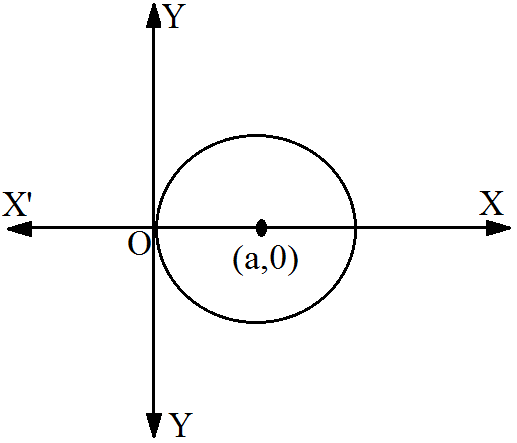
Differentiating equation (1) with respect to x, get: $2\text{x} + 2\text{yy}'=2\text{a}$ $\Rightarrow \text{x}+\text{yy}' = \text{a}$ Now, on substituting the value of a in equation (1), we get: $\text{x}^2+\text{y}^2 = 2 (\text{x+yy}')\text{x}$ $\Rightarrow \text{x}^2+\text{y}^2=2\text{x}^2+2\text{xyy}'$ $\Rightarrow 2\text{xyy}' + \text{x}^2=\text{y}^2$ This is the required differential equation. View full question & answer→Question 1225 Marks
Solve the following differential equation
$(\text{x}^2+1)\frac{\text{dy}}{\text{dx}}=1$
AnswerWe have,
$(\text{x}^2+1)\frac{\text{dy}}{\text{dx}}=1$
$\Rightarrow\text{dy}=\frac{1}{\text{x}^2+1}$
Intergrating both sides, we get
$\Rightarrow\int\text{dy}=\int\Big(\frac{1}{\text{x}^2+1}\Big)\text{dx}$
$\Rightarrow\text{y}=\tan^{-1}\text{x}+\text{C}$
so, $\Rightarrow\text{y}=\tan^{-1}\text{x}+\text{C}$ is defined for all $\text{x}\in\text{R}$ except x = 0
Hence, $\Rightarrow\text{y}=\tan^{-1}\text{x}+\text{C}$, where $\text{x}\in\text{R}-\{0\},$ is the solution o the given differential equation.
View full question & answer→Question 1235 Marks
For each of the differential equation in find the particular solution satisfying the given condition:$\text{x}^2\ \text{dy}+(\text{xy}+\text{y}^2)\ \text{dx}=0;\ \text{y}=1\ \text{when}\ \text{x}=1$
AnswerGiven: Differential equation $\text{x}^2\ \text{dy}+(\text{xy}+\text{y}^2)\ \text{dx}=0$ $\Rightarrow\ \ \text{x}^2\ \text{dy}-(\text{xy}+\text{y}^2)\ \text{dx}\ \ $ $\Rightarrow\ \ \frac{\text{dy}}{\text{dx}}=-\frac{\text{y}(\text{x}+\text{y})}{\text{x}^2}=-\frac{\text{xy}\Big(1+\frac{\text{y}}{\text{x}}\Big)}{\text{x}^2}$ $\Rightarrow\ \ \frac{\text{dy}}{\text{dx}}=-\frac{\text{y}}{\text{x}}\Big(1+\frac{\text{y}}{\text{x}}\Big)=f\Big(\frac{\text{y}}{\text{x}}\Big)\ \ ...\text{(i)}$ Therefore the given differential equation is homogeneous. $\text{Putting}\frac{\text{y}}{\text{x}}=\text{v}\ \ \Rightarrow\ \ \text{y}=\text{vx}\ \ $ $\Rightarrow\ \ \frac{\text{dy}}{\text{dx}}=\text{v}+\text{x}\frac{\text{dv}}{\text{dx}}$ $\text{Putting these values of}\ \frac{\text{y}}{\text{x}}\ \text{and}\ \frac{\text{dv}}{\text{dx}}\ \text{in eq. (ii), we have}$ $\text{v}+\text{x}\frac{\text{dv}}{\text{dx}}=-\text{v}(1+\text{v})=-\text{v}-\text{v}^2\ \ $ $\Rightarrow\ \ \text{x}\frac{\text{dv}}{\text{dx}}=-\text{v}^2-2\text{v}$ $\Rightarrow\ \ \text{x}\frac{\text{dv}}{\text{dx}}=-\text{v}(\text{v}+2)\ \ \Rightarrow\ \ \frac{\text{dv}}{\text{v}(\text{v}+2)}=-\frac{\text{dx}}{\text{x}}$ $\text{Integrating both sides,}$ $\ \ \int\frac{1} {\text{v}(\text{v}+2)}\text{dv}=-\int\frac{1}{\text{x}}\text{dx}$ $\Rightarrow\ \ \frac{1}{2}\int\frac{2} {\text{v}(\text{v}+2)}\text{dv}=-\log|\text{x}|+\log|\text{c}|\ \ $ $\Rightarrow\ \ \frac{1}{2}\int\frac{(\text{v}+2)-\text{v}}{\text{v}(\text{v}+2)}\ \text{dv}=-\log|\text{x}|+\log|\text{c}|$ $\Rightarrow\ \ \int\Big(\frac{1}{\text{v}}-\frac{1}{\text{v+2}}\Big)\text{dv}=-2\log|\text{x}|+\log|\text{c}|$ $\Rightarrow\ \ \log\Big|\frac{\text{v}}{\text{v}+2}\Big|=\log\big|\text{x}^{-2}\big|+\log|\text{c}|$ $\Rightarrow\ \ \log\Big|\frac{\text{v}}{\text{v}+2}\Big|=\log\big|\text{cx}^{-2}\big|\ \ $ $\Rightarrow\ \ \frac{\text{v}}{\text{v}+2}=\pm\text{cx}^{-2}$ $\text{Putting}\ \text{v}=\frac{\text{y}}{\text{x}},\ \ \frac{\frac{\text{y}}{\text{x}}}{\frac{\text{y}}{\text{x}}+2}=\pm\text{cx}^{-2}\ \ $ $\Rightarrow\ \ \frac{\text{y}}{\text{y}+2\text{x}}=\pm\text{cx}^{-2}$ $\Rightarrow\ \ \text{x}^{2}\text{y}=\text{C}(\text{y}+2\text{x})\ \ \text{where C}=\pm\text{c}\ \ .....(\text{ii})$ Now putting x = 1 and y = 1 in eq. (ii), we get $1=3\text{C}\ \ \Rightarrow\ \ \text{C}=\frac{1}{3}$Putting value of C in eq. (ii),
$\text{x}^{2}\text{y}=\frac{1}{3}(\text{y}+2\text{x})\ \ \Rightarrow\ \ 3\text{x}^2\text{y}=\text{y}+2\text{x}$
View full question & answer→Question 1245 Marks
The rate of growth of a population is proportional to the number present. If the population of a city doubled in the past 25 year, and the present population is 100000, when will the city have a population of 500000?
AnswerLet the origional population be N and the population at any time t be P.
Given: $\frac{\text{dP}}{\text{dt}}\propto\text{P}$
$\Rightarrow\frac{\text{dP}}{\text{dt}}=\text{aP}$
$\Rightarrow\frac{\text{dP}}{\text{P}}=\text{a}\text{dt}$
$\Rightarrow\log|\text{P}|=\text{at}+\text{C}\ ...(\text{i})$
Now,
$\text{P}=\text{N}$ at $\text{t}=0$
Putting $\text{P}=\text{N}$ at $\text{t}=0$ in (i), we get
$\log|\text{N}|=\text{C}$
Putting $\text{C}=\log|\text{N}|$ in (i), we get
$\log|\text{P}|=\text{at}+\log|\text{N}|$
$\Rightarrow \text{log}|\frac{\text{P}}{\text{N}}|=\text{at}\ ...(\text{ii})$
According to the question,
$\log|\frac{2\text{N}}{\text{N}}|=25\text{a}$
$\Rightarrow\ \text{a}=\frac{1}{25}\log|2|$
$=\frac{1}{25}\times0.6931=0.0277$
Putting $\text{a}=0.0277$ in (ii), we get
$\log|\frac{\text{P}}{\text{N}}|=0.0277 \text{t}\ ...(\text{iii})$
For $\text{P}=500000$ and $\text{N}=100000$
$\log|\frac{500000}{100000}|=0.0277 \text{t}$
$\Rightarrow \text{t}=\frac{\log\ 5}{0.0277}=\frac{1.609}{0.0277}$
$=58.08\ \text{year}$
View full question & answer→Question 1255 Marks
Solve the following differential equations:$\frac{\text{dy}}{\text{dx}}=\frac{\text{x}(2\log\text{x}+1)}{\sin\text{y + y}\cos\text{y}}$
Answerwe have, $\frac{\text{dy}}{\text{dx}}=\frac{\text{x}(2\log\text{x}+1)}{\sin\text{y + y}\cos\text{y}}$
$\Rightarrow(\sin\text{y+y}\cos\text{y})\text{dy = x}(2\log\text{x}+1)\text{dx}$
Integrating both sides, we get
$\int(\sin\text{y+y}\cos\text{y})\text{dy}=\int\text{x}(2\log\text{x}+1)\text{dx}$
$\Rightarrow\int\sin\text{y dy}+\int\text{y}\cos\text{y dy }=2\int\text{x}\log\text{x dx}+\int\text{x dx}$
$\Rightarrow-\cos\text{y}+\Big[\text{y}\int\cos\text{y dy}-\int\Big\{\frac{\text{d}}{\text{dy}}\text{(y)}\int\cos\text{y dy}\Big\}\text{dy}\Big]\\=2\Big[\log\text{x}\int\text{x dx}-\int\Big\{\frac{\text{d}}{\text{dx}}(\log\text{x})\int\text{x dx}\Big\}\text{dx}\Big]+\frac{\text{x}^2}{2}$
$\Rightarrow-\cos\text{y}+\Big[\text{y}\sin\text{y}-\int\sin\text{y dy}\Big]=2\Big[\log\text{x}\times\frac{\text{x}^2}{2}-\int\frac{1}{\text{x}}\times\frac{\text{x}^2}{2}\Big]+\frac{\text{x}^2}{2}$
$\Rightarrow-\cos\text{y+y}\sin\text{y}+\cos\text{y}=\text{x}^2\log\text{x}-\frac{\text{x}^2}{2}+\frac{\text{x}^2}{2}+\text{C}$
$\Rightarrow\text{y}\sin\text{y}=\text{x}^2\log\text{x + C}$
Hence, $\text{y}\sin\text{y = x}^2\log\text{x + C}$ is the required solution.
View full question & answer→Question 1265 Marks
At any point (x, y) of a curve, the slope of the tangent is twice the slope of the line segment joining the point of contact to the point (–4, –3). Find the equation of the curve given that it passes through (–2, 1).
AnswerLet y = f(x) be equation of curve. $\text{Now}\frac{\text{dy}}{\text{dx}}$ is the slope of the tangent to the curve at the point (x, y) From the given condition,$\frac{\text{dy}}{\text{dx}}=2\bigg[\frac{-3-\text{y}}{-4-\text{x}}\bigg]\ \text{or}\ \frac{\text{dy}}{\text{dx}}=2\bigg[\frac{\text{y}+3}{\text{x}+4}\bigg]$
Separating the variables, we get,$\frac{1}{\text{y}+3}\text{dy}=\frac{2}{\text{x}+4}\text{dx}$
$\text{Integrating},\ \int\frac{1}{\text{y}+3}\text{dy}=\int\frac{2}{\text{x}+4}\text{dx}$
$\therefore\ \log|\text{y}+3|=2\log|\text{x}+4|+\text{c}\ ...(1)$
Since curve passe through (-2, 1)$\therefore\ \log|1+3|=2\log|-2+4|+\text{c}$
$\therefore\log4=2\log2+\text{c}\ \ \Rightarrow\ \ 2\log2$ $=2\log2+\text{c}\ \ \Rightarrow\ \ \text{c}=0$
$\therefore\text{from}(1),\ \log|\text{y}+3|=2\log|\text{x}+4|$
$\text{or}\ \log|\text{y}+3|=\log|\text{x}+4|^2$
$\therefore\ |\text{y}+3|=|\text{x}+4|^2\ \text{or}\ \text{y}+3=(\text{x}+4)^2$
which is required equation of curve.
View full question & answer→Question 1275 Marks
Solve the following differential equations:$\tan\text{y}\frac{\text{dy}}{\text{dx}}=\sin(\text{x}+\text{y})+\sin(\text{x}-\text{y})$
Answer$\tan\text{y}\frac{\text{dy}}{\text{dx}}=\sin(\text{x}+\text{y})+\sin(\text{x}-\text{y})$
$\tan\text{y}\frac{\text{dy}}{\text{dx}}=2\sin\Big\{\frac{(\text{x + y})+(\text{x}-\text{y})}{2}\Big\}\cos\Big\{\frac{(\text{x + y})-(\text{x}-\text{y})}{2}\Big\}$
$=2\sin\Big(\frac{\text{x + y + x}-\text{y}}{2}\Big)\cos\Big(\frac{\text{x + y}-\text{ x}+\text{y}}{2}\Big)$
$\tan\text{y}\frac{\text{dy}}{\text{dx}}=2\sin\text{x}\cos\text{y}$
$\frac{\tan\text{y}}{\cos\text{y}}\text{dy}=2\sin\text{x dx}$
$\int\sec\text{y}\tan\text{y dy}=2\int\sin\text{x dx}$
$\sec\text{y}=-2\cos\text{x + C}$
$\sec\text{y}+2\cos\text{x = C}$
View full question & answer→Question 1285 Marks
The slope of a curve at each of its points is equal to the square of the abscissa of the point. Find the particular curve through the point $(−1, 1).$
AnswerGiven,
Slope of tangent at $(x, y) = x^2$
$\frac{\text{dy}}{\text{dx}}=\text{x}^{2}$
$\text{dy}=\text{x}^{2}\text{dx}$
$\int \text{dy}=\int\text{x}^{2}\text{dx}$
$\text{y}=\frac{\text{x}^{3}}{3}+\text{C}\ ...(\text{i})$
It is passing through $(-1, 1)$
$1=\frac{(-1)}{3}+\text{C}$
$1=-\frac{1}{3}+\text{C}$
$\text{C}=\frac{4}{3}$
Put is equation,
$\text{y}=\frac{\text{x}^{3}}{3}+\frac{4}{3}$
$3\text{y}=\text{x}^{3}+{4}$
View full question & answer→Question 1295 Marks
Solve the following differential equation:
$(\text{x}-\text{y})\frac{\text{dy}}{\text{dx}}=\text{x + 2y}$
AnswerHere, $(\text{x}-\text{y})\frac{\text{dy}}{\text{dx}}=\text{x + 2y}$
$\Rightarrow\ \frac{\text{dy}}{\text{dx}}=\frac{\text{x}+2\text{y}}{\text{x}-\text{y}}$
It is a homogeneous equation.
Put x = vy
and $\frac{\text{dy}}{\text{dx}}=\text{v + x}\frac{\text{dv}}{\text{dx}}$
So,
$\text{v + x}\frac{\text{dv}}{\text{dx}}=\frac{\text{x}+2\text{vx}}{\text{x}-\text{vx}}$
$\text{x}\frac{\text{dv}}{\text{dx}}=\frac{1+2\text{v}}{1+\text{v}}-\text{v}$
$\text{x}\frac{\text{dv}}{\text{dx}}=\frac{1+2\text{v}-\text{v + v}^2}{1-\text{v}}$
$\text{x}\frac{\text{dv}}{\text{dx}}=\frac{1+\text{v + v}^2}{1-\text{v}}$
$\frac{1-\text{v}}{\text{v}^2+\text{v}+1}\text{dv}=\frac{\text{dx}}{\text{x}}$
$-\frac{\text{v}-1}{\text{v}^2+\text{v}+1}\text{dv}=\frac{\text{dx}}{\text{x}}$
$\frac{1}2\times\frac{2\text{v}-2}{\text{v}^2+\text{v}+1}\text{dv}=\frac{-\text{dx}}{\text{x}}$
$\int\frac{(2\text{v}+1)-3}{\text{v}^2+\text{v}+1}\text{dv}=-\int\frac{2\text{dx}}{\text{x}}$
$\int\frac{2\text{v}+1}{\text{v}^2+\text{v}+1}\text{dv}-\int\frac{3}{\text{v}^2+2\text{v}\big(\frac{1}2\big)+\big(\frac{1}2\big)^2-\big(\frac{1}2\big)^2+1}=-2\int\frac{\text{dx}}{\text{x}}$
$\int\frac{2\text{v}+1}{\text{v}^2+\text{v}+1}\text{dv}-\int\frac{3}{\big(\text{v}+\frac{1}2\big)^2+\big(\frac{\sqrt3}2\big)^2}\text{dv}=-2\int\frac{\text{dx}}{\text{x}}$
$\log|\text{v}^2+\text{v}+1|-3\Big(\frac{2}{\sqrt3}\Big)\tan^{-1}\Bigg(\frac{\text{v}+\frac{1}2}{\frac{\sqrt3}{2}}\Bigg)=-2\log|\text{x}|+\text{C}$
$\log|\text{y}^2+\text{xy}+\text{x}^2|=2\sqrt3\tan^{-1}\Big(\frac{2\text{y + x}}{\text{x}\sqrt3}\Big)+\text{C}$
View full question & answer→Question 1305 Marks
If y(x) is a solution of the different equation $\Big(\frac{2+\sin\text{x}}{1+\text{y}}\Big)\frac{\text{dy}}{\text{dx}}=-\cos\text{x}$ and $\text{y}(0)=1,$ then find the value of $\text{y}\Big(\frac{\pi}{2}\Big).$
AnswerConsider the given equation
$\Big(\frac{2+\sin\text{x}}{1+\text{y}}\Big)\frac{\text{dy}}{\text{dx}}=-\cos\text{x}$
$\Rightarrow\frac{\text{dy}}{(1+\text{y})}=\frac{-\cos\text{x dx}}{(2+\sin\text{x})}$
Integrating both the sides,
$\Rightarrow\int\frac{\text{dy}}{(1+\text{y})}=\int\frac{-\cos\text{x dx}}{(2+\sin\text{x})}$
$\Rightarrow\log(1+\text{y})=-\log(2+\sin\text{x})+\log\text{C}$
$\Rightarrow\log(1+\text{y})+\log(2+\sin\text{x})=\log\text{C}$
$\Rightarrow\log(1+\text{y})(2+\sin)\text{x}=\log\text{C}$
$\Rightarrow(1+\text{y})(2+\sin\text{x})=\text{C}...(1)$
Given that $\text{y}(0)=1$
$\Rightarrow(1+1)(2+\sin0)=\text{C}$
$\Rightarrow\text{C}=4$
Substituting the value of C in equation (1) we have,
$\Rightarrow(1+\text{y})(2+\sin\text{x})=4$
$\Rightarrow(1+\text{y})=\frac{4}{(2+\sin\text{x})}$
$\Rightarrow\text{y}=\frac{4}{(2+\sin\text{x})}-1...(2)$
We need to find the value of $\text{y}\Big(\frac{\pi}{2}\Big)$
Substituting the value of $\text{x}=\frac{\pi}{2}$ in equation (2), we get,
$\text{y}=\frac{4}{\Big(2+\sin\frac{\pi}{2}\Big)}-1$
$\Rightarrow\text{y}=\frac{4}{(2+1)}-1$
$\Rightarrow\text{y}=\frac{4}{3}-1$
$\Rightarrow\text{y}=\frac{1}{3}$
Note: Answer given in the book is incorrect.
View full question & answer→Question 1315 Marks
Find the particular solution of $\text{e}^{\frac{\text{dy}}{\text{dx}}}=\text{x}+1,$ that $\text{y}=3,$ when $\text{x}=0.$
Answer$\text{e}^{\frac{\text{dy}}{\text{dx}}}=\text{x}+1$
$\frac{\text{dy}}{\text{dx}}=\log(\text{x}+1),\text{y}=3$ at $\text{x}=0$
$\int\text{dy}=\int\log(\text{x}+1)\text{dx}$
$\text{y}=\log|\text{x}+1|\times\int1\times\text{dx}-\int\Big(\frac{1}{\text{x}+1}\times\int1\text{dx}\Big)\text{dx}+\text{C}$
Using integration by parts
$\text{y = x}\log|\text{x}+1|-\int\frac{\text{x}}{\text{x}+1}\text{dx}+\text{C}$
$\text{y = x}\log|\text{x}+1|-\Big(\int\Big(1-\frac{1}{\text{x}+1}\Big)\text{dx}\Big)+\text{C}$
$=\text{x}\log|\text{x}+1|-(\text{x}-\log|\text{x}+1|)+\text{C}$
$\text{y = x}\log|\text{x}+1|-\text{x}+\log|\text{x}+1|+\text{C}$
$\text{y}=(\text{x}+1)\log|\text{x}+1|-\text{x + C}$
Put $\text{y}=3$ and $\text{x}=0$
$3=0-0+\text{C}$
$\text{C}=3$
Put $\text{C}=3$ in equation (1),
$\text{y}=(\text{x}+1)\log|\text{x}+1|-\text{x}+3$
View full question & answer→Question 1325 Marks
Find the solution of $\frac{\text{dy}}{\text{dx}}=2^\text{y-x}.$
AnswerGiven that, $\frac{\text{dy}}{\text{dx}}=2^\text{y-x}$
$\Big[\because\text{a}^\text{m-n}=\frac{\text{a}^\text{m}}{\text{a}^\text{n}}\Big]$
$\Rightarrow\frac{\text{dy}}{\text{dx}}=\frac{2^\text{y}}{2^\text{x}}$
$\Rightarrow\frac{\text{dy}}{2^\text{y}}=\frac{\text{dx}}{2^\text{x}}$
On integrating both sides, we get
$\int2^\text{-y}\text{dy}=\int2^\text{x}\text{dx}$
$\Rightarrow\frac{-2^\text{-y}}{\log2}=\frac{-2^\text{-x}}{\log2}+\text{C}$
$\Rightarrow-2^\text{-y}+2^\text{-x}=+\text{C}\log2$
$\Rightarrow-2^\text{-x}+2^\text{-x}=+\text{C}\log2$
$\Rightarrow2^\text{-x}-2^\text{-y}=-\text{C}\log2$
$\Rightarrow2^\text{-x}-2^\text{-y}=\text{K}$ $[\text{where}, \text{K} = +\text{C}\log2]$
View full question & answer→Question 1335 Marks
Form the differential equation of the family of circles in the first quadrant which touch the coordinate axes.
Answer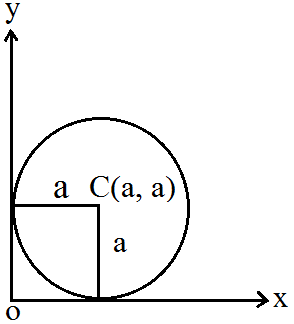 We know that the circle in the first quadrant which touches the co-ordinates axes has centre (a, a) where a is the radius of the circle.
$\therefore\ \ \text{Equation of the circle is}$
$(\text{x}-\text{a})^2+(\text{y}-\text{a})^2=\text{a}^2\ \ ....\text{(i)}$
$\Rightarrow\ \ \text{x}^2+\text{y}^2-2\text{ax}-2\text{ay}+\text{a}^2=0$
$\text{Differentiating with respect to x; 2x}+2\text{yy}'-2\text{a}-2\text{ay}'=0$
$\Rightarrow\ \ \text{x}+\text{yy}'-\text{a}-\text{ay}'=0$
$\Rightarrow\ \ \text{x}+\text{yy}'=\text{a}(1+\text{y}')\ \ \Rightarrow\ \ \text{a}=\frac{\text{x}+\text{yy}'}{1+\text{y}'}$
$\text{Substituting value of a in eq. (i),}$ $\Big(\text{x}-\frac{\text{x}+\text{yy}'}{1+\text{y}'}\Big)^2+\Big(\text{y}-\frac{\text{x}+\text{yy}'}{1+\text{y}'}\Big)^2=\Big(\frac{\text{x}+\text{yy}'}{1+\text{y}'}\Big)^2$
$\Rightarrow\ \ \Big(\frac{\text{x}+\text{xy}'-\text{x}+\text{yy}'}{1+\text{y}'}\Big)^2+\Big(\frac{\text{y}+\text{yy}'-\text{x}-\text{yy}'}{1+\text{y}'}\Big)^2=\Big(\frac{\text{x}+\text{yy}'}{1+\text{y}'}\Big)^2$
$\Rightarrow\ \ (\text{xy}'-\text{yy}')^2+(\text{y}-\text{x})^2=(\text{x}+\text{yy}')^2$ $\Rightarrow\ \ \text{y}'^2(\text{x}-\text{y})^2+(\text{x}-\text{y})^2=(\text{x}+\text{yy}')^2$
$\Rightarrow\ \ (\text{x}-\text{y})^2+(1+\text{y}'^2)=(\text{x}+\text{yy}')^2$ View full question & answer→Question 1345 Marks
Solve the following differential equation
$(\text{x}-1)\frac{\text{dy}}{\text{dx}}=2\text{xy}$
AnswerWe have
$(\text{x}-1)\frac{\text{dy}}{\text{dx}}=2\text{xy}$
$\Rightarrow(\text{x}-1)\text{dy}=2\text{xy dx}$
$\Rightarrow\frac{2\text{x}}{(\text{x}-1)}\ \text{dx}=\frac{1}{\text{y}}\text{ dy}$
Integrating both sides, we get
$2\int\frac{\text{x}}{(\text{x}-1)}\ \text{dx}=\int\frac{1}{\text{y}}\ \text{dy}$
$\Rightarrow2\int\frac{\text{x}-1+1}{\text{x}-1}\ \text{dx}=\int\frac{1}{\text{y}}\ \text{dx}$
$\Rightarrow2\int\text{dx}+2\int\frac{1}{\text{x}-1}\text{dx}=\int\frac{1}{\text{y}}\ \text{dy}$
$\Rightarrow2\text{x}+2\log|\text{x}-1|=\log|\text{y}|+\text{C}$
View full question & answer→Question 1355 Marks
For each of the differential equation in find the particular solution satisfying the given condition:$\Big[\text{x}\sin^{2}\Big(\frac{\text{y}}{\text{x}}\Big)-\text{y}\Big]\ \text{dx} +\text{x dy}=0;\text{y}=\frac{\pi}{4}\ \text{when x}=1$
AnswerGiven: Differential equation $\Big(\text{x}\sin^{2}\frac{\text{y}}{\text{x}}-\text{y}\Big)\ \text{dx} +\text{x dy}=0;\text{y}=\frac{\pi}{4},\ \text{x}=1$
$\Rightarrow\ \ \text{x dy}=-\Big(\text{x}\sin^{2}\frac{\text{y}}{\text{x}}-\text{y}\Big)\ \text{dx}\ \ $ $\Rightarrow\ \ \frac{\text{dy}}{\text{dx}}=-\sin^2\frac{\text{y}}{\text{x}}+\frac{\text{y}}{\text{x}}=f\Big(\frac{\text{y}}{\text{x}}\Big)\ \ ....(\text{i})$
Therefore, the given differential equation is homogeneous.
$\text{Putting}\frac{\text{y}}{\text{x}}=\text{v}\ \ \Rightarrow\ \ \text{y}=\text{vx}\ \ $ $\Rightarrow\ \ \frac{\text{dy}}{\text{dx}}=\text{v}+\text{x}\frac{\text{dv}}{\text{dx}}$
$\text{Putting these values of}\ \frac{\text{y}}{\text{x}}\ \text{and}\ \frac{\text{dv}}{\text{dx}}\ \text{in eq. (ii), we have}$
$\text{v}+\text{x}\frac{\text{dv}}{\text{dx}}=-\sin^2\text{v}+\text{v}\ \ \Rightarrow\ \ \text{x}\frac{\text{dv}}{\text{dx}}=-\sin^2\text{v}$
$\Rightarrow\ \ \frac{\text{dv}}{\sin^2\text{v}}=-\frac{\text{dx}}{\text{x}}\ \ \big[\text{Separating variables}\big]$
$\text{Integrating both sides,}$ $\int\cos\text{ec}^2\text{v dv}=-\int\frac{1}{\text{x}}\ \text{dx}\ \ $ $\Rightarrow\ \ -\cot\text{v}=-\log|\text{x}|+\text{c}$
$\Rightarrow\ \ \cot\text{v}=\log|\text{x}|-\text{c}\ \ $ $\Rightarrow\ \ \cot\frac{\text{y}}{\text{x}}=\log|\text{x}|+\text{c}\ \ \big[\text{Putting}\frac{\text{y}}{\text{x}}=\text{v}\big]\ \ .....\text{(ii)}$
$\text{Now putting y}=\frac{\pi}{4},\text{x}=1\ \text{in eq. (ii),}$ $\cot\frac{\pi}{4}=\log1-\text{c}\ \ \Rightarrow\ \ \text{c}=-1$
Putting the value of c in eq. (ii),
$\cot\frac{\text{y}}{\text{x}}=\log|\text{x}|+1\ \ $ $\Rightarrow\ \ \cot\frac{\text{y}}{\text{x}}=\log|\text{x}|+\log\text{e}\ \ \Rightarrow\ \ \cot\frac{\text{y}}{\text{x}}=\log\text{xe}$
View full question & answer→Question 1365 Marks
Show that $\text{y}=\text{A}\cos2\text{x}+\text{B}\sin2\text{x}$ is a solution of the differential equation $\frac{\text{d}^2\text{y}}{\text{dx}^2}+4\text{y}=0$
AnswerWe have,
$\text{y}=\text{A}\cos2\text{x}+\text{B}\sin2\text{x}\ ...(1)$
Differentiating both sides of equation (1) with respect to 3, we get
$\frac{\text{dy}}{\text{dx}}=-2\text{A}\sin2\text{x}-\text{B}\cos2\text{x}\ ...(2)$
Differentiating both sides of equation (2) with respect to 3, we get
$\frac{\text{d}^2\text{y}}{\text{dx}^2}=-4\text{A}\cos2\text{x}+4\text{B}\sin2\text{x}$
$\Rightarrow\frac{\text{d}^2\text{y}}{\text{dx}^2}=-4(\text{A}\cos2\text{x}+4\text{B}\sin2\text{x})$
$\Rightarrow\frac{\text{d}^2\text{y}}{\text{dx}^2}=-4\text{y}$
$\Rightarrow\frac{\text{d}^2\text{y}}{\text{dx}^2}+4\text{y}=0$
Hence, the given function is the solution to the given differential equation.
View full question & answer→Question 1375 Marks
For each of the differential equations given in find the general solution:
$\frac{\text{dy}}{\text{dx}}+2\text{y}=\sin\text{x}$
AnswerThe given differential equation is $\frac{\text{dy}}{\text{dx}}+2\text{y}=\sin\text{x}.$ This is in the form of $\frac{\text{dy}}{\text{dx}}+\text{py}=\text{Q}$ (where p = 2 and Q = sin x). $\text{Now, I.F}=\text{e}^{\int\text{pdx}}=\text{e}^{\int2\text{dx}}=\text{e}^{2\text{x}}.$The solution of the given differential equation is given by the relation,
$\text{y}(\text{I.F})=\int(\text{Q}\times\text{I.F})\text{dx}+\text{C}$ $\Rightarrow\ \text{ye}^{2\text{x}}=\int\sin\text{x}\cdot\text{e}^{2\text{x}}\text{dx}+\text{C}\ \ ....{(1)}$ $\text{Let}\ I=\int\sin\text{x}\cdot\text{e}^{2\text{x}}.$ $\Rightarrow\ I=\sin\text{x}\cdot\int\text{e}^{2\text{x}}\text{dx}-\int\bigg(\frac{\text{d}}{\text{dx}}(\sin\text{x})\cdot\int\text{e}^{2\text{x}}\text{dx}\bigg)\text{dx}$ $\Rightarrow\ I=\sin\text{x}\cdot\frac{\text{e}^{2\text{x}}}{2}-\int\bigg(\cos\text{x}\cdot\frac{\text{e}^{2\text{x}}}{2}\bigg)\text{dx}$ $\Rightarrow\ I=\frac{\text{e}^{2\text{x}}\sin\text{x}}{2}-\frac{1}{2}\bigg[\cos\text{x}\cdot\int\text{e}^{2\text{x}}-\int\bigg(\frac{\text{d}}{\text{dx}}(\cos\text{x})\cdot\int\text{e}^{2\text{x}}\text{dx}\bigg)\text{dx}\bigg]$ $\Rightarrow\ I=\frac{\text{e}^{2\text{x}}\sin\text{x}}{2}-\frac{1}{2}\bigg[\cos\text{x}\cdot\frac{\text{e}^{2\text{x}}}{2}-\int\bigg[(-\sin\text{x})\cdot\frac{\text{e}^{2\text{x}}}{2}\bigg]\text{dx}\bigg]$ $\Rightarrow\ I=\frac{\text{e}^{2\text{x}}\sin\text{x}}{2}-\frac{\text{e}^{2\text{x}}\cos\text{x}}{4}-\frac{1}{4}\int\big(\sin\text{x}.\text{e}^{2\text{x}}\big)\text{dx}$ $\Rightarrow\ I=\frac{\text{e}^{2\text{x}}}{4}(2\sin\text{x}-\cos\text{x})-\frac{1}{4}I$ $\Rightarrow\ \frac{5}{4}I=\frac{\text{e}^{2\text{x}}}{4}(2\sin\text{x}-\cos\text{x})$ $\Rightarrow\ I=\frac{\text{e}^{2\text{x}}}{5}(2\sin\text{x}-\cos\text{x})$ Therefore, equation (1) becomes: $\text{y}^{2\text{x}}=\frac{\text{e}^{2\text{x}}}{5}(2\sin\text{x}-\cos\text{x})+\text{C}$ $\Rightarrow\ \text{y}=\frac{1}{5}(2\sin\text{x}-\cos\text{x})+\text{C}\text{e}^{-2\text{x}}$ This is the required general solution of the given differential equation.
View full question & answer→Question 1385 Marks
In each of the form a differential equation representing the given family of curves by eliminating arbitrary constants a and b.
$y = ae^{3x} + be^{–2x}$
Answer$y = ae^{3x} + be^{–2x ....(1)}$
Differentiating both sides with respect to x, we get:
$y'= 3ae^{3x} - 2be^{-2x ....(2)}$
Again, differentiating both sides with respect to x, we get:
$y'' = 9ae^{3x} + 4be^{-2x ............(3)}$
Multiplying equation (1) with (2) and then adding it to equation (2), we get:
$(2ae^{3x} + 2be^{-2x}) + (3ae^{3x} - 2bc^{-2x}) = 2y + y'$
$\Rightarrow 5\text{ae}^{3\text{x}} = 2\text{y} + \text{y}'$
$\Rightarrow \text{ae}^{3\text{x}} = \frac{2\text{y}+\text{y}'}{5}$
Now, multiplying equation (1) with 3 and subtracting equation (2) from it, we get:
$(3ae^{3x} + 3be^{-2x}) - (3ae^{3x} - 2be^{-2x}) = 3y - y'$
$\Rightarrow 5\text{be}^{-2\text{x}}= 3\text{y}-\text{y}'$
$\Rightarrow \text{be}^{-2\text{x}} = \frac{3\text{y}-\text{y}'}{5}$
Substituting the values of $ae^{3x}$ and $be^{-2x}$ in equation (3), we get:
$\text{y}''=9\cdot\frac{(2\text{y+y}')}{5}+4\frac{(3\text{y-y}')}{5}$
$\Rightarrow \text{y}''= \frac{18\text{y}+9\text{y}'}{5}+\frac{12\text{y}-4\text{y}'}{5}$
$\Rightarrow{\text{y}''}=\frac{30\text{y}+5\text{y}}{5}'$
$\Rightarrow \text{y}'' = 6\text{y}+\text{y}'$
$\Rightarrow \text{y}'' -\text{y}'-6\text{y}=0$
This is the required differential equation of the given curve.
View full question & answer→Question 1395 Marks
Find the particular solution of the differential equation $\frac{\text{dy}}{\text{dx}}=-4\text{xy}^2$ given that $\text{y}=1.$ when $\text{x}=0.$
AnswerWe have,
$\frac{\text{dy}}{\text{dx}}=-4\text{xy}^2$
$\Rightarrow\frac{1}{\text{y}^2}\text{dy}=-4\text{x dx}$
Integrating both sides, we get
$\int\frac{1}{\text{y}^2}\text{dy}=-4\int\text{x dx}$
$\Rightarrow-\frac{1}{\text{y}}=-4\times\frac{\text{x}^2}{2}+\text{C}$
$\Rightarrow-\frac{1}{\text{y}}=-2\text{x}^2+\text{C}...(1)$
It is given that at $\text{x}=0,\text{y}=1.$
Substituting the valuse of x and y in (1), we get
$\text{C}=-1$
Therefore, substituting the value of C in (1), we get
$-\frac{1}{\text{y}}=-2\text{x}^2-1$
$\Rightarrow\text{y}=\frac{1}{2\text{x}^2+1}$
Hence, $\text{y}=\frac{1}{2\text{x}^2+1}$ is the required solution.
View full question & answer→Question 1405 Marks
Solve the following initial value problems:
$\frac{\text{dy}}{\text{dx}}+2\text{y}=\text{e}^{-2\text{x}}\sin\text{x},\text{ y}(0)=0$
AnswerWe have,
$\frac{\text{dy}}{\text{dx}}+2\text{y}=\text{e}^{-2\text{x}}\sin\text{x}\ ...(\text{i})$
Clearly, it is a linear differential equation of the form
$\frac{\text{dy}}{\text{dx}}+\text{Py}=\text{Q}$
Where $\text{P}=2$ and $\text{Q}=\text{e}^{-2\text{x}}\sin\text{x}$
$\therefore\text{ I.F.}=\text{e}^{\int\text{Pdx}}$
$=\text{e}^{\int2\text{dx}}$
$=\text{e}^{2\text{x}}$
Multiplying both sides of (1) by $\text{I.F.}=\text{e}^{2\text{x}},$ we get
$\text{e}^{2\text{x}}\Big(\frac{\text{dy}}{\text{dx}}+2\text{y}\Big)=\text{e}^{2\text{x}}\text{e}^-{2\text{x}}\sin\text{x}$
$\Rightarrow\text{e}^{2\text{x}}\Big(\frac{\text{dy}}{\text{dx}}+2\text{y}\Big)=\sin\text{x}$
Integrating both sides with respect to x, we get
$\text{y}\text{e}^{2\text{x}}=\int\sin\text{x dx}+\text{C}$
$\Rightarrow\text{y}\text{e}^{2\text{x}}=-\cos\text{x}+\text{C}\ ....(\text{ii})$
Now,
$\text{y}(0)=0$
$\therefore\ 0\times\text{e}^0=-\cos0+\text{C}$
$\Rightarrow\text{C}=1$
Putting the value of C in (2), we get
$\text{y}\text{e}^{2\text{x}}=-\cos\text{x}+1$
$\Rightarrow\text{y}\text{e}^{2\text{x}}=1-\cos\text{x}$
Hence, $\text{y}\text{e}^{2\text{x}}=1-\cos\text{x}$ is the required solution.
View full question & answer→Question 1415 Marks
Solve the differential equation $(\text{y}+3\text{x}^2)\frac{\text{dx}}{\text{dy}}=\text{x}$
AnswerWe have,
$(\text{y}+3\text{x}^2)\frac{\text{dx}}{\text{dy}}=\text{x}$
$\Rightarrow\frac{\text{dy}}{\text{dy}}=\frac{\text{y}+3{\text{x}^{\text{2}}}}{\text{x}}$
$\Rightarrow\frac{\text{dy}}{\text{dx}}-\frac{1}{\text{x}}{\text{y}}=3{\text{x}}\ ...(1)$
Clearly, it is a linear differential equation of the form
$\frac{\text{dy}}{\text{dx}}+\text{Py}=\text{Q}$
Where $\text{P}=-\frac{1}{\text{x}}$ and $\text{Q}=3\text{x}$
$\therefore \ \text{I}.\text{F}. = \text{e}^{\int{\text{P}\text{dx}}}$
$ =\text{e}^{-\int\frac{1}{\text{x}}\text{dx}}$
$=\text{e}^{-\log\text{x}}$
$=\frac{1}{\text{x}}$
Multiplying both sides of (1) by $\text{I.F.}=\frac{1}{\text{x}},$ we get
$\frac{1}{\text{x}}\Big(\frac{\text{dy}}{\text{dx}}-\frac{1}{\text{x}}{\text{y}}\Big)=\frac{1}{\text{x}}3\text{x}$
$\Rightarrow\frac{1}{\text{x}}\frac{\text{dy}}{\text{dx}}-\frac{1}{\text{x}^{2}}\text{y}=3$
Integrating both sides with respect to x, we get
$\frac{1}{\text{x}}\text{y}=3\int\text{dx}+\text{C}$
$\Rightarrow\frac{\text{y}}{\text{x}}=3\text{x}+\text{C}$
Hence, $\frac{\text{y}}{\text{x}}=3\text{x}+\text{C}$ is the required solution.
View full question & answer→Question 1425 Marks
Solve the following differential equations:$\text{x}\sqrt{1-\text{y}^2}\text{dx}+\text{y}\sqrt{1-\text{x}^2}\text{dy}=0$
AnswerWe have,
$\text{x}\sqrt{1-\text{y}^2}\text{dx}+\text{y}\sqrt{1-\text{x}^2}\text{dy}=0$
$\Rightarrow\text{y}\sqrt{1-\text{x}^2}\text{dy}=-\text{x}\sqrt{1-\text{y}^2}\text{dx}$
$\Rightarrow\frac{\text{y}}{\sqrt{1-\text{y}^2}}\text{dy}=-\frac{\text{x}}{\sqrt{1-\text{x}^2}}\text{dx}$
Integrating both sides, we get
$\int\frac{\text{y}}{\sqrt{1-\text{y}^2}}\text{dy}=-\int\frac{\text{x}}{\sqrt{1-\text{x}^2}}\text{dx}$
Substituting $1-\text{y}^2=\text{t}$ and $1-\text{x}^2=\text{u},$ we get
$-2\text{y dy = dt}$ and $-2\text{x dy = du}$
$\therefore\frac{-1}{2}\int\frac{1}{\sqrt{\text{t}}}\text{dt}=\frac{1}{2}\int\frac{1}{\sqrt{\text{u}}}\text{du}$
$\Rightarrow-\text{t}^{\frac{1}{2}}=\text{u}^{\frac{1}{2}}+\text{K}$
$\Rightarrow\sqrt{1-\text{x}^2}+\sqrt{1-\text{y}^2}=-\text{K}$
$\Rightarrow\sqrt{1-\text{x}^2}+\sqrt{1-\text{y}^2}=\text{C}$ (where, C = K)
Hence, $\sqrt{1-\text{x}^2}+\sqrt{1-\text{y}^2}=\text{C}$ is the required solution.
View full question & answer→Question 1435 Marks
Find one-parameter families of solution curves of the following differential equation: (or solve the following differential equation)$\text{e}^{-\text{y}}\sec^2\text{y dy}=\text{dx}+\text{x dy}$
AnswerWe have,
$\text{e}^{-\text{y}}\sec^2\text{y dy}=\text{dx}+\text{x dy}$
$\Rightarrow\text{dx}=\text{e}^{-\text{y}}\sec^2\text{y dy}-\text{x dy}$
$\Rightarrow\frac{\text{dx}}{\text{dy}}=\text{e}^{-\text{y}}\sec^2\text{y}-\text{x}$
$\Rightarrow\frac{\text{dx}}{\text{dy}}+\text{x}=\text{e}^{-\text{y}}\sec^2\text{y}\ ...(1)$
Clearly, it is a linear differential equation of tyhe form
$\frac{\text{dx}}{\text{dy}}+\text{Px}=\text{Q}$
Where
$\text{P}=1$
$\text{Q}=\text{e}^{-\text{y}}\sec^2\text{y}$
$\therefore\ \text{I.F.}=\text{e}^{\int\text{Pdy}}$
$=\text{e}^{\int\text{dy}}$
$=\text{e}^{\text{y}}$
Multiplying both sides of (1) by ey, we get
$\text{e}^{\text{y}}\Big(\frac{\text{dx}}{\text{dy}}+\text{x}\Big)=\text{e}^{\text{y}}\text{e}^{-\text{y}}\sec^2\text{y}$
$\Rightarrow\text{e}^{\text{y}}\frac{\text{dx}}{\text{dy}}+\text{e}^{\text{y}}\text{x}=\sec^2\text{y}$
Integrating both sides with respect to y, we get
$\text{e}^{\text{y}}\text{x}=\int\sec^2\text{y dy}+\text{C}$
$\Rightarrow\text{e}^{\text{y}}\text{x}=\tan\text{y}+\text{C}$
$\Rightarrow\text{x}=(\tan\text{y}+\text{C})\text{e}^{-\text{y}}$
Hence, $\text{x}=(\tan\text{y}+\text{C})\text{e}^{-\text{y}}$ is the required solution.
View full question & answer→Question 1445 Marks
Differential equation $\frac{\text{d}^2\text{y}}{\text{dx}^2}-\text{y}=0,\text{y}(0)=2,\text{y}'(0)=0$Function $\text{y}=\text{e}^\text{x}+\text{e}^{-\text{x}}$
AnswerWe have $\text{y}=\text{e}^{\text{x}}+\text{e}^{\text{-x}} ...(1)$ Differentiating both sides of (1) with respect to x, we get $\frac{\text{dy}}{\text{dx}}=\text{e}^{\text{x}}-\text{e}^{\text{x}} ...(2)$ Differentiating both sides of (2) with respect to x, we get $\frac{\text{d}^{2}\text{y}}{\text{dx}^{2}}=\text{e}^{\text{x}}+\text{e}^{\text{-x}}$
$\Rightarrow\frac{\text{d}^{2}\text{y}}{\text{dx}^{2}}=\text{y}$ [Using (1)]$\Rightarrow\frac{\text{d}^{2}\text{y}}{\text{dx}^{2}}-\text{y}=0$
It is the given differential equation.Therefore, $y = e^x+ e^{-x}$satisfies the given differential equation.
Also, when $x = 0; = e^0+ e^0= 1 + 1, i.e. y(0) = 2.$
And, when $x = 0; y_1= e^0- e^0= 1 - 1, i.e. y'(0) = 0$
Hence, $y = e^x+ e^{-x}$ is the solution to the given initial value problem.
View full question & answer→Question 1455 Marks
Solve the following differential equations:
$\frac{\text{dy}}{\text{dx}}=1+\text{x}+\text{y}^2+\text{xy}^2$ when $\text{y}=0,\text{x}=0$
Answer$\frac{\text{dy}}{\text{dx}}=1+\text{x}+\text{y}^2+\text{xy}^2$
$\frac{\text{dy}}{\text{dx}}=(1+\text{x})(1+\text{y}^2)$
$\frac{1}{(1+\text{y}^2)}\text{dy}=(1+\text{x})\text{dx}$
Integrating on both the sides we get
$\int\frac{1}{(1+\text{y}^2)}\text{dy}=\int(1+\text{x})\text{dx}$
$\tan^{-1}\text{y = x}+\frac{\text{x}^2}{2}+\text{C}...(1)$
Put $\text{y}=0,\text{x}=0$ then
$\tan^{-1}0=0+0+\text{C}$
$\text{C}=0$
From (1) we have
$\tan^{-1}\text{y = x}+\frac{\text{x}^2}{2}$
$\text{y}=\tan\Big(\text{x}+\frac{\text{x}^2}{2}\Big)$
View full question & answer→Question 1465 Marks
Write the minors and cofactors of element of the first column of the following matrices and hence evaluate the determinant in case:
$\text{A}=\begin{vmatrix}0&2&6\\1&5&0\\3&7&1 \end{vmatrix}$
AnswerLet $M_{ij}$ and $C_{ij}$ are respectively the minor and co-factor of the element $a_{ij}$.
Now,
$\text{M}_{11}=\begin{vmatrix}5&0\\7&1 \end{vmatrix}=5-0=5$
$\text{M}_{21}=\begin{vmatrix}2&6\\7&1 \end{vmatrix}=2-42=-40$
$\text{M}_{31}=\begin{vmatrix}2&6\\5&0 \end{vmatrix}=0-30=-30$
$\text{C}_{11}=(-1)^{1+1}\text{M}_{11}=5$
$\text{C}_{21}=(-1)^{2+1}\text{M}_{21}=(-1)(-40)=40$
$\text{C}_{31}=(-1)^{3+1}\text{M}_{31}=(-30)=-30$
Now, expanding the determinant along the first column.
$|\text{A}|=\text{a}_{11}\text{C}_{11}+\text{a}_{21}\text{C}_{21}+\text{a}_{31}\text{C}_{31}$
$=0\times5+1\times(40)+3\times(-30)$
$=40-90$
$=-50$
View full question & answer→Question 1475 Marks
In each of the form a differential equation representing the given family of curves by eliminating arbitrary constants a and b.
$y = e^x (acos\ x + bsin\ x)$
Answer$y = e^x (acos\ x + bsin\ x)$ ....(1)
Differentiating both sides with respect to x, we get:
$\text{y}'=\text{e}^\text{x}(\text{acos x + bsin x)} + \text{e}^\text{x}(-\text{asin x + bcos x})$
$\Rightarrow \text{y}'=\text{e}^\text{x} \big[(\text{a+b)cos x} -(\text{a}-\text{b) sin x} \big] \ ...(2)$
Again, differentiating with respect to x, we get:
$\text{y}''=\text{e}^\text{x}\big[(\text{a + b)cos x} - (\text{a}-\text{b})\text{sin x} \big] + \text{e}^\text{x} \big[-(\text{a+b)sin x} - (\text{a}-\text{b) cos x}\big]$
$\text{y}''=\text{e}^\text{x} [2\text{bcos x - 2asin x]}$
$\text{y}''=2\text{e}^\text{x} (\text{bcos x} - \text{asin x)}$
$\Rightarrow \frac{\text{y}''}{2}=\text{e}^\text{x} (\text{bcos x} - \text{asin x)} \ ....(3)$
Adding equations (1) and (3), we get:
$\text{y}+\frac{\text{y}''}{2}=\text{e}^\text{x}\big[(\text{a+b)cos x} -(\text{a}-\text{b)sin x} \big]$
$\Rightarrow \text{y}+ \frac{\text{y}''}{2}=\text{y}'$
$\Rightarrow 2\text{y}+\text{y}''=2\text{y}'$
$\Rightarrow \text{y}'' - 2\text{y}'+2\text{y}=0$
This is the required differential equation of the given curve.
View full question & answer→Question 1485 Marks
Solve the following differential equation:
$(\text{x}+2\text{y})\text{dx}-(2\text{x}-\text{y})\text{dy}=0$
Answer$(\text{x}+2\text{y})\text{dx}-(2\text{x}-\text{y})\text{dy}=0$$\Rightarrow\ \frac{\text{dy}}{\text{dx}}=\frac{\text{x}+2\text{y}}{2\text{x}-\text{y}}$
This is a homogeneous differential equation. Putting y = vx and $\frac{\text{dy}}{\text{dx}}=\text{v + x}\frac{\text{dv}}{\text{dx}}$, we get $\text{v + x}\frac{\text{dv}}{\text{dx}}=\frac{\text{x}+2\text{vx}}{2\text{x}-\text{vx}}$ $\Rightarrow\ \text{x}\frac{\text{dv}}{\text{dx}}=\frac{1+2\text{v}}{2-\text{v}}-\text{v}$ $\Rightarrow\ \text{x}\frac{\text{dv}}{\text{dx}}=\frac{1+\text{v}^2}{2-\text{v}}$ $\Rightarrow\ \frac{2-\text{v}}{1+\text{v}^2}\text{dv}=\frac{1}{\text{x}}\text{dx}$ Integrating both sides, we get $\int\frac{2-\text{v}}{1+\text{v}^2}\text{dv}=\int\frac{1}{\text{x}}\text{dx}\ \dots(1)$ $\Rightarrow\ \int\frac{2}{1+\text{v}^2}\text{dv}-\int\frac{\text{v}}{1+\text{v}^2}\text{dv}=\int\frac{1}{\text{x}}\text{dx}$ $\Rightarrow\ \int\frac{2}{1+\text{v}^2}\text{dv}-\frac{1}2\int\frac{2\text{v}}{1+\text{v}^2}\text{dv}=\int\frac{1}{\text{x}}\text{dx}$ $\Rightarrow\ 2\tan^{-1}\text{v}-\frac{1}2\log|1+\text{v}^2|=\log|\text{x}|+\log\text{C}$ $\Rightarrow\ 2\tan^{-1}\text{v}=\log|\text{x}|+\log\text{C}+\log\Big|(1+\text{v}^2)^{\frac{1}2}\Big|$ $\Rightarrow\ 2\tan^{-1}\text{v}=\log\Big|\text{Cx}\sqrt{1+\text{v}^2}\Big|$ $\Rightarrow\ \Big|\text{Cx}\sqrt{1+\text{v}^2}\Big|=\text{e}^{2\tan^{-1}\text{v}}$ Putting $\text{v}=\frac{\text{y}}{\text{x}}$, we get $\Rightarrow\ \Bigg|\text{Cx}\sqrt{1+\Big(\frac{\text{y}}{\text{x}}\Big)^2}\Bigg|=\text{e}^{2\tan^{-1}\big(\frac{\text{y}}{\text{x}}\big)}$ $\Rightarrow\ \text{C}\sqrt{\text{x}^2+\text{y}^2}=\text{e}^{2\tan^{-1}\big(\frac{\text{y}}{\text{x}}\big)}$ Hence, $\sqrt{\text{x}^2+\text{y}^2}=\text{Ke}^{2\tan^{-1}\big(\frac{\text{y}}{\text{x}}\big)}$ is the required solution.
View full question & answer→Question 1495 Marks
Form the differential equation of all circles which pass through origin and whose centres lie on Y-axis.
AnswerIt is given that, circles pass through origin and their centres lie on Y-axis. Let (0, k) be the centre of the circle and radius is k.
So, the equation of circle is
$(\text{x}-0)^2+(\text{y}-\text{k})^2=\text{k}^2$
$\Rightarrow\text{x}^2+(\text{y}-\text{k})^2=\text{k}^2$
$\Rightarrow\text{x}^2+\text{y}^2-2\text{ky}=0$
$\Rightarrow\frac{\text{x}^2+\text{y}^2}{2\text{y}}=\text{k}\ ......(\text{i})$
On differentiating Eq. (i) w.r.t.x, we get
$\frac{2\text{y}\Big(2\text{x}+2\text{y}\frac{\text{dy}}{\text{dx}}\Big)-({\text{x}^2+\text{y}^2})\frac{2\text{dy}}{\text{dx}}}{4\text{y}^2}=0$
$\Rightarrow4\text{y}\Big(\text{x}+\text{y}\frac{\text{dy}}{\text{dx}}\Big)-2(\text{x}^2+\text{y}^2)\frac{\text{dy}}{\text{dx}}=0$
$\Big[4\text{y}^2-2(\text{x}^2+\text{y}^2)\Big]\frac{\text{dy}}{\text{dx}}+4\text{xy}=0$
$\Rightarrow(4\text{y}^2-2\text{x}^2-2\text{y}^2)\frac{\text{dy}}{\text{dx}}+4\text{xy}=0$
$\Rightarrow(2\text{y}^2-2\text{x}^2)\frac{\text{dy}}{\text{dx}}+4\text{xy}=0$
$\Rightarrow(\text{y}^2-\text{x}^2)\frac{\text{dy}}{\text{dx}}+2\text{xy}=0$
$\Rightarrow(\text{x}^2-\text{y}^2)\frac{\text{dy}}{\text{dx}}-2\text{xy}=0$
View full question & answer→Question 1505 Marks
Find the curve for which the intercept cut-off by a tangent on x-axis is equal to four times the ordinate of the point of contact.
AnswerLet P(x, y) be the point of contact of tangent and curve y = f(x). It cuts axes at A and B equation P(x, y),
$\text{y}-\text{y}=\frac{\text{dy}}{\text{dx}}(\text{x}-\text{x})$
Put X = 0
$\text{y}-\text{y}=\frac{\text{dy}}{\text{dx}}(-\text{x})$
$\text{y}=\text{y}-\text{x}\frac{\text{dy}}{\text{dx}}$
So, $\text{A}=\big(0, \text{y}-\text{x}\frac{\text{dy}}{\text{dx}}\big)$
Put Y = 0
$\text{0}-\text{y}=\frac{\text{dy}}{\text{dx}}(\text{x}-\text{x})$
$-\text{y}\frac{\text{dx}}{\text{dy}}=\text{x}-\text{x}$
$\text{x}=\text{x}-\text{y}\frac{\text{dx}}{\text{dy}}$
So, $\text{B}=\big( \text{x}-\text{y}\frac{\text{dx}}{\text{dy}}, 0\big)$
Given, (intercepect on x-axis) = 4(ordinate)
$\text{x}-\text{y}\frac{\text{dx}}{\text{dy}}=4\text{y}$
$\text{y}\frac{\text{dx}}{\text{dy}}+4\text{y}=\text{x}$
$\frac{\text{dx}}{\text{dy}}+4=\frac{\text{x}}{\text{y}}$
$\frac{\text{dx}}{\text{dy}}-\frac{\text{x}}{\text{y}}=-4$
It is a linear different with $\frac{\text{dx}}{\text{dy}}+\text{Px}=\text{Q}$
$\text{P}=-\frac{1}{\text{y}}, \text{Q}=-4$
$\text{I.F}=\text{e}^{\int\text{pdy}}$
$=\text{e}^{-\int\frac{1}{\text{y}}\text{dy}}$
$=\text{e}^{-\log\text{y}}$
$=\frac{1}{\text{y}}$
Solution of the equation is given by,
$\text{x}(\text{I.F})=\int\text{Q}(\text{I.F})\text{dy}+\log\text{C}$
$\text{x}\Big(\frac{1}{\text{y}}\Big)=\int(\text{-4})\Big(\frac{1}{\text{y}}\Big)\text{dy}+\log\text{C}$
$\frac{\text{x}}{\text{y}}=-4\log\text{y}+\log\text{C}$
View full question & answer→