Question 1515 Marks
Find the curve for which the intercept cut-off by a tangent on x-axis is equal to four times the ordinate of the point of contact.
AnswerLet P(x, y) be the point of contact of tangent and curve y = f(x). It cuts axes at A and B equation P(x, y),
$\text{y}-\text{y}=\frac{\text{dy}}{\text{dx}}(\text{x}-\text{x})$
Put X = 0
$\text{y}-\text{y}=\frac{\text{dy}}{\text{dx}}(-\text{x})$
$\text{y}=\text{y}-\text{x}\frac{\text{dy}}{\text{dx}}$
So, $\text{A}=\big(0, \text{y}-\text{x}\frac{\text{dy}}{\text{dx}}\big)$
Put Y = 0
$\text{0}-\text{y}=\frac{\text{dy}}{\text{dx}}(\text{x}-\text{x})$
$-\text{y}\frac{\text{dx}}{\text{dy}}=\text{x}-\text{x}$
$\text{x}=\text{x}-\text{y}\frac{\text{dx}}{\text{dy}}$
So, $\text{B}=\big( \text{x}-\text{y}\frac{\text{dx}}{\text{dy}}, 0\big)$
Given, (intercepect on x-axis) = 4(ordinate)
$\text{x}-\text{y}\frac{\text{dx}}{\text{dy}}=4\text{y}$
$\text{y}\frac{\text{dx}}{\text{dy}}+4\text{y}=\text{x}$
$\frac{\text{dx}}{\text{dy}}+4=\frac{\text{x}}{\text{y}}$
$\frac{\text{dx}}{\text{dy}}-\frac{\text{x}}{\text{y}}=-4$
It is a linear different with $\frac{\text{dx}}{\text{dy}}+\text{Px}=\text{Q}$
$\text{P}=-\frac{1}{\text{y}}, \text{Q}=-4$
$\text{I.F}=\text{e}^{\int\text{pdy}}$
$=\text{e}^{-\int\frac{1}{\text{y}}\text{dy}}$
$=\text{e}^{-\log\text{y}}$
$=\frac{1}{\text{y}}$
Solution of the equation is given by,
$\text{x}(\text{I.F})=\int\text{Q}(\text{I.F})\text{dy}+\log\text{C}$
$\text{x}\Big(\frac{1}{\text{y}}\Big)=\int(\text{-4})\Big(\frac{1}{\text{y}}\Big)\text{dy}+\log\text{C}$
$\frac{\text{x}}{\text{y}}=-4\log\text{y}+\log\text{C}$
View full question & answer→Question 1525 Marks
Find one-parameter families of solution curves of the following differential equation: (or solve the following differential equation)$\text{x}\log\text{x}\frac{\text{dy}}{\text{dx}}+\text{y}=2\log\text{x}$
AnswerWe have
$\text{x}\log\text{x}\frac{\text{dy}}{\text{dx}}+\text{y}=2\log\text{x}$
Dividing both sides by $\text{x}\log\text{x},$ we get
$\frac{\text{dy}}{\text{dx}}+\frac{\text{y}}{\text{x}\log\text{x}}=2\frac{\log\text{x}}{\text{x}\log\text{x}}$
$\Rightarrow\frac{\text{dy}}{\text{dx}}+\frac{\text{y}}{\text{x}\log\text{x}}=\frac{2}{\text{x}}$
$\Rightarrow\frac{\text{dy}}{\text{dx}}+\Big(\frac{1}{\text{x}\log\text{x}}\Big)\text{y}=\frac{2}{\text{x}}$
Comparing with $\frac{\text{dy}}{\text{dx}}+\text{Py}=\text{Q},$ we get
$\text{P}=\frac{1}{\text{x}\log\text{x}}$
$\text{Q}=\frac{2}{\text{x}}$
Now,
$\text{I.F}=\text{e}^{\int\text{Pdx}}$
$=\text{e}^{\int\frac{1}{\text{x}\log\text{x}}\text{dx}}$
$=\text{e}^{\log|\log\text{x}|}$
$=\log\text{x}$
So, the solution is given by
$\text{y}\times\text{I.F.}=\int\text{Q}\times\text{I.F.}\text{ dx}+\text{C}$
$\Rightarrow\text{y}\log\text{x}=2\int\frac{1}{\text{x}}\times\log\text{x dx}+\text{C}$
Putting $\log\text{x}=\text{t}$
$\Rightarrow\text{y}\log\text{x}=2\int\frac{1}{\text{x}}\times\log\text{x dx}+\text{C}$
Putting $\log\text{x}=\text{t}$
$\Rightarrow\frac{1}{\text{x}}\text{dx}=\text{dt}$
$\therefore\text{ y}\log\text{x}=2\int\text{t dt}+\text{C}$
$\Rightarrow\text{y}\log\text{x}=\frac{2\text{t}^2}{2}+\text{C}$
$\Rightarrow\text{y}\log\text{x}=\text{t}^2+\text{C}$
$\Rightarrow\text{y}\log\text{x}=(\log\text{x})^2+\text{C}$ $(\because\log\text{x}=\text{t})$
$\Rightarrow\text{y}=\log\text{x}+\frac{\text{C}}{\log\text{x}}$
View full question & answer→Question 1535 Marks
Solve the following differential equation
$\frac{\text{dy}}{\text{dx}}=\tan^{-1}\text{x}$
AnswerWe have,
$\frac{\text{dy}}{\text{dx}}=\tan^{-1}\text{x}$
$\Rightarrow\text{dy}=(\tan^{-1}\text{x})\text{dx}$
Integrating both sides, we get
$\int\text{dy}=\int(\tan^{-1}\text{x})\text{dx}$
$\Rightarrow\text{y}=\int1\times\tan^{-1}\text{x}\text{ dx}$
$\Rightarrow\text{y}=\tan^{-1}\text{x}\int\int1\text{dx}-\int\Big[\frac{\text{d}}{\text{dx}}(\tan^{-1}\text{x})\int1\text{dx}\Big]\text{dx}$
$\Rightarrow\text{y}=\text{x}\tan^{-1}\text{x }-\int\frac{\text{x}}{1+\text{x}^2}\text{dx}$
$\Rightarrow\text{y}=\text{x}\tan^{-1}\text{x}-\frac{1}{2}\int\frac{2\text{x}}{1+\text{x}^2}\text{ dx}$
$\Rightarrow\text{y}=\text{x}\tan^{-1}\text{x}-\frac{1}{2}\log|1+\text{x}^2|+\text{C}$
So, $\text{y}=\text{x}\tan^{-1}\text{x}-\frac{1}{2}\log|1+\text{x}^2|+\text{C}$ is defined for all $\text{x}\in\text{R}$
Hence, $\text{y}=\text{x}\tan^{-1}\text{x}-\frac{1}{2}\log|1+\text{x}^2|+\text{C}$ is the solution o the given differential equation.
View full question & answer→Question 1545 Marks
Solve the following initial value problems:
$\text{x}\frac{\text{dy}}{\text{dx}}-\text{y + x}\sin\Big(\frac{\text{y}}{\text{x}}\Big)=0,\text{y}(2)=\text{x}$
Answer$\text{x}\frac{\text{dy}}{\text{dx}}-\text{y + x}\sin\Big(\frac{\text{y}}{\text{x}}\Big)=0,\text{y}(2)=\text{x}$
It is a homogeneous equation. put y = vx
and $\frac{\text{dy}}{\text{dx}}=\text{v + x}\frac{\text{dv}}{\text{dx}}$
So, $\text{v + x}\frac{\text{dv}}{\text{dx}}=\frac{\text{vx}}{\text{x}}-\sin\Big(\frac{\text{vx}}{\text{x}}\Big)$
$\text{x}\frac{\text{dv}}{\text{dx}}=-\sin\text{v}$
$\frac{\text{dv}}{\sin\text{v}}=-\frac{\text{dx}}{\text{x}}$
$\text{cosec(v)dv}=-\frac{\text{dx}}{\text{x}}$
integrating both sides we get,
$\log(\text{cosec(v)}-\cot(\text{v}))=-\log\text{x}+\log\text{c}$
$\log\Big(\text{cosec}\Big(\frac{\text{y}}{\text{x}}\Big)-\cot\Big(\frac{\text{y}}{\text{x}}\Big)\Big)=-\log\text{x}+\log\text{c}$
Putting the values $\text{x}=2$ and $\text{y}=\pi$
$\log\Big(\text{cosec}\Big(\frac{\pi}{2}\Big)-\cot\Big(\frac{\pi}{2}\Big)\Big)=-\log2+\log\text{C}$
$\text{C}=0$
$\log\Big(\text{cosec}\Big(\frac{\text{y}}{\text{x}}\Big)-\cot\Big(\frac{\text{y}}{\text{x}}\Big)\Big)=-\log\text{x}$
View full question & answer→Question 1555 Marks
Solve the following differential equations $\frac{\text{dy}}{\text{dx}}=\frac{2\text{x}(\log\text{x}+1)}{\sin\text{y+y}\cos\text{y}},$ given that $\text{y}=0,$ when $\text{x}=1.$
Answer$\frac{\text{dy}}{\text{dx}}=\frac{2\text{x}(\log\text{x}+1)}{\sin\text{y+y}\cos\text{y}},\text{y}=0$ at $\text{x}=1$
$\int(\sin\text{y+y}\cos\text{y})\text{dy}=\int2\text{x}(\log\text{x}+1)\text{dx}$
$\Rightarrow\int\sin\text{y dy}+\int\text{y}\cos\text{y dy}=\int2\text{x}\log\text{x dx}+2\int\text{x dx}$
$\Rightarrow-\cos\text{y}+\big[\text{y}\times\int\cos\text{y dy}-\int(1\times\int\cos\text{y dy})\text{dy}\big]\\=2\Big[\log\text{x}\int\text{x dx}-\int\Big(\frac{1}{\text{x}}\int\text{x dx}\Big)\text{dx}\Big]+\text{x}^2+\text{C}$
$\Rightarrow-\cos\text{y + y}\sin\text{y}-\int\sin\text{y dy}=2\frac{\text{x}^2}{2}\log\text{x}-2\int\frac{\text{x}}{2}\text{dx}+\text{x}^2+\text{C}$
$\Rightarrow-\cos\text{y + y}\sin\text{y}+\cos\text{y}=\text{x}^2\log\text{x}-\frac{\text{x}^2}{2}+\text{x}^2+\text{C}$
$\text{y}\sin\text{y}=\text{x}^2\log\text{x}+\frac{\text{x}^2}{2}+\text{C}$
Put $\text{y}=0,\text{x}=1$
$0=0+\frac{1}{2}+\text{C}$
$\text{C}=-\frac{1}{2}$
Put $\text{C}=-\frac{1}{2}$ in equation (1),
$\text{y}\sin\text{y = x}^2\log\text{x}+\frac{\text{x}^2}{2}-\frac{1}{2}$
$2\text{y}\sin\text{y}=2\text{x}^2\log\text{x + x}^2-1$
View full question & answer→Question 1565 Marks
Show that $\text{y}=\text{ae}^{2\text{x}}+\text{be}^{-\text{x}}$ is a solution of the differential equation $\frac{\text{d}^2\text{y}}{\text{dx}^2}-\frac{\text{dy}}{\text{dx}}-2\text{y}=0$
AnswerWe have,
$\text{y}=\text{ae}^{2\text{x}}+\text{be}^{-\text{x}}\ ...(1)$
Differentiating both sides of equation (1) with respect to 3, we get
$\frac{\text{dy}}{\text{dx}}=\text{ae}^{2\text{x}}+\text{be}^{-\text{x}}\ ...(2)$
Differentiating both sides of equation (2) with respect to 3, we get
$\frac{\text{d}^2\text{y}}{\text{dx}^2}=4\text{ae}^{2\text{x}}+\text{be}^{-\text{x}}$
$\Rightarrow\frac{\text{d}^2\text{y}}{\text{dx}^2}=2\text{ae}^{2\text{x}}-\text{be}^{-\text{x}}+2\text{ae}^{2\text{x}}+2\text{be}^{-\text{x}}$
$\Rightarrow\frac{\text{d}^2\text{y}}{\text{dx}^2}=\big(2\text{ae}^{2\text{x}}-\text{be}^{-\text{x}}\big)+2\big(\text{ae}^{2\text{x}}+2\text{be}^{-\text{x}}\big)$
$\Rightarrow\frac{\text{d}^2\text{y}}{\text{dx}^2}=\frac{\text{dy}}{\text{dx}}+2\text{y}$
$\Rightarrow\frac{\text{d}^2\text{y}}{\text{dx}^2}-\frac{\text{dy}}{\text{dx}}-2\text{y}=0$
Hence, the given function is the solution to the given differential equation.
View full question & answer→Question 1575 Marks
Solve the following differential equation:
$\big(\text{y}^2-2\text{xy}\big)\text{dx}=\big(\text{x}^2-2\text{xy}\big)\text{dy}$
AnswerHere, $\big(\text{y}^2-2\text{xy}\big)\text{dx}=\big(\text{x}^2-2\text{xy}\big)\text{dy}$
$\Rightarrow\ \frac{\text{dy}}{\text{dx}}=\frac{\text{y}^2-2\text{xy}}{\text{x}^2-2\text{xy}}$
It is a homogeneous equation.
Put y = vx and $\frac{\text{dy}}{\text{dx}}=\text{v + x}\frac{\text{dv}}{\text{dx}}$
So,
$\text{v + x}\frac{\text{dv}}{\text{dx}}=\frac{\text{v}^2\text{x}^2-2\text{xvx}}{\text{x}^2-2\text{xvx}}$
$\text{v + x}\frac{\text{dv}}{\text{dx}}=\frac{\text{v}^2-2\text{v}}{1-2\text{v}}$
$\text{x}\frac{\text{dv}}{\text{dx}}=\frac{\text{v}^2-2\text{v}}{1-2\text{v}}-\text{v}$
$=\frac{\text{v}^2-2\text{v}-\text{v}+2\text{v}^2}{1-2\text{v}}$
$\text{x}\frac{\text{dv}}{\text{dx}}=\frac{3\text{v}^2-3\text{v}}{1-2\text{v}}$
$\frac{1-2\text{v}}{3(\text{v}^2-\text{v})}\text{dv}=\frac{\text{dx}}{\text{x}}$
$\frac{-(2\text{v}-1)}{3(\text{v}^2-\text{v})}\text{dv}=\frac{\text{dx}}{\text{x}}$
$\int\frac{2\text{v}-1}{\text{v}^2-\text{v}}\text{dv}=-3\int\frac{\text{dx}}{\text{x}}$
$\log\big|\text{v}^2-\text{v}\big|-3\log|\text{x}|+\log\text{C}$
$\text{v}^2-\text{v}=\frac{\text{C}}{\text{x}^3}$
$\frac{\text{y}^2}{\text{x}^2}-\frac{\text{y}}{\text{x}}=\frac{\text{C}}{\text{x}^3}$
$\text{y}^2-\text{xy}=\frac{\text{C}}{\text{x}}$
$\text{x}\big(\text{y}^2-\text{xy}\big)=\text{C}$
View full question & answer→Question 1585 Marks
Solve the following differential equations:$\frac{\text{dy}}{\text{dx}}=\frac{\text{e}^{\text{x}}(\sin^2\text{x}+\sin2\text{x})}{\text{y}(2\log\text{y}+1)}$
Answer$\frac{\text{dy}}{\text{dx}}=\frac{\text{e}^{\text{x}}(\sin^2\text{x}+\sin2\text{x})}{\text{y}(2\log\text{y}+1)}$
$\Rightarrow\text{y}(2\log\text{y}+1)\text{dy}=\text{e}^{\text{x}}(\sin^2\text{x}+\sin2\text{x})\text{dx}$
$\Rightarrow(2\text{y}\log\text{y+y})\text{dy}=(\text{e}^{\text{x}}\sin^2\text{x + e}^{\text{x}}\sin2\text{x})\text{dx}$
$\Rightarrow2\text{y}\log\text{y}\text{ dy}+\text{y dy}=\text{e}^{\text{x}}\sin^2\text{x dx}+\text{e}^{\text{x}}\sin2\text{x}\text{ dx}$
Integrating both sides, we get
$2\int\text{y}\log\text{y dy}+\int\text{y dy}=\int\text{e}^{\text{x}}\sin^2\text{x dx}+\int\text{e}^{\text{x}}\sin2\text{x dx}$
$\Rightarrow2\Big[\log\text{y}\int\text{y dy}-\int\Big\{\frac{\text{d}}{\text{dy}}(\log\text{ y})\int\text{y dy}\Big\}\Big]\text{dy}+\int\text{y dy}\\=\sin^2\text{x}\int\text{e}^{\text{x}}\text{dx}-\int\Big[\frac{\text{d}}{\text{dx}}(\sin^2\text{x})\int\text{e}^{\text{x}}\text{dx}\Big]\text{dx}+\int\text{e}^{\text{x}}\sin2\text{x dx} $
$\Rightarrow2\Big[\log\text{y}\Big(\frac{\text{y}^2}{2}\Big)-\int\Big(\frac{1}{\text{y}}\Big)\frac{\text{y}^2}{2}\text{dy}\Big]+\int\text{y dy}\\=\sin^2\text{x }\text{e}^{\text{x}}-\int\big[2\sin\text{x}\cos\text{x}\text{ e}^{\text{x}}\big]\text{dx}+\int\text{e}^{\text{x}}\sin2\text{x dx + C}$
$\Rightarrow\text{y}^2\log\text{ y}-\int\text{y dy}+\int\text{y dy}\\=\text{e}^{\text{x}}\sin^2\text{x}-\int\text{e}^{\text{x}}\sin2\text{x dx}+\int\text{e}^{\text{x}}\sin2\text{x dx + C}$
$\Rightarrow\text{y}^2\log\text{y}=\text{e}^{\text{x}}\sin^2\text{x + C}$
View full question & answer→Question 1595 Marks
Solve the following differential equations:
$\frac{\text{dy}}{\text{dx}}=\frac{\text{y}-\text{x}}{\text{y + x}}$
Answer$\frac{\text{dy}}{\text{dx}}=\frac{\text{y}-\text{x}}{\text{y + x}}$
It is homogeneous equation
Put y = vx
$\frac{\text{dy}}{\text{dx}}=\text{v + x}\frac{\text{dv}}{\text{dx}}$
So,
$\text{v + x}\frac{\text{dv}}{\text{dx}}=\frac{\text{vx}-\text{x}}{\text{vx + x}}$
$\text{v + x}\frac{\text{dv}}{\text{dx}}=\frac{\text{v}-1}{\text{v}+1}$
$\text{x}\frac{\text{dv}}{\text{dx}}=\frac{\text{v}-1}{\text{v}+1}-\text{v}$
$=\frac{\text{v}-1-\text{v}^2-\text{v}}{\text{v}+1}$
$\text{x}\frac{\text{dv}}{\text{dx}}=-\frac{(1+\text{v}^2)}{\text{v}+1}$
$\int\frac{\text{v}+1}{\text{v}^2+1}\text{dv}=-\int\frac{\text{dx}}{\text{x}}$
$\int\frac{\text{v}}{\text{v}^2+1}\text{dv}+\int\frac{1}{\text{v}^2+1}\text{dv}=-\int\frac{\text{dx}}{\text{x}}$
$\frac{1}2\int\frac{2\text{v}}{\text{v}^2+1}\text{dv}+\int\frac{1}{\text{v}^2+1}\text{dv}=-\int\frac{\text{dx}}{\text{x}}$
$\frac{1}2\log\big|\text{v}^2+1\big|+\tan^{-1}\text{v}=-\log|\text{x}|+\log|\text{C}|$
$\log\Big|\frac{\text{y}^2+\text{x}^2}{\text{x}^2}\Big|+2\tan^{-1}\Big(\frac{\text{y}}{\text{x}}\Big)=2\log\Big|\frac{\text{C}}{\text{x}}\Big|$
$\log\big|\text{x}^2+\text{y}^2\big|-2\log|\text{x}|+2\tan^{-1}\Big(\frac{\text{y}}{\text{x}}\Big)=2\log\Big|\frac{\text{C}}{\text{x}}\Big|$
$\log\big|\text{x}^2+\text{y}^2\big|+2\tan^{-1}\Big(\frac{\text{y}}{\text{x}}\Big)=2\log|\text{C}|$
$\log\big|\text{x}^2+\text{y}^2\big|+2\tan^{-1}\Big(\frac{\text{y}}{\text{x}}\Big)=\text{K}$
View full question & answer→Question 1605 Marks
Solve the following initial value problems:
$\text{dy}=\cos\text{x}(2-\text{y cosecx})\text{dx}$
AnswerWe have,
$\text{dy}=\cos\text{x}(2-\text{y cosecx})\text{dx}$
$\Rightarrow\frac{\text{dy}}{\text{dx}}=2\cos\text{x}-\text{y}\cot\text{x}$
$\frac{\text{dy}}{\text{dx}}+\text{y}\cot\text{x}=2\cos\text{x}\ ...(1)$
Clearly, it is a linear differential equation of the form
$\frac{\text{dy}}{\text{dx}}+\text{Py}=\text{Q}$
Where $\text{P}=\cot\text{x}$ and $\text{Q}=2\cos\text{x}$
$\therefore\text{ I.F.}=\text{e}^{\int\text{Pdx}}$
$=\text{e}^{\int\cot\text{x dx}}$
$=\text{e}^{\log\sin\text{x}}$
$=\sin\text{x}$
Multiplying both sides of (1) by $\text{I.F.}=\sin\text{x},$ we get
$\sin\text{x}\Big(\frac{\text{dy}}{\text{dx}}+\text{y}\cot\text{x}\Big)=2\sin\text{x }\cos\text{x}$
$\Rightarrow\sin\text{x}\frac{\text{dy}}{\text{dx}}+\text{y}\cos\text{x}=\sin2\text{x}$
Integrating both sides with respect to x, we get
$\text{y}\sin\text{x}=\int\sin2\text{x dx}+\text{C}$
$\Rightarrow\text{y}\sin\text{x}=-\frac{\cos2\text{x}}{2}+\text{C}$
Hence, $\text{y}\sin\text{x}=-\frac{\cos2\text{x}}{2}+\text{C}$ is the required solution.
View full question & answer→Question 1615 Marks
The volume of a spherical balloon being inflated changes at a constant rate. If initially its radius is 3 units and after 3 seconds it is 6 units. Find the radius of the balloon after t seconds.
Answer$\text{V}=\frac{4}{3}\pi\text{r}^3$
Given:
$\frac{\text{dv}}{\text{dt}}=-\text{k}$ (where k > 0)
$\Rightarrow\frac{\text{d}}{\text{dt}}\Big(\frac{4}{3}\pi\text{r}^3\Big)=-\text{k}$
$\Rightarrow4\pi\text{r}^2\frac{\text{dr}}{\text{dt}}=-\text{k}$
$\Rightarrow4\pi\text{r}^{2}\text{dr}=-\text{kdt}$
Integrating both sides, we get
$\int4\pi\text{r}^2\text{dr}=-\int\text{kdt}$
$\frac{4}{3}\pi\text{r}^3=-\text{kt + C}...(1)$
It is given that at $\text{t}=0,\text{r}=3.$
$\text{C}=36\pi$
putting $\text{C}=36\pi$ in (1), we get
$\frac{4}{3}\pi\text{r}^3=-\text{kt}+36\pi...(2)$
It is also given that at $\text{t}=3,\text{r}=6.$
Putting $\text{t}=3$ and $\text{r}=6$ in (1), we get
$288\pi=-3\text{k}+36\pi$
$\Rightarrow\text{k}=-84\pi$
Putting $\text{k}=-84\pi$ in (2), we get
$\frac{4}{3}\pi\text{r}^3=84\pi\text{t}+36\pi$
$\Rightarrow\text{r}^3=63\text{t}+27$
$\Rightarrow\text{r}=(63\text{t}+27)^{\frac{1}{3}}$
View full question & answer→Question 1625 Marks
Solve the following differential equations:$\tan\text{y dx}+\sec^2\text{y}\tan\text{x dy}=0$
AnswerWe have,
$\tan\text{y dx}+\sec^2\text{y}\tan\text{x dy}=0$
$\Rightarrow\sec^2\text{y}\tan\text{x dy}=-\tan\text{y dx}$
$\Rightarrow\frac{\sec^2\text{y}}{\tan\text{y}}\text{dy}=-\frac{1}{\tan\text{x}}\text{dx}$
$\Rightarrow\frac{1}{\cos^2\text{y}}\times\frac{\cos\text{y}}{\sin\text{y}}\text{dy}=-\cot\text{x dx}$
$\Rightarrow\frac{1}{\sin\text{y}\cos\text{y}}\text{dy}=-\cot\text{x dx}$
$\Rightarrow\frac{2}{\sin2\text{y}}\text{dy}=-\cot\text{x dx}$
$\Rightarrow2\text{ cosec }2\text{y dy}=-\cot\text{x dx}$
Integrating both sides, we get
$2\int\text{cosec}\text{ 2y dy}=-\int\cot\text{x dx}$
$\Rightarrow\log\tan\text{x}=-\log\sin\text{x}=\log\text{C}$
$\Rightarrow\log \tan\text{x}+\log\sin\text{x}=\log\text{C}$
$\Rightarrow\log(\tan\text{ x}\times\sin\text{x})=\log\text{C}$
$\Rightarrow\tan\text{x}\times\sin\text{x}=\text{C}$
View full question & answer→Question 1635 Marks
In a bank principal increases at the rate of 5% per year. An amount of Rs 1000 is deposited with this bank, how much will it worth after 10 years $(e^{0.5}=1.648).$
AnswerLet p and t be the principal and time respectively.
It is given that the principal increases continuously at the rate of 5% per year.
$\Rightarrow\frac{\text{dp}}{\text{dt}}=\Big(\frac{5}{100}\Big)\text{p}$
$\Rightarrow\frac{\text{dp}}{\text{dt}}=\frac{\text{P}}{20}$
$\Rightarrow\frac{\text{dp}}{\text{p}}=\frac{\text{dt}}{20}$
Integrating both sides, we get:
$\int\frac{\text{dp}}{\text{p}}=\frac{1}{20}\int\text{dt}$
$\Rightarrow\log\text{p}=\frac{\text{t}}{20}+\text{C}$
$\Rightarrow\text{p}=\text{e}^{\frac{\text{t}}{20}}+\text{C}...(1)$
Now, when $\text{t}=0,\text{P}=1000.$
$1000=\text{e}^{\text{C}}...(2)$
View full question & answer→Question 1645 Marks
The population of a city increases at a rate proportional to the number of inhabitants present at any time t. If the population of the city was 200000 in 1990 and 250000 in 2000, what will be the population in 2010?
AnswerLet the population at any time t be P.
Given: $\frac{\text{dP}}{\text{dt}}\propto\text{P}$
$\Rightarrow\frac{\text{dP}}{\text{dt}}=\beta\text{P}$
$\Rightarrow\frac{\text{dP}}{\text{P}}=\beta\text{dt}$
$\Rightarrow\log|\text{P}|=\beta\text{t}+\log\text{C}\ ...(\text{ii})$
Now,
At t = 1990, P = 200000 and at t = 2000, P = 250000
$\therefore \log 200000=1990\beta+\log\text{C}\ ...(\text{ii})$
$ \log 250000=2000\beta+\log\text{C}\ ...(\text{iii})$
Subtracting (iii) from (ii), we get
$\log 200000-\log25000=10\beta$
$\Rightarrow\beta=\frac{1}{10}\log(\frac{5}{4})$
Putting $\beta=\frac{1}{10}\log(\frac{5}{4})$ in (ii), we get
$\log200000=1990\times\frac{1}{10}\log(\frac{5}{4})+\log\text{C}$
$\Rightarrow\log200000=199\log(\frac{5}{4})+\log\text{C}$
$\Rightarrow\log\text{C}=\log200000-199\log(\frac{5}{4})$
Putting $\beta=\frac{1}{10}\log(\frac{5}{4}), \log\text{C}=\log200000-199\log(\frac{5}{4})$
$\log|\text{P}|=\frac{1}{10}\times2010\log(\frac{5}{4})+\log200000-199\log(\frac{5}{4})$
$\Rightarrow\log|\text{P}|=201\log(\frac{5}{4})+\log200000-199\log(\frac{5}{4})$
$\Rightarrow\log|\text{P}|=\log(\frac{5}{4})^{201}-\log(\frac{5}{4})^{199}+\log200000$
$\Rightarrow\log|\text{P}|=\log\left\{(\frac{5}{4})^{201}\log(\frac{5}{4})^{199}\right\}+\log200000$
$\Rightarrow\log|\text{P}|=\log\left\{(\frac{5}{4})^{2}\right\}+\log200000$
$\Rightarrow\log|\text{P}|=\log\big(\frac{25}{16}\times200000\big)$
$\Rightarrow\log|\text{P}|=\log312500$
$\Rightarrow \text{P}=312500$
View full question & answer→Question 1655 Marks
Solve the following differential equation:
$\text{x}\frac{\text{dy}}{\text{dx}}-\text{y + x}\sin\Big(\frac{\text{y}}{\text{x}}\Big)=0$
AnswerWe have, $\text{x}\frac{\text{dy}}{\text{dx}}-\text{y + x}\sin\Big(\frac{\text{y}}{\text{x}}\Big)=0$ $\Rightarrow\ \frac{\text{dy}}{\text{dx}}=\frac{\text{y + x}\sin\Big(\frac{\text{y}}{\text{x}}\Big)}{\text{x}}$ This is a homogeneous differential equation. Put y = vx and $\frac{\text{dy}}{\text{dx}}=\text{v +x}\frac{\text{dv}}{\text{dx}},$ we get$\text{v +x}\frac{\text{dv}}{\text{dx}}=\frac{\text{vx}-\text{x}\sin\text{v}}{\text{x}}$
$\Rightarrow\ \text{x}\frac{\text{dv}}{\text{dx}}=\text{v}-\sin\text{v}-\text{v}$
$\Rightarrow\ \text{x}\frac{\text{dv}}{\text{dx}}=-\sin\text{v}$
$\Rightarrow\ \text{cosec v dv}=-\frac{1}{\text{x}}\text{dx}$
Integrating both sides, we get$\int\text{cosec v dv}=-\int\frac{1}{\text{x}}\text{dx}$
$\Rightarrow\ -\int\text{cosec v dv}=\int\frac{1}{\text{x}}\text{dx}$
$\Rightarrow\ -\log|\text{cosec v}-\cot\text{v}|=\log|\text{x}|+\log\text{C}$
$\Rightarrow\ \log\Big|\frac{1}{\text{cosec v}-\cot\text{v}}\Big|=\log|\text{Cx}|$
$\Rightarrow\ \log|\text{cosec v}+\cot\text{v}|=\log|\text{Cx}|$
$\Rightarrow\ \log\Big|\frac{1+\cos\text{v}}{\sin\text{v}}\Big|=\log|\text{Cx}|$
$\Rightarrow\ \frac{1+\cos\text{v}}{\sin\text{v}}=\text{Cx}$
$\Rightarrow\ \text{x}\sin\text{v}=\frac{1}{\text{C}}(1+\cos\text{v})$
$\Rightarrow\ \text{x}\sin\text{v}=\text{K}(1+\cos\text{v})$ $\Big($where, $\text{K}=\frac{1}{\text{C}}\Big)$
Putting $\text{v}=\frac{\text{y}}{\text{x}},$ we get
$\Rightarrow\ \text{x}\sin\Big(\frac{\text{y}}{\text{x}}\Big)=\text{K}\Big[1+\cos\Big(\frac{\text{y}}{\text{x}}\Big)\Big]$
Hence, $\text{x}\sin\Big(\frac{\text{y}}{\text{x}}\Big)=\text{K}\Big[1+\cos\Big(\frac{\text{y}}{\text{x}}\Big)\Big]$ is the required solution.
View full question & answer→Question 1665 Marks
Form the differential equation representing the family of ellipses having centre at the origin and foci on x-axis.
Answerwe know that the equation of said family of ellopsis is
$\frac{\text{x}^2}{\text{a}^2}+\frac{\text{y}^2}{\text{b}^2}=1\ ...(1)$
Differentiating (1) w..r.t.x, we get
$\frac{2\text{x}}{\text{a}^2}+\frac{2\text{y}}{\text{b}^2}.\frac{\text{dy}}{\text{dx}}=0$
$\Rightarrow\frac{\text{y}}{\text{x}}\Big(\frac{\text{dy}}{\text{dx}}\Big)=\frac{-\text{b}^2}{\text{a}^2}\ ...(2)$
Differentiating (2) w..r.t.x, we get
$\frac{\text{y}}{\text{x}}\Big(\frac{\text{d}^2\text{y}}{\text{dx}^2}\Big)+\bigg(\frac{\text{x}\frac{\text{dy}}{\text{dx}}-\text{y}}{\text{x}^2}\bigg)\frac{\text{dy}}{\text{dx}}=0$
$\Rightarrow\text{xy}\frac{\text{d}^2\text{y}}{\text{dx}^2}+\text{x}\Big(\frac{\text{dy}}{\text{dx}}\Big)^2-\text{y}\frac{\text{dy}}{\text{dx}}$
Which is the required difeerential equation.
View full question & answer→Question 1675 Marks
Solve the following differential equation
$\frac{\text{dy}}{\text{dx}}=(\text{e}^\text{x}+1)\text{y}$
AnswerWe have $\frac{\text{dy}}{\text{dx}}=(\text{e}^\text{x}+1)\text{y}$$\Rightarrow\frac{1}{\text{y}}\text{dy}=(\text{e}^\text{x}+1)\text{dx}$
Integrating both sides, we get
$\frac{1}{\text{y}}\text{dy}=(\text{e}^\text{x}+1)\text{dx}$
$\Rightarrow\log|\text{y}|=\text{e}^\text{x}+\text{x} +\text{C}$ Hence, $\Rightarrow\log|\text{y}|=\text{e}^\text{x}+\text{x} +\text{C}$ is the required solution.
View full question & answer→Question 1685 Marks
Find the general solution of the differential equation $\frac{\text{dy}}{\text{dx}}-{\text{y}}=\cos\text{x}$
AnswerWe have,
$\frac{\text{dy}}{\text{dx}}-{\text{y}}=\cos\text{x}$
Clearly, it is a linear differential equation of the form
$\frac{\text{dy}}{\text{dx}}+\text{P}\text{y}=\text{Q}$
Where P = -1 and $\text{Q}=\cos\text{x}$
$\therefore\text{ I}.\text{F}.=\text{e}^{\int{\text{P}\text{dx}}}$
$=\text{e}^{-\int\text{dx}}$
$=\text{e}^{-\text{x}}$
Multiplying both sides of (1) by $\text{I.F.}=\text{e}^{-\text{x}},$ we get
$\text{e}^{-\text{x}}\Big(\frac{\text{dy}}{\text{dx}}-\text{y}\Big)=\text{e}^{-\text{x}}\cos\text{x}$
$\Rightarrow\text{e}^{-\text{x}}\frac{\text{dy}}{\text{dx}}-\text{e}^{-\text{x}}\text{y}=\text{e}^{-\text{x}}\cos\text{x}$
Integrating both sides with respect to x, we get
$\text{y}\text{e}^{-\text{x}}=\int \ \text{e}^{-\text{x}} \cos\text{x}\text{ dx} \ + \ \text{C}$
$\Rightarrow\text{ye}^{-\text{x}}=\text{I}+\text{C} \ ....(2)$
Here,
$\text{I}=\int\text{e}^{-\text{x}}\cos\text{x}\text{ dx}\ ..(3)$
$\Rightarrow\text{I}=\text{e}^{-\text{x}}\sin{\text{x}}-\int\big(-\text{e}^{-\text{x}}\sin\text{x}\big)\text{dx}$
$\Rightarrow\text{I}=\text{e}^{-\text{x}}\sin\text{x}+\int {\text{e}^{-\text{x}}}\sin\text{x}\text{ dx}$
$\Rightarrow\text{I}= \text{e}^{-\text{x}}\sin \text{x}-\text{e}^{-\text{x}}\cos\text{x}-\int[(-\text{e}^{-\text{x}})\times(-\cos\text{x})]\text{dx}$
$\Rightarrow\text{I}=\text{e}^{-\text{x}}\sin\text{x}-\text{e}^{-\text{x}}\cos\text{x}-\int\text{e}^{-\text{x}}\cos\text{x}\text{ dx}$
$\Rightarrow\text{I}=\text{e}^{-\text{x}}\sin\text{x} - \text{e}^{-\text{x}}\cos\text{x} - \text{I}$ [From (3)]
$ \Rightarrow2\text{I}=\text{e}^{-\text{x}}(\sin\text{x}-\cos\text{x})$
$\Rightarrow\text{I}=\frac{\text{e}^{-\text{x}}}{2}(\sin\text{x}-\cos{\text{x}})\ ...(4)$
From (2) and (4) we get
$\Rightarrow\text{y}\text{e}^{-\text{x}}=\frac{\text{e}^{-\text{x}}}{2}(\sin\text{x} - \cos\text{x})+\text{C}$
$\Rightarrow\text{y}=\frac{1}{2}(\sin\text{x} - \cos\text{x}) +\text{C}\text{e}^{\text{x}}$
Hence, $\text{y}=\frac{1}{2}(\sin\text{x} - \cos\text{x}) +\text{C}\text{e}^{\text{x}}$ is the requires solution.
View full question & answer→Question 1695 Marks
Solve the following initial value problems:
$\frac{\text{dy}}{\text{dx}}-3\text{y}\cot\text{x}=\sin2\text{x},\text{ y}=2,\text{ when x}=\frac{\pi}{2}$
AnswerWe have,
$\frac{\text{dy}}{\text{dx}}-3\text{y}\cot\text{x}=\sin2\text{x}\ ....(1)$
Clearly, it is a linear differential equation of the form
$\frac{\text{dy}}{\text{dx}}+\text{Py}=\text{Q}$
Where $\text{P}=-3\cot\text{x}$ and $\text{Q}=\sin2\text{x}$
$\therefore\text{ I.F.}=\text{e}^{\int\text{Pdx}}$
$=\text{e}^{-3\int\cot\text{x dx}}$
$=\text{e}^{-3\log|\sin\text{x}|}$
$=\text{cosec}^3\text{x}$
Multiplying both sides of (1) by $\text{I.F.}=\text{cosec}^3\text{x},$ we get
$\text{cosec}^3\text{x}\Big(\frac{\text{dy}}{\text{dx}}-3\text{y}\cot\text{x}\Big)=\sin2\text{x}(\text{cosec}^3\text{x})$
$\Rightarrow\text{cosec}^3\text{x}\Big(\frac{\text{dy}}{\text{dx}}-3\text{y}\cot\text{x}\Big)=2\cot\text{x cosec x}$
Integrating both sides with respect to x, we get
$\text{y }\text{cosec}^3\text{x}=2\int\cot\text{x}\text{ cosec}\text{ x dx}+\text{C}$
$\Rightarrow\text{y }\text{cosec}^3\text{x}=-2\text{cosec}\text{ x}+\text{C}$
$\Rightarrow\text{y}=-2\sin^2\text{x}+\text{C}\sin^3\text{x}\ ...(2)$
Now,
$\text{y}\Big(\frac{\pi}{2}\Big)=2$
$\therefore\ 2=-2\sin^2\frac{\pi}{2}+\text{C}\sin^3\frac{\pi}{2}$
$\Rightarrow\text{C}=4$
Putting the value of C in (2), we get
$\text{y}=-2\sin^2\text{x}+4\sin^3\text{x}$
$\Rightarrow\text{y}=4\sin^3\text{x}-2\sin^2\text{x}$
Hence, $\text{y}=4\sin^3\text{x}-2\sin^2\text{x}$ is the required solution.
View full question & answer→Question 1705 Marks
If the interest is compounded continuously at 6% per annum, how much worth Rs 100 will be after 10 years? How long will it take to double Rs 1000?
AnswerLet $P_0$ be the intial amount and P be the amount at any time t. Then,
$\frac{\text{dP}}{\text{dt}}=\frac{6\text{P}}{100}$
$\Rightarrow \frac{\text{dP}}{\text{dt}}=0.06\text{P}$
$\Rightarrow \frac{\text{dP}}{\text{P}}=0.06\text{dt}$
Integrating both sides with respect to t, we get
$\log \text{P}=0.06 \text{t}+\text{C}$
Now,
$\therefore \log\text{P}_{0}=0+\text{C}$
$\Rightarrow \text{C}=\log\text{P}_{0}$
$\log \text{P}=0.06\text{t}+\log\text{P}_{0}$
$\Rightarrow\log\frac{\text{P}}{\text{P}_{0}}=0.06\text{t}$
$\Rightarrow \text{e}^{0.06\text{t}}=\frac{\text{P}}{\text{P}_{0}}$
To find the amount 10 years, we get
$\Rightarrow \text{e}^{0.06\text{t}\times10}=\frac{\text{P}}{\text{P}_{0}}$
$\Rightarrow \text{e}^{0.6}=\frac{\text{P}}{\text{P}_{0}}$
$\Rightarrow 1.822=\frac{\text{P}}{\text{P}_{0}}$
$\Rightarrow \text{P}=1.822\ \text{P}_{0}$
To find the time after which the amount will doble, we have
$\text{P}=2\text{P}_{0}$
$\therefore \log\frac{2\text{P}_{0}}{\text{P}_{0}}=0.06\text{t}$
$\Rightarrow \log2=0.06\text{t}$
$\Rightarrow \text{t}=\frac{0.6931}{0.06}=11.55 \ \text{years}$
View full question & answer→Question 1715 Marks
Solve the following differential equations:$\cos\text{x}\cos\text{y}\frac{\text{dy}}{\text{dx}}=-\sin\text{x}\sin\text{y}$
AnswerWe have,
$\cos\text{x}\cos\text{y}\frac{\text{dy}}{\text{dx}}=-\sin\text{x}\sin\text{y}$
$\Rightarrow\frac{\cos\text{y}}{\sin\text{y}}\text{dy}=\frac{-\sin\text{x}}{\cos\text{x}}\text{dx}$
$\Rightarrow\cot\text{y dy}=-\tan\text{x dx}$
Integrating both sides, we get
$\int\cot\text{y dy}=-\int\tan\text{x dx}$
$\Rightarrow\log|\sin\text{y}|=-\log|\sec\text{x}|+\log\text{C}$
$\Rightarrow\log |\sin\text{y}|=\log|\cos\text{x}|+\log\text{C}$
$\Rightarrow\sin\text{y}=\text{C}\cos\text{x}$
Hence, $\sin\text{y =C}\cos\text{x}$ is the reguired solution.
View full question & answer→Question 1725 Marks
Solve the following differential equations:$(\text{y + xy})\text{dx}+(\text{x}-\text{xy}^2)\text{dy}=0$
AnswerWe have,
$(\text{y + xy})\text{dx}+(\text{x}-\text{xy}^2)\text{dy}=0$
$\Rightarrow\text{y}(1+\text{x})\text{dx = x}(\text{y}^2-1)\text{dy}$
$\Rightarrow\frac{1+\text{x}}{\text{x}}\text{dx}=\frac{\text{y}^2-1}{\text{y}}\text{dy}$
Integrating both sides, we get
$\int\frac{1+\text{x}}{\text{x}}\text{dx}=\int\frac{\text{y}^2-1}{\text{y}}\text{dy}$
$\Rightarrow\int\frac{1}{\text{x}}\text{dx}+\int\text{dx}=\int\text{y dy}-\int\frac{1}{\text{y}}\text{dy}$
$\Rightarrow\log|\text{x}|+\text{x}=\frac{\text{y}^2}{2}-\log|\text{y}|+\text{C}$
$\Rightarrow\log|\text{x}|+\text{x}-\frac{\text{y}^2}{2}+\log|\text{y}|=\text{C}$
Hence, $\log|\text{x}|+\text{x}-\frac{\text{y}^2}{2}+\log|\text{y}|=\text{C}$ is the required solution.
View full question & answer→Question 1735 Marks
Find the particular solution of the differential equation$(1-\text{y}^2)(1+\log\text{x})\text{dx}+2\text{xy dy}=0,$ given that $\text{y}=0$ when $\text{x}=1.$
AnswerGiven:
$(1-\text{y}^2)(1+\log\text{x})\text{dx}+2\text{xy dy}=0$
$\Rightarrow(1-\text{y}^2)(1+\log\text{x})\text{dx}=-2\text{x y dy}$
$\Rightarrow\Big(\frac{1+\log\text{x}}{2\text{x}}\Big)\text{dx}=-\Big(\frac{\text{y}}{1-\text{y}^2}\Big)\text{dy}...(1)$
Let:
$1+\log\text{x = t}$
and
$(1-\text{y}^2)=\text{p}$
$\Rightarrow\frac{1}{\text{x}}\text{dx dt}$ and $-2\text{y dy = dp}$
Therefore, (1) becomes
$\int\frac{\text{t}}{2}\text{dt}=\int\frac{1}{2\text{p}}\text{dp}$
$\Rightarrow\frac{\text{t}^2}{4}=\frac{\log\text{p}}{2}+\text{C}...(2)$
Substituting the values of t and p in (2) we get
$\frac{(1+\log\text{x})^2}{4}=\frac{\log(1-\text{y}^2)}{2}+\text{C}...(3)$
At $\text{x}=1$ and $\text{y}=0,$ (3) becomes
$\text{C}=\frac{1}{4}$
Substituting the value of C in (3), we get
$\frac{(1+\log\text{x})^2}{4}=\frac{\log(1-\text{y}^2)}{2}+\frac{1}{4}$
$\Rightarrow(1+\log\text{x})^2=2\log(1-\text{y}^2)+1$
Or
$(\log\text{x})^2+\log\text{x}^2=\log(1-\text{y}^2)^2$
It is the required particular solution.
View full question & answer→Question 1745 Marks
Solve the following differential equations:$\text{xy}\frac{\text{dy}}{\text{dx}}=\text{y}+2,\text{y}(2)=0$
AnswerWe have,
$\text{xy}\frac{\text{dy}}{\text{dx}}=\text{y}+2,\text{y}(2)=0$
$\Rightarrow\frac{\text{y}}{\text{y}+2}\text{dy}=\frac{1}{\text{x}}\text{dx}$
Integrating both sides, we get
$\int\frac{\text{y}}{\text{y}+2}\text{dy}=\int\frac{1}{\text{x}}\text{dx}$
$\Rightarrow\int\frac{\text{y}+2-2}{\text{y}+2}\text{dy}=\int\frac{1}{\text{x}}\text{dx}$
$\Rightarrow\int\text{dy}-2\int\frac{1}{\text{y}+2}\text{dy}=\log\text{x + C}$
$\Rightarrow\text{y}-2\log|\text{y}+2|=\log|\text{x}|+\text{C}\dots(1)$
It is given that at $\text{x}=2,\text{y}=0.$
Substituting the valuse of x and y in (1), we get
$-2\log2-\log2=\text{C}$
$\Rightarrow-\log(2^2\times2)=\text{C}$
$\Rightarrow\text{C}=-\log8$
Substituting the value of C in (1), we get
$\text{y}-2\log|\text{y}+2|=\log|\text{x}|-\log8$
$\Rightarrow\text{y}-2\log|\text{y}+2|=\log\Big|\frac{\text{x}}{8}\Big|$
Hence, $\text{y}-2\log|\text{y}+2|=\log\Big|\frac{\text{x}}{8}\Big|$ is the required solution.
View full question & answer→Question 1755 Marks
Solve the following differential equation
$\frac{\text{dy}}{\text{dx}}-\text{x}\text{e}^\text{x}-\frac{5}{2}+\cos^2\text{x}$
Answer$\frac{\text{dy}}{\text{dx}}-\text{x}\text{e}^\text{x}-\frac{5}{2}+\cos^2\text{x}$
$\text{dy}=\Big(\text{xe}^\text{x}-\frac{5}{2}+\cos^2\text{x}\Big)\text{dx}$
$\int\text{dy}=\int\text{xe}^\text{x}\text{dx}-\frac{5}{2}\int\text{dx}+\cos^2\text{x dx}$
$\int\text{dy}=\int\text{xe}^\text{x}\text{dx}-\frac{5}{2}\int\text{dx}+\int\Big(\frac{1+\cos2\text{x}}{2}\Big)\text{dx}$
$=\int\text{xe}^\text{x}-\frac{5}{2}\int\text{dx}+\frac{1}{2}\int\text{dx}+\frac{1}{2}\int\cos2\text{x dx}$
$\int\text{dy}=\int\text{xe}^\text{x}-2\int\text{dx}+\frac{1}{2}\int\cos2\text{x dx}$
$\text{y}=[\text{x}\times\int\text{e}^\text{x}\text{dx}-\int(1\times\int\text{e}^\text{x}\text{dx})\text{dx}]-2\text{x}+\frac{1}{2}\frac{\sin2\text{x}}{2}+\text{C}$
Using integration by parts
$\text{y}=\text{xe}^\text{x}-\text{e}^\text{x}-2\text{x}+\frac{1}{4}\sin2\text{x}+\text{C}$
$\text{y}=\text{xe}^\text{x}-\text{e}^\text{x}-2\text{x}+\frac{1}{4}\sin2\text{x}+\text{C}$
View full question & answer→Question 1765 Marks
Solve the following differential equation:
$\frac{\text{dy}}{\text{dx}}-\text{y}=\text{xe}^{\text{x}}$
AnswerWe have, $\frac{\text{dy}}{\text{dx}}-\text{y}=\text{xe}^{\text{x}}\ \dots(1)$ Clearly, it is a linear differential equation of the form $\frac{\text{dy}}{\text{dx}}+\text{Py}=\text{Q}$ where $\text{P}=-1$ $\text{Q}=\text{e}^{\text{x}}$ $\therefore$ I.F. $=\text{e}^{\int\text{Pdx}}$ $=\text{e}^{-\int\text{dx}}$ $=\text{e}^{-\text{x}}$Multiplying both sides of (1) by $e^{-x}$, we get
$\text{e}^{-\text{x}}\Big(\frac{\text{dy}}{\text{dx}}-\text{y}\Big)=\text{xe}^{\text{x}}\text{e}^{-\text{x}}$$\Rightarrow\ \text{e}^{-\text{x}}\frac{\text{dy}}{\text{dx}}-\text{e}^{-\text{x}}\text{y}=\text{x}$
Integrating both sides with respect to x, we get
$\text{e}^{-\text{x}}\text{y}=\int\text{xdx + C}$ $\Rightarrow\ \text{e}^{-\text{x}}\text{y}=\frac{\text{x}^2}{2}+\text{C}$$\Rightarrow\ \text{y}=\Big(\frac{\text{x}^2}{2}+\text{C}\Big)\text{e}^{\text{x}}$
Hence, $\text{y}=\Big(\frac{\text{x}^2}{2}+\text{C}\Big)\text{e}^{\text{x}}$ is the required solution.
View full question & answer→Question 1775 Marks
The slope of the tangent at a point P(x, y) on a curve is $\frac{-\text{x}}{\text{y}}$. If the curve passs es through the point (3, -4). Find the equation of the curve.
AnswerAccording to the question,
$\frac{\text{dy}}{\text{dx}}=\frac{-\text{x}}{\text{y}}$
$\text{y}\ \text{dy}=-\text{x}\ \text{dx}$
Integrating both sides with respect to x, we get
$\int\text{y}\ \text{dy}=-\int \text{x}\ \text{dx} $
$\Rightarrow \frac{\text{y}^{2}}{2}=-\frac{\text{x}^{2}}{2}+\text{C}$
Since the curve passes through (3, -4), it satisfies the above equation.
$\therefore \frac{(-4)^{2}}{2}=-\frac{3^{2}}{2}+\text{C}$
$\Rightarrow 8 = -\frac{9}{2}+\text{C}$
$\Rightarrow \text{C}=\frac{25}{2}$
Putting the value of C, we get
$\frac{\text{y}^{2}}{2}=-\frac{\text{x}^{2}}{2}+\frac{25}{2}$
$\Rightarrow \text{x}^{2}+\text{y}^{2}=25$
View full question & answer→Question 1785 Marks
Solve the following differential equations:
$\frac{\text{dy}}{\text{dx}}=\frac{\text{x + y}}{\text{x}-\text{y}}$
AnswerWe have,$\frac{\text{dy}}{\text{dx}}=\frac{\text{x + y}}{\text{x}-\text{y}}$
This is a homogeneous differential equation.
Put y = vx and $\frac{\text{dy}}{\text{dx}}=\text{v + x}\frac{\text{dv}}{\text{dx}}$, we get
$\text{v + x}\frac{\text{dv}}{\text{dx}}=\frac{{\text{x}}+\text{vx}}{\text{x}-\text{vx}}$
$\Rightarrow\ \text{v + x}\frac{\text{dv}}{\text{dx}}=\frac{1+\text{v}}{1-\text{v}}$
$\Rightarrow\ \text{x}\frac{\text{dv}}{\text{dx}}=\frac{1+\text{v}}{1-\text{v}}-\text{v}$
$\Rightarrow\ \text{x}\frac{\text{dv}}{\text{dx}}=\frac{1+\text{v}^2}{1-\text{v}}$
$\frac{1-\text{v}}{1+\text{v}^2}\text{dv}=\frac{1}{\text{x}}\text{dx}$
Integrating both sides, we get
$\int\frac{1-\text{v}}{1+\text{v}^2}\text{dv}=\int\frac{1}{\text{x}}\text{dx}$
$\Rightarrow\ \int\frac{1}{1+\text{v}^2}\text{dv}-\int\frac{\text{v}}{1+\text{v}^2}\text{dv}=\int\frac{1}{\text{x}}\text{dx}$
$\Rightarrow\ \int\frac{1}{1+\text{v}^2}\text{dv}-\frac{1}2\int\frac{2\text{v}}{1+\text{v}^2}\text{dv}=\int\frac{1}{\text{x}}\text{dx}$
$\tan^{-1}\text{v}-\frac{1}2\log\big|1+\text{v}^2\big|=\log|\text{x}|+\text{C}$
Putting $\text{v}=\frac{\text{y}}{\text{x}}$, we get
$\Rightarrow\ \tan^{-1}\Big(\frac{\text{y}}{\text{x}}\Big)-\frac{1}2\log\Big|1+\frac{\text{y}^2}{\text{x}^2}\Big|=\log|\text{x}|+\text{C}$
$\Rightarrow\ \tan^{-1}\Big(\frac{\text{y}}{\text{x}}\Big)=\frac{1}2\log\Big|1+\frac{\text{y}^2}{\text{x}^2}\Big|+\log|\text{x}|+\text{C}$
$\Rightarrow\ \tan^{-1}\Big(\frac{\text{y}}{\text{x}}\Big)=\frac{1}2\log\Big|\frac{\text{x}^2+\text{y}^2}{\text{x}^2}\Big|+\log|\text{x}|+\text{C}$
$\Rightarrow\ \tan^{-1}\Big(\frac{\text{y}}{\text{x}}\Big)=\frac{1}2\log\Big|\text{x}^2+\text{y}^2\Big|-\frac{1}2\log|\text{x}^2|+\log|\text{x}|+\text{C}$
$\Rightarrow\ \tan^{-1}\Big(\frac{\text{y}}{\text{x}}\Big)=\frac{1}2\log\Big|\text{x}^2+\text{y}^2\Big|-\log|\text{x}|+\log|\text{x}|+\text{C}$
$\Rightarrow\ \tan^{-1}\Big(\frac{\text{y}}{\text{x}}\Big)=\frac{1}2\log\Big|\text{x}^2+\text{y}^2\Big|+\text{C}$
Hence, $\tan^{-1}\Big(\frac{\text{y}}{\text{x}}\Big)=\frac{1}2\log\Big|\text{x}^2+\text{y}^2\Big|+\text{C}$ is the required solution.
View full question & answer→Question 1795 Marks
Find the equation of the curve which passes through the point (1, 2) and the distance between the foot of the ordinate of the point of contact and the point of intersection of the tangent with x-axis twice abscissa of the pont of contact.
Answer
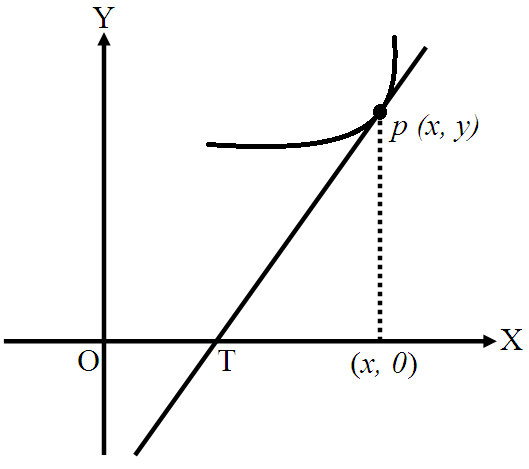 It is given that the distance between the foot of ordinate of point of contanct (A) and the point of intersection of tangent with x-axis (T) = 2x
Coordinate of $\text{T}=\big(\text{x}-\text{y}\frac{\text{dx}}{\text{dy}}, 0\big)$
$\text{AT}=\Big[\text{x}-\Big(\text{x}-\text{y}\frac{\text{dx}}{\text{dy}}, 0\Big)\Big]=2\text{x}$
Equation of tangent,
$\text{y}-\text{y}=\frac{\text{dy}}{\text{dx}}(\text{x}-\text{x})$
$\Rightarrow\text{y}-\text{0}=\frac{\text{dy}}{\text{dx}}\Big(\text{x}-\big(\text{x}-\text{y}\frac{\text{dx}}{\text{dy}}\big)\Big)$
$\Rightarrow \text{y}\frac{\text{dx}}{\text{dy}}=2\text{x}$
$\Rightarrow \int\frac{\text{dx}}{\text{x}}=2\int\frac{\text{dy}}{\text{y}}$
$\Rightarrow \log\text{x}=\log\text{y}^{2}+\log\text{C}$
$\text{x}=\text{Cy}^{2}$
As the circle passes through (1, 2)
$1=\text{C}\times2^{2}$
$\Rightarrow \text{C}=\frac{1}{4}$
$\Rightarrow 4\text{x}=\text{y}^{2}$ View full question & answer→Question 1805 Marks
Solve the following initial value problems:
$\frac{\text{dy}}{\text{dx}}+\text{y}\cot\text{x}=2\cos\text{x},\text{ y}\Big(\frac{\pi}{2}\Big)=0$
AnswerWe have,
$\frac{\text{dy}}{\text{dx}}+\text{y}\cot\text{x}=2\cos\text{x},\text{ y}\Big(\frac{\pi}{2}\Big)=0$
$\frac{\text{dy}}{\text{dx}}+\text{y}\cot\text{x}=2\cos\text{x}\ ...(1)$
Clearly, it is a linear differential equation of the form
$\frac{\text{dy}}{\text{dx}}+\text{Py}=\text{Q}$
Where $\text{P}=\cot\text{x}$ and $\text{Q}=2\cos\text{x}$
$\therefore\text{ I.F.}=\text{e}^{\int\text{Pdx}}$
$=\text{e}^{\int\cot\text{x dx}}$
$=\text{e}^{\log\sin\text{x}}$
$=\sin\text{x}$
Multiplying both sides of (1) by $\text{I.F.}=\sin\text{x},$ we get
$\sin\text{x}\Big(\frac{\text{dy}}{\text{dx}}+\text{y}\cot\text{x}\Big)=2\sin\text{x }\cos\text{x}$
$\Rightarrow\sin\text{x}\frac{\text{dy}}{\text{dx}}+\text{y}\cos\text{x}=\sin2\text{x}$
Integrating both sides with respect to x, we get
$\text{y}\sin\text{x}=\int\sin2\text{x dx}+\text{C}$
$\Rightarrow\text{y}\sin\text{x}=-\frac{\cos2\text{x}}{2}+\text{C}\ ...(2)$
Now,
$\text{y}\Big(\frac{\pi}{2}\Big)=0$
$\therefore\ 0\times\sin\frac{\pi}{2}=-\frac{\cos\pi}{2}+\text{C}$
$\Rightarrow\text{C}=-\frac{1}{2}$
Putting the value of C in (2), we get
$\text{y}\sin\text{x}=-\frac{\cos2\text{x}}{2}-\frac{1}{2}$
$\Rightarrow2\text{y}\sin\text{x}=-(1+\cos2\text{x})$
$\Rightarrow2\text{y}\sin\text{x}=-2\cos^2\text{x}$
$\Rightarrow\text{y}=-\cot\text{x}\cos\text{x}$
Hence, $\text{y}=-\cot\text{x}\cos\text{x}$ is the required solution.
View full question & answer→Question 1815 Marks
Solve the following differential equation:
$\text{x}\frac{\text{dy}}{\text{dx}}+2\text{y}=\text{x}\cos\text{x}$
AnswerHere, $\frac{\text{dy}}{\text{dx}}+\frac{2\text{y}}{\text{x}}=\cos\text{x}$ It is a linear differential equation. Comparing it with, $\frac{\text{dy}}{\text{dx}}+\text{Py}=\text{Q}$ $\text{P}=\frac{2}{\text{x}},\text{Q}=\cos\text{x}$ I.F. $=\text{e}^{\int\text{Pdx}}$ $=\text{e}^{2\int\frac{1}{\text{x}}\text{dx}}$ $=\text{e}^{2\log|\text{x}|}$ $=\text{x}^2$Solution of the equation is given by,
$\text{y}\times(\text{I.F.}=\int\text{Q}\times(\text{I.F.})\text{dx + C}$ $\text{y}(\text{x}^2)=\int\cos\text{x}(\text{x}^2)\text{dx + C}$ $\text{yx}^2=\int\text{x}^2\cos\text{xdx + C}$ $=\text{x}^2\int\cos\text{x}-\int(2\text{x}\times\int\cos\text{xdx})\text{dx + C}$ Usind integration by parts $\text{yx}^2=\text{x}^2\sin\text{x}-\int2\text{x}\sin\text{xdx + C}$ $=\text{x}^2\sin\text{x}-2\big[\text{x}\times\int\sin\text{xdx}-\int(1\times\int\sin\text{xdx})\text{dx}\big]+\text{C}$ $=\text{x}^2\sin\text{x}+2\text{x}\cos\text{x}-2\int\cos\text{xdx + C}$ $\text{yx}^2=\text{x}^2\sin\text{x}+2\text{x}\cos\text{x}-2\sin\text{x + C}$ $\text{y}=\sin\text{x}+\frac{2}{\text{x}}\cos\text{x}-\frac{2}{\text{x}^2}\sin\text{x}+\frac{\text{C}}{\text{x}^2}$
View full question & answer→Question 1825 Marks
Solve the following differential equation:
$\text{x}\frac{\text{dy}}{\text{dx}}-\text{y}=(\text{x}-1)\text{e}^{\text{x}}$
AnswerHere, $\text{x}\frac{\text{dy}}{\text{dx}}-\text{y}=(\text{x}-1)\text{e}^{\text{x}}$
$\frac{\text{dy}}{\text{dx}}-\frac{\text{y}}{\text{x}}=\Big(\frac{\text{x}-1}{\text{x}}\Big)\text{e}^{\text{x}}$
It is a linear differential equation. comparing the equation by,
$\frac{\text{dy}}{\text{dx}}+\text{Py}=\text{Q}$
$\text{P}=-\frac{1}{\text{x}},\text{Q}=\Big(\frac{\text{x}-1}{\text{x}}\Big)\text{e}^{\text{x}}$
I.F. $=\text{e}^{\int\text{Pdx}}=\text{e}^{-\int\frac{1}{\text{x}}\text{dx}}$
$\text{e}^{-\log|\text{x}|}=\frac{1}{\text{x}},\text{x}>0$
Solution of the equation is given by,
$\text{y}\times(\text{I.F.})=\int\text{Q}\times(\text{I.F.})\text{dx + C}$
$\text{y}\Big(\frac{1}{\text{x}}\Big)=\int\Big(\frac{\text{x}-1}{\text{x}}\Big)\text{e}^{\text{x}}\text{dx + C}$
$\frac{\text{y}}{\text{x}}=\int\Big(\frac{1}{\text{x}}-\frac{1}{\text{x}^2}\Big)\text{e}^{\text{x}}\text{dx + C}$
$\frac{\text{y}}{\text{x}}=\frac{1}{\text{x}}\text{e}^{\text{x}}+\text{C}$
Since $\int[\text{f(x)}+\text{f}'(\text{x})]\text{e}^{\text{x}}\text{dx}=\text{f(x)}\text{e}^{\text{x}}+\text{C}$
$\text{y}=\text{e}^{\text{x}}+\text{Cx},\text{x}>0$
View full question & answer→Question 1835 Marks
Solve the following differential equation:
$\frac{\text{dy}}{\text{dx}}+\text{y}\cot\text{x}=\text{x}^2\cot\text{x}+2\text{x}$
AnswerWe have,
$\frac{\text{dy}}{\text{dx}}+\text{y}\cot\text{x}=\text{x}^2\cot\text{x}+2\text{x}\ \dots(1)$
Clearly, it is a linear differential equation of the form
$\frac{\text{dy}}{\text{dx}}+\text{Py}=\text{Q}$
where
$\text{P}=\cot\text{x}$
$\text{Q}=\text{x}^2\cot\text{x}+2\text{x}$
$\therefore$ I.F. $=\text{e}^{\int\text{Pdx}}$
$=\text{e}^{\int\cot\text{xdx}}$
$=\text{e}^{\log|\sin\text{x}|}=\sin\text{x}$
Multiplying both sides of (1) by $\sin\text{x},$ we get
$\sin\text{x}\Big(\frac{\text{dy}}{\text{dx}}+\text{y}\cot\text{x}\Big)=\sin\text{x}(\text{x}^2\cot\text{x}+2\text{x})$
$\Rightarrow\ \sin\text{x}\frac{\text{dy}}{\text{dx}}+\text{y}\cos\text{x}=\text{x}^2\cos\text{x}+2\text{x}\sin\text{x}$
Integrating both sides with respect to x, we get
$\text{y}\sin\text{x}=\int\text{x}^2\cos\text{xdx}+\int2\text{x}\sin\text{xdx + C}$
$\Rightarrow\ \text{y}\sin\text{x}=\text{x}^2\int\cos\text{xdx}-\int\Big[\frac{\text{d}}{\text{dx}}(\text{x}^2)\int\cos\text{xdx}\Big]\text{dx}+\int2\text{x}\sin\text{x dx + C}$
$\Rightarrow\ \text{y}\sin\text{x}=\text{x}^2\sin\text{x}-\int2\text{x}\sin\text{xdx}+\int2\text{x}\sin\text{xdx + C}$
$\Rightarrow\ \text{y}\sin\text{x}=\text{x}^2\sin\text{x +C}$
Hence, $\Rightarrow\ \text{y}\sin\text{x}=\text{x}^2\sin\text{x +C}$ is the required solution.
View full question & answer→Question 1845 Marks
Solve the following differential equation
$\frac{\text{dy}}{\text{dx}}=\log\text{x}$
AnswerWe have,
$\frac{\text{dy}}{\text{dx}}=\log\text{x}$
$\Rightarrow\text{dy}=(\log\text{x})\text{dx}$
Integrating both sides, we get
$\int\text{dy}=\int(\log\text{x})\text{dx}$
$\Rightarrow\text{dy}=\int1\times\log\text{x}\text{ dx}$
$\Rightarrow\text{dy}=\log\text{x}\int\int1\text{dx}-\int\Big[\frac{\text{d}}{\text{dx}}(\log\text{x})\int1\text{dx}\Big]\text{dx}$
$\Rightarrow\text{y}=\text{x}\log\text{x }-\int\frac{\text{x}}{\text{x}}\text{dx}$
$\Rightarrow\text{y}=\text{x}\log\text{x}-\int1\text{dx}$
$\Rightarrow\text{y}=\text{x}\log\text{x}-\text{x}$
$\Rightarrow\text{y}=\text{x}(\log\text{x}-1)+\text{C}$
So, $\Rightarrow\text{y}=\text{x}(\log\text{x}-1)+\text{C}$ is defined for all $\text{x}\in\text{R}$ except x = 0
Hence, $\Rightarrow\text{y}=\text{x}(\log\text{x}-1)+\text{C}$ where $\text{x}\in\text{R}-\{0\}$ is the solution o the given differential equation.
View full question & answer→Question 1855 Marks
Solve the following differential equation:
$\frac{\text{dy}}{\text{dx}}\cos(\text{x}-\text{y})=1$
Answer$\frac{\text{dy}}{\text{dx}}\times\cos(\text{x}-\text{y})=1$
Let $\text{x}-\text{y}=\text{v}$
$1-\frac{\text{dy}}{\text{dx}}=\frac{\text{dv}}{\text{dx}}$
$\frac{\text{dy}}{\text{dx}}=1-\frac{\text{dv}}{\text{dx}}$
So,
$\Big(1-\frac{\text{dv}}{\text{dx}}\Big)\cos\text{v}=1$
$1-\frac{\text{dv}}{\text{dx}}=\sec\text{v}$
$1-\sec\text{v}=\frac{\text{dv}}{\text{dx}}$
$\text{dx}=\frac{\text{dv}}{1-\sec\text{v}}$
$\text{dx}=\frac{\cos\text{v}}{1-\cos\text{v}}\text{dv}$
$\int\text{dx}=\int\frac{\cos^{2}\frac{\text{v}}{2}-\sin^{2}\frac{\text{v}}{2}}{2\sin^{2}\frac{\text{v}}{2}}\text{dv}$
$\int\text{dx}=\int\frac{1}{2}\cot\big(\frac{\text{v}}{2}\big)\text{dv}-\frac{1}{2}\text{dv}$
$2\int\text{dx}=\int\cot^{2}\big(\frac{\text{v}}{2}\big)-\int\text{dv}$
$2\int\text{dx}=\int\Big(\text{cosec}^{2}\frac{\text{v}}{2}-1\Big)\text{dv}-\int\text{dv}$
$2\text{x}=-2\cot\big(\frac{\text{v}}{2}\big)\text{dv}-\text{v}-\text{v}+\text{C}_{1}$
$2(\text{x}+\text{v})=-2\cot\frac{\text{v}}{2}+\text{C}_{1}$
$\text{x}+\text{x}-\text{y}=-\cot\Big(\frac{\text{x}-\text{y}}{2}\Big)+\text{C}$
$\text{C}+\text{y}=\cot\Big(\frac{\text{x}-\text{y}}{2}\Big)$
View full question & answer→Question 1865 Marks
The surface area of a balloon being inflated, changes at a rate proportional to time t. If initially its radius is 1 unit and after 3 seconds it is 2 units, find the radius after time t.
AnswerLet A be the surface area of balloon, So
$\frac{\text{dA}}{\text{dt}}\propto\text{t}$
$\Rightarrow\frac{\text{dA}}{\text{dt}}=\lambda\text{t}$
$\Rightarrow\frac{\text{d}}{\text{dt}}(4\pi\text{r}^{2})=\lambda\text{t}$
$\Rightarrow 8\pi\text{r}\frac{\text{dr}}{\text{dt}}=\lambda\text{t}$
$\Rightarrow8\pi\text{r}\ \text{dr}=\lambda\text{t}$
$\Rightarrow 8\pi\int\limits_{}{}\text{r}\ \text{dr}=\lambda\int_{}^{}\text{t}\ \text{dt} $
$\Rightarrow 8\pi\frac{\text{r}^{2}}{2}=\frac{\lambda\text{t}^{2}}{2}+\text{c}$
$\Rightarrow 4\pi\text{r}^{2}=\frac{\lambda\text{t}^{2}}{2}+\text{c}\ ...(\text{i})$
Given r = 1 units When t = 0, so
$4\pi(1)^{2}=0+\text{c}$
$4\pi=\text{c}$
Using it is equation (i),
$\Rightarrow 4\pi\text{r}^{2}=\frac{\lambda\text{t}^{2}}{2}+4\pi\ ...(\text{ii})$
Also, given r = 2 units when t = 3 Sec.
$4\pi\text{(2)}^{2}=\frac{\lambda\text{(3)}^{2}}{2}+4\pi$
$ \Rightarrow16\pi=\frac{9}{2}\lambda+4\pi$
$\Rightarrow\frac{9}{2}\lambda=12\pi$
$\Rightarrow\lambda=\frac{24}{9}\pi$
$\Rightarrow\lambda=\frac{8}{3}\pi$
Now, equation (ii) becomes
$ 4\pi\text{r}^{2}=\frac{8\pi}{6}\text{t}^{2}+4\pi$
$\Rightarrow 4\pi(\text{r}^{2}-1)=\frac{4}{3}\pi\text{t}^{2}$
$\Rightarrow\text{r}^{2}-1=\frac{1}{3}\text{t}^{2}$
$\Rightarrow\text{r}^{2}=1+\frac{1}{3}\text{t}^{2}$
$\therefore\ \text{r}=\sqrt{(1+\frac{1}{3}\text{t}^{2}})$
View full question & answer→Question 1875 Marks
Solve the following differential equation:
$\text{xy}\frac{\text{dy}}{\text{dx}}=\text{x}^2-\text{y}^2$
AnswerWe have,
$\text{xy}\frac{\text{dy}}{\text{dx}}=\text{x}^2-\text{y}^2$
$\Rightarrow\ \frac{\text{dy}}{\text{dx}}=\frac{\text{x}^2-\text{y}^2}{\text{xy}}$
This is a homogeneous differential equation.
Putting y = vx and $\frac{\text{dy}}{\text{dx}}=\text{v + x}\frac{\text{dv}}{\text{dx}}$, we get
$\text{v + x}\frac{\text{dv}}{\text{dx}}=\frac{\text{x}^2-\text{v}^2\text{x}^2}{\text{vx}^2}$
$\Rightarrow\ \text{v + x}\frac{\text{dv}}{\text{dx}}=\frac{1-\text{v}^2}{\text{v}}$
$\Rightarrow\ \text{x}\frac{\text{dv}}{\text{dx}}=\frac{1-\text{v}^2}{\text{v}}-\text{v}$
$\Rightarrow\ \text{x}\frac{\text{dv}}{\text{dx}}=\frac{1-2\text{v}^2}{\text{v}}$
$\Rightarrow\ \frac{\text{v}}{1-2\text{v}^2}\text{dv}=\frac{1}{\text{x}}\text{dx}$
Integrating both sides, we get
$\int\frac{\text{v}}{1-2\text{v}^2}\text{dv}=\int\frac{1}{\text{x}}\text{dx}$
$\Rightarrow\ \frac{-1}4\log\big|1-2\text{v}^2\big|=\log|\text{x}|+\log\text{C}$
$\Rightarrow\ \log\big|1-2\text{v}^2\big|=-4\log|\text{x}|-4\log\text{C}$
$\Rightarrow\ \log\big|\big(1-2\text{v}^2\big)\big(\text{x}^4\big)\big|=\log\frac{1}{\text{C}^4}$
Putting $\text{v}=\frac{\text{y}}{\text{x}}$, we get
$\Rightarrow\ \log\big|\text{x}^2\big(\text{x}^2-2\text{y}^2\big)\big|=\log\frac{1}{\text{C}^4}$
$\Rightarrow\ \text{x}^2\big(\text{x}^2-2\text{y}^2\big)=\text{C}_1$
where
$\text{C}_1=\frac{1}{\text{C}^4}$
Hence, $\text{x}^2\big(\text{x}^2-2\text{y}^2\big)=\text{C}_1$ is the required solution.
View full question & answer→Question 1885 Marks
Solve the following differential equations:
$2(\text{y}+3)-\text{xy}\frac{\text{dy}}{\text{dx}}=0,\text{y}(1)=-2$
Answer$2(\text{y}+3)-\text{xy}\frac{\text{dy}}{\text{dx}}=0$
$\Rightarrow2(\text{y}+3)=\text{xy}\frac{\text{dy}}{\text{dx}}$
$\Rightarrow\frac{2}{\text{x}}\text{dx}=\frac{\text{y}}{\text{y}+3}\text{dy}$
$\Rightarrow\frac{2}{\text{x}}\text{dx}=\frac{\text{y}+3-3}{\text{y}+3}\text{dy}$
$\Rightarrow\frac{2}{\text{x}}\text{dx}=\Big(1-\frac{3}{\text{y}+3}\Big)\text{dy}$
$\Rightarrow\int\frac{2}{\text{x}}\text{dx}=\int\Big(1-\frac{3}{\text{y}+3}\Big)\text{dy}$
$\Rightarrow2\log\text{x = y}-3\log|\text{y}+3|+\text{C}$
$\Rightarrow\log\text{x}^2+\log|(\text{y}+3)^3|=\text{y + C}$
$\Rightarrow\log|(\text{x}^2)(\text{y}+3)^3|=\text{y + C}...(1)$
$\Rightarrow\log|(1)^2(-2+3)^3|=-2+\text{C}$
$\Rightarrow\text{C}=2$
Substituting the value of C in (1), we get
$\log|(\text{x}^2)(\text{y}+3)^3|=\text{y}+2$
$\Rightarrow(\text{x}^2)(\text{y}+3)^3=\text{e}^{\text{y}+2}$
View full question & answer→Question 1895 Marks
Show that $\text{y}=\frac{\text{a}}{\text{x}}+\text{b}$ is a solution of the differential equation $\frac{\text{d}^2\text{y}}{\text{dx}^2}=\frac{2}{\text{x}}\Big(\frac{\text{dy}}{\text{dx}}\Big)=0$
AnswerWe have,
$\text{y}=\frac{\text{a}}{\text{x}}+\text{b}\ ...(1)$
Differentiating both sides of equation (1) with respect to 3, we get
$\frac{\text{dy}}{\text{dx}}=-\frac{\text{a}}{\text{x}^2}\ ...(2)$
Differentiating both sides of equation (2) with respect to 3, we get
$\frac{\text{d}^2\text{y}}{\text{dx}^2}=2\frac{\text{a}}{\text{x}^3}$
$\frac{\text{d}^2\text{y}}{\text{dx}^2}=-\frac{2}{\text{x}}\Big(-\frac{\text{a}}{\text{x}^2}\Big)$
$\frac{\text{d}^2\text{y}}{\text{dx}^2}=-\frac{2}{\text{x}}\Big(\frac{\text{dy}}{\text{dx}}\Big)$
$\Rightarrow\frac{\text{d}^2\text{y}}{\text{dx}^2}+\frac{2}{\text{x}}\Big(\frac{\text{dy}}{\text{dx}}\Big)=0$
Hence, the given function is the solution to the given differential equation.
View full question & answer→Question 1905 Marks
Solve the following differential equation:
$\cos^2(\text{x}-2\text{y}) = 1-2\frac{\text{dy}}{\text{dx}}$
AnswerWe have,
$\cos^2(\text{x}-2\text{y}) = 1-2\frac{\text{dy}}{\text{dx}}$
$\Rightarrow 2\frac{\text{dy}}{\text{dx}} = 1 - \cos^2(\text{x}-2\text{y} )$
Let $\text{x}-2\text{y}=\text{v}$
$\Rightarrow1-2\frac{\text{dy}}{\text{dx}}=\frac{\text{dv}}{\text{dx}}$
$\Rightarrow 2\frac{\text{dy}}{\text{dx}} = 1 -\frac{\text{dv}}{\text{dx}}$
$\therefore 1 - \frac{\text{dv}}{\text{dx}} = 1 - \cos^2\text{v}$
$\Rightarrow \frac{\text{dv}}{\text{dx}} = \cos^2\text{v}$
$\Rightarrow \sec^2 \text{v}\text{ dv} = \text{dx}$
Integrating both sides, we get
$\int\sec^2\text{v}\text{ dv} = \int \text{dx}$
$\Rightarrow \tan \text{v} = \text{x} - \text{C}$
$\Rightarrow \tan (\text{x}-2\text{y}) = \text{x}-\text{C}$
$\Rightarrow \text{x} = \tan (\text{x}-2\text{y})+\text{C}$
View full question & answer→Question 1915 Marks
Solve the following differential equation:
$\text{y}^2\frac{\text{dx}}{\text{dy}}+\text{x}-\frac{1}{\text{y}}=0$
AnswerHere, $\text{y}^2\frac{\text{dx}}{\text{dy}}+\text{x}-\frac{1}{\text{y}}=0$
$\Rightarrow\ \frac{\text{dy}}{\text{dx}}+\frac{\text{x}}{\text{y}^2}=\frac{1}{\text{y}^3}$
It is a linear differential equation. Comparing the equation with,
$\frac{\text{dy}}{\text{dx}}+\text{Py}=\text{Q}$
$\text{P}=\frac{1}{\text{y}^2},\text{Q}=\frac{1}{\text{y}^3}$
I.F. $=\text{e}^{\int\text{Pdy}}$
$=\text{e}^{\int\frac{1}{\text{y}^2}\text{dy}}$
$=\text{e}^{-\frac{1}{\text{y}}}$
Solution of the equation is given by,
$\text{x}\times(\text{I.F.})=\int\text{Q}\times(\text{I.F.})\text{dy + C}$
$\text{x}\Big(\text{e}^{-\frac{1}{\text{y}}}\Big)=\int\frac{1}{\text{y}^3}\Big(\text{e}^{-\frac{1}{\text{y}}}\Big)\text{dy + C}$
Let $\text{e}^{-\frac{1}{\text{y}}}=\text{t}$
$\Rightarrow\frac{1}{\text{y}}=-\log\text{t}$
$\text{e}^{-\frac{1}{\text{y}}}\times\frac{1}{\text{y}^2}\text{dy = dt}$
$\text{x (t)}=\int\frac{1}{\text{y}}\text{dt + C}$
$=-\log+\text{dt + C}$
$=-\Big[\log\text{t}\times\int1\times\text{dt}-\int\Big(\frac{1}{\text{t}}\int1\times\text{dt}\Big)\text{dt}\Big]+\text{C}$
$=-\Big[\text{t}\log\text{t}-\int\frac{\text{t}}{\text{t}}\text{dt}\Big]+\text{C}$
$\text{x (t)}=-\text{t}\log\text{t + t + C}$
$\text{x (t)}=-\text{t}[\log\text{t}-1]+\text{C}$
$\text{x}=-\Big[-\frac{1}{\text{y}}-1\Big]\text{Ce}^{\frac{1}{\text{y}}}$
$\text{x}=\frac{1}{\text{y}}+1+\text{Ce}^{\frac{1}{\text{y}}}$
$\text{x}=\Big(\frac{1+\text{y}}{\text{y}}\Big)+\text{Ce}^{\frac{1}{\text{y}}}$
View full question & answer→Question 1925 Marks
Solve the following differential equation:
$\text{x}\frac{\text{dy}}{\text{dx}}+\text{y}=\text{x}\log\text{x}$
AnswerWe have,
$\text{x}\frac{\text{dy}}{\text{dx}}+\text{y}=\text{x}\log\text{x}$
Dividing both sides by x, we get
$\frac{\text{dy}}{\text{dx}}+\frac{\text{y}}{\text{x}}=\log{\text{x}}$
Comparing with $\frac{\text{dy}}{\text{dx}}+\text{Py}=\text{Q},$ we get
$\text{P}=\frac{1}{\text{x}}$
$\text{Q}=\log\text{x}$
Now,
I.F. $=\text{e}^{\int\text{Pdx}}=\text{e}^{\int\frac{1}{\text{x}}\text{dx}}$
$\text{e}^{\log|\text{x}|}=\text{x}$
So, the solution is given by
$\text{y}\times\text{I.F.}=\int\text{Q}\times\text{I.F. dx + C}$
$\Rightarrow\ \text{xy}=\int\text{x}\log\text{x dx + C}$
$\Rightarrow\ \text{xy}=\log\text{x}\int\text{xdx}-\int\Big[\frac{\text{d}}{\text{dx}}(\log\text{x})\int\text{x dx}\Big]\text{ dx + C}$
$\Rightarrow\ \text{xy}=\frac{\text{x}^2\log\text{x}}{2}-\int\frac{\text{x}}2\text{dx + C}$
$\Rightarrow\ \text{xy}=\frac{\text{x}^2\log\text{x}}{2}-\frac{\text{x}^2}4+\text{C}$
$\Rightarrow\ 4\text{xy}=2\text{x}^2\log\text{x}-\text{x}^2+\text{K}$ (where, K = 2C)
View full question & answer→Question 1935 Marks
Solve the following differential equations:
$\frac{\text{dy}}{\text{dx}}=\frac{\text{y}^2-\text{x}^2}{2\text{xy}}$
AnswerHere, $\frac{\text{dy}}{\text{dx}}=\frac{\text{y}^2-\text{x}^2}{2\text{xy}}$It is homogeneous equation
Put y = vx
$\frac{\text{dy}}{\text{dx}}=\text{v + x}\frac{\text{dv}}{\text{dx}}$
So,
$\text{v + x}\frac{\text{dv}}{\text{dx}}=\frac{\text{v}^2\text{x}^2-\text{x}^2}{2\text{xvx}}$
$\text{x}\frac{\text{dv}}{\text{dx}}=\frac{\text{v}^2-1}{2\text{v}}-\frac{\text{v}}1$
$=\frac{\text{v}^2-1-2\text{v}^2}{2\text{v}}$
$\text{x}\frac{\text{dv}}{\text{dx}}=\frac{-1-\text{v}^2}{2\text{v}}$
$\int\frac{2\text{v}}{1+\text{v}^2}\text{dv}=-\int\frac{\text{dx}}{\text{x}}$
$\log\big|1+\text{v}^2\big|=-\log|\text{x}|+\log|\text{C}|$
$1+\text{v}^2=\frac{\text{C}}{\text{x}}$
$1+\frac{\text{y}^2}{\text{x}^2}=\frac{\text{C}}{\text{x}}$
$\text{x}^2+\text{y}^2=\text{Cx}$
View full question & answer→Question 1945 Marks
verify that $\text{y}=\text{e}^{\text{m}\cos^{-1}}$ is a solution of the differential equation $(1+\text{x}^2)\frac{\text{d}^2\text{y}}{\text{dx}^2}-\text{x}\frac{\text{dy}}{\text{dx}}-\text{m}^2\text{y}=0$
AnswerWe have,
$\text{y}=\text{e}^{\text{m}\cos^{-1}}\ ...(1)$
Differentiating both sides of (1) with respect to x, we get
$\frac{\text{dy}}{\text{dx}}=\text{me}^{\text{m}^{\cos^{-1}}}\Big(\frac{-1}{\sqrt{1-\text{x}^2}}\Big)$
$\Rightarrow\frac{\text{dy}}{\text{dx}}=-\frac{\text{me}^{\text{m}^{\cos^{-1}}}\text{x}}{\sqrt{1-\text{x}^3}}\ ...(2)$
Differentiating both sides of (2) with respect to x, we get
$\frac{\text{d}^2\text{y}}{\text{dx}^2}=\frac{\text{d}}{\text{dx}}\Big(-\frac{\text{me}^{\text{m}^{\cos^{-1}}}\text{x}}{\sqrt{1-\text{x}^2}}\Big)$
$\Rightarrow\frac{\text{d}^2\text{y}}{\text{dx}^2}=(-\text{m})\Bigg[\frac{\sqrt{1-\text{x}^2}\text{me}^{\text{m}^{\cos^{-1}}}\Big(-\frac{1}{\sqrt{1-\text{x}}}\Big)-\text{e}^{\text{m}^{\cos^{-1}}}\text{x}\frac{1}{2}\Big(-\frac{2\text{x}}{\sqrt{1-\text{x}^2}}\Big)}{(1-\text{x}^2)}\Bigg]$
$\Rightarrow(1-\text{x}^2)\frac{\text{d}^2\text{y}}{\text{dx}^2}=(-\text{m})\Big[-\text{me}^{\text{m}^{\cos^{-1}}}\text{x}+\frac{\text{xe}^{\text{m}^{\cos^{-1}}}\text{x}}{\sqrt{1-\text{x}^2}}$
$\Rightarrow(1-\text{x}^2)\frac{\text{d}^2\text{y}}{\text{dx}^2}=\text{m}^2\text{y}+\text{x}\frac{\text{dy}}{\text{dx}}$
$\Rightarrow(1-\text{x}^2)\frac{\text{d}^2\text{y}}{\text{dx}^2}\text{m}^2\text{y}+\text{x}\frac{\text{dy}}{\text{dx}}$
$\Rightarrow(1-\text{x}^2)\frac{\text{d}^2\text{y}}{\text{dx}^2}-\text{x}\frac{\text{dy}}{\text{dx}}-\text{m}^2\text{y}=0$
Hence, the given function is the solution to the given differential equation.
View full question & answer→Question 1955 Marks
Solve the following differential equation:
$(2\text{x}^2\text{y}+\text{y}^3)\text{dx}+(\text{xy}^2-3\text{x}^2)\text{dy}=0$
Answer$(2\text{x}^2\text{y}+\text{y}^3)\text{dx}+(\text{xy}^2-3\text{x}^2)\text{dy}=0$
$\frac{\text{dy}}{\text{dx}}=\frac{2\text{x}^2\text{y}+\text{y}^3}{\text{xy}^2-3\text{x}^2}$
It is a homogeneous equation
Put y = vx
and $\frac{\text{dy}}{\text{dx}}=\text{v +x}\frac{\text{dv}}{\text{dx}}$
So,
$\text{v +x}\frac{\text{dv}}{\text{dx}}=\frac{2\text{x}^2\text{vx}+\text{v}^3\text{x}^3}{3\text{x}^3-\text{xv}^2\text{x}^2}$
$\text{x}\frac{\text{dv}}{\text{dx}}=\frac{2\text{v + v}^3}{3-\text{v}^2}-\text{v}$
$=\frac{2\text{v + v}^3-3\text{v + v}^3}{3-\text{v}^2}$
$\text{x}\frac{\text{dv}}{\text{dx}}=\frac{2\text{v}^3-\text{v}}{3-\text{v}^2}$
$\int\frac{3-\text{v}^2}{2\text{v}^3-\text{v}}\text{dv}=\int\frac{\text{dx}}{\text{x}}\ \dots(\text{i})$
$\frac{3-\text{v}^2}{\text{v}(2\text{v}^2-1)}=\frac{\text{A}}{(\text{v})}+\frac{\text{Bv + C}}{(2\text{v}^2-1)}$
$3-\text{v}^2=\text{A}(2\text{v}^2-1)+(\text{Bv + C})(\text{v})$
$=2\text{Av}^2-\text{A}+\text{Bv}^2+\text{Cv}$
$3-\text{v}^2=(2\text{A + B})\text{v}^2\text{Cv}-\text{A}$
Comparing the co-efficient of like powers of v
A = -3
C = 0
and 2A + B = -1
⇒ 2(-3) + B = -1
⇒ B = 5
So,
$\int\frac{-3}{\text{v}}\text{dv}+\int\frac{5\text{v}}{2\text{v}^2-1}\text{dv}=\int\frac{\text{dx}}{\text{x}}$
$-3\int\frac{1}{\text{v}}\text{dv}+\frac{5}4\int\frac{4\text{v}}{2\text{v}^2-1}\text{dv}=\int\frac{\text{dx}}{\text{x}}$
$-3\log|\text{v}|+\frac{5}4\log|2\text{v}^2-1|=\log|\text{x}|+\log|\text{C}|$
$-12\log|\text{v}|+5\log|2\text{v}^2-1|=4\log|\text{x}|+4\log|\text{C}$
$\frac{|2\text{v}^2-1|^5}{\text{v}^{12}}=\text{x}^4\text{C}^4$
$\frac{|2\text{y}^2-\text{x}^2|^5}{\text{x}^{10}}=\text{x}^4\text{C}^4\Big(\frac{\text{y}}{\text{x}}\Big)^{12}$
$|2\text{y}^2-\text{x}^2|^5=\text{x}^{14}\text{C}^4\frac{\text{y}^{12}}{\text{x}^{12}}$
$\text{x}^2\text{C}^4\text{y}^{12}=|2\text{y}^2-\text{x}^2|^5$
View full question & answer→Question 1965 Marks
Solve the following differential equation
$\cos\text{x }\frac{\text{dy}}{\text{dx}}-\cos2\text{x}=\cos3\text{x}$
AnswerWe have,
$\cos\text{x }\frac{\text{dy}}{\text{dx}}-\cos2\text{x}=\cos3\text{x}$
$\Rightarrow\text{dy}=\frac{\cos3\text{x}+\cos2\text{x}}{\cos\text{x}}\ \text{dx}$
$\Rightarrow\text{dy}=\frac{4\cos^2\text{x}-3\cos\text{x}+2\cos^2\text{x}-1}{\cos\text{x}}\ \text{dx}$
$\Rightarrow\text{dy}=(4\cos^2\text{x}-3+2\cos\text{x}-\sec\text{x})\text{dx}$
$\Rightarrow\text{dy}[2(2\cos^2\text{x}-1)-1+2\cos\text{x}-\sec\text{x}]\text{dx}$
$\Rightarrow\text{dy}(2\cos2\text{x}-1+2\cos\text{x}-\sec\text{x})\text{ dx}$
Integrating both sides, we get
$\int\text{dy}=\int(2\cos2\text{x}-1+2\cos\text{x}-\sec\text{x})\text{dx}$
$\Rightarrow\text{y}=\sin2\text{x}-\text{x}+2\sin\text{x}-\log|\sec\text{x}+\tan\text{x}|+\text{C}$
hence, $\text{y}=\sin2\text{x}-\text{x}+2\sin\text{x}-\log|\sec\text{x}+\tan\text{x}|+\text{C}$ is the solution to the given differential equation.
View full question & answer→Question 1975 Marks
Solve the following differential equation:
$\frac{\text{dy}}{\text{dx}}=\text{y}\tan\text{x}-2\sin\text{x}$
AnswerWe have,
$\frac{\text{dy}}{\text{dx}}=\text{y}\tan\text{x}-2\sin\text{x}$
$\frac{\text{dy}}{\text{dx}}-\text{y}\tan\text{x}=-2\sin\text{x}\ \dots(1)$
Clearly, it is a linear differential equation of the form
$\frac{\text{dy}}{\text{dx}}+\text{Py}=\text{Q}$
where
$\text{P}=-\tan\text{x}$
$\text{Q}=-2\sin\text{x}$
$\therefore$ I.F. $=\text{e}^{\int\text{Pdx}}$
$=\text{e}^{-\int\tan\text{xdx}}$
$=\text{e}^{-\log|\sec\text{x}|}=\cos\text{x}$
Multiplying both sides of (1) by $\cos\text{x},$ we get
$\cos\text{x}\Big(\frac{\text{dy}}{\text{dx}}-\text{y}\tan\text{x}\Big)=-2\sin\text{x}\times\cos\text{x}$
$\Rightarrow\ \cos\text{x}\frac{\text{dy}}{\text{dx}}+\text{y}\sin\text{x}=-\sin2\text{x}$
Integrating both sides with respect to x, we get
$\text{y}\cos\text{x}=-\int\sin2\text{x dx + C}$
$\Rightarrow\ \text{y}\cos\text{x}=\frac{\cos2\text{x}}{2}+\text{C}$
$\Rightarrow\ \text{y}\cos\text{x}=\frac{1-2\sin^2\text{x}}{2}+\text{C}$
$\Rightarrow\ \text{y}\cos\text{x}=-\sin^2\text{x}+\frac{1}{2}+\text{C}$
$\Rightarrow\ \text{y}\cos\text{x}=-\sin^2\text{x}+\text{K}$ $\Big($where $\text{K}=\frac{1}2+\text{c}\Big)$
$\Rightarrow\ \text{y}=\sec\text{x}\big(-\sin^2\text{x}+\text{K}\big)$
Hence, $\text{y}=\sec\text{x}\big(-\sin^2\text{x}+\text{K}\big)$ is the required solution.
View full question & answer→Question 1985 Marks
Solve the following differential equation:
$\frac{\text{dy}}{\text{dx}}+2\text{y}=\text{xe}^{4\text{x}}$
AnswerWe have, $\frac{\text{dy}}{\text{dx}}+2\text{y}=\text{xe}^{4\text{x}}\ \dots(1)$ Clearly, it is a linear differential equation of the form $\frac{\text{dy}}{\text{dx}}+\text{Py}=\text{Q}$ where $\text{P}=2$ $\text{Q}=\text{xe}^{4\text{x}}$ $\therefore$ I.F. $=\text{e}^{\int\text{Pdx}}$ $=\text{e}^{\int2\text{dx}}$ $=\text{e}^{2\text{x}}$Multiplying both sides of (1) by $e^{2x}$, we get
$\text{e}^{2\text{x}}\Big(\frac{\text{dy}}{\text{dx}}+2\text{y}\Big)=\text{e}^{2\text{x}}\times\text{xe}^{4\text{x}}$$\Rightarrow\ \text{e}^{2\text{x}}\frac{\text{dy}}{\text{dx}}+2\text{e}^{2\text{x}}\text{y}=\text{xe}^{6\text{x}}$
Integrating both sides with respect to x, we get
$\text{e}^{2\text{x}}\text{y}=\int\text{e}^{6\text{x}}\text{xdx + C}$ $\Rightarrow\ \text{e}^{2\text{x}}\text{y}=\text{x}\int\text{e}^{6\text{x}}\text{dx}-\int\Big[\frac{\text{d}}{\text{dx}}(\text{x})\int\text{e}^{6\text{x}}\text{dx}\Big]\text{dx + C}$$\Rightarrow\ \text{e}^{2\text{x}}\text{y}=\frac{\text{x}\text{e}^{6\text{x}}}{6}-\frac{\text{e}^{6\text{x}}}{36}+\text{C}$
$\Rightarrow\ \text{y}=\frac{\text{xe}^{4\text{x}}}{6}-\frac{\text{e}^{4\text{x}}}{36}+\text{Ce}^{-2\text{x}}$ Hence, $\text{y}=\frac{\text{xe}^{4\text{x}}}{6}-\frac{\text{e}^{4\text{x}}}{36}+\text{Ce}^{-2\text{x}}$ is the required solution.
View full question & answer→Question 1995 Marks
Solve the following initial value problems:
$\text{y}'+\text{y}=\text{e}^{\text{x}},\text{ y}(0)=\frac{1}{2}$
AnswerWe have,
$\text{y}'+\text{y}=\text{e}^{\text{x}}$
$\Rightarrow\frac{\text{dy}}{\text{dx}}+\text{y}=\text{e}^{\text{x}}\ ...(\text{1})$
Clearly, it is a linear differential equation of the form
$\frac{\text{dy}}{\text{dx}}+\text{Py}=\text{Q}$
Where P = 1 and $Q = e^x$
$\therefore\ \text{I.F.}=\text{e}^{\int\text{Pdx}}$
$=\text{e}^{\int1\text{dx}}$
$=\text{e}^{\text{x}}$
Multiplying both sides of (1) by I.F. $= e^x$, we get
$\text{e}\Big(\frac{\text{dy}}{\text{dx}}+\text{y}\Big)=\text{e}^{\text{x}}\text{e}^{\text{x}}$
$\Rightarrow\text{e}^{\text{x}}\frac{\text{dy}}{\text{dx}}+\text{e}^{\text{x}}\text{y}=\text{e}^{2\text{x}}$
Integrating both sides with respect to x, we get
$\text{y}\text{e}^{\text{x}}=\int\text{e}^{2\text{x}}\text{dx}+\text{C}$
$\Rightarrow\text{y}\text{e}^{\text{x}}=\frac{\text{e}^{2\text{x}}}{2}+\text{C}\ ...(\text{ii})$
Now,
$\text{y}(0)=\frac{1}{2}$
$\therefore\ \frac{1}{2}\text{e}^0=\frac{\text{e}^0}{2}+\text{C}$
$\Rightarrow\text{C}=0$
Putting the value of C in (2), we get
$\text{y}\text{e}^{\text{x}}=\frac{\text{e}^{2\text{x}}}{2}$
$\Rightarrow\text{e}^{\text{x}}=\frac{\text{e}^{\text{x}}}{2}$
Hence, $\text{y}=\frac{\text{e}^{\text{x}}}{2}$ is the required solution.
View full question & answer→Question 2005 Marks
Solve the following differential equation
$\text{C}(\text{x})=2+0.15\text{x},\text{C}(0)=100$
Answer$\text{C}(\text{x})=2+0.15\text{x},\text{C}(0)=100$$\text{C}'(\text{x})\text{dx}=(2+0.15\text{x})\text{dx}$
$\int\text{C}'(\text{x})\text{dx}=\int2\text{dx}+0.15\int\text{x dx}$
$\text{C}(\text{x})=2\text{x}+0.15\frac{\text{x}^2}{2}+\text{C}\ ...(1)$
Put x = 0, c(x) = 100
100 = 2(0) + 0 + c
100 = c
Put c = 100 in equation 1
$\text{c}(\text{x})=2\text{x}+(0.15)\frac{\text{x}^2}{2}+100$
View full question & answer→