MCQ 1511 Mark
Choose the correct answer from the given four options.The value of $\cot\Big[\cos^{-1}\Big(\frac{7}{25}\Big)\Big]$ is:
- A
$\frac{25}{24}$
- B
$\frac{25}{7}$
- C
$\frac{24}{25}$
- ✓
$\frac{7}{24}$
AnswerCorrect option: D. $\frac{7}{24}$
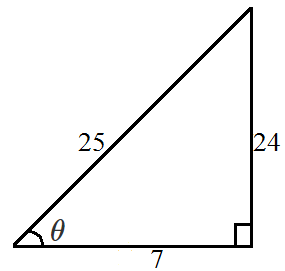
$\cot\Big[\cos^{-1}\Big(\frac{7}{25}\Big)\Big]$
$=\cot\Big(\cot^{-1}\frac{7}{24}\Big)$
$=\frac{7}{24}$ View full question & answer→MCQ 1521 Mark
The value of $\sin ^{ -1 }{ \left( \cos { \frac { 53\pi }{ 5 } } \right) }=\sin ^{ -1 }{ \left( \cos { \frac { 50\pi+3\pi }{ 5 } } \right) }:$
- A
$ \frac {- \pi }{ 1 }$
- B
$ \frac {- \pi }{ 7 }$
- C
$ \frac { \pi }{ 10 }$
- ✓
$ \frac {- \pi }{ 10 }$
AnswerCorrect option: D. $ \frac {- \pi }{ 10 }$
We have: $\sin ^{ -1 }{ \left( \cos { \frac { 53\pi }{ 5 } } \right) }=\sin ^{ -1 }{ \left( \cos { \frac { 50\pi+3\pi }{ 5 } } \right) }$
$ =\sin ^{ -1 }{ \left( \cos \left({ \frac { 50\pi}{5}+\frac{3\pi }{ 5 } }\right) \right) }$
$ =\sin ^{ -1 }{ \left( \cos \left({ 10\pi+\frac{3\pi }{ 5 } }\right) \right) }$
$ =\sin ^{ -1 }{ \left( \cos \left({ \frac{3\pi }{ 5 } }\right) \right) }, [\because \cos(2\text{n}\pi+\theta)=\cos\theta, n\in \text{Z}]$
$ =\sin ^{ -1 }{ \left( \sin \left({ \frac{\pi}{2}-\frac{3\pi }{ 5 } }\right) \right) },[\because \sin(2\pi −\theta )=\cos\theta ]$
$ =\sin ^{ -1 }{ \left( \sin \left(-\frac{\pi}{10 }\right) \right) } =−\frac{\pi}{10}$
Note $ \sin^{-1}(\sin \theta)=\theta \text{ if} -\frac{\pi}{2}\le \theta\le \frac{\pi}{2}$
View full question & answer→MCQ 1531 Mark
If $\tan ^{-1} x=y$, then
- A
- B
$\frac{-\pi}{2} \leq y \leq \frac{\pi}{2}$
- C
$\frac{-\pi}{2}$ < y < $\frac{\pi}{2}$
- D
$y \in\left\{\frac{-\pi}{2}, \frac{\pi}{2}\right\}$
AnswerRange of $\tan ^{-1} x=\left(\frac{-\pi}{2}, \frac{\pi}{2}\right)$
$\therefore \frac{-\pi}{2}$< y < $\frac{\pi}{2}$
View full question & answer→MCQ 1541 Mark
Simplest form of
$\tan ^{-1}\left(\frac{\sqrt{1+\cos x}+\sqrt{1-\cos x}}{\sqrt{1+\cos x}-\sqrt{1-\cos x}}\right)$,$\pi$< x<$\frac{3 \pi}{2}$ is
AnswerWe have,
$\tan ^{-1}\left(\frac{\sqrt{1+\cos x}+\sqrt{1-\cos x}}{\sqrt{1+\cos x}-\sqrt{1-\cos x}}\right)$,$\pi$<x<$\frac{3 \pi}{2}$
$=\tan ^{-1}\left(\frac{\left|\sqrt{2} \cos \frac{x}{2}\right|+\left|\sqrt{2} \sin \frac{x}{2}\right|}{\left|\sqrt{2} \cos \frac{x}{2}\right|-\left|\sqrt{2} \sin \frac{x}{2}\right|}\right)$
$=\tan ^{-1}\left(\frac{-\sqrt{2} \cos \frac{x}{2}+\sqrt{2} \sin \frac{x}{2}}{-\sqrt{2} \cos \frac{x}{2}-\sqrt{2} \sin \frac{x}{2}}\right)$ $\left(\because \frac{\pi}{2}<\frac{x}{2}<\frac{3 \pi}{4}\right)$
$=\tan ^{-1}\left(\frac{\cos \frac{x}{2}-\sin \frac{x}{2}}{\cos \frac{x}{2}+\sin \frac{x}{2}}\right)=\tan ^{-1}\left(\frac{1-\tan \frac{x}{2}}{1+\tan \frac{x}{2}}\right)$
$=\tan ^{-1}\left(\tan \left(\frac{\pi}{4}-\frac{x}{2}\right)\right)=\frac{\pi}{4}-\frac{x}{2}$
View full question & answer→MCQ 1551 Mark
$\sin \left(\tan ^{-1} x\right)$, where $|x|<1$, is equal to
- A
$\frac{x}{\sqrt{1-x^2}}$
- B
$\frac{1}{\sqrt{1-x^2}}$
- C
$\frac{1}{\sqrt{1+x^2}}$
- D
$\frac{x}{\sqrt{1+x^2}}$
AnswerWe have, $\sin \left(\tan ^{-1} x\right)$
Let $\tan ^{-1} x=\theta \Rightarrow x=\tan \theta \Rightarrow \sin \theta=\frac{x}{\sqrt{x^2+1}}$
$\therefore \quad \sin \left(\tan ^{-1} x\right)=\sin \theta=\frac{x}{\sqrt{x^2+1}}$
View full question & answer→MCQ 1561 Mark
$\sin \left[\frac{\pi}{3}-\sin ^{-1}\left(-\frac{1}{2}\right)\right]$ is equal to
- A
$\frac{1}{2}$
- B
$\frac{1}{3}$
- C
$-1$
- ✓
$1$
AnswerWe have,
$\sin \left[\frac{\pi}{3}-\sin ^{-1}\left(\frac{-1}{2}\right)\right]$
$=\sin \left[\frac{\pi}{3}+\sin ^{-1}\left(\frac{1}{2}\right)\right]$
$=\sin \left[\frac{\pi}{3}+\frac{\pi}{6}\right]$
$=\sin \left(\frac{\pi}{2}\right)$
$=1$
View full question & answer→MCQ 1571 Mark
The value of $\sin ^{-1}\left(\cos \frac{13 \pi}{5}\right)$ is
- A
$-\frac{3 \pi}{5}$
- ✓
$-\frac{\pi}{10}$
- C
$\frac{3 \pi}{5}$
- D
$\frac{\pi}{10}$
AnswerCorrect option: B. $-\frac{\pi}{10}$
$\text {We have, } \sin ^{-1}\left(\cos \frac{13 \pi}{5}\right)$
$=\sin ^{-1}\left[\cos \left(2 \pi+\frac{3 \pi}{5}\right)\right]$
$=\sin ^{-1}\left[\cos \frac{3 \pi}{5}\right]$
$=\sin ^{-1}\left[\cos \left(\frac{\pi}{2}+\frac{\pi}{10}\right)\right]$
$=\sin ^{-1}\left(-\sin \frac{\pi}{10}\right)$
$=-\sin ^{-1}\left(\sin \frac{\pi}{10}\right)$
$=-\frac{\pi}{10}$
View full question & answer→MCQ 1581 Mark
If $f(x)=|\cos x|$, then $f\left(\frac{3 \pi}{4}\right)$ is
- A
$1$
- B
$-1$
- C
$\frac{-1}{\sqrt{2}}$
- ✓
$\frac{1}{\sqrt{2}}$
AnswerCorrect option: D. $\frac{1}{\sqrt{2}}$
$f(x)=|\cos x|$
At$\frac{\pi}{2} < x < \pi, \cos x < 0$
$\therefore|\cos x|=-\cos x$
$\Rightarrow f(x)=-\cos x$
$\therefore f\left(\frac{3 \pi}{4}\right)$
$=-\cos \left(\frac{3 \pi}{4}\right)$
$=-\cos \left(\pi-\frac{\pi}{4}\right)$
$=\cos \frac{\pi}{4}$
$=\frac{1}{\sqrt{2}} [\because \cos (\pi-\theta)=-\cos \theta]$
View full question & answer→MCQ 1591 Mark
$\sin \left[\frac{\pi}{3}+\sin ^{-1}\left(\frac{1}{2}\right)\right]$ is equal to
- A
- B
$\frac{1}{2}$
- C
$\frac{1}{3}$
- D
$\frac{1}{4}$
AnswerWe have,
$\sin \left[\frac{\pi}{3}+\sin ^{-1}\left(\frac{1}{2}\right)\right]=\sin \left[\frac{\pi}{3}+\sin ^{-1}\left(\sin \frac{\pi}{6}\right)\right]=\sin \left[\frac{\pi}{3}+\frac{\pi}{6}\right]$
$=\sin \left(\frac{\pi}{2}\right)=1$
View full question & answer→MCQ 1601 Mark
The principal value of $\tan ^{-1}\left(\tan \frac{3 \pi}{5}\right)$ is
- A
$\frac{2 \pi}{5}$
- B
$\frac{-2 \pi}{5}$
- ✓
$\frac{3 \pi}{5}$
- D
$\frac{-3 \pi}{5}$
AnswerCorrect option: C. $\frac{3 \pi}{5}$
We have, $\tan ^{-1}\left(\tan \frac{3 \pi}{5}\right)$
We know that the range of $\tan ^{-1} x$ is $\left(\frac{-\pi}{2}, \frac{\pi}{2}\right)$
$\therefore \tan ^{-1}\left(\tan \frac{3 \pi}{5}\right)=\tan ^{-1}\left(\tan \left(\pi-\frac{2 \pi}{5}\right)\right)$
$=\tan ^{-1}\left[-\tan \left(\frac{2 \pi}{5}\right)\right] \quad[\because \tan (\pi-\theta)=\tan \theta]$
$=-\tan ^{-1}\left[\tan \left(\frac{2 \pi}{5}\right)\right]=-\frac{2 \pi}{5} \quad\left[\because \tan ^{-1}(\tan \theta)=\theta\right]$
View full question & answer→MCQ 1611 Mark
$\tan ^{-1} 3+\tan ^{-1} \lambda=\tan ^{-1}\left(\frac{3+\lambda}{1-3 \lambda}\right)$ is valid for what values of $\lambda ?$
AnswerCorrect option: C. $\lambda < \frac{1}{3}$
$\text {Given, } \tan ^{-1} 3+\tan ^{-1} \lambda$
$=\tan ^{-1}\left(\frac{3+\lambda}{1-3 \lambda}\right)$
$\tan ^{-1} 3+\tan ^{-1} \lambda$
$=\tan ^{-1}\left(\frac{3+\lambda}{1-3 \lambda}\right) \text { for } 3 \lambda < 1$
$\therefore 3 \lambda < 1$
$\Rightarrow \lambda < \frac{1}{3}$
View full question & answer→MCQ 1621 Mark
The principal value of $\cot ^{-1}(-\sqrt{3})$ is
- A
$-\frac{\pi}{6}$
- B
$\frac{\pi}{6}$
- C
$\frac{2 \pi}{3}$
- D
$\frac{5 \pi}{6}$
AnswerWe know that $\cot ^{-1}(x) \in(0, \pi)$
$\begin{array}{ll}
\cot ^{-1}(-\sqrt{3})=\cot ^{-1}\left(-\cot \frac{\pi}{6}\right) & \\
=\cot ^{-1}\left[\cot \left(\pi-\frac{\pi}{6}\right)\right] & {[\because \cot (\pi-\theta)=-\cot \theta]} \\
=\cot ^{-1}\left[\cot \left(\frac{5 \pi}{6}\right)\right]=\frac{5 \pi}{6} & {\left[\because \cot ^{-1}[\cot \theta]=\theta\right]}
\end{array}
$Thus, the principal value of $\cot ^{-1}(-\sqrt{3})$ is $\frac{5 \pi}{6}$.
View full question & answer→MCQ 1631 Mark
The principal solution of $\sin ^{-1}\left(\sin \left(\frac{5 \pi}{3}\right)\right)$ is
- A
$\frac{4 \pi}{3}$
- B
$\frac{5 \pi}{3}$
- C
$\frac{-5 \pi}{3}$
- ✓
$\frac{-\pi}{3}$
AnswerCorrect option: D. $\frac{-\pi}{3}$
$\left[\frac{-\pi}{2}, \frac{\pi}{2}\right]$
$\sin ^{-1}\left(\sin \left(\frac{5 \pi}{3}\right)\right)$
$=\sin ^{-1}\left(\sin \left(2 \pi-\frac{\pi}{3}\right)\right)$
$=\sin ^{-1}\left(\sin \left(\frac{-\pi}{3}\right)\right)$
$=\frac{-\pi}{3}$
View full question & answer→MCQ 1641 Mark
The principal solution of $\tan ^{-1}\left(\tan \left(\frac{7 \pi}{6}\right)\right)$ is
- A
$\frac{7 \pi}{6}$
- ✓
$\frac{\pi}{6}$
- C
$\frac{-\pi}{6}$
- D
$\frac{-5 \pi}{6}$
AnswerCorrect option: B. $\frac{\pi}{6}$
$\text { (b) : In }\left(\frac{-\pi}{2}, \frac{\pi}{2}\right),$
$\tan ^{-1}\left(\tan \left(\frac{7 \pi}{6}\right)\right)=\tan ^{-1}\left(\tan \left(\pi+\frac{\pi}{6}\right)\right)$
$=\tan ^{-1}\left(\tan \left(\frac{\pi}{6}\right)\right)=\frac{\pi}{6}$
View full question & answer→MCQ 1651 Mark
The principal solution of $\cos ^{-1}\left(\cos \left(\frac{9 \pi}{4}\right)\right)$ is
- A
$\frac{7 \pi}{4}$
- B
$\frac{-\pi}{4}$
- C
$\frac{9 \pi}{4}$
- ✓
$\frac{\pi}{4}$
AnswerCorrect option: D. $\frac{\pi}{4}$
$\text { (d): In }[0, \pi]$
$\cos ^{-1}\left(\cos \left(\frac{9 \pi}{4}\right)\right)=\cos ^{-1}\left(\cos \left(2 \pi+\frac{\pi}{4}\right)\right)$
$=\left(\cos ^{-1}\left(\cos \frac{\pi}{4}\right)\right)=\frac{\pi}{4}$
View full question & answer→MCQ 1661 Mark
If $\tan ^{-1}(\cot \theta)=2 \theta$, then $\theta$ is equal to
- A
$\frac{\pi}{3}$
- B
$\frac{\pi}{4}$
- ✓
$\frac{\pi}{6}$
- D
AnswerCorrect option: C. $\frac{\pi}{6}$
$\text { (c) }: \tan ^{-1}(\cot \theta)=2 \theta$
$\Rightarrow \cot \theta=\tan 2 \theta$
$\Rightarrow \cot \theta=\cot \left(\frac{\pi}{2}-2 \theta\right)$
$\Rightarrow \theta=\frac{\pi}{2}-2 \theta$
$\Rightarrow 3 \theta=\frac{\pi}{2}$
$\Rightarrow \theta=\frac{\pi}{6}$
View full question & answer→MCQ 1671 Mark
$\cos ^{-1}\left[\cos \left(2 \cot ^{-1}(\sqrt{3})\right)\right]=$
- A
$\frac{2 \pi}{3}$
- B
$\frac{\pi}{2}$
- C
$\frac{\pi}{4}$
- ✓
$\frac{\pi}{3}$
AnswerCorrect option: D. $\frac{\pi}{3}$
We have, $\cos ^{-1}\left[\cos \left(2 \cot ^{-1}(\sqrt{3})\right)\right]$
$=\cos ^{-1}\left[\cos 2\left(\frac{\pi}{6}\right)\right]$
$=\cos ^{-1}\left(\cos \left(\frac{\pi}{3}\right)\right)=\cos ^{-1}\left(\frac{1}{2}\right)=\frac{\pi}{3}$
View full question & answer→MCQ 1681 Mark
The solution set of the equation $\tan ^{-1} x-\cot ^{-1} x=\cos ^{-1}(2-x)$ is
- A
$[0,1]$
- B
$[-1,1]$
- ✓
$[1,3]$
- D
AnswerCorrect option: C. $[1,3]$
(c) : Since, $\tan ^{-1} x$ and $\cot ^{-1} x$ exists for all $x \in R$ and $\cos ^{-1}(2-x)$ exists, if $-1 \leq 2-x \leq 1 \Rightarrow 1 \leq x \leq 3$
$\therefore \tan ^{-1} x-\cot ^{-1} x=\cos ^{-1}(2-x)$ is possible only if $1 \leq x \leq 3$
Thus, the solution of given equation is $[1,3]$.
View full question & answer→MCQ 1691 Mark
If $\cos ^{-1} \alpha+\cos ^{-1} \beta+\cos ^{-1} \gamma=3 \pi$, then $\alpha(\beta+\gamma)+\beta(\gamma+\alpha)+\gamma(\alpha+\beta)$ equals
Answer$\cos ^{-1} \alpha+\cos ^{-1} \beta+\cos ^{-1} \gamma=3 \pi$
$\because \leq \cos ^{-1} x \leq \pi$
$\Rightarrow \cos ^{-1} \alpha=\cos ^{-1} \beta=\cos ^{-1} \gamma=\pi$
$\Rightarrow \alpha=\beta=\gamma=-1$
$\therefore \alpha(\beta+\gamma)+\beta(\gamma+\alpha)+\gamma(\alpha+\beta)$
$=-1(-1-1)+(-1)(-1-1)+(-1)(-1-1)$
$=2+2+2=6$
View full question & answer→MCQ 1701 Mark
The value of $\sin \left(2 \tan ^{-1}(0.75)\right)$ is equal to
- A
$0.75$
- B
$1.5$
- ✓
$0.96$
- D
$\sin 1.5$
AnswerCorrect option: C. $0.96$
Let $2 \tan ^{-1}(0.75)=\theta$
$\Rightarrow 0.75=\tan \left(\frac{\theta}{2}\right)$
$\therefore \sin \left(2 \tan ^{-1}(0.75)\right)$
$=\sin \theta=\frac{2 \tan \theta / 2}{1+\tan ^2 \theta / 2}=\frac{2 \times 0.75}{1+(0.75)^2}=\frac{1.50}{1.5625}=0.96$
View full question & answer→MCQ 1711 Mark
The domain of the function defined by $f(x)=\sin ^{-1} \sqrt{x-1}$ is
- ✓
$[1,2]$
- B
$[-1,1]$
- C
$[0,1]$
- D
AnswerCorrect option: A. $[1,2]$
(a): We know, $\frac{-\pi}{2} \leq \sin ^{-1} \sqrt{x-1} \leq \frac{\pi}{2}$
$\Rightarrow-1 \leq \sqrt{x-1} \leq 1 \Rightarrow 0 \leq x-1 \leq 1 \Rightarrow 1 \leq x \leq 2$
$\therefore \quad$ Domain of $f(x)$ is $[1,2]$.
View full question & answer→MCQ 1721 Mark
The domain of the function $\cos ^{-1}(2 x-1)$ is
- ✓
$[0,1]$
- B
$[-1,1]$
- C
$(-1,1)$
- D
$[0, \pi]$
AnswerCorrect option: A. $[0,1]$
(a) : We know, $0 \leq \cos ^{-1}(2 x-1) \leq \pi$
$\Rightarrow-1 \leq 2 x-1 \leq 1 \Rightarrow 0 \leq 2 x \leq 2 \Rightarrow 0 \leq x \leq 1$
$\therefore$ Domain of $\cos ^{-1}(2 x-1)=[0,1]$
View full question & answer→MCQ 1731 Mark
If $\theta=\tan ^{-1} a, \phi=\tan ^{-1} b$ and $a b=-1$, then $|\theta-\phi|$ is equal to
- A
- B
$\frac{\pi}{4}$
- ✓
$\frac{\pi}{2}$
- D
AnswerCorrect option: C. $\frac{\pi}{2}$
(c) : Given that, $\theta=\tan ^{-1} a, \phi=\tan ^{-1} b$ and $a b=-1$
$\therefore \tan \theta \tan \phi=a b=-1 \Rightarrow \tan \theta=-\cot \phi$
$\Rightarrow \tan \theta=\tan \left(\frac{\pi}{2}+\phi\right) \Rightarrow \theta-\phi=\frac{\pi}{2}$
View full question & answer→MCQ 1741 Mark
The value of $\tan ^{-1}(1)+\tan ^{-1}(0)+\tan ^{-1}(-1)$ is equal to
- ✓
$\pi$
- B
$\frac{5 \pi}{4}$
- C
$\frac{\pi}{2}$
- D
Answer(a) : $\tan ^{-1}(1)+\tan ^{-1}(0)+\tan ^{-1}(-1)$
$
=\frac{\pi}{4}+\pi-\frac{\pi}{4}=\pi
$
View full question & answer→MCQ 1751 Mark
If $6 \sin ^{-1}\left(x^2-6 x+8.5\right)=\pi$, then $x$ is equal to
AnswerWe have, $6 \sin ^{-1}\left(x^2-6 x+8.5\right)=\pi$
$\Rightarrow \sin ^{-1}\left(x^2-6 x+8.5\right)=\frac{\pi}{6}$
$\Rightarrow x^2-6 x+8.5=\sin \frac{\pi}{6}=\frac{1}{2}$
$\Rightarrow x^2-6 x+8=0$
$\Rightarrow(x-4)(x-2)=0$
$\Rightarrow x=4 \text { or } x=2$
View full question & answer→MCQ 1761 Mark
The number of triplets $(x, y, z)$ satisfies the equation $\sin ^{-1} x+\sin ^{-1} y+\sin ^{-1} z=\frac{3 \pi}{2}$ is
Answer(a) : We have, $\sin ^{-1} x+\sin ^{-1} y+\sin ^{-1} z=\frac{3 \pi}{2}$
$\because \quad-\frac{\pi}{2} \leq \sin ^{-1} x \leq \frac{\pi}{2}, \frac{-\pi}{2} \leq \sin ^{-1} y \leq \frac{\pi}{2}$
and $\frac{-\pi}{2} \leq \sin ^{-1} z \leq \frac{\pi}{2}$
$\therefore \quad$ The above condition will satisfy if $\sin ^{-1} x=\sin ^{-1} y=\sin ^{-1} z=\frac{\pi}{2} \Rightarrow x=y=z=1$
View full question & answer→MCQ 1771 Mark
The domain of $\sin ^{-1} x+\cos ^{-1} x+\tan ^{-1} x$ is
- A
$[0,1]$
- ✓
$[-1,1]$
- C
$[0,1)$
- D
$(-\infty, \infty)$
AnswerCorrect option: B. $[-1,1]$
(b) : Let $f(x)=\sin ^{-1} x+\cos ^{-1} x+\tan ^{-1} x$. Then $\operatorname{Dom}(f)=[-1,1] \cap[-1,1] \cap R=[-1,1]$.
View full question & answer→MCQ 1781 Mark
$\cos ^{-1}\left(\frac{\sqrt{3}}{2}\right)=$
- A
$\frac{\pi}{2}$
- B
$\frac{\pi}{3}$
- C
$\frac{\pi}{4}$
- ✓
$\frac{\pi}{6}$
AnswerCorrect option: D. $\frac{\pi}{6}$
Let $\cos ^{-1} \frac{\sqrt{3}}{2}=\theta$
$\Rightarrow \cos \theta=\frac{\sqrt{3}}{2}=\cos \frac{\pi}{6}$
$\Rightarrow \theta=\frac{\pi}{6} \in[0, \pi]$
$\therefore \cos ^{-1}\left(\frac{\sqrt{3}}{2}\right)=\frac{\pi}{6}$
View full question & answer→MCQ 1791 Mark
Domain of $\cos ^{-1}[x]$ (where [.] denotes G.I.F.) is
- A
$[-1,2]$
- ✓
$[-1,2)$
- C
$(-1,2]$
- D
AnswerCorrect option: B. $[-1,2)$
(b) : Clearly, $-1 \leq[x] \leq 1$
$\Rightarrow-1 \leq x<2 \Rightarrow x \in[-1,2)$
View full question & answer→MCQ 1801 Mark
$\cos ^{-1}\left(\frac{1}{2}\right)+2 \sin ^{-1}\left(\frac{1}{2}\right)+4 \tan ^{-1}\left(\frac{1}{\sqrt{3}}\right)$ is equal to
- A
$\frac{\pi}{6}$
- B
$\frac{\pi}{3}$
- ✓
$\frac{4 \pi}{3}$
- D
$\frac{3 \pi}{4}$
AnswerCorrect option: C. $\frac{4 \pi}{3}$
(c) : $\cos ^{-1}\left(\frac{1}{2}\right)+2 \sin ^{-1}\left(\frac{1}{2}\right)+4 \tan ^{-1}\left(\frac{1}{\sqrt{3}}\right)$
$
=\frac{\pi}{3}+2 \cdot \frac{\pi}{6}+4 \cdot \frac{\pi}{6}=\frac{\pi}{3}+\frac{\pi}{3}+\frac{2 \pi}{3}=\frac{4 \pi}{3}
$
View full question & answer→MCQ 1811 Mark
$\cos ^{-1}\left(\frac{-1}{2}\right)+2 \sin ^{-1}\left(\frac{-1}{2}\right)$ is equal to
- ✓
$\frac{\pi}{3}$
- B
$\frac{2 \pi}{3}$
- C
$\frac{3 \pi}{4}$
- D
$\frac{5 \pi}{8}$
AnswerCorrect option: A. $\frac{\pi}{3}$
(a) : Principal value of $\cos ^{-1}\left(\frac{-1}{2}\right)$ is $\frac{2 \pi}{3}$
and principal value of $\sin ^{-1}\left(\frac{-1}{2}\right)$ is $\left(\frac{-\pi}{6}\right)$.
$\therefore \quad \cos ^{-1}\left(\frac{-1}{2}\right)+2 \sin ^{-1}\left(\frac{-1}{2}\right)$
$=\frac{2 \pi}{3}+\left(2 \times \frac{-\pi}{6}\right)=\frac{2 \pi}{3}-\frac{\pi}{3}=\frac{\pi}{3}$
View full question & answer→MCQ 1821 Mark
Find the principal values of: $\cot ^{-1}(-\sqrt{3})$
- ✓
$\frac{5 \pi}{6}$
- B
$\frac{\pi}{3}$
- C
$\frac{\pi}{2}$
- D
$\frac{\pi}{4}$
AnswerCorrect option: A. $\frac{5 \pi}{6}$
(a) : Let $\cot ^{-1}(-\sqrt{3})=\theta \Rightarrow \cot \theta=-\sqrt{3}=-\cot \frac{\pi}{6}$
$=\cot \left(\pi-\frac{\pi}{6}\right)=\cot \frac{5 \pi}{6} \Rightarrow \theta=\frac{5 \pi}{6} \in(0, \pi)$
$\therefore$ Principal value of $\cot ^{-1}(-\sqrt{3})$ is $\frac{5 \pi}{6}$.
View full question & answer→MCQ 1831 Mark
Find the principal values of: $\tan ^{-1}(\sqrt{3})$
- A
$\frac{\pi}{6}$
- ✓
$\frac{\pi}{3}$
- C
$\frac{2 \pi}{3}$
- D
$\frac{5 \pi}{6}$
AnswerCorrect option: B. $\frac{\pi}{3}$
(b) : Let $\tan ^{-1}(\sqrt{3})=\theta \Rightarrow \tan \theta=\sqrt{3}=\tan \frac{\pi}{3}$
$\Rightarrow \theta=\frac{\pi}{3} \in\left(\frac{-\pi}{2}, \frac{\pi}{2}\right)$
$\therefore$ Principal value of $\tan ^{-1} \sqrt{3}$ is $\frac{\pi}{3}$.
View full question & answer→MCQ 1841 Mark
Find the principal values of: $\sec ^{-1}(2)$
- A
$\frac{\pi}{6}$
- ✓
$\frac{\pi}{3}$
- C
$\frac{2 \pi}{3}$
- D
$\frac{5 \pi}{6}$
AnswerCorrect option: B. $\frac{\pi}{3}$
(b) : Let $\sec ^{-1}(2)=\theta \Rightarrow \sec \theta=2=\sec \frac{\pi}{3}$
$\Rightarrow \theta=\frac{\pi}{3} \in[0, \pi]-\left\{\frac{\pi}{2}\right\}$
$\therefore \quad$ Principal value of $\sec ^{-1}(2)$ is $\frac{\pi}{3}$.
View full question & answer→MCQ 1851 Mark
Find the principal values of: $\operatorname{cosec}^{-1}(2)$
- ✓
$\frac{\pi}{6}$
- B
$\frac{2 \pi}{3}$
- C
$\frac{5 \pi}{6}$
- D
AnswerCorrect option: A. $\frac{\pi}{6}$
(a) : Let $\operatorname{cosec}^{-1}(2)=\theta \Rightarrow \operatorname{cosec} \theta=2=\operatorname{cosec} \frac{\pi}{6}$
$\Rightarrow \theta=\frac{\pi}{6} \in\left[\frac{-\pi}{2}, \frac{\pi}{2}\right]-\{0\}$
$\therefore \quad$ Principal value of $\operatorname{cosec}^{-1}(2)$ is $\frac{\pi}{6}$.
View full question & answer→MCQ 1861 Mark
Find the principal values of: $\cot ^{-1}(1)$
- A
$\frac{\pi}{3}$
- ✓
$\frac{\pi}{4}$
- C
$\frac{\pi}{2}$
- D
AnswerCorrect option: B. $\frac{\pi}{4}$
(b) : Let $\cot ^{-1}(1)=\theta \Rightarrow \cot \theta=1=\cot \frac{\pi}{4}$
$\Rightarrow \theta=\frac{\pi}{4} \in(0, \pi)$
$\therefore$ Principal value of $\cot ^{-1}(1)$ is $\frac{\pi}{4}$.
View full question & answer→MCQ 1871 Mark
Find the principal values of: $\cos ^{-1}\left(\frac{1}{2}\right)$
- A
$-\frac{\pi}{3}$
- ✓
$\frac{\pi}{3}$
- C
$\frac{\pi}{2}$
- D
$\frac{2 \pi}{3}$
AnswerCorrect option: B. $\frac{\pi}{3}$
(b) : Let $\cos ^{-1}\left(\frac{1}{2}\right)=\theta \Rightarrow \cos \theta=\frac{1}{2}=\cos \frac{\pi}{3}$
$\Rightarrow \theta=\frac{\pi}{3} \in[0, \pi]$
$\therefore$ Principal value of $\cos ^{-1}\left(\frac{1}{2}\right)$ is $\frac{\pi}{3}$.
View full question & answer→MCQ 1881 Mark
Find the principal values of: $\sec ^{-1}\left(\frac{-2}{\sqrt{3}}\right)$
- A
$\frac{\pi}{6}$
- B
$\frac{\pi}{3}$
- ✓
$\frac{5 \pi}{6}$
- D
$\frac{2 \pi}{3}$
AnswerCorrect option: C. $\frac{5 \pi}{6}$
(c) : Let $\sec ^{-1}\left(\frac{-2}{\sqrt{3}}\right)=\theta \Rightarrow \sec \theta=\frac{-2}{\sqrt{3}}=-\sec \frac{\pi}{6}$
$
\begin{aligned}
& =\sec \left(\pi-\frac{\pi}{6}\right)=\sec \frac{5 \pi}{6} \\
\Rightarrow & \theta=\frac{5 \pi}{6} \in[0, \pi]-\left\{\frac{\pi}{2}\right\}
\end{aligned}
$
$\therefore \quad$ Principal value of $\sec ^{-1}\left(\frac{-2}{\sqrt{3}}\right)$ is $\frac{5 \pi}{6}$.
View full question & answer→MCQ 1891 Mark
Find the principal values of: $\sin ^{-1}\left(\frac{-1}{2}\right)$
- A
$\frac{\pi}{3}$
- B
$-\frac{\pi}{3}$
- C
$\frac{\pi}{6}$
- ✓
$-\frac{\pi}{6}$
AnswerCorrect option: D. $-\frac{\pi}{6}$
(d) : Let $\sin ^{-1}\left(\frac{-1}{2}\right)=\theta \Rightarrow \sin \theta=\frac{-1}{2}=-\sin \frac{\pi}{6}=\sin \left(\frac{-\pi}{6}\right)$
$\Rightarrow \theta=\frac{-\pi}{6} \in\left[\frac{-\pi}{2}, \frac{\pi}{2}\right]$
$\therefore$ Principal value of $\sin ^{-1}\left(\frac{-1}{2}\right)$ is $\left(\frac{-\pi}{6}\right)$.
View full question & answer→MCQ 1901 Mark
Find the principal value of: $\tan ^{-1}(-1)$.
- ✓
$-\frac{\pi}{4}$
- B
$\frac{\pi}{4}$
- C
$\frac{\pi}{3}$
- D
$\frac{\pi}{6}$
AnswerCorrect option: A. $-\frac{\pi}{4}$
(a): Let $\tan ^{-1}(-1)=x \Rightarrow-1=\tan x$
We know that the range of principal value branch of $\tan ^{-1}$ is $\left(-\frac{\pi}{2}, \frac{\pi}{2}\right)$.
Then, $-1=\tan \left(-\frac{\pi}{4}\right)$, where $-\frac{\pi}{4} \in\left(-\frac{\pi}{2}, \frac{\pi}{2}\right)$
Hence, the principal value of $\tan ^{-1}(-1)$ is $-\frac{\pi}{4}$.
View full question & answer→MCQ 1911 Mark
Evaluate : $\sin \left[\frac{\pi}{3}+\sin ^{-1}\left(\frac{1}{2}\right)\right]$
- A
$\sqrt{3} / 2$
- B
$1 / 2$
- C
$0$
- ✓
$1$
Answer$ \sin \left(\frac{\pi}{3}+\sin ^{-1}\left(\frac{1}{2}\right)\right)$
$=\sin \left(\frac{\pi}{3}+\frac{\pi}{6}\right)=\sin \frac{\pi}{2}=1$
View full question & answer→MCQ 1921 Mark
The principal solution of $\cos ^{-1}\left(\cos \left(\frac{7 \pi}{6}\right)\right)$ is
- A
$\frac{7 \pi}{6}$
- ✓
$\frac{5 \pi}{6}$
- C
$\frac{\pi}{6}$
- D
$\frac{11 \pi}{6}$
AnswerCorrect option: B. $\frac{5 \pi}{6}$
$\cos ^{-1}\left(\cos \left(\frac{7 \pi}{6}\right)\right)=\cos ^{-1}\left(\cos \left(\pi+\frac{\pi}{6}\right)\right)$
$=\cos ^{-1}\left(-\cos \left(\frac{\pi}{6}\right)\right)$
$=\cos ^{-1}\left(\cos \left(\pi-\frac{\pi}{6}\right)\right)=\cos ^{-1}\left(\cos \left(\frac{5 \pi}{6}\right)\right)=\frac{5 \pi}{6}$
View full question & answer→MCQ 1931 Mark
Find the value of $\tan ^{-1}\left(2 \cos \left(2 \sin ^{-1} \frac{1}{2}\right)\right)$.
- A
$\frac{\pi}{3}$
- ✓
$\frac{\pi}{4}$
- C
$\frac{\pi}{2}$
- D
$\frac{\pi}{6}$
AnswerCorrect option: B. $\frac{\pi}{4}$
We have,
$\tan ^{-1}\left\{2 \cos \left(2 \sin ^{-1}\left(\frac{1}{2}\right)\right)\right\}=\tan ^{-1}\left\{2 \cos \left(2 \times \frac{\pi}{6}\right)\right\}$
$=\tan ^{-1}\left\{2 \cos \frac{\pi}{3}\right\}=\tan ^{-1}\left[2 \times \frac{1}{2}\right]=\tan ^{-1} 1=\frac{\pi}{4}$
View full question & answer→MCQ 1941 Mark
Evaluate: $\cos \left(\frac{\pi}{3}-\cos ^{-1} \frac{1}{2}\right)$
Answer(c) : $\cos \left(\frac{\pi}{3}-\frac{\pi}{3}\right)=\cos 0=1$
View full question & answer→MCQ 1951 Mark
Evaluate : $\cos \left(2 \cos ^{-1}\left(\frac{2}{5}\right)\right)$
- A
$\frac{13}{25}$
- B
$\frac{17}{25}$
- C
$\frac{-13}{25}$
- ✓
$\frac{-17}{25}$
AnswerCorrect option: D. $\frac{-17}{25}$
(d) : $\cos \left(2 \cos ^{-1}\left(\frac{2}{5}\right)\right)=\cos 2 x$, where $x=\cos ^{-1} \frac{2}{5}$ $=2 \cos ^2 x-1=2\left(\frac{2}{5}\right)^2-1 \quad\left(\because \cos x=\frac{2}{5}\right)$
$=\frac{2 \times 4}{25}-1=\frac{8-25}{25}=-\frac{17}{25}$
View full question & answer→MCQ 1961 Mark
Evaluate : $\operatorname{cosec}^{-1}(2 / \sqrt{3})$
- A
$\frac{\pi}{4}$
- ✓
$\frac{\pi}{3}$
- C
$\frac{\pi}{6}$
- D
$\frac{5 \pi}{3}$
AnswerCorrect option: B. $\frac{\pi}{3}$
(b) : $\operatorname{cosec}^{-1}(2 / \sqrt{3})=\operatorname{cosec}^{-1}\left(\operatorname{cosec}\left(\frac{\pi}{3}\right)\right)=\frac{\pi}{3}$
View full question & answer→MCQ 1971 Mark
Find the principal value of $\cos ^{-1}\left(\frac{-\sqrt{3}}{2}\right)$
- A
$\frac{2 \pi}{3}$
- B
$\frac{\pi}{3}$
- ✓
$\frac{5 \pi}{6}$
- D
$\frac{\pi}{4}$
AnswerCorrect option: C. $\frac{5 \pi}{6}$
(c) : Let $x=\cos ^{-1}\left(\frac{-\sqrt{3}}{2}\right)$, then $\cos x=\frac{-\sqrt{3}}{2}$
We know that the range of principal value branch of $\cos ^{-1}$ is $[0, \pi]$
$\Rightarrow \cos x=\cos \left(\pi-\frac{\pi}{6}\right)=\frac{-\sqrt{3}}{2} \Rightarrow x=\frac{5 \pi}{6} \in[0, \pi]$
$\therefore \quad$ Principal value is $\frac{5 \pi}{6}$.
View full question & answer→MCQ 1981 Mark
Find the principal value of $\sin ^{-1}\left(\frac{1}{\sqrt{2}}\right)$.
- ✓
$\frac{\pi}{4}$
- B
$\frac{\pi}{6}$
- C
$\frac{\pi}{3}$
- D
$\frac{\pi}{2}$
AnswerCorrect option: A. $\frac{\pi}{4}$
(a) : Let $x=\sin ^{-1}\left(\frac{1}{\sqrt{2}}\right)$, then $\sin x=\frac{1}{\sqrt{2}}$
We know that the range of principal value branch of $\sin ^{-1}$ is $\left[\frac{-\pi}{2}, \frac{\pi}{2}\right]$ and $\sin x=\sin \left(\frac{\pi}{4}\right)=\frac{1}{\sqrt{2}} \Rightarrow x=\frac{\pi}{4} \in\left[\frac{-\pi}{2}, \frac{\pi}{2}\right]$
$\therefore \quad$ Principal value is $\frac{\pi}{4}$.
View full question & answer→