Question 1013 Marks
Find the cartesian equation of the line which passes through the point (-2, 4, -5) and parallel to the line given by $\frac{\text{x}+3}{3}=\frac{\text{y}-4}{5}=\frac{\text{z}+8}{6}.$
AnswerWe know that the cartesian equation of a line passing with position vector $\vec{\text{a}}$ and parallel to the vector $\vec{\text{b}}$ is $\frac{\text{x}-\text{x}_1}{\text{a}}=\frac{\text{y}-\text{y}_2}{\text{b}}=\frac{\text{z}-\text{z}_3}{\text{c}}.$
Here,
$\vec{\text{a}}=-2\hat{\text{i}}+4\hat{\text{j}}-5\hat{\text{k}}$
$\vec{\text{b}}=3\hat{\text{i}}+5\hat{\text{j}}-6\hat{\text{k}}$
The cartesian equation of the required line is
$\frac{\text{x}-(-2)}{3}=\frac{\text{y}-4}{5}=\frac{\text{z}-(-5)}{6}$
$=\frac{\text{x}+2}{3}=\frac{\text{y}-4}{5}=\frac{\text{z}+5}{6}$
View full question & answer→Question 1023 Marks
Write the angle between the lines 2x = 3y = -z and 6x = -y = -4z.
AnswerWe have
2x = 3y = -z
6x = -y = -4z
The given lines can be re-written as
$\frac{\text{x}}{\frac{1}{2}}=\frac{\text{y}}{\frac{1}{3}}=\frac{\text{z}}{-1}$ and $\frac{\text{x}}{\frac{1}{6}}=\frac{\text{y}}{-1}=\frac{\text{z}}{-\frac{1}{4}}$
$\Rightarrow\frac{\text{x}}{3}=\frac{\text{y}}{2}=\frac{\text{z}}{-6}$ and $\frac{\text{x}}{2}=\frac{\text{y}}{-12}=\frac{\text{z}}{-3}$
These lines are parallel to vectors $\vec{\text{b}}_1=3\hat{\text{i}}+2\hat{\text{j}}-6\hat{\text{k}}$ and $\vec{\text{b}}_2=2\hat{\text{i}}-12\hat{\text{j}}-3\hat{\text{k}}$
Let $\theta$ be the angle between these lines.
Now,
$\cos\theta=\frac{\vec{\text{b}}_1.\vec{\text{b}}_2}{\big|\vec{\text{b}}_1\big|\big|\vec{\text{b}}_2\big|}$
$=\frac{\big(3\hat{\text{i}}+2\hat{\text{j}}-6\hat{\text{k}}\big).\big(2\hat{\text{i}}-12\hat{\text{j}}-3\hat{\text{k}}\big)}{\sqrt{3^2+2^2+(-6)^2}\sqrt{2^2+(-12)^2+(-3)^2}}$
$=\frac{6-24+18}{\sqrt{9+4+36}\sqrt{4+144+9}}$
$=0$
$\Rightarrow\theta=\frac{\pi}{2}$
View full question & answer→Question 1033 Marks
Find the vector equation of a line passing through (2, -1, 1) and parallel to the line whose equations are $\frac{\text{x}-3}{2}=\frac{\text{y}+1}{7}=\frac{\text{z}-2}{-3}.$
AnswerWe know that the vector equation of a line passing through a point with position vector $\vec{\text{a}}$ and parallel to the vector $\vec{\text{b}}$ is $\vec{\text{r}}=\vec{\text{a}}+\lambda\vec{\text{b}}$
Here,
$\vec{\text{a}}=2\hat{\text{i}}-\hat{\text{j}}+\hat{\text{k}}$
$\vec{\text{b}}=2\hat{\text{i}}+7\hat{\text{j}}-3\hat{\text{k}}$
Vector equation of the required line is
$\vec{\text{r}}=\big(2\hat{\text{i}}-\hat{\text{j}}+\hat{\text{k}}\big)+\lambda\big(2\hat{\text{i}}+7\hat{\text{j}}-3\hat{\text{k}}\big)$
Here, $\lambda$ is a parameter.
View full question & answer→Question 1043 Marks
Find the vector equations of the following planes in scalar product form $(\vec{\text{r}}\cdot\vec{\text{n}}=\text{d}):$
$\vec{\text{r}}=\hat{\text{i}}-\hat{\text{j}}+\lambda(\hat{\text{i}}+\hat{\text{j}}+\hat{\text{k}})+\mu(4\hat{\text{i}}-2\hat{\text{j}}+3\hat{\text{k}})$
Answer$\vec{\text{r}}=\hat{\text{i}}-\hat{\text{j}}+\lambda(\hat{\text{i}}+\hat{\text{j}}+\hat{\text{k}})+\mu(4\hat{\text{i}}-2\hat{\text{j}}+3\hat{\text{k}})$
Plane is passing through $(\hat{\text{i}}-\hat{\text{j}})$ and parallel to
$\text{b}(\hat{\text{i}}+\hat{\text{j}}+\hat{\text{k}})$ and $\text{c}(4\hat{\text{i}}-2\hat{\text{j}}+3\hat{\text{k}})$
$\vec{\text{n}}=\vec{\text{b}}\times\vec{\text{c}}$
$=\begin{vmatrix}\hat{\text{i}}&\hat{\text{j}}&\hat{\text{k}}\\1&1&1\\4&-2&3\end{vmatrix}$
$\text{n}=5\hat{\text{i}}+\hat{\text{j}}-6\hat{\text{k}}$
$\vec{\text{r}}\cdot\text{n}=(\hat{\text{i}}-\hat{\text{j}})\cdot(5\hat{\text{i}}+\hat{\text{j}}-6\hat{\text{k}})$
$=5-1=4$
$\text{r}\cdot(5\hat{\text{i}}+\hat{\text{j}}-6\hat{\text{k}})=4$
View full question & answer→Question 1053 Marks
Write the normal form of the equation of the plane 2x - 3y + 6z + 14 = 0
AnswerThe given equation of the plane is,
2x - 3y + 6z + 14 = 0
2x - 3y + 6z + 14 = 0 ...(i)
Now, $\sqrt{2^2+(-3)^2+(6)^2}$
$=\sqrt{4+9+36}$
$=\sqrt{49}$
$=7$
Dividing (i) by 7, we get
$\frac{2}{7}\text{x}-\frac{3}{7}\text{y}+\frac{6}{7}\text{z}=2$
This is the normal form of the given equation of the plane.
View full question & answer→Question 1063 Marks
Find the perpendicular distence of the point (3, -1, 11) from the line $\frac{\text{x}}{2}=\frac{\text{y}-2}{-3}=\frac{\text{z}-3}{4}.$
AnswerLet the point (3, -1, 11) be P and the point through which the line passes be Q (0, 2, 3).
The line is parallel to the vector $\vec{\text{b}}=2\hat{\text{i}}-3\hat{\text{j}}+4\hat{\text{k}}$
Now,
$\therefore\vec{\text{b}}\times\overrightarrow{\text{PQ}}=\begin{vmatrix}\hat{\text{i}}&\hat{\text{j}}&\hat{\text{k}}\\2&-3&4\\-3&3&-8\end{vmatrix}$
$=12\hat{\text{i}}+4\hat{\text{j}}+15\hat{\text{k}}$
$\Rightarrow|\vec{\text{b}}\times\overrightarrow{\text{PQ}}|=\sqrt{12^2+4^2+15^2}$
$=\sqrt{144+16+225}$
$=\sqrt{385}$
$\text{d}=\frac{\big|\vec{\text{b}}\times\overrightarrow{\text{PQ}}\big|}{\big|\vec{\text{b}}\big|}$
$=\frac{\sqrt{385}}{\sqrt{29}}$
$=\frac{\sqrt{385}}{\sqrt{29}}$
View full question & answer→Question 1073 Marks
If the coordinates of the points $A, B, C, D$ be $(1, 2, 3), (4, 5, 7), (–4, 3, –6)$ and $(2, 9, 2)$ respectively, then find the angle between the lines $AB$ and $CD.$
AnswerGiven: Points $A(1, 2, 3), B(4, 5, 7), C(-4, 3, -6)$ and $D(2, 9, 2).$
$\therefore$ Direction ratios of line AB are $x_2 - x_1, y_2 - y_1, z_2 - z_1$
$\Rightarrow 4 - 1, 5 - 2, 7 - 3 = 3, 3, 4 = a_1, b_1, c_1$
$\therefore$ A vector along the line AB is $\vec{\text{b}_1}=3\hat{\text{i}}+3\hat{\text{j}}+4\hat{\text{k}}$
Similarly, direction ratios of line CD are $x_2 - x_1, y_2 - y_1, z_2 - z_1$
$\Rightarrow 2 - (-4), 9 - 3, 2 - (-6) = 6, 6, 8 = a_1, b_1, c_1$
$\therefore$ A vector along the line AB is $\vec{\text{b}_2}=6\hat{\text{i}}+6\hat{\text{j}}+8\hat{\text{k}}$
Let $\theta$ be the angle between the two lines, then
$\cos\theta=\frac{\Big|\vec{\text{b}_1}.\vec{\text{b}_2}\big|}{\big|\vec{\text{b}_1}\big|.\big|\vec{\text{b}_2}\big|}=\frac{|3(6)+3(6)+4(8)|}{\sqrt{9+9+16}\sqrt{36+36+64}}$
$=\frac{|18+18+32|}{\sqrt{34}\sqrt{136}}=\frac{68}{\sqrt{34\times34\times4}}=\frac{68}{34\times2}=1$
$=\cos0^{\circ}$
$\Rightarrow\ \ \ \theta=0^{\circ}$
Therefore, lines AB and CD are parallel.
View full question & answer→Question 1083 Marks
Find the equations of the planes that passes through three points.
$(1, 1, 0), (1, 2, 1), (-2, 2, -1)$
AnswerThe given points are A(1, 1, 0), B(1, 2, 1), and c(-2, 2, -1).
$\begin{vmatrix}1&1&0\\1&2&1\\-2&2&-1\end{vmatrix}$
$= (-2 - 2) - 1(-1 + 2) = -5\neq0$
Therefore, a plane will pass through the points A, B, and C.
It is known that the equation of the plane through the points, $(x_1, y_1, z_1), (x_2, y_2, z_2)$ and $(x_3, y_3, z_3)$ is
$\begin{vmatrix}\text{x}-\text{x}_1&\text{y}-\text{y}_1&\text{z}-\text{z}_1\\\text{x}_2-\text{x}_1&\text{y}_2-\text{y}_1&\text{z}_2-\text{z}_1\\\text{x}_3-\text{x}_1&\text{y}_3-\text{y}_1&\text{z}_3-\text{z}_1\end{vmatrix}=0$
$\Rightarrow\begin{vmatrix}\text{x}-1&\text{y}-1&\text{z}\\0&1&1\\-3&1&-1\end{vmatrix}=0$
$\Rightarrow (-2)(x - 1) - 3(y - 1) + 3z = 0$
$\Rightarrow -2x - 3y + 3z + 2 + 3 = 0$
$\Rightarrow -2x - 3y + 3z = -5$
$\Rightarrow 2x + 3y - 3z = 5$
This is the Cartesian equation of the required plane.
View full question & answer→Question 1093 Marks
Find the angle between two lines, one of which has direction ratios 2, 2, 1 while the other one is obtained by joining the points (3, 1, 4) and (7, 2, 12).
AnswerThe direction ratios of the line joining the points (3, 1, 4) and (7, 2, 12) are proportional to 4, 1, 8.
Let $\vec{\text{m}}_1$ and $\vec{\text{m}}_2$ be vectors parallel to the lines having direction ratios proportional to 2, 2, 1 and 4, 1, 8.
Now,
$\vec{\text{b}}_1=2\hat{\text{i}}+2\hat{\text{j}}+\hat{\text{k}}$
$\vec{\text{b}}_2=4\hat{\text{i}}+\hat{\text{j}}+8\hat{\text{k}}$
If $\theta$ is the angle between the given lines, then
$\cos\theta=\frac{\vec{\text{m}}_1.\vec{\text{m}}_2}{|\vec{\text{m}}_1||\vec{\text{m}}_2|}$
$=\frac{\big(2\hat{\text{i}}+2\hat{\text{j}}+\hat{\text{k}}\big).\big(4\hat{\text{i}}+\hat{\text{j}}+8\hat{\text{k}}\big)}{\sqrt{2^2+2^2+1^2}\sqrt{4^2+1^2+8^2}}$
$=\frac{8+2+8}{3\times9}$
$=\frac{2}{3}$
$\Rightarrow\theta=\cos^{-1}\big(\frac{2}{3}\big)$
View full question & answer→Question 1103 Marks
A line makes an angle of 60° with each of X-axis and Y-axis. Find the acute angle made by the line with Z-axis.
AnswerIt is given that a line makes an angle of 60° with both x-axis and y-axis.
Suppose the line makes an angle of $\alpha$ with the z-axis.
$\Rightarrow\text{l}=\cos60^\circ=\frac{1}{2}\text{m}$
$=\cos60^\circ=\frac{1}{2}\text{n}=\cos\alpha$
We know $\text{l}^2+\text{m}^2+\text{n}^2=1$
$\Rightarrow\Big(\frac{1}{2}\Big)^2+\Big(\frac{1}{2}\Big)^2+(\cos\alpha)^2=1$
$\Rightarrow\frac{1}{4}+\frac{1}{4}+\cos ^2\alpha=1$
$\Rightarrow\cos\alpha=\frac{1}{\sqrt{2}}$
$\Rightarrow\alpha=45^\circ$
Thus, the line makes an angle of 45° with the z-axis.
View full question & answer→Question 1113 Marks
If a unit vector $\vec{\text{a}}$ makes an angle $\frac{\pi}{3}$ with $\hat{\text{i}},\frac{\pi}{4}$ with $\hat{\text{j}}$ and an acute angle $\theta$ with $\hat{\text{k}}$, and ,then find the value of $\theta$.
AnswerScince a unit vector makes an angle of $\frac{\pi}{3}$ with$\hat{\text{i}}$, $\frac{\pi}{4}$ with $\hat{\text{j}}$ andan acute angle $\theta$ with $\hat{\text{k}},\text{l}=\cos\frac{\pi}{3}$ or $\frac{\pi}{4}$ or $\frac{1}{\sqrt{2}}$and $\text{n}=\cos\theta$.
We know
$\text{l}^2+\text{m}^2+\text{n}^2=1$
$\Rightarrow\Big(\frac{1}{2}\Big)^2+\Big(\frac{1}{\sqrt{2}}\Big)^2+\cos^2\theta=1$
$\Rightarrow\frac{1}{4}+\frac{1}{2}+\cos^2\theta$
$\Rightarrow\cos^2\theta=\frac{1}{4}$
$\Rightarrow\cos^2\theta=\frac{1}{2}$
$\Rightarrow\frac{\pi}{3}$
Thus, the vector $\vec{\text{a}}$ makes an angle of $\frac{\pi}{3}$ with $\hat{\text{k}}$.
View full question & answer→Question 1123 Marks
Write the angle between the lines $\frac{\text{x}-5}{7}=\frac{\text{y}+2}{-5}=\frac{\text{z}-2}{1}$ and $\frac{\text{x}-1}{1}=\frac{\text{y}}{2}=\frac{\text{z}-1}{3}.$
AnswerWe have
$\frac{\text{x}-5}{7}=\frac{\text{y}+2}{-5}=\frac{\text{z}-2}{1}$
$\frac{\text{x}-1}{1}=\frac{\text{y}}{2}=\frac{\text{z}-1}{3}$
The given lines are parallel to the vectors $\vec{\text{b}}_1=7\hat{\text{i}}-5\hat{\text{j}}+\hat{\text{k}}$ and $\vec{\text{b}}_2=\hat{\text{i}}+2\hat{\text{j}}+3\hat{\text{k}}$
Let $\theta$ be the angle between the given lines.
Now,
$\cos\theta=\frac{\vec{\text{b}}_1.\vec{\text{b}}_2}{\big|\vec{\text{b}}_1\big|\big|\vec{\text{b}}_2\big|}$
$=\frac{\big(7\hat{\text{i}}-5\hat{\text{j}}+\hat{\text{k}}\big).\big(\hat{\text{i}}+2\hat{\text{j}}+3\hat{\text{k}}\big)}{\sqrt{7^2+(-5)^2+1^2}\sqrt{1^2+2^2+3^2}}$
$=\frac{7-10+3}{\sqrt{49+25+1}\sqrt{1+4+9}}$
$=0$
View full question & answer→Question 1133 Marks
Find the equation of rthe planes parallel to the plane x + 2y - 2z + 8 = 0 that are at a distance of 2 units from the point (2, 1, 1).
AnswerThe equation of the plane parallel to the given plane is
x + 2y - 2z + k = 0 ....(i)
It is given that plane (i) is at a distance of 2 unit from (2, 1, 1).
$\Rightarrow\frac{|2+2-2+\text{k}|}{\sqrt{1^2+2^2+(-2)^2}}=2$
$\Rightarrow\frac{|2+\text{k}|}{3}=2$
$\Rightarrow|2+\text{k}|=6$
$\Rightarrow2+\text{k}=6,{ 2}+\text{k}=-6$
$\Rightarrow\text{k}=4,\text{k}=-8$
Substi9tuting these two values one by one in (i) we get
x + 2y - 2z + 4 = 0 and x + 2y - 2z - 8 = 0, which are the equatioms of the required planes.
View full question & answer→Question 1143 Marks
Find the angle between the plane:
x - y + z = 5 and x + 2y + z = 9
AnswerWe know that the angle between the planes,
$\text{a}_1\text{x}+\text{b}_1\text{y}+\text{c}_1\text{z}+\text{d}_1=0$ and $\text{a}_2\text{x}+\text{b}_2\text{y}+\text{c}_2\text{z}+\text{d}_2=0$ is given by
$\cos\theta=\frac{\text{a}_1\text{a}_2+\text{b}_1\text{b}_2+\text{c}_1\text{c}_2}{\sqrt{\text{a}_1^2+\text{b}_1^2+\text{c}_1^2}\sqrt{\text{a}_2^2+\text{b}_2^2+\text{c}^2_2}}$
So, the angle between x - y + z = 5 and x + 2y + z = 9 is given by
$\cos\theta=\frac{(1)(1)+(-1)(2)+(1)(1)}{\sqrt{1^2+(-1)^2+1^2}\sqrt{1^2+2^2+1^2}}$
$=\frac{1-2+1}{\sqrt{1+1+1}\sqrt{1+4+1}}$
$=\frac{0}{\sqrt{3}\sqrt{6}}=0$
$\theta=\cos^{-1}(0)=\frac{\pi}{2}$
View full question & answer→Question 1153 Marks
Find the length of the perpendicular drow from the point (5, 4, -1) to the line $\vec{\text{r}}=\hat{\text{i}}+\lambda\big(2\hat{\text{i}}+9\hat{\text{j}}+5\hat{\text{k}}\big).$
AnswerLet the point (5, 4, -1) be P and the point through which the line passes be Q(1, 0, 0).The line is parallel to the vector $\vec{\text{b}}=2\hat{\text{i}}+9\hat{\text{k}}+5\hat{\text{k}}.$
Now,
$\therefore\vec{\text{b}}\times\overrightarrow{\text{PQ}}=\begin{vmatrix}\hat{\text{i}}&\hat{\text{j}}&\hat{\text{k}}\\2&9&5\\-4&-4&1\end{vmatrix}$
$=29\hat{\text{i}}-22\hat{\text{j}}+28\hat{\text{k}}$
$\Rightarrow\big|\vec{\text{b}}\times\overrightarrow{\text{PQ}}\big|=\sqrt{29^2+(-22)^2+28^2}$
$=\sqrt{841+484+784}$
$=\sqrt{2109}$
$\big|\vec{\text{b}}\big|=\sqrt{2^+9^2+5^2}$
$=\sqrt{4+81+25}$
$=\sqrt{110}$
$\text{d}=\frac{\big|\vec{\text{b}}\times\overrightarrow{\text{PQ}}\big|}{\big|\vec{\text{b}}\big|}$
$=\frac{\sqrt{2109}}{\sqrt{110}}$
View full question & answer→Question 1163 Marks
Show that the lines $\frac{\text{x}-5}{7}=\frac{\text{y}+2}{-5}=\frac{\text{z}}{1}\ \text{and}\ \frac{\text{x}}{1}=\frac{\text{y}}{2}=\frac{\text{z}}{3}$ are perpendicular to each other.
AnswerEquation of one line $\frac{\text{x}-5}{7}=\frac{\text{y}+2}{-5}=\frac{\text{z}}{3}$
$\therefore$ Direction ratios of this line are $7, -5, 1 = a_1, b_1, c_1$
$\Rightarrow\ \ \vec{\text{b}_1}= 7\hat{\text{i}}-5\hat{\text{j}}+\hat{\text{k}}$
Again equation of another line $\frac{\text{x}}{1}=\frac{\text{y}}{2}=\frac{\text{z}}{3}$
$\therefore$ Direction ratios of this line are $1, 2, 3 = a_2, b_2, c_2$
$\Rightarrow\ \ \vec{\text{b}_2}= \hat{\text{i}}+2\hat{\text{j}}+3\hat{\text{k}}$
$= 7 × 1 + (-5) × 2 + 1 × 3$
$= 7 - 10 + 3 = 0$
Hence, the given two lines are perpendicular to each other.
View full question & answer→Question 1173 Marks
Find the angle between the plane:
2x - 3y + 4z = 1 and -x + y = 4
AnswerWe know that the angle between the planes,
$\text{a}_1\text{x}+\text{b}_1\text{y}+\text{c}_1\text{z}+\text{d}_1=0$ and $\text{a}_2\text{x}+\text{b}_2\text{y}+\text{c}_2\text{z}+\text{d}_2=0$ is given by
$\cos\theta=\frac{\text{a}_1\text{a}_2+\text{b}_1\text{b}_2+\text{c}_1\text{c}_2}{\sqrt{\text{a}_1^2+\text{b}_1^2+\text{c}_1^2}\sqrt{\text{a}_2^2+\text{b}_2^2+\text{c}^2_2}}$
So, the angle between 2x - 3y + 4z = 1 and -x + y + 0z = 4 is given by
$\cos\theta=\frac{(2)(-1)+(-3)(1)+(4)(0)}{\sqrt{2^2+(-3)^2+4^2}\sqrt{(-1)^2+1^2+0^2}}$
$=\frac{-2-3+0}{\sqrt{4+9+16}\sqrt{1+1+0}}$
$=\frac{-5}{\sqrt{29}\sqrt{2}}=\frac{-5}{\sqrt{58}}$
$\theta=\cos^{-1}\Big(\frac{-5}{\sqrt{58}}\Big)$
View full question & answer→Question 1183 Marks
The line $\vec{\text{r}}=\hat{\text{i}}+\lambda(2\hat{\text{i}}-\text{m}\hat{\text{j}}-3\hat{\text{k}})$ is parallel to the plane $\vec{\text{r}}\cdot(\text{m}\hat{\text{i}}+3\hat{\text{j}}+\hat{\text{k}})=4.$ Find m.
AnswerThe given line is parallel to the vector $\vec{\text{b}}=2\hat{\text{i}}-\text{m}\hat{\text{j}}-3\hat{\text{k}}$ and the given plane is normal to the vector $\vec{\text{n}}=\text{m}\hat{\text{i}}+3\hat{\text{j}}+\hat{\text{k}}$
If the line is parallel to the plane, the normal to the plane is perpendicular to the line.
$\Rightarrow\vec{\text{b}}\perp\vec{\text{n}}$
$\Rightarrow\vec{\text{b}}\cdot\vec{\text{n}}=0$
$\Rightarrow(2\hat{\text{i}}-\text{m}\hat{\text{j}}-3\hat{\text{k}})\cdot(\text{m}\hat{\text{i}}+3\hat{\text{j}}+\hat{\text{k}})=0$
$\Rightarrow2\text{m}-3\text{m}-3=0$
$\Rightarrow-\text{m}-3=0$
$\Rightarrow\text{m}=-3$
View full question & answer→Question 1193 Marks
Write the equation of the plane whose intercepts on the coordinate axes are 2, -3 and 4
AnswerGiven, intercepts on the coordinate axes are 2, -3 and 4
We know that,
The equation of a plane whose intercept onb the coordinate axes are a, b and c
$\frac{\text{x}}{\text{a}}+\frac{\text{y}}{\text{b}}+\frac{\text{z}}{\text{c}}=1\ ...(\text{i})$
Here, a = 2, b = -3, c = 4
So,
Equation of required plane is,
$\frac{\text{x}}{2}+\frac{\text{y}}{-3}+\frac{\text{z}}{4}=1$
$\frac{6\text{x}-4\text{y}+3\text{z}}{12}=1$
${6\text{x}-4\text{y}+3\text{z}=}{12}$
View full question & answer→Question 1203 Marks
Find the values of p so that the lines $\frac{1-\text{x}}{3}=\frac{7\text{y}-14}{2\text{p}}=\frac{\text{z}-3}{2}\ \text{and}\ \frac{7-7\text{x}}{3\text{p}}=\frac{\text{y}-5}{1}=\frac{6-\text{z}}{5}$ are at right angles.
AnswerGiven: Equation of one line $\frac{1-\text{x}}{3}=\frac{7\text{y}-14}{2\text{p}}=\frac{\text{z}-3}{2}$
$\Rightarrow\ \ \frac{-(\text{x}-1)}{3}=\frac{7(\text{y}-2)}{2\text{p}}=\frac{\text{z}-3}{2}$
$\Rightarrow\ \ \frac{-(\text{x}-1)}{3}=\frac{\text{y}-2}{\frac{2\text{p}}{7}}=\frac{\text{z}-3}{2}$
$\therefore$ Direction ratios of this line are $-3,\ \frac{2\text{p}}{7},\ 2=\text{a}_1,\ \text{b}_1,\ \text{c}_1$
Again, equation of another line $\frac{7-7\text{x}}{3\text{p}}=\frac{\text{y}-5}{1}=\frac{6-\text{z}}{5}$
$\Rightarrow\ \ \frac{-7(\text{x}-1)}{3\text{p}}=\frac{\text{y}-5}{1}=\frac{-(\text{z}-6)}{5}$
$\Rightarrow\ \ \frac{\text{x}-1}{\frac{-3\text{p}}{7}}=\frac{\text{y}-5}{1}=\frac{\text{z}-6}{-5}$
$\therefore$ Direction ratios of this line are $\frac{-3\text{p}}{7},\ 1,-5=\text{a}_2,\ \text{b}_2,\ \text{c}_2$
Since, these two lines are perpendicular.
Therefore, $a_1a_2 + b_1b_2 + c_1c_2 = 0$
$\Rightarrow\ \ (-3)\Big(\frac{-3\text{p}}{7}\Big)+\Big(\frac{2\text{p}}{7}\Big)(1)+(2)(-5)=0$
$\Rightarrow\ \ \frac{9\text{p}}{7}+\frac{2\text{p}}{7}-10=0$
$\Rightarrow\ \ \frac{11\text{p}}{7}=10$
$\Rightarrow\ \ \text{p}=\frac{70}{11}$
View full question & answer→Question 1213 Marks
Find the value of $\lambda$ so that the following lines are perpendicular to each other.$\frac{\text{x}-5}{5\lambda+2}=\frac{2-\text{y}}{5}=\frac{1-\text{z}}{-1},\frac{\text{x}}{1}=\frac{2\text{y}+1}{4\lambda}=\frac{1-\text{z}}{-3}$
AnswerThe equation of the given lines $\frac{\text{x}-5}{5\lambda+2}=\frac{2-\text{y}}{5}=\frac{1-\text{z}}{-1}$ and $\frac{\text{x}}{1}=\frac{2\text{y}+1}{4\lambda}=\frac{1-\text{z}}{-3}$ can be re-written as $\frac{\text{x}-5}{5\lambda+2}=\frac{\text{y}-2}{-5}=\frac{\text{z}-1}{1}$ and $\frac{\text{x}}{1}=\frac{\text{y}+\frac{1}{2}}{2\lambda}=\frac{\text{z}-1}{3}$
Since the given lines are pependicular to each other, we have
$(5\lambda+2)1-5(2\lambda)+1(3)=0$
$\Rightarrow5\lambda=5$
$\Rightarrow\lambda=1$
View full question & answer→Question 1223 Marks
A plane meets the coordinate axes at A, B and C, respectively, such that the centriod of triangle ABC is (1, -2, 3). Find the equation of the plane.
AnswerLet a, b and c be the intercepts of the given plane on the coordinate axes.
Then the plane meets the coordinate axes at
A(a, 0, 0), B(0, b, 0) and C(0, 0, c)
Given that the centroid of the triangle is (1, -2, 3)
$\Rightarrow\Big(\frac{\text{a}+0+0}{3},\frac{0+\text{b}+0}{3},\frac{0+0+\text{c}}{3}\Big)=(1,-2,3)$
$\Rightarrow\Big(\frac{\text{a}}{3},\frac{\text{b}}{3},\frac{\text{c}}{3}\Big)=(1,-2,3)$
$\Rightarrow\frac{\text{a}}{3}=1,\frac{\text{b}}{3}=-2,\frac{\text{c}}{3}=3$
$\Rightarrow\text{a}=3,\text{b}=-6,\text{c}=9\ ...(\text{i})$
Equation of the plane whose intercepts on the coordinate axes a, b and c is,
$\frac{\text{x}}{\text{a}}+\frac{\text{y}}{\text{b}}+\frac{\text{z}}{\text{c}}=1$
$\Rightarrow\frac{\text{x}}{3}+\frac{\text{y}}{-6}+\frac{\text{z}}{9}=1$ [From (i)]
$\Rightarrow6\text{x}-3\text{y}+2\text{x}=18$
View full question & answer→Question 1233 Marks
Find the equation of the line in vector and in cartesian form that passes through the point with position vector $2\hat{\text{i}}-\hat{\text{j}}+4\hat{\text{k}}$ and is in the direction $\hat{\text{i}}+2\hat{\text{j}}-\hat{\text{k}}.$
AnswerPosition vector of a point on the required line is$\vec{\text{a}}=2\hat{\text{i}}-\hat{\text{j}}+4\hat{\text{k}}=(2,-1,\ 4)=(\text{x}_1,\ \text{y}_1,\ \text{z}_1)$
The required line is in the direction of the vector $\hat{\text{b}}=\hat{\text{i}}+2\hat{\text{j}-\hat{\text{k}}}$
$\therefore$ Direction ratios of the required line are coefficients of $\hat{\text{i}},\ \hat{\text{j}},\ \hat{\text{k}}\ \text{in}\ \vec{\text{b}}=1,\ 2,-1=\text{a},\ \text{b},\ \text{c}$
$\therefore$ Equation of the required line in vector form is $\vec{\text{r}}=\vec{\text{a}}+\lambda\vec{\text{b}}$
$\Rightarrow\ \ \vec{\text{r}}=\Big(2\hat{\text{i}}-\hat{\text{j}}+4\hat{\text{k}}\Big)+\lambda\Big(\hat{\text{i}}+2\hat{\text{j}}-\hat{\text{k}}\Big)$
Where $\lambda$ is a real number.
Cartesian equation of this equation is $\frac{\text{x}-2}{1}=\frac{\text{y}+1}{2}=\frac{\text{z}-4}{1}.$
View full question & answer→Question 1243 Marks
Show that the line joining the origin to the points (2, 1, 1) is perpendicular to the line detarmined by the points (3, 5, -1) and (4, 3, -1).
AnswerThe direction ratios of the line joining the origin to the point (2, 1, 1) are 2, 1, 1.
Let $\vec{\text{b}}_1=2\hat{\text{i}}+\hat{\text{j}}+\hat{\text{k}}$
The direction ratios ot the line joining the points (3, 5, -1) and (4, 3, -1) are 1, -2, 0.
Let $\vec{\text{b}}_2=\hat{\text{i}}-2\hat{\text{j}}+0\hat{\text{k}}$
Now,
$\vec{\text{b}}_1.\vec{\text{b}}_2=\big(2\hat{\text{i}}+\hat{\text{j}}+\hat{\text{k}}\big).\big(\hat{\text{i}}-2\hat{\text{j}}+0\hat{\text{k}}\big)$
$=2-2+0$.
$=0$
$\therefore\vec{\text{b}}_1\perp\vec{\text{b}}_2$
Hence, the two lines joining the given points are perpendicular to each other.
View full question & answer→Question 1253 Marks
Show that the normals to the following parirs of planes are perpendicular other.
x - y + z - 2 = 0 and 3x + 2y - z + 4 = 0
AnswerLet $\vec{\text{n}_1}$ and $\vec{\text{n}_2}$ be the vectors which are normals to the planes x - y + z = 2 and 3x + 2y - z = -4 respectively.
The given equations of the planes are
x + y + z = 2
3x + 2y - z = -4
$\Rightarrow(\text{x}\hat{\text{i}}+\text{y}\hat{\text{j}}+\text{z}\hat{\text{k}})\cdot(\hat{\text{i}}-\hat{\text{j}}+\hat{\text{k}})=8,$
$\Rightarrow(\text{x}\hat{\text{i}}+\text{y}\hat{\text{j}}+\text{z}\hat{\text{k}})\cdot(3\hat{\text{i}}+2\hat{\text{j}}-\hat{\text{k}})=-4$
$\Rightarrow\vec{\text{n}_1}=\hat{\text{i}}-\hat{\text{j}}+\hat{\text{k}}$
$\Rightarrow\vec{\text{n}_2}=3\hat{\text{i}}+2\hat{\text{j}}-\hat{\text{k}}$
Now, $\vec{\text{n}_1}\cdot\vec{\text{n}_2}=(\hat{\text{i}}-\hat{\text{j}}+\hat{\text{k}})\cdot(3\hat{\text{i}}+2\hat{\text{j}}-\hat{\text{k}})$
$=3-2-1=0$
So, the normals to the given planes are perpendicular to each other.
View full question & answer→Question 1263 Marks
Find the image of the point (1, 2, 3) in the plane x + 2y + 4z = 38.
Answer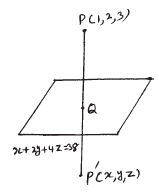
Let P' (x, y, z) be the image of P in the given plane.
$\therefore$ Equation of line PP' is $\frac{\text{x - 1}}{1}=\frac{\text{y - 2}}{2}=\frac{\text{z - 3}}{4}.........\text{(i)}$
Any point on this line is ($\lambda$ + 1, 2$\lambda$ + 2, 4$\lambda$ + 3)
If this point is Q, then ($\lambda$ + 1) + 2 (2$\lambda$ + 2) + 4 (4$\lambda$ + 3) = 38
$\Rightarrow$ $\lambda$ = 1 $\Rightarrow$ Q (2, 4, 7)
Q is the mid-point of PP'
$\therefore\text{ }\frac{1+\text{x}}{2}=2\Rightarrow\text{x}=3,\text{ }\frac{2+\text{y}}{2}=4\Rightarrow\text{y}=6,\text{ }\frac{3+\text{z}}{2}=7,\text{ }\Rightarrow\text{z}=11$
$\therefore$ Image (P') is (3, 6, 11). View full question & answer→Question 1273 Marks
Show that the following point are coplanar:
(0, 4, 3), (-1, -5, -3), (-2, -2, 1) and (1, 1, -1)
AnswerThe equation of the plane passing through points (0, 4, 3), (-1, -5, -3), (-2, -2, 1) is, $\begin{vmatrix}\text{x}-0&\text{y}-4&\text{z}-3\\-1-0&-5-4&-3-3\\-2-0&-2-4&1-3\end{vmatrix}=0$ $\Rightarrow\begin{vmatrix}\text{x}&\text{y}-4&\text{z}-3\\-1&-9&-6\\-2&-6&-2\end{vmatrix}=0$ $\Rightarrow-18\text{x}+10(\text{y}-4)-12(\text{z}-3)=0$ $\Rightarrow9\text{x}-5(\text{y}-4)+6(\text{z}-3)=0$ $\Rightarrow9\text{x}-5\text{y}+\text{z}+2=0$ Substituting the last points (1, 1, -1) (it means x = 1; y = 1; z = -1) in this plane equation, we get9(1) - 5(1) + 6(-1) + 2 = 0
⇒ 4 - 4 = 0 ⇒ 0 = 0 So, the plane equation is satisfied by the points (1, 1, -1) So, the given pointsa are coplanar.
View full question & answer→Question 1283 Marks
Write the value of $\lambda$ for which the lines $\frac{\text{x}-3}{-3}=\frac{\text{y}+2}{2\lambda}=\frac{\text{z}+4}{2}$ and $\frac{\text{x}+1}{3\lambda}=\frac{\text{y}-2}{1}=\frac{\text{z}+6}{-5}$ are perpendicular to each other.
AnswerWe have
$\frac{\text{x}-3}{-3}=\frac{\text{y}+2}{2\lambda}=\frac{\text{z}+4}{2}$
$\frac{\text{x}+1}{3\lambda}=\frac{\text{y}-2}{1}=\frac{\text{z}+6}{-5}$
The given lines are parallel to vector $\vec{\text{b}}_1=-3\hat{\text{i}}+2\lambda\hat{\text{j}}+2\hat{\text{k}}$ and $\vec{\text{b}}_2=3\lambda\hat{\text{i}}+\hat{\text{j}}-5\hat{\text{k}}.$
For $\vec{\text{b}}_1\perp\vec{\text{b}}_2,$ we must have
$\vec{\text{b}}_1.\vec{\text{b}}_2=0$
$\Rightarrow\big(-3\hat{\text{i}}+2\lambda\hat{\text{j}}+2\hat{\text{k}}\big).\big(3\lambda\hat{\text{i}}+\hat{\text{j}}-5\hat{\text{k}}\big)=0$
$\Rightarrow-7\lambda-10=0$
$\Rightarrow\lambda=-\frac{10}7{}$
View full question & answer→Question 1293 Marks
Obtain the equation of the plane passing through the point (1, - 3, -2) and perpendicular to the planes x + 2y + 2z = 5 and 3x + 3y + 2z = 8.
AnswerThe equation of any plane passing through (1, -3, -2) is,
a(x - 1) + b(y + 3) + c(z + 2) = 0 ....(i)
It is given that (i) is perpendicular to each of the planes x + 2y + 2z = 5 and 3x + 3y + 2z = 8. Then,
a + 2b + 2c = 0 ....(ii)
3a + 3b + 2c = 0 .....(ii)
Solving (i), (ii) and (iii) we get,
$\begin{vmatrix}\text{x}-1&\text{y}+3&\text{z}+2\\1&2&2\\3&3&2\end{vmatrix}=0$
⇒ -2(x - 1) + 4(y + 3) - 3(z + 2) = 0
⇒ -2x + 2 + 4y + 12 - 3z - 6 = 0
⇒ 2x - 4y + 3z - 8 = 0
View full question & answer→Question 1303 Marks
Find in vector form as wel as in cartesian form, the equation of the line passing through the points $A(1, 2, -1)$ and $B(2, 1, 1)$.
AnswerWe know that, equation of line passing through two points $(x_1, y_1, z_1)$ and $(x_2, y_2, z_2)$ is
$\frac{\text{x}-\text{x}_1}{\text{x}_2-\text{x}_1}=\frac{\text{y}-\text{y}_1}{\text{y}_2-\text{y}_1}=\frac{\text{z}-\text{z}_1}{\text{z}_2-\text{z}_1}\dots(1)$
Here, $\big(\text{x}_1,\text{y}_1,\text{z}_1\big)=\text{A}(1,2,-1)$
$\big(\text{x}_2,\text{y}_2,\text{z}_2\big)=\text{B}(2,1,1)$
Using equation (1), equation of line AB
$\frac{\text{x}-1}{2-1}=\frac{\text{y}-2}{1-2}=\frac{\text{z}+1}{1+1}$
$\frac{\text{x}-1}{1}=\frac{\text{y}-2}{-1}=\frac{\text{z}+1}{2}=\lambda$ (Say)
$\text{x}=\lambda+1,\text{y}=-\lambda+2,\text{z}=2\lambda-1$
vector form of equation of line Ab is,
$\text{x}\hat{\text{i}}+\text{y}\hat{\text{j}}+\text{z}\hat{\text{k}}=(\lambda+1)\hat{\text{i}}+(-\lambda+2)\hat{\text{j}}+(2\lambda-1)\hat{\text{k}}$
$\vec{\text{r}}=\big(\hat{\text{i}}+2\hat{\text{j}}-\hat{\text{k}}\big)+\lambda\big(\hat{\text{i}}-\hat{\text{j}}+2\hat{\text{k}}\big)$
View full question & answer→Question 1313 Marks
Show that the line through points $(1, -1, 2)$ and $(3, 4, -2)$ is perpendicular to the line throught the points $(0, 3, 2)$ and $(3, 5, 6).$
AnswerWe know that two lines with direction ratios $a_1, b_1, c_2$ and $a_2, b_2, c_2$ are pependicular if $a_1 a_2+b_1 b_2+c_1 c_2=0$. The direction ratios of the line passing through the points $(1,-1,2)$ and $(3,4,-2)$ are $(3-1),[4-(-1)],(-2-2)$,
$\text { i.e. } \Rightarrow a_1=2, b_1=2, c_1=-4$
Similarly, the direction ratios of the line passing through the points $(0,3,2)$ and $(3,5,6)$ and $(3-0),(5-3),(6-2)$, i.e. $\Rightarrow a_2=3, b_2=2, c_2=4$
$\therefore a_1 a_2+b_1 b_2+c_1 c_2=2 \times 3+5 \times 2(-4) \times 4=6+10-16=0$
Thus the line through the points $(1,-1,2)$ and $(3,4,-2)$ is perpendicular to the line throught the points $(0,3,2)$ and $(3,5,6)$
View full question & answer→Question 1323 Marks
Find the coordinates of the foot of the perpendicular drawn from the origin.
$2x + 3y + 4z - 12 = 0$
AnswerLet the coordinates of the foot of perpendicular P from the origin to the plane be $(x_1, y_1, z_1)$.
$2x + 3y + 4z - 12 = 0$
$\Rightarrow 2x + 3y + 4z = 12$ .....(1)
The direction ratios of normal are $2, 3$, and $4$.
$\therefore\ \ \sqrt{(2)^2+(3)^2+(4)^2}=\sqrt{29}$
Dividing both sides of equation (1) by $\sqrt{29},$ we obtain
$\frac{2}{\sqrt{29}}\text{x}+\frac{3}{\sqrt{29}}\text{y}+\frac{4}{\sqrt{29}}\text{z}=\frac{12}{\sqrt{29}}$
This equation is of the form lx + my + nz = d, where l, m, n are the direction cosines of
normal to the plane and d is the distance of normal from the origin.
The coordinates of the foot of the perpendicular are given by
(ld, md, nd).
Therefore, the coordinates of the foot of the perpendicular are
$\Big(\frac{2}{\sqrt{29}}.\frac{12}{\sqrt{29}},\ \frac{3}{\sqrt{29}}.\frac{12}{\sqrt{29}},\ \frac{4}{\sqrt{29}}.\frac{12}{\sqrt{29}}\Big)\ \text{i.e.},\ \Big(\frac{24}{29},\ \frac{36}{29},\ \frac{48}{29}\Big).$
View full question & answer→Question 1333 Marks
Find the angle between the line $\frac{\text{x}-2}{3}=\frac{\text{y}+1}{-1}=\frac{\text{z}-3}{2}$ and the plane 3x + 4y + z + 5 = 0
AnswerThe given line is parallel to the vector $\vec{\text{b}}=3\hat{\text{i}}-\hat{\text{j}}+2\hat{\text{k}}$ and the given plane id normal to the vector $\vec{\text{n}}=3\hat{\text{i}}+4\hat{\text{j}}+\hat{\text{k}}$
We know that the angle $\theta$ between the line and the plane is given by
$\sin\theta=\frac{\vec{\text{b}}\cdot\vec{\text{n}}}{|\vec{\text{b}}|\vec{|\text{n}}|}$
$=\frac{(3\hat{\text{i}}-\hat{\text{j}}+2\hat{\text{k}})\cdot(3\hat{\text{i}}+4\hat{\text{j}}+\hat{\text{k}})}{|3\hat{\text{i}}-\hat{\text{j}}+2\hat{\text{k}}||3\hat{\text{i}}+4\hat{\text{j}}+\hat{\text{k}}|}$
$=\frac{9-4+2}{\sqrt{9+1+4}\sqrt{9+16+1}}=\frac{7}{\sqrt{14}\sqrt{26}}$
$=\frac{7}{\sqrt{2}\sqrt{7}\sqrt{2}\sqrt{13}}=\frac{\sqrt{7}}{\sqrt{52}}=\sqrt{\frac{7}{52}}$
$\theta=\sin^{-1}\Big(\sqrt{\frac{7}{52}}\Big)$
View full question & answer→Question 1343 Marks
Find the points on the line $\frac{\text{x}+2}{3}=\frac{\text{y}+1}{2}=\frac{\text{z}-3}{2}$ at a distance of 5 units from the point P(1, 3, 3).
AnswerThe coordinates of any point on the line $\frac{\text{x}+2}{3}=\frac{\text{y}+1}{2}=\frac{\text{z}-3}{2}$ are given by
$\frac{\text{x}+2}{3}=\frac{\text{y}+1}{2}=\frac{\text{z}-3}{2}=\lambda$
$\Rightarrow\text{x}=3\lambda-2,\text{y}=2\lambda-1,\text{z}=2\lambda+3\dots(1)$
Let the coordinates of the desired point be $(3\lambda-2,2\lambda-1,2\lambda+3)$
The distance between this point and (1, 3, 3) is 5 units.
$\therefore\sqrt{(3\lambda-2-1)^2+(2\lambda-1-3)^2+(2\lambda+3-3)^2}=5$
$\Rightarrow(3\lambda-3)^2+(2\lambda-4)^2+(2\lambda)^2=25$
$\Rightarrow17\lambda^2-34\lambda=0$
$\Rightarrow\lambda(\lambda-2)=0$
$\Rightarrow\lambda=0$ or $2$
Substituting the values of $\lambda$ in (1), we get the coordinates of the desired point as (-2, -1, 3) and (4, 3, 7).
View full question & answer→Question 1353 Marks
Show that the lines $\frac{\text{x}-5}{7}=\frac{\text{y}+2}{-5}=\frac{\text{z}}{1}$ and $\frac{\text{x}}{1}=\frac{\text{y}}{2}=\frac{\text{z}}{3}$ are perpendicular to each other.
AnswerThe direction ratios of the lines $\frac{\text{x}-5}{7}=\frac{\text{y}+2}{-5}=\frac{\text{z}}{1}$ and $\frac{\text{x}}{1}=\frac{\text{y}}{2}=\frac{\text{z}}{3}$ are proportional to 7, -5, 1 and 1, 2, 3, respectiveiy.
Let:
$\vec{\text{b}}_1=7\hat{\text{i}}-5\hat{\text{j}}+\hat{\text{k}}$
$\vec{\text{b}}_2=\hat{\text{i}}+2\hat{\text{j}}+3\hat{\text{k}}$
Now,
$\vec{\text{b}}_1.\vec{\text{b}}_2=\big(7\hat{\text{i}}-5\hat{\text{j}}+\hat{\text{k}}\big).\big(\hat{\text{i}}+2\hat{\text{j}}+3\hat{\text{k}}\big)$
$=7-10+3$
$=0$
$\therefore\vec{\text{b}}_1\perp\vec{\text{b}}_2$
Hence, the given lines are perpendicular to each other.
View full question & answer→Question 1363 Marks
Write the direction cosines of the line whose cartesian equations are 6x -2 = 3y + 1 =2z - 4.
AnswerWe have
6x -2 = 3y + 1 =2z - 4
The equation of given line can be re-written as
$\frac{\text{x}-\frac{1}{3}}{\frac{1}{6}}=\frac{\text{y}+\frac{1}{3}}{\frac{1}{3}}=\frac{\text{z}-2}{\frac{1}{2}}$
$\Rightarrow\frac{\text{x}-\frac{1}{3}}{1}=\frac{\text{y}+\frac{1}{3}}{2}=\frac{\text{z}-2}{3}$
The direction ratios of the line parallel to AB are proportional to 1, 2, 3.
Hence, the direction cosines of the line parallel to AB are proportional to
$\frac{1}{\sqrt{1^2+2^2+3^2}},\frac{2}{\sqrt{1^2+2^2+3^2}},\frac{3}{\sqrt{1^2+2^2+3^2}}$
$=\frac{1}{\sqrt{14}},\frac{2}{\sqrt{14}},\frac{3}{\sqrt{14}}$
View full question & answer→Question 1373 Marks
Prove that the lines x = py + q, z = ry + s and x = p′y + q′, z = r′y + s′ are perpendicular if pp′ + rr′ + 1 = 0.
AnswerWe have line $\text{x}=\text{py}+\text{q},\ \text{z}=\text{ry}+\text{s}$
$\Rightarrow\text{y}=\frac{\text{x}-\text{q}}{\text{p}}$ and $\text{y}=\frac{\text{z}-\text{s}}{\text{r}}$
$\Rightarrow\frac{\text{x}-\text{q}}{\text{p}}=\frac{\text{y}}{1}=\frac{\text{z}-\text{s}}{\text{r}}\ .....(\text{i})$
Similarly line $\text{x}=\text{p}'\text{y}+\text{q}',\ \text{z}=\text{r}'\text{y}+\text{s}'$
$\Rightarrow\frac{\text{x}-\text{q}'}{\text{p}}=\frac{\text{y}}{1}=\frac{\text{z}-\text{s}'}{\text{r}}\ ....(\text{ii})$
Line (i) is parallel tpo the vector $\text{p}\hat{\text{i}}+\hat{\text{j}}+\text{r}\hat{\text{k}}.$
Line (ii) is parallel tpo the vector $\text{p}'\hat{\text{i}}+\hat{\text{j}}+\text{r}'\hat{\text{k}}.$
Line are perpendicular,
$\therefore(\text{p}\hat{\text{i}}+\hat{\text{j}}+\text{r}\hat{\text{k}})\cdot(\text{p}'\hat{\text{i}}+\hat{\text{j}}+\text{r}'\hat{\text{k}})$
$\therefore\text{p}\text{p}'+1+\text{r}'\text{r}=0.$
View full question & answer→Question 1383 Marks
Find the equation of the plane passing through the following point:
(-5, 0, -6), (-3, 10, -9) and (-2, 6, -6)
AnswerThe equation of the plane passing through points (-5, 0, -6), (-3, 10, -9) and (-2, 6, -6) is given by,
$\begin{vmatrix}\text{x}+5&\text{y}-0&\text{z}+6\\-3+5&10-0&-9+6\\-2+5&6-0&-6+6\end{vmatrix}=0$
$\Rightarrow\begin{vmatrix}\text{x}+5&\text{y}&\text{z}+6\\2&10&-3\\3&6&0\end{vmatrix}=0$
$\Rightarrow18(\text{x}+5)-\text{y}-18(\text{z}+6)=0$
$\Rightarrow2(\text{x}+5)-\text{y}-2(\text{z}+6)=0$
$\Rightarrow2\text{x}+10-\text{y}-2\text{z}-12=0$
$\Rightarrow2\text{x}-\text{y}-2\text{z}-2=0$
View full question & answer→Question 1393 Marks
Write the angle between the lines whose direction ratios are perportional to 1, -2, 1 and 4, 3, 2.
AnswerThe direction ratios of the first line are 1, -2, 1 and the direction ratios of the second line are 4, 3, 2.
Let $\theta$ be the angle between these two lines.
Now,
$\cos\theta =\Bigg|\frac{1(4)+(-2)(3)+1(2)}{\sqrt{(1)^2+(-2)^2+(1)^2}\sqrt{(4)^2+(3)^2+(2)^2}}\Bigg|$
$=\Bigg|\frac{4+6+2}{\sqrt{1+4+1}\sqrt{16+9+4}}\Bigg|$
$=\frac{0}{\sqrt{6}\sqrt{29}}$
$=0$
$\Rightarrow\theta=\frac{\pi}{2}$
Hence, the required angle is$\frac{\pi}{2}$.
View full question & answer→Question 1403 Marks
Find the equation of the plane with intercept 3 on the y-axis and parallel to the ZOX plane.
AnswerThe equation of the plane parallel to the plane ZOX is,
y = b ....(i), where b is a constant.
It is given that this plane passes through (0, 3, 0). So,
3 = b
Substituting this value in (i), we get
y = 3, which is the required equation of the plane.
View full question & answer→Question 1413 Marks
Show that the following point are coplanar:
(0, -1, 0), (2, 1, -1), (1, 1, 1) and (3, 3, 0)
AnswerThe equation of the plane passing through points (0, -1, 0), (2, 1, -1) and (1, 1, 1) is given by, $\begin{vmatrix}\text{x}-0&\text{y}+1&\text{z}-0\\2-0&1+1&-1-0\\1-0&1+1&1-0\end{vmatrix}=0$ $\Rightarrow\begin{vmatrix}\text{x}&\text{y}+1&\text{z}\\2&2&-1\\1&2&1\end{vmatrix}=0$ $\Rightarrow4\text{x}-3(\text{y}+1)+2\text{z}=0$ $\Rightarrow4\text{x}-3\text{y}+2\text{z}-3=0$ Substituting the last points (3, 3, 0) (it means x = 3; y = 3; z = 0) in this plane equation, we get4(3) - 3(3) + 2(0) - 3 = 0
⇒ 12 - 12 = 0 ⇒ 0 = 0 So, the plane equation is satisfied by the points (3, 3, 0) So, the given pointsa are coplanar.
View full question & answer→Question 1423 Marks
Show that the following planes are at right angles.
$x - 2y + 4z = 10$ and $18x + 17y + 4z = 49$
AnswerWe know that the planes $a_1x + b_1y + c_1z + d_1 = 0$ and $a_2x + b_2y + c_2z + d_2 = 0$ are perperndicular to each other only if
$a_1a_2 + b_1b_2 + c_1c_2= 0$
The given planes are $x - 2y + 4z = 10$ and $18x + 17y + 4z = 49$
$\Rightarrow a_1 = 1; b_1 = -2; c_1 = 4; a_2 = 18; b_2 = 17; c_2 = 4$
Now,
$a_1a_2 + b_1b_2 + c_1c_2$
$= (1)(18) + (-2)(17) + (4)(4)$
$= 18 - 34 + 16$
$= 0$
So, the given planes are perpendicular.
View full question & answer→Question 1433 Marks
Show that the normals to the following parirs of planes are perpendicular other.
$\vec{\text{r}}\cdot(2\hat{\text{i}}-\hat{\text{j}}+3\hat{\text{k}})=5$ and $\vec{\text{r}}\cdot(2\hat{\text{i}}-\hat{\text{j}}-2\hat{\text{k}})=5$
AnswerLet $\vec{\text{n}_1}$ and $\vec{\text{n}_2}$ be the vectors which are normals to the planes $\vec{\text{r}}\cdot(2\hat{\text{i}}-\hat{\text{j}}+3\hat{\text{k}})=5$ and $\vec{\text{r}}\cdot(2\hat{\text{i}}-\hat{\text{j}}-2\hat{\text{k}})=5$ respectively.The given equations of the planes are
$\vec{\text{r}}\cdot(2\hat{\text{i}}-\hat{\text{j}}+3\hat{\text{k}})=5$
$\vec{\text{r}}\cdot(2\hat{\text{i}}-\hat{\text{j}}-2\hat{\text{k}})=5$
$\Rightarrow\vec{\text{n}_1}=(2\hat{\text{i}}-\hat{\text{j}}+3\hat{\text{k}}),$
$\Rightarrow\vec{\text{n}_2}=(2\hat{\text{i}}-\hat{\text{j}}-2\hat{\text{k}})$
Now, $\vec{\text{n}_1}\cdot\vec{\text{n}_2}=(2\hat{\text{i}}-\hat{\text{j}}+3\hat{\text{k}})\cdot(2\hat{\text{i}}-\hat{\text{j}}-2\hat{\text{k}})$
$=4+2-6=0$
So, the normals to the given planes are perpendicular to each other.
View full question & answer→