Question 515 Marks
Using vectors, find the area of the triangle with vertices A(1, 1, 2), B(2, 3, 5) and C(1, 5, 5).
AnswerArea $\Delta$ ABC = $\frac{1}{2}|\overrightarrow{\text{AB}}\times\overrightarrow{\text{BC}}|$
Here, $\overrightarrow{\text{AB}}$ = $\hat{\text{i}}+2\hat{\text{j}}+3\hat{\text{k}}\text{ and }\overrightarrow{\text{BC}}=-\hat{\text{i}}+2\hat{\text{j}}$
$\overrightarrow{\text{AB}}\times\overrightarrow{\text{BC}}=\begin{vmatrix} \hat{\text{i}} & \hat{\text{j}} & \hat{\text{k}}\\ 1 & 2 & 3\\ -1 & 2 & 0 \end{vmatrix}=-6 \hat{\text{i}}-3 \hat{\text{j}}+4 \hat{\text{k}}$
$\Rightarrow\text{Area}=\frac{1}{2}\sqrt{36+9+16}=\frac{1}{2}\sqrt{61}\text{ sq. units}$
View full question & answer→Question 525 Marks
Find the vector equation of the plane passing through points $3\hat{\text{i}}+4\hat{\text{j}}+2\hat{\text{k}},2\hat{\text{i}}-2\hat{\text{j}}-\hat{\text{k}}$ and $7\hat{\text{i}}+6\hat{\text{k}}.$
View full question & answer→Question 535 Marks
Reduce the equation $\vec{\text{r}}\cdot(\hat{\text{i}}-2\hat{\text{j}}+2\hat{\text{k}})+6=0$ to the normal form and, hence, find the length of the perpendicular from the origin to the plane.
AnswerThe given equation of the plane is,
$\vec{\text{r}}\cdot(\hat{\text{i}}-2\hat{\text{j}}+2\hat{\text{k}})+6=0$
$\Rightarrow\vec{\text{r}}\cdot(\hat{\text{i}}-2\hat{\text{j}}+2\hat{\text{k}})=-6$ or $\vec{\text{r}}\cdot\vec{\text{n}}=-6,$ where $\vec{\text{n}}=\hat{\text{i}}-2\hat{\text{j}}+2\hat{\text{k}}$
$|\vec{\text{n}}|=\sqrt{1+4+4}=3$
For reducing the given equation to normal form, we need to divide it by $|\vec{\text{n}}|$ Then, we get
$|\vec{\text{r}}|\cdot\frac{\vec{\text{n}}}{|\vec{\text{n}}|}=\frac{-6}{|\vec{\text{n}}|}$
$\Rightarrow\vec{\text{r}}\cdot\Big(\frac{\hat{\text{i}}-2\hat{\text{j}}+2\hat{\text{k}}}{3}\Big)=\frac{-6}{3}$
$\Rightarrow\vec{\text{r}}\cdot\Big(\frac{1}{3}\hat{\text{i}}-\frac{2}{3}\hat{\text{j}}+\frac{2}{3}\hat{\text{k}}\Big)=-2$
Dividing both sides by -1 we get
$\vec{\text{r}}\cdot\Big(-\frac{1}{3}\hat{\text{i}}+\frac{2}{3}\hat{\text{j}}-\frac{2}{3}\hat{\text{k}}\Big)=2\ ...(\text{i})$
The equation of the plane in normal form is
$\vec{\text{r}}\cdot\vec{\text{n}}=\text{d}\ ...(\text{ii})$
(where d is distance of the plane from the origin)
Comparing (i) and (ii)
length of the perpendicular from the origin to the plane = d = 2 units
View full question & answer→Question 545 Marks
The two adjacent sides of a parallelogram are $2\hat{i} - 4\hat{j} - 5\hat{k} \text{ and } 2\hat{i} + 2\hat{j} + 3\hat{k}.$ Find the two unit vectors parallel its diagonals. Using the diagonal vectors, find the area of the parallelogram.
Answer$\text{let } \text{d}_{1} \& \text{ d}_{2}$ be the two diagonal vectors:
$\therefore \overrightarrow{\text{d}}_{1} = 4\hat{\text{i}} - 2\hat{\text{j}} - 2\hat{\text{k}}, \overrightarrow{\text{d}}_{2} = -6\hat{\text{j}} - 8\hat{\text{k}}$
$\text{or} \overrightarrow{\text{d}}_{2} = 6\hat{\text{j}} + 8\hat{\text{k}}$
Unit vectors parallel to the diagonals are:
$\overrightarrow{\text{d}}_{1} = \frac{2}{\sqrt{6}}\hat{\text{i}} - \frac{1}{\sqrt{6}}\hat{\text{j}} - \frac{1}{\sqrt{6}}\hat{\text{k}}$
$\overrightarrow{\text{d}}_{2} = \frac{3}{5}\hat{\text{j}} - \frac{4}{5}\hat{\text{k}} \bigg(\overrightarrow{\text{d}}_{2} = \frac{3}{5}\hat{\text{j}} + \frac{4}{5}\hat{\text{k}}\bigg)$
$\overrightarrow{\text{d}}_{1}\times\overrightarrow{\text{d}}_{2} = \begin{vmatrix} \hat{\text{i}} & \hat{\text{j}} & \hat{\text{k}} \\ 4 & -2 & -2 \\ 0 & -6 & -8 \end{vmatrix} = 4\hat{\text{i}} + 32\hat{\text{j}} - 24\hat{\text{k}} $
Area of parallelogram $= \frac{1}{2}|\overrightarrow{\text{d}}_{1}\times\overrightarrow{\text{d}}_{2}| = \sqrt{404} \text{ or } 2\sqrt{101} \text{sq. units}$
View full question & answer→Question 555 Marks
Find the shortest distance between the following pairs of lines whose vector equation are:
$\vec{\text{r}}=3\hat{\text{i}}+8\hat{\text{j}}+3\hat{\text{k}}+\lambda\big(3\hat{\text{i}}-\hat{\text{j}}+\hat{\text{k}}\big)$ and $\vec{\text{r}}=-3\hat{\text{i}}-7\hat{\text{j}}+6\hat{\text{k}}+\mu\big(-3\hat{\text{i}}+2\hat{\text{j}}+4\hat{\text{k}}\big)$
AnswerWe know that, shortest distance betwee lines
$\vec{\text{r}}=\vec{\text{a}}_1+\lambda\vec{\text{b}}_1$ and $\vec{\text{r}}=\vec{\text{a}}_2+\mu\vec{\text{b}}_2$ is given by
$\text{S.D}=\Bigg|\frac{(\vec{\text{a}}_2-\vec{\text{a}}_1).(\vec{\text{b}}_1\times\vec{\text{b}}_2)}{\big|\vec{\text{b}}_1\times\vec{\text{b}}_2\big|}\Bigg|\dots(1)$
Given equation of lines are.
$\vec{\text{r}}=3\hat{\text{i}}+8\hat{\text{j}}+3\hat{\text{k}}+\lambda\big(3\hat{\text{i}}-\hat{\text{j}}+\hat{\text{k}}\big)$
$\vec{\text{r}}=\big(-3\hat{\text{i}}-7\hat{\text{j}}+9\hat{\text{k}}\big)+\mu\big(-3\hat{\text{i}}+2\hat{\text{j}}+4\hat{\text{k}}\big)$
$\Rightarrow\vec{\text{a}}_1=\big(3\hat{\text{i}}+8\hat{\text{j}}+3\hat{\text{k}}\big),\vec{\text{b}}_1=3\hat{\text{i}}-\hat{\text{j}}+\hat{\text{k}}$
$\Rightarrow\vec{\text{a}}_2=\big(-3\hat{\text{i}}-7\hat{\text{j}}+6\hat{\text{k}}\big),\vec{\text{b}}_2=\big(-3\hat{\text{i}}+2\hat{\text{j}}+4\hat{\text{k}}\big)$
Now,
$\vec{\text{a}}_2-\vec{\text{a}}_1=\big(-3\hat{\text{i}}-7\hat{\text{j}}+6\hat{\text{k}}\big)-\big(3\hat{\text{i}}+8\hat{\text{j}}+3\hat{\text{k}}\big)$
$=-3\hat{\text{i}}-7\hat{\text{j}}+6\hat{\text{k}}-3\hat{\text{i}}-8\hat{\text{j}}-3\hat{\text{k}}$
$\big(\vec{\text{a}}_2-\vec{\text{a}}_1\big)=-6\hat{\text{i}}-15\hat{\text{j}}+3\hat{\text{k}}$
$\big(\vec{\text{b}}_1\times\vec{\text{b}}_2\big)=\begin{vmatrix}\hat{\text{i}}&\hat{\text{J}}&\hat{\text{k}}\\3&-1&1\\-3&2&4 \end{vmatrix}$
$=\hat{\text{i}}(-4-2)-\hat{\text{j}}(12+3)+\hat{\text{k}}(6-3)$
$=\big(-6\hat{\text{i}}-15\hat{\text{j}}+3\hat{\text{k}}\big)$
$\big(\vec{\text{a}}_2-\vec{\text{a}}_1\big).\big(\vec{\text{b}}_1-\vec{\text{b}}_2\big)$
$=\big(-6\hat{\text{i}}-15\hat{\text{j}}+3\hat{\text{k}}\big).\big(-6\hat{\text{i}}-15\hat{\text{j}}+3\hat{\text{k}}\big)$
$=(-6)(6)+(-15)(-15)+(3)(3)$
$=36+225+9$
$=270$
$\big|\vec{\text{b}}_1\times\vec{\text{b}}_2\big|=\sqrt{(-6)^2+(-15)^2+(3)^2}$
$=\sqrt{36+25+9}$
$=\sqrt{270}$
Substituting values of $\big|\vec{\text{b}}_1\times\vec{\text{b}}_2\big|$ and $\big(\vec{\text{a}}_2-\vec{\text{a}}_1\big).\big(\vec{\text{b}}_1\times\vec{\text{b}}_2\big)$ in equation (1) to get shortest distance between given lines, so
$\text{S.D.}=\frac{270}{\sqrt{270}}$
$=\sqrt{270}$
$\text{S.D.}=3\sqrt{30}\text{ units}$
View full question & answer→Question 565 Marks
Let $\overrightarrow{\text{a}} = \hat{\text{i}} + 4\hat{\text{j}} +2\hat{\text{k}}, \overrightarrow{\text{b}} = 3\hat{\text{i}} - 2\hat{\text{j}} +7\hat{\text{k}}$ and $\overrightarrow{\text{c}} = 2\hat{\text{i}} - \hat{\text{j}} + 4\hat{\text{k}}$ Find a vector $\overrightarrow{\text{d}}$ which is perpendicular to both $\overrightarrow{\text{a}} \text{and} \overrightarrow{\text{b}}\text{and} \overrightarrow{\text{c}} . \overrightarrow{\text{d}} = 27.$
Answer$\text{Writing} \overrightarrow{\text{d}} = \lambda\bigg(\overrightarrow{\text{a}}\times\overrightarrow{\text{b}}\bigg)$
$= \lambda \begin{vmatrix} \hat{\text{i}} & \hat{\text{j}} & \hat{\text{k}} \\ 1 & 4 & 2 \\ 3 & -2 & 7 \end{vmatrix} $
$ = \lambda \bigg(32 \hat{\text{i}} - \hat{\text{j}} - 14\hat{\text{k}}\bigg)\dots\dots\dots\dots\text{(1)}$
$\overrightarrow{\text{c}}. \overrightarrow{\text{d}} = 27$
$\bigg(2\hat{\text{i}} - \hat{\text{j}} + 4\hat{\text{k}}\bigg).\lambda\bigg(32\hat{\text{i}} - \hat{\text{j}} + 14\hat{\text{k}}\bigg) = 27$
$9\lambda = 27$
$\lambda = 3$
$\therefore\overrightarrow{\text{d}} = \bigg(96\hat{\text{i}} - \hat{\text{3j}} + 42\hat{\text{k}}\bigg)$
View full question & answer→Question 575 Marks
If $\hat{\text{i}}+\hat{\text{j}}+\hat{\text{k}},\ 2\hat{\text{i}}+5\hat{\text{j}},\ 3\hat{\text{i}}+2\hat{\text{j}}-3\hat{\text{k}}$ and $\hat{\text{i}}-6\hat{\text{j}}-\hat{\text{k}}$ respectively are the position vectors of points A, B, C and D, then find the angle between the straight lines AB and CD. Find whether $\vec{\text{AB}}$ and $\vec{\text{CD}}$ are collinear or not.
AnswerGiven:
The position vector of A is $\hat{\text{i}}+\hat{\text{j}}+\hat{\text{k}}.$
The position vector of B is $2\hat{\text{i}}+5\hat{\text{j}}.$
Therefore, $\vec{\text{AB}}=(2-1)\hat{\text{i}}+(5-1)\hat{\text{j}}+(0-1)\hat{\text{k}}=\hat{\text{i}}+\hat4{\text{j}}-\hat{\text{k}}$
The position vector of C is $3\hat{\text{i}}+2\hat{\text{j}}-3\hat{\text{k}}$ and
The postion vector of D is $\hat{\text{i}}-6\hat{\text{j}}-\hat{\text{k}}.$
Therefore, $\vec{\text{CD}}=(1-3)\hat{\text{i}}+(-6-2)\hat{\text{j}}\\+(-1+3)\hat{\text{k}}=-2\hat{\text{i}}-\hat8{\text{j}}+2\hat{\text{k}}$
$\cos\theta=\frac{\vec{\text{AB}}.\vec{\text{CD}}}{|\vec{\text{AB}}||\vec{\text{CD}}|}$
$\Rightarrow\cos\theta=\frac{-2-32-2}{\sqrt{18}\sqrt{72}}=-1$
$\Rightarrow\theta=180^\circ$
Since, angle between Line AB and CD is 180°, therefore $\vec{\text{AB}}$ and $\vec{\text{CD}}$ are collinear.
View full question & answer→Question 585 Marks
Find the Cartesian equation of the plane passing through the points A(0, 0, 0) and B(3, –1, 2) and parallel to the line $\frac{\text{x-4}}{1}=\frac{\text{y+3}}{-4}=\frac{\text{z+1}}{7}$ .
AnswerEquation of plane passing through (0,0,0) is$\therefore$ a(x – 0) + b (y – 0) + c (z – 0) = 0 $\Rightarrow$ ax + by + cz = 0 .............(i)
It passes through (3, –1, 2)
$\therefore$ 3a – b + 2 c = 0 ........................(ii)
line $\frac{\text{x-4}}{1}=\frac{\text{y+3}}{-4}=\frac{\text{z+1}}{7}$ is | | to the plane (i)
$\Rightarrow$ a – 4 b + 7c = 0 .............................................(iii)
From (ii) and (iii), a = 1, b = – 19 and c = – 11
Equation of plane is x – 19y – 11z = 0.
View full question & answer→Question 595 Marks
the cartesian equation of a line are $\frac{\text{x}-5}{3}=\frac{\text{y}+4}{7}=\frac{\text{z}-6}{2}.$ Find a vector equation for the line.
AnswerThe cartesian equation of the given line is $\frac{\text{x}-5}{3}=\frac{\text{y}+4}{7}=\frac{\text{z}-6}{2}.$
It can be re-written as
$\frac{\text{x}-5}{3}=\frac{\text{y}-(-4)}{7}=\frac{\text{z}-6}{2}.$
Thus, the given line passes through the point having position vector $\vec{\text{a}}=5\hat{\text{i}}-4\hat{\text{j}}+6\hat{\text{k}}$ and is parallel to the vector $\vec{\text{b}}=3\hat{\text{i}}+7\hat{\text{j}}+2\hat{\text{k}}.$
We know that the vector equation of a line passing through a point with position vector $\vec{\text{a}}$ and parallel to the vector $\vec{\text{b}}$ is $\vec{\text{r}}=\vec{\text{a}}+\lambda\vec{\text{b}}.$
Vector equation of the required line is
$\vec{\text{r}}=\big(5\hat{\text{i}}-4\hat{\text{j}}+6\hat{\text{k}}\big)+\lambda\big(3\hat{\text{i}}+7\hat{\text{j}}+2\hat{\text{k}}\big)$
Here, $\lambda$ is a parameter.
View full question & answer→Question 605 Marks
Find the equation of the perpendicular drawn from the point P(2, 4, -1) to the line $\frac{\text{x}+5}{1}=\frac{\text{y}+3}{4}=\frac{\text{z}-6}{-9}.$ Also, write down the coordinates of the foot of the perpendicular from P.
AnswerLet L be the foot of the perpendicular drawn from the point P(2, 4, -1) to the given line. The coordinates of a general point on the line $\frac{\text{x}+5}{1}=\frac{\text{y}+3}{4}=\frac{\text{z}-6}{-9}$ are given by $\frac{\text{x}+5}{1}=\frac{\text{y}+3}{4}=\frac{\text{z}-6}{-9}=\lambda$ $\Rightarrow\text{x}=\lambda-5$ $\text{y}=4\lambda-3$ $\text{z}=-9\lambda+6$ Let the coordinates of L be $\lambda-5,4\lambda-3,-9\lambda+6.$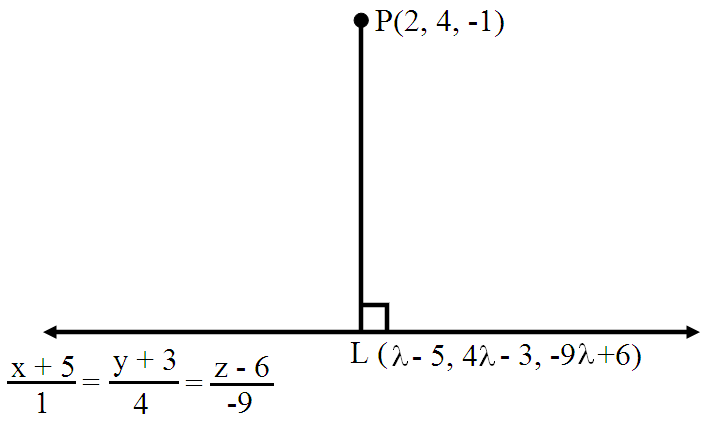
The direction ratios of PL are proportional to $\lambda-5-2,4\lambda-3-4,-9\lambda+6+1,$ i,e. $4\lambda-7,-9\lambda+7.$ The direction ratios of the given line are proportional to 1, 4, -9, but PL is perpendicular to the given line. View full question & answer→Question 615 Marks
Find the equation of the line passing through the points $\hat{\text{i}}+\hat{\text{j}}-3\hat{\text{k}}$ and perpendicular to the lines $\vec{\text{r}}=\hat{\text{i}}+\lambda\big(2\hat{\text{i}}+\hat{\text{j}}-3\hat{\text{k}}\big)$ and $\vec{\text{r}}=\big(2\hat{\text{i}}+\hat{\text{j}}-\hat{\text{k}}\big)+\mu\big(\hat{\text{i}}+\hat{\text{j}}+\hat{\text{k}}\big).$
AnswerWe know that equation of a line passing through a point with position vector $\vec{\text{a}}$ and perpendiculat to $\vec{\text{r}}=\vec{\text{a}}_1+\lambda\vec{\text{b}}_1$ and $\vec{\text{r}}=\vec{\text{a}}_2+\lambda\vec{\text{b}}_2$ is given by
$\vec{\text{r}}=\vec{\text{a}}+\lambda\big(\vec{\text{b}}_1\times\vec{\text{b}}_2\big)\dots(1)$
Here, $\vec{\text{a}}=\big(\hat{\text{i}}+\hat{\text{j}}-3\hat{\text{k}}\big)$
and required line is perpendicular to
$\vec{\text{r}}=\hat{\text{i}}+\lambda\big(2\hat{\text{i}}+\hat{\text{j}}-3\hat{\text{k}}\big)$ and
$\vec{\text{r}}=\big(2\hat{\text{i}}+\hat{\text{j}}-\hat{\text{k}}\big)+\mu\big(\hat{\text{i}}+\hat{\text{j}}+\hat{\text{k}}\big)$
$\Rightarrow\vec{\text{b}}_1=\big(2\hat{\text{i}}+\hat{\text{j}}-3\hat{\text{k}}\big),\vec{\text{b}}_2=\hat{\text{i}}+\hat{\text{j}}+\hat{\text{k}}$
Now,
$\vec{\text{b}}_1\times\vec{\text{b}}_2=\begin{vmatrix}\hat{\text{i}}&\hat{\text{j}}&\hat{\text{k}}\\2&1&-3\\1&1&1\end{vmatrix}$
$=\hat{\text{i}}(1+3)-\hat{\text{j}}(2+3)+\hat{\text{k}}(2-1)$
$\vec{\text{b}}_1\times\vec{\text{b}}_2=4\hat{\text{i}}-5\hat{\text{j}}+\hat{\text{k}}$
Using equation, required equation of line is
$\vec{\text{r}}=\vec{\text{a}}+\lambda\big(\vec{\text{b}}_1\times\vec{\text{b}}_2\big)$
$\vec{\text{r}}=\big(\hat{\text{i}}+\hat{\text{j}}-3\hat{\text{k}}\big)+\lambda\big(4\hat{\text{i}}-5\hat{\text{j}}+\hat{\text{k}}\big)$
View full question & answer→Question 625 Marks
Find the vector and Cartesian equations of the line through the point (1, 2, – 4) and perpendicular to the two lines.
$\overrightarrow{\text{r}} = (8\hat{\text{i}} - 19\hat{\text{j}} + 10\hat{\text{k}})+\lambda(3\hat{\text{i}} - 16\hat{\text{j}} + 7\hat{\text{k})}$ and $\overrightarrow{\text{r}} = (15\hat{\text{i}} - 29\hat{\text{j}} + 5\hat{\text{k}})+\mu(3\hat{\text{i}} - 8\hat{\text{j}} + 5\hat{\text{k})}.$
AnswerVector equation of the required line is
$\overrightarrow{\text{r}} = (\hat{\text{i}} + 2\hat{\text{j}} - 4\hat{\text{k}})+\mu[(3\hat{\text{i}} - 16\hat{\text{j}} + 7\hat{\text{k})}\times(3\hat{\text{i}} + 8\hat{\text{j}} - 5\hat{\text{k})]}$
$\Rightarrow\overrightarrow{\text{r}} = (\hat{\text{i}} + 2\hat{\text{j}} - 4\hat{\text{k}})+\lambda[(2\hat{\text{i}} + 3\hat{\text{j}} + 6\hat{\text{k})]}$
in cartesian form, $\frac{\text{x - 1}}{2} = \frac{\text{y - 2}}{3} = \frac{\text{z + 4}}{6}$
View full question & answer→Question 635 Marks
Find the equation of the plane through the intersection of the planes $\vec{\text{r}}\cdot(\hat{\text{i}}+3\hat{\text{j}})-6=0$ and $\vec{\text{r}}\cdot(3\hat{\text{i}}-\hat{\text{j}}-4\hat{\text{k}})=0,$ whose perpendicular distance from origin is unity.
AnswerGiven planes are $\vec{\text{r}}\cdot(\hat{\text{i}}+3\hat{\text{j}})-6=0$ and $\vec{\text{r}}\cdot(3\hat{\text{i}}-\hat{\text{j}}-4\hat{\text{k}})=0$
Equation of family of planes through intersection of these of these planes is
$\vec{\text{r}}\cdot(\hat{\text{i}}+3\hat{\text{j}})-6+\lambda\big[\vec{\text{r}}\cdot(3\hat{\text{i}}-\hat{\text{j}}-4\hat{\text{k}})\big]=0$
$\Rightarrow\vec{\text{r}}\cdot\big[(1+3\lambda)\hat{\text{i}}+(3-\lambda)\hat{\text{j}}+\hat{\text{k}}(-4\lambda)\big]=6\ ...(\text{i})$
$\Rightarrow\frac{{\text{r}}\cdot\big[(1+3\lambda)\hat{\text{i}}+(3-\lambda)\hat{\text{j}}+\hat{\text{k}}(-4\lambda)\big]}{\sqrt{(1+3\lambda)^2+(3-\lambda)^2+(-4\lambda)^2}}$
$=\frac{6}{\sqrt{(1+3\lambda)^2+(3-\lambda)^2+(-4\lambda)^2}}$
Since, the perpendicular distance from origin is unity.
$\therefore\ \frac{6}{\sqrt{(1+3\lambda)^2+(3-\lambda)^2+(-4\lambda)^2}}=1$
$\Rightarrow(1+3\lambda)^2+(3-\lambda)^2+(-4\lambda)^2=36$
$\Rightarrow1+9\lambda^2+6\lambda+9+\lambda^2-6\lambda+16\lambda^2=36$
$\Rightarrow\lambda^2=1$
$\therefore\lambda=\pm1$
Using Eq. (i) the required equation of plane is
$\vec{\text{r}}\cdot\big[(1\pm3\lambda)\hat{\text{i}}+(3\pm\lambda)\hat{\text{j}}+\hat{\text{k}}(\pm4\lambda)\big]=6$
$\Rightarrow\vec{\text{r}}\cdot(4\hat{\text{i}}+2\hat{\text{j}}-4\hat{\text{k}})=6$ and $\vec{\text{r}}\cdot(2\hat{\text{i}}+4\hat{\text{j}}+4\hat{\text{k}})=6$
Or $4\text{x}+2\text{y}-4\text{z}-6=0$ and $-2\text{x}+4\text{y}+4\text{z}-6=0$
View full question & answer→Question 645 Marks
Show that the points $(2, 3, 4), (-1, -2, 1), (5, 8, 7)$ are collinear.
AnswerSuppose the points are $A(2, 3, 4), B(-1, -2, 1)$ and $C(5, 8, 7)$.We know that the direction ratios of the line joining the points $(x_1, y_1, z_1)$ and $(x_2, y_2, z_2)$ are $x_2- x_{1,}y_2- y_{1,}z_2- z_{1.}$
The direction ratios of AB are $(-1 - 2), (-2 - 3), (1 - 4),$
i.e. $-3, -5, -3.$
The direction ratios of BC are $(5 - (-1)), (8 - (-2)), (7 - 1),$
i.e. $6, 10, 6.$
It can be seen that the direction ratios of BC are -2 times that of AB, i.e. they are proportional. Therefore, AB is parallel to BC.
Since point B is common in both AB and BC, points A, B, and C are collinear.
View full question & answer→Question 655 Marks
If $\hat{\text{i}}+\hat{\text{j}}+\hat{\text{k}},\ 2\hat{\text{i}}+5\hat{\text{j}},\ 3\hat{\text{i}}+2\hat{\text{j}}-3\hat{\text{k}}$ and $\hat{\text{i}}-6\hat{\text{j}}-\hat{\text{k}}$ respectively are the position vectors of points A, B, C and D, then find the angle between the straight lines AB and CD. Find whether $\vec{\text{AB}}$ and $\vec{\text{CD}}$ are collinear or not.
AnswerGiven:
The position vector of A is $\hat{\text{i}}+\hat{\text{j}}+\hat{\text{k}}.$
The position vector of B is $2\hat{\text{i}}+5\hat{\text{j}}.$
Therefore, $\vec{\text{AB}}=(2-1)\hat{\text{i}}+(5-1)\hat{\text{j}}+(0-1)\hat{\text{k}}=\hat{\text{i}}+\hat4{\text{j}}-\hat{\text{k}}$
The position vector of C is $3\hat{\text{i}}+2\hat{\text{j}}-3\hat{\text{k}}$ and
The postion vector of D is $\hat{\text{i}}-6\hat{\text{j}}-\hat{\text{k}}.$
Therefore, $\vec{\text{CD}}=(1-3)\hat{\text{i}}+(-6-2)\hat{\text{j}}\\+(-1+3)\hat{\text{k}}=-2\hat{\text{i}}-\hat8{\text{j}}+2\hat{\text{k}}$
$\cos\theta=\frac{\vec{\text{AB}}.\vec{\text{CD}}}{|\vec{\text{AB}}||\vec{\text{CD}}|}$
$\Rightarrow\cos\theta=\frac{-2-32-2}{\sqrt{18}\sqrt{72}}=-1$
$\Rightarrow\theta=180^\circ$
Since, angle between Line AB and CD is 180°, therefore $\vec{\text{AB}}$ and $\vec{\text{CD}}$ are collinear.
View full question & answer→Question 665 Marks
Find the distance between the point (-1, -5, -10) and the point of intersection of the line $\frac{x - 2}{3} = \frac{y + 1}{4} = \frac{z - 2}{12}$ and the plane $x - y + z = 5.$
AnswerAny point on the line $\frac{\text{x} - 2}{3} = \frac{\text{y} + 1}{4} = \frac{\text{z} - 2}{12} = \text{is} (3\lambda + 2, 4\lambda - 1, 12\lambda + 2)$
If this is the point of intersection with plane $\text{x - y + z = 5}$
$\text{then 3} \lambda + 2 - 4\lambda + 1 + 12\lambda + 2 - 5 = 0 \Rightarrow \lambda = 0$
$\therefore$ Point of intersection is (2, -1, 2)
Required distance = $\sqrt{(2 + 1)^{2} +(-1 + 5)^{2} + (2 + 10)^{2} } = 13$
View full question & answer→Question 675 Marks
Find the foot of the perpendicular drawn from the point $\hat{\text{i}}+6\hat{\text{j}}+3\hat{\text{k}}$ to the line $\vec{\text{r}}=\hat{\text{j}}+2\hat{\text{k}}+\lambda\big(\hat{\text{i}}+2\hat{\text{j}}+3\hat{\text{k}}\big).$ Also, find the length of the perpendicylar
AnswerLet $\angle$ be the foot of the perpendicular drawn from the point $\text{p}\big(\hat{\text{i}}+6\hat{\text{j}}+3\hat{\text{k}}\big)$ to the line $\vec{\text{r}}=\hat{\text{j}}+2\hat{\text{k}}+\lambda\big(\hat{\text{i}}+2\hat{\text{j}}+3\hat{\text{k}}\big).$ Let the position vector $\angle$ be $\vec{\text{r}}=\hat{\text{j}}+2\hat{\text{k}}+\lambda\big(\hat{\text{i}}+2\hat{\text{j}}+3\hat{\text{k}}\big)$ $=\lambda\hat{\text{i}}+(1+2\lambda)\hat{\text{j}}+(2+3\lambda)\hat{\text{k}}\dots(1)$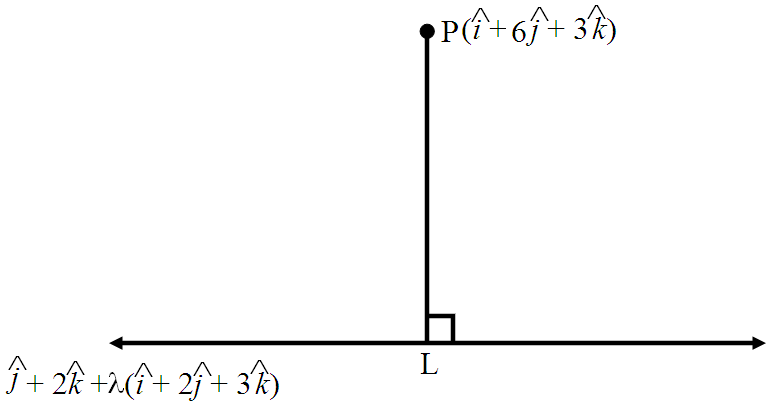
Now, $\overrightarrow{\text{PL}}=$ Position vector of L - Position vector of P $\Rightarrow\overrightarrow{\text{PL}}=\Big\{\lambda\hat{\text{i}}+(1+2\lambda)\hat{\text{j}}+(2+3\lambda)\hat{\text{k}}\Big\}-\big(\hat{\text{i}}+6\hat{\text{j}}+3\hat{\text{k}}\big)$ $\Rightarrow\overrightarrow{\text{PL}}=(\lambda-1)\hat{\text{i}}+(2\lambda-5)\hat{\text{j}}+(3\lambda-1)\hat{\text{k}}\dots(2)$ Since $\overrightarrow{\text{PL}}$ is perpandicular to the given line, which is parallel to $\vec{\text{b}}=\hat{\text{i}}+2\hat{\text{j}}+3\hat{\text{k}},$ we have $\overrightarrow{\text{PL}}.\vec{\text{b}}=0$ $\Rightarrow\Big\{(\lambda-1)\hat{\text{i}}+(2\lambda-5)\hat{\text{j}}+(3\lambda-1)\hat{\text{k}}\Big\}.\big(\hat{\text{i}}+2\hat{\text{j}}+3\hat{\text{k}}\big)=0$ $\Rightarrow1(\lambda-1)+2(2\lambda-5)+3(3\lambda-1)=0$ $\Rightarrow\lambda=1$ Substituting $\lambda=1$ in (1), we get the position vector of $\angle$ as $\hat{\text{i}}+3\hat{\text{j1}}+5\hat{\text{k}}.$ Substituting $\lambda=1$ in (2), we get $\overrightarrow{\text{PL}}=-3\hat{\text{j}}+2\hat{\text{k}}$ $=\sqrt{(-3)^2+2^2}$ $=\sqrt{13}$ Hence, the length of the perpendicular from point P on PL is $\sqrt{13}\text{ units}.$ View full question & answer→Question 685 Marks
Find the angle between the lines $\vec{\text{r}}=3\hat{\text{i}}-2{\hat{\text{j}}}+6\hat{\text{k}}+\lambda(2\hat{\text{i}}+{\hat{\text{j}}}+2\hat{\text{k}})$ and $\vec{\text{r}}=(2\hat{\text{i}}-5\hat{\text{k}})+\mu(6\hat{\text{i}}+3{\hat{\text{j}}}+2\hat{\text{k}}).$
AnswerWe have $\vec{\text{r}}=3\hat{\text{i}}-2{\hat{\text{j}}}+6\hat{\text{k}}+\lambda(2\hat{\text{i}}+{\hat{\text{j}}}+2\hat{\text{k}})$
And $\vec{\text{r}}=(2\hat{\text{i}}-5\hat{\text{k}})+\mu(6\hat{\text{i}}+3{\hat{\text{j}}}+2\hat{\text{k}})$
where $\vec{\text{a}_1}=3\hat{\text{i}}-2{\hat{\text{j}}}+6\hat{\text{k}},\ \vec{\text{b}_1}=(2\hat{\text{i}}+{\hat{\text{j}}}+2\hat{\text{k}})$
And $\vec{\text{a}_2}=2\hat{\text{i}}-5\hat{\text{k}},\ \vec{\text{b}_2}=6\hat{\text{i}}+3{\hat{\text{j}}}+2\hat{\text{k}}$
If $\theta$ is angle between the lines, then
$\cos\theta=\frac{|\vec{\text{b}_1}\cdot\vec{\text{b}_2}|}{|\vec{\text{b}_1|}\cdot|\vec{\text{b}_1}|}$
$=\frac{|(2\hat{\text{i}}+{\hat{\text{j}}}+2\hat{\text{k}})\cdot|(6\hat{\text{i}}+3{\hat{\text{j}}}+2\hat{\text{k}})|}{|2\hat{\text{i}}+{\hat{\text{j}}}+2\hat{\text{k}}||6\hat{\text{i}}+3{\hat{\text{j}}}+2\hat{\text{k}}|}$
$=\frac{|12+3+4|}{\sqrt{9}\sqrt{49}}=\frac{19}{21}$
$\theta=\cos^{-1}\frac{19}{21}$
View full question & answer→Question 695 Marks
Find the distance of the point (3, 3, 3) from the plane $\vec{\text{r}}\cdot(5\hat{\text{i}}+2\hat{\text{j}}-7\hat{\text{k}})+9=0$
AnswerThe given plane is
$\vec{\text{r}}\cdot(5\hat{\text{i}}+2\hat{\text{j}}-7\hat{\text{k}})+9=0$
$\vec{\text{r}}\cdot(5\hat{\text{i}}+2\hat{\text{j}}-7\hat{\text{k}})=9$
We know that the perpendicular distance of a point P of position vector $\vec{\text{a}}$ from the plane $\vec{\text{r}}\cdot\vec{\text{n}}=\text{d}$ is given by
$\text{p}=\frac{\big|\vec{\text{a}}\cdot\vec{\text{n}}-\text{d}\big|}{|\vec{\text{n}}|}$
Finding the distance from (3, 3, 3) $($which means $3\hat{\text{i}}+3\hat{\text{j}}+3\hat{\text{k}})$ to the given plane
Here, $\vec{\text{a}}=3\hat{\text{i}}+3\hat{\text{j}}+3\hat{\text{k}},\vec{\text{n}}=5\hat{\text{i}}+2\hat{\text{j}}-7\hat{\text{k}},\text{d}=9$
So, the required distance p
$=\frac{\big|(3\hat{\text{i}}+3\hat{\text{j}}+3\hat{\text{k}})\cdot(5\hat{\text{i}}+2\hat{\text{j}}-7\hat{\text{k}})-9\big|}{\big|3\hat{\text{i}}+3\hat{\text{j}}+3\hat{\text{k}}\big|}$
$=\frac{|-15-6+21-9|}{\sqrt{25+4+49}}$
$=\frac{-9}{\sqrt{78}}$
$=\frac{-9}{\sqrt{78}}\text{ units}$
View full question & answer→Question 705 Marks
Find the angle between the follwing pairs of lines:$\vec{\text{r}}=\big(4\hat{\text{i}}-\hat{\text{j}}\big)+\lambda\big(\hat{\text{i}}+2\hat{\text{j}}-2\hat{\text{k}}\big)$ and $\vec{\text{r}}=\hat{\text{i}}-\hat{\text{j}}+2\hat{\text{k}}-\mu\big(2\hat{\text{i}}+4\hat{\text{j}}-4\hat{\text{k}}\big)$
Answer$\vec{\text{r}}=\big(4\hat{\text{i}}-\hat{\text{j}}\big)+\lambda\big(\hat{\text{i}}+2\hat{\text{j}}-2\hat{\text{k}}\big)$ and $\vec{\text{r}}=\hat{\text{i}}-\hat{\text{j}}+2\hat{\text{k}}-\mu\big(2\hat{\text{i}}+4\hat{\text{j}}-4\hat{\text{k}}\big)$
Let $b_1$ and $b_2$ be vectors parallel to the given lines.
Now,
$\vec{\text{b}}_1=\hat{\text{i}}+2\hat{\text{j}}-2\hat{\text{k}}$
$\vec{\text{b}}_2=2\hat{\text{i}}+4\hat{\text{j}}-4\hat{\text{k}}$
If $\theta$ is the angle between the given lines, then
$\cos\theta=\frac{\vec{\text{b}}_1.\vec{\text{b}}_2}{\big|\vec{\text{b}}_1\big|\big|\vec{\text{b}}_2\big|}$
$=\frac{\big(\hat{\text{i}}+2\hat{\text{j}}-2\hat{\text{k}}\big).\big(2\hat{\text{i}}+4\hat{\text{j}}-4\hat{\text{k}}\big)}{\sqrt{1^2+2^2+(-2)^2}\sqrt{2^2+4^2+(-4)^2}}$
$=\frac{2+8+8}{3\times6}$
$=1$
$\Rightarrow\theta=0^{\circ}$
View full question & answer→Question 715 Marks
Find the equation of a plane which is at a distance $3\sqrt{3}$ units from origin and the normal to which is equally inclined to coordinate axis.
AnswerSince, normal to the plane is equally inclined to the coordinate axis.
Therefore, $\cos\alpha+\cos\beta=\cos\gamma=\frac{1}{\sqrt{3}}$
So, the normal is $\vec{\text{N}}=\frac{1}{\sqrt{3}}\hat{\text{i}}+\frac{1}{\sqrt{3}}\hat{\text{j}}+\frac{1}{\sqrt{3}}\hat{\text{k}}$ and plane is at a distance of $3\sqrt{3}$ units from origin.
The equation of plane is $\vec{\text{r}}\cdot\hat{\text{N}}=3\sqrt{3}$ $\Big[\because\hat{\text{N}}=\frac{\vec{\text{N}}}{|\text{N}|}\Big]$
$[$Since, vector equation of the plane at a distance p from the origin is $\vec{\text{r}}\cdot\hat{\text{N}}=\text{p}]$
$\Rightarrow(\text{x}\hat{\text{i}}+\text{y}\hat{\text{j}}+\text{k}\hat{\text{k}})\cdot\frac{\Big(\frac{1}{\sqrt{3}}\hat{\text{i}}+\frac{1}{\sqrt{3}}\hat{\text{j}}+\frac{1}{\sqrt{3}}\hat{\text{k}}\Big)}{1}=3\sqrt{3}$
$\Rightarrow\frac{\text{x}}{\sqrt{3}}+\frac{\text{y}}{\sqrt{3}}+\frac{\text{z}}{\sqrt{3}}=3\sqrt{3}$
$\therefore\text{x}+\text{y}+\text{z}=3\sqrt{3}\cdot\sqrt{3}=9$
So, the required equation of plane is $\text{x}+\text{y}+\text{z}=9.$
View full question & answer→Question 725 Marks
Find the position vector of a point A in space such that $\overrightarrow{\text{OA}}$ is is inclined at 60° to OX and at 45° to OY and $|\overrightarrow{\text{OA}}|=10$ units.
AnswerGiven that, $\overrightarrow{\text{OA}}$ is inclined at 60° to OX and at 45° To OY.
Let $\overrightarrow{\text{OA}}$ makes angle a with OZ.
$\therefore\cos^260^\circ+\cos^245^\circ+\cos^2\alpha=1$
$\Rightarrow\Big(\frac{1}{2}\Big)^2+\Big(\frac{1}{\sqrt{2}}\Big)^2+\cos^2\alpha=1$ $[\because\text{l}^2+\text{m}^2+\text{n}^2=1]$
$\Rightarrow\frac{1}{4}+\frac{1}{2}+\cos^2\alpha=1$
$\Rightarrow\cos^2\alpha=1-\Big(\frac{1}{2}+\frac{1}{4}\Big)$
$\Rightarrow\cos^2\alpha=1-\Big(\frac{6}{8}\Big)$
$\Rightarrow\cos^2\alpha=\Big(\frac{1}{4}\Big)$
$\Rightarrow\cos\alpha=\frac{1}{2}=\cos60^\circ$
$\therefore\alpha=60^\circ$
$\therefore\overrightarrow{\text{OA}}=|\overrightarrow{\text{OA}}|\Big(\frac{1}{2}\hat{\text{i}}+\frac{1}{\sqrt{2}}\hat{\text{j}}+\frac{1}{2}\hat{\text{k}}\Big)$
$=10\Big(\frac{1}{2}\hat{\text{i}}+\frac{1}{\sqrt{2}}\hat{\text{j}}+\frac{1}{2}\hat{\text{k}}\Big)$ $[\because|\overrightarrow{\text{AB}}|=10]$
$=5\hat{\text{i}}+5{\sqrt{2}\hat{\text{j}}}+5\hat{\text{k}}$
View full question & answer→Question 735 Marks
Find the vector equation of the plane which is at a distance of $\frac{6}{\sqrt{29}}$ from the origin and its normal vector from the origin is $2\hat{\text{i}}-3\hat{\text{j}}+4\hat{\text{k}}$ Also, find its cartesian form.
AnswerGiven, normal vector, $\vec{\text{n}}=2\hat{\text{i}}-3\hat{\text{j}}+4\hat{\text{k}}$
Now, $\hat{\text{n}}=\frac{\vec{\text{n}}}{|\vec{\text{n}}|}$
$=\frac{2\hat{\text{i}}-3\hat{\text{j}}+4\hat{\text{k}}}{\sqrt{29}}$
$=\frac{2}{\sqrt{29}}\hat{\text{i}}-\frac{3}{\sqrt{29}}\hat{\text{j}}+\frac{4}{\sqrt{29}}\hat{\text{k}}$
The equation of the plane in normal from is
$\vec{\text{r}}\cdot\hat{\text{n}}={\text{d}}$ (where d is distance of the plane from the origin)
Substituting, $\hat{\text{n}}=\frac{2}{\sqrt{29}}\hat{\text{i}}-\frac{3}{\sqrt{29}}\hat{\text{j}}+\frac{4}{\sqrt{29}}\hat{\text{k}}$ and $\text{d}=\frac{6}{\sqrt{29}}$ here, we get
$\vec{\text{r}}\cdot\Big(\frac{2}{\sqrt{29}}\hat{\text{i}}-\frac{3}{\sqrt{29}}\hat{\text{j}}+\frac{4}{\sqrt{29}}\hat{\text{k}}\Big)=\frac{6}{\sqrt{29}}\ ...(\text{i})$
Cartesian form
For cartesian form, substituting $\vec{\text{r}}=\text{x}\hat{\text{i}}+\text{y}\hat{\text{j}}+\text{z}\hat{\text{k}}$ in (i) we get
$(\text{x}\hat{\text{i}}+\text{y}\hat{\text{j}}+\text{z}\hat{\text{k}})\cdot\Big(\frac{2}{\sqrt{29}}\hat{\text{i}}-\frac{3}{\sqrt{29}}\hat{\text{j}}+\frac{4}{\sqrt{29}}\hat{\text{k}}\Big)=\frac{6}{\sqrt{29}}$
$\Rightarrow\frac{2\text{x}-3\text{y}+4\text{z}}{\sqrt{29}}=\frac{6}{\sqrt{29}}$
$\Rightarrow2\text{x}-3\text{y}+4\text{z}=6$
View full question & answer→Question 745 Marks
Show that the lines$\frac{\text{X} + 1 }{3} =\frac{\text{y} + 3}{5} = \frac{\text{z} + 5}{7}\text{ and } \frac{\text{x} - 2}{1} =\frac{\text{y} - 4}{3} =\frac{\text{z} - 6 }{5}$ intersect. Also find their point of intersection.
Answerlet $\frac{\text{x} + 1 }{3} =\frac{\text{y} + 3}{5} =\frac{\text{z} + 5}{7} = \text{u};\frac{\text{x} - 2 }{1} = \frac{\text{y} - 4}{3} =\frac{\text{z} - 6}{5} = \text{v}$
General points on the lines are
(3u – 1, 5u – 3, 7u – 5) & (v + 2, 3v + 4, 5v + 6)
lines intersect if
3u – 1 = v + 2, 5u – 3 = 3v + 4, 7u – 5 = 5v + 6 for some u & v
or 3u – v = 3 ........... (1), 5u – 3v = 7 .............. (2), 7u – 5v = 11 ................... (3)
Solving equations (1) and (2),weget $\text{u} = \frac{1}{2},\text{v} = - \frac{3}{2}$
Putting u&v in equation (3), $ 7.\frac{1}{2} - 5 \big(-\frac{3}{2}\big) = 11 \therefore\text{ lines intersect }$
Point of intersection of lines is: $\bigg(\frac{1}{2},-\frac{1}{2}, - \frac{3}{2}\bigg).$
View full question & answer→Question 755 Marks
Using direction ratios show that the points A(2, 3, -4) B(1, - 2, 3) and C(3, 8, -11) are collinear.
AnswerHere A(2, 3, -4), B(1, -2, 3) and C(3, 8, -11).
Direction ratios of AB = (1 - 2, -2 - 3, 3 + 4) = (-1, -5, 7)
Direction ratios of BC = (3 - 1, 8 + 2, -11 - 3) = (2, 10, -14)
Here, the respective direction consines of AB and AC,
$\frac{-1}{2}=\frac{-5}{10}=\frac{7}{-14}$ are proportional.
Also, Bis the common point between the two lines,
$\therefore$ The points A(2, 3, -4) B(1, -2, 3) and C(3, 8, -11) are collinear.
View full question & answer→Question 765 Marks
Show that the points whose position vectors are $-2\hat{\text{i}}+3\hat{\text{j}},\hat{\text{i}}+2\hat{\text{j}}+3\hat{\text{k}}$ and $7\hat{\text{i}}-\hat{\text{k}}$ are collinear.
AnswerLet the given points be P, Q and R and let their position vectors be $\vec{\text{a}},\vec{\text{b}}$ and $\vec{\text{c}},$ respectively.
$\vec{\text{a}}=-2\hat{\text{i}}+3\hat{\text{j}}$
$\vec{\text{b}}=\hat{\text{i}}+2\hat{\text{j}}+3\hat{\text{k}}$
$\vec{\text{c}}=7\hat{\text{i}}+9\hat{\text{k}}$
Vector equation of line passing through P and Q is
$\vec{\text{r}}=\vec{\text{a}}+\lambda\big(\vec{\text{b}}-\vec{\text{a}}\big)$
$\Rightarrow\vec{\text{r}}=\big(-2\hat{\text{i}}+3\hat{\text{j}}\big)+\lambda\big\{\big(\hat{\text{i}}+2\hat{\text{j}}+3\hat{\text{k}}\big)-\big(-2\hat{\text{i}}+3\hat{\text{j}}\big)\big\}$
$\Rightarrow\vec{\text{r}}=\big(-2\hat{\text{i}}+3\hat{\text{j}}\big)+\lambda\big(3\hat{\text{i}}-\hat{\text{j}}+3\hat{\text{k}}\big)\dots(1)$
If points P, Qand R are collinear, then point R must satisfy (1).
Replacing $\vec{\text{r}}$ by $\vec{\text{c}}=7\hat{\text{i}}+9\hat{\text{k}}$ in (1), we get
$7\hat{\text{i}}+9\hat{\text{k}}=\big(-2\hat{\text{i}}+3\hat{\text{j}}\big)+\lambda\big(3\hat{\text{i}}-\hat{\text{j}}+3\hat{\text{k}}\big)$
Comparing the coefficients of $\hat{\text{i}},\hat{\text{j}}$ and $\hat{\text{k}},$ we get
$7=-2+3\lambda,0=3-\lambda,9=3\lambda$
$\therefore\lambda=3$
These three equations are consistent, i.e. they give the same value of $\lambda.$
Hence, the given three points are colinear.
Disclaimar: The question given in the book has a minor error. The third vectors should be $7\hat{\text{i}}+9\hat{\text{k}}.$
The solution here is created accordingly
View full question & answer→Question 775 Marks
Find the coordinates of the point where the line $\frac{\text{x}-2}{3}=\frac{\text{y}+1}{4}=\frac{\text{z}-2}{2}$ intersect the plane x - y + z - 5 = 0. Also, find the angle between the line and the plane.
AnswerThe coordinates of any point on this line are of the form
$\frac{\text{x}-2}{3}=\frac{\text{y}+1}{4}=\frac{\text{z}-2}{2}=\lambda$
$\Rightarrow\text{x}=3\lambda+2,\text{ y}=4\lambda-1,\text{ z}=2\lambda+2$
So, the coordinates of the point on the given line are $(3\lambda+2,4\lambda-1,2\lambda+2).$ This point lies on the plane x - y + z - 5 = 0
$\Rightarrow3\lambda+2-4\lambda+1+2\lambda+2-5=0$
$\Rightarrow\lambda=0$
So, the coordinates of the point are
$(3\lambda+2,4\lambda-1,2\lambda+2)$
$=\big(3(0)+2,4(0)-1,2(0)+2\big)$
$=(2,-1,2)$
Finding the angle between the line and the plane.
The given line is parallel to the vector $\vec{\text{b}}=3\hat{\text{i}}+4\hat{\text{j}}+2\hat{\text{k}}$ and the given plane is normal to the vector $\vec{\text{n}}=\hat{\text{i}}-\hat{\text{j}}+\hat{\text{k}}$
We know that the angle $\theta$ between the linr and the plane is given by
$\sin\theta=\frac{\vec{\text{b}}\cdot\vec{\text{n}}}{|\vec{\text{b}}||\vec{\text{n}}|}$
$=\frac{(3\hat{\text{i}}+4\hat{\text{j}}+2\hat{\text{k}})\cdot(\hat{\text{i}}-\hat{\text{j}}+\hat{\text{k}})}{|3\hat{\text{i}}+4\hat{\text{j}}+2\hat{\text{k}}||\hat{\text{i}}-\hat{\text{j}}+\hat{\text{k}}|}$
$=\frac{3-4+2}{\sqrt{9+16+4}\sqrt{1+1+1}}$
$=\frac{1}{\sqrt{87}}$
$\theta=\sin^{-1}\Big(\frac{1}{\sqrt{87}}\Big)$
View full question & answer→Question 785 Marks
Find the value of so $\lambda$ that the lines$\frac{1 - x}{3} = \frac{7y - 14}{2\lambda} = \frac{5z - 10}{11} \text{and} \frac{7 - 7x}{3\lambda} = \frac{y - 5}{1}= \frac{6 - z}{5}$
are perpendicular to each other.
AnswerGetting direction rations of two lines as$(a_{1}, b_{1}, c_{1},) = \bigg( -3, \frac{2\lambda}{7}, \frac{11}{5}\bigg) \text{and} (a_{2}, b_{2}, c_{2},) = \bigg(-\frac{3\lambda}{7},1, -5\bigg)$
Two lines are perpendicular then $a_{1}a_{2} + b_{1}b_{2} + c_{1}c_{2} = 0$
$\Rightarrow \frac{9\lambda}{7} + \frac{2\lambda}{7} - 11 = 0 \Rightarrow \frac{11\lambda}{7} = 11 \Rightarrow \lambda = 7$
View full question & answer→Question 795 Marks
Find the angle between the lines whose direction cosines are given by the equations:
$2l - m + 2n = 0$ and $mn + nl + lm = 0$
AnswerGiven that,
$2l - m + 2n = 0 .....(1)$
$mn + nl + lm = 0 .....(2)$
From equation (1),
$2l - m + 2n = 0$
$m = 2l + 2n$
Put the value of m in equation (2),
$mn + nl + lm = 0$
$(2l + 2n) n + nl + l(2l + 2n) = 0$
$2ln + 2n^2 +nl +2l^2 + 2ln = 0$
$2l^2 + 5ln + 2n^2 = 0$
$2l^2 + 4ln + ln + 2ln^2 = 0$
$2l (l + 2n) + n(l + 2n) = 0$
$(1 + 2n) (2l = n) = 0$
$l + 2n = 0 or 2l + n = 0$
$l = -2n$ or $\text{l}=-\frac{\text{n}}{2}$
Put the value of l = -2n in equation $(1)$
$2l - m + 2n = 0$
$2 (-2n) - m + 2n = 0$
$-4n - m + 2n = 0$
$-2n - m = 0$
$-2n = m$
$m = -2n$
Again, put the value of $\text{l}=-\frac{1}{2}$ in equation (1)
$2l - m + 2n = 0$
$2\Big(-\frac{1}{2}\text{n}\Big)-\text{m}+2\text{n}=0$
$-n - m + 2n = 0$
$-m + n = 0$
$-m = -n$
$m = n$
So, direction cosines of the lines are given by,
$-2n, -2n, n$ or $-\frac{1}{2},\text{n},\text{n},\text{n}$
$-2, -2, 1$ or $-\frac{1}{2},1,1$
So, vectors parallel to these lines
$\vec{\text{a}}=2\hat{\text{i}}-2\hat{\text{j}}+\hat{\text{k}}$ and $\vec{\text{b}}=-\frac{1}{2}\hat{\text{i}}+\hat{\text{j}}+\hat{\text{k}}$ respectively.
Let, $\theta$ be the angle between the $\vec{\text{a}}$ and $\vec{\text{b}},$
$\cos\theta=\frac{\vec{\text{a}}\times\vec{\text{b}}}{\big|\vec{\text{a}}\big|\big|\vec{\text{b}}\big|}$
$=\frac{\big(-2\hat{\text{i}}-2\hat{\text{j}}+\hat{\text{k}}\big)\times\Big(-\frac{1}{2}\hat{\text{i}}+\hat{\text{j}}+\hat{\text{k}}\Big)}{\sqrt{(-2)^2+(-2)^2+(1)^2}\sqrt{\Big(-\frac{1}{2}^2\Big)+(1)^2+(1)^2}}$
$=\frac{(-2)\big(-\frac{1}{2}\big)+(-2)(1)+(1)(1)}{\sqrt{4+4+1}\sqrt{\frac{1}{4}1+1}}$
$=\frac{1-2+1}{\sqrt{9}\sqrt{\frac{9}{4}}}$
$=\frac{0}{3\times\frac{3}{2}}$
$\cos\theta=0$
$\theta=\cos^{-1}(0)$
$\theta=\frac{\pi}{2}$
So, angle between the lines $=\frac{\pi}{2}$.
View full question & answer→Question 805 Marks
Find the equation of the plane passing through (a, b, c) and parallel to the plane $\vec{\text{r}}\cdot(\hat{\text{i}}+\hat{\text{j}}+\hat{\text{k}})=2.$
AnswerSubstituting $\vec{\text{r}}=\text{x}\hat{\text{i}}+\text{y}\hat{\text{j}}+\text{z}\hat{\text{k}}$ in the given equation of the plane, we get
$(\text{x}\hat{\text{i}}+\text{y}\hat{\text{j}}+\text{z}\hat{\text{k}})\cdot(\hat{\text{i}}+\hat{\text{j}}+\hat{\text{k}})=2$
x + y + z - 2 = 0 ....(i)
The equation of a plane which is parallel to plane (i) is of the form
x + y + z = k ....(ii)
It is given that plane (ii) is passing through the point (a, b, c). So,
a + b + c = k
Substituting this value of k in (ii) we get
x + y + z = a + b + c, which is the required of the plane.
View full question & answer→Question 815 Marks
Find the equation of the plane which is parallel to 2x - 3y + z = 0 and which passes through (1, -1, 2).
AnswerGiven, equation of plane is,
2x - 3y + z = 0 ....(i)
We know that equation of a plane parallel the plane (i) is given by
$2\text{x}-3\text{y}+\text{z}+\lambda=0\ ....(\text{ii})$
Given that, plane (ii) is passing through the point (1, -1, 2) so it must satisfy the equation (ii),
$2(1)-3(-1)+(2)+\lambda=0$
$2+3+2+\lambda=0$
$7+\lambda=0$
$\lambda=-7$
Put the value of $\lambda$ in equation (ii),
2x - 3y + z - 7 = 0
So, equation of the required plane is,
2x - 3y + z = 7
View full question & answer→Question 825 Marks
Find the equation of the plane which bisects the line segment joining the points (-1, 2, 3) and (3, -5, 6) at right angles.
AnswerThe normal is passing through the point A(-1, 2, 3) and B(3, -5, 6) So,
$\overrightarrow{\text{n}}=\overrightarrow{\text{AB}}=\overrightarrow{\text{OB}}-\overrightarrow{\text{OA}}$
$=(3\hat{\text{i}}-5\hat{\text{j}}+6\hat{\text{k}})-(-\hat{\text{i}}+2\hat{\text{j}}+3\hat{\text{k}})$
$=14\hat{\text{i}}-7\hat{\text{j}}+3\hat{\text{k}}$
$\text{Mid}-\text{point of AB} =\Big(\frac{-1+3}{2},\frac{2-5}{2},\frac{3+6}{2}\Big)$
$=\Big(1,\frac{-3}{2},\frac{9}{2}\Big)$
Since the plane passes through $\Big(1,\frac{-3}{2},\frac{9}{2}\Big)$
$\vec{\text{a}}=\hat{\text{i}}-\frac{3}{2}\hat{\text{j}}+\frac{9}{2}\hat{\text{k}}$
We know that the vector equation of the plane passing through a point $\vec{\text{a}}$ and normal to $\vec{\text{n}}$ is,
$\vec{\text{r}}\cdot\vec{\text{n}}=\vec{\text{a}}\cdot\vec{\text{n}}$
Substituting $\vec{\text{a}}=\hat{\text{i}}-\hat{\text{j}}+\hat{\text{k}}$ and $\vec{\text{n}}=4\hat{\text{i}}-7\hat{\text{j}}+3\hat{\text{k}},$ we get
$(\text{x}\hat{\text{i}}+\text{y}\hat{\text{j}}+\text{z}\hat{\text{k}})\cdot(4\hat{\text{i}}-7\hat{\text{j}}+3\hat{\text{k}})=28$
$\Rightarrow4\text{x}-7\text{y}+3\text{z}=28$
$\Rightarrow4\text{x}-7\text{y}+3\text{z}-28=0$
View full question & answer→Question 835 Marks
Find the foot of the perpendicular from (1, 2, -3) on the line $\frac{\text{x}+1}{2}=\frac{\text{y}-3}{-2}=\frac{\text{z}}{-1}.$
AnswerLet L be the foot of the perpendicular drawn from the point P(1, 2, -3) to the given line. The coordinates of a general point on the line $\frac{\text{x}+1}{2}=\frac{\text{y}-3}{-2}=\frac{\text{z}}{-1}=\lambda$ are given by $\frac{\text{x}+1}{2}=\frac{\text{y}-3}{-2}=\frac{\text{z}}{-1}=\lambda$ $\Rightarrow\text{x}=2\lambda-1$ $\text{y}=-2\lambda+3$ $\text{z}=-\lambda$ Let the coordinates of L be $2\lambda-1,-2\lambda+3,-\lambda.$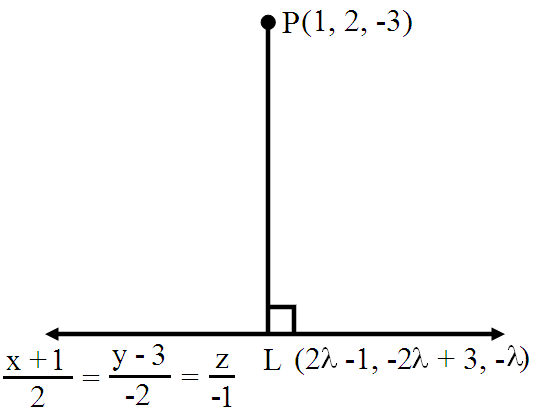
The direction ratios of PL are proportional to $2\lambda-1-1,-2\lambda+3-2,-\lambda+3,$ i.e. $2\lambda-2,-2\lambda+1,-\lambda+3.$ The direction ratios of the given line are proportional to 2, -2, -1, but PL is perpendicular to the given line. $\therefore22\lambda-2-2-2\lambda+1-1-\lambda+3=0\Rightarrow\lambda=1$ Substituting $\lambda=1$ in $2\lambda-1,-2\lambda+3,-\lambda,$ we get the coordinates of L as 1, 1, -1. View full question & answer→Question 845 Marks
Find the vector equation of a line passing through the point with position vector $\hat{\text{i}}-2\hat{\text{j}}-3\hat{\text{k}}$ and parallel to the line joining the points with position vectors $\hat{\text{i}}-\hat{\text{j}}+4\hat{\text{k}}$ and $2\hat{\text{i}}+\hat{\text{j}}+2\hat{\text{k}}.$ Also, find the cartesian equivalent of this equation.
AnswerWe know that, equation of a line passing through $\vec{\text{a}}$ and parallel to vector $\vec{\text{b}}$ is,
$\vec{\text{r}}=\vec{\text{a}}+\lambda\vec{\text{b}}\dots(1)$
Here, $\vec{\text{a}}=\hat{\text{i}}-2\hat{\text{j}}-3\hat{\text{k}}$
and, $\vec{\text{b}}=$ line joining $\big(\hat{\text{i}}-\hat{\text{j}}+4\hat{\text{k}}\big)$ and $\big(2\hat{\text{i}}+\hat{\text{j}}+2\hat{\text{k}}\big)$
$=\big(2\hat{\text{i}}+\hat{\text{j}}+2\hat{\text{k}}\big)-\big(\hat{\text{i}}-\hat{\text{j}}+4\hat{\text{k}}\big)$
$=2\hat{\text{i}}-\hat{\text{i}}+\hat{\text{j}}+\hat{\text{j}}+2\hat{\text{k}}-4\hat{\text{k}}$
$=\hat{\text{i}}+2\hat{\text{j}}-2\hat{\text{k}}$
Equation of the line is
$\vec{\text{r}}=\big(\hat{\text{i}}-2\hat{\text{j}}-3\hat{\text{k}}\big)+\lambda\big(\hat{\text{i}}+2\hat{\text{j}}-2\hat{\text{k}}\big)$
For cortesion form of equation put $\text{x}\hat{\text{i}}+\text{y}\hat{\text{j}}+\text{z}\hat{\text{k}},$
$\text{x}\hat{\text{i}}+\text{y}\hat{\text{j}}+\text{z}\hat{\text{k}}=(1+\lambda)\hat{\text{i}}+(-2+2\lambda)\hat{\text{j}}+(-3-2\lambda)\hat{\text{k}}$
Equating coeffcients of $\hat{\text{i}},\hat{\text{j}},\hat{\text{k}}$ so
$\text{x}=1+\lambda,\text{y}=-2+2\lambda,\text{z}=-3-2\lambda$
$\Rightarrow\frac{\text{x}-1}{1}=\lambda,\frac{\text{y}+2}{2}=\lambda,\frac{\text{z}+3}{-2}=\lambda$
So, $\frac{\text{x}-1}{1}=\frac{\text{y}+2}{2}=\frac{\text{z}+3}{-2}$
View full question & answer→Question 855 Marks
Find the coordinates of the point where the line through the points A(3, 4, 1) and B(5, 1, 6) crosses the XZ plane. Also find the angle which this line makes with the XZ plane.
AnswerEquation of line through A(3, 4, 1) and B(5, 1, 6)
$\frac{\text{x - 3}}{2} = \frac{\text{y - 4}}{-3} = \frac{\text{z - 1}}{5} = \text{k (say)}$
General point on the line:
$\text{x = 2k + 3, y = -3k + 4, z = 5k + 1}$
line crosses xz plane i.e. $\text{y = 0 if -3k + 4 = 0}$
$\therefore\text{k} = \frac{4}{3}$
Co-ordinate of required point $\bigg(\frac{17}{3}, 0, \frac{23}{3}\bigg)$
Angle, which line makes with xz plane:
$\sin\theta = \bigg|\frac{2(0) + (-3) (1) + 5 (0)}{\sqrt{4 + 9 + 25}\sqrt{1}}\bigg| = \frac{3}{\sqrt{38}}\Rightarrow \theta = \sin^{-1}\bigg(\frac{3}{\sqrt{38}}\bigg)$
View full question & answer→Question 865 Marks
Find the equation of the plane passing through the point (2, 3, 1), given that the direction ratios of the normal to the plane are proportional to 5, 3, 2.
AnswerGiven that, the plane is passing throught p(2, 3, 1) having 5, 3, 2 as the direction ratio of the normal to the plane.
We know that,
Equation of a plane passing through a point $\vec{\text{a}}$ and $\vec{\text{n}}$ is a vector normal to the plane, is given by,
$(\vec{\text{r}}-\vec{\text{a}})\vec{\text{n}}=0\ ...(\text{i})$
So, $\vec{\text{a}}=2\hat{\text{i}}+3\hat{\text{j}}+2\hat{\text{k}}$
$\vec{\text{n}}=5\hat{\text{i}}+3\hat{\text{j}}+2\hat{\text{k}}$
Put, $\vec{\text{a}}$ and $\vec{\text{n}}$ in equation (i),
$\Big[\vec{\text{r}}-(2\hat{\text{i}}+\hat{\text{j}}+\hat{\text{k}})\Big](5\hat{\text{i}}+3\hat{\text{j}}+2\hat{\text{k}})=0$
$\vec{\text{r}}(5\hat{\text{i}}+3\hat{\text{j}}+2\hat{\text{k}})-(2\hat{\text{i}}+3\hat{\text{j}}+\hat{\text{k}})(5\hat{\text{i}}+3\hat{\text{j}}+2\hat{\text{k}})=0$
$\vec{\text{r}}(5\hat{\text{i}}+3\hat{\text{j}}+2\hat{\text{k}})-\big[(2)(5)+(3)(3)+(1)(2)\big]=0$
$\vec{\text{r}}(5\hat{\text{i}}+3\hat{\text{j}}+2\hat{\text{k}})-[10+9+2]=0$
$\vec{\text{r}}(5\hat{\text{i}}+3\hat{\text{j}}+2\hat{\text{k}})-21=0$
Put, $\vec{\text{r}}=\text{x}\hat{\text{i}}+\text{y}\hat{\text{j}}+\text{z}\hat{\text{k}}$
$(\text{x}\hat{\text{i}}+\text{y}\hat{\text{j}}+\text{z}\hat{\text{k}})(5\hat{\text{i}}+3\hat{\text{j}}+2\hat{\text{k}})-21=0$
$(\text{x})(5)+(\text{y})(3)+(\text{z})(2)=21$
$5\text{x}+3\text{y}+2\text{z}=21$
View full question & answer→Question 875 Marks
Find the angle between the vectors whose direction cosines are proportional to 2, 3, -6 and 3, -4, 5.
AnswerLet $\vec{\text{a}}$ be a vector with direction ratios 2, 3, -6.
$\Rightarrow\vec{\text{a}}=2\hat{\text{i}}+3\hat{\text{j}}-6\hat{\text{k}}$
Let $\vec{\text{b}}$ be a vector with direction ratios 3, -4, 5.
$\Rightarrow\vec{\text{b}}=3\hat{\text{i}}-4\hat{\text{j}}+5\hat{\text{k}}$
Let $\theta$ be the angle between the given vectors.
Now,
$\cos\theta=\frac{\vec{\text{a}}.\vec{\text{b}}}{\big|\vec{\text{a}}\big|\big|\vec{\text{b}}\big|}$
$=\frac{(2\hat{\text{i}}+3\hat{\text{j}}-6\hat{\text{k}}).(3\hat{\text{i}}-4\hat{\text{j}}+5\hat{\text{k}})}{\big|2\hat{\text{i}}+3\hat{\text{j}}-6\hat{\text{k}}\big|\big|3\hat{\text{i}}-4\hat{\text{j}}+5\hat{\text{k}}\big|}$
$=\frac{6-12-30}{\sqrt{4+9+36}\sqrt{9+16+25}}$
$=\frac{-36}{\sqrt{49}\sqrt{50}}$
$=\frac{-36}{35\sqrt{2}}$
Rationalising the result, we get
$\cos\theta=-\frac{18\sqrt{2}}{35}$
$\therefore\theta=\cos^{-1}\Big(-\frac{18\sqrt{2}}{35}\Big)$
Thus, the angle between the given vectors measures $\cos^{-1}\Big(-\frac{18\sqrt{2}}{35}\Big)$.
View full question & answer→Question 885 Marks
Find the Vector and Cartesian equations of the line passing through the point (1, 2, – 4) and perpendicular to the two lines $\frac{\text{x - 8}}{3} =\frac{\text{y + 19}}{-16}=\frac{\text{z - 10}}{7}\text{ and }\frac{\text{x - 15}}{3}= \frac{\text{y - 29}}{8}=\frac{\text{z - 5}}{-5}$.
AnswerEquations of the line can be written as $\frac{\text{x - 1}}{a} =\frac{\text{y - 2}}{b}=\frac{\text{z + 4}}{c}$ since the line is perpendicular to two given lines
$\therefore$ 3a – 16b + 7c = 0 and 3a + 8b – 5c = 0
$\therefore$ $\frac{\text{a}}{24} =\frac{\text{b}}{36}=\frac{\text{c}}{{72}}$
Hence the equations of the line are
$\frac{\text{x - 1}}{24}= \frac{\text{y - 2}}{36}=\frac{\text{z + 4}}{72}\text{ OR }\frac{\text{x - 1}}{2}= \frac{\text{y - 2}}{3}=\frac{\text{z + 4}}{6}$
and the vector form is
$\overrightarrow{r}=(\hat{\text{i}}+\hat{\text{2j}}-\hat{\text{4k}})+\lambda(\hat{\text{2i}}+\hat{\text{3j}}+\hat{\text{6k}})$
View full question & answer→Question 895 Marks
Find the angle between the pairs of lines with direction ratios proportional to
$5, -12, 13$ and $-3, 4, 5$
AnswerWe know that, angle $(\theta)$ between two lines
$\frac{\text{x}-\text{x}_1}{\text{a}_1}=\frac{\text{y}-\text{y}_1}{\text{b}_1}=\frac{\text{z}-\text{z}_1}{\text{c}_1}$ and $\frac{\text{x}-\text{x}_2}{\text{a}_2}=\frac{\text{y}-\text{y}_2}{\text{b}_2}=\frac{\text{z}-\text{z}_2}{\text{c}_2}$
Is given by,
$\cos\theta=\frac{\text{a}_1\text{a}_2+\text{b}_1\text{b}_2+\text{c}_1\text{c}_2}{\sqrt{{\text{a}_1}^2+{{\text{b}_1}^2}+{{\text{c}_1}^2}}\sqrt{{\text{a}_2}^2+{{\text{b}_2}^2}+{{\text{c}_2}^2}}}\dots(1)$
Here, a_1= 5, b_1= -12, c_1 =13
$a_2= -3, b_2= 4, c_2= 5$
Let $\theta$ be the required angle, so using equation (1),
$\cos\theta=\frac{(5)(-3)+(-12)(4)+(13)(5)}{\sqrt{(5)^2+(-12)^2+(13)^2}\sqrt{(-3)^2+(4)^2+(5)^2}}$
$=\frac{-15-48+65}{\sqrt{169\times2}\sqrt{25\times2}}$
$=\frac{2}{65\times2}$
$\cos\theta=\frac{1}{65}$
$\theta=\cos^{-1}\Big(\frac{1}{65}\Big)$
View full question & answer→Question 905 Marks
If a variable line in two adjacent positions has direction cosines l, m, n and $\text{l}+\delta\text{l},\text{m}+\delta\text{m},\text{n}+\delta\text{n},$ show that the small angle $\delta\theta$ between the two positions is given by $\delta\theta^2=\delta\text{l}^2+\delta\text{m}^2+\delta\text{n}^2.$
AnswerWe have l, m, n and $\text{l}+\delta\text{l},\text{m}+\delta\text{m},\text{n}+\delta\text{n}$ as direction cosines of a variable line in two different positions.
$\therefore\text{l}^2+\text{m}^2+\text{n}^2=1\ ....(\text{i})$
and $(\text{l}+\delta\text{l})^2+(\text{m}+\delta\text{m})^2+(\text{n}+\delta)\ ....(\text{ii})$
$\Rightarrow\text{l}^2+\text{m}^2+\text{n}^2+\delta\text{l}^2+\delta\text{m}^2+\delta\text{n}^2+2(\text{l}\delta\text{l}+\text{m}\delta\text{m}+\text{n}\delta\text{n})=1$
$\Rightarrow\delta\text{l}^2+\delta\text{m}^2+\delta\text{n}^2=2(\text{l}\delta\text{l}+\text{m}\delta\text{m}+\text{n}\delta\text{n})$ $[\because\text{l}^2+\text{m}^2+\text{n}^2=1]$
$\Rightarrow\text{l}\delta\text{l}+\text{m}\delta\text{m}+\text{n}\delta\text{n}=\frac{-1}{2}(\delta\text{l}^2+\delta\text{m}^2+\delta\text{n}^2)\ ....(\text{iii})$
Now $\vec{\text{a}}$ and $\vec{\text{b}}$ are unit vectors along a line with direction cosines l, m, n and
$(\text{l}+\delta\text{l}),(\text{m}+\delta\text{m}),(\text{n}+\delta\text{n}),$ respectively.
$\therefore\vec{\text{a}}=\text{l}\hat{\text{i}}+\text{m}\hat{\text{j}}+\text{n}\hat{\text{k}}$ and $\vec{\text{b}}=(\text{l}+\delta\text{l})\hat{\text{i}}+(\text{m}+\delta\text{m})\hat{\text{j}}+(\text{n}+\delta\text{n})\hat{\text{k}}$
$\Rightarrow\cos\delta\theta=\text{l}(\text{l}+\delta\text{l})+\text{m}(\text{m}+\delta\text{m})+\text{n}(\text{n}+\delta\text{n})$
$=(\text{l}^2+\text{m}^2+\text{n}^2)+(\text{l}\delta\text{l}+\text{m}\delta\text{m}+\text{n}\delta\text{n})$
$=1-\frac{1}{2}(\delta\text{l}^2+\delta\text{m}^2+\delta\text{n}^2)$
$\Rightarrow2(1-\cos\delta\theta)=(\delta\text{l}^2+\delta\text{m}^2+\delta\text{n}^2)$
$\Rightarrow2\cdot2\sin^2\frac{\delta\theta}{2}=\delta\text{l}^2+\delta\text{m}^2+\delta\text{n}^2$
$\Rightarrow4\Big(\frac{\delta\theta}{2}\Big)=\delta\text{l}^2+\delta\text{m}^2+\delta\text{n}^2$$\Big[\text{Since}\frac{\delta\theta}{2}\text{is small,}\sin\frac{\delta\theta}{2}=\frac{\delta\theta}{2}\Big]$
$\Rightarrow\delta\theta^2=\delta\text{l}^2+\delta\text{m}^2+\delta\text{n}^2$
View full question & answer→Question 915 Marks
A line passes through (2, –1, 3) and is perpendicular to the lines$\overrightarrow{\text{r}}= (\hat{\text{i}} + \hat{\text{j}} - \hat{\text{k}}) + \lambda(2 \hat{\text{i}} - 2\hat{\text{j}} + \hat{\text{k}})\text{ and }\overrightarrow{\text{r}} = (2\hat{\text{i}} -\hat{\text{j}} - 3\hat{\text{k}}) + \mu(\hat{\text{i}} + 2 \hat{\text{j}} + 2\hat{\text{k}}).$Obtain its equation in vector and cartesian form.
AnswerThe direction perpendicular to the given lines is given by
$(2\hat{\text{i}} - 2 \hat{\text{j}} +\hat{\text{k}})\times(\hat{\text{i}} + 2\hat{\text{j}} + 2\hat{\text{k}})$
$= \begin{bmatrix} \hat{\text{i}} &\hat{\text{j}}&\hat{\text{k}} \$0.3em] 2 & -2 & 1 \$0.3em] 1 & 2& 2 \end{bmatrix} = -6\hat{\text{i}} - 3\hat{\text{j}} + 6\hat{\text{k}}\text{ or }2\hat{\text{i}} +\hat{\text{j}} - 2\hat{\text{k}}$
$\therefore$ Vector equation of required line is
$\overrightarrow{\text{r}} = (2\hat{\text{i}} -\hat{\text{j}} + 3 \hat{\text{k}}) + \lambda(2\hat{\text{i}} + \hat{\text{j}} - 2 \hat{\text{k}})$
and the cartesian form is
$\frac{\text{x} - 2}{2} = \frac{\text{y} + 1 }{1} =\frac{\text{z} - 3}{-2}.$
View full question & answer→Question 925 Marks
Find the equation of the plane determined by the intersection of the lines $\frac{\text{x}+3}{3}=\frac{\text{y}}{-2}=\frac{\text{z}-7}{6}$ and $\frac{\text{x}+6}{1}=\frac{\text{y}+5}{-3}=\frac{\text{z}-1}{2}$
AnswerLet $\text{L}_1:=\frac{\text{x}+3}{3}=\frac{\text{y}}{-2}=\frac{\text{z}-7}{6}$ and $\text{L}_2:\frac{\text{x}+6}{1}=\frac{\text{y}+5}{-3}=\frac{\text{z}-1}{2}$ be the equation of two lines.
Let the plane be ax + by + cz + d = 0 ....(i)
Given that the required plane passes through the intersection of the lines $L_1$ and $L_2$
Hence the normal to the plane is perpendicular to the lines $L_1$ and $L_2$
$\therefore$ 3a - 2b + 6c = 0
a - 3b + 2c = 0
Using cross-multiplication we get
$\frac{\text{a}}{-4+18}=\frac{\text{b}}{6-6}=\frac{\text{c}}{-9+2}$
$\Rightarrow\frac{\text{a}}{14}=\frac{\text{b}}{0}=\frac{\text{c}}{-7}$
$\Rightarrow\frac{\text{a}}{2}=\frac{\text{b}}{0}=\frac{\text{c}}{-1}$
View full question & answer→Question 935 Marks
Find the equation of the plane which is perpendicular to the plane 5x + 3y + 6z + 8 = 0 and which contains the line of intersection of the planes x + 2y + 3z – 4 = 0 and 2x + y – z + 5 = 0.
AnswerThe equation of a plane through the line of intersection of the planes x + 2y + 3z - 4 = 0 and 2x + y - z + 5 = 0.
$(\text{x}+2\text{y}+3\text{z} – 4)+\lambda(2\text{x}+\text{y}- \text{z} + 5) = 0$
$\Rightarrow\text{x}(1+2\lambda)+\text{y}(2+\lambda)+\text{z}(-\lambda+3)-4+5\lambda=0\ .....(\text{i})$
Also, this is perpendicular to the plane $5\text{x}+3\text{y}+6\text{z}+8=0.$
$\therefore5(1+2\lambda)+3(2+\lambda)+6(3-\lambda)=0$ $[\because\text{a}_1\text{a}_2+\text{b}_1\text{b}_2+\text{c}_1\text{c}_1=0]$
$\Rightarrow5+10\lambda+6+3\lambda+18-6\lambda=0$
$\Rightarrow\lambda=-\frac{29}{7}$
Putting this value of $\lambda$ in equation (i), we get
$\text{x}\Big[1+2\Big(\frac{-29}{7}\Big)\Big]+\text{y}\Big(2-\frac{29}{7}\Big)+\Big(\frac{29}{7}+3\Big)-4+5\Big(\frac{-29}{7}\Big)=0\Big]$
$\Rightarrow\text{x}(7-58)+\text{y}(14-29)+\text{z}(29+21)-28-145=0$
$\Rightarrow-51\text{x}-15\text{y}+50\text{z}-173=0$
So, the required equation of plane is $-51\text{x}-15\text{y}+50\text{z}-173=0.$
View full question & answer→Question 945 Marks
Find the direction cosines of the line $\frac{\text{x}+2}{2}=\frac{2\text{y}-7}{6}=\frac{5-\text{z}}{6}.$ Also, find the vector equation of the line through the point A(-1, 2, 3) and parallel to the given line.
AnswerThe equation of the given line is $\frac{\text{x}+2}{2}=\frac{2\text{y}-7}{6}=\frac{5-\text{z}}{6}.$
The given equation can be re-written as $\frac{\text{x}+2}{2}=\frac{\text{y}-\frac{7}{2}}{3}=\frac{\text{z}-5}{-6.}$
This line passes through the point $\big(-2, \frac{7}{2}, 5\big)$ and has direction ratios proportionl to 2, 3, -6.
So, its direction cosines are
$\frac{2}{\sqrt{2^2+3^2+(-6)^2}},\frac{3}{\sqrt{2^2+3^2+(-6)^2}},\frac{-6}{\sqrt{2^2+3^2+(-6)^2}}$
$\text{or }\frac{2}{7},\frac{3}{7},\frac{-6}{7}$
The required line passes throuth the point having position vector $\vec{\text{a}}=-\hat{\text{i}}+2\hat{\text{j}}+3\hat{\text{k}}$ and is parallel to the vector $\vec{\text{b}}=2\hat{\text{i}}+3\hat{\text{j}}-6\hat{\text{k}}.$
So, its vector equation is
$\vec{\text{r}}=\big(-\hat{\text{i}}+2\hat{\text{j}}+3\hat{\text{k}}\big)+\lambda\big(2\hat{\text{i}}+3\hat{\text{j}}-6\hat{\text{k}}\big)$
View full question & answer→Question 955 Marks
Find the shortest distance between the following pairs of parallel lines whose equations are:
$\vec{\text{r}}=\big(\hat{\text{i}}+\hat{\text{j}}\big)+\lambda\big(2\hat{\text{i}}-\hat{\text{j}}+\hat{\text{k}}\big)$ and $\vec{\text{r}}=\big(2\hat{\text{i}}+\hat{\text{j}}-\hat{\text{k}}\big)+\mu\big(4\hat{\text{i}}-2\hat{\text{j}}+2\hat{\text{k}}\big)$
Answer$\vec{\text{r}}=\big(\hat{\text{i}}+\hat{\text{j}}\big)+\lambda\big(2\hat{\text{i}}-\hat{\text{j}}+\hat{\text{k}}\big)$ and $\vec{\text{r}}=\big(2\hat{\text{i}}+\hat{\text{j}}-\hat{\text{k}}\big)+\mu\big(4\hat{\text{i}}-2\hat{\text{j}}+2\hat{\text{k}}\big)$ or $\vec{\text{r}}=\big(2\hat{\text{i}}+\hat{\text{j}}-\hat{\text{k}}\big)+2\mu\big(2\hat{\text{i}}-\hat{\text{j}}+\hat{\text{k}}\big)$
These two lines pass through the points having position vectors
$\vec{\text{a}}_1=\hat{\text{i}}+\hat{\text{j}}$ and $\vec{\text{a}}_2=2\hat{\text{i}}+\hat{\text{j}}-\hat{\text{k}}$ and are parallel to the vector $\vec{\text{b}}=2\hat{\text{i}}-\hat{\text{j}}+\hat{\text{k}}.$
Now,
$\vec{\text{a}}_2-\vec{\text{a}}_1=\hat{\text{i}}-\hat{\text{k}}$
and
$\big(\vec{\text{a}}_2-\vec{\text{a}}_1\big)\times\vec{\text{b}}=\big(\hat{\text{i}}-\hat{\text{k}}\big)\times\big(2\hat{\text{i}}-\hat{\text{j}}+\hat{\text{k}}\big)$
$=\begin{vmatrix}\hat{\text{i}}&\hat{\text{j}}&\hat{\text{k}}\\1&0&-1\\2&-1&1 \end{vmatrix}$
$=-\hat{\text{i}}-3\hat{\text{j}}-\hat{\text{k}}$
$\Rightarrow\big|\big(\vec{\text{a}}_2-\vec{\text{a}}_1\big)\times\vec{\text{b}}\big|=\sqrt{(-1)^2+(-3)^2+(-1)^2}$
$=\sqrt{1+9+1}$
$=\sqrt{11}$
The shortest distance between the two lines is given by
$\frac{\big|\big(\vec{\text{a}}_2-\vec{\text{a}}_1\big)\times\vec{\text{b}}\big|}{\big|\vec{\text{b}}}\big|=\frac{\sqrt{11}}{\sqrt{6}}$
View full question & answer→Question 965 Marks
Find the angle between the lines whose direction cosines are given by the equations
$l + 2m + 3n = 0$ and $3lm - 4ln + mn = 0$
AnswerGiven that,
$l + 2m + 3n = 0 .....(1)$
$3lm - 4ln + mn = 0 .....(2)$
From equation $(1),$
$l + 2m + 3n = 0$
$l = -2m - 3n$
Put the value of l in equation $(2),$
$3lm - 4ln + mn = 0$
$3(-2m - 3n) m - 4(-2m - 3n) n + mn = 0$
$-6m^2- 9nm + 8mn + 12n^2 + mn = 0$
$-6m^2 + 12n^2 = 0$
$m^2 = 2n^2$
$\text{m}=\pm\sqrt{2\text{n}^2}$
$\text{m}=\text{n}\sqrt{2}$ or $\text{m}=-\text{n}\sqrt{2}$
Put $\text{m}=\text{n}\sqrt{2}$ in equation (1)
$l + 2m + 3n = 0$
$\text{l}+2\big(\text{n}\sqrt{2}\big)+3\text{n}=0$
$\text{l}+\text{n}\big(2\sqrt{2}+3\big)=0$
$\text{l}+-\big(2\sqrt{2}+3\big)\text{n}$
Again, $\text{m}=-\sqrt{2\text{n}}$ in equation (1)
$l + 2m + 3n = 0$
$\text{l}+2\big(-\sqrt{2\text{n}}\big)+3\text{n}=0$
$\text{l}-2\sqrt{2\text{n}}+3\text{n}=0$
$\text{l}+\text{n}\big(-2\sqrt{2\text{n}}+3\big)=0$
$\text{l}=\big(2\sqrt{2\text{n}}-3\big)\text{n}$
Thus, direction cosines of the lines are given by,
$-\big(2\sqrt{2}+3\big)\text{n},\sqrt{2\text{n}},\text{n}$ or $\big(2\sqrt{2}-3\big)\text{n},\sqrt{2\text{n}},\text{n}$
$-\big(2\sqrt{2}+3\big)\text{n},\sqrt{2},1$ or $\big(2\sqrt{2}-3\big)\text{n},-\sqrt{2},1$
So, vectors parallel to these lines are
$\vec{\text{a}}=-\Big(2\sqrt{2}+3\Big)\hat{\text{i}}+\sqrt{2}\hat{\text{j}}+\hat{\text{k}}$ and $\vec{\text{b}}=\Big(2\sqrt{2}-3\Big)\hat{\text{i}}-\sqrt{2}\hat{\text{j}}+\hat{\text{k}}$ respectively.
Let, $\theta$ be the angle between the lines,
then,
$\cos\theta=\frac{\vec{\text{a}}\times\vec{\text{b}}}{\big|\vec{\text{a}}\big|\times\big|\vec{\text{b}}\big|}$
$=\frac{-\big(2\sqrt{2}+3\big)\times{\big(2\sqrt{2}-3\big)+\big(\sqrt{2}\big)}\times\big(-\sqrt{2}\big)+(1)(1)}{\sqrt{\big(2\sqrt{2}+3\big)^2+\big(-\sqrt{2}\big)^2+(1)^2}\sqrt{\big(2\sqrt{2}-3\big)^2+\big(-\sqrt{2}\big)^2+(1)^2}}$
$=\frac{-(8-9)-2+1}{\sqrt{8+9+12\sqrt{2}+2+1\sqrt{8+9-12\sqrt{2}+2+1}}}$
$=\frac{-(-1)-2+1}{\sqrt{20+12\sqrt{2}}\sqrt{20-12\sqrt{2}}}$
$=\frac{1-2+1}{\sqrt{20+12\sqrt{2}}\sqrt{20-12\sqrt{2}}}$
$\cos\theta=0$
$\theta=\cos^{-1}(0)$
$\theta=\frac{\pi}{2}$
Angle between the lines $=\frac{\pi}{2}$.
View full question & answer→Question 975 Marks
Find the direction cosines of the sides of the triangle whose vertices are (3, 5, -4), (-1, 1, 2) and (-5, -5, -2).
AnswerA(3, 5, -4), B(-1, 1, 2) and C(-5, -5, -2) The direction ratios of the side AB = (-1 - 3, 1 - 3, 2 + 4) = (-4, -4 ,6) Direction cosines of AB will be $\frac{-4}{\sqrt{(-4)^2+(-4)^2+6^2}},\frac{-4}{\sqrt{(-4)^2+(-4)^2+6^2}},\frac{6}{\sqrt{(-4)^2+(-4)^2+6^2}}$ $=\frac{-4}{\sqrt{68}},\frac{-4}{\sqrt{68}},\frac{6}{\sqrt{68}}$ $=\frac{-2}{\sqrt{17}},\frac{-2}{\sqrt{17}},\frac{3}{\sqrt{17}}$ The direction ratios of the side BC = (-5 + 1, -5 - 1, -2 - 2) = (-4, -6, -4) Direction cosines of BC will be $\frac{-4}{\sqrt{(-4)^2+(-6)^2+(-4)^2}},\frac{-6}{\sqrt{(-4)^2+(-6)^2+(-4)^2}},\frac{-4}{\sqrt{(-4)^2+(-6)^2+(-4)^2}}$ $=\frac{-4}{\sqrt{68}},\frac{-6}{\sqrt{68}},\frac{-4}{\sqrt{68}}$ $=\frac{-2}{\sqrt{17}},\frac{-3}{\sqrt{17}},\frac{-2}{\sqrt{17}}$ The direction ratios of the side AC = (-5 - 3, -5 - 5, -2 + 4) = (-8, -10, 2)Direction cosines of AC will be
$\frac{-8}{\sqrt{(-8)^2+(-10)^2+2^2}},\frac{-10}{\sqrt{(-8)^2+(-10)^2+2^2}},\frac{2}{\sqrt{(-8)^2+(-10)^2+2^2}}$ $=\frac{-8}{\sqrt{168}},\frac{-10}{\sqrt{168}},\frac{2}{\sqrt{168}}$ $=\frac{-4}{\sqrt{42}},\frac{-5}{\sqrt{42}},\frac{1}{\sqrt{42}}$.
View full question & answer→Question 985 Marks
Find the foot of the perpendicular drawn from the point A(1, 0, 3) to the joint of the points B(4, 7, 1) and C(3, 5, 3).
AnswerLet the foot of the perpendicular drawn from A(1, 0, 3) to the line joining the points B(4, 7, 1) And C(3, 5, 3) be D
Equation of line passing through B(4, 7, 1) and C(3, 5, 3) is
$\frac{\text{x}-\text{x}1}{\text{x}2-\text{x}1}=\frac{\text{y}-\text{y}1}{\text{y}2-\text{y}1}=\frac{\text{z}-\text{z}1}{\text{z}2-\text{z}1}$
$\Rightarrow\frac{\text{x}-4}{3-4}=\frac{\text{y}-7}{5-7}=\frac{\text{z}-1}{3-1}$
$\Rightarrow\frac{\text{x}-4}{-1}=\frac{\text{y}-7}{-2}=\frac{\text{z}-1}{2}=\lambda$ (say)
Direction ratios of AD are
$(-\lambda+4-1),(-2\lambda+7-0),(2\lambda+1-3)$
$=(-\lambda+3),(-2\lambda+7),(2\lambda-2)$
Line AD is perpendicular to BC so
$\text{a}_1\text{a}_2+\text{b}_1\text{b}_2+\text{c}_1\text{c}_2=0$
$\Rightarrow(-1)(-\lambda+3)+(-2)(-2\lambda+7)+2(2\lambda-2)=0$
$\Rightarrow\lambda-3+4\lambda-14+4\lambda-4=0$
$\Rightarrow9\lambda-21=0$
$\Rightarrow\lambda=\frac{21}{9}$
Co-ordinates of D are
$=\Big(-\frac{21}{9}+4,(-2)\Big(\frac{21}{9}+7\Big),2\Big(\frac{21}{9}+1\Big)\Big)$
$=\Big(\frac{15}{9},\frac{21}{9},\frac{51}{9}\Big)$
$=\Big(\frac{5}{3},\frac{7}{3},\frac{17}{3}\Big)$
View full question & answer→Question 995 Marks
If the product of the distances of the point $(1, 1, 1)$ from the origin and the plane $x - y + z + λ = 0$ be $5$, find the value of λ.
AnswerWe know that the distance of the point $(x_1, y_1, z_1)$ from the plane ax + by + cz + d = 0 is given by
$\frac{|\text{ax}_1+\text{by}_1+\text{cz}_1+\text{d}|}{\sqrt{\text{a}^2+\text{d}^2+\text{c}^2}}$
Distance of the point (1, 1, 1) from the plane $\text{x}-\text{y}+\text{z}+\lambda=0$
The required distance,
$=\frac{|1-1+1+\lambda|}{\sqrt{1^2+(-1)^2+1^2}}$
$=\frac{|1+\lambda|}{\sqrt{3}}\text{ units}\ ...(\text{i})$
Distance of the point (0, 0, 0) from the plane $\text{x}-\text{y}+\text{z}+\lambda=0$
The required distance,
$=\frac{|0-0+0+\lambda|}{\sqrt{1^2+(-1)^2+1^2}}$
$=\frac{|\lambda|}{\sqrt{3}}\text{ units}\ ...(\text{ii})$
It is given that the product of the distance (i) and (ii) is 5
$\frac{|1+\lambda|}{\sqrt{3}}\times\frac{|\lambda|}{\sqrt{3}}=5$
$\lambda^2+\lambda-15=0$
View full question & answer→Question 1005 Marks
Find the equation of a plane which is at a distance of $3\sqrt{3}\text{ units}$ from the origin and the normal to which is equally inclined to the coordinate axes.
AnswerLet $\alpha,\beta$ and $\gamma$ be the angle made by $\vec{\text{n}}$ with x, y and z-axes, respectively.
It is given that
$\alpha=\beta=\gamma$
$\Rightarrow\cos\alpha=\cos\beta=\cos\gamma$
$\Rightarrow\text{l}=\text{m}=\text{n},$ where l, m, n are direction cosines of $\vec{\text{n}}$
But $\text{l}^2+\text{m}^2+\text{n}^2=1$
$\Rightarrow\text{l}^2+\text{l}^2+\text{l}^2=1$
$\Rightarrow3\text{l}^2=1$
$\Rightarrow\text{l}^2=\frac{1}{3}$
$\Rightarrow\text{l}=\frac{1}{\sqrt{3}}$
So, $\text{l}=\text{m}=\text{n}=\frac{1}{\sqrt{3}}$
It is given that the length of the perpendicular of the plane from the origin, $\text{p}=3\sqrt{3}$
The normal from of the plane is lx + my + nz = p
$\Rightarrow\frac{1}{\sqrt{3}}\text{x}+\frac{1}{\sqrt{3}}\text{y}+\frac{1}{\sqrt{3}}\text{z}=3\sqrt{3}$
$\Rightarrow\text{x}+\text{y}+\text{z}=3\sqrt{3}(\sqrt{3})$
$\Rightarrow\text{x}+\text{y}+\text{z}=9$
View full question & answer→