Question 1015 Marks
Let $\overrightarrow{\text{a}} = \hat{\text{i}} + 4\hat{\text{j}} +2\hat{\text{k}}, \overrightarrow{\text{b}} = 3\hat{\text{i}} - 2\hat{\text{j}} +7\hat{\text{k}}$ and $\overrightarrow{\text{c}} = 2\hat{\text{i}} - \hat{\text{j}} + 4\hat{\text{k}}$ Find a vector $\overrightarrow{\text{d}}$ which is perpendicular to both $\overrightarrow{\text{a}} \text{and} \overrightarrow{\text{b}}\text{and} \overrightarrow{\text{c}} . \overrightarrow{\text{d}} = 27.$
Answer $\text{Writing} \overrightarrow{\text{d}} = \lambda\bigg(\overrightarrow{\text{a}}\times\overrightarrow{\text{b}}\bigg)$
$= \lambda \begin{vmatrix} \hat{\text{i}} & \hat{\text{j}} & \hat{\text{k}} \\ 1 & 4 & 2 \\ 3 & -2 & 7 \end{vmatrix} $
$ = \lambda \bigg(32 \hat{\text{i}} - \hat{\text{j}} - 14\hat{\text{k}}\bigg)\dots\dots\dots\dots\text{(1)}$
$\overrightarrow{\text{c}}. \overrightarrow{\text{d}} = 27$
$\bigg(2\hat{\text{i}} - \hat{\text{j}} + 4\hat{\text{k}}\bigg).\lambda\bigg(32\hat{\text{i}} - \hat{\text{j}} + 14\hat{\text{k}}\bigg) = 27$
$9\lambda = 27$
$\lambda = 3$
$\therefore\overrightarrow{\text{d}} = \bigg(96\hat{\text{i}} - \hat{\text{3j}} + 42\hat{\text{k}}\bigg)$
View full question & answer→Question 1025 Marks
The equation of tangent at (2, 3) on the curve $y^{2} = \text{ax}^{3} + \text{b is y = 4x - 5}. $ Find the value of a and b.
Answer$\text{y}^{2} = \text{ax}^{3} + \text{b} \Rightarrow\text{2y}\frac{\text{dy}}{\text{dx}} = \text{3ax}^{2}\therefore \frac{\text{dy}}{\text{dx}} = \frac{\text{3a}}{2} \frac{\text{x}^{2}}{\text{y}}$
Slope of tangent at (2, 3) $\frac{\text{dy}}{\text{dx}}\bigg]_{(2, 3)} =\frac{\text{3a}}{2}. \frac{4}{3} = \text{2a}$
Comparing with slope of tangent $\text{y = 4x - 5, we get, 2a = 4}\therefore$
Also (2, 3) lies on the curve $\therefore 9 = \text{8a + b, put a = 2, we get b = -7}$
View full question & answer→Question 1035 Marks
Show that the points A, B, C with position vectors $2\hat{\text{i}} - \hat{\text{j}} + \hat{\text{k}}, \hat{\text{i}} - 3\hat{\text{j}} - 5\hat{\text{k}} \text{ and } 3\hat{\text{i}} - 4\hat{\text{j}} - 4\hat{\text{k}}$ respectively, are the vertices of a right-angled triangle. Hence find the area of the triangle.
Answer $\vec{\text{AB}} = - \hat{\text{i}} - 2\hat{\text{j}} - 6\hat{\text{k}}, \vec{\text{BC}} = 2\hat{\text{i}} - \hat{\text{j}} + \hat{\text{k}}, \vec{\text{CA}} = -\hat{\text{i}} + 3\hat{\text{j}} + 5\hat{\text{k}}$
Since $\vec{\text{AB}}, \vec{\text{BC}}, \vec{\text{CA}},$ are not parallel vectors, and $\vec{\text{AB}} + \vec{\text{BC}} + \vec{\text{CA}} = \vec{0} \therefore \text{A, B, C}$ form a triangle
$\text{Also} \vec{\text{ BC}}. \vec{\text{CA}} = 0 \text{ }\text{ }\text{ }\text{ }\text{ } \therefore\text{A, B, C}$ form a right triangle
$\text{Area of} \Delta = \frac{1}{2} | \vec{\text{AB}} \times \vec{\text{BC}}| = \frac{1}{2} \sqrt{210}$
View full question & answer→Question 1045 Marks
Find the shortest distance between the lines:
$\vec{\text{r}}=(\hat{\text{i}}+2\hat{\text{j}}+\hat{\text{k}})+\lambda(\hat{\text{i}}-\hat{\text{j}}+\hat{\text{k}})\ \text{and}\ $
$\vec{\text{r}}=2\hat{\text{i}}-\hat{\text{j}}-\hat{\text{k}}+\mu(2\hat{\text{i}}+\hat{\text{j}}+2\hat{\text{k}})$
AnswerComparing the given equations with
$\vec{\text{r}}=\vec{\text{a}_1}+\lambda\vec{\text{b}_1}\ \text{and}\ \vec{\text{r}}=\vec{\text{a}_2}+\lambda\vec{\text{b}_2},$ we get
$\vec{\text{a}_1}=\hat{\text{i}}+2\hat{\text{j}}+\hat{\text{k}},\ \ \vec{\text{b}_1}=\hat{\text{i}}-\hat{\text{j}}+\hat{\text{k}} \ \ \text{and}$
$\vec{\text{a}_2}=2\hat{\text{i}}-\hat{\text{j}}-\hat{\text{k}},\ \ \vec{\text{b}_2}=2\hat{\text{i}}+\hat{\text{j}}+2\hat{\text{k}}$
Since, the shortest distance between the two skew lines is given by
$\text{d}=\frac{\Big|\Big(\vec{\text{a}_2}-\vec{\text{a}_1}\Big).\Big(\vec{\text{b}_1}\times\vec{\text{b}_2}\Big)\Big|}{\Big|\vec{\text{b}_1}\times\vec{\text{b}_2}\Big|}\ \ \ .....(\text{i})$
Here, $\vec{\text{a}_2}-\vec{\text{a}_1}=\Big(2\hat{\text{i}}-\hat{\text{j}}-\hat{\text{k}}\Big)-\Big(\hat{\text{i}}+2\hat{\text{j}}+\hat{\text{k}}\Big)=\hat{\text{i}}-3\hat{\text{j}}-2\hat{\text{k}}$
$\vec{\text{b}_1}\times\vec{\text{b}_2}=\begin{vmatrix}\hat{\text{i}}&\hat{\text{j}}&\hat{\text{k}}\\1&-1&1\\2&1&2\end{vmatrix}$
$=(-2-1)\hat{\text{i}}-(2-2)\hat{\text{j}}+(1+2)\hat{\text{k}}=-3\hat{\text{i}}+3\hat{\text{k}}$
$\Big|\vec{\text{b}_1}\times\vec{\text{b}_2}\Big|=\sqrt{(-3)^2+(0)^2+(3)^2}=\sqrt{18}=3\sqrt{2}$
$\Big(\vec{\text{a}_2}-\vec{\text{a}_1}\Big).\Big(\vec{\text{b}_1}\times\vec{\text{b}_2}\Big)=\Big(\hat{\text{i}}-3\hat{\text{j}}-2\hat{\text{k}}\Big).\Big(-3\hat{\text{i}}+3\hat{\text{k}}\Big)$
=1 × (-3) + (-3 × 0) + (-2 × 3) = -9
Putting these values in eq. (i)
Shortest distance $(\text{d})=\frac{|-9|}{3\sqrt{2}}=\frac{9}{3\sqrt{2}}=\frac{3}{\sqrt{2}}=\frac{3\sqrt{2}}{2}.$
View full question & answer→Question 1055 Marks
Find the vector and Cartesian equations of the line through the point (1, 2, – 4) and perpendicular to the two lines.
$\overrightarrow{\text{r}} = (8\hat{\text{i}} - 19\hat{\text{j}} + 10\hat{\text{k}})+\lambda(3\hat{\text{i}} - 16\hat{\text{j}} + 7\hat{\text{k})}$ and $\overrightarrow{\text{r}} = (15\hat{\text{i}} - 29\hat{\text{j}} + 5\hat{\text{k}})+\mu(3\hat{\text{i}} - 8\hat{\text{j}} + 5\hat{\text{k})}.$
AnswerVector equation of the required line is
$\overrightarrow{\text{r}} = (\hat{\text{i}} + 2\hat{\text{j}} - 4\hat{\text{k}})+\mu[(3\hat{\text{i}} - 16\hat{\text{j}} + 7\hat{\text{k})}\times(3\hat{\text{i}} + 8\hat{\text{j}} - 5\hat{\text{k})]}$
$\Rightarrow\overrightarrow{\text{r}} = (\hat{\text{i}} + 2\hat{\text{j}} - 4\hat{\text{k}})+\lambda[(2\hat{\text{i}} + 3\hat{\text{j}} + 6\hat{\text{k})]}$
in cartesian form, $\frac{\text{x - 1}}{2} = \frac{\text{y - 2}}{3} = \frac{\text{z + 4}}{6}$
View full question & answer→Question 1065 Marks
Find the angle between the following pairs of lines:$\frac{\text{x}-1}{2}=\frac{\text{y}-2}{3}=\frac{\text{z}-3}{-3}$ and $\frac{\text{x}+3}{-1}=\frac{\text{y}-5}{8}=\frac{\text{z}-1}{4}$
Answer$\frac{\text{x}-1}{2}=\frac{\text{y}-2}{3}=\frac{\text{z}-3}{-3}$ and $\frac{\text{x}+3}{-1}=\frac{\text{y}-5}{8}=\frac{\text{z}-1}{4}$
Let $\vec{\text{b}}_1$ and $\vec{\text{b}}_2$ be vectors parallel to the given lines.
Now,
$\vec{\text{b}}_1=2\hat{\text{i}}+3\hat{\text{j}}-3\hat{\text{k}}$
$\vec{\text{b}}_2=-\hat{\text{i}}+8\hat{\text{j}}+4\hat{\text{k}}$
If $\theta$ is the angle between the given lines, then
$\cos\theta=\frac{\vec{\text{b}}_1.\vec{\text{b}}_2}{\big|\vec{\text{b}}_1\big|\big|\vec{\text{b}}_2\big|}$
$=\frac{\big(2\hat{\text{i}}+3\hat{\text{j}}-3\hat{\text{k}}\big).\big(-\hat{\text{i}}+8\hat{\text{j}}+4\hat{\text{k}}\big)}{\sqrt{2^2+3^2+(-3)^2}\sqrt{(-1)^2+8^2+4^2}}$
$=\frac{-2+24-12}{9\sqrt{22}}$
$=\frac{10}{9\sqrt{22}}$
$\Rightarrow\theta=\cos^{-1}\Big(\frac{10}{9\sqrt{22}}\Big)$
View full question & answer→Question 1075 Marks
Prove that the line through A(0, –1, –1) and B(4, 5, 1) intersects the line through C(3, 9, 4) and D(–4, 4, 4).
AnswerEquation of line $\vec{\text{AB}}$
$\vec{\text{r}} = (-\hat{\text{j}} - \hat{\text{k}}) + \lambda (4\hat{\text{i}} + 6\hat{\text{j}} + 2\hat{\text{k}})$
Equation of line $\vec{\text{CD}}$
$\vec{\text{r}} = (3\hat{\text{i}} + 9\hat{\text{j}} + 4\hat{\text{k}}) + \mu (-7\hat{\text{i}} - 5\hat{\text{j}})$
$\vec{\text{a}}_{2} - \vec{\text{a}}_{1} = 3\hat{\text{i}} + 10\hat{\text{j}} + 5 \hat{\text{k}}$
$\vec{\text{b}}_{1} \times \vec{\text{b}}_{2} = \begin{vmatrix} \hat{\text{i}} & \hat{\text{j}} & \hat{\text{k}} \\ 4 & 6 & 2 \\ -7 & -5 & 0 \end{vmatrix} = 10\hat{\text{i}} - 14\hat{\text{j}} + 22\hat{\text{k}}$
$(\vec{\text{a}}_{2} - \vec{\text{a}}_{1}). (\vec{\text{b}}_{1} \times \vec{\text{b}}_{2}) = 30 – 140 + 110 = 0$
$\Rightarrow$ Lines intersect.
View full question & answer→Question 1085 Marks
Find the shortest distance between the following lines whose vector equations are:$\overrightarrow{r}=\text{(1 - t)}\hat{\text{i}}+\text{(t - 2)}\hat{\text{j}}+\text{(3 - 2t)}\hat{\text{k}}$ and
$\overrightarrow{r}=\text{(s + 1)}\hat{\text{i}}+\text{(2s - 1)}\hat{\text{j}}-\text{(2s + 1)}\hat{\text{k}}$
AnswerEquations of the lines are,
$\overrightarrow{r}=(\hat{\text{i}}-2\hat{\text{j}}+3\hat{\text{k})}+\text{t}(-\hat{\text{i}}+\hat{\text{j}}-2\hat{\text{k})}\text{ and }$
$\overrightarrow{r}=(\hat{\text{i}}-\hat{\text{j}}-\hat{\text{k})}+\text{s}(\hat{\text{i}}+2\hat{\text{j}}-2\hat{\text{k})}$
shortest distance =$\frac{\Big|(\overrightarrow{\text{a}_{2}}-\overrightarrow{\text{a}_{1}})\cdot(\overrightarrow{\text{b}_{1}}\times\overrightarrow{\text{b}_{2}})\Big|}{\Bigg|\overrightarrow{\text{b}_{1}}\times\overrightarrow{\text{b}_{2}}\Bigg|}$ where
$\overrightarrow{\text{a}_{1}}=\hat{\text{i}}-2\hat{\text{j}}+3\hat{\text{k}},\text{ }\overrightarrow{\text{a}_{2}}=\hat{\text{i}}-\hat{\text{j}}-\hat{\text{k}},\overrightarrow{\text{b}_{1}}=-\hat{\text{i}}+\hat{\text{j}}-2\hat{\text{k}},\text{ }\overrightarrow{\text{b}_{2}}=\hat{\text{i}}+2\hat{\text{j}}-2\hat{\text{k}},$
$\overrightarrow{\text{a}_{2}}-\overrightarrow{\text{a}_{1}}=\hat{\text{j}}-4\hat{\text{k}},\text{ }\overrightarrow{\text{b}_{1}}\times\overrightarrow{\text{b}_{2}}=2\hat{\text{i}}-4\hat{\text{j}}-3\hat{\text{k}}$
$\therefore$ S.D. = $\frac{0-4+12}{\sqrt{29}}=\frac{8}{\sqrt{29}}$.
View full question & answer→Question 1095 Marks
Show that the points $\hat{\text{i}}-\hat{\text{j}}+3\hat{\text{k}}$ and $3\hat{\text{i}}+3\hat{\text{j}}+3\hat{\text{k}}$ are equidistant from the plane $\vec{\text{r}}\cdot(5\hat{\text{i}}+2\hat{\text{j}}-7\hat{\text{k}})+9=0$
AnswerWe know that, distance of a point P of position vector $\vec{\text{a}}$ from the plane $\vec{\text{r}}\cdot\hat{\text{n}}=\text{d}$ is given by
$\text{p}=\frac{\big|\vec{\text{a}}\cdot\vec{\text{n}}-\text{d}\big|}{|\vec{\text{n}}|}\ ...(\text{i})$
Let $D_1$ be the distance of point $(\hat{\text{i}}-\hat{\text{j}}+\hat{\text{k}})$ from the plane $\vec{\text{r}}\cdot(5\hat{\text{i}}+2\hat{\text{j}}-7\hat{\text{k}})+9=0,$ then
$\text{D}_1=\Bigg|\frac{(\hat{\text{i}}-\hat{\text{j}}+3\hat{\text{k}})\cdot(5\hat{\text{i}}+2\hat{\text{j}}-7\hat{\text{k}})+9}{\sqrt{(5)^2+(2)^2+(-7)^2}}\Bigg|$ [Using equation (i)]
$=\Bigg|\frac{(1)(5)+(-1)(2)+(3)(-7)+9}{\sqrt{25+4+49}}\Bigg|$
$=\Big|\frac{5-2-21+9}{\sqrt{78}}\Big|$
$=\Big|-\frac{9}{\sqrt{78}}\Big|$
$\text{D}_1=\frac{9}{\sqrt{78}}\text{ units}\ ...(\text{ii})$
Again, let $D_2$ be the distance of point $(3\hat{\text{i}}-3\hat{\text{j}}+3\hat{\text{k}})$ from the plane $\vec{\text{r}}\cdot(5\hat{\text{i}}+2\hat{\text{j}}-7\hat{\text{k}})+9=0,$ then using equation (i) we get,
$\text{D}_2=\Bigg|\frac{(3\hat{\text{i}}-3\hat{\text{j}}+3\hat{\text{k}})\cdot(5\hat{\text{i}}+2\hat{\text{j}}-7\hat{\text{k}})+9}{\sqrt{(5)^2+(2)^2+(-7)^2}}\Bigg|$
$=\Bigg|\frac{(3)(5)+(3)(2)+(3)(-7)+9}{\sqrt{25+4+49}}\Bigg|$
$=\Big|\frac{15+6-21+9}{\sqrt{78}}\Big|$
$=\Big|\frac{9}{\sqrt{78}}\Big|$
$\text{D}_2=\frac{9}{\sqrt{78}}\text{ units}\ ...(\text{iii})$
From equation (i) and (iii)
$\text{D}_1=\text{D}_2$
Distance of point $(\hat{\text{i}}-\hat{\text{j}}+3\hat{\text{k}})$ from plane $\vec{\text{r}}\cdot(5\hat{\text{i}}+2\hat{\text{j}}-7\hat{\text{k}})+9=0$ = Distance of point $(3\hat{\text{i}}-3\hat{\text{j}}+3\hat{\text{k}})$ from plane $\vec{\text{r}}\cdot(5\hat{\text{i}}+2\hat{\text{j}}-7\hat{\text{k}})+9=0$
View full question & answer→Question 1105 Marks
The coordinates of the foot of the perpendicular drawn from the origin to a plane are (12, -4, 3). Find the equation of the plane.
AnswerThe given equation of the line are
$\frac{\text{x}+3}{3}=\frac{\text{y}}{-2}=\frac{\text{z}-7}{6}\ ....(\text{i})$
$\frac{\text{x}+6}{1}=\frac{\text{y}+5}{-3}=\frac{\text{z}-1}{2}\ ....(\text{ii})$
Let the directions of the plane be proportional to a, b, c.
Since the plane contains line (i), it should pass through (-3, 0, 7)
And is parallel to the line (i)
Equation of the plane through (i) is,
a(x + 3) + b(y) + c(z - 7) = 0 ....(iii)
Where 3a - 2b + 6c = 0 ...(iv)
Since the plane contains line (ii), the plane is parallel to line (ii) also
⇒ a - 3b + 2c = 0 ....(v)
Solving (iv) and (v) using cross-multiplication, we get
$\frac{\text{a}}{14}=\frac{\text{b}}{0}=\frac{\text{c}}{-7}$
Substituting a, b and c in (iii) we get
14(x + 3) + 0(y) - 7(z - 7) = 0
⇒ 2(x + 3) + 0(y) - 1(z - 7) = 0
⇒ 2x - z + 13 = 0
View full question & answer→Question 1115 Marks
Find the equation of the plane through the line of intersection of the planes $x + y + z = 1$ and $2x + 3y + 4z = 5$ which is perpendicular to the plane $x - y + z = 0$.
AnswerThe equation of plane through the intersection of planes, x + y + z = 1 and 2x + 3y + 4z = 5, is
$(\text{x + y + z}-1)+\lambda(2\text{x}+3\text{y}+4\text{z}-5)=0$
$\Rightarrow\ \ (2\lambda+1)\text{x}+(3\lambda+1)\text{y}+(4\lambda+1)\text{z}-(5\lambda+1)=0\ \ ....(1)$
The direction ratios, $a_1, b_1, c_1$, are $1, -1$, and $1$.
Since the planes are perpendicular,
$a_1a_2 + b_1b_2 + c_1c_2 = 0$
$\Rightarrow\ \ (2\lambda+1)-(3\lambda+1)+(4\lambda+1)=0$
$\Rightarrow\ \ 3\lambda+1=0$
$\Rightarrow\ \ \lambda=-\frac{1}{3}$
Substituting $\lambda=-\frac{1}{3}$ in equation (1), we obtain
$\frac{1}{3}\text{x}-\frac{1}{3}\text{z}+\frac{2}{3}=0$
⇒ x - z + 2 = 0
This is the required equation of the plane.
View full question & answer→Question 1125 Marks
Prove that the lines through A(0, -1, -1) and B(4, 5, 1) intersects the line through C(3, 9, 4) and D(-4, 4, 4). Also, find their point of intersection.
AnswerThe coordinates of any point on the line AB are given by
$\frac{\text{x}-0}{4-0}=\frac{\text{y}+1}{5+1}=\frac{\text{z}+1}{1+1}=\lambda$
$\Rightarrow\text{x}=4\lambda$
$\text{y}=6\lambda-1$
$\text{z}=2\lambda-1$
The coordinates of a general point on AB are $4\lambda,6\lambda-1,2\lambda-1.$
The coordinates of any point on the line CD are given by
$\frac{\text{x}-3}{3+4}=\frac{\text{y}-9}{9-4}=\frac{\text{z}-4}{4-4}=\mu$
$\Rightarrow\text{x}=7\mu+3$
$\text{y}=5\mu+9$
$\text{z}=4$
The coordinates of a general point on CD are $7\mu+3,5\mu+9,4.$
If the lines AB and CD intersect, then they have a common point. so, for some valuse of $\lambda$ and $\mu,$
We must have
$4\lambda=7\mu+3,6\lambda-1=5\mu+9,2\lambda-1=4$
$\Rightarrow4\lambda-7\mu=3\dots(1)$
$6\lambda-5\mu=10\dots(2)$
$\lambda=\frac{5}{2}\dots(3)$
Solving (2) and (3), we get
$\lambda=\frac{5}{2}$
$\mu=1$
Substituting $\lambda=\frac{5}{2}$ and $\mu=1$ in (1), we get
$\text{LHS}=4\lambda-7\mu$
$=4\Big(\frac{5}{2}\Big)-7(1)$
$=3$
$=\text{RHS}$
Since $\lambda=\frac{5}{2}$ and $\mu=1$ satisfy (3), the given lines intersect.
substituting the value of $\lambda$ in the coordinates of a general point on the line AB, we get
x = 10
y = 14
z = 4
Hence, AB and CD intersect at point (10, 14, 4).
View full question & answer→Question 1135 Marks
Find the distance between the parallel planes $2x - y + 3z − 4 = 0$ and $6x - 3y + 9z + 13 = 0$.
AnswerMultiplying the first equation of the plane by 3, we get
6x - 3y + 9z - 12 = 0
6x - 3y + 9z = 12 ....(i)
The second equation of the plane is
6x - 3y + 9z = -13 ...(ii)
We know that the distance between two planes $ax + by + cz = d_1$ and $ax + by + cz = d_2$ is $\frac{\big|\text{d}_2-\text{d}_1\big|}{\sqrt{\text{a}^2+\text{b}^2+\text{c}^2}}$
So, the required distance
$=\frac{|-13-12|}{\sqrt{6^2+(-3)^2+9^2}}$
$=\frac{|-25|}{\sqrt{39-9+81}}$
$=\frac{25}{\sqrt{126}}$
$=\frac{5}{3\sqrt{14}}\text{ units}$
View full question & answer→Question 1145 Marks
Find the value of $\lambda$ such that the line $\frac{\text{x}-2}{6}=\frac{\text{y}-1}{\lambda}=\frac{\text{z}+5}{-4}$ is perpendicular to the plane 3x - y - 2z = 7.
AnswerHere, given mid line $\frac{\text{x}-2}{6}=\frac{\text{y}-1}{\lambda}=\frac{\text{z}+5}{-4}$ is parpendicular to plane 3x - y - 2z = 7 so, normal vector of plane is parallel to line so,
Direction ratios of normal to plane are proparional to the direction ratios of line.
Here,
$\frac{6}{3}=\frac{\lambda}{-1}=\frac{-4}{-2}$
cross multiplying the last two
$-2\lambda=4$
$\lambda=\frac{4}{-2}$
$\lambda=-2$
View full question & answer→Question 1155 Marks
If the axes are rectangular and p is the point (2, 3, -1), find the equation of the plane throught p at right angles to OP.
AnswerThe normal is passing through the points O(0, 0, 0) and P(2, 3, -1). So,$\vec{\text{n}}=\overrightarrow{\text{OP}}$
$=(2\hat{\text{i}}+3\hat{\text{j}}-\hat{\text{k}})-(0\hat{\text{i}}+0\hat{\text{j}}+0\hat{\text{k}})$
$=2\hat{\text{i}}+3\hat{\text{j}}-\hat{\text{k}}$
Since the plane passes through the point (2, 3, -1)
$=2\hat{\text{i}}+3\hat{\text{j}}-\hat{\text{k}}$
We know that the vector equation of the plane passing through a point $\vec{\text{a}}$ and normal to $\vec{\text{n}}$ is
$\vec{\text{r}}\cdot\vec{\text{n}}=\vec{\text{a}}\cdot\vec{\text{n}}$
Substituting $\vec{\text{a}}=2\hat{\text{i}}+3\hat{\text{j}}-\hat{\text{k}}$ and $\vec{\text{n}}=2\hat{\text{i}}+3\hat{\text{j}}-\hat{\text{k}},$ we get
$\vec{\text{r}}\cdot(2\hat{\text{i}}+3\hat{\text{j}}-\hat{\text{k}})=(2\hat{\text{i}}+3\hat{\text{j}}-\hat{\text{k}})\cdot(2\hat{\text{i}}+3\hat{\text{j}}-\hat{\text{k}})$
$\Rightarrow\vec{\text{r}}\cdot(2\hat{\text{i}}+3\hat{\text{j}}-\hat{\text{k}})=4+9+1$
$\Rightarrow\vec{\text{r}}\cdot(2\hat{\text{i}}+3\hat{\text{j}}-\hat{\text{k}})=14$
Substituting $\vec{\text{r}}=\text{x}\hat{\text{i}}+\text{y}\hat{\text{j}}+\text{z}\hat{\text{k}}$ in the vector equation, we get
$(\text{x}\hat{\text{i}}+\text{y}\hat{\text{j}}+\text{z}\hat{\text{k}})\cdot(2\hat{\text{i}}+3\hat{\text{j}}-\hat{\text{k}})=14$
$\Rightarrow2\text{x}+3\text{y}-\text{z}=14$
View full question & answer→Question 1165 Marks
Find the equatoion of the passing through the points (1, -1, 2) and (2, -2, 2) and which is perpendicular to the plane 6x - 2y + 2z = 9.
AnswerThe equation of any plane passing through (1, -1, 2) is
a(x - 1) + b(y + 1) + c(z - 2) = 0 ....(i)
It is given that (i) is passing through (2, -2, 2). So,
a(2 - 1) + b(-2 + 1) + c(2 - 2) = 0
⇒ a - b + 0c = 0 ...(ii)
It is given that (i) is perpendicular to the plane 6x - 2y + 2z = 9. So,
6a - 2b + 2c = 0
⇒ 3a - b + c = 0 ...(iii)
Solving (i), (ii) and (iii) we get,
$\begin{vmatrix}\text{x}-1&\text{y}+1&\text{z}-2\\1&-1&0\\3&-1&1\end{vmatrix}=0$
⇒ -1(x - 1) - 1(y + 1) + 2(z - 2) = 0
⇒ -x + 1 - y - 1 + 2z - 4= 0
⇒ x + y - 2z + 4 = 0
View full question & answer→Question 1175 Marks
Let $\overrightarrow{\text{a}} = \hat{\text{i}} + 4\hat{\text{j}} +2\hat{\text{k}}, \overrightarrow{\text{b}} = 3\hat{\text{i}} - 2\hat{\text{j}} +7\hat{\text{k}}$ and $\overrightarrow{\text{c}} = 2\hat{\text{i}} - \hat{\text{j}} + 4\hat{\text{k}}$ Find a vector $\overrightarrow{\text{d}}$ which is perpendicular to both $\overrightarrow{\text{a}} \text{and} \overrightarrow{\text{b}}\text{and} \overrightarrow{\text{c}} . \overrightarrow{\text{d}} = 27.$
Answer$\text{Writing} \overrightarrow{\text{d}} = \lambda\bigg(\overrightarrow{\text{a}}\times\overrightarrow{\text{b}}\bigg)$
$= \lambda \begin{vmatrix} \hat{\text{i}} & \hat{\text{j}} & \hat{\text{k}} \\ 1 & 4 & 2 \\ 3 & -2 & 7 \end{vmatrix} $
$ = \lambda \bigg(32 \hat{\text{i}} - \hat{\text{j}} - 14\hat{\text{k}}\bigg)\dots\dots\dots\dots\text{(1)}$
$\overrightarrow{\text{c}}. \overrightarrow{\text{d}} = 27$
$\bigg(2\hat{\text{i}} - \hat{\text{j}} + 4\hat{\text{k}}\bigg).\lambda\bigg(32\hat{\text{i}} - \hat{\text{j}} + 14\hat{\text{k}}\bigg) = 27$
$9\lambda = 27$
$\lambda = 3$
$\therefore\overrightarrow{\text{d}} = \bigg(96\hat{\text{i}} - \hat{\text{3j}} + 42\hat{\text{k}}\bigg)$
View full question & answer→Question 1185 Marks
Show that the four points (0, -1, -1), (4, 5, 1), (3, 9, 4) and (-4, 4, 4) are coplanar and find the equation of the common plane.
AnswerThe equation of the plane passing through points (0, -1, -1), (4, 5, 1) and (3, 9, 4) is given by,
$\begin{vmatrix}\text{x}-0&\text{y}+1&\text{z}+1\\4-0&5+1&1+1\\3-0&9+1&4+1\end{vmatrix}=0$
$\Rightarrow\begin{vmatrix}\text{x}&\text{y}+1&\text{z}+1\\4&6&2\\3&10&5\end{vmatrix}=0$
$\Rightarrow10\text{x}-14(\text{y}+1)+22(\text{z}+1)=0$
$\Rightarrow5\text{x}-7(\text{y}+1)+11(\text{z}+1)=0$
$\Rightarrow5\text{x}-7\text{y}+11\text{z}+4=0$
Substituting the last points (-4, 4, 4) (it means x = -4; y = 4; z = 4) in this plane equation, we get
5(-4) - 7(4) + 11(4) + 4 = 0
⇒ -48 + 48 = 0
So, the plane equation is satisfied by the points (-4, 4, 4)
So, the given pointsa are coplanar and the equation of the common plane (as we already founded) is
5x - 7y + 11z + 4 = 0
View full question & answer→Question 1195 Marks
Find the vector and Cartesian equations of the line through the point (1, 2, – 4) and perpendicular to the two lines.
$\overrightarrow{\text{r}} = (8\hat{\text{i}} - 19\hat{\text{j}} + 10\hat{\text{k}})+\lambda(3\hat{\text{i}} - 16\hat{\text{j}} + 7\hat{\text{k})}$ and $\overrightarrow{\text{r}} = (15\hat{\text{i}} - 29\hat{\text{j}} + 5\hat{\text{k}})+\mu(3\hat{\text{i}} - 8\hat{\text{j}} + 5\hat{\text{k})}.$
AnswerVector equation of the required line is
$\overrightarrow{\text{r}} = (\hat{\text{i}} + 2\hat{\text{j}} - 4\hat{\text{k}})+\mu[(3\hat{\text{i}} - 16\hat{\text{j}} + 7\hat{\text{k})}\times(3\hat{\text{i}} + 8\hat{\text{j}} - 5\hat{\text{k})]}$
$\Rightarrow\overrightarrow{\text{r}} = (\hat{\text{i}} + 2\hat{\text{j}} - 4\hat{\text{k}})+\lambda[(2\hat{\text{i}} + 3\hat{\text{j}} + 6\hat{\text{k})]}$
in cartesian form, $\frac{\text{x - 1}}{2} = \frac{\text{y - 2}}{3} = \frac{\text{z + 4}}{6}$
View full question & answer→Question 1205 Marks
Find the equations of the line passing through the point (3, 0, 1) and parallel to the planes x + 2y = 0 and 3y - z = 0.
AnswerEquation of the two planes are x + 2y and 3y - z = 0.
Let $\vec{\text{n}}_1$ and $\vec{\text{n}}_2$ are the normal to the two planes, respectively.
$\therefore\vec{\text{n}}_1=\hat{\text{i}}+2\hat{\text{j}}$ and $\vec{\text{n}}_2=3\hat{\text{j}}-\hat{\text{k}}$
Since, required line is parallel to the given two planes.
Therefore, $\vec{\text{b}}=\vec{\text{n}}_1\times\vec{\text{n}}_2=\begin{vmatrix}\hat{\text{i}}&\hat{\text{j}}&\hat{\text{k}} \\1&2&0\\0&3&-1 \end{vmatrix}$
$=\hat{\text{i}}(-2)-\hat{\text{j}}(-1)+\hat{\text{k}}(3)$
$=-2\hat{\text{i}}+\hat{\text{j}}+3\hat{\text{k}}$
So, the equation of the lines through the point (3, 0, 1) and parallel to the given two planes are
$\Rightarrow(\text{x}-3)\hat{\text{i}}+(\text{y}-0)\hat{\text{j}}+(\text{z}-1)\hat{\text{k}}+\lambda(-2\hat{\text{i}}+\hat{\text{j}}+3\hat{\text{k}})$
View full question & answer→Question 1215 Marks
Find the vector equation of the line passing through the point (1, 2, – 4) and perpendicular to the two lines: $\frac{\text{x}-8}{3}=\frac{\text{y}+19}{-16}=\frac{\text{z}-10}{7}\ \text{and}\ \frac{\text{x}-15}{3}=\frac{\text{y}-29}{8}=\frac{\text{z}-5}{-5}.$
AnswerGiven: A point on the Required line is A(1, 2, -4)
$\therefore\ \text{Position vector of point A is }\vec{\text{a}}=(1,2,-4)=\hat{\text{i}}+2\hat{\text{j}}-4\hat{\text{k}}$
Also given equations of two lines
$\frac{\text{x}-8}{3}=\frac{\text{y}+19}{-16}=\frac{\text{z}-10}{7}\ \text{and}\ \frac{\text{x}-15}{3}=\frac{\text{y}-29}{8}=\frac{\text{z}-5}{-5}$
$\therefore$ Direction ratios of given two lines are
$\vec{\text{b}_1}=3\hat{\text{i}}-16\hat{\text{j}}+7\hat{\text{k}}\ \text{and}\ \vec{\text{b}_2}=3\hat{\text{i}}+8\hat{\text{j}}-5\hat{\text{k}}$
$\vec{\text{b}}=\vec{\text{b}_1}\times\vec{\text{b}_2}=\begin{vmatrix}\hat{\text{i}}&\hat{\text{j}}&\hat{\text{k}}\\3&-16&7\\3&8&-5\end{vmatrix}$
Expanding along first row,
$=\hat{\text{i}}(80-56)-\hat{\text{j}}(-15-21)+\hat{\text{k}}(24+48)=24\hat{\text{i}}+36\hat{\text{j}}+72\hat{\text{k}}$
$\Rightarrow\ \vec{\text{b}}=12\Big(2\hat{\text{i}}+3\hat{\text{j}}+6\hat{\text{k}}\Big)$
$\therefore$ Equation of the required line is $\vec{\text{r}}=\vec{\text{a}}+\lambda\vec{\text{b}}$
$\Rightarrow \vec{\text{r}}=\Big(\hat{\text{i}}+2\hat{\text{j}}-4\hat{\text{k}}\Big)+\lambda(12)\Big(2\hat{\text{i}}+3\hat{\text{j}}+6\hat{\text{k}}\Big)$
Again replacing $12\lambda\ \text{by}\ \lambda$
$\Rightarrow \vec{\text{r}}=\Big(\hat{\text{i}}+2\hat{\text{j}}-4\hat{\text{k}}\Big)+\lambda\Big(2\hat{\text{i}}+3\hat{\text{j}}+6\hat{\text{k}}\Big).$
View full question & answer→Question 1225 Marks
Find the acute angle between the lines whose direction ratios are proportional to 2 : 3 : 6 and 1 : 2 : 2.
AnswerThe vectors, represented by these are
$\vec{\text{a}}=2\hat{\text{i}}+3\hat{\text{j}}+6\hat{\text{k}}$
and $\vec{\text{b}}=\hat{\text{i}}+2\hat{\text{j}}+2\hat{\text{k}}$
Let, $\theta$ be the angle between the lines,
then,
$\cos\theta=\frac{\vec{\text{a}}\times\vec{\text{b}}}{\Big|\vec{\text{a}}\Big|\Big|\vec{\text{b}}\Big|}$
$=\frac{(2\hat{\text{i}}+3\hat{\text{j}}+6\hat{\text{k}})(\hat{\text{i}}+2\hat{\text{j}}+2\hat{\text{k}})}{\sqrt{(2)^2+(3)^2+(6)^2}\sqrt{(1)^2+(2)^2+(2)^2}}$
$=\frac{(2)(1)+(3)(2)+(6)(2)}{\sqrt{4+9+36}\sqrt{1+4+4}}$
$=\frac{2+6+12}{\sqrt{49}\sqrt{9}}$
$=\frac{20}{7\times3}$
$\cos\theta=\frac{20}{21}$
$\theta=\cos^{-1}\Big(\frac{20}{21}\Big)$
Angle between the lines $=\cos^{-1}\Big(\frac{20}{21}\Big)$.
View full question & answer→Question 1235 Marks
Find the coordinates of the point where the line through $(5, 1, 6)$ and $(3, 4, 1)$ crosses the $YZ$-plane.
AnswerGiven: A line through the points A(5, 1, 6) and $B(3, 4, 1)$
$\therefore$ Direction ratios of this line AB are $x_2 - x_1, y_2 - y_1, z_2 - z_1$
$\Rightarrow 3 - 5, 4 - 1, 1 - 6$
$\Rightarrow -2, 3, -5 = a, b, c$
Equation of the line AB is $\frac{\text{x}-\text{x}_1}{\text{a}}=\frac{\text{y}-\text{y}_1}{\text{b}}=\frac{\text{z}-\text{z}_1}{\text{c}}$
$\Rightarrow\ \ \frac{\text{x}-5}{-2}=\frac{\text{y}-1}{3}=\frac{\text{z}-6}{-5}\ \ \ .....(\text{i})$
Now we have to find the coordinates of the point where this line AB crosses the YZ-plane
i.e., x = 0 .......(ii)
Putting x = 0 in eq. (i), we get
$\frac{-5}{-2}=\frac{\text{y}-1}{3}=\frac{\text{z}-6}{-5}$
$\Rightarrow\ \ \frac{\text{y}-1}{3}=\frac{5}{2}\ \text{and}\ \frac{\text{z}-6}{-5}=\frac{5}{2}$
⇒ 2y - 2 = 15 and 2z - 12 = -25
⇒ 2y = 17 and 2z = -13
$\Rightarrow\ \ \ \text{y}=\frac{17}{2}\ \text{and}\ \text{z}=\frac{-13}{2}$
Thus, required point is $\text{P}\Big(0,\ \frac{17}{2},\ \frac{-13}{2}\Big).$
View full question & answer→Question 1245 Marks
Find the distance between the lines $l_1$ and $l_2$ given by$\vec{\text{r}}=\hat{\text{i}}+2\hat{\text{j}}-4\hat{\text{k}}+\lambda\big(2\hat{\text{i}}+3\hat{\text{j}}+6\hat{\text{k}}\big)$ and, $\vec{\text{r}}=3\hat{\text{i}}+3\hat{\text{j}}-5\hat{\text{k}}+\mu\big(2\hat{\text{i}}+3\hat{\text{j}}+6\hat{\text{k}}\big)$
Answer$\vec{\text{a}}_1=\hat{\text{i}}+2\hat{\text{j}}-4\hat{\text{k}}$
$\vec{\text{a}}_2=3\hat{\text{i}}+3\hat{\text{j}}-5\hat{\text{k}}$
$\vec{\text{a}}_2-\vec{\text{a}}_1=3\hat{\text{i}}+3\hat{\text{j}}-5\hat{\text{k}}-\hat{\text{i}}-2\hat{\text{j}}+4\hat{\text{k}}$
$=2\hat{\text{i}}+\hat{\text{j}}-\hat{\text{k}}$
$\vec{\text{b}}=2\hat{\text{i}}+3\hat{\text{j}}+6\hat{\text{k}}$
$\big(\vec{\text{a}}_2-\vec{\text{a}}_1\big)\times\vec{\text{b}}=\begin{vmatrix}\hat{\text{i}}&\hat{\text{j}}&\hat{\text{k}}\\2&1&-1\\2&3&6\end{vmatrix}$
$=\hat{\text{i}}(6+3)-\hat{\text{j}}(12+2)+\hat{\text{k}}(6-2)$
$=9\hat{\text{i}}-14\hat{\text{j}}+4\hat{\text{k}}$
Shortest distance between 2 lines
$=\Bigg|\frac{\big(\vec{\text{a}}_2-\vec{\text{a}}_1\big)\times\vec{\text{b}}}{\big|\vec{\text{b}}\big|}\Bigg|$
$=\Bigg|\frac{9\hat{\text{i}}-14\hat{\text{j}}+4\hat{\text{k}}}{\big|\sqrt{2^2+3^2+6^2}\big|}\Bigg|$
$=\Bigg|\frac{9\hat{\text{i}}-14\hat{\text{j}}+4\hat{\text{k}}}{\sqrt{49}}\Bigg|$
$=\Bigg|\frac{\sqrt{9^2+(-14)^2+4^2}}{\sqrt{49}}\Bigg|$
$=\Big|\frac{\sqrt{293}}{\sqrt{49}}\Big|=\frac{\sqrt{293}}{7}\text{ units}$
View full question & answer→Question 1255 Marks
Find the coordinates of the point where the line through the points A(3, 4, 1) and B(5, 1, 6) crosses the XZ plane. Also find the angle which this line makes with the XZ plane.
AnswerEquation of line through A(3, 4, 1) and B(5, 1, 6)
$\frac{\text{x - 3}}{2} = \frac{\text{y - 4}}{-3} = \frac{\text{z - 1}}{5} = \text{k (say)}$
General point on the line:
$\text{x = 2k + 3, y = -3k + 4, z = 5k + 1}$
line crosses xz plane i.e. $\text{y = 0 if -3k + 4 = 0}$
$\therefore\text{k} = \frac{4}{3}$
Co-ordinate of required point $\bigg(\frac{17}{3}, 0, \frac{23}{3}\bigg)$
Angle, which line makes with xz plane:
$\sin\theta = \bigg|\frac{2(0) + (-3) (1) + 5 (0)}{\sqrt{4 + 9 + 25}\sqrt{1}}\bigg| = \frac{3}{\sqrt{38}}\Rightarrow \theta = \sin^{-1}\bigg(\frac{3}{\sqrt{38}}\bigg)$
View full question & answer→Question 1265 Marks
The equation of tangent at (2, 3) on the curve $y^{2} = \text{ax}^{3} + \text{b is y = 4x - 5}. $ Find the value of a and b.
Answer$\text{y}^{2} = \text{ax}^{3} + \text{b} \Rightarrow\text{2y}\frac{\text{dy}}{\text{dx}} = \text{3ax}^{2}\therefore \frac{\text{dy}}{\text{dx}} = \frac{\text{3a}}{2} \frac{\text{x}^{2}}{\text{y}}$
Slope of tangent at (2, 3) $\frac{\text{dy}}{\text{dx}}\bigg]_{(2, 3)} =\frac{\text{3a}}{2}. \frac{4}{3} = \text{2a}$
Comparing with slope of tangent $\text{y = 4x - 5, we get, 2a = 4}\therefore$
Also (2, 3) lies on the curve $\therefore 9 = \text{8a + b, put a = 2, we get b = -7}$
View full question & answer→Question 1275 Marks
Find the vector equation of the plane passing through the points P(2, 5, -3), Q(-2, -3, 5) and R(5, 3, -3).
Answer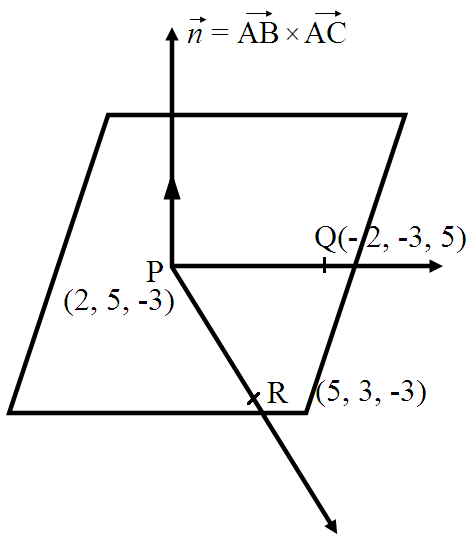
The required plane passes through the point P(2, 5, -3), whose position vector is $\vec{\text{a}}=2\hat{\text{i}}+5\hat{\text{j}}-3\hat{\text{k}}$ and is normal to the vector $\vec{\text{n}}$ given by
$\overrightarrow{\text{PQ}}=\overrightarrow{\text{OQ}}-\overrightarrow{\text{OP}}$
$=(-2\hat{\text{i}}-3\hat{\text{j}}+5\hat{\text{k}})-(2\hat{\text{i}}+5\hat{\text{j}}-3\hat{\text{k}})$
$=-4\hat{\text{i}}-8\hat{\text{j}}+8\hat{\text{k}}$
$\overrightarrow{\text{PR}}=\overrightarrow{\text{OR}}-\overrightarrow{\text{OP}}$
$=(5\hat{\text{i}}+3\hat{\text{j}}-3\hat{\text{k}})-(2\hat{\text{i}}+5\hat{\text{j}}-3\hat{\text{k}})$
$=3\hat{\text{i}}-2\hat{\text{j}}-0\hat{\text{k}}$
$\vec{\text{n}}=\overrightarrow{\text{PQ}}\times\overrightarrow{\text{PR}}$
$=\begin{vmatrix}\hat{\text{i}}&\hat{\text{j}}&\hat{\text{k}}\\-4&-8&8\\3&-2&0\end{vmatrix}$
$=16\hat{\text{i}}+24\hat{\text{j}}+32\hat{\text{k}}$
The vector equation of the required plane is
$\vec{\text{r}}\cdot\vec{\text{n}}=\vec{\text{a}}\cdot\vec{\text{n}}$
$\Rightarrow\vec{\text{r}}\cdot(16\hat{\text{i}}+24\hat{\text{j}}+32\hat{\text{k}})=(2\hat{\text{i}}+5\hat{\text{j}}-3\hat{\text{k}})\cdot(16\hat{\text{i}}+24\hat{\text{j}}+32\hat{\text{k}})$
$\Rightarrow\vec{\text{r}}\cdot\Big[8(2\hat{\text{i}}+3\hat{\text{j}}+4\hat{\text{k}})\Big]=32+120-96$
$\Rightarrow\vec{\text{r}}\cdot\Big[8(2\hat{\text{i}}+3\hat{\text{j}}+4\hat{\text{k}})\Big]=56$
$\Rightarrow\vec{\text{r}}\cdot(2\hat{\text{i}}+3\hat{\text{j}}+4\hat{\text{k}})=7$ View full question & answer→Question 1285 Marks
Show that the vectors $\overrightarrow{\text{a}},\overrightarrow{\text{b}} \text{and}{\overrightarrow{\text{c}}}$ are coplanar $\overrightarrow{\text{a}} +\overrightarrow{\text{b}}, \overrightarrow{\text{b}}+\overrightarrow{\text{c}}\text{and} \overrightarrow{\text{c}} + \overrightarrow{\text{a}}$ are coplanar.
AnswerGiven that $\overrightarrow{\text{a}} +\overrightarrow{\text{b}}, \overrightarrow{\text{b}} + \overrightarrow{\text{c}}, \overrightarrow{\text{c}} + \overrightarrow{\text{a}}$ are coplanar
$\therefore[\overrightarrow{\text{a}} +\overrightarrow{\text{b}}, \overrightarrow{\text{b}} + \overrightarrow{\text{c}}, \overrightarrow{\text{c}} + \overrightarrow{\text{a}}] = 0$
$\text{i.e} \overrightarrow{\text{(a}} +\overrightarrow{\text{b})}, \big\{\overrightarrow{\text{(b}} + \overrightarrow{\text{c})} \times\overrightarrow{\text{(c}} + \overrightarrow{\text{a})}\big\} = 0$
$\overrightarrow{\text{(a}} +\overrightarrow{\text{b})}. \big\{\overrightarrow{\text{(b}} \times \overrightarrow{\text{c}}+ \overrightarrow{\text{b}} \times\overrightarrow{\text{a}}\times\overrightarrow{\text{c}} \times \overrightarrow{\text{a})}\big\} = 0$
$\Rightarrow\overrightarrow{\text{a}}.(\overrightarrow{\text{b}}\times\overrightarrow{\text{c})} + \overrightarrow{\text{a}}.(\overrightarrow{\text{b}}\times\overrightarrow{\text{a})} + \overrightarrow{\text{a}}(\overrightarrow{\text{c}}\times\overrightarrow{\text{a})}+\overrightarrow{\text{b}}. (\overrightarrow{\text{b}}\times\overrightarrow{\text{c})} + \overrightarrow{\text{b}}.(\overrightarrow{\text{b}}\times\overrightarrow{\text{a})} + \overrightarrow{\text{b}}.(\overrightarrow{\text{c}}\times\overrightarrow{\text{a})} = 0$
$\Rightarrow 2 [\overrightarrow{\text{a}}, \overrightarrow{\text{b}}, \overrightarrow{\text{c}}] = \text{0 or} [\overrightarrow{\text{a}},\overrightarrow{\text{b}}, \overrightarrow{\text{c] }} = 0$
$\Rightarrow\overrightarrow{\text{a}}, \overrightarrow{\text{b}}, \overrightarrow{\text{c}}\text{are coplanar}.$
View full question & answer→Question 1295 Marks
Find the direction cosines of the sides of the triangle whose vertices are (3, 5, –4), (–1, 1, 2) and (–5, –5, –2).
AnswerDirection ratios of the line joining A and B are -1 - 3, 1 - 5, 2 - (-4)
$\Rightarrow-4,\ -4,\ 6\ \ \ \ \ \ \ \ [\because\ \text{x}_2-\text{x}_1,\ \text{y}_2-\text{y}_1]$
$\therefore$ Direction cosines of line AB are
$\frac{\text{a}}{\sqrt{\text{a}^2+\text{b}^2+\text{c}^2}},\ \frac{\text{b}}{\sqrt{\text{a}^2+\text{b}^2+\text{c}^2}},\ \frac{\text{c}}{\sqrt{\text{a}^2+\text{b}^2+\text{c}^2}}$
$\Rightarrow\ \frac{-4}{\sqrt{(-4)^2+(-4)^2+(6)^2}},\ \frac{-4}{\sqrt{(-4)^2+(-4)^2+(6)^2}},\ \frac{6}{\sqrt{(-4)^2+(-4)^2+(6)^2}}$
$\Rightarrow\ \frac{-4}{\sqrt{16+16+36}},\ \frac{-4}{\sqrt{16+16+36}},\ \frac{6}{\sqrt{16+16+36}}$
$\Rightarrow\ \frac{-4}{\sqrt{68}},\ \frac{-4}{\sqrt{68}},\ \frac{6}{\sqrt{68}}\ \ \Rightarrow\ \frac{-4}{2\sqrt{17}},\ \frac{-4}{2\sqrt{17}},\ \frac{6}{2\sqrt{17}}$
$\Rightarrow\ \frac{-2}{\sqrt{17}},\ \frac{-2}{\sqrt{17}},\ \frac{3}{\sqrt{17}}$
Now Direction ratios of the line joining B and C are -5 - (-1), -5 - 1, -2 - 2 = -4, -6, -4
$\therefore$ Direction cosines of line BC are
$\frac{\text{a}}{\sqrt{\text{a}^2+\text{b}^2+\text{c}^2}},\ \frac{\text{b}}{\sqrt{\text{a}^2+\text{b}^2+\text{c}^2}},\ \frac{\text{c}}{\sqrt{\text{a}^2+\text{b}^2+\text{c}^2}}$
$\therefore$ Direction cosines of line BC are
$\Rightarrow\ \frac{-4}{\sqrt{(-4)^2+(-6)^2+(-4)^2}},\ \frac{-6}{\sqrt{(-4)^2+(-6)^2+(-4)^2}},\ \frac{-4}{\sqrt{(-4)^2+(-6)^2+(-4)^2}}$
$\Rightarrow\ \frac{-4}{\sqrt{16+36+16}},\ \frac{-6}{\sqrt{16+36+16}},\ \frac{-4}{\sqrt{16+36+16}}$
$\Rightarrow\ \frac{-4}{\sqrt{68}},\ \frac{-6}{\sqrt{68}},\ \frac{-4}{\sqrt{68}}\ \ \Rightarrow\ \frac{-4}{2\sqrt{17}},\ \frac{-6}{2\sqrt{17}},\ \frac{-4}{2\sqrt{17}}$
$\Rightarrow\ \frac{-2}{\sqrt{17}},\ \frac{-3}{\sqrt{17}},\ \frac{-2}{\sqrt{17}}$
Direction ratios of the line joining C and A are 3 - (-5), 5 - (-5), -4 - (-2) = 8, 10, -2
$\therefore$ Direction cosines of line CA are
$\frac{\text{a}}{\sqrt{\text{a}^2+\text{b}^2+\text{c}^2}},\ \frac{\text{b}}{\sqrt{\text{a}^2+\text{b}^2+\text{c}^2}},\ \frac{\text{c}}{\sqrt{\text{a}^2+\text{b}^2+\text{c}^2}}$
$\Rightarrow\ \frac{8}{\sqrt{(8)^2+(10)^2+(-2)^2}},\ \frac{10}{\sqrt{(8)^2+(10)^2+(-2)^2}},\ \frac{-2}{\sqrt{(8)^2+(10)^2+(-2)^2}}$
$\Rightarrow\ \frac{8}{\sqrt{64+100+4}},\ \frac{10}{\sqrt{64+100+4}},\ \frac{-2}{\sqrt{64+100+4}}$
$\Rightarrow\ \frac{8}{\sqrt{168}},\ \frac{10}{\sqrt{168}},\ \frac{-2}{\sqrt{168}}\ \ \Rightarrow\ \frac{8}{2\sqrt{42}},\ \frac{10}{2\sqrt{42}},\ \frac{-2}{2\sqrt{42}}$
$\Rightarrow\ \frac{4}{\sqrt{42}},\ \frac{5}{\sqrt{42}},\ \frac{-1}{\sqrt{42}}.$
View full question & answer→Question 1305 Marks
Find the coordinates of the point where the line through the points A(3, 4, 1) and B(5, 1, 6) crosses the XZ plane. Also find the angle which this line makes with the XZ plane.
AnswerEquation of line through A(3, 4, 1) and B(5, 1, 6)
$\frac{\text{x - 3}}{2} = \frac{\text{y - 4}}{-3} = \frac{\text{z - 1}}{5} = \text{k (say)}$
General point on the line:
$\text{x = 2k + 3, y = -3k + 4, z = 5k + 1}$
line crosses xz plane i.e. $\text{y = 0 if -3k + 4 = 0}$
$\therefore\text{k} = \frac{4}{3}$
Co-ordinate of required point $\bigg(\frac{17}{3}, 0, \frac{23}{3}\bigg)$
Angle, which line makes with xz plane:
$\sin\theta = \bigg|\frac{2(0) + (-3) (1) + 5 (0)}{\sqrt{4 + 9 + 25}\sqrt{1}}\bigg| = \frac{3}{\sqrt{38}}\Rightarrow \theta = \sin^{-1}\bigg(\frac{3}{\sqrt{38}}\bigg)$
View full question & answer→Question 1315 Marks
Find the value of p, so that the lines $l_1$ :$\frac{1-\text{x}}{3}=\frac{7\text{y}-\text{14}}{\text{p}}=\frac{\text{z}-\text{3}}{2}$ and $l_2$: $\frac{7-\text{7x}}{3\text{p}}=\frac{\text{y}-\text{5}}{1}=\frac{6-\text{z}}{5}$are perpendicular to each other. Also find the equations of a line passing through a point (3, 2,– 4) and parallel to line $l_1$.
AnswerGiven lines can be written as
$l_1$:$\frac{1-\text{x}}{-3}=\frac{\text{y}-\text{2}}{\text{p}/7}=\frac{\text{z}-\text{3}}{2}$ ; $l_2$: $\frac{\text{x}-\text{1}}{-3\text{p}/7}=\frac{\text{y}-\text{5}}{1}=\frac{\text{z}-6}{-5}$
since the lines are perpendicular
$\therefore\ (-3)\big(-\frac{3\text{p}}{7}\big)+\big(\frac{\text{p}}{7}\big)(1)+(2)(-5)=0$
$\Rightarrow$ p = 7
Equation of line passing through (3, 2, – 4) and parallel to $l_1$ is
$\frac{\text{x}-3}{-3}=\frac{\text{y}-\text{2}}{\text{1}}=\frac{\text{z}+\text{4}}{2}$
View full question & answer→Question 1325 Marks
Find the vector and the cartesian equations of the lines that passes through the origin and $(5, -2, 3).$
Answer$\vec{\text{a}}=$ Position vector of a point here O (say) on the line $(0,\ 0,\ 0)=0\hat{\text{i}}+0\hat{\text{j}}+0\hat{\text{k}}=\vec{0}$
$\vec{\text{b}}=$ A vector along the line $=\overrightarrow{\text{OA}}=$ Position vector of a point A - Position vector of O $=(5,-2,\ 3)-(0,\ 0,\ 0)=(5,-2,\ 3)=5\hat{\text{i}}-2\hat{\text{j}}+3\hat{\text{k}}$
$\therefore$ Vector equation of the line is $\Big(\vec{\text{r}}=\vec{\text{a}}+\lambda\vec{\text{b}}\Big)$
$\Rightarrow\ \ \vec{\text{r}}=\vec{0}+\lambda\Big(5\hat{\text{i}}-2\hat{\text{j}}+3\hat{\text{k}}\Big)$
$\Rightarrow\ \ \vec{\text{r}}=\lambda\Big(5\hat{\text{i}}-2\hat{\text{j}}+3\hat{\text{k}}\Big)$ Now Cartesian equation of the line Direction ratios of line OA are $5 - 0, -2 - 0, 3 - 0 = 5, -2, 3 $ And a point on the line is $O(0, 0, 0) = (x_1, y_1, z_1)$
$\therefore$ Cartesian equation of the line $=\frac{\text{x}-\text{x}_1}{\text{a}}=\frac{\text{y}-\text{y}_1}{\text{b}}=\frac{\text{z}-\text{z}_1}{\text{c}}$
$=\frac{\text{x}-0}{5}=\frac{\text{y}-0}{-2}=\frac{\text{z}-0}{3}=\frac{\text{x}}{5}=\frac{\text{y}}{-2}=\frac{\text{z}}{3}$
Remark: In the solution of the above question we can also take:
$\vec{\text{a}}=$ Position vector of point $A = (5, -2, 3) =5\hat{\text{i}}-2\hat{\text{j}}+3\hat{\text{k}}$ for vector form and point A as $(x_1, y_1, z_1) = (5, -2, 3)$ for Cartesian form.
Then the equation of the line in vector form is $\vec{\text{r}}=5\hat{\text{i}}-2\hat{\text{j}}+3\hat{\text{k}}+\lambda\Big(5\hat{\text{i}}-2\hat{\text{j}}+3\hat{\text{k}}\Big)$
And equation of line in Cartesian form is $\frac{\text{x}-5}{5}=\frac{\text{y}+2}{-2}=\frac{\text{z}-3}{3}$
View full question & answer→Question 1335 Marks
Find the equation of the plane passing through the point $(-1, 3, 2)$ and perpendicular to each of the planes $x + 2y + 3z = 5$ and $3x + 3y + z = 0.$
AnswerSince equation of any plane through the point $(-1, 3, 2) is a(x - x_1) + b(y - y_1) + c(z - z_1) = 0$
$\therefore$ $a(x + 1) + b(y - 3) + c(z - 2) .....(i)$
$\Rightarrow ax + a + by - 3b + cz - 2c = 0$
$\Rightarrow ax + by + cz = -a + 3b + 2c$
This required plane is perpendicular to the olane $x + 2y + 3z = 5(a_1a_2 + b_1b_2 + c_1c_2 = 0)$
$\therefore$ Products of coefficients $\Rightarrow\ \text{a}(1)+\text{b}(2)+\text{c}(3)=0\ \ \ ....(\text{ii})$
Again, the required plane is perpendicular to the plane 3x + 3y + z = 0
$\therefore$ Products of coefficients $\Rightarrow\ \text{a}(3)+\text{b}(3)+\text{c}(1)=0\ \ \ ....(\text{iii})$
Solving eq. (ii) and (iii), we get
$\frac{\text{a}}{2-9}=\frac{\text{b}}{9-1}=\frac{\text{c}}{3-6}\ \ \ \Rightarrow\ \ \frac{\text{a}}{-7}=\frac{\text{b}}{8}=\frac{\text{c}}{-3}$
Putting these values of a, b, c in eq. (i), we get
$-7(x + 1) + 8(y - 3) - 3(z - 2) = 0$
$\Rightarrow -7x - 7 + 8y - 24 - 3z + 6 = 0$
$\Rightarrow -7x + 8y - 3z - 25 = 0$
$\Rightarrow 7x - 8y + 3z + 25 = 0.$
View full question & answer→Question 1345 Marks
Find the angle between the follwing pairs of lines:$\vec{\text{r}}=\big(3\hat{\text{i}}+2\hat{\text{j}}-4\hat{\text{k}}\big)+\lambda\big(\hat{\text{i}}+2\hat{\text{j}}+2\hat{\text{k}}\big)$ and $\vec{\text{r}}=\big(5\hat{\text{j}}-2\hat{\text{k}}\big)+\mu\big(3\hat{\text{i}}+2\hat{\text{j}}+6\hat{\text{k}}\big)$
Answer$\vec{\text{r}}=\big(3\hat{\text{i}}+2\hat{\text{j}}-4\hat{\text{k}}\big)+\lambda\big(\hat{\text{i}}+2\hat{\text{j}}+2\hat{\text{k}}\big)$ and $\vec{\text{r}}=\big(5\hat{\text{j}}-2\hat{\text{k}}\big)+\mu\big(3\hat{\text{i}}+2\hat{\text{j}}+6\hat{\text{k}}\big)$
Let $b_1$ and $b_2$ be vectors parallel to the given lines.
Now,
$\vec{\text{b}}_1=\hat{\text{i}}+2\hat{\text{j}}+2\hat{\text{k}}$
$\vec{\text{b}}_2=3\hat{\text{i}}+2\hat{\text{j}}+6\hat{\text{k}}$
If $\theta$ is the angle between the given lines, then
$\cos\theta=\frac{\vec{\text{b}}_1.\vec{\text{b}}_2}{\big|\vec{\text{b}}_1\big|\big|\vec{\text{b}}_2\big|}$
$=\frac{\big(\hat{\text{i}}+2\hat{\text{j}}+2\hat{\text{k}}\big).\big(3\hat{\text{i}}+2\hat{\text{j}}+6\hat{\text{k}}\big)}{\sqrt{1^1+2^2+2^2}\sqrt{3^2+2^2+6^2}}$
$=\frac{3+4+12}{3\times7}$
$=\frac{19}{21}$
$\Rightarrow\theta=\cos^{-1}\Big(\frac{19}{21}\Big)$
View full question & answer→Question 1355 Marks
Find the vector equation of the line passing through the points (-1, 0, 2) and (3, 4, 6).
AnswerWe know that the vector equation of a line passing through the points with position vectors $\vec{\text{a}}$ and $\vec{\text{b}}$ is $\vec{\text{r}}=\vec{\text{a}}+\lambda\big(\vec{\text{b}}-\vec{\text{a}}\big) $ where $\lambda$ is a scalar.
Here,
$\vec{\text{a}}=-1\hat{\text{i}}+0\hat{\text{j}}+2\hat{\text{k}}$
$\vec{\text{b}}=3\hat{\text{i}}+4\hat{\text{j}}+6\hat{\text{k}}$
Vector equation of the required line is
$\vec{\text{r}}=\big(-1\hat{\text{i}}+0\hat{\text{j}}+2\hat{\text{k}}\big)+\lambda\big\{\big(3\hat{\text{i}}+4\hat{\text{j}}+6\hat{\text{k}}\big)-\big(-1\hat{\text{i}}+0\hat{\text{j}}+12\hat{\text{k}}\big)\big\}$
$\Rightarrow\vec{\text{r}}=\big(-1\hat{\text{i}}+0\hat{\text{j}}+2\hat{\text{k}}\big)+\lambda\big(4\hat{\text{i}}+4\hat{\text{j}}+4\hat{\text{k}}\big)$
Here, $\lambda$ is a parameter.
View full question & answer→Question 1365 Marks
Find the value of $\lambda,$ so that the lines $\frac{1-\text{x}}{3}=\frac{\text{7}\text{y}-14}{\lambda}=\frac{\text{z}-3}{2}$ and $=\frac{7-7\text{x}}{3\lambda}=\frac{\text{y}-5}{1}=\frac{6-\text{z}}{5}$ are at right angles. Also, find whether the lines are intersecting or not.
AnswerGiven lines are $\frac{1-\text{x}}{3}=\frac{\text{7}\text{y}-14}{\lambda}=\frac{\text{z}-3}{2}$ and $=\frac{7-7\text{x}}{3\lambda}=\frac{\text{y}-5}{1}=\frac{6-\text{z}}{5}$
Converting them into standard form,
we have $=\frac{\text{x}-1}{-3}=\frac{\text{y}-2}{\Big(\frac{\lambda}{7}\Big)}=\frac{\text{z}-3}{2}$ and $\frac{\text{x}-1}{\Big(\frac{-3\lambda}{7}\Big)}=\frac{\text{y}-5}{1}=\frac{\text{z}-6}{-5}$
View full question & answer→Question 1375 Marks
Find the distance between the point (-1, -5, -10) and the point of intersection of the line $\frac{x - 2}{3} = \frac{y + 1}{4} = \frac{z - 2}{12}$ and the plane $x - y + z = 5.$
AnswerAny point on the line $\frac{\text{x} - 2}{3} = \frac{\text{y} + 1}{4} = \frac{\text{z} - 2}{12} = \text{is} (3\lambda + 2, 4\lambda - 1, 12\lambda + 2)$
If this is the point of intersection with plane $\text{x - y + z = 5}$
$\text{then 3} \lambda + 2 - 4\lambda + 1 + 12\lambda + 2 - 5 = 0 \Rightarrow \lambda = 0$
$\therefore$ Point of intersection is (2, -1, 2)
Required distance = $\sqrt{(2 + 1)^{2} +(-1 + 5)^{2} + (2 + 10)^{2} } = 13$
View full question & answer→Question 1385 Marks
Find the angle between the following pairs of lines:$\frac{\text{x}-2}{3}=\frac{\text{y}+3}{-2},\text{z}=5$ and $\frac{\text{x}+1}{1}=\frac{2\text{y}-3}{3}=\frac{\text{z}-5}{2}$
Answer$\frac{\text{x}-2}{3}=\frac{\text{y}+3}{-2},\text{z}=5$ and $\frac{\text{x}+1}{1}=\frac{2\text{y}-3}{3}=\frac{\text{z}-5}{2}$ The equations of the given lines can be re-written as $\frac{\text{x}-2}{3}=\frac{\text{y}+3}{-2}=\frac{\text{z}-5}{0}$ and $\frac{\text{x}+1}{1}=\frac{\text{y}-\frac{3}{2}}{\frac{3}{2}}=\frac{\text{z}-5}{2}$ Let $\vec{\text{b}}_1$ and $\vec{\text{b}}_2$ be vectors parallel to the given lines. Now, $\vec{\text{b}}_1=3\hat{\text{i}}-2\hat{\text{j}}+0\hat{\text{k}}$ $\vec{\text{b}}_2=\hat{\text{i}}+\frac{3}{2}\hat{\text{j}}+2\hat{\text{k}}$ If $\theta$ is the angle between the given lines, then $\cos\theta=\frac{\vec{\text{b}}_1.\vec{\text{b}}_2}{\big|\vec{\text{b}}_1\big|\big|\vec{\text{b}}_2\big|}$ $=\frac{\big(3\hat{\text{i}}-2\hat{\text{j}}+0\hat{\text{k}}\big).\big(\hat{\text{i}}+\frac{3}{2}\hat{\text{j}}+2\hat{\text{k}}\big)}{\sqrt{3^2+(-2)^2+0^2}\sqrt{1^2+\Big(\frac{3}{2}\Big)+2^2}}$ $=\frac{3-3+0}{\sqrt{13}\sqrt{\frac{29}{4}}}$ $=0$$\Rightarrow\theta=\frac{\pi}{2}$
View full question & answer→Question 1395 Marks
Find the value of $\lambda$ for which the lines $\frac{\text{x}-1}{1}=\frac{\text{y}-2}{2}=\frac{\text{z}+3}{\lambda^2}$ and $\frac{\text{x}-3}{1}=\frac{\text{y}-2}{\lambda^2}=\frac{\text{z}-1}{2}$ are coplanar.
AnswerThe lines $\frac{\text{x}-\text{x}_1}{\text{a}_1}=\frac{\text{y}-\text{y}_1}{\text{b}_1}=\frac{\text{z}-\text{z}_1}{\text{c}_1}$ and $\frac{\text{x}-\text{x}_2}{\text{a}_2}=\frac{\text{y}-\text{y}_2}{\text{b}_2}=\frac{\text{z}-\text{z}_2}{\text{c}_2}$ are coplanar if
$\begin{vmatrix}\text{x}_2-\text{x}_1&\text{y}_2-\text{y}_1&\text{z}_2-\text{z}_1\\\text{a}_1&\text{b}_1&\text{c}_1\\\text{a}_2&\text{b}_2&\text{c}_2\end{vmatrix}=0$
The given lines $\frac{\text{x}-1}{1}=\frac{\text{y}-2}{2}=\frac{\text{z}+3}{\lambda^2}$ and $\frac{\text{x}-3}{1}=\frac{\text{y}-2}{\lambda^2}=\frac{\text{z}-1}{2}$ are coplanar.
$\therefore\ \begin{vmatrix}\text{x}_2-\text{x}_1&\text{y}_2-\text{y}_1&\text{z}_2-\text{z}_1\\\text{a}_1&\text{b}_1&\text{c}_1\\\text{a}_2&\text{b}_2&\text{c}_2\end{vmatrix}=0$
$\Rightarrow\begin{vmatrix}3-1&2-2&1-(-3)\\1&2&\lambda^2\\1&\lambda^2&2\end{vmatrix}=0$
$\Rightarrow\begin{vmatrix}2&0&4\\1&2&\lambda^2\\1&\lambda^2&2\end{vmatrix}=0$
$\Rightarrow2(4-\lambda^4)-0+4(\lambda^4-2)=0$
$\Rightarrow-2\lambda^4+4\lambda^2=0$
$\Rightarrow\lambda^2(\lambda^2-2)=0$
$\Rightarrow\lambda^2=0\text{ or }\lambda^2-2=0$
$\Rightarrow\lambda=0\text{ or }\lambda=\pm\sqrt{2}$
Thus, the values of $\lambda$ are $0,-\sqrt{2}$ and $\sqrt{2}$
View full question & answer→Question 1405 Marks
Find the coordinates of the point where the line through the points A(3, 4, 1) and B(5, 1, 6) crosses the XY-plane.
AnswerEquations of line AB are
$\frac{\text{x-3}}{\text{2}}=\frac{\text{y-4}}{-3}=\frac{\text{z-1}}{5}=\lambda\ ......\text{(i)}$
the general point on (i) is
$2\lambda + 3,\ – 3\lambda + 4,\ 5\lambda + 1$
the line (i) crosses XY-plane, then z = 0
$\lambda=-\frac{1}{5}$
hence point is $\bigg[2\Big(\frac{-1}{5}\Big)+3,\ -3\Big(\frac{-1}{5}\Big)+4,\ 5\Big(\frac{-1}{5}\Big)+1\bigg]$
$=\Big[\frac{13}{5},\ \frac{23}{5},\ 0\Big]$
View full question & answer→Question 1415 Marks
Find the equation of the plane through $(2, 3, -4)$ and $(1, -1, 3)$ and parallel to x-axis.
AnswerThe equation of the plane through $(2, 3, -4)$ is
$a(x - 2) + b(y - 3) + c(z + 4) = 0 ....(i)$
This plane passes through (1, -1, 3). So,
$a(1 - 2) + b(-1 - 3) + c(3 + 4) = 0$
$\Rightarrow -a - 4b + 7c = 0 ....(ii)$
Again plane (i) is parallel to x-axis. It means that plane (i) is perpendicular to the yz-plane whose equation is $x = 0$ or $1x + 0y + 0z = 0$
$\Rightarrow a(1) + b(0) + c(0) = 0 ....(iii)$ (Because $a_1a_2 + b_1b_2 + c_1c_2= 0)$
Solving (i), (ii) and (iii), we get
$\begin{vmatrix}\text{x}-3&\text{y}-3&\text{z}+4\\-1&-4&7\\1&0&0\end{vmatrix}=0$
$\Rightarrow0(\text{x}-3)+7(\text{y}-3)+4(\text{z}+4)=0$
$\Rightarrow7\text{y}+4\text{z}-5=0$
View full question & answer→Question 1425 Marks
Find the shortest distance between the lines
$\vec{\text{r}}=\Big(4\hat{\text{i}}-\hat{\text{j}}\Big)+\lambda\Big(\hat{\text{i}}+2\hat{\text{j}}-3\hat{\text{k}}\Big)$ $\text{and}\ \vec{\text{r}}=\Big(\hat{\text{i}}-\hat{\text{j}}+2\hat{\text{k}}\Big)+\mu\Big(2\hat{\text{i}}+4\hat{\text{j}}-5\hat{\text{k}}\Big).$
Answer$\vec{\text{r}}=\Big(4\hat{\text{i}}-\hat{\text{j}}\Big)+\lambda\Big(\hat{\text{i}}+2\hat{\text{j}}-3\hat{\text{k}}\Big)$
$\vec{\text{a}}_1=4\hat{\text{i}}-\hat{\text{j}}\ \ \ \vec{\text{b}}_1=\hat{\text{i}}+2\hat{\text{j}}-3\hat{\text{k}}$
$\vec{\text{r}}=\Big(\hat{\text{i}}-\hat{\text{j}}+2\hat{\text{k}}\Big)+\mu\Big(2\hat{\text{i}}+4\hat{\text{j}}-5\hat{\text{k}}\Big)$
$\vec{\text{a}}_2=\hat{\text{i}}-\hat{\text{j}}+2\hat{\text{k}},\ \vec{\text{b}}_2=2\hat{\text{i}}+4\hat{\text{j}}-5\hat{\text{k}}$
$\text{S.D.}=\begin{vmatrix}\frac{\big(\vec{\text{a}}_2-\vec{\text{a}}_1\big)\cdot\big(\vec{\text{b}}_2\times\vec{\text{b}}_2\big)}{\big|\vec{\text{b}}_1-\vec{\text{b}}_2\big|}\end{vmatrix}$
$\vec{\text{b}}_1\times\vec{\text{b}}_2=\begin{vmatrix}\hat{\text{i}} &\hat{\text{j}}&\hat{\text{k}}\\1 & 2&-3\\2&4&-5 \end{vmatrix}$
$=\hat{\text{i}}(-10+12)-\hat{\text{j}}(-5+6)+\hat{\text{k}}(4-4)$
$=2\hat{\text{i}}-\hat{\text{j}}$
$\text{S.D.}=\begin{vmatrix}\frac{\big(-3\hat{\text{i}}+0\hat{\text{j}}+2\hat{\text{k}}\big)\cdot\big(2\hat{\text{i}}-\hat{\text{j}}\big)}{\sqrt{4+1}}\end{vmatrix}$
$=\begin{vmatrix}\frac{-6}{\sqrt{5}}\end{vmatrix}=\frac{6}{\sqrt{5}}$
View full question & answer→Question 1435 Marks
$\overrightarrow{\text{n}}$ is a vector of magnitude $\sqrt{3}$ and is equally inclined to an acute angle with the coordinate axes. Find the vector and cartesian form of the equation of a plane which passes through (2, 1, -1) and is normal to $\overrightarrow{\text{n}}$
AnswerHere, it is given that $\vec{\text{n}}=\sqrt{3}$ and $\vec{\text{n}}$ makes equal angle with coordinate axes.
Let, $\vec{\text{n}}$ has direction cosine as l. m and n and it makes angle of $\alpha,\beta$ and $\gamma$ with the coordinate axes, so
Here, $\alpha=\beta=\gamma$
$\Rightarrow\cos\alpha=\cos\beta=\cos\gamma$
$\Rightarrow\text{l}=\text{m}=\text{n}=\text{p}(\text{say})$
We know that,
$\text{l}^2+\text{m}^2+\text{n}^2=1$
$\text{p}^2+\text{p}^2+\text{p}^2=1$
$3\text{p}^2=1$
$\text{p}^2=\frac{1}{3}$
$\text{p}=\pm\frac{1}{\sqrt{3}}$
So,
$\text{l}=\pm\frac{1}{\sqrt{3}}$
$\cos\alpha=\pm\frac{1}{\sqrt{3}}$
Now, $\alpha=\cos^{-1}\Big(-\frac{1}{\sqrt{3}}\Big)$
It gives, $\alpha$ is an obtuse angle so, neglect it.
Again, $\alpha=\cos^{-1}\Big(-\frac{1}{\sqrt{3}}\Big)$
It gives, $\alpha$ is an acute angle, so
$\cos\alpha=\frac{1}{\sqrt{3}}$
$\therefore\ \text{l}=\text{m}=\text{n}=\frac{1}{\sqrt{3}}$
So,
$\vec{\text{n}}=|\vec{\text{n}}|(\text{l}\hat{\text{i}}+\text{m}\hat{\text{j}}+\text{n}\hat{\text{k}})$
$=\sqrt{3}\Big(\frac{1}{\sqrt{3}}\hat{\text{i}}+\frac{1}{\sqrt{3}}\hat{\text{j}}+\frac{1}{\sqrt{3}}\hat{\text{k}}\Big)$
$\vec{\text{n}}=\hat{\text{i}}+\hat{\text{j}}+\hat{\text{k}}$
And, $\vec{\text{a}}=2\hat{\text{i}}+\hat{\text{j}}-\hat{\text{k}}$
We know that, vector equation of a plane passing through the point $\vec{\text{a}}$ and perpendicular to the vector $\vec{\text{n}}$ is given by,
$(\vec{\text{r}}-\vec{\text{a}}){\vec{\text{n}}}=0$
$\big[\vec{\text{r}}-(2\hat{\text{i}}+\hat{\text{j}}-\hat{\text{k}})\big]\cdot(\hat{\text{i}}+\hat{\text{j}}+\hat{\text{k}})=0$
$\vec{\text{r}}\cdot(\hat{\text{i}}+\hat{\text{j}}+\hat{\text{k}})-(2\hat{\text{i}}+\hat{\text{j}}-\hat{\text{k}})(\hat{\text{i}}+\hat{\text{j}}+\hat{\text{k}})=0$
$\vec{\text{r}}\cdot(\hat{\text{i}}+\hat{\text{j}}+\hat{\text{k}})-[(2)(1)+(1)(1)+(-1)(1)]=0$
$\vec{\text{r}}\cdot(\hat{\text{i}}+\hat{\text{j}}+\hat{\text{k}})-[2+1-1]=0$
$\vec{\text{r}}\cdot(\hat{\text{i}}+\hat{\text{j}}+\hat{\text{k}})-2=0$
$\vec{\text{r}}\cdot(\hat{\text{i}}+\hat{\text{j}}+\hat{\text{k}})=2$
Put, $\vec{\text{r}}=(\text{x}\hat{\text{i}}+\text{y}\hat{\text{j}}+\text{z}\hat{\text{k}})$
$(\text{x}\hat{\text{i}}+\text{y}\hat{\text{j}}+\text{z}\hat{\text{k}})(\hat{\text{i}}+\hat{\text{j}}+\hat{\text{k}})=2$
$(\text{x})(1)+(\text{y})(1)+(\text{z})(1)=2$
$\text{x}+\text{y}+\text{z}=2$
So, vector and cartesian equation of the plane is,
$\vec{\text{r}}\cdot(\hat{\text{i}}+\hat{\text{j}}+\hat{\text{k}})=2$
$\text{x}+\text{y}+\text{z}=2$
View full question & answer→Question 1445 Marks
Find the equation of the plane through the points (2, 1, -1) and (-1, 3, 4), and perpendicular to the plane x – 2y + 4z = 10.
AnswerThe equation of the plane passing through (2, 1, -1) is
a(x - 2) + b(y - 1) + c(z + 1) = 0 ......(i)
Since, this passes through (-1, 3, 4).
$\therefore$ a(-1 - 2) + b(3 - 1) + c(4 + 1) = 0
⇒ -3a + 2b + 5c = 0 ......(ii)
Since, the plane (i) is perpendicular to the plane x - 2y + 4z = 10.
$\therefore$ 1× a - 2 × b + 4 × c = 0
⇒ a - 2b + 4c = 0 ......(iii)
On solving equations (ii) and (iii), by cross multiplication method, we get
$\frac{\text{a}}{8+10}=\frac{\text{-b}}{-17}=\frac{\text{c}}{4}=\lambda$
$\Rightarrow\text{a}=18\lambda,\text{b}=17\lambda,\text{c}=4\lambda$
From Eq. (i),
$18\lambda(\text{x}-2)+17\lambda(\text{y}-1)+4\lambda(\text{z}-1)=0$
$\Rightarrow18\text{x}-36+17\text{y}-17-4\text{z}+4=0$
$\therefore18\text{x}+17\text{y}+4\text{z}-49$
View full question & answer→Question 1455 Marks
Find the equation of the perpendicular drawn from the point P(-1, 3, 2) to the line $\vec{\text{r}}=\big(2\hat{\text{j}}+3\hat{\text{k}}\big)+\lambda\big(2\hat{\text{i}}+\hat{\text{j}}+3\hat{\text{k}}\big).$ Also, find the coordinates of the foot of the perpendicular from P.
AnswerLet Q be the perpendicular drow from $\text{p}\big(\hat{-\text{i}}+3\hat{\text{j}}+2\hat{\text{k}}\big)$ on the line
$\vec{\text{r}}=\big(2\hat{\text{j}}+3\hat{\text{k}}\big)+\lambda\big(2\hat{\text{i}}+\hat{\text{j}}+3\hat{\text{k}}\big)$
Let the position vector of Q be
$\big (2\hat{\text{j}}+3\hat{\text{k}}\big)+\lambda\big(2\hat{\text{i}}+\hat{\text{j}}+3\hat{\text{k}}\big)$
$\big(2\lambda\big)\hat{\text{i}}+\big(2+\lambda\big)\hat{\text{j}}+\big(3+3\lambda\big)\hat{\text{k}}$
$\overrightarrow{\text{PQ}}=$ position vector of Q-position vector of P
$\big\{\big(2\lambda\big)\hat{\text{i}}+\big(2+\lambda\big)\hat{\text{j}}+\big(3+3\lambda\big)\hat{\text{k}}\big\}-\big(-\hat{\text{i}}+3\hat{\text{j}}+2\hat{\text{k}}\big)$
$=(2\lambda+1)\hat{\text{i}}+(2\lambda-3)\hat{\text{j}}+(3+3\lambda-2)\hat{\text{k}}$
$\overrightarrow{\text{PQ}}=(2\lambda+1)\hat{\text{i}}+(\lambda-1)\hat{\text{j}}+(3\lambda+1)\hat{\text{k}}$
Since, $\overrightarrow{\text{PQ}}$ is perpendicular to given line, so
$\big\{(2\lambda+1)\hat{\text{i}}+(\lambda-1)\hat{\text{j}}+(3\lambda+1)\hat{\text{k}}\big\}\big(2\hat{\text{i}}+\hat{\text{j}}+3\hat{\text{k}}\big)=0$
$(2\lambda+1)(2)+(\lambda-1)(1)+(3\lambda+1)3=0$
$4\lambda+2+\lambda-1+9\lambda+3=0$
$14\lambda+4=0$
$\lambda=-\frac{4}{14}$
$\lambda=-\frac{2}{7}$
Position vector of Q $=(2\lambda)\hat{\text{i}}+(2+\lambda)\hat{\text{j}}+(3+3\lambda)\hat{\text{k}}$
$=2\Big(-\frac{2}{7}\Big)\hat{\text{i}}+\Big(2-\frac{2}{7}\Big)\hat{\text{j}}+\Big(3+3\Big(-\frac{2}{7}\Big)\Big)\hat{\text{k}}$
$=-\frac{4}{7}\hat{\text{i}}+\frac{12}{7}\hat{\text{j}}+\frac{15}{7}\hat{\text{k}}$
Coordinates of foot of the perpendicular $=\Big(-\frac{4}{7},\frac{12}{7},\frac{15}{7}\Big)$
Equation of PQ is
$\vec{\text{r}}=\vec{\text{a}}+\lambda\big(\vec{\text{b}}-\vec{\text{a}}\big)$
$\Rightarrow\vec{\text{r}}=\big(-\hat{\text{i}}+3\hat{\text{j}}+2\hat{\text{k}}\big)+\lambda\Big(\Big(-\frac{4}{7}\hat{\text{i}}+\frac{12}{7}\hat{\text{j}}+\frac{15}{7}\hat{\text{k}}\Big)-\big(-\hat{\text{i}}+3\hat{\text{j}}+2\hat{\text{k}}\big)\Big)$
View full question & answer→Question 1465 Marks
Find the shortest distance between the lines whose vector equations are:
$\vec{\text{r}}=(1-\text{t})\hat{\text{i}}+(\text{t}-2)\hat{\text{j}}+(3-2\text{t})\hat{\text{k}}\ \text{and}$
$\vec{\text{r}}=(\text{s}+1)\hat{\text{i}}+(2\text{s}-1)\hat{\text{j}}-(2\text{s}+1)\hat{\text{k}}$
AnswerEquation of first line is $\vec{\text{r}}=(1-\text{t})\hat{\text{i}}+(\text{t}-2)\hat{\text{j}}+(3-2\text{t})\hat{\text{k}}$
$\hat{\text{i}}-\text{t}\hat{\text{i}}+\text{t}\hat{\text{j}}-2\hat{\text{j}}+3\hat{\text{k}}-2\text{t}\hat{\text{k}}$
$=\Big(\hat{\text{i}}-2\hat{\text{j}}+3\hat{\text{k}}\Big)+\text{t}\Big(-\hat{\text{i}}+\hat{\text{j}}-2\hat{\text{k}}\Big)$
Comparing this equation with $\vec{\text{a}_1}+\text{t}\vec{\text{b}_1},$
$\vec{\text{a}_1}=\hat{\text{i}}-2\hat{\text{j}}+3\hat{\text{k}},\ \ \ \vec{\text{b}_1}=-\hat{\text{i}}+\hat{\text{j}}-2\hat{\text{k}}$
Equation of second line is $\vec{\text{r}}=(\text{s}+1)\hat{\text{i}}+(2\text{s}-1)\hat{\text{j}}+(2\text{s}+1)\hat{\text{k}}$
$\text{s}\hat{\text{i}}+\hat{\text{i}}+2\text{s}\hat{\text{j}}-\hat{\text{j}}-2\text{s}\hat{\text{k}}-\hat{\text{k}}$
$=\Big(\hat{\text{i}}-\hat{\text{j}}-\hat{\text{k}}\Big)+\text{s}\Big(\hat{\text{i}}+2\hat{\text{j}}-2\hat{\text{k}}\Big)$
Comparing this equation with $\vec{\text{a}_2}+\text{s}\vec{\text{b}_2},$
$\vec{\text{a}_2}=\hat{\text{i}}-\hat{\text{j}}-\hat{\text{k}},\ \ \ \vec{\text{b}_2}=\hat{\text{i}}+2\hat{\text{j}}-2\hat{\text{k}}$
Now shortest distance $(\text{d})=\frac{\Big|\Big(\vec{\text{a}_2}-\vec{\text{a}_1}\Big).\Big(\vec{\text{b}_1}\times\vec{\text{b}_2}\Big)\Big|}{\Big|\vec{\text{b}_1}\times\vec{\text{b}_2}\Big|}\ \ \ \ ...(\text{i})$
$\vec{\text{a}_2}-\vec{\text{a}_1}=\Big(\hat{\text{i}}-\hat{\text{j}}-\hat{\text{k}}\Big)-\Big(\hat{\text{i}}-2\hat{\text{j}}+3\hat{\text{k}}\Big)=\hat{\text{j}}-4\hat{\text{k}}$
$\vec{\text{b}_1}\times\vec{\text{b}_2}=\begin{vmatrix}\hat{\text{i}}&\hat{\text{j}}&\hat{\text{k}}\\-1&1&-2\\1&2&-2\end{vmatrix}$
$=(-2+4)\hat{\text{i}}-(2+2)\hat{\text{j}}+(-2-1)\hat{\text{k}}=2\hat{\text{i}}-4\hat{\text{j}}-3\hat{\text{k}}$
$\Big|\vec{\text{b}_1}\times\vec{\text{b}_2}\Big|=\sqrt{(2)^2+(-4)^2+(-3)^2}=\sqrt{29}$
$\Big(\vec{\text{a}_2}-\vec{\text{a}_1}\Big).\Big(\vec{\text{b}_1}\times\vec{\text{b}_2}\Big)=\Big(\hat{\text{j}}-4\hat{\text{k}}\Big).\Big(2\hat{\text{i}}-4\hat{\text{j}}-3\hat{\text{k}}\Big)$
=0 × 2 + 1 × (-4) + (-4)(-3) = 8
Putting these values in eq.(i),
Shortest distance $(\text{d})=\frac{|8|}{\sqrt{29}}=\frac{8}{\sqrt{29}}.$
View full question & answer→Question 1475 Marks
Find the shortest distance between the following pairs of lines whose cartesian equation are:
$\frac{\text{x}-1}{2}=\frac{\text{y}+1}{3}=\text{z}$ and $\frac{\text{x}+2}{3}=\frac{\text{y}-2}{1};\text{z}=2$
AnswerThe equation of the given are
$\frac{\text{x}-1}{2}=\frac{\text{y}+1}{3}=\frac{\text{z}-0}{1}\dots(1)$
$\frac{\text{x}+1}{3}=\frac{\text{y}-2}{1}=\frac{\text{z}-2}{0}\dots(2)$
Since line (1) passes through the point (1, -1, 0) and has direction ratios proportional to 2, 3, 1, its vector equation is
$\vec{\text{r}}=\vec{\text{a}}_1+\lambda\vec{\text{b}}_1$
Here,
$\vec{\text{a}}_1=\hat{\text{i}}-\hat{\text{j}}+0\hat{\text{k}}$
$\vec{\text{b}}_1=2\hat{\text{i}}+3\hat{\text{j}}+\hat{\text{k}}$
Also, line (2) passes through the point (-1, 2, 2) and has diraction ratios proportional to 3, 1, 0.
Its vector equation is
$\vec{\text{r}}=\vec{\text{a}}_2+\mu\vec{\text{b}}_2$
Here,
$\vec{\text{a}}_2=-\hat{\text{i}}+2\hat{\text{j}}+2\hat{\text{k}}$
$\vec{\text{b}}_2=3\hat{\text{i}}+\hat{\text{j}}+0\hat{\text{k}}$
Now,
$\vec{\text{a}}_2-\vec{\text{a}}_1=-2\hat{\text{i}}+3\hat{\text{j}}+2\hat{\text{k}}$
and $\vec{\text{b}}_1\times\vec{\text{b}}_2=\begin{vmatrix}\hat{\text{i}}&\hat{\text{j}}&\hat{\text{k}}\\2&3&1\\3&1&0\end{vmatrix}$
$=-\hat{\text{i}}+3\hat{\text{j}}-7\hat{\text{k}}$
$\Rightarrow\big|\vec{\text{b}}_1\times\vec{\text{b}}_2\big|=\sqrt{(-1)^2+3^2(-7)^2}$
$=\sqrt{1+9+49}$
$=\sqrt{59}$
and $\big(\vec{\text{a}}_2-\vec{\text{a}}_1\big).\big(\vec{\text{b}}_1\times\vec{\text{b}}_2\big)=\big(-2\hat{\text{i}}+3\hat{\text{j}}+2\hat{\text{k}}\big).\big(-\hat{\text{i}}+3\hat{\text{j}}-7\hat{\text{k}}\big)$
$=2+9-14$
$=-3$
The shortest distance between the lines $\vec{\text{r}}=\vec{\text{a}}_1+\lambda\vec{\text{b}}_1$ and $\vec{\text{r}}=\vec{\text{a}}_2+\mu\vec{\text{b}}_2$ is given by
$\text{d}=\Bigg|\frac{\big(\vec{\text{a}}_2-\vec{\text{a}}_1\big).\big(\vec{\text{b}}_1\times\vec{\text{b}}_2\big)}{\big|\vec{\text{b}}_1\times\vec{\text{b}}_2\big|}\Bigg|$
$=\Big|\frac{-3}{\sqrt{59}}\Big|$
$=\frac{3}{\sqrt{59}}$
View full question & answer→Question 1485 Marks
Prove that the line through A(0, –1, –1) and B(4, 5, 1) intersects the line through C(3, 9, 4) and D(–4, 4, 4).
AnswerEquation of line $\vec{\text{AB}}$
$\vec{\text{r}} = (-\hat{\text{j}} - \hat{\text{k}}) + \lambda (4\hat{\text{i}} + 6\hat{\text{j}} + 2\hat{\text{k}})$
Equation of line $\vec{\text{CD}}$
$\vec{\text{r}} = (3\hat{\text{i}} + 9\hat{\text{j}} + 4\hat{\text{k}}) + \mu (-7\hat{\text{i}} - 5\hat{\text{j}})$
$\vec{\text{a}}_{2} - \vec{\text{a}}_{1} = 3\hat{\text{i}} + 10\hat{\text{j}} + 5 \hat{\text{k}}$
$\vec{\text{b}}_{1} \times \vec{\text{b}}_{2} = \begin{vmatrix} \hat{\text{i}} & \hat{\text{j}} & \hat{\text{k}} \\ 4 & 6 & 2 \\ -7 & -5 & 0 \end{vmatrix} = 10\hat{\text{i}} - 14\hat{\text{j}} + 22\hat{\text{k}}$
$(\vec{\text{a}}_{2} - \vec{\text{a}}_{1}). (\vec{\text{b}}_{1} \times \vec{\text{b}}_{2}) = 30 – 140 + 110 = 0$
$\Rightarrow$ Lines intersect.
View full question & answer→Question 1495 Marks
Show that the lines $\frac{5 - x }{-4} =\frac{\text{y}- 7}{4} = \frac{\text{z} + 3}{-5}\text{ and } \frac{{x} - 8}{7} =\frac{2\text{y} - 8}{2} =\frac{\text{z} - 5 }{3}$ are coplanar.
AnswerEquations of lines are:
$\frac{x - 5}{4} =\frac{\text{y}- 7}{4} = \frac{\text{z} + 3}{-5};\ \frac{{x} - 8}{7} =\frac{\text{y} - 4}{1} =\frac{\text{z} - 5 }{3}$
Here, $x_1 = 5, y_1 = 7, z_1 = – 3 ; x_2 = 8, y_2 = 4, z_2 = 5$
$a_1 = 4, b_1 = 4, c_1 = – 5 ; a2 = 7, b_2 = 1, c_2 = 3$
$ \begin{vmatrix} \text{x}_2-\text{x}_1 & \text{y}_2-\text{y}_1 & \text{z}_2-\text{z}_1 \\ \text{a}_1 & \text{b}_1 &\text{c}_1 \\ \text{a}_2 & \text{b}_2 & \text{c}_2 \end{vmatrix}$$= \begin{vmatrix} 3 & -3 & 8 \\ 4 & 4 & -5 \\ 7 & 1 & 3 \end{vmatrix}= 3(17) + 3 (47) + 8 (– 24) = 0$
$\therefore$ lines are co-planar
View full question & answer→Question 1505 Marks
Find the vector equation of the following planes in non-parametric form.
$\vec{\text{r}}=(2\hat{\text{i}}+2\hat{\text{j}}-\hat{\text{k}})+\lambda(\hat{\text{i}}+2\hat{\text{j}}+3\hat{\text{k}})+\mu(5\hat{\text{i}}-2\hat{\text{j}}+7\hat{\text{k}})$
AnswerWe know that equation $\vec{\text{r}}=\vec{\text{a}}+\lambda\vec{\text{b}}+\mu\vec{\text{c}} $ represents a plane passing through a point whose position vector is $\vec{\text{a}}$ and parallel to t.Here, $\vec{\text{a}}=2\hat{\text{i}}+2\hat{\text{j}}-\hat{\text{k}},\vec{\text{b}}=\hat{\text{i}}+2\hat{\text{j}}+3\hat{\text{k}},\hat{\text{c}}=5\hat{\text{i}}-2\hat{\text{j}}+7\hat{\text{k}}$
Normal vector, $\vec{\text{n}}=\vec{\text{b}}\times\vec{\text{c}}$
$=\begin{vmatrix}\hat{\text{i}}&\hat{\text{j}}&\hat{\text{k}}\\1&2&3\\5&-2&7\end{vmatrix}$
$=20\hat{\text{i}}+8\hat{\text{j}}-12\hat{\text{k}}$
The vector equation of the plane in scalar product form is,
$\vec{\text{r}}\cdot\vec{\text{n}}=\vec{\text{a}}\cdot\vec{\text{n}}$
$\Rightarrow\vec{\text{r}}\cdot(20\hat{\text{i}}+8\hat{\text{j}}-12\hat{\text{k}})=(2\hat{\text{i}}+2\hat{\text{j}}-\hat{\text{k}})(20\hat{\text{i}}+8\hat{\text{j}}-12\hat{\text{k}})$
$\Rightarrow\vec{\text{r}}\cdot\big(4(5\hat{\text{i}}+2\hat{\text{j}}-3\hat{\text{k}})\big)=40+16+12$
$\Rightarrow\vec{\text{r}}\cdot\big(4(5\hat{\text{i}}+2\hat{\text{j}}-3\hat{\text{k}})\big)=68$
$\Rightarrow\vec{\text{r}}\cdot(5\hat{\text{i}}+2\hat{\text{j}}-3\hat{\text{k}})=17$
View full question & answer→