Questions · Page 4 of 4

M.C.Q (1 Marks)

MCQ 1511 Mark
The value of $\big(\vec{\text{a}}\times\vec{\text{b}}\big)^2$ is:
  • A
    $|\vec{\text{a}}|^2+\big|\vec{\text{b}}\big|^2-\big(\vec{\text{a}}.\vec{\text{b}}\big)^2$
  • $|\vec{\text{a}}|^2\big|\vec{\text{b}}\big|^2-\big(\vec{\text{a}}.\vec{\text{b}}\big)^2$
  • C
    $|\vec{\text{a}}|^2+\big|\vec{\text{b}}\big|^2-2\big(\vec{\text{a}}.\vec{\text{b}}\big)$
  • D
    $|\vec{\text{a}}|^2+\big|\vec{\text{b}}\big|^2-\vec{\text{a}}.\vec{\text{b}}$
Answer
Correct option: B.
$|\vec{\text{a}}|^2\big|\vec{\text{b}}\big|^2-\big(\vec{\text{a}}.\vec{\text{b}}\big)^2$
$\big(\vec{\text{a}}.\vec{\text{b}}\big)^2+\big|\vec{\text{a}}\times\vec{\text{b}}\big|^2$
$=\big(|\vec{\text{a}}|\big|\vec{\text{b}}\big|\cos\theta\big)^2+\big(|\vec{\text{a}}|\big|\vec{\text{b}}\big|\sin\theta\big)^2$
$=|\vec{\text{a}}|^2\big|\vec{\text{b}}\big|^2(\cos^2\theta+\sin^2\theta)$
$=|\vec{\text{a}}|^2\big|\vec{\text{b}}\big|^2$ (1)
$=|\vec{\text{a}}|^2\big|\vec{\text{b}}\big|^2$
$\therefore\big|\vec{\text{a}}\times\vec{\text{b}}\big|^2=|\vec{\text{a}}|^2\big|\vec{\text{b}}\big|^2-\big(\vec{\text{a}}.\vec{\text{b}}\big)^2$
Thus, the value of $\big(\vec{\text{a}}\times\vec{\text{b}}\big)^2$ is $|\vec{\text{a}}|^2\big|\vec{\text{b}}\big|^2-\big(\vec{\text{a}}.\vec{\text{b}}\big)^2.$
View full question & answer
MCQ 1521 Mark
If $\vec{\text{a}},\vec{\text{b}}$ represent the diagonals of a rhombus, then:
  • A
    $\vec{\text{a}}\times\vec{\text{b}}=\vec{0}$
  • $\vec{\text{a}}.\vec{\text{b}}=0$
  • C
    $\vec{\text{a}}.\vec{\text{b}}=1$
  • D
    $\vec{\text{a}}\times\vec{\text{b}}=\vec{\text{a}}$
Answer
Correct option: B.
$\vec{\text{a}}.\vec{\text{b}}=0$
We know that the diagonals in a rhombus $\vec{\text{a}}$ and $\vec{\text{b}}$ are perpendicular.
Therefore, their dot product is zero.
$\Rightarrow\vec{\text{a}}.\vec{\text{b}}=0$
View full question & answer
MCQ 1531 Mark
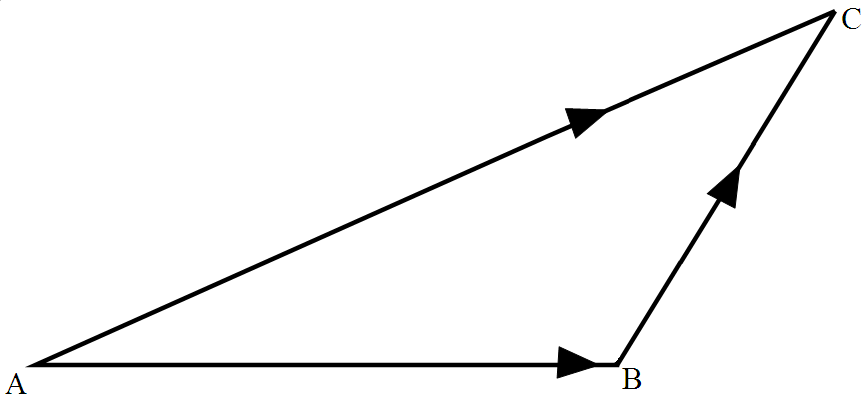
In figure, which of the following is not true?
  • A
    $​​​​​\overrightarrow{\text{AB}}+\overrightarrow{\text{BC}}+\overrightarrow{\text{CA}}=\vec0$
  • B
    $​​​​​\overrightarrow{\text{AB}}+\overrightarrow{\text{BC}}-\overrightarrow{\text{AC}}=\vec0$
  • $​​​​​\overrightarrow{\text{AB}}+\overrightarrow{\text{BC}}-\overrightarrow{\text{CA}}=\vec0$
  • D
    $​​​​​\overrightarrow{\text{AB}}-\overrightarrow{\text{CB}}+\overrightarrow{\text{CA}}=\vec0$
Answer
Correct option: C.
$​​​​​\overrightarrow{\text{AB}}+\overrightarrow{\text{BC}}-\overrightarrow{\text{CA}}=\vec0$
We have, LHS = $\overrightarrow{\text{AB}}+\overrightarrow{\text{BC}}-\overrightarrow{\text{AC}}=\overrightarrow{\text{AC}}-\overrightarrow{\text{CA}}$ $\Big[\because​​\overrightarrow{\text{AB}}+\overrightarrow{\text{BC}}=\overrightarrow{\text{AC}}\Big]$
$=-\overrightarrow{\text{CA}}-\overrightarrow{\text{CA}}$
$=-2\overrightarrow{\text{CA}}$
So, $\text{LHS}\neq\text{RHS}$
Hence, It is not true.
View full question & answer
MCQ 1541 Mark
If $\vec{\text{a}},\ \vec{\text{b}}$ are the vectors forming consecutive sides of a regular hexagon ABCDEF, then the vector representing side CD is,
  • A
    $\vec{\text{a}}+\vec{\text{b}}$
  • B
    $\vec{\text{a}}-\vec{\text{b}}$
  • $\vec{\text{b}}-\vec{\text{a}}$
  • D
    $-\big(\vec{\text{a}}+\vec{\text{b}}\big)$
Answer
Correct option: C.
$\vec{\text{b}}-\vec{\text{a}}$
Let ABCDEF be a regular hexagon such that $\overrightarrow{\text{AB}}=\vec{\text{a}}$ and $\overrightarrow{\text{BC}}=\vec{\text{b}}$. We know, AD is parallel to BC such that AD = 2BC.
$\therefore\ \overrightarrow{\text{AD}}=2\overrightarrow{\text{BC}}=2\vec{\text{b}}$
In $\triangle{\text{ABC}}$, we have
$\overrightarrow{\text{AB}}+\overrightarrow{\text{BC}}=\overrightarrow{\text{AC}}$
$\Rightarrow\ \vec{\text{a}}+\vec{\text{b}}=\overrightarrow{\text{AC}}$
In $\triangle{\text{ACD}}$, we have
$\overrightarrow{\text{AC}}+\overrightarrow{\text{CD}}=\overrightarrow{\text{AD}}$
$\Rightarrow\overrightarrow{\text{CD}}=\overrightarrow{\text{AD}}-\overrightarrow{\text{AC}}$
$\Rightarrow\overrightarrow{\text{CD}}=2\vec{\text{b}}-\big(\vec{\text{a}}+\vec{\text{b}}\big)$
$\Rightarrow\overrightarrow{\text{CD}}=\vec{\text{b}}-\vec{\text{a}}$
View full question & answer
MCQ 1551 Mark
Two or more vectors having the same initial point are:
  • Coinitial vectors
  • B
    colinear vectors
  • C
    equal vectors
  • D
    Cannot say
Answer
Correct option: A.
Coinitial vectors
Two or more vectors having same initial points are known as co-initial vectors.
View full question & answer
MCQ 1561 Mark
If A(6, 3, 2), B(5, 1, 4), C(3, −4, 7), D(0, 2, 5) are four points, then projection of CD on AB is:
  • $-\frac{13}{7}$
  • B
    $-\frac{13}{7}$
  • C
    $-\frac{3}{13}$
  • D
    $-\frac{7}{13}$
Answer
Correct option: A.
$-\frac{13}{7}$
$-\frac{13}{7}$
View full question & answer
MCQ 1571 Mark
The vector equation of the plane passing through $\vec{\text{a}},\ \vec{\text{b}},\ \vec{\text{c}},$ is $\vec{\text{r}}=\alpha\vec{\text{a}}+\beta\vec{\text{b}}+\gamma\vec{\text{c}}$, provided that,
  • A
    $\alpha+\beta+\gamma=0$
  • $\alpha+\beta+\gamma=1$
  • C
    $\alpha+\beta=\gamma$
  • D
    $\alpha^2+\beta^2+\gamma^2=1$
Answer
Correct option: B.
$\alpha+\beta+\gamma=1$
Given: A plane passing through $\vec{\text{a}},\ \vec{\text{b}},\ \vec{\text{c}}$.
⇒ Lines $\vec{\text{a}}-\vec{\text{b}}$ and $\vec{\text{c}}-\vec{\text{a}}$ lie on the plane.
The parmetric equation of the plane can be written as:
$\vec{\text{r}}=\vec{\text{a}}+\lambda_1\big(\vec{\text{a}}-\vec{\text{b}}\big)+\lambda_2\big(\vec{\text{c}}-\vec{\text{a}}\big)$
$\vec{\text{r}}=\vec{\text{a}}(1+\lambda_1+\lambda_2)-\lambda_1\vec{\text{b}}+\lambda_2\vec{\text{c}}$
Given that $\vec{\text{r}}=\alpha\vec{\text{a}}+\beta\vec{\text{b}}+\gamma\vec{\text{c}}$
$\therefore\alpha+\beta+\gamma=1+\lambda_1-\lambda_2-\lambda_1+\lambda_2$
$\alpha+\beta+\gamma=1$
View full question & answer
MCQ 1581 Mark
The system of vectors i, j, k is:
  • Orthogonal
  • B
    Collinear
  • C
    Coplana
  • D
    None of these
Answer
Correct option: A.
Orthogonal
Since i, j, k represent unit vector in the direction of X, Y and Z axis respectively.
$\therefore$ they are orthogonal.
View full question & answer
MCQ 1591 Mark
The direction cosines l, m and n of two lines are connected by the relations l + m + n = 0, l m = 0, then the angles between them is:
  • $\frac{\pi}{3}$
  • B
    $\frac{\pi}{4}$
  • C
    $\frac{\pi}{2}$
  • D
    0
Answer
Correct option: A.
$\frac{\pi}{3}$
$\frac{\pi}{3}$
View full question & answer
MCQ 1601 Mark
$\mid\text{a}\times\text{b}\mid^2+\mid\text{a.b}\mid^2=144$ and $\mid\text{a}\mid=4$ then $\mid\text{b}\mid$ is equal to:
  • A
    12
  • 3
  • C
    8
  • D
    4
Answer
Correct option: B.
3
3
View full question & answer
MCQ 1611 Mark
The vector $\cos\alpha\cos\beta\hat{\text{i}}+\cos\alpha\sin\beta\hat{\text{j}}+\sin\alpha\hat{\text{k}}$ is a,
  • A
    Null vector.
  • Unit vector.
  • C
    Constant vector.
  • D
    None of these.
Answer
Correct option: B.
Unit vector.
Given: The vector $\cos\alpha\cos\beta\hat{\text{i}}+\cos\alpha\sin\beta\hat{\text{j}}+\sin\alpha\hat{\text{k}}$. Then,
$\big|\cos\alpha\cos\beta\hat{\text{i}}+\cos\alpha\sin\beta\hat{\text{j}}+\sin\alpha\hat{\text{k}}\big|$
$=\sqrt{\cos^2\alpha\cos^2\beta+\cos^2\alpha\sin^2\beta+\sin^2\alpha}$
$=\sqrt{\cos^2\alpha+\sin^2\alpha}=1$
View full question & answer
MCQ 1621 Mark
If O and O' are circumcenter and orthocenter of $\triangle{\text{ABC}}$ , then $\overrightarrow{\text{OA}}+\overrightarrow{\text{OB}}+\overrightarrow{\text{OC}}$ equals,
  • A
    $2\overrightarrow{\text{OO}'}$
  • $\overrightarrow{\text{OO}'}$
  • C
    $\overrightarrow{\text{O}'\text{O}}$
  • D
    $2\overrightarrow{\text{O}'\text{O}}$
Answer
Correct option: B.
$\overrightarrow{\text{OO}'}$
Given: O be the circumcentre an O' be the orthocenter of $\triangle{\text{ABC}}$. Let G be the centroid of the triangle.
We know that O, G and H are collinear and by geometry $\overrightarrow{\text{O}'\text{G}}=2\overrightarrow{\text{OG}}$. This yields, $\overrightarrow{\text{O}'\text{O}}=\overrightarrow{\text{O}'\text{G}}+\overrightarrow{\text{GO}}=2\overrightarrow{\text{GO}}+\overrightarrow{\text{GO}}=3\overrightarrow{\text{GO}}$
In other words $\overrightarrow{\text{OO}'}=3\overrightarrow{\text{GO}}$
Since, $\overrightarrow{\text{OG}}=\frac{\vec{\text{a}}+\vec{\text{b}}+\vec{\text{c}}}3$
$\therefore\overrightarrow{\text{OO}'}=3\times\frac{\vec{\text{a}}+\vec{\text{b}}+\vec{\text{c}}}3=\vec{\text{a}}+\vec{\text{b}}+\vec{\text{c}}$
$=\overrightarrow{\text{OA}}+\overrightarrow{\text{OB}}+\overrightarrow{\text{OC}}$
View full question & answer
MCQ 1631 Mark
If $\hat{\text{i}},\hat{\text{j}},\hat{\text{k}}$ are unit vectors, then
  • A
    $\hat{\text{i}}.\hat{\text{j}}=1$
  • $\hat{\text{i}}.\hat{\text{i}}=1$
  • C
    $\hat{\text{i}}\times\hat{\text{j}}=1$
  • D
    $\hat{\text{i}}\times\big(\hat{\text{j}}\times\hat{\text{k}}\big)=1$
Answer
Correct option: B.
$\hat{\text{i}}.\hat{\text{i}}=1$
Let us check each option one by one.
  1. We know
$\hat{\text{i}}.\hat{\text{j}}=0$

$\neq1$
  1. We know
$\hat{\text{i}}.\hat{\text{i}}=|\hat{\text{i}}|^2$

$=1^2$

$=1$
  1. $\hat{\text{i}}\times\hat{\text{j}}=\hat{\text{k}}$
$\neq1$
  1. $\hat{\text{i}}\times\big(\hat{\text{i}}\times\hat{\text{k}}\big)=\hat{\text{i}}\times\hat{\text{i}}$
$=0$

$\neq1$
View full question & answer
MCQ 1641 Mark
Choose the correct answer from the given four options.
The vectors from origin to the points A and B are $\vec{\text{a}}=2\hat{\text{i}}-3\hat{\text{j}}+2\hat{\text{k}}$ and $\vec{\text{b}}=2\hat{\text{i}}+3\hat{\text{j}}+\hat{\text{k}},$ respectively, then the area of the triangle OAB is:
  • A
    $340$
  • B
    $\sqrt{25}$
  • C
    $\sqrt{229}$
  • $\frac{1}{2}\sqrt{229}$
Answer
Correct option: D.
$\frac{1}{2}\sqrt{229}$
$\therefore$ Area of $\triangle\text{OAB}=\frac{1}{2}|\overrightarrow{\text{OA}}\times\overrightarrow{\text{OB}}|$
$=\frac{1}{2}|(2\hat{\text{i}}-3\hat{\text{j}}+2\hat{\text{k}})\times(2\hat{\text{i}}+3\hat{\text{j}}+\hat{\text{k}})|$
$=\frac{1}{2}\begin{vmatrix}\hat{\text{i}}&\hat{\text{j}}&\hat{\text{k}} \\2&-3&2\\2&3&1 \end{vmatrix}$
$=\frac{1}{2}|[\hat{\text{i}}(-3-6)-\hat{\text{j}}(2-4)+\hat{\text{k}}(6+6)]|$
$=\frac{1}{2}|-9\hat{\text{i}}+2\hat{\text{j}}+12\hat{\text{k}}|$
$\therefore$ Area of $\triangle\text{OAB}=\frac{1}{2}\sqrt{81+4+144}$
$=\frac{1}{2}\sqrt{229}$
View full question & answer
MCQ 1651 Mark
Point (4, 0) lies on:
  • A
    $\vec{\text{XO}}$
  • B
    $\vec{\text{YO}}$
  • $\vec{\text{OX}}$
  • D
    $\vec{\text{OY}}$
Answer
Correct option: C.
$\vec{\text{OX}}$
$\vec{\text{XO}}$ is positive x-axis, so (4, 0) lies on it.
View full question & answer
MCQ 1661 Mark
Choose the correct answer from the given four options.
The vector having initial and terminal points as (2, 5, 0) and (–3, 7, 4), respectively is:
  • A
    $-\hat{\text{i}}+12\hat{\text{j}}+4\hat{\text{k}}$
  • B
    $-5\hat{\text{i}}+2\hat{\text{j}}-4\hat{\text{k}}$
  • $-5\hat{\text{i}}+12\hat{\text{j}}+4\hat{\text{k}}$
  • D
    $\hat{\text{i}}+\hat{\text{j}}+\hat{\text{k}}$
Answer
Correct option: C.
$-5\hat{\text{i}}+12\hat{\text{j}}+4\hat{\text{k}}$
Given points are (2, 5, 0) and (–3, 7, 4).

Thus, the required vector $=(-3-2)\hat{\text{i}}+(7-5)\hat{\text{j}}+(4-0)\hat{\text{k}}$

$=-5\hat{\text{i}}+2\hat{\text{j}}+4\hat{\text{k}}$
View full question & answer
MCQ 1671 Mark
If AD, BE and CF are $\triangle\text{ABC},$ then $\vec{\text{AD}}+\vec{\text{BE}}+\vec{\text{CF​}}$
  • $\vec{0}$
  • B
    1
  • C
    0
  • D
    2
Answer
Correct option: A.
$\vec{0}$
$\vec{0}$
View full question & answer
MCQ 1681 Mark
The equation of normal to the curve $3x^2 - y^2 = 8$ which is parallel to the line $x + 3y = 8$ is:
  • A
    $3x - y = 8$
  • B
    $3x + y + 8 = 0$
  • $\text{x + 3y} \underline{+} 8 = 0$
  • D
    $x + 3y = 0$
Answer
Correct option: C.
$\text{x + 3y} \underline{+} 8 = 0$
View full question & answer
MCQ 1691 Mark
What is direction of vector $\vec{\text{a}}$ if it is multiplied with $-\lambda$:
  • A
    Downwards
  • B
    Upwards
  • C
    Same
  • Opposite
Answer
Correct option: D.
Opposite
If the vector is multiplied with $-\lambda$ then its direction become opposite as the direction in which it was previous may be positive or negative. After it is multiplied with a negative value then its direction becomes exactly opposite to the previous direction.
View full question & answer
MCQ 1701 Mark
If $\vec{a}$ is a nonzero vector of magnitude 'a' and $\lambda$ a nonzero scalar, then $\lambda\ \vec{a}$ is unit vector if
  • A
    $\lambda=1$
  • B
    $\lambda=-1$
  • C
    $a=\big|\lambda\big|$
  • $a=1/\big|\lambda\big|$
Answer
Correct option: D.
$a=1/\big|\lambda\big|$
Given: $ \vec{a}$ is a non-zero vector of magnitude a $ \Rightarrow\ \ \ |\vec{a}|=1$
Also given $\lambda\neq0\ \text{and}\ \lambda\vec{a}$ is a unit vector.
$\Rightarrow\ \ |\lambda\vec{a}|=1\ \Rightarrow\ \ |\lambda|\big|\vec{a}\big|=1$
$\Rightarrow\ \ \ \ \ \ |\lambda|a=1\ \ \Rightarrow\ \ a=\frac{1}{|\lambda|}$
Therefore, option (D) is correct.
View full question & answer
MCQ 1711 Mark
Which of the following represents collinear but not equal vectors:
  • a, c
  • B
    b, d
  • C
    b, m
  • D
    Both (a) and (b)
Answer
Correct option: A.
a, c
a, c
View full question & answer
M.C.Q (1 Marks) - Page 4 - MATHS STD 12 Science Questions - Vidyadip