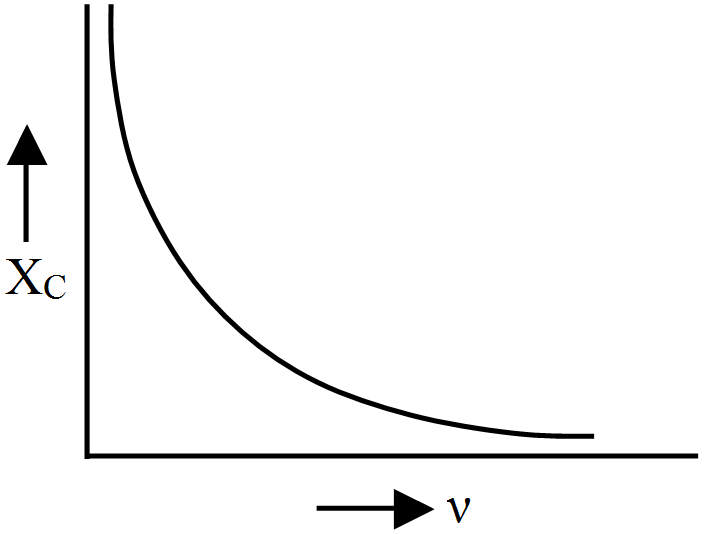
What will be the effect on inductive reactance XL and capacitive reactance XC if frequency of ac source is increased?
Answer
The inductive reactance $\text{X}_{\text{L}}=\omega\text{L}=2\pi\text{vL}$ will increase with the increase of frequency v, while capacitive reactance $\text{X}_{\text{C}}=\frac{1}{\omega\text{C}}=\frac{1}{2\pi\text{vC}}$ will decrease with the increase of frequency v.
Suppose the initial charge on the capacitor in Exercise 7.7 is 6mC. What is the total energy stored in the circuit initially? What is the total energy at later time?
Answer
Capacitance of the capacitor, $\mathrm{C}=30 \mu \mathrm{~F}=30 \times 10^{-6} \mathrm{~F}$
Inductance of the inductor, $\mathrm{L}=27 \mathrm{mH}=27 \times 10^{-3} \mathrm{H}$ Charge on
the capacitor, $\mathrm{Q}=6 \mathrm{mC}=6 \times 10^{-3} \mathrm{C}$
Total energy stored in the capacitor can be calculated by the relation,
$\text{E}=\frac{1}{2}\frac{\text{Q}^2}{\text{C}}$
$=\frac{1}{2}\times\frac{(6\times10^{-3})^2}{30\times10^{-6}}$
$=\frac{6}{10}=0.6\text{J}$
Total energy at a later time will remain the same because energy is shared between the capacitor and the inductor.
A choke coil in series with a lamp is connected to a dc line. The lamp is seen to shine brightly. Insertion of an iron core in the choke causes no change in the lamp’s brightness. Predict the corresponding observations if the connection is to an ac line.
Answer
If an iron core is inserted in the choke coil (which is in series with a lamp connected to the ac line), then the lamp will glow dimly. This is because the choke coil and the iron core increase the impedance of the circuit.
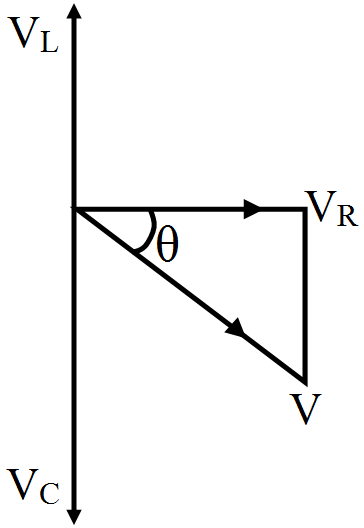
Can the voltage drop across the inductor or the capacitor in a series LCR circuit be greater than the applied voltage of the a.c. source? Justify your answer.
Answer
Yes; because As $V_C$and $V_L$ have opposite faces, $V_C$ or $V_L$ may be greater than V. The situation may be as shown in figure where $V_C > V$
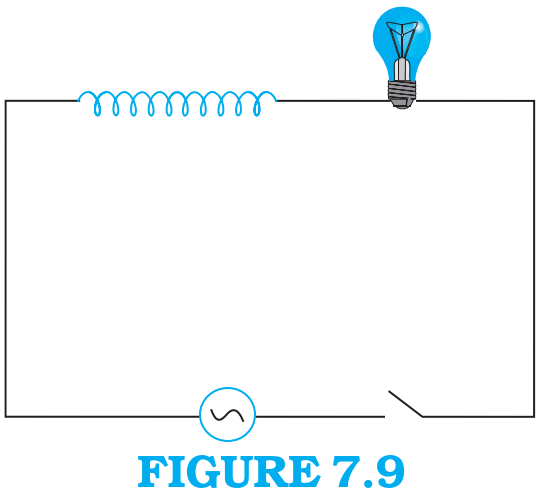
A light bulb and an open coil inductor are connected to an ac source through a key as shown in Fig. 7.9. The switch is closed and after sometime, an iron rod is inserted into the interior of the inductor. The glow of the light bulb (a) increases; (b) decreases; (c) is unchanged, as the iron rod is inserted. Give your answer with reasons.
Answer
As the iron rod is inserted, the magnetic field inside the coil magnetizes the iron increasing the magnetic field inside it. Hence, the inductance of the coil increases. Consequently, the inductive reactance of the coil increases. As a result, a larger fraction of the applied ac voltage appears across the inductor, leaving less voltage across the bulb. Therefore, the glow of the light bulb decreases.
A $15.0 \mu F$ capacitor is connected to a $220 V , 50 Hz$ source. Find the capacitive reactance and the current (rms and peak) in the circuit. If the frequency is doubled, what happens to the capacitive reactance and the current?
Answer
The capacitive reactance is $ X_C=\frac{1}{2 \pi v C}=\frac{1}{2 \pi(50 Hz )\left(15.0 \times 10^{-6} F \right)}=212 \Omega $ The rms current is $ I=\frac{V}{X_C}=\frac{220 V }{212 \Omega}=1.04 A $ The peak current is $ i_m=\sqrt{2} I=(1.41)(1.04 A )=1.47 A $ This current oscillates between $+1.47 A$ and $-1.47 A$, and is ahead of the voltage by $\pi / 2$. If the frequency is doubled, the capacitive reactance is halved and consequently, the current is doubled.
A lamp is connected in series with a capacitor. Predict your observations for dc and ac connections. What happens in each case if the capacitance of the capacitor is reduced?
Answer
When a de source is connected to a capacitor, the capacitor gets charged and after charging no current flows in the circuit and the lamp will not glow. There will be no change even if $C$ is reduced. With ac source, the capacitor offers capacitative reactance $(1 / \omega C)$ and the current flows in the circuit. Consequently, the lamp will shine. Reducing $C$ will increase reactance and the lamp will shine less brightly than before.
A light bulb is rated at $100 W$ for a $220 V$ supply. Find (a) the resistance of the bulb; (b) the peak voltage of the source; and (c) the rms current through the bulb.
Answer
(a) We are given $P=100 W$ and $V=220 V$. The resistance of the bulb is $ R=\frac{V^2}{P}=\frac{(220 V )^2}{100 W }=484 \Omega $ (b) The peak voltage of the source is $ v_m=\sqrt{2} V =311 V $ (c) Since, $P=I V$ $ I=\frac{P}{V}=\frac{100 W }{220 V }=0.454 A $