Questions · Page 3 of 3

5 Marks Questions

Question 1015 Marks
A wire of resistance $15.0\Omega$ is bent to form a regular hexagon ABCDEFA. Find the equivalent resistance of the loop between the points (a) A and B (b) A and C and (c) A and D.
Answer
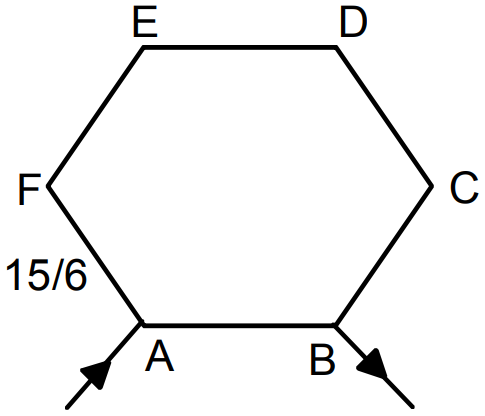
  1. $\text{R}_\text{eff}=\frac{\frac{15\times5}{6}\times\frac{15}{6}}{\frac{15\times5}{6}+\frac{15}{6}}=\frac{\frac{15\times5\times15}{6\times6}}{\frac{75+15}{6}}$
$=\frac{15\times5\times15}{6\times90}=\frac{25}{12}=2.08\Omega$
  1. Across AC,
$\text{R}_\text{eff}=\frac{\frac{15\times4}{6}\times\frac{15\times2}{6}}{\frac{15\times4}{6}+\frac{15\times2}{6}}=\frac{\frac{15\times4\times15\times2}{6\times6}}{\frac{60+30}{6}}$

$=\frac{15\times4\times15\times2}{6\times90}=\frac{10}{3}=3.33\Omega$
  1. Across AD,
$\text{R}_\text{eff}=\frac{\frac{15\times3}{6}\times\frac{15\times3}{6}}{\frac{15\times3}{6}+\frac{15\times3}{6}}=\frac{\frac{15\times3\times15\times3}{6\times6}}{\frac{60+30}{6}}$

$=\frac{15\times3\times15\times3}{6\times90}=\frac{15}{4}=3.75\Omega.$
View full question & answer
Question 1025 Marks
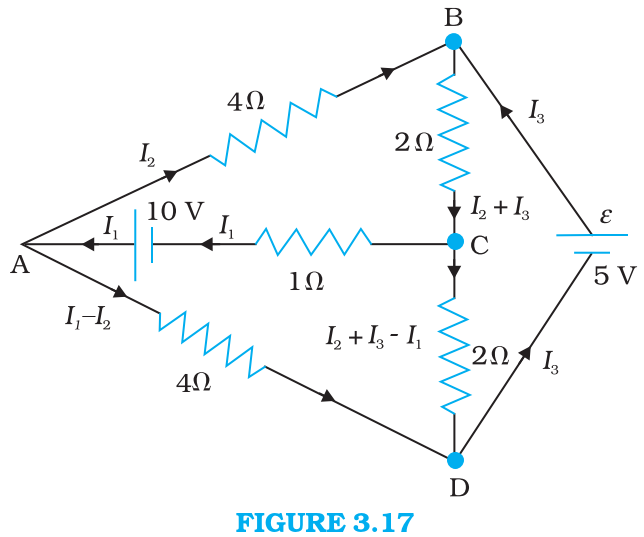
Determine the current in each branch of the network shown in Fig. $3.17.$
Image
Answer
Each branch of the network is assigned an unknown current to be determined by the application of Kirchhoffs rules. To reduce the number of unknowns at the outset, the first rule of Kirchhoff is used at every junction to assign the unknown current in each branch. We then have three unknowns $I_1, I_2$ and $I_3$ which can be found by applying the second rule of Kirchhoff to three different closed loops. Kirchhoffs second rule for the closed loop $\text{ADCA}$ gives,
$10-4\left(I_1-I_2\right)+2\left(I_2+I_3-I_1\right)-I_1=0 \quad\quad\text{[3.61(a)]}$
that is, $7 I_1-6 I_2-2 I_3=10$
For the closed loop $\text{ABCA,}$ we get
$10-4 I_2-2\left(I_2+I_3\right)-I_1=0 \quad\quad\text{[3.61(b)]}$
that is, $I_1+6 I_2+2 I_3=10$
For the closed loop $\text{BCDEB,}$ we get
$5-2\left(I_2+I_3\right)-2\left(I_2+I_3-I_1\right)=0 \quad\quad\text{[3.61(c)]}$
that is, $2 I_1-4 I_2-4 I_3=-5$
Equations $( 3.61 a , b , c )$ are three simultaneous equations in three unknowns. These can be solved by the usual method to give
$I_1=2.5 A , I_2=\frac{5}{8} A , I_3=1 \frac{7}{8} A$
The currents in the various branches of the network are
$AB : \frac{5}{8} A , CA : 2 \frac{1}{2} A , DEB : 1 \frac{7}{8} A$
$AD : 1 \frac{7}{8} A , CD : 0 A , BC : 2 \frac{1}{2} A$
It is easily verified that Kirchhoff's second rule applied to the remaining closed loops does not provide any additional independent equation, that is, the above values of currents satisfy the second rule for every closed loop of the network. For example, the total voltage drop over the closed loop $\text{BADEB}$
$5 V +\left(\frac{5}{8} \times 4\right) V -\left(\frac{15}{8} \times 4\right) V$
equal to zero, as required by Kirchhoffs second rule.
View full question & answer
Question 1035 Marks
(a) Estimate the average drift speed of conduction electrons in a copper wire of cross-sectional area $1.0 \times 10^{-7} m ^2$ carrying a current of 1.5 A. Assume that each copper atom contributes roughly one conduction electron. The density of copper is $9.0 \times 10^3 kg / m ^3$, and its atomic mass is $63.5 u$. (b) Compare the drift speed obtained above with, (i) thermal speeds of copper atoms at ordinary temperatures, (ii) speed of propagation of electric field along the conductor which causes the drift motion.
Answer
(a) The direction of drift velocity of conduction electrons is opposite to the electric field direction, i.e., electrons drift in the direction of increasing potential. The drift speed $v_d$ is given by Eq. (3.18) $v_d=(I / n e A)$
Now, $e=1.6 \times 10^{-19} C , A=1.0 \times 10^{-7} m ^2, I=1.5 A$. The density of conduction electrons, $n$ is equal to the number of atoms per cubic metre (assuming one conduction electron per $Cu$ atom as is reasonable from its valence electron count of one). A cubic metre of copper has a mass of $9.0 \times 10^3 kg$. Since $6.0 \times 10^{23}$ copper atoms have a mass of $63.5 g$,
$
\begin{aligned}
n & =\frac{6.0 \times 10^{23}}{63.5} \times 9.0 \times 10^6 \\
& =8.5 \times 10^{28} m ^{-3}
\end{aligned}
$
which gives,
$
\begin{aligned}
v_d & =\frac{1.5}{8.5 \times 10^{28} \times 1.6 \times 10^{-19} \times 1.0 \times 10^{-7}} \\
& =1.1 \times 10^{-3} m s ^{-1}=1.1 mm s ^{-1}
\end{aligned}
$

(b) (i) At a temperature $T$, the thermal speed* of a copper atom of mass $M$ is obtained from $\left[<(1 / 2) M v^2>=(3 / 2) k_{ B } T\right]$ and is thus typically of the order of $\sqrt{k_B T / M}$, where $k_B$ is the Boltzmann constant. For copper at $300 K$, this is about $2 \times 10^2 m / s$. This figure indicates the random vibrational speeds of copper atoms in a conductor. Note that the drift speed of electrons is much smaller, about $10^{-5}$ times the typical thermal speed at ordinary temperatures.
(ii) An electric field travelling along the conductor has a speed of an electromagnetic wave, namely equal to $3.0 \times 10^8 m s ^{-1}$ (You will learn about this in Chapter 8). The drift speed is, in comparison, extremely small; smaller by a factor of $10^{-11}$.
View full question & answer
5 Marks Questions - Page 3 - Physics STD 12 Science Questions - Vidyadip