The e.m.f. of a standard cell balances across 150 cm length of a wire of potentiometer. When a resistance of 2 Ω is connected as a shunt with the cell, the balance point is obtained at 100 cm. The internal resistance of the cell is
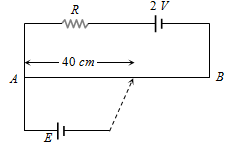
Resistance of 100 cm long potentiometer wire is 10 W, it is connected to a battery (2 volt) and a resistance R in series. A source of 10 mV gives null point at 40 cm length, then external resistance R is
The length of a wire of a potentiometer is 100 cm, and the emf of its standard cell is E volt. It is employed to measure the e.m.f of a battery whose internal resistance is 0.5 $\Omega$. If the balance point is obtained at l = 30 cm from the positive end, the e.m.f. of the battery is (where i is the current in the potentiometer)
A galvanometer, having a resistance of 50 W gives a full scale deflection for a current of 0.05 A. The length in meter of a resistance wire of area of cross-section $2.97 \times 10^{-2} \mathrm{~cm}^2$ that can be used to convert the galvanometer into an ammeter which can read a maximum of 5 A current is (Specific resistance of the wire = $5 \times 10^{-7} \Omega \mathrm{m}$)
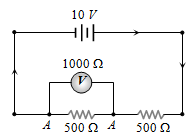
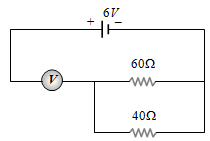
Two resistances of 400 W and 800 W are connected in series with 6 volt battery of negligible internal resistance. A voltmeter of resistance 10,000 W is used to measure the potential difference across 400 W. The error in the measurement of potential difference in volts approximately is
A potentiometer has uniform potential gradient. The specific resistance of the material of the potentiometer wire is $10^{-7}$ ohm–meter and the current passing through it is 0.1 ampere; cross-section of the wire is $10^{-6} \mathrm{~m}^2$. The potential gradient along the potentiometer wire is
A 50 ohm galvanometer gets full scale deflection when a current of 0.01 A passes through the coil. When it is converted to a 10 A ammeter, the shunt resistance is
A galvanometer of resistance 36 W is changed into an ammeter by using a shunt of 4 W. The fraction $f_0$ of total current passing through the galvanometer is
An ammeter of 100 W resistance gives full deflection for the current of $10^{-5}$ amp. Now the shunt resistance required to convert it into ammeter of 1 amp. range, will be
A cell of internal resistance 3 ohm and emf 10 volt is connected to a uniform wire of length 500 cm and resistance 3 ohm. The potential gradient in the wire is
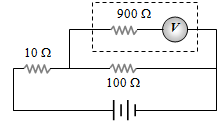
The potential difference across the 100 W resistance in the following circuit is measured by a voltmeter of 900 W resistance. The percentage error made in reading the potential difference is
Voltmeters $\mathrm{V}_1$ and $\mathrm{V}_2$ are connected in series across a $D.C.$ line. $\mathrm{V}_1$ reads $80$ volts and has a per volt resistance of $200$ ohms. $\mathrm{V}_2$ has a total resistance of $32$ kilo ohms. The line voltage is
A potentiometer has uniform potential gradient across it. Two cells connected in series
(i) to support each other and
(ii) to oppose each other are balanced over 6m and 2m respectively on the potentiometer wire.
The e.m.f.’s of the cells are in the ratio of
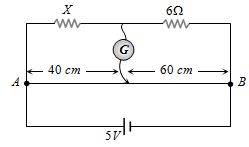
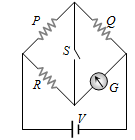
In the circuit shown, a meter bridge is in its balanced state. The meter bridge wire has a resistance 0.1 ohm/cm. The value of unknown resistance X and the current drawn from the battery of negligible resistance is
A galvanometer has a resistance of 25 ohm and a maximum of 0.01 A current can be passed through it. In order to change it into an ammeter of range 10 A, the shunt resistance required is
A galvanometer of 25 W resistance can read a maximum current of 6mA. It can be used as a voltmeter to measure a maximum of 6 V by connecting a resistance to the galvanometer. Identify the correct choice in the given answers
A galvanometer with a resistance of 12 W gives full scale deflection when a current of 3 mA is passed. It is required to convert it into a voltmeter which can read up to 18 V. the resistance to be connected is
A 10 m long wire of 20W resistance is connected with a battery of 3 volt e.m.f. (negligible internal resistance) and a 10 W resistance is joined to it is series. Potential gradient along wire in volt per meter is
There are three voltmeters of the same range but of resistances 1000Ω, 8000 Ω and 4000 Ω respectively. The best voltmeter among these is the one whose resistance is
A galvanometer of resistance 20 W is to be converted into an ammeter of range 1 A. If a current of 1 mA produces full scale deflection, the shunt required for the purpose is
A wire of length 100 cm is connected to a cell of emf 2 V and negligible internal resistance. The resistance of the wire is 3 W. The additional resistance required to produce a potential drop of 1 milli volt per cm is
An ammeter and a voltmeter of resistance R are connected in series to an electric cell of negligible internal resistance. Their readings are A and V respectively. If another resistance R is connected in parallel with the voltmeter
A milliammeter of range 10 mA has a coil of resistance 1 W. To use it as voltmeter of range 10 volt, the resistance that must be connected in series with it, will be
In a potentiometer experiment two cells of e.m.f. $E_1$ and $E_2$ are used in series and in conjunction and the balancing length is found to be 58 cm of the wire. If the polarity of $E_2$ is reversed, then the balancing length becomes 29 cm. The ratio $\frac{E_1}{E_2}$ of the e.m.f. of the two cells is
A voltmeter having resistance of $50 \times 10^3$ ohm is used to measure the voltage in a circuit. To increase the range of measurement $3$ times the additional series resistance required is
An ammeter gives full deflection when a current of 2 amp. flows through it. The resistance of ammeter is 12 ohms. If the same ammeter is to be used for measuring a maximum current of 5 amp., then the ammeter must be connected with a resistance of
AB is a potentiometer wire of length 100 cm and its resistance is 10 ohms. It is connected in series with a resistance R = 40 ohms and a battery of e.m.f. 2 V and negligible internal resistance. If a source of unknown e.m.f. E is balanced by 40 cm length of the potentiometer wire, the value of E is
A potentiometer having the potential gradient of 2 mV/cm is used to measure the difference of potential across a resistance of 10 ohm. If a length of 50 cm of the potentiometer wire is required to get the null point, the current passing through the 10 ohm resistor is (in mA)
In a meter bridge, the balancing length from the left end (standard resistance of one ohm is in the right gap) is found to be 20 cm. The value of the unknown resistance is
A potentiometer consists of a wire of length 4 m and resistance 10Ω. It is connected to a cell of e.m.f. 2 V. The potential difference per unit length of the wire will be
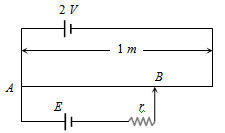
In the given figure, battery E is balanced on 55 cm length of potentiometer wire but when a resistance of 10 W is connected in parallel with the battery then it balances on 50 cm length of the potentiometer wire then internal resistance r of the battery is
For a cell of e.m.f. 2V, a balance is obtained for 50 cm of the potentiometer wire. If the cell is shunted by a 2Ω resistor and the balance is obtained across 40 cm of the wire, then the internal resistance of the cell is