Questions · Page 4 of 11

M.C.Q (1 Marks)

MCQ 1511 Mark
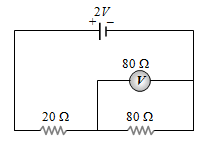
In the adjoining circuit, the e.m.f. of the cell is 2 volt and the internal resistance is negligible. The resistance of the voltmeter is 80 ohm. The reading of the voltmeter will be
  • A
    0.80 volt
  • B
    1.60 volt
  • 1.33 volt
  • D
    2.00 volt
Answer
Correct option: C.
1.33 volt
(c) 1.33 volt
View full question & answer
MCQ 1521 Mark
We have a galvanometer of resistance 25 Ω. It is shunted by a 2.5 Ω wire. The part of total current that flows through the galvanometer is given as
  • $\frac{I}{I_0}=\frac{1}{11}$
  • B
    $\frac{I}{I_0}=\frac{1}{10}$
  • C
    $\frac{I}{I_0}=\frac{3}{11}$
  • D
    $\frac{I}{I_0}=\frac{4}{11}$
Answer
Correct option: A.
$\frac{I}{I_0}=\frac{1}{11}$
(a) $\frac{I}{I_0}=\frac{1}{11}$
View full question & answer
MCQ 1531 Mark
The resistance of 10 metre long potentiometer wire is 1ohm/meter. A cell of e.m.f. 2.2 volts and a high resistance box are connected in series to this wire. The value of resistance taken from resistance box for getting potential gradient of 2.2 millivolt/metre will be
  • A
    790 Ω
  • B
    810 Ω
  • 990 Ω
  • D
    1000 Ω
Answer
Correct option: C.
990 Ω
 990 Ω
View full question & answer
MCQ 1541 Mark
A voltmeter of resistance 1000 Ω gives full scale deflection when a current of 100 mA flow through it. The shunt resistance required across it to enable it to be used as an ammeter reading 1 A at full scale deflection is
  • A
     10000 Ω
  • B
     9000 Ω
  • C
     222 Ω
  •  111 Ω
Answer
Correct option: D.
 111 Ω
111 Ω
View full question & answer
MCQ 1551 Mark
In a potentiometer experiment, the galvanometer shows no deflection when a cell is connected across 60 cm of the potentiometer wire. If the cell is shunted by a resistance of 6Ω, the balance is obtained across 50 cm of the wire. The internal resistance of the cell is
  • A
    0.5 Ω
  • B
    0.6 Ω
  • 1.2 Ω
  • D
     1.5 Ω
Answer
Correct option: C.
1.2 Ω
1.2 Ω
View full question & answer
MCQ 1561 Mark
A galvanometer whose resistance is 120 Ω gives full scale deflection with a current of 0.05 A so that it can read a maximum current of 10 A. A shunt resistance is added in parallel with it. The resistance of the ammeter so formed is
  • A
     0.06 Ω
  • B
     0.006 Ω
  •  0.6 Ω
  • D
     6 Ω s
Answer
Correct option: C.
 0.6 Ω
 0.6 Ω
View full question & answer
MCQ 1571 Mark
An ammeter whose resistance is 180 Ω gives full scale deflection when current is 2 mA. The shunt required to convert it into an ammeter reading 20 mA (in ohms) is.
  • A
     18
  •  20
  • C
     0.1
  • D
     10
Answer
Correct option: B.
 20
 20
View full question & answer
MCQ 1581 Mark
A potentiometer wire has length 10 m and resistance 20Ω. A 2.5 V battery of negligible internal resistance is connected across the wire with an 80 Ω series resistance. The potential gradient on the wire will be
  • $5\times 10^{-5}$ V/mm
  • B
    $2.5\times 10^{-4}$ V/mm
  • C
    $0.62\times 10^{-4}$ V/mm
  • D
    $1\times 10^{-5}$ V/mm
Answer
Correct option: A.
$5\times 10^{-5}$ V/mm
(a) $5\times 10^{-5}$ V/mm
View full question & answer
MCQ 1591 Mark
A galvanometer having a resistance of 8 ohm is shunted by a wire of resistance 2 ohm. If the total current is 1 amp, the part of it passing through the shunt will be
  • A
     0.25 amp
  •  0.8 amp
  • C
     0.2 amp
  • D
     0.5 amp
Answer
Correct option: B.
 0.8 amp
 0.8 amp
View full question & answer
MCQ 1601 Mark
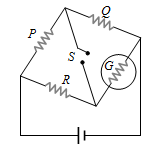
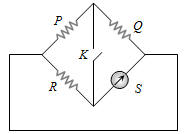
In the following Wheatstone bridge P/Q = R/S. If key K is closed, then the galvanometer will show deflection
  • A
    In left side
  • B
    In right side
  • C
    No deflection
  • In either side
Answer
Correct option: D.
In either side
(d) In either side
View full question & answer
MCQ 1611 Mark
A moving coil galvanometer has a resistance of 50 Ω and gives full scale deflection for 10 mA. How could it be converted into an ammeter with a full scale deflection for 1A.
  • A
     50/99 Ω in series
  •  50/99 Ω in parallel
  • C
     0.01 Ω in series
  • D
     0.01 Ω in parallel
Answer
Correct option: B.
 50/99 Ω in parallel
50/99 Ω in parallel
View full question & answer
MCQ 1621 Mark
The net resistance of a voltmeter should be large to ensure that
  • A
    It does not get overheated
  • B
    It does not draw excessive current
  • C
    It can measure large potential difference
  • It does not appreciably change the potential difference to be measured
Answer
Correct option: D.
It does not appreciably change the potential difference to be measured
 It does not appreciably change the potential difference to be measured
View full question & answer
MCQ 1631 Mark
Constantan wire is used in making standard resistances because its.
  • A
     Specific resistance is low
  • B
     Density is high
  •  Temperature coefficient of resistance is negligible
  • D
    Melting point is high
Answer
Correct option: C.
 Temperature coefficient of resistance is negligible
 Temperature coefficient of resistance is negligible
View full question & answer
MCQ 1641 Mark
A 100 V voltmeter of internal resistance 20 kQ in series with a high resistance R is connected to a 110 V line. The voltmeter reads 5 V, the value of R is
  • A
    210 kΩ
  • B
    315 kΩ
  • 420 kΩ
  • D
    440 kΩ
Answer
Correct option: C.
420 kΩ
420 kΩ
View full question & answer
MCQ 1651 Mark
The resistance of an ideal voltmeter is
  • A
    Zero
  • B
    Very low
  • C
    Very large
  • Infinite
Answer
Correct option: D.
Infinite
 Infinite
View full question & answer
MCQ 1661 Mark
If only 2% of the main current is to be passed through a galvanometer of resistance G, then the resistance of shunt will be
  • A
    $\frac{G}{50}$
  • $\frac{G}{49}$
  • C
    50 G
  • D
    49 G
Answer
Correct option: B.
$\frac{G}{49}$
(b) $\frac{G}{49}$
View full question & answer
MCQ 1671 Mark
The resistivity of a potentiometer wire is $40 \times 10^{-8}$ ohm -m and its area of cross-section is $8{\times 10^{-6} \mathrm{~m}^2}$. If 0.2 amp current is flowing through the wire, the potential gradient will be
  • $10^{-2} \mathrm{volt} / \mathrm{m}$
  • B
    $10^{-1}$ volt $/ \mathrm{m}$
  • C
    $3.2 \times 10^{-2} \mathrm{volt} / \mathrm{m}$
  • D
    1 volt/m
Answer
Correct option: A.
$10^{-2} \mathrm{volt} / \mathrm{m}$
(a) $10^{-2} \mathrm{volt} / \mathrm{m}$
View full question & answer
MCQ 1681 Mark
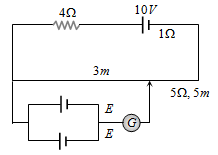
A resistance of 4$\Omega$ and a wire of length 5 metres and resistance 5$\Omega$ are joined in series and connected to a cell of e.m.f. 10 V and internal resistance 1$\Omega$. A parallel combination of two identical cells is balanced across 300 cm of the wire. The e.m.f. E of each cell is
  • A
    1.5 V
  • 3.0 V
  • C
    0.67 V
  • D
    1.33 V
Answer
Correct option: B.
3.0 V
(b) 3.0 V
View full question & answer
MCQ 1691 Mark
The resistance of a galvanometer is 50 ohms and the current required to give full scale deflection is 100μA. In order to convert it into an ammeter, reading upto 10A, it is necessary to put a resistance of
  • A
    $5 \times 10^{-3}\Omega$ in parallel
  • $5 \times 10^{-4}\Omega$ in parallel
  • C
    $10^5\Omega$ in series
  • D
    99,950 $\Omega$ in series
Answer
Correct option: B.
$5 \times 10^{-4}\Omega$ in parallel
(b) $5 \times 10^{-4}\Omega$ in parallel
View full question & answer
MCQ 1701 Mark
A potentiometer wire of length 1 m and resistance 10 W is connected in series with a cell of emf 2V with internal resistance 1 W and a resistance box including a resistance R. If potential difference between the ends of the wire is 1 mV, the value of R is
  • A
    20000 W
  • 19989 W
  • C
    10000 W
  • D
    9989 W
Answer
Correct option: B.
19989 W
19989 W
View full question & answer
MCQ 1711 Mark
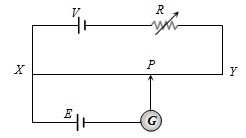
A potentiometer circuit shown in the figure is set up to measure e.m.f. of a cell E. As the point P moves from X to Y the galvanometer G shows deflection always in one direction, but the deflection decreases continuously until Y is reached. In order to obtain balance point between X and Y it is necessary to
  • Decreases the resistance R
  • B
    Increase the resistance R
  • C
    Reverse the terminals of battery V
  • D
    Reverse the terminals of cell E
Answer
Correct option: A.
Decreases the resistance R
(a) Decreases the resistance R
View full question & answer
MCQ 1721 Mark
In an experiment to measure the internal resistance of a cell by potentiometer, it is found that the balance point is at a length of 2m when the cell is shunted by a 5 Ω resistance; and is at a length of 3m when the cell is shunted by a 10 Ω resistance. The internal resistance of the cell is, then
  • A
    1.5 Ω
  • 10 Ω
  • C
    15 Ω
  • D
    1 Ω
Answer
Correct option: B.
10 Ω
10 Ω
View full question & answer
MCQ 1731 Mark
A voltmeter has resistance of 2000 ohms and it can measure upto 2V. If we want to increase its range to 10 V, then the required resistance in series will be
  • A
    2000 Ω
  • B
    4000 Ω
  • C
    6000 Ω
  • 8000 Ω
Answer
Correct option: D.
8000 Ω
8000 Ω
View full question & answer
MCQ 1741 Mark
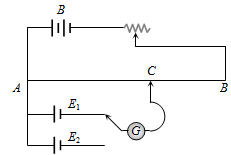
The circuit shown here is used to compare the e.m.f. of two cells $E_1$ and $E_2\left(E_1>E_2\right)$. The null point is at C when the galvanometer is connected to $E_1$. When the galvanometer is connected to $E_2$, the null point will be
  • To the left of C
  • B
    To the right of C
  • C
    At C itself
  • D
    Nowhere on AB
Answer
Correct option: A.
To the left of C
(a) To the left of C
View full question & answer
MCQ 1751 Mark
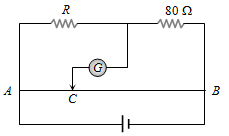
AB is a wire of uniform resistance. The galvanometer G shows no current when the length AC = 20cm and CB = 80 cm. The resistance R is equal to
  • A
    2 Ω
  • B
    8 Ω
  • 20 Ω
  • D
    40 Ω
Answer
Correct option: C.
20 Ω
(c) 20 Ω
View full question & answer
MCQ 1761 Mark
An ammeter with internal resistance 90 Ω reads 1.85 A when connected in a circuit containing a battery and two resistors 700 Ω and 410 Ω in series. Actual current will be
  • A
    1.85 A
  • Greater than 1.85 A
  • C
    Less than 1.85 A
  • D
    None of these
Answer
Correct option: B.
Greater than 1.85 A
Greater than 1.85 A
View full question & answer
MCQ 1771 Mark
Which of the following is correct
  • Ammeter has low resistance and is connected in series
  • B
    Ammeter has low resistance and is connected in parallel
  • C
    Voltmeter has low resistance and is connected in parallel
  • D
    None of the above
Answer
Correct option: A.
Ammeter has low resistance and is connected in series
View full question & answer
MCQ 1781 Mark
For comparing the e.m.f.'s of two cells with a potentiometer, a standard cell is used to develop a potential gradient along the wires. Which of the following possibilities would make the experiment unsuccessful
  • A
    The e.m.f. of the standard cell is larger than the E e.m.f.'s of the two cells
  • B
    The diameter of the wires is the same and uniform throughout
  • C
    The number of wires is ten
  • The e.m.f. of the standard cell is smaller than the e.m.f.'s of the two cells
Answer
Correct option: D.
The e.m.f. of the standard cell is smaller than the e.m.f.'s of the two cells
View full question & answer
MCQ 1791 Mark
A voltmeter having a resistance of 998 ohms is connected to a cell of e.m.f. 2 volt and internal resistance 2 ohm. The error in the measurement of e.m.f. will be
  • A
    $4 \times 10^{-1}$ volt
  • B
    $2 \times 10^{-3}$ volt
  • $4 \times 10^{-3}$ volt
  • D
    $2 \times 10^{-1}$ volt
Answer
Correct option: C.
$4 \times 10^{-3}$ volt
(c) $4 \times 10^{-3}$ volt
View full question & answer
MCQ 1801 Mark
Which is a wrong statement
  • A
    The Wheatstone bridge is most sensitive when all the four resistances are of the same order
  • In a balanced Wheatstone bridge, interchanging the positions of galvanometer and cell affects the balance of the bridge
  • C
    Kirchhoff's first law (for currents meeting at a junction in an electric circuit) expresses the conservation of charge
  • D
    The rheostat can be used as a potential divider
Answer
Correct option: B.
In a balanced Wheatstone bridge, interchanging the positions of galvanometer and cell affects the balance of the bridge
View full question & answer
MCQ 1811 Mark
The resistance of a galvanometer is 25 ohm and it requires 50μA for full deflection. The value of the shunt resistance required to convert it into an ammeter of 5 amp is
  • $2.5 \times 10^{-4} \mathrm{ohm}$
  • B
    $1.25 \times 10^{-3} \mathrm{ohm}$
  • C
    0.05 ohm
  • D
    2.5 ohm
Answer
Correct option: A.
$2.5 \times 10^{-4} \mathrm{ohm}$
(a) $2.5 \times 10^{-4} \mathrm{ohm}$
View full question & answer
MCQ 1821 Mark
In a potentiometer circuit there is a cell of e.m.f. 2 volt, a resistance of 5 ohm and a wire of uniform thickness of length 1000 cm and resistance 15 ohm. The potential gradient in the wire is
  • A
    $\frac{1}{500} \mathrm{~V} / \mathrm{cm}$
  • $\frac{3}{2000} \mathrm{~V} / \mathrm{cm}$
  • C
    $\frac{3}{5000} \mathrm{~V} / \mathrm{cm}$
  • D
    $\frac{1}{1000} \mathrm{~V} / \mathrm{cm}$
Answer
Correct option: B.
$\frac{3}{2000} \mathrm{~V} / \mathrm{cm}$
(b) $\frac{3}{2000} \mathrm{~V} / \mathrm{cm}$
View full question & answer
MCQ 1831 Mark
A galvanometer of resistance 25 Ω gives full scale deflection for a current of 10 milliampere, is to be changed into a voltmeter of range 100 V by connecting a resistance of ‘R’ in series with galvanometer. The value of resistance R in Ω is
  • A
    10000
  • B
    10025
  • C
    975
  • 9975
Answer
Correct option: D.
9975
9975
View full question & answer
MCQ 1841 Mark
The current flowing through a coil of resistance 900 ohms is to be reduced by 90%. What value of shunt should be connected across the coil
  • A
    90 Ω
  • 100 Ω
  • C
    9 Ω
  • D
    10 Ω
Answer
Correct option: B.
100 Ω
100 Ω
View full question & answer
MCQ 1851 Mark
50 Ω and 100 Ω resistors are connected in series. This connection is connected with a battery of 2.4 volts. When a voltmeter of 100 Ω resistance is connected across 100 Ω resistor, then the reading of the voltmeter will be
  • A
    1.6 V
  • B
    1.0 V
  • 1.2 V
  • D
    2.0 V
Answer
Correct option: C.
1.2 V
1.2 V
View full question & answer
MCQ 1861 Mark
A 2 volt battery, a 15 Ω resistor and a potentiometer of 100 cm length, all are connected in series. If the resistance of potentiometer wire is 5 Ω, then the potential gradient of the potentiometer wire is
  • 0.005 V/cm
  • B
    0.05 V/cm
  • C
    0.02 V/cm
  • D
    0.2 V/cm
Answer
Correct option: A.
0.005 V/cm
0.005 V/cm
View full question & answer
MCQ 1871 Mark
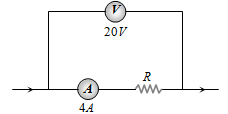
In the diagram shown, the reading of voltmeter is 20 V and that of ammeter is 4 A. The value of R should be (Consider given ammeter and voltmeter are not ideal)
  • A
    Equal to 5Ω
  • B
    Greater from 5 Ω
  • Less than 5 Ω
  • D
    Greater or less than 5 Ω depends on the material of R
Answer
Correct option: C.
Less than 5 Ω
(c) Less than 5 Ω
View full question & answer
MCQ 1881 Mark
Which of the following statement is wrong
  • A
    Voltmeter should have high resistance
  • B
    Ammeter should have low resistance
  • Ammeter is placed in parallel across the conductor in a circuit
  • D
    Voltmeter is placed in parallel across the conductor in a circuit
Answer
Correct option: C.
Ammeter is placed in parallel across the conductor in a circuit
View full question & answer
MCQ 1891 Mark
A voltmeter has a resistance of G ohms and range V volts. The value of resistance used in series to convert it into a voltmeter of range nV volts is
  • A
    nG
  • (n – 1)G
  • C
    $\frac{\mathrm{G}}{n}$
  • D
    $\frac{G}{(n-1)}$
Answer
Correct option: B.
(n – 1)G
(b) (n – 1)G
View full question & answer
MCQ 1901 Mark
Two cells when connected in series are balanced on 8m on a potentiometer. If the cells are connected with polarities of one of the cell is reversed, they balance on 2m. The ratio of e.m.f.'s of the two cells is
  • A
    3 : 5
  • 5 : 3
  • C
    3 : 4
  • D
    4 : 3
Answer
Correct option: B.
5 : 3
5 : 3
View full question & answer
MCQ 1911 Mark
The resistance of a galvanometer is 90 ohms. If only 10 percent of the main current may flow through the galvanometer, in which way and of what value, a resistor is to be used
  • A
    10 ohms in series
  • 10 ohms in parallel
  • C
    810 ohms in series
  • D
    810 ohms in parallel
Answer
Correct option: B.
10 ohms in parallel
10 ohms in parallel
View full question & answer
MCQ 1921 Mark
If in the experiment of Wheatstone's bridge, the positions of cells and galvanometer are interchanged, then balance points will
  • A
    Change
  • Remain unchanged
  • C
    Depend on the internal resistance of cell and resistance of galvanometer
  • D
    None of these
Answer
Correct option: B.
Remain unchanged
Remain unchanged
View full question & answer
MCQ 1931 Mark
In the experiment of potentiometer, at balance, there is no current in the
  • A
    Main circuit
  • Galvanometer circuit
  • C
    Potentiometer circuit
  • D
    Both main and galvanometer circuits
Answer
Correct option: B.
Galvanometer circuit
View full question & answer
MCQ 1941 Mark
If the length of potentiometer wire is increased, then the length of the previously obtained balance point will
  • Increase
  • B
    Decrease
  • C
    Remain unchanged
  • D
    Become two times
Answer
Correct option: A.
Increase
 Increase
View full question & answer
MCQ 1951 Mark
The figure shows a circuit diagram of a ‘Wheatstone Bridge’ to measure the resistance G of the galvanometer. The relation $\frac{P}{Q}=\frac{R}{G}$ will be satisfied only when
  • A
    The galvanometer shows a deflection when switch S is closed
  • B
    The galvanometer shows a deflection when switch S is open
  • The galvanometer shows no change in deflection whether S is open or closed
  • D
    The galvanometer shows no deflection
Answer
Correct option: C.
The galvanometer shows no change in deflection whether S is open or closed
(c) The galvanometer shows no change in deflection whether S is open or closed
View full question & answer
MCQ 1961 Mark
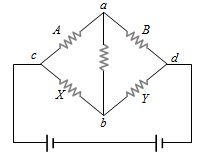
In the Wheatstone's bridge (shown in figure) X = Y and A > B. The direction of the current between ab will be
  • A
    From a to b
  • From b to a
  • C
    From b to a through c
  • D
    From a to b through c
Answer
Correct option: B.
From b to a
(b) From b to a
View full question & answer
MCQ 1971 Mark
In an experiment of meter bridge, a null point is obtained at the centre of the bridge wire. When a resistance of 10 ohm is connected in one gap, the value of resistance in other gap is
  • 10 Ω
  • B
    5 Ω
  • C
    $\frac{1}{5}$ Ω
  • D
    500 Ω
Answer
Correct option: A.
10 Ω
(a) 10 Ω
View full question & answer
MCQ 1981 Mark
Potential gradient is defined as
  • Fall of potential per unit length of the wire
  • B
    Fall of potential per unit area of the wire
  • C
    Fall of potential per unit area of the wire
  • D
    Potential at any one end of the wire
Answer
Correct option: A.
Fall of potential per unit length of the wire
View full question & answer
MCQ 1991 Mark
A galvanometer of 10 ohm resistance gives full scale deflection with 0.01 ampere of current. It is to be converted into an ammeter for measuring 10 ampere current. The value of shunt resistance required will be 
  • $\frac{10}{999}$ ohm
  • B
    0.1 ohm
  • C
    0.5 ohm
  • D
    1.0 ohm
Answer
Correct option: A.
$\frac{10}{999}$ ohm
(a) $\frac{10}{999}$ ohm
View full question & answer
MCQ 2001 Mark
A battery of 6 volts is connected to the terminals of a three metre long wire of uniform thickness and resistance of the order of 100 Ω. The difference of potential between two points separated by 50 cm on the wire will be
  • 1 V
  • B
    1.5 V
  • C
    2 V
  • D
    3 V
Answer
Correct option: A.
1 V
1 V
View full question & answer
M.C.Q (1 Marks) - Page 4 - Physics STD 12 Science Questions - Vidyadip