Questions · Page 1 of 7

M.C.Q (1 Marks)

🎯

Test yourself on this topic

50 questions · timed · auto-graded

MCQ 11 Mark
Assertion : A compass needle when placed on the magnetic north pole of the earth rotates in vertical direction.
Reason : The earth has only horizontal component of its magnetic field at the north poles.
  • A
    If both assertion and reason are true and the reason is the correct explanation of the assertion.
  • B
    If both assertion and reason are true but reason is not the correct explanation of the assertion.
  • C
    If assertion is true but reason is false.
  • If the assertion and reason both are false.
Answer
Correct option: D.
If the assertion and reason both are false.
 If the assertion and reason both are false.
View full question & answer
MCQ 21 Mark
Assertion : Basic difference between an electric line and magnetic line of force is that former is discontinuous and the latter is continuous or endless.
Reason : No electric lines of forces exist inside a charged body but magnetic lines do exist inside a magnet.
  • If both assertion and reason are true and the reason is the correct explanation of the assertion.
  • B
    If both assertion and reason are true but reason is not the correct explanation of the assertion.
  • C
    If assertion is true but reason is false.
  • D
    If the assertion and reason both are false.
Answer
Correct option: A.
If both assertion and reason are true and the reason is the correct explanation of the assertion.
View full question & answer
MCQ 31 Mark
Assertion : Magnetic moment of an atom is due to both, the orbital motion and spin motion of every electron.
Reason : A charged particle produces a magnetic field.
  • A
    If both assertion and reason are true and the reason is the correct explanation of the assertion.
  • B
    If both assertion and reason are true but reason is not the correct explanation of the assertion.
  • If assertion is true but reason is false.
  • D
    If the assertion and reason both are false.
Answer
Correct option: C.
If assertion is true but reason is false.
 If assertion is true but reason is false.
View full question & answer
MCQ 41 Mark
Assertion : Gauss theorem is not applicable in magnetism.
Reason : Mono magnetic pole does not exist.
  • If both assertion and reason are true and the reason is the correct explanation of the assertion.
  • B
    If both assertion and reason are true but reason is not the correct explanation of the assertion.
  • C
    If assertion is true but reason is false.
  • D
    If the assertion and reason both are false.
Answer
Correct option: A.
If both assertion and reason are true and the reason is the correct explanation of the assertion.
View full question & answer
MCQ 51 Mark
Assertion : For a perfectly diamagnetic substance permeability is always one.
Reason : The ability of a material of permit the passage of magnetic lines of force through it is called magnetic permeability.
  • A
    If both assertion and reason are true and the reason is the correct explanation of the assertion.
  • B
    If both assertion and reason are true but reason is not the correct explanation of the assertion.
  • C
    If assertion is true but reason is false.
  • If assertion is false but reason is true.
Answer
Correct option: D.
If assertion is false but reason is true.
  If assertion is false but reason is true.
View full question & answer
MCQ 61 Mark
Assertion : The permeability of a ferromagnetic material is independent of the magnetic field.
Reason : Permeability of a material is a constant quantity.
  • A
    If both assertion and reason are true and the reason is the correct explanation of the assertion.
  • B
    If both assertion and reason are true but reason is not the correct explanation of the assertion.
  • C
    If assertion is true but reason is false.
  • If the assertion and reason both are false.
Answer
Correct option: D.
If the assertion and reason both are false.
 If the assertion and reason both are false.
View full question & answer
MCQ 71 Mark
Assertion : Reduction factor (K) of a tangent galvanometer helps in reducing deflection to current.
Reason : Reduction factor increases with increase of current.
  • A
    If both assertion and reason are true and the reason is the correct explanation of the assertion.
  • B
    If both assertion and reason are true but reason is not the correct explanation of the assertion.
  • If assertion is true but reason is false.
  • D
    If the assertion and reason both are false.
Answer
Correct option: C.
If assertion is true but reason is false.
 If assertion is true but reason is false.
View full question & answer
MCQ 81 Mark
Assertion : When a magnetic dipole is placed in a non uniform magnetic field, only a torque acts on the dipole.
Reason : Force would also acts on dipole if magnetic field were uniform.
  • A
    If both assertion and reason are true and the reason is the correct explanation of the assertion.
  • B
    If both assertion and reason are true but reason is not the correct explanation of the assertion.
  • C
    If assertion is true but reason is false.
  • If the assertion and reason both are false.
Answer
Correct option: D.
If the assertion and reason both are false.
  If the assertion and reason both are false.
View full question & answer
MCQ 91 Mark
Assertion : When a magnet is brought near iron nails, only translatory force act on it.
Reason : The field due to a magnet is generally uniform.
  • A
    If both assertion and reason are true and the reason is the correct explanation of the assertion.
  • B
    If both assertion and reason are true but reason is not the correct explanation of the assertion.
  • C
    If assertion is true but reason is false.
  • If the assertion and reason both are false.
Answer
Correct option: D.
If the assertion and reason both are false.
View full question & answer
MCQ 101 Mark
Assertion : To protect any instrument from external magnetic field, it is put inside an iron body.
Reason : Iron is a magnetic substance.
  • If both assertion and reason are true and the reason is the correct explanation of the assertion.
  • B
    If both assertion and reason are true but reason is not the correct explanation of the assertion.
  • C
    If assertion is true but reason is false.
  • D
    If the assertion and reason both are false.
Answer
Correct option: A.
If both assertion and reason are true and the reason is the correct explanation of the assertion.
View full question & answer
MCQ 111 Mark
Assertion : A paramagnetic sample display greater magnetisation (for the same magnetising field) when cooled.
Reason : The magnetisation does not depend on temperature.
  • A
    If both assertion and reason are true and the reason is the correct explanation of the assertion.
  • B
    If both assertion and reason are true but reason is not the correct explanation of the assertion.
  • If assertion is true but reason is false.
  • D
    If the assertion and reason both are false.
Answer
Correct option: C.
If assertion is true but reason is false.
 If assertion is true but reason is false.
View full question & answer
MCQ 121 Mark
Assertion : Magnetism is relativistic.
Reason : When we move along with the charge so that there is no motion relative to us, we find no magnetic field associated with the charge.
  • If both assertion and reason are true and the reason is the correct explanation of the assertion.
  • B
    If both assertion and reason are true but reason is not the correct explanation of the assertion.
  • C
    If assertion is true but reason is false.
  • D
    If the assertion and reason both are false.
Answer
Correct option: A.
If both assertion and reason are true and the reason is the correct explanation of the assertion.
 If both assertion and reason are true and the reason is the correct explanation of the assertion.
View full question & answer
MCQ 131 Mark
Assertion : The properties of paramagnetic and ferromagnetic substance are not effected by heating.
Reason : As temperature rises, the alignment of molecular magnets gradually decreases.
  • A
    If both assertion and reason are true and the reason is the correct explanation of the assertion.
  • B
    If both assertion and reason are true but reason is not the correct explanation of the assertion.
  • C
    If assertion is true but reason is false.
  • If assertion is false but reason is true.
Answer
Correct option: D.
If assertion is false but reason is true.
View full question & answer
MCQ 141 Mark
Assertion : The tangent galvanometer can be made more sensitive by increasing the number of turns of its coil.
Reason : Current through galvanometer is proportional to the number of turns of coil.
  • A
    If both assertion and reason are true and the reason is the correct explanation of the assertion.
  • If both assertion and reason are true but reason is not the correct explanation of the assertion.
  • C
    If assertion is true but reason is false.
  • D
    If the assertion and reason both are false.
Answer
Correct option: B.
If both assertion and reason are true but reason is not the correct explanation of the assertion.
View full question & answer
MCQ 151 Mark
The dipole moment of each molecule of a paramagnetic gas is $1.5 \times 10^{-23} \mathrm{amp} \times \mathrm{m}^2$. The temperature of gas is $27^{\circ} \mathrm{C}$ and the number of molecules per unit volume in it is $2 \times 10^{26} \mathrm{~m}^{-3}$. The maximum possible intensity of magnetisation in the gas will be
  • $3 \times 10^3 \mathrm{amp} / \mathrm{m}$
  • B
    $4 \times 10^{-3} \mathrm{amp} / \mathrm{m}$
  • C
    $5 \times 10^5 \mathrm{amp} / \mathrm{m}$
  • D
    $6 \times 10^{-4} \mathrm{amp} / \mathrm{m}$
Answer
Correct option: A.
$3 \times 10^3 \mathrm{amp} / \mathrm{m}$
View full question & answer
MCQ 161 Mark
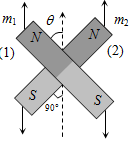
Two magnets of equal mass are joined at right angles to each other as shown the magnet 1 has a magnetic moment 3 times that of magnet 2. This arrangement is pivoted so that it is free to rotate in the horizontal plane. In equilibrium what angle will the magnet 1 subtend with the magnetic meridian
  • A
    $\tan ^{-1}\left(\frac{1}{2}\right)$
  • $\tan ^{-1}\left(\frac{1}{3}\right)$
  • C
    $\tan ^{-1}(1)$
  • D
Answer
Correct option: B.
$\tan ^{-1}\left(\frac{1}{3}\right)$
(b) $\tan ^{-1}\left(\frac{1}{2}\right)$
View full question & answer
MCQ 171 Mark
A cylindrical rod magnet has a length of 5 cm and a diameter of 1 cm. It has a uniform magnetisation of $5.30\times10^3$Amp/m$^3$. What its magnetic dipole moment
  • A
    $1\times 10^{-2}J/T$
  • $2.08 \times 10^{-2}J/T$
  • C
    $3.08 \times 10^{-2}J/T$
  • D
    $1.52 \times 10^{-2}J/T$
Answer
Correct option: B.
$2.08 \times 10^{-2}J/T$
(b) $2.08 \times 10^{-2}J/T$
View full question & answer
MCQ 181 Mark
Assertion : When radius of circular loop carrying current is doubled, its magnetic moment becomes four times.
Reason : Magnetic moment depends on area of the loop.
  • A
    If both assertion and reason are true and the reason is the correct explanation of the assertion.
  • If both assertion and reason are true but reason is not the correct explanation of the assertion.
  • C
    If assertion is true but reason is false.
  • D
    If the assertion and reason both are false.
Answer
Correct option: B.
If both assertion and reason are true but reason is not the correct explanation of the assertion.
 If both assertion and reason are true but reason is not the correct explanation of the assertion.
View full question & answer
MCQ 191 Mark
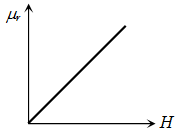
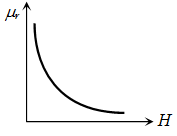
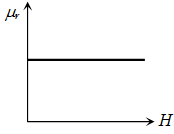
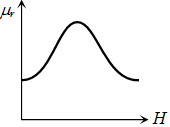
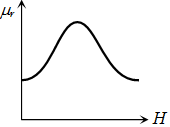
For ferromagnetic material, the relative permeability ($\mu_r$), versus magnetic intensity (H) has the following shape
  • A
  • B
  • C
Answer
Correct option: D.
(d)
View full question & answer
MCQ 201 Mark
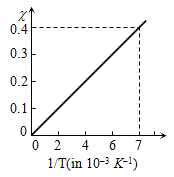
The X – 1/T graph for an alloy of paramagnetic nature is shown in Fig. The curie constant is, then
  • 57 K
  • B
    $2.8 \times 10^{-3} \mathrm{~K}$
  • C
    570 K
  • D
    $17.5 \times 10^{-3} \mathrm{~K}$
Answer
Correct option: A.
57 K
(a) 57 K
View full question & answer
MCQ 211 Mark
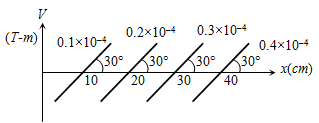
Some equipotential surfaces of the magnetic scalar potential are shown in the figure. Magnetic field at a point in the region is
  • A
    $10^{-4} \mathrm{~T}$
  • $2 \times 10^{-4} \mathrm{~T}$
  • C
    $0.5 \times 10^{-4} \mathrm{~T}$
  • D
    None of these
Answer
Correct option: B.
$2 \times 10^{-4} \mathrm{~T}$
(b) $2 \times 10^{-4} \mathrm{~T}$
View full question & answer
MCQ 231 Mark
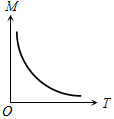
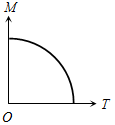
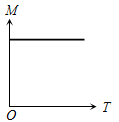
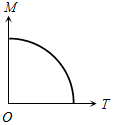
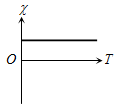
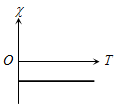
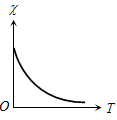
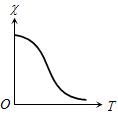
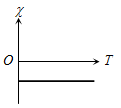
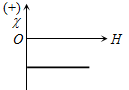
The variation of magnetic susceptibility (x) with temperature for a diamagnetic substance is best represented by
  • A
  • C
  • D
Answer
Correct option: B.
(b)
View full question & answer
MCQ 241 Mark
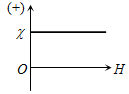
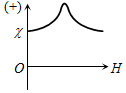
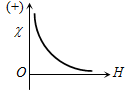
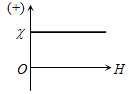
The variation of magnetic susceptibility (x) with magnetising field for a paramagnetic substance is
  • B
  • C
  • D
Answer
Correct option: A.
(a)
View full question & answer
MCQ 251 Mark
A dip needle lies initially in the magnetic meridian when it shows an angle of dip q at a place. The dip circle is rotated through an angle x in the horizontal plane and then it shows an angle of dip $\theta^{\prime}$. Then $\frac{\tan \theta^{\prime}}{\tan \theta}$ is
  • $\frac{1}{\cos x}$
  • B
    $\frac{1}{\sin x}$
  • C
    $\frac{1}{\tan x}$
  • D
    cos x
Answer
Correct option: A.
$\frac{1}{\cos x}$
(a) $\frac{1}{\cos x}$
View full question & answer
MCQ 261 Mark
A short magnet oscillates with a time period 0.1 s at a place where horizontal magnetic field is 24μT. A downward current of 18 A is established in a vertical wire 20 cm east of the magnet. The new time period of oscillator
  • A
    0.1 s
  • B
    0.089 s
  • 0.076 s
  • D
    0.057 s
Answer
Correct option: C.
0.076 s
 0.076 s
View full question & answer
MCQ 271 Mark
The unit for molar susceptibility is
  • $\mathrm{m}^3 $
  • B
    $ \mathrm{~kg}-\mathrm{m}^{-3}$
  • C
    $ \mathrm{~kg}^{-1} \mathrm{~m}^3$
  • D
    No units 
Answer
Correct option: A.
$\mathrm{m}^3 $
$m^3$
View full question & answer
MCQ 281 Mark
A dip needle vibrates in the vertical plane perpendicular to the magnetic meridian. The time period of vibration is found to be $2$ seconds. The same needle is then allowed to vibrate in the horizontal plane and the time period is again found to be $2$ seconds. Then the angle of dip is
  • A
    $ 0^{\circ} $
  • B
    $ 30^{\circ} $
  • $ 45^{\circ} $
  • D
    $ 90^{\circ}$
Answer
Correct option: C.
$ 45^{\circ} $
$ 45^{\circ}$
View full question & answer
MCQ 291 Mark
A magnet is suspended in the magnetic meridian with an untwisted wire. The upper end of wire is rotated through $180^{\circ}$ to deflect the magnet by $30^{\circ}$ from magnetic meridian. When this magnet is replaced by another magnet, the upper end of wire is rotated through $270^{\circ}$ to deflect the magnet $30^{\circ}$ from magnetic meridian. The ratio of magnetic moments of magnets is
  • A
    $1 : 5$
  • B
    $1 : 8$
  • $5 : 8$
  • D
    $8 : 5$
Answer
Correct option: C.
$5 : 8$
$5 : 8$
View full question & answer
MCQ 301 Mark
A bar magnet has coercivity $4 \times 10^3 \mathrm{Am}^{-1}$. It is desired to demagnetise it by inserting it inside a solenoid 12 cm long and having 60 turns. The current that should be sent through the solenoid is
  • A
    2 A
  • B
    4 A
  • C
    6 A
  • 8 A
Answer
Correct option: D.
8 A
(d) 8 A
View full question & answer
MCQ 311 Mark
An iron rod of volume $10^{-4} \mathrm{~m}^3$ and relative permeability 1000 is placed inside a long solenoid wound with 5 turns/cm. If a current of 0.5 A is passed through the solenoid, then the magnetic moment of the rod is
  • A
    $10 \mathrm{Am}^2$
  • B
    $15 \mathrm{Am}^2$
  • C
    $20 \mathrm{Am}^2$
  • $25 \mathrm{Am}^2$
Answer
Correct option: D.
$25 \mathrm{Am}^2$
(d) $25 \mathrm{Am}^2$
View full question & answer
MCQ 321 Mark
Each atom of an iron bar (5cm × 1 cm × 1 cm) has a magnetic moment $1.8\times 10^{-23}Am^2$ . Knowing that the density of iron is $7.78\times 10^3 kg^{-3}m,$  atomic weight is 56 and Avogadro's number is $6.02\times 10^{23}$  the magnetic moment of bar in the state of magnetic saturation will be
  • A
    4.75 Am$^2$
  • B
    5.74 Am$^2$
  • 7.54 Am$^2$
  • D
    75.4 Am$^2$
Answer
Correct option: C.
7.54 Am$^2$
(c) 7.54 Am$^2$
View full question & answer
MCQ 331 Mark
Assertion : The earth’s magnetic field does not affect the working of a moving coil galvanometer.
Reason : Earth’s magnetic field is very weak.
  • If both assertion and reason are true and the reason is the correct explanation of the assertion.
  • B
    If both assertion and reason are true but reason is not the correct explanation of the assertion.
  • C
    If assertion is true but reason is false.
  • D
    If the assertion and reason both are false.
Answer
Correct option: A.
If both assertion and reason are true and the reason is the correct explanation of the assertion.
View full question & answer
MCQ 341 Mark
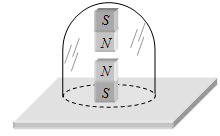
Two identical bar magnets with a length 10 cm and weight 50 gm-weight are arranged freely with their like poles facing in a inverted vertical glass tube. The upper magnet hangs in the air above the lower one so that the distance between the nearest pole of the magnet is 3mm. Pole strength of the poles of each magnet will be
  • 6.64 amp × m
  • B
    2 amp × m
  • C
    10.25 amp × m
  • D
    None of these
Answer
Correct option: A.
6.64 amp × m
(a) 6.64 amp × m
View full question & answer
MCQ 351 Mark
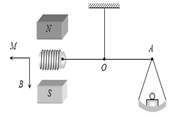
A small coil C with N = 200 turns is mounted on one end of a balance beam and introduced between the poles of an electromagnet as shown in figure. The cross sectional area of coil is A= 1.0 cm$^2$, length of arm OA of the balance beam is l = 30 cm. When there is no current in the coil the balance is in equilibrium. On passing a current I = 22 mA through the coil the equilibrium is restored by putting the additional counter weight of mass ∆m = 60 mg on the balance pan. Find the magnetic induction at the spot where coil is located.
  • 0.4 T
  • B
    0.3 T
  • C
    0.2 T
  • D
    0.1 T
Answer
Correct option: A.
0.4 T
(a) 0.4 T
View full question & answer
MCQ 361 Mark
Assertion : The ferromagnetic substance do not obey Curie’s law.
Reason : At Curie point a ferromagnetic substance start behaving as a paramagnetic substance.
  • A
    If both assertion and reason are true and the reason is the correct explanation of the assertion.
  • If both assertion and reason are true but reason is not the correct explanation of the assertion.
  • C
    If assertion is true but reason is false.
  • D
    If the assertion and reason both are false.
Answer
Correct option: B.
If both assertion and reason are true but reason is not the correct explanation of the assertion.
View full question & answer
MCQ 371 Mark
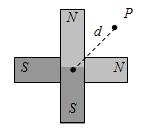
Two short magnets of equal dipole moments M are fastened perpendicularly at their centre (figure). The magnitude of the magnetic field at a distance d from the centre on the bisector of the right angle is
  • A
    $\frac{\mu_0}{4 \pi} \frac{M}{d^3}$
  • B
    $\frac{\mu_0}{4 \pi} \frac{\mathrm{M} \sqrt{2}}{d^3}$
  • $\frac{\mu_0}{4 \pi} \frac{2 \sqrt{2} \mathrm{M}}{\mathrm{d}^3}$
  • D
    $\frac{\mu_0}{4 \pi} \frac{2 M}{d^3}$
Answer
Correct option: C.
$\frac{\mu_0}{4 \pi} \frac{2 \sqrt{2} \mathrm{M}}{\mathrm{d}^3}$
(c) $\frac{\mu_0}{4 \pi} \frac{2 \sqrt{2} \mathrm{M}}{\mathrm{d}^3}$
View full question & answer
MCQ 381 Mark
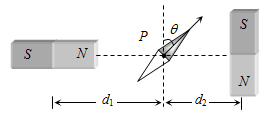
Two magnets A and B are identical and these are arranged as shown in the figure. Their length is negligible in comparison to the separation between them. A magnetic needle is placed between the magnets at point P which gets deflected through an angle θ under the influence of magnets. The ratio of distance $d_1$ and $d_2$ will be
  • A
    $(2 \tan \theta)^{1 / 3}$
  • B
    $(2 \tan \theta)^{-1 / 3}$
  • $(2 \cot \theta)^{1 / 3}$
  • D
    $(2 \cot \theta)^{-1 / 3}$
Answer
Correct option: C.
$(2 \cot \theta)^{1 / 3}$
(c) $(2 \cot \theta)^{1 / 3}$
View full question & answer
MCQ 391 Mark
Assertion : The earth’s magnetic field is due to iron present in its core.
Reason : At a high temperature magnet losses its magnetic property or magnetism.
  • A
    If both assertion and reason are true and the reason is the correct explanation of the assertion.
  • B
    If both assertion and reason are true but reason is not the correct explanation of the assertion.
  • C
    If assertion is true but reason is false.
  • If assertion is false but reason is true.
Answer
Correct option: D.
If assertion is false but reason is true.
 If assertion is false but reason is true.
View full question & answer
MCQ 401 Mark
Assertion : The poles of magnet cannot be separated by breaking into two pieces.
Reason : The magnetic moment will be reduced to half when a magnet is broken into two equal pieces.
  • A
    If both assertion and reason are true and the reason is the correct explanation of the assertion.
  • If both assertion and reason are true but reason is not the correct explanation of the assertion.
  • C
    If assertion is true but reason is false.
  • D
    If the assertion and reason both are false.
Answer
Correct option: B.
If both assertion and reason are true but reason is not the correct explanation of the assertion.
 If both assertion and reason are true but reason is not the correct explanation of the assertion.
View full question & answer
MCQ 411 Mark
Curie temperature is the temperature above which
  • A
    A paramagnetic material becomes ferromagnetic
  • A ferromagnetic material becomes paramagnetic
  • C
    A paramagnetic material becomes diamagnetic
  • D
    A ferromagnetic material becomes diamagnetic
Answer
Correct option: B.
A ferromagnetic material becomes paramagnetic
 A ferromagnetic material becomes paramagnetic
View full question & answer
MCQ 421 Mark
A diamagnetic material in a magnetic field moves
  • A
    From weaker to the stronger parts of the field
  • B
    Perpendicular to the field
  • From stronger to the weaker parts of the field
  • D
    In none of the above directions
Answer
Correct option: C.
From stronger to the weaker parts of the field
View full question & answer
MCQ 431 Mark
In a vibration magnetometer, the time period of a bar magnet oscillating in horizontal component of earth's magnetic field is 2 sec. When a magnet is brought near and parallel to it, the time period reduces to 1 sec. The ratio H/F of the horizontal component H and the field F due to magnet will be
  • A
    3
  • 1/3
  • C
    $\sqrt{3}$
  • D
    $1 / \sqrt{3}$
Answer
Correct option: B.
1/3
(b) 1/3
View full question & answer
MCQ 441 Mark
A vibration magnetometer consists of two identical bar magnets placed one over the other such that they are perpendicular and bisect each other. The time period of oscillation in a horizontal magnetic field is $2^{5 / 4}$ seconds. One of the magnets is removed and if the other magnet oscillates in the same field, then the time period in seconds is
  • A
    $2^{1 / 4}$
  • B
    $2^{1 / 2}$
  • 2
  • D
    $2^{3 / 4}$
Answer
Correct option: C.
2
(c) 2
View full question & answer
MCQ 451 Mark
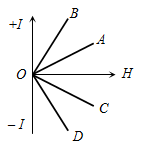
The variation of the intensity of magnetisation (I) with respect to the magnetising field (H) in a diamagnetic substance is described by the graph
  • A
    OD
  • OC
  • C
    OB
  • D
    OA
Answer
Correct option: B.
OC
(b) OC
View full question & answer
MCQ 461 Mark
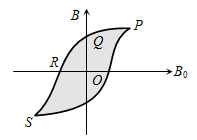
The figure illustrate how B, the flux density inside a sample of unmagnetised ferromagnetic material varies with $B_0$, the magnetic flux density in which the sample is kept. For the sample to be suitable for making a permanent magnet
  • A
    OQ should be large, OR should be small
  • OQ and OR should both be large
  • C
    OQ should be small and OR should be large
  • D
    OQ and OR should both be small
Answer
Correct option: B.
OQ and OR should both be large
(b) OQ and OR should both be large
View full question & answer
MCQ 471 Mark
Two identical magnetic dipoles of magnetic moments 1.0 A-m$^2$ each, placed at a separation of 2m with their axis perpendicular to each other. The resultant magnetic field at a point midway between the dipoles is
  • A
    $5\times 10^{-7}T$
  • $\sqrt{5} \times 10^{-7} \mathrm{~T}$
  • C
    $10^{-7}T$
  • D
    None of these
Answer
Correct option: B.
$\sqrt{5} \times 10^{-7} \mathrm{~T}$
(b) $\sqrt{5} \times 10^{-7} \mathrm{~T}$
View full question & answer
MCQ 481 Mark
Two short magnets placed along the same axis with their like poles facing each other repel each other with a force which varies inversely as
  • A
    Square of the distance
  • B
    Cube of the distance
  • C
    Distance
  • Fourth power of the distance
Answer
Correct option: D.
Fourth power of the distance
View full question & answer
MCQ 491 Mark
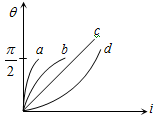
Which curve may best represent the current deflection in a tangent galvanometer
  • A
    A
  • B
  • C
    C
  • D
    D
Answer
Correct option: B.
B
(b) B
View full question & answer
MCQ 501 Mark
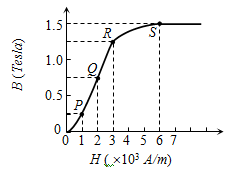
The basic magnetization curve for a ferromagnetic material is shown in figure. Then, the value of relative permeability is highest for the point
  • A
    P
  • Q
  • C
    R
  • D
    S
Answer
Correct option: B.
Q
(b) Q
View full question & answer