Questions · Page 2 of 2

2 Marks Questions

Question 522 Marks
A 1cm object is placed perpendicular to the principal axis of a convex mirror of focal length 7.5cm. Find its distance from the mirror if the image formed is 0.6cm in size.
Answer
$\text{m}=-\frac{\text{v}}{\text{u}}=0.6$ and $\text{f}=7.5\text{cm}=\frac{15}{2}\text{cm}$
From mirror equation,
$\Rightarrow\frac{1}{\text{v}}+\frac{1}{\text{u}}=\frac{1}{\text{f}}$
$\Rightarrow\frac{1}{0.6\text{u}}-\frac{1}{\text{u}}=\frac{1}{\text{f}}$
$\Rightarrow \frac{5}{3\text{u}}-\frac{1}{\text{u}}=\frac{5}{15}$
$\Rightarrow\text{u}=5\text{cm}$
View full question & answer
Question 532 Marks
A concave lens is placed in water. Will there be any change in focal length? Give reason.
Answer
Focal length of lens in water $\text{f}_{\text{w}}=\frac{\text{n}_{\text{g}}-1}{\frac{\text{n}_{\text{g}}-1}{\text{nw}}-1}$
$\text{As n}_{\text{g}}>\text{n}_{\text{w}},\frac{\text{n}_{\text{g}}}{\text{n}_{\text{w}}}>1,\text{ so }\text{f}_{\text{w}}>\text{f}_{\text{a}}$
View full question & answer
Question 542 Marks
Can virtual image be formed on the retina in a seeing process?
Answer
The retina acts as a screen; only real images can be obtained on the screen. In case of people having eye defects, the spectacles form the virtual image of the object and the eye lens form the real and inverted image on the retina.
View full question & answer
Question 552 Marks
Can a virtual image be photographed by a camera?
Answer

Yes, when you stand in front of plane mirror image is virtual and can be photographed.
View full question & answer
Question 562 Marks
An optical fibre $(\mu=1.72)$ is surrounded by a glass coating $(\mu=1.50).$ Find the critical angle for total internal/ reflection at the fibre-glass interface.
Answer
For calculation of critical angle,
$\frac{\sin\text{i}}{\sin\text{r}}=\frac{\mu_2}{\mu_1}$
$\Rightarrow\frac{\sin\theta_\text{C}}{\sin90^\circ}=\frac{15}{1.72}$
$=\frac{75}{86}$
$\Rightarrow\theta_\text{C}=\sin^{-1}\Big(\frac{75}{86}\Big)$
View full question & answer
Question 572 Marks
A nearsighted person cannot clearly see beyond 200cm. Find the power of the lens needed to see objects at large distances.
Answer
For the near sighted person,$\text{u}= \infty$ and $\text{v}=-200\text{cm}=-2\text{m}$
So, $\frac{1}{\text{f}}=\frac{1}{\text{v}}-\frac{1}{\text{u}}=\frac{1}{-2}-\frac{1}{\infty}$
$\frac{1}{\text{f}}=-\frac{1}{2}=-0.5$
So, power of the lens is -0.5D
View full question & answer
Question 582 Marks
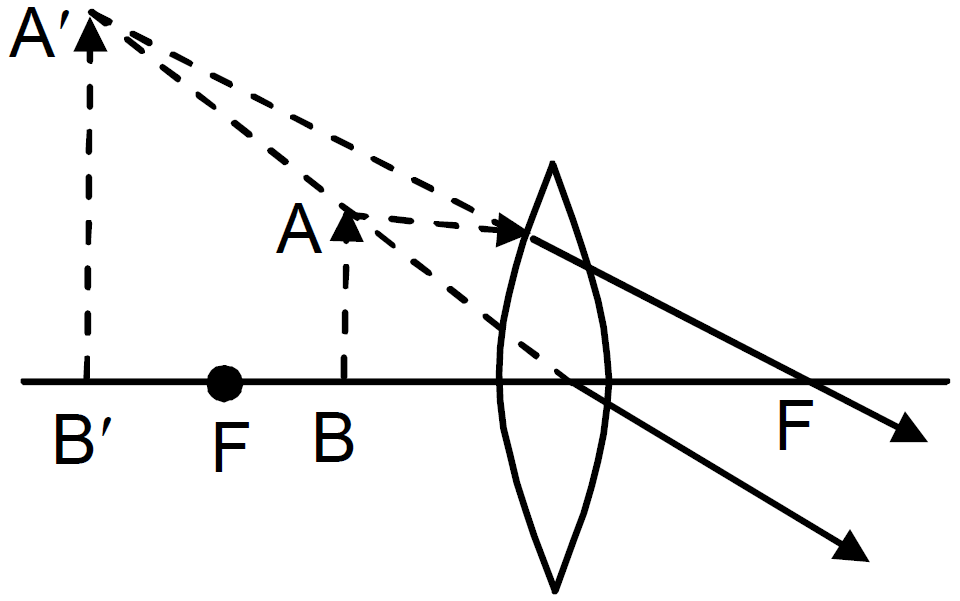
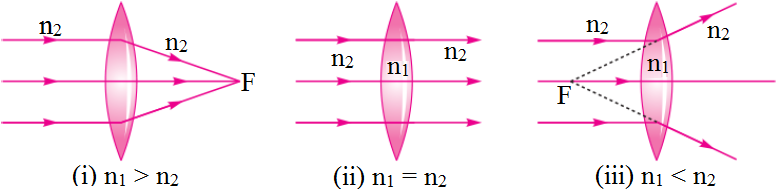
A convex lens made of a material of refractive index $n_1$ is kept in a medium of refractive index $n_2$. Parallel rays of light are incident on the lens. Complete the path of rays of light emerging from the convex lens if: (i) $\mathrm{n}_1>\mathrm{n}_2$ (ii) $\mathrm{n}_1=\mathrm{n}_2$ (iii) $\mathrm{n}_1<\mathrm{n}_2$.
$\frac{1}{\text{f}}=\Big(\frac{\text{n}_1}{\text{n}_2}-1\Big)\Big(\frac{1}{\text{R}_2}+\frac{1}{\text{R}_2}\Big)$
Answer
  1. In case (i) $\mathrm{n}_1>\mathrm{n}_2$, the lens behaves as convergent lens.
  2. In case (ii) $n_1=n_2$, the lens behaves as a plane plate.
  3. In case (iii) $\mathrm{n}_1<\mathrm{n}_2$, the lens behaves as a divergent lens.
The path of rays in all the three cases is shown in fig.
View full question & answer
Question 592 Marks
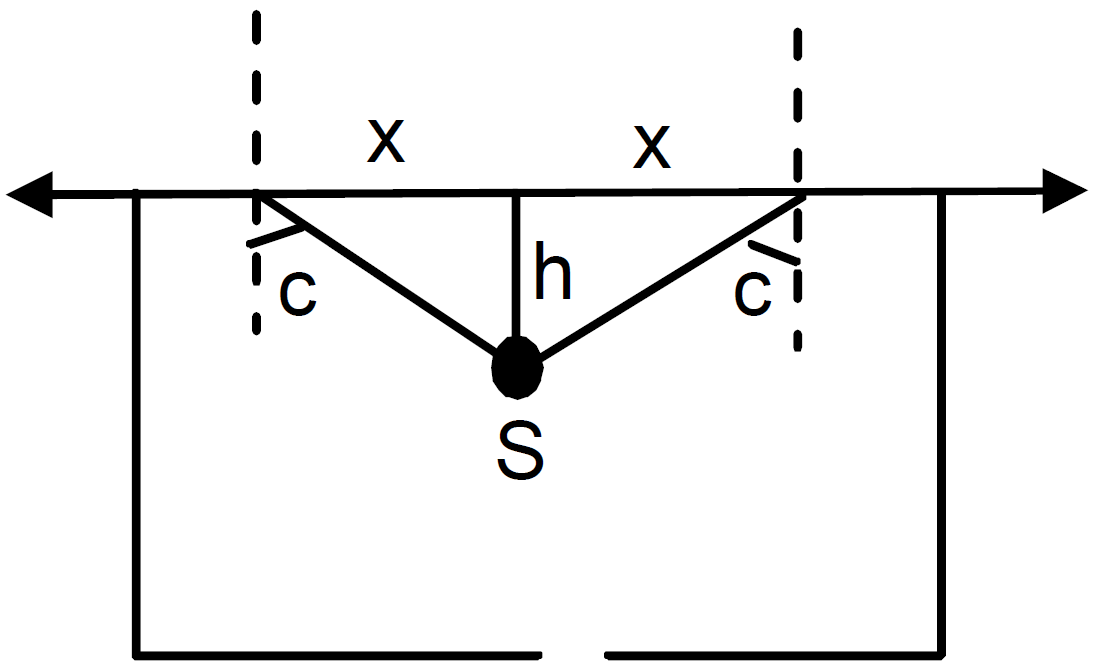
A point source is placed at a depth h below the surface of water (refractive index = μ).
  1. Show that light escapes through a circular area on the water surface with its centre directly above the point source.
  2. Find the angle subtended by a radius of the area on the source.
Answer
  1. Let, x = radius of the circular area
$\frac{\text{x}}{\text{h}}=\tan\theta_\text{C}$ (where C is the critical angle)

$\Rightarrow\frac{\text{x}}{\text{h}}=\frac{\sin\theta_\text{C}}{\sqrt{1-\sin^2\theta_\text{C}}}=\frac{\frac{1}{\mu}}{\sqrt{1-\frac{1}{\mu^2}}} \ \Big(\because \ \sin\theta_\text{C}=\frac{1}{\mu}\Big)$

$\Rightarrow\frac{\text{x}}{\text{h}}=\frac{1}{\sqrt{\mu^2-1}}$ or $\text{x}=\frac{\text{h}}{\sqrt{\mu^2-1}}$

So, light escapes through a circular area on the water surface directly above the point source.
  1. Angle subtained by a radius of the area on the source, $\theta_\text{C}=\sin^{-1}\Big(\frac{1}{\mu}\Big)$
View full question & answer
Question 602 Marks
Light falls from glass $(\mu=1.5)$ to air. Find the angle of incidence for which the angle of deviation is 90°.
Answer
Since, $\mu=1.5,$ Critial angle $=\sin^{-1}\Big(\frac{1}{\mu}\Big)=\sin^{-1}\Big(\frac{1}{1.5}\Big)=41.8^{\circ}$
We know, the maximum attainable deviation in refraction is (90° - 41.8°) = 47.2°
So, in this case, total internal reflection must have taken place.
In reflection,
Deviation = 180° - 2i = 90°
⇒ 2i = 90° ⇒ i = 45°.
View full question & answer
Question 612 Marks
A simple microscope is rated 5 for a normal relaxed eye. What will be its magnifying power for a relaxed farsighted eye whose near point is 40cm?
Answer
The simple microscope has magnification of 5 for normal relaxed eye (D = 25cm).Because, the eye is relaxed the image is formed at infinity (normal adjustment)
So, $\text{m}=5=\frac{\text{D}}{\text{f}}=\frac{25}{\text{f}}\Rightarrow\text{f}=5\text{cm}$
For the relaxed farsighted eye, $\text{D} = 40\text{cm}$
So, $\text{m}=\frac{\text{D}}{\text{f}}=\frac{40}{5}=8$
So, its magnifying power is 8X.
View full question & answer
Question 622 Marks
A concave mirror and a converging lens have the same focal length in air. Which one of the two will have greater focal length when both are immersed in water?
Answer
Converging lens; the focal length of a spherical mirror remains unaffected.
For converging lens $\frac{1}{\text{f}}=\Big(\frac{\text{n}_1}{\text{n}_2}-1\Big)\Big(\frac{1}{\text{R}_2}-\frac{1}{\text{R}_2}\Big)$
When it is immersed in water $\mathrm{n}_2$ (in water) $>\mathrm{n}_2$ (air)
$\Big(\frac{\text{n}_1}{\text{n}_2}-1\Big)$ decreases hence focal length of converging lens increases in water.
View full question & answer
Question 632 Marks
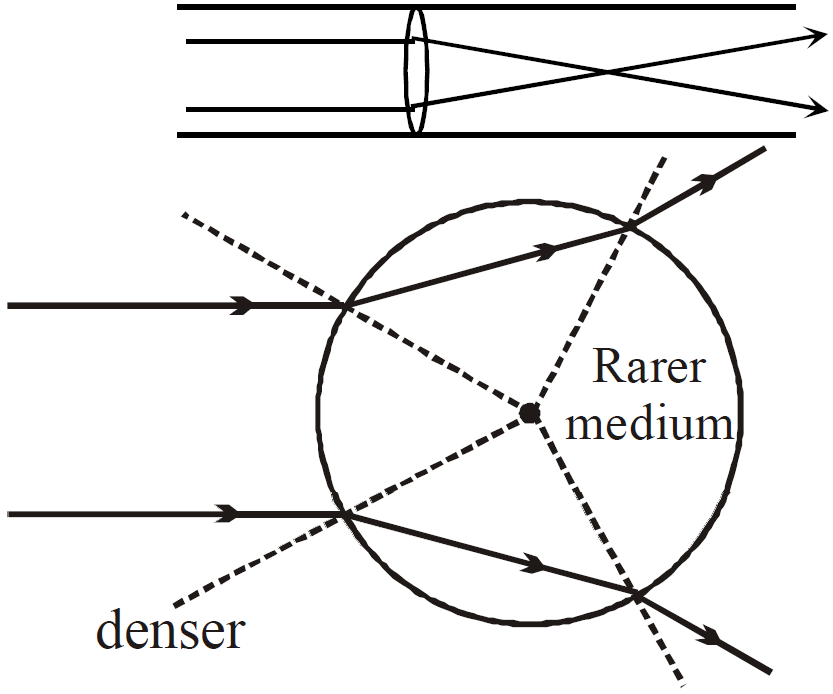
A single lens is mounted in a tube. A parallel beam enters the tube and emerges out of the tube as a divergent beam. Can you say with certainty that there is a diverging lens in the tube?
Answer
No,
View full question & answer
Question 642 Marks
A farsighted person cannot see objects placed closer to 50cm. Find the power of the lens needed to see the objects at 20cm.
Answer
For the far sighted person,u = -20cm, v = -50cm
from lens formula $\frac{1}{\text{v}}-\frac{1}{\text{u}}=\frac{1}{\text{f}}$
$\frac{1}{\text{f}}=\frac{1}{-50}-\frac{1}{-20}=\frac{1}{-20}-\frac{1}{50}=\frac{3}{100}$
$\Rightarrow\text{f}=\frac{100}{3}\text{cm}=\frac{1}{3}\text{m}$
So, power of the lens $=\frac{1}{\text{f}}=3\text{ Diopter}$
View full question & answer
Question 652 Marks
A convex lens (n = 1.5) of focal length fa is immersed.
  1. In water n = 1.33 and.
  2. In carbon disulphide n = 1.6, how does the lens behave in the two cases?
Answer
  1. When lens is immersed in water, it behaves as a convex lens but its focal length will increase.
  2. When convex lens is immersed in carbon-disulphide, it will behave as a concave lens.
View full question & answer
Question 672 Marks
The equation $\omega=\frac{\mu_\text{v}-\mu_\text{r}}{\mu-1}$ asderived for a prism having small refracting angle. Is it also valid for a prism of large refracting angle? Is it also valid for a glass slab or a glass sphere?
Answer
Dispersive power depends on angular deviation, and angular deviation is valid only for a small refracting angle and a small angle of incidence. Therefore, dispersive power is not valid for a prism of large refracting angle. It is also not valid for a glass slab or a glass sphere, as it has a large refracting angle.
View full question & answer
Question 682 Marks
A compound microscope forms an inverted image of an object. In which of the following cases it is kely to create difficulties?
  1. Looking at small germs.
  2. Looking at circular spots.
  3. Looking at a vertical tube containing some water.
Answer
  1. Looking at a vertical tube containing some water
Explantion:

If the experimentalist is looking at a vertical tube containing some water, he has to be careful, as the lower meniscus will appear as upper.
View full question & answer
Question 692 Marks
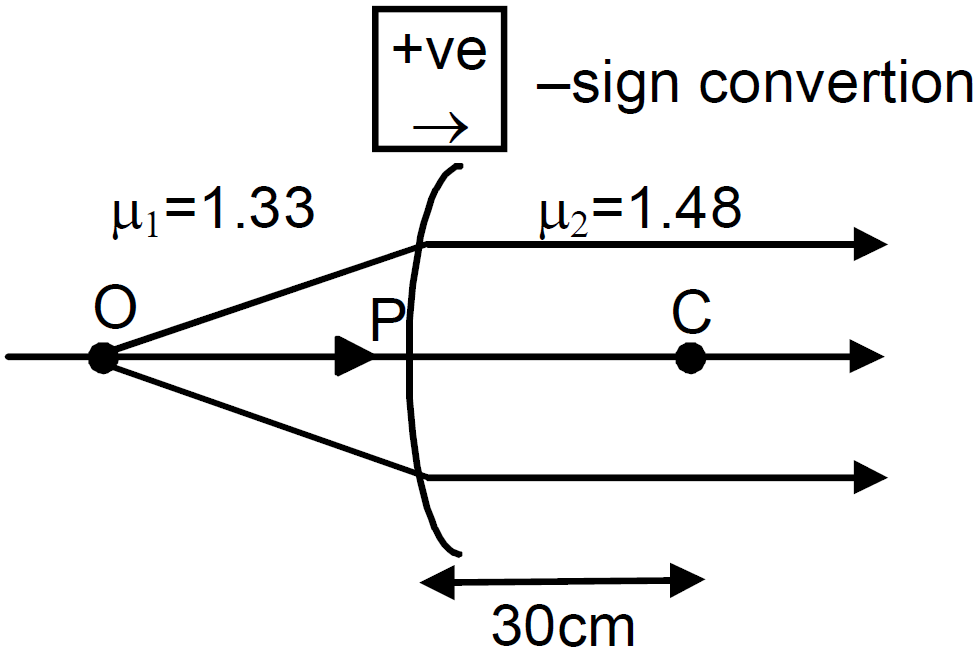
A spherical surface of radius 30cm separates two transparent media A and B with refractive indices 1.33 and 1.48 respectively. The medium A is on the convex side of the surface. Where should a point object be placed in medium A so that the paraxial rays become parallel after refraction at the surface?
Answer

Since, paraxial rays become parallel after refraction i.e. image is formed at $\infty.$
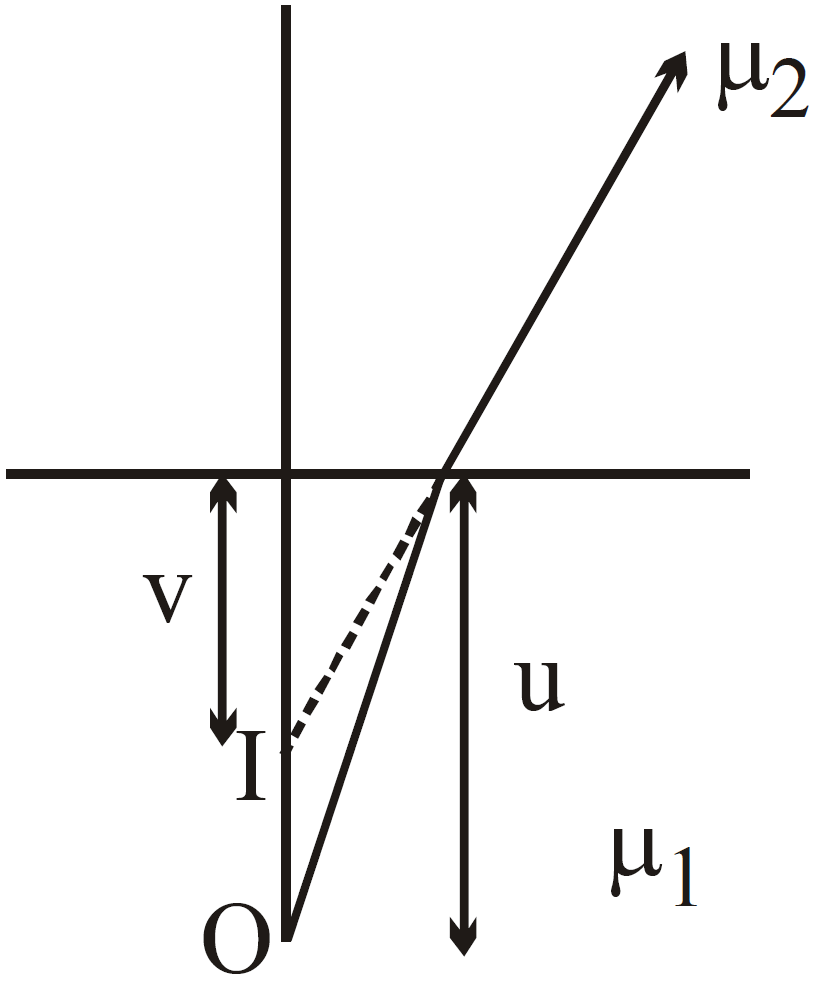
$\text{v}=\infty, \ \mu_1=1.33, \ \text{u}=?, \ \mu_2=1.48, \ \text{R}=30\text{cm}$
$\frac{\mu_2}{\text{v}}-\frac{\mu_1}{\text{u}}=\frac{\mu_2-\mu_1}{\text{R}}$
$\Rightarrow\frac{1.48}{\infty}-\frac{1.33}{\text{u}}=\frac{1.48-1.33}{30}\Rightarrow-\frac{1.33}{\text{u}}-\frac{0.15}{30}$
$\Rightarrow\text{u}=-266.0\text{cm}$
$\therefore$ Object should be placed at a distance of 266cm from surface (convex) on side A.
View full question & answer
Question 702 Marks
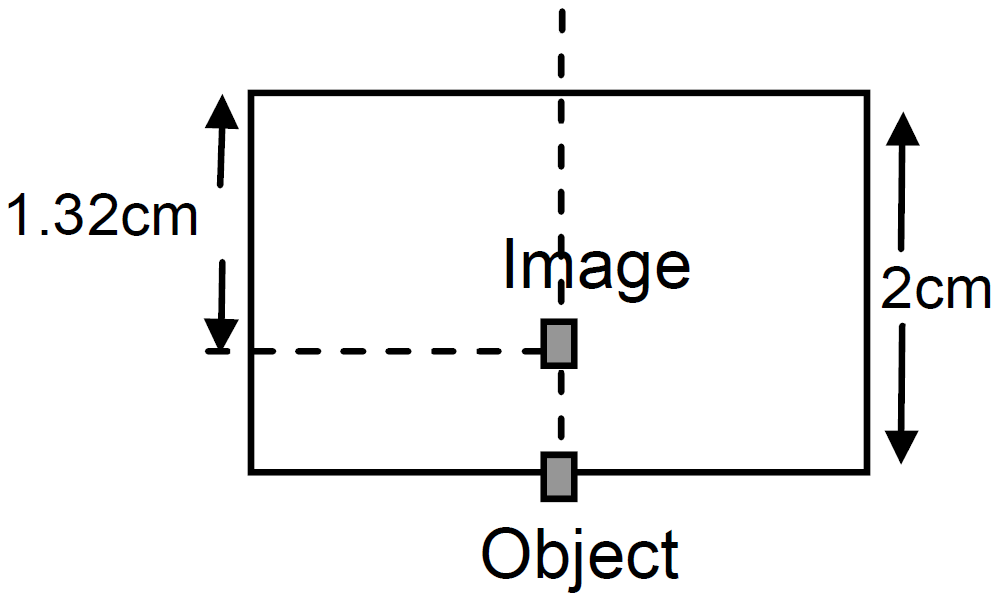
The refractive index of a material changes by 0.014 as the colour of the light changes from red to violet. A rectangular slab of height 2.00cm made of this material is placed on a newspaper. When viewed normally in yellow light, the letters appear 1.32cm below the top surface of the slab. Calculate the dispersive power of the material.
Answer
Given that, $\mu_\text{v}-\mu_\text{r}=0.014$
$\text{Again,}\ \mu_\text{y}=\frac{\text{Real depth}}{\text{Apparent depth}}=\frac{2.00}{1.30}=1.515$
So, dispersive power $=\frac{\mu_\text{v}-\mu_\text{r}}{\mu_\text{y}-1}=\frac{0.014}{1.515-1}=0.027$
View full question & answer
Question 712 Marks
Can the dispersive power $\omega=\frac{\mu_\text{v}-\mu\text{r}}{\mu-1}$ be negative? What is the sign of co if a hollow prism is immersed into water?
Answer
No, it cannot be negative, as the refractive index for violet light is always greater than that for red light. Also, refractive index is inversely proportional to $\lambda^2$. The sign of wwill be positive, as $\mu$ is still greater than 1 and es $\mu_\text{v}>\mu_\text{r}.$
View full question & answer
Question 722 Marks
The minimum deviations suffered by red, yellow and violet beams passing through an equilateral transparent prism are 38.4°, 38.7° and 39.2° respectively. Calculate the dispersive power of the medium.
Answer
Given that, $\delta_\text{r}=38.4^\circ,\delta_\text{y}=38.7^\circ\ \text{and}\ \delta_\text{v}=39.2^\circ$
Dispersive power $=\frac{\mu_\text{v}-\mu_\text{r}}{\mu_\text{y}-1}=\frac{(\mu_\text{v}-1)-(\mu_\text{r}-1)}{(\mu_\text{y}-1)}$ $=\frac{\Big(\frac{\delta_\text{v}}{\text{A}}\Big)-\Big(\frac{\delta_\text{r}}{\text{A}}\Big)}{\Big(\frac{\delta_\text{v}}{\text{A}}\Big)}\ [\because\delta=(\mu-1)\text{A}]$
$=\frac{\delta_\text{v}-\delta_\text{r}}{\delta_\text{y}}=\frac{39.2-3.84^\circ}{38.7}=0.0204$
View full question & answer
Question 732 Marks
A simple microscope using a single lens often shows coloured image of a white source. Why?
Answer
A simple microscope consists of a single convex lens. Sometimes due to chromatic and spherical aberrations, the image of a white source seems coloured at the corners of the lens and somewhere in between.
View full question & answer
Question 742 Marks
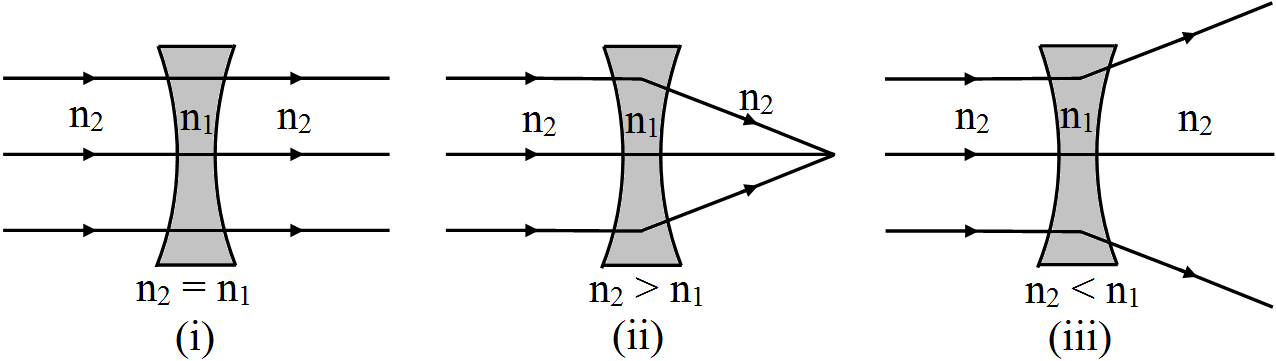
The refractive index of a material of a concave lens is $n_1$. It is immersed in a medium of refractive index $n_2 A$ parallel beam of light is incident on the lens. Trace the path of emergent rays when (i) $n_2=n_1$ (ii) $n_2>n_1$ (iii) $n_2<n_1$.
$\frac{1}{\text{f}}=\Big(\frac{\text{n}_1}{\text{n}_2}-1\Big)\Big(\frac{1}{\text{R}_2}-\frac{1}{\text{R}_2}\Big)$
Answer
$\text{For} \text{ n}_1 = \text{n}_2\text{ f} = \infty$
$\text{For} \text{ n}_1 < \text{n}_2 \text{ f} > 0$
$\text{For} \text{ n}_1 > \text{n}_2 \text{ f} < 0$
The path of rays in three cases is shown in fig.
View full question & answer
Question 752 Marks
Suggest a method to produce a rainbow in your house.
Answer
A rainbow can be produced using a prism. Another way of producing a rainbow is to dip a mirror inside water, keeping it inclined along the wall of a tumbler. The light coming from water after reflecting from the mirror will give a rainbow.
View full question & answer
Question 762 Marks
The angular magnification of a system is less than one. Does it mean that the image formed is inverted?
Answer
No, angular magnification is the ratio of the angle subtended by the final image on the eye to the angle subtended by the object on the unaided eye. Its value less than one signifies reduction in the size of the image. It does not mean that the image is inverted.
View full question & answer
Question 772 Marks
Find the maximum angle of refraction when a light ray is refracted from glass $(\mu=1.50)$ to air.
Answer
From the definition of critical angle, if refracted angle is more than 90°, then reflection occurs, which is known as total internal reflection.
So, maximum angle of refraction is 90°.
View full question & answer
Question 782 Marks
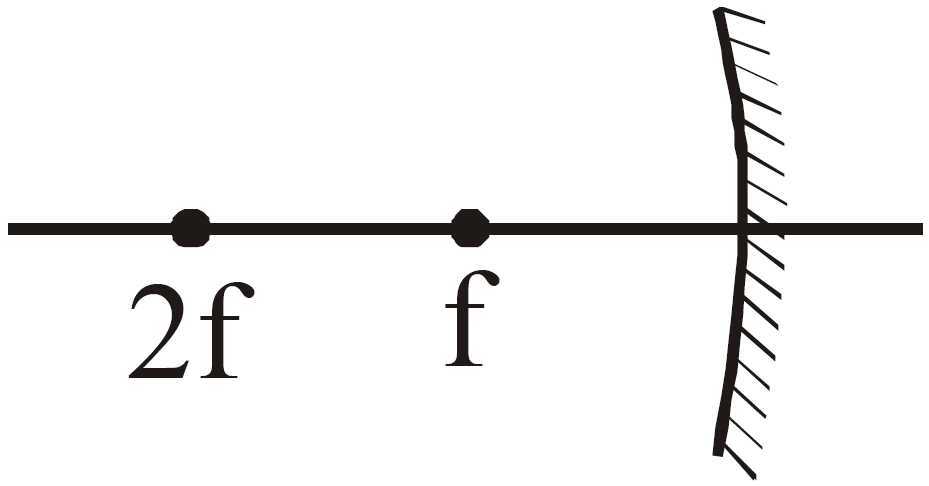
If an object far away from a convex mirror moves towards the mirror, the image also moves. Does it move faster, slower or at the same speed as compared to the object?
Answer
Slower $\text{V}_{\text{img}}=\text{m}^2\text{v}_0$ [m < 1 as far away]

It objects moves from infinity to 2f as distance moved by object is more in same time hence velocity of object is more.
View full question & answer
Question 792 Marks
A Galilean telescope is 27cm long when focused to form an image at infinity. If the objective has a focal length of 30cm, what is the focal length of the eyepiece?
Answer
For the given Galilean telescope, (When the image is formed at infinity) $\mathrm{f}_0=30 \mathrm{~cm}, \mathrm{~L}=27 \mathrm{~cm}$ Since $L=f_0-\left|f_e\right|$
[Since, concave eyepiece lens is used in Galilean Telescope]
$\Rightarrow f_e=f_0-L=30-27=3 \mathrm{~cm}$
View full question & answer
Question 802 Marks
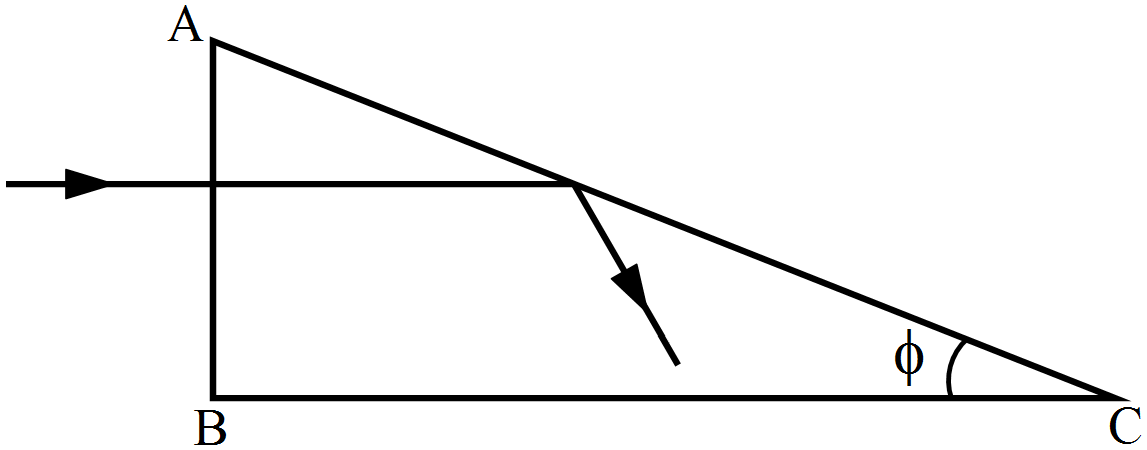
A light ray is incident normally on the face AB of a right-angled prism ABC $(\mu=1.50)$ as shown in figure. What is the largest angle $\phi$ for which the light ray is totally reflected at the surface AC?
Answer

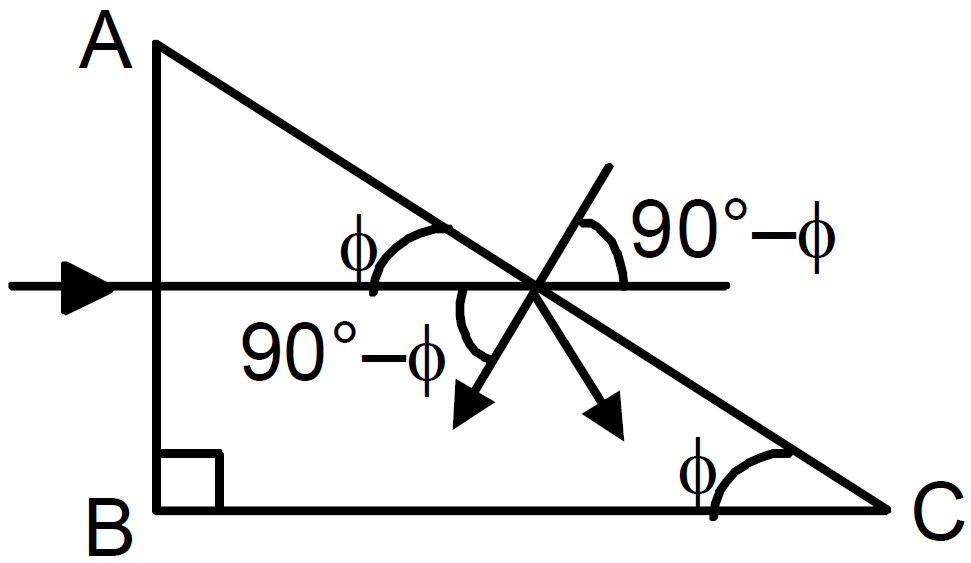
Let $\theta_\text{c}$ be the critical angle for the glass
$\frac{\sin\theta_{\text{c}}}{\sin90^{\circ}}=\frac{1}{\text{x}}\Rightarrow\sin\theta_{\text{c}}=\frac{1}{1.5}=\frac{2}{3}\Rightarrow\theta_{\text{c}}=\sin^{-1}\Big(\frac{2}{3}\Big)$
From figure, for total internal reflection, $90^{\circ}-\phi>\theta_{\text{c}}$
$\Rightarrow\phi<90^{\circ}-\theta_{\text{c}}\Rightarrow\phi<\cos^{-1}\Big(\frac{2}{3}\Big)$
So, the largest angle for which light is totally reflected at the surface is $\cos^{-1}\Big(\frac{2}{3}\Big).$
View full question & answer
Question 812 Marks
An extended object is placed at a distance of 5.0cm from a convex lens of focal length 8.0cm.
  1. Draw the ray diagram (to the scale) to locate the image and from this, measure the distance of the image from the lens.
  2. Find the position of the image from the lens formula and see how close the drawing is to the correct result.
Answer
  1.  
​​​​​​
  1. Given, u = -5cm, f = 8cm
So, $\Rightarrow\frac{1}{\text{v}}-\frac{1}{\text{u}}=\frac{1}{\text{f}}​​$
$\Rightarrow\frac{1}{8}-\frac{1}{5}=\frac{-3}{40}$
$\Rightarrow\text{v}=-13.3\text{cm}$ (virtual image).
View full question & answer
Question 822 Marks
A telescope has been adjusted for relaxed eye. You are asked to adjust it for least distance of distinct vision, then how will you change the distance between two lenses?
Answer
For relaxed eye, $\text{L} = \text{f}_0 +\text{f}_{\text{e}}$
For least distance of distinct vision $\text{L}' = \text{f}_0 + \text{u}_{\text{e}}, \text{u}_{\text{e}} < \text{f}_{\text{e}}$
Therefore, L' < L, that is, the distance will be decreased.
View full question & answer
Question 832 Marks
Why is there no dispersion in the light refracted through a rectangular glass slab?
Answer
It can be considered to be equivalent to two prisms in reverse way. In the case of a rectangular glass slab the rays of all colours combine together in the reverse prism. Hence, there is no dispersion.
View full question & answer
Question 842 Marks
An object is placed at the principal focus of a concave lens of focal length f. Where will its image be formed?
$\frac{1}{\text{f}}=\frac{1}{\text{v}}-\frac{1}{\text{u}}$
$\Rightarrow\frac{1}{\text{v}}=\frac{1}{\text{f}}+\frac{1}{\text{u}}$
Answer
Here u = -f and for a concave lens f = -f
$\frac{1}{\text{f}}=\frac{1}{\text{v}}-\frac{1}{\text{u}}$
$\Rightarrow\frac{1}{\text{v}}=\frac{1}{\text{f}}+\frac{1}{\text{u}}$
That image will be formed between optical centre and focus of lens; towards the side of the object.
View full question & answer
Question 852 Marks
A person wears glasses of power -2.5D. Is the person farsighted or nearsighted? What is the far point of the person without the glasses?
Answer
The person wears glasses of power -2.5DSo, the person must be near sighted
$\text{u}=\infty,$ $\text{v}=\text{far point,}$ $\text{f}=\frac{1}{-2.5}=-0.4\text{m}=-40\text{cm}$
Now, $\frac{1}{\text{v}}-\frac{1}{\text{v}}=\frac{1}{\text{f}}$
$\Rightarrow\frac{1}{\text{v}}=\frac{1}{\text{u}}+\frac{1}{\text{f}}=0+\frac{1}{-40}$
$\Rightarrow \text{v}=-40\text{cm}$
So, the far point of the person is 40cm.
View full question & answer
Question 862 Marks
The focal length of a convex lens made of glass is 20cm. What will be its new focal length when placed in a medium of refractive index 1.25?
Answer
$\frac{1}{\text{f}}=(\mu-1)\Big[\frac{1}{\text{R}_1}-\frac{1}{\text{R}_2}\Big]$
$\Rightarrow\frac{1}{20}=\frac{1}{4}\Big[\frac{1}{\text{R}_1}-\frac{1}{\text{R}_2}\Big]$
$\frac{1}{\text{f}}=\frac{1}{4}\Big[\frac{1}{\text{R}_1}-\frac{1}{\text{R}_2}\Big]$
$\Rightarrow\text{f}'=40\text{cm}$
View full question & answer
Question 872 Marks
The equation of refraction at a spherical surface is $\frac{\mu_2}{\text{v}}-\frac{\mu_1}{\text{u}}-=\frac{\mu_2-\mu_1}{\text{R}}.$ Taking $\text{R}=\infty,$ show that this equation leads to the equation $\frac{\text{Real depth}}{\text{Apparent depth}}=\frac{\mu_2}{\mu_1}$ for refraction at a plane surface.
Answer
$\frac{\mu_2}{\text{v}}-\frac{\mu_1}{\text{u}}-=\frac{\mu_2-\mu_1}{\infty}$
$\frac{\mu_2}{\text{v}}=\frac{\mu_1}{\text{u}}$
$\Rightarrow\frac{\mu_2}{\mu_1}=\frac{\text{v}}{\text{u}}.$
View full question & answer
Question 882 Marks
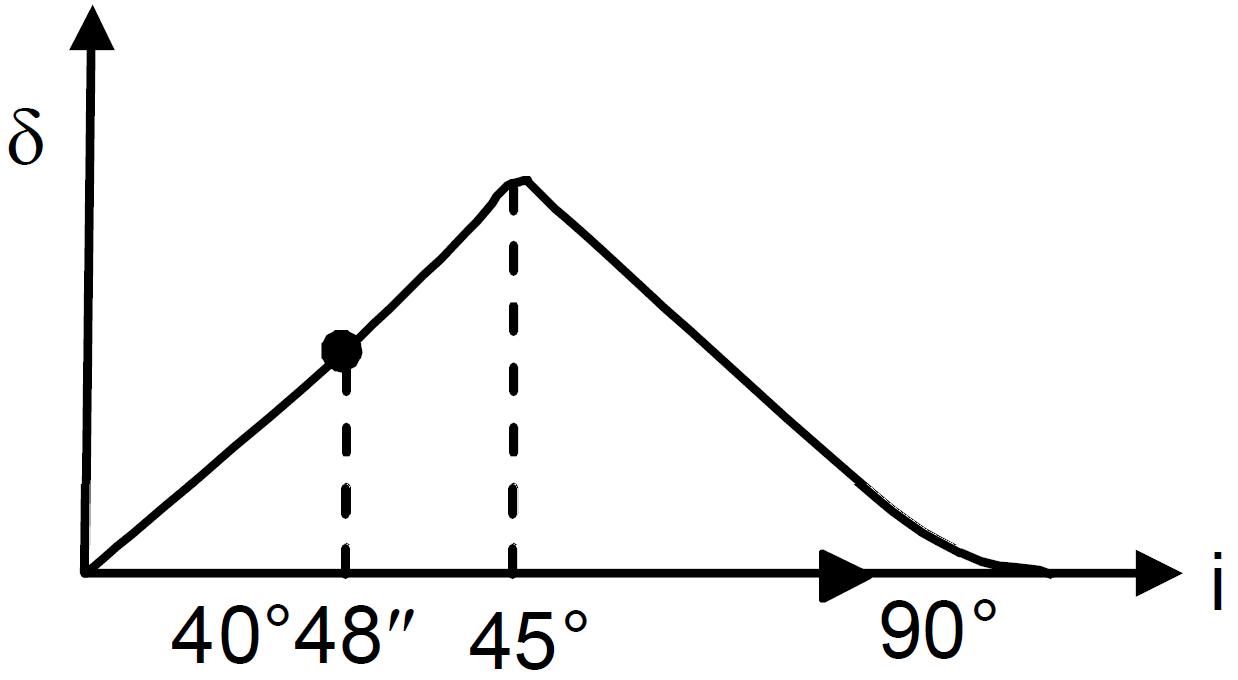
Light is incident from glass $(\mu=1.5)$ to air. Sketch the variation of the angle of deviation $\delta$ with the angle of incident i for 0 < i < 90°.
Answer

Refractive index of glass $\mu_{\text{g}}=1.5$
Given, 0° < i < 90°
Let, $\theta_\text{C}$ → Critical angle.
$\frac{\sin\theta_\text{C}}{\sin\text{r}}=\frac{\mu_{\text{a}}}{\mu_{\text{g}}}$
$\Rightarrow\frac{\sin\theta_\text{C}}{\sin90^{\circ}}=\frac{1}{1.5}=0.66$
$\Rightarrow\text{C}=40^{\circ}48''$
The angle of deviation due to refraction from glass to air increases as the angle of incidence increases from 0° to 40°48''. The angle of deviation due to total internal reflection further increases for 40°48'' to 45° and then it decreases.
View full question & answer
Question 892 Marks
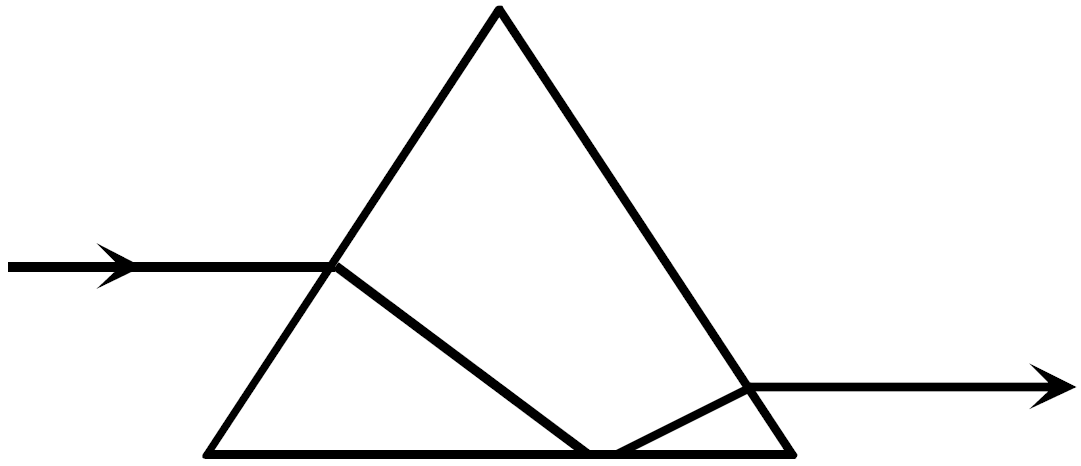
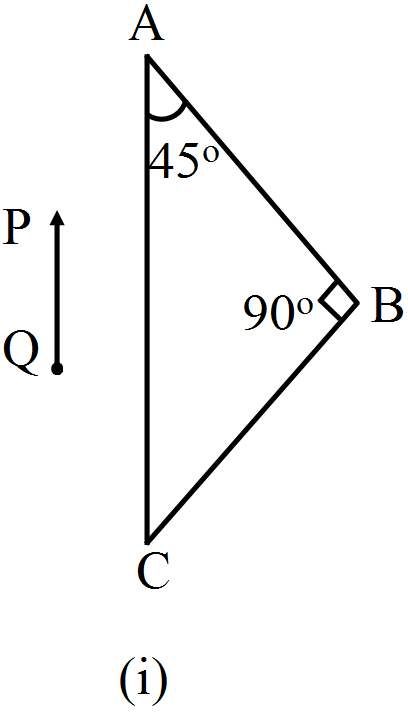
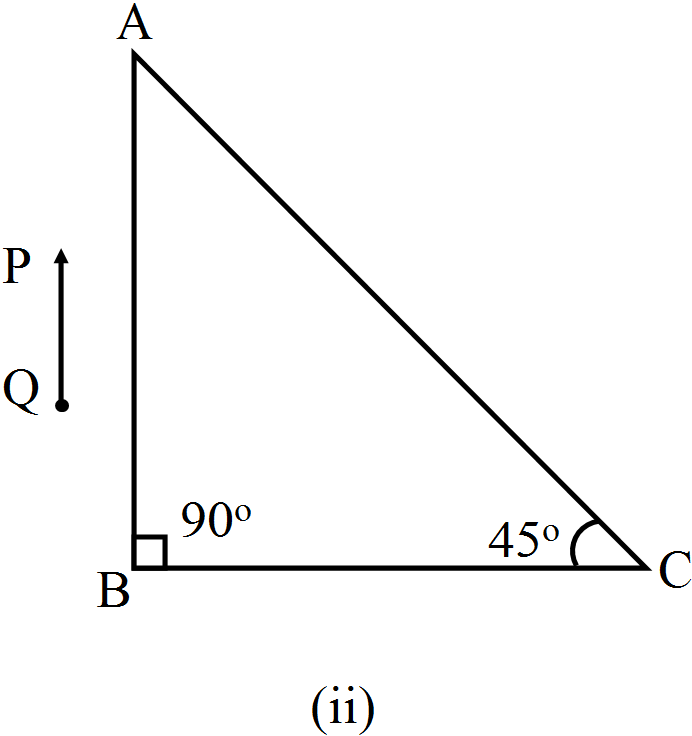
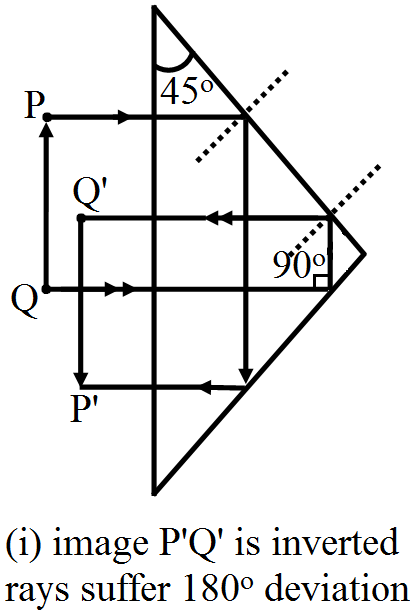
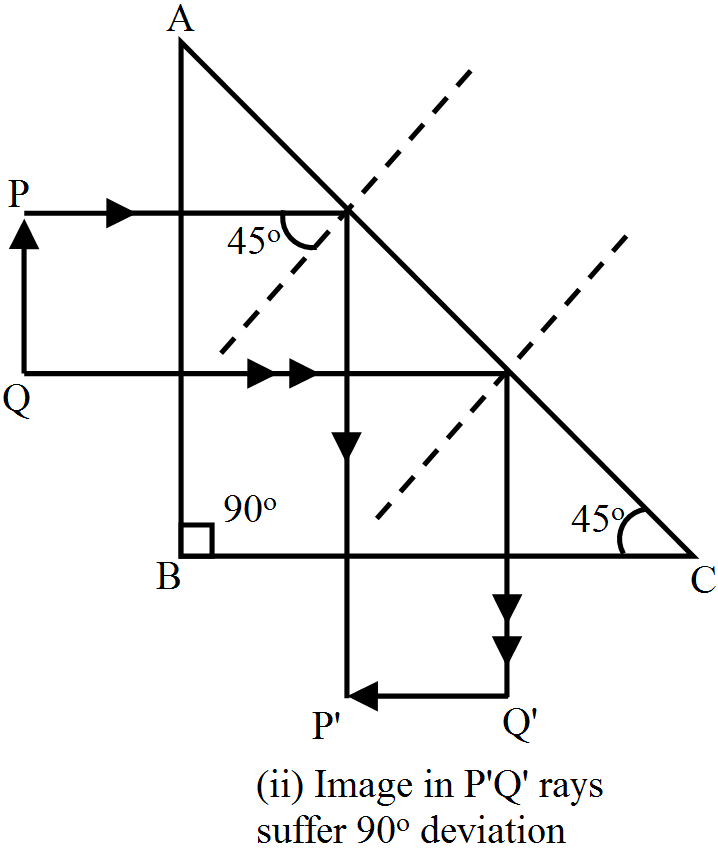
A right-angled crown glass prism with critical angle 41° is placed before an object, PQ in two positions as shown in the figures (i) and (ii). Trace the paths of the rays from P and Q passing through the prisms in the two cases.
Answer
The formation of images is shown in figures (i) and (ii).
View full question & answer
Question 902 Marks
The eyepiece of an astronomical telescope has a focal length of 10cm. The telescope is focused for normal vision of distant objects when the tube length is 1.0m. Find the focal length of the objective and the magnifying power of the telescope.
Answer
For the given astronomical telescope in normal adjustment, $\mathrm{F}_{\mathrm{e}}=10 \mathrm{~cm}, \mathrm{~L}=1 \mathrm{~m}=100 \mathrm{~cm}$
So $, \mathrm{f}_0=\mathrm{L}-\mathrm{f}_{\mathrm{e}}=100-10=90 \mathrm{~cm}$
and, magnifying power $=\frac{\text{f}_0}{\text{f}_\text{e}}=\frac{90}{10}=9$
View full question & answer
Question 912 Marks
If three identical prisms are combined, is it possible to pass a beam that emerges undeviated? Undispersed?
Answer
No, it is not possible even when prisms are be combined with their refractive angle reversed with respect to each other. There will be at least a net deviation and dispersion equal to the dispersion and deviation produced by a single prism.
View full question & answer
Question 922 Marks
"Monochromatic light should be used to produce pure spectrum". Comment on this statement.
Answer
No, monochromatic light cannot be used to produce a pure spectrum. A spectrum is produced when a light of different wavelengths is deviated through different angles and gets separated. Monochromatic light, on the other hand, has a single wavelength.
View full question & answer
Question 932 Marks
How does the power of a convex lens vary, if the incident red light is replaced by violet light?
Answer
Power of a lens increases if red light is replaced by violet light because.
$\text{P}=\frac{1}{\text{f}}=(_{\text{a}\text{n}_{\text{g}}-1})\Big(\frac{1}{\text{R}_1}-\frac{1}{\text{R}_1}\Big)$ and refractive index is maximum for violet light in visible region of spectrum.
View full question & answer
2 Marks Questions - Page 2 - Physics STD 12 Science Questions - Vidyadip