Questions · Page 3 of 3

3 Marks Question

Question 1013 Marks
The near point and the far point of a child are at 10cm and 100cm. If the retina is 2.0cm behind the eye-lens, what is the range of the power of the eye-lens?
Answer
The child has near point and far point 10cm and 100cm respectively.Since, the retina is 2cm behind the eye-lens, v = 2cm
For near point u = -10cm = -0.1m, v = 2cm = 0.02m
So, $\frac{1}{\text{f}_\text{near}}=\frac{1}{\text{v}}-\frac{1}{\text{u}}=\frac{1}{0.02}-\frac{1}{-1}=50+10=60\text{D}$
For far point, u = -100cm = = -1m,
v = 2cm = 0.02m
So, $\frac{1}{\text{f}_\text{far}}=\frac{1}{\text{v}}-\frac{1}{\text{u}}=\frac{1}{-1}=50+1=51\text{D}$
So, the rage of power of the eye-lens is +60D to +51D.
View full question & answer
Question 1023 Marks
Two lenses of power 10D and -5D are placed in contact.
  1. Calculate the power of lens combination.
  2. Where should an object be held from the lens, so as to obtain a virtual image of magnification 2?
Answer
  1. Given $P_1 = 10\ D,$
$P_2 = -5D$
Power of Combination, $P = p_1 + P_2 = 10D - 5D = 5D$
  1. Focal length (Convergent lens) $\text{f}=\frac{1}{\text{P}}=\frac{1}{5}\text{m}$
$=0.20\text{m}=20\text{cm}$
(Convergent lens)
Magnification $\text{m}=\frac{\text{v}}{\text{u}}=+2$
$\Rightarrow\text{v}=2\text{u}$
From lens formula (u is negative) $\frac{1}{\text{f}}=\frac{1}{\text{v}}-\frac{1}{\text{u}}$
$\frac{1}{20}=\frac{1}{2\text{u}}-\frac{1}{\text{u}}$
$\Rightarrow-\frac{1}{2\text{u}}=\frac{1}{20}$
$\Rightarrow\text{u}=-10\text{cm}.$
View full question & answer
Question 1033 Marks
A flint glass prism and a crown glass prism are to be combined in such a way that the deviation of the mean ray is zero. The refractive index of flint and crown glasses for the mean ray are 1.620 and 1.518 respectively. If the refracting angle of the flint prism is 6.0°, what would be the refracting angle of the crown prism?
Answer
Given that,
Refractive index of flint glass $=\mu_\text{f}=1.620$
Refractive index of crown glass $=\mu_\text{c}=1.518$
Refracting angle of flint prism $=\text{A}_\text{f}=6.0^\circ$
For zero net deviation of mean ray
$(\mu_\text{f}-1)\text{A}_\text{f}=(\mu_\text{c}-1)\text{A}_\text{c}$
$\Rightarrow\text{A}_\text{c}=\frac{\mu_\text{f}-1}{\mu_\text{c}-1}\text{A}_\text{f}=\frac{1.620-1}{1.518-1}(6.0)^\circ=7.2^\circ$
View full question & answer
Question 1043 Marks
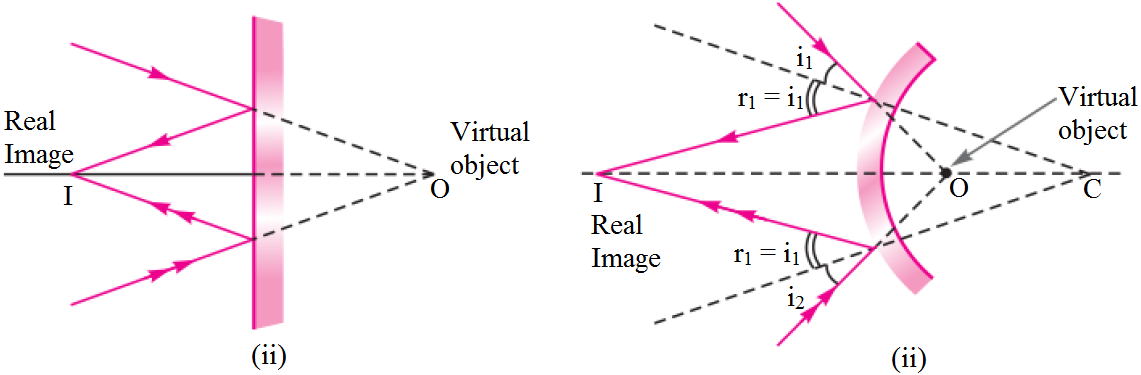
You have learnt that plane and convex mirrors produce virtual images of objects. Can they produce real images under some circumstances? Explain.
Answer
Yes, plane and convex mirrors can form real images if the object is virtual i.e., rays incident on the mirror is convergent as shown in figs. (i) and (ii).
View full question & answer
Question 1053 Marks
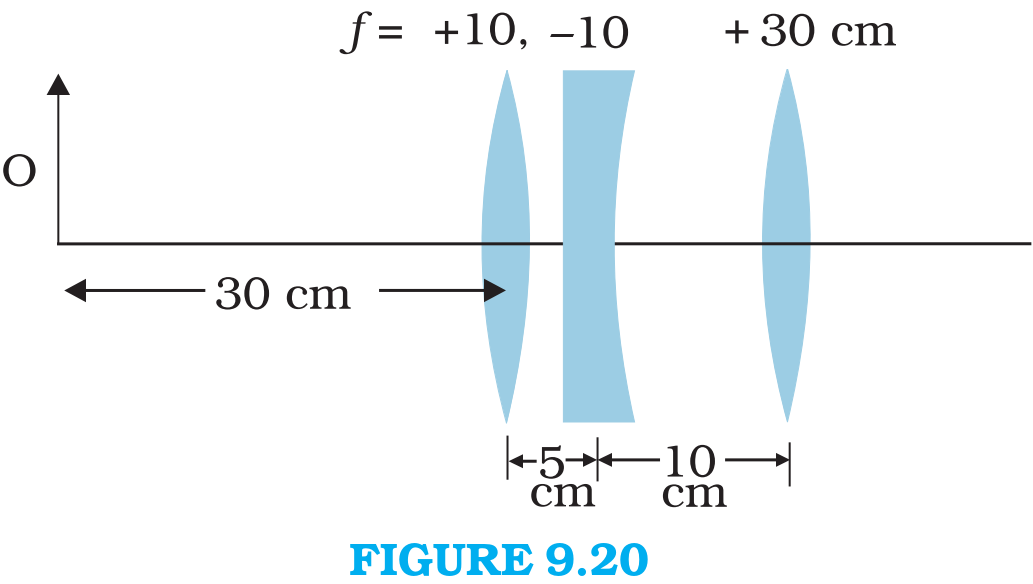
Find the position of the image formed by the lens combination given in the Fig. $9.20$.
Image
Answer
Image formed by the first lens
$\frac{1}{v_1}-\frac{1}{u_1}=\frac{1}{f_1}$
$\frac{1}{v_1}-\frac{1}{-30}=\frac{1}{10}$
or $ v_1=15 \ cm$
The image formed by the first lens serves as the object for the second.
This is at a distance of $(15-5) \ cm =10 \ cm$ to the right of the second lens.
Though the image is real, it serves as a virtual object for the second lens,
Which means that the rays appear to come from it for the second lens.
$\frac{1}{v_2}-\frac{1}{10}=\frac{1}{-10}$
or $ v_2=\infty$
The virtual image is formed at an infinite distance to the left of the second lens.
This acts as an object for the third lens.
$\frac{1}{v_3}-\frac{1}{u_3}=\frac{1}{f_3}$
or $ \frac{1}{v_3}=\frac{1}{\infty}+\frac{1}{30}$
or $ v_3=30 \ cm$
The final image is formed $30 \ cm$ to the right of the third lens.
View full question & answer
Question 1063 Marks
(i) If $f=0.5 m$ for a glass lens, what is the power of the lens? (ii) The radii of curvature of the faces of a double convex lens are $10 cm$ and $15 cm$. Its focal length is $12 cm$. What is the refractive index of glass? (iii) A convex lens has $20 cm$ focal length in air. What is focal length in water? (Refractive index of air-water $=1.33$, refractive index for air-glass $=1.5$.)
Answer
(i) Power $=+2$ dioptre.
(ii) Here, we have $f=+12 cm , R_1=+10 cm , R_2=-15 cm$.
Refractive index of air is taken as unity.
We use the lens formula of Eq. (9.22). The sign convention has to be applied for $f, R_1$ and $R_2$.
Substituting the values, we have
$
\frac{1}{12}=(n-1)\left(\frac{1}{10}-\frac{1}{-15}\right)
$
This gives $n=1.5$.
(iii) For a glass lens in air, $n_2=1.5, n_1=1, f=+20 cm$. Hence, the lens formula gives
$
\frac{1}{20}=0.5\left[\frac{1}{R_1}-\frac{1}{R_2}\right]
$
For the same glass lens in water, $n_2=1.5, n_1=1.33$. Therefore,
$
\frac{1.33}{f}=(1.5-1.33)\left[\frac{1}{R_1}-\frac{1}{R_2}\right]
$
Combining these two equations, we find $f=+78.2 cm$.
View full question & answer
Question 1073 Marks
Suppose while sitting in a parked car, you notice a jogger approaching towards you in the side view mirror of $R=2 m$. If the jogger is running at a speed of $5 m s ^{-1}$, how fast the image of the jogger appear to move when the jogger is (a) $39 m$, (b) $29 m$, (c) $19 m$, and (d) $9 m$ away.
Answer
From the mirror equation, Eq. (9.7), we get
$
v=\frac{f u}{u-f}
$
For convex mirror, since $R=2 m , f=1 m$. Then
for $u=-39 m , v=\frac{(-39) \times 1}{-39-1}=\frac{39}{40} m$
Since the jogger moves at a constant speed of $5 m s ^{-1}$, after $1 s$ the position of the image $v$ (for $u=-39+5=-34)$ is $(34 / 35) m$.
The shift in the position of image in $1 s$ is
$
\frac{39}{40}-\frac{34}{35}=\frac{1365-1360}{1400}=\frac{5}{1400}=\frac{1}{280} m
$
Therefore, the average speed of the image when the jogger is between $39 m$ and $34 m$ from the mirror, is $(1 / 280) m s ^{-1}$
Similarly, it can be seen that for $u=-29 m ,-19 m$ and $-9 m$, the speed with which the image appears to move is
$
\frac{1}{150} m s ^{-1}, \frac{1}{60} m s ^{-1} \text { and } \frac{1}{10} m s ^{-1} \text {, respectively. }
$
Although the jogger has been moving with a constant speed, the speed of his/her image appears to increase substantially as he/she moves closer to the mirror. This phenomenon can be noticed by any person sitting in a stationary car or a bus. In case of moving vehicles, a similar phenomenon could be observed if the vehicle in the rear is moving closer with a constant speed.
View full question & answer
Question 1083 Marks
An object is placed at $(i) 10 \ cm, (ii) 5 \ cm$ in front of a concave mirror of radius of curvature $15 \ cm$. Find the position, nature, and magnification of the image in each case.
Answer
The focal length $f=-15 / 2 \ cm =-7.5 \ cm$
$(i)$ The object distance $u=-10 \ cm$.
Then Eq. $(9.7)$ gives
$\frac{1}{v}+\frac{1}{-10}=\frac{1}{-7.5}$
$\text { or } v=\frac{10 \times 7.5}{-2.5}=-30 \ cm$
The image is $30 \ cm$ from the mirror on the same side as the object.
Also, magnification $m=-\frac{v}{u}$
$=-\frac{(-30)}{(-10)}=-3$
The image is magnified, real and inverted.
$(ii)$ The object distance $u=-5 \ cm$.
Then from Eq. $(9.7),$
$\frac{1}{v}+\frac{1}{-5}=\frac{1}{-7.5}$
or $ v=\frac{5 \times 7.5}{(7.5-5)}=15 \ cm$
This image is formed at $15 \ cm$ behind the mirror. It is a virtual image.
Magnification $m=-\frac{v}{u}$
$=-\frac{15}{(-5)}=3$
The image is magnified, virtual and erect.
View full question & answer
Question 1093 Marks
  1. For a glass prism $(\mu =\sqrt{3} )$ the angle of minimum deviation is equal to the angle of the prism. Calculate the angle of the prism.
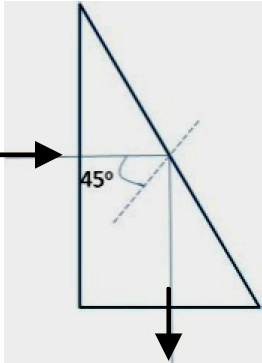
  2. Draw ray diagram when incident ray falls normally on one of the two equal sides of a right angled isosceles prism having refractive index $\mu = \sqrt{3} . $
Answer
  1. $\mu = \frac{\sin(\frac{\text{A} + \text{D}}{2})}{\sin\frac{\text{A}}{2}}$
$ = \frac{\sin(\frac{2\text{A}}{2})}{\sin\frac{\text{A}}{2}} =2 \cos\text{A}\sqrt{2} = \sqrt{3}$$\therefore\text{A} = 60 ^{o}$
  1. $\mu = \sqrt{3} = \frac{1}{\sin\text{i}_{c}}$
Image
$\therefore\sin\text{i}_{c} = \frac{1}{\sqrt{3}}\cong0.58$
Lies between 30oand 45o
Hence, TIR takes place.
Alternate Answer
$\sin\text{C} = \frac{1}{\sqrt{3}}$which is less than$\frac{1}{\sqrt{2}}$
$\therefore $Angle of incidence > ic
$\therefore\text{TIR}$
View full question & answer
3 Marks Question - Page 3 - Physics STD 12 Science Questions - Vidyadip