Questions · Page 2 of 3

3 Marks Question

Question 513 Marks
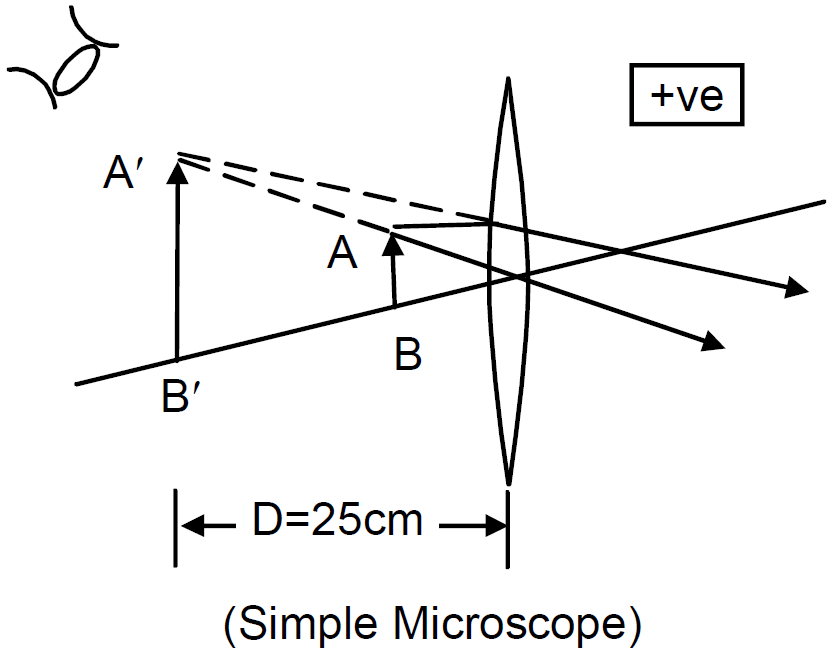
The magnifying power of a simple microscope is given by $1+\frac{\text{D}}{\text{f}},$ where D is the least distance for clear vision. For farsighted persons, D is greater than the usual. Does it mean that the magnifying power of a simple microscope is greater for a farsighted person as compared to a normal person? Does it mean that a farsighted person can see an insect more clearly under a microscope than a normal person?
Answer
The magnifying power of a simple microscope depends on the ratio $\frac{\text{D}}{\text{f}}$ for a farsighted person. Here, D for a farsighted person is greater than that for a normal person, but the value of f remains the same. Therefore, the magnifying power of a simple microscope is greater for a farsighted person compared to that for a person with normal vision. Also, a farsighted person can see the insect more clearly under the microscope than a person with normal vision.
View full question & answer
Question 523 Marks
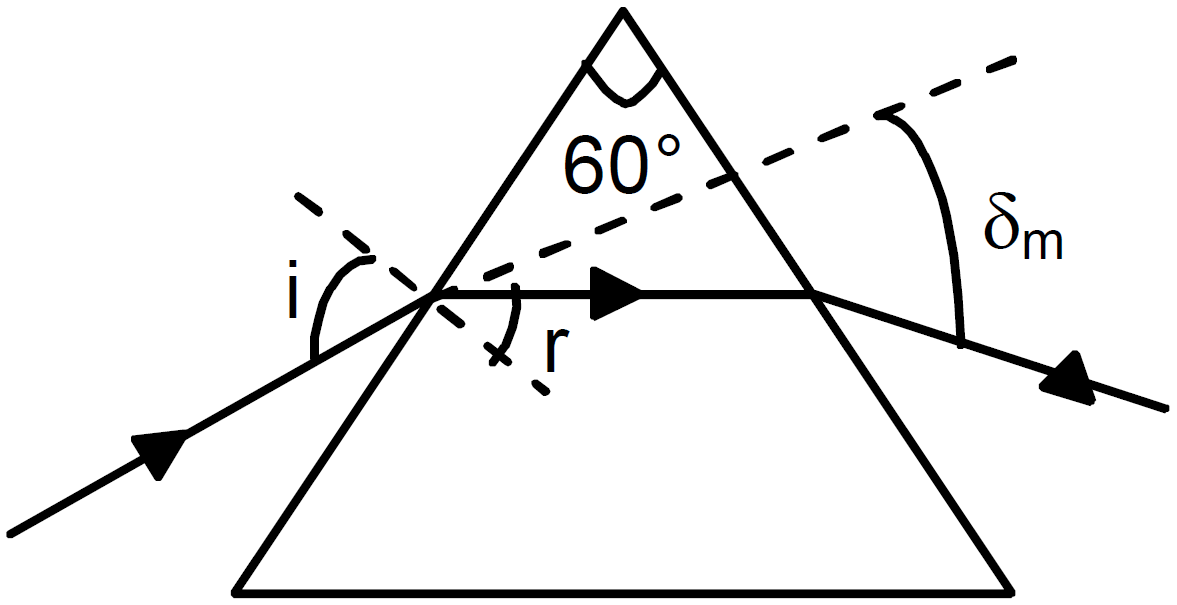
Find the angle of minimum deviation for an equilateral prism made of a material of refractive index 1.732. What is the angle of incidence for this deviation?
Answer
Refractive index $(\mu)$ of the material from which prism is made = 1.732
We know refractive index is given by:
$\mu=\frac{\Big[\frac{\delta_{\text{min}}+\text{A}}{2}\Big]}{\sin\Big[\frac{\text{A}}{2}\Big]}$

Where $\delta_{\text{min}}$ is the angleof minimum deviation and A is the angle of prism = 60º
$\Rightarrow 1.732\times \sin(30^\circ)=\sin\Big(\frac{\delta_{\text{min}}+60^\circ}{2}\Big)$
$\Rightarrow \frac{1.732}{2}=\sin\Big(\frac{\delta_{\text{min}}+60^\circ}{2}\Big)$
$\Rightarrow \Big(\frac{\delta_{\text{min}}+60^\circ}{20}\Big)=60^\circ$
$\delta_{\text{min}}=60^\circ$
$\delta_{\text{min}}=2\text{i}-\text{A}$
$2\text{i}=120^\circ$
$\text{i}=60^\circ$
Hence, the required angle of deviation is 60°.
View full question & answer
Question 533 Marks
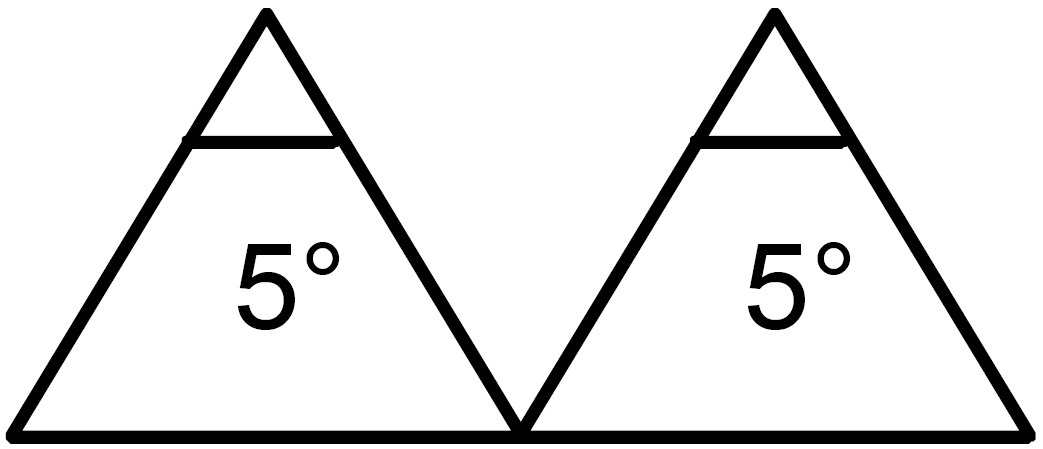
A thin prism of crown glass $(\mu_\text{r}=1.515,\mu_\text{v}=1.525)$ and a thin prism of flint glass $(\mu_\text{r}=1.612,\mu_\text{v}=1.632)$ are placed in contact with each other. Their refracting angles are 5.0° each and are similarly directed. Calculate the angular dispersion produced by the combination.
Answer
Given that,
$\mu_\text{cr}=1.515,\mu_\text{cv}=1.525$ and $\mu_\text{fr}=1.612,\mu_\text{fv}=1.632$ and A = 5° Since, they are similarly directed, the total deviation produced is given by, $\delta=\delta_\text{c}+\delta_\text{r}=(\mu_\text{c}-1)\text{A}+(\mu_\text{r}-1)\text{A}$ $=(\mu_\text{c}+\mu_\text{r}-2)\text{A}$ So, angular dispersion of the combination is given by, $\delta_\text{v}-\delta_\text{y}=(\mu_\text{cv}+\mu_\text{fv}-2)\text{A}-(\mu_\text{cr}+\mu_\text{fr}-2)\text{A}$ $=(\mu_\text{cv}+\mu_\text{fv}-\mu_\text{cr}-\mu_\text{fr})\text{A}$ $=(1.525+1.632-1.515-1.612)5=0.15^\circ$
View full question & answer
Question 543 Marks

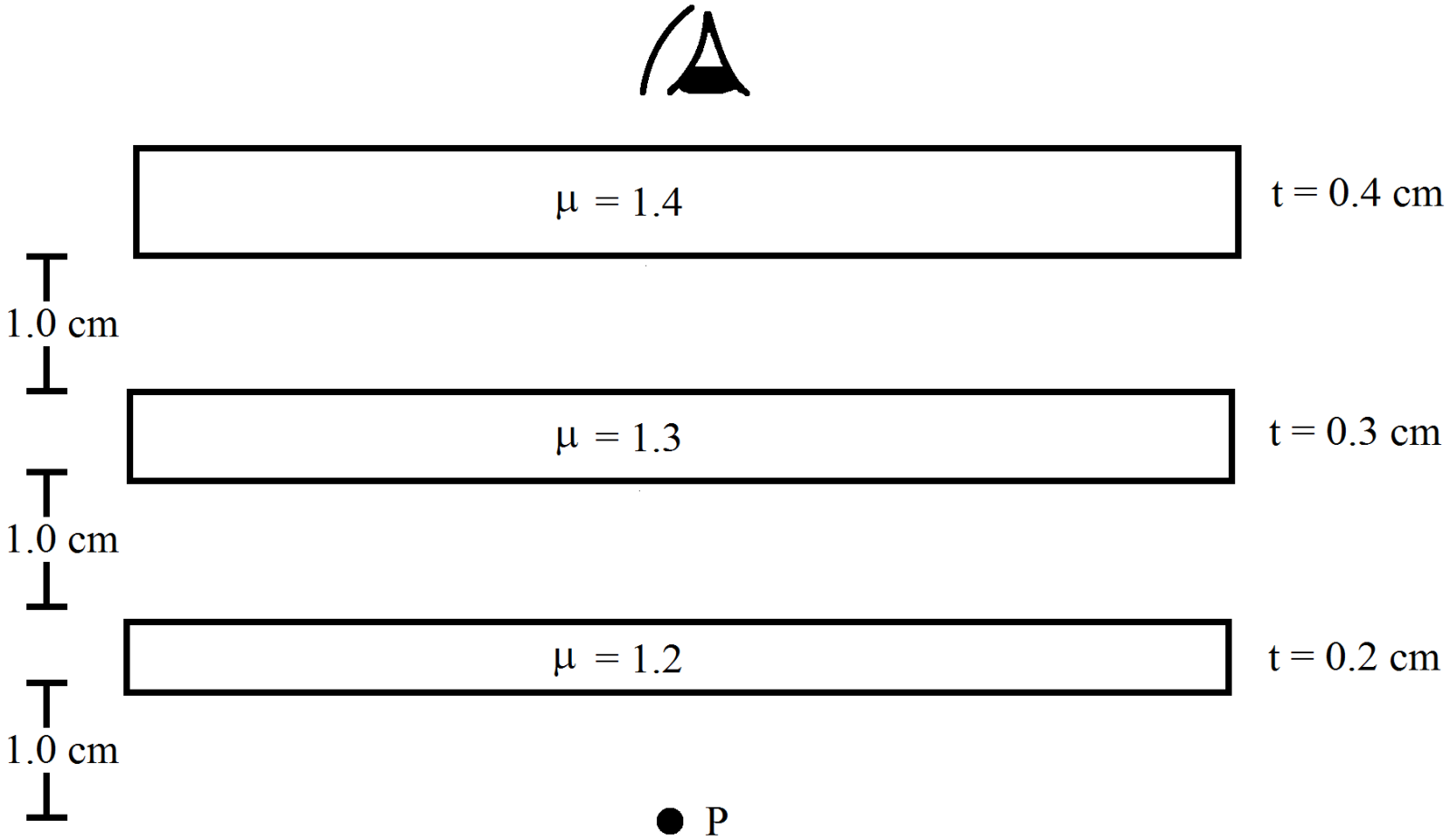
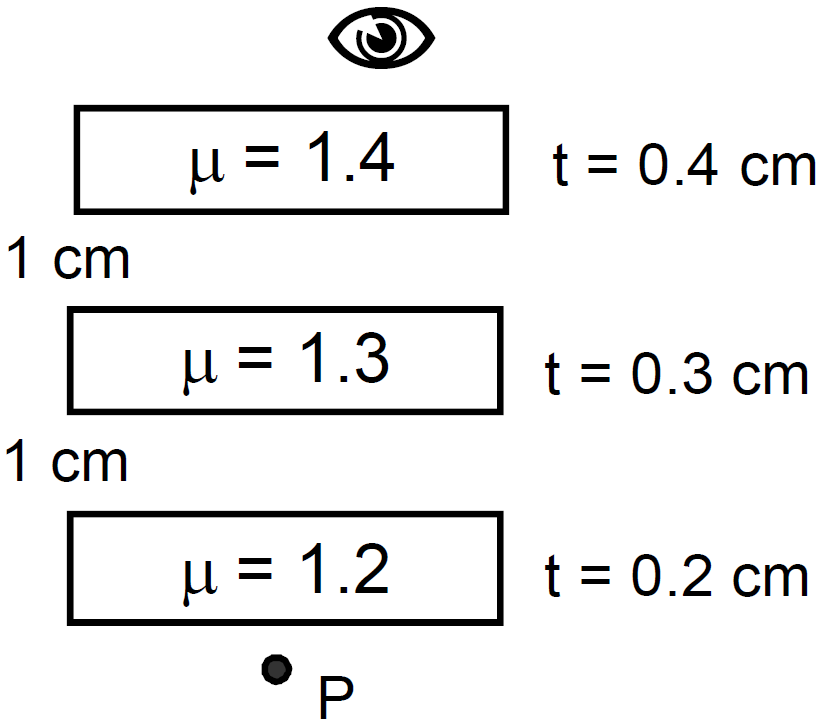
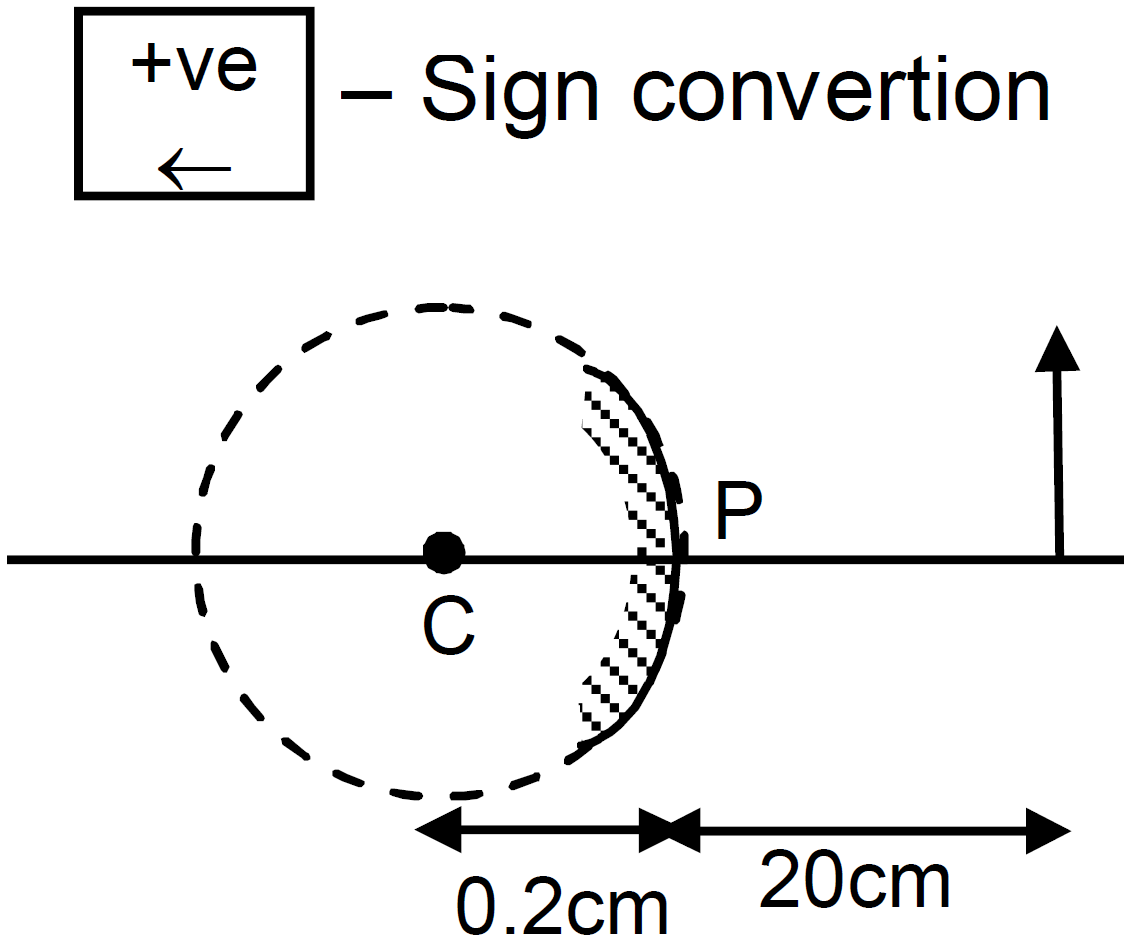
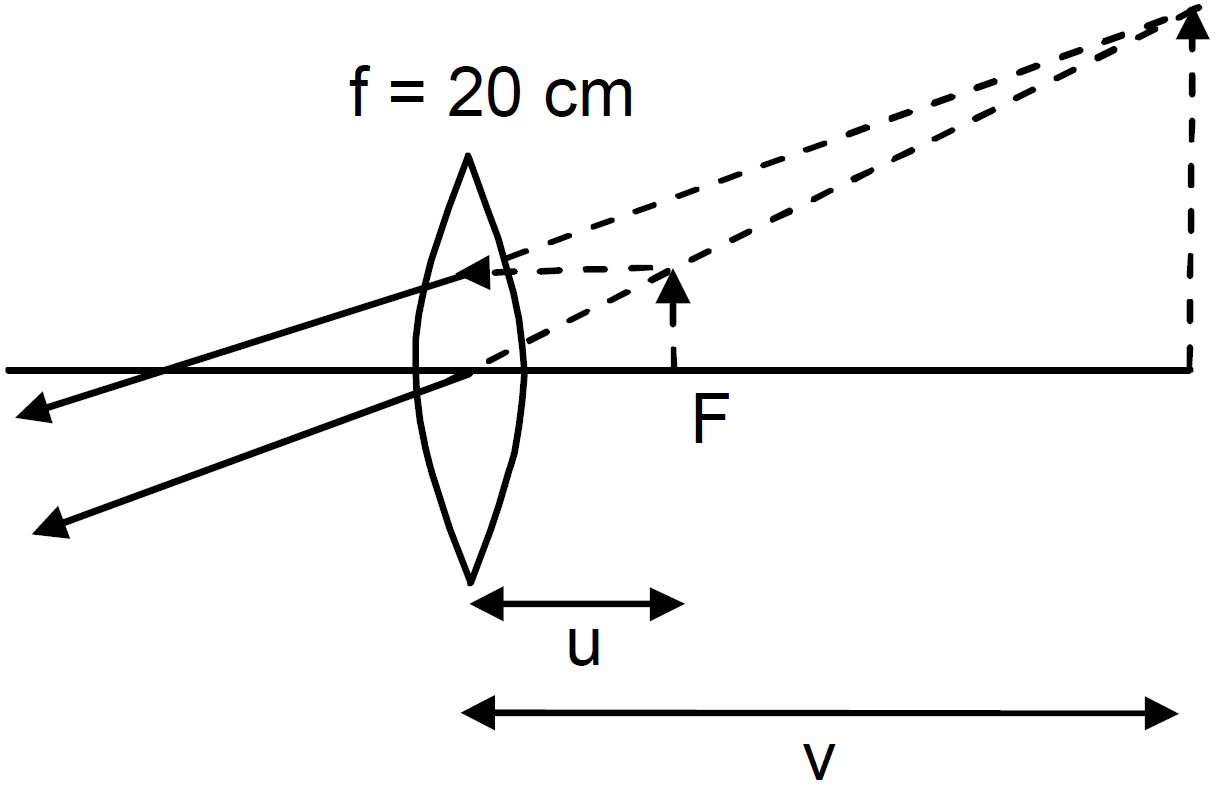
Locate the image of the point P as seen by the eye in the figure.
Answer
The presence of air medium in between the sheets does not affect the shift. The shift will be due to 3 sheets of different refractive index other than air. $\Delta \text{t}=\Big[1-\frac{1}{\mu_1}\Big]\text{t}_1+\Big[1-\frac{1}{\mu_2}\Big]\text{t}_2+\Big[1-\frac{1}{\mu_3}\Big]\text{t}_3$ $=\Big(1-\frac{1}{1.2}\Big)(0.2)+\Big(1-\frac{1}{13}\Big)(0.3)+\Big(1-\frac{1}{14}\Big)(0.4)$ $=0.2\text{cm}$ above point P.
View full question & answer
Question 553 Marks
A 5.0 diopter lens forms a virtual image which is 4 times the object placed perpendicularly on the principal axis of the lens. Find the distance of the object from the lens.
Answer

Given, P = 5 diopter (convex lens)
$\Rightarrow\text{f}=\frac{1}{5}\text{m}=20\text{cm}$
Since, a virtual image is formed, u and v both are negative.Given, $\frac{\text{v}}{\text{u}}=4$
$\Rightarrow\text{v}=4\text{u} \ ...(1)$
From lens formula, $\frac{1}{\text{v}}-\frac{1}{\text{u}}=\frac{1}{\text{f}}$
$​​\Rightarrow\frac{1}{\text{f}}=\frac{1}{4\text{u}}-\frac{1}{\text{u}}​​\Rightarrow\frac{1}{20}=\frac{1-4}{4\text{u}}=-\frac{3}{4\text{u}}$
$\Rightarrow\text{u}=-15\text{cm}$
$\therefore$ Object is placed 15cm away from the lens.
View full question & answer
Question 563 Marks
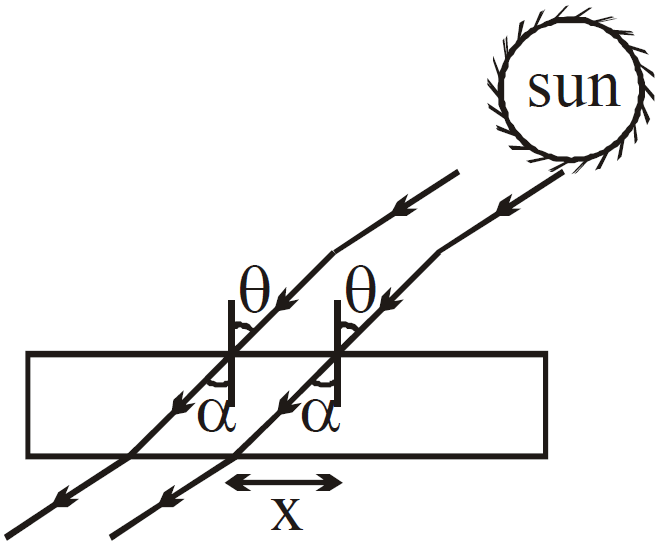
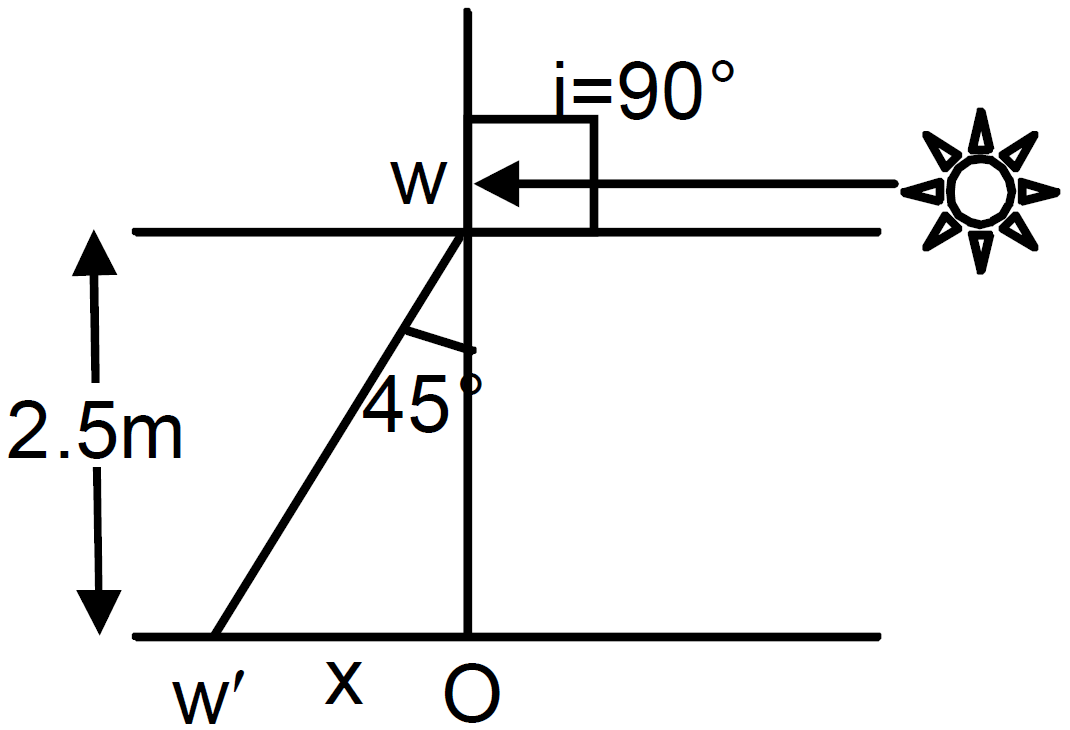
A small piece of wood is floating on the surface of a 2.5m deep lake. Where does the shadow form on the bottom when the sun is just setting? Refractive index of water $=\frac{4}{3}.$
Answer

Height of the lake = 2.5m
When the sun is just setting, $\theta$ is approximately = 90°
$\therefore \ \frac{\sin\text{i}}{\sin\text{r}}=\frac{\mu_2}{\mu_1}\Rightarrow\frac{1}{\sin\text{r}}=\frac{\frac{4}{3}}{1}\Rightarrow\sin\text{r}=\frac{3}{4}\Rightarrow\text{r}=49^{\circ}$
As shown in the figure, $\frac{\text{x}}{2.5}=\tan\text{r}=1.15$
$\Rightarrow\text{x}=2.5\times1.15=2.8\text{m}.$
View full question & answer
Question 573 Marks
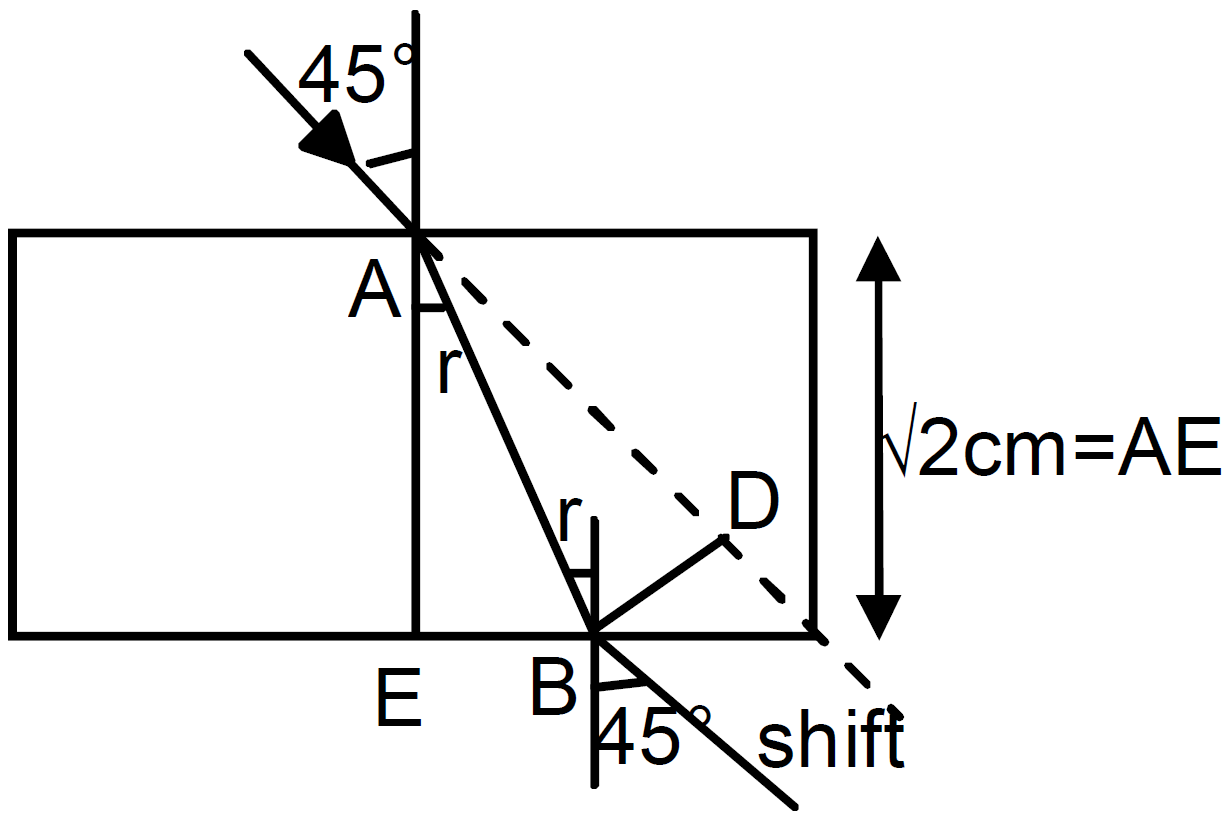
A light ray is incident at an angle of 45° with the normal to a $\sqrt{2}\text{cm}$ thick plate $(\mu = 2.0)$. Find the shift in the path of the light as it emerges out from the plate.
Answer
Applying snell's law,
$\frac{\sin \text{i}}{\sin \text{r}}=\frac{1}{\mu}$ $\Rightarrow \frac{\sin \text{i}}{\sin \text{r}}=\frac{2}{1}$ As shown in the figure, $\frac{\sin45^{\circ}}{\sin\text{r}}=\frac{2}{1}\Rightarrow\sin\text{r}=\frac{\sin45^{\circ}}{2}=\frac{1}{2\sqrt{2}}\Rightarrow\text{r}=21^{\circ}$ Here, BD = shift in path = AB sin 24° $=0.406\times\text{AB}=\frac{\text{AE}}{\cos21^{\circ}}\times0.406=0.62\text{cm}.$
View full question & answer
Question 583 Marks
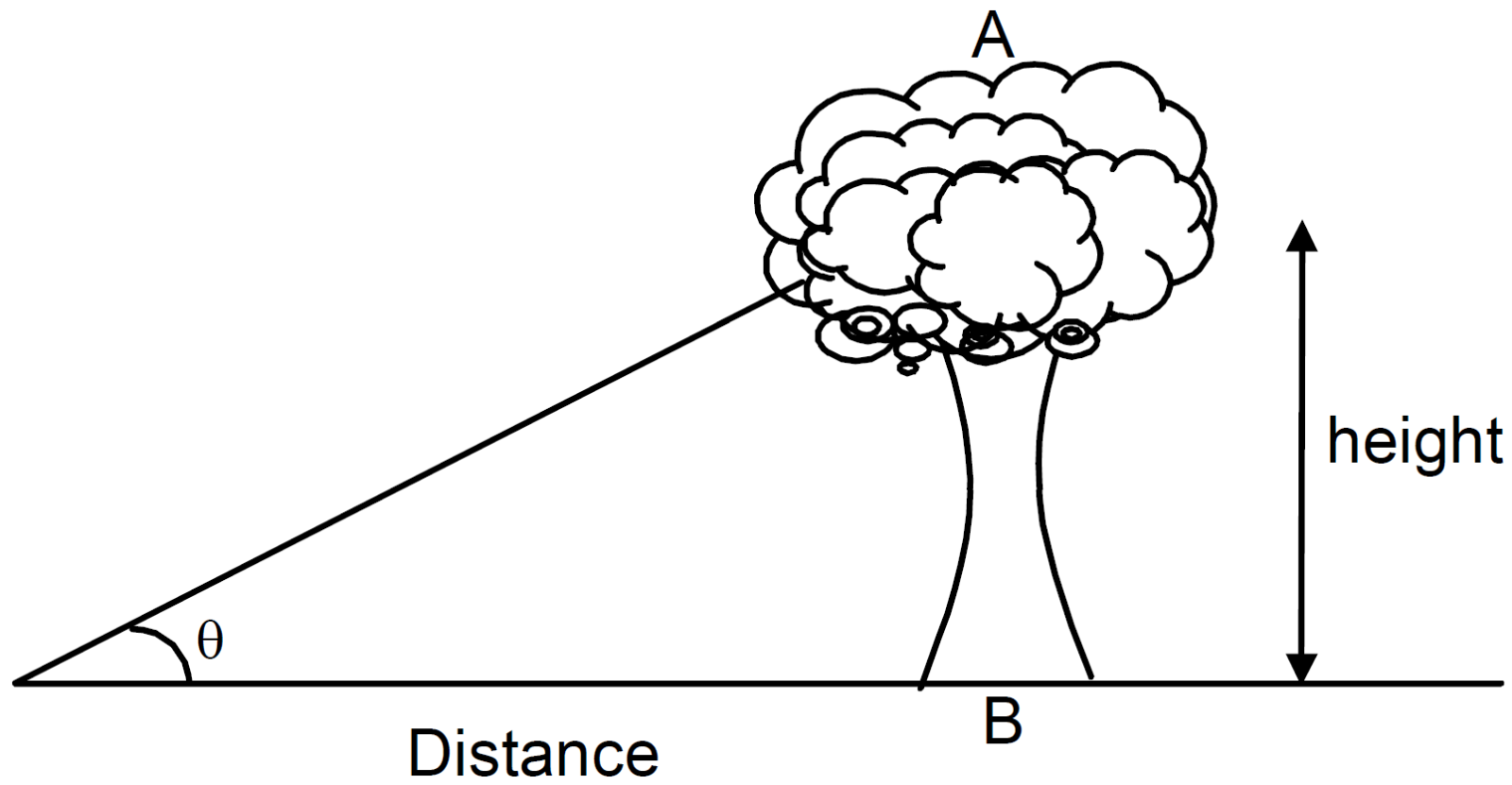
A person looks at different trees in an open space with the following details. Arrange the trees in decreasing order of their apparent sizes.
Tree Height(m) Distance form the eye(m)
A 2.8 50
B 2.5 80
C 1.8 70
D 2.8 100
Answer
The visual angles made by the tree with the eyes can be calculated be below.
$\theta=\frac{\text{Height of the tree}}{\text{Distance from the eye}}=\frac{\text{AB}}{\text{OB}}$
$\Rightarrow\theta_\text{A}=\frac{2}{50}=0.04$
Similarly, $\theta_\text{B}=\frac{2.5}{80}=0.03125$
$\theta_\text{c}=\frac{2.8} {70}=0.02571$
$\theta_\text{D}=\frac{2.8}{100}=0.028$
Since, $\theta_\text{A}>\theta_\text{B}>\theta_\text{D}>\theta_\text{C}$ the arrangement in decreasing order is given by A, B, D and C.
View full question & answer
Question 593 Marks
The focal lengths of a convex lens for red, yellow and violet rays are 100cm, 98cm and 96cm respectively. Find the dispersive power of the material of the lens.
Answer
The focal length of a lens is given by
$\frac{1}{\text{f}}=(\mu-1)\Big(\frac{1}{\text{R}_1}-\frac{1}{\text{R}_2}\Big)$
$\Rightarrow(\mu-1)=\frac{1}{\text{f}}\times\frac{1}{\Big(\frac{1}{\text{R}_1}-\frac{1}{\text{R}_2}\Big)}=\frac{\text{k}}{\text{f}}\ ...(1)$
So, $\mu_\text{r}-1=\frac{\text{K}}{100}\ ...(2)$
$\mu_\text{y}-1=\frac{\text{K}}{98}\ ...(3)$
And $\mu_\text{v}-1=\frac{\text{K}}{96}\ ...(4)$
So, Dispersive power $=\omega=\frac{\mu_\text{v}-\mu_\text{r}}{\mu_\text{y}-1}=\frac{(\mu_\text{v}-1)-(\mu_\text{r}-1)}{(\mu_\text{y}-1)}=\frac{\frac{\text{K}}{96}-\frac{\text{K}}{100}}{\frac{\text{K}}{98}}$ $=\frac{98\times4}{9600}=0.0408$
View full question & answer
Question 603 Marks
For a given position of an object, an equiconvex lens forms its real image at a distance of 60cm from the lens. A convex mirror is now kept in between this image position and the convex lens. The final image formed by this combination coincides with the object when the distance between the convex lens and the convex mirror equals 25cm. Calculate the radius of curvature of the convex mirror.
Answer
Given that the image formed by the combination of convex lens and the convex mirror coincides with the object.
This means that the position of the image formed by the convex lens alone corresponds to the position of centre of curvature of the convex mirror.
Hence, the distance between the convex mirror and this image (formed by the lens) which is equal to 60-25 represents radius of curvature of the mirror.
Thus, radius of curvature of the mirror = 35cm.
View full question & answer
Question 613 Marks
The following data was recorded for values of object distance and the corresponding values of image distance in the experiment on study of real image formation by a convex lens of power +5D. One of these observations is incorrect. Identify this observation and give reason for your choice:
S .No
Object distance (cm)
Image distance (cm)
1
25
97
2
30
61
3
35
37
4
45
35
5
50
32
6
55
30
Answer
Power of lens = +5D
Focal length of lens,
The observations at serial number (3) i.e., (object distance 35cm and image distance 37cm is incorrect), because if the object is placed at a distance between f and 2f its image will be formed beyond 2f, while in this observation the object and image distances, both are between f and 2f.
View full question & answer
Question 623 Marks
A man uses a concave mirror for shaving. He keeps his face at a distance of 25cm from the mirror and gets an image which is 1.4 times enlarged. Find the focal length of the mirror.
Answer
$\text{u}=-25\text{cm}$
$\text{m}=\frac{\text{A}'\text{B}'}{\text{AB}}=-\frac{\text{v}}{\text{u}}\Rightarrow1.4=-\Big(\frac{\text{v}}{-25}\Big)\Rightarrow\frac{14}{10}=\frac{\text{v}}{25}$
$\Rightarrow\text{v}=\frac{25\times14}{10}=35\text{cm}$
Now, $\frac{1}{\text{v}}+\frac{1}{\text{u}}=\frac{1}{\text{f}}$
$\Rightarrow\frac{1}{\text{f}}=\frac{1}{35}-\Big(\frac{1}{-25}\Big)$
$\Rightarrow\frac{5-7}{175}=\frac{-2}{175}$
$\Rightarrow\text{f}=-87.5\text{cm}$
So, focal length of the concave mirror is 87.5cm.
View full question & answer
Question 633 Marks
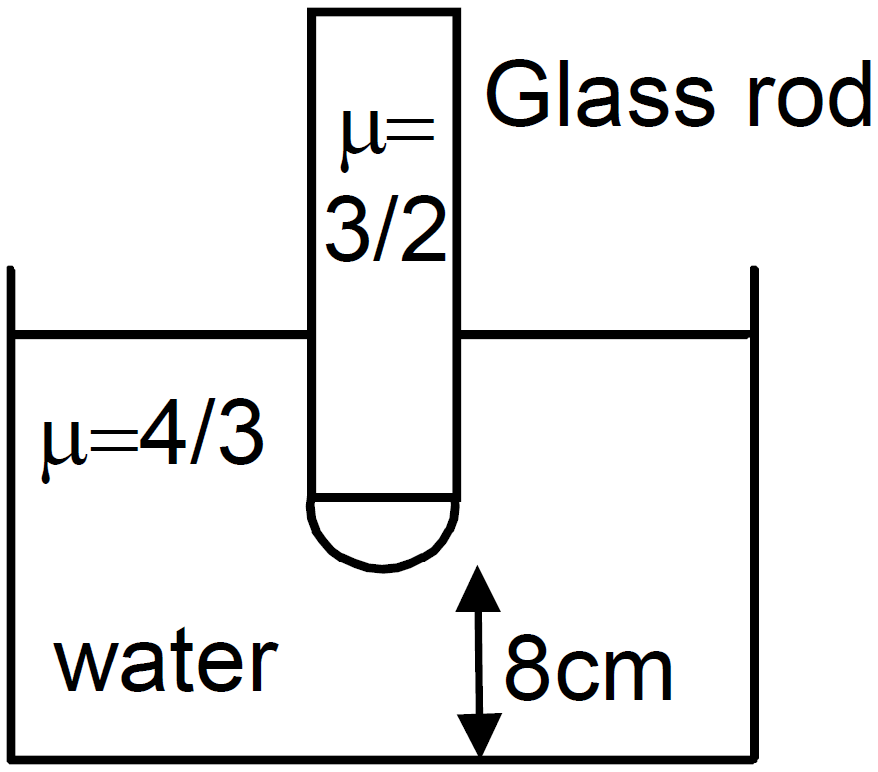
One end of a cylindrical glass rod $(\mu=1.5)$ of radius 1.0cm is rounded in the shape of a hemisphere. The rod is immersed in water $\Big(\mu=\frac{4}{3}\Big)$ and an object is placed in the water along the axis of the rod at a distance of 8.0cm from the rounded edge. Locate the image of the object.
Answer

Radius of the cylindrical glass tube = 1cm
We know, $\frac{\mu_2}{\text{v}}-\frac{\mu_1}{\text{u}}=\frac{\mu_2-\mu_1}{\text{R}}$
Here, $\text{u}=-8\text{cm}, \ \mu_2=\frac{3}{2},\mu_1=\frac{4}{3},\text{R}=+1\text{cm}$
So, $\frac{3}{2\text{v}}+\frac{4}{3\times8}\Rightarrow\frac{3}{2\text{v}}+\frac{1}{6}=\frac{1}{6}$
$ \ \text{v}=\infty$
$\therefore$ The image will be formed at infinity.
View full question & answer
Question 643 Marks
A convex lens produces a double size real image when an object is placed at a distance of 18cm from it. Where should the object be placed to produce a triple size real image?
Answer
A real image is formed. So, magnification m = -2(inverted image)
$\therefore\frac{\text{v}}{\text{u}}=-2\Rightarrow\text{v}=-2\text{u}=(-2)(-18)=36$
From lens formula, $\frac{1}{\text{v}}-\frac{1}{\text{u}}=\frac{1}{\text{f}}​​\Rightarrow\frac{1}{36}-\frac{1}{-18}=\frac{1}{\text{f}}$
$\Rightarrow\text{f}=12\text{cm}$
Now, for triple sized image $\text{m}=-3=\Big(\frac{\text{v}}{\text{u}}\Big)$
$\therefore \ \frac{1}{\text{v}}-\frac{1}{\text{u}}=\frac{1}{\text{f}}​​\Rightarrow\frac{1}{-3\text{u}}-\frac{1}{\text{u}}=\frac{1}{12}$
$\Rightarrow3\text{u}=-48\Rightarrow\text{u}=-16\text{cm}$
So, object should be placed 16cm from lens.
View full question & answer
Question 653 Marks
A concave mirror has a focal length of 20cm. Find the position or positions of an object for which the imagesize is double of the object-size.
Answer


For the concave mirror,
$\text{f}=-20\text{cm}, \ \text{M}=-\frac{\text{v}}{\text{u}}=2$
$\Rightarrow\text{v}=-2\text{u}$
$1^{st} case:$ $2^{nd} case:$
$\frac{1}{\text{v}}+\frac{1}{\text{u}}=\frac{1}{\text{f}}$ $\frac{-1}{2\text{u}}-\frac{1}{\text{u}}=-\frac{1}{\text{f}}$
$\Rightarrow\frac{1}{2\text{u}}-\frac{1}{\text{u}}=-\frac{1}{\text{f}}$ $\Rightarrow\frac{3}{2\text{u}}=\frac{1}{\text{f}}$
$\Rightarrow\text{u}=\frac{\text{f}}{2}=10\text{cm}$ $\Rightarrow\text{u}=\frac{3\text{f}}{2}=30\text{cm}$
$\therefore$ The positions are 10cm or 30cm from the concave mirror.
View full question & answer
Question 663 Marks
The magnifying power of a converging lens used as a simple microscope is $\Big(1+\frac{\text{D}}{\text{f}}\Big).$ A compound microscope is a combination of two such converging lenses. Why don't we have magnifying power $\Big(1+\frac{\text{D}}{\text{f}_\text{o}}\Big) \Big(1+\frac{\text{D}}{\text{f}_\text{o}}\Big)?$ In other words, why can the objective not be treated as a simple microscope but the eyepiece can?
Answer
In a simple microscope, the converging lens is used to magnify the object. It is done by the eyepiece in a compound microscope. But the purpose of the objective lens is the same, i.e., to form an enlarged, real and inverted image of the object at a distance less than the focal length of the eyepiece. So, its magnification power cannot be expressed in a way it is expressed for a simple microscope.
View full question & answer
Question 673 Marks
A nearsighted person cannot see beyond 25cm. Assuming that the separation of them glass from the eye is 1cm, find the power of lens needed to see distant objects.
Answer
For the near sighted person,
v = distance of image from glass
= distance of image from eye - separation between glass and eye
= 25cm - 1cm = 24cm = 0.24m
So, for the glass, $\text{u}=\infty$ and v = -24cm = -0.24m
So, $\frac{1}{\text{f}}=\frac{1}{\text{v}}-\frac{1}{\text{u}}=\frac{1}{-0.24}-\frac{1}{\infty}=-4.2\text{D}$
View full question & answer
Question 683 Marks
A person has near point at 100cm. What power of lens is needed to read at 20cm if he/ she uses.
  1. Contact lens,
  2. Spectacles having glasses 2.0cm separated from the eyes?
Answer
The person has near point 100cm. It is needed to read at a distance of 20cm.
  1. When contact lens is used,
u = -20cm = -0.2m,

v = -100cm = -1m

So, $\frac{1}{\text{f}}=\frac{1}{\text{v}}-\frac{1}{\text{u}}=\frac{1}{-1}-\frac{1}{-0.2}=-1+5=+4\text{D}$
  1. When spectacles are used,
u = -(20 - 2) = -18cm = -0.18m

v = -100cm = -1m

So, $\frac{1}{\text{f}}=\frac{1}{\text{v}}-\frac{1}{\text{u}}=\frac{1}{-1}-\frac{1}{-0.18}=-1+5.55=+4.5\text{D}$
View full question & answer
Question 693 Marks
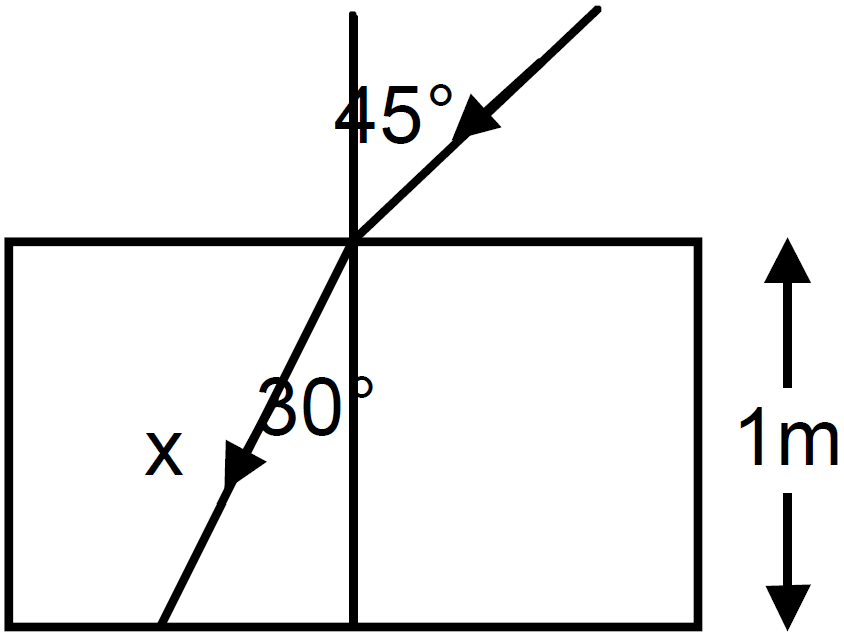
A light ray falling at an angle of 45° with the surface of a clean slab of ice of thickness 1m is refracted into it at an angle of 30°. Calculate the time taken by the light rays, to cross the slab. Speed of light in vacuum $= 3 \times 10^8m/s$
Answer


We know, $\frac{\sin\text{i}}{\sin\text{r}}=\frac{3\times10^8}{\text{v}}=\frac{\sin45^{\circ}}{\sin30^{\circ}}=\sqrt{2}$
$\Rightarrow\text{v}=\frac{3\times10^8}{\sqrt{2}}\text{m}/\text{sec}$
Distance travelled by light in the slab is,
$\text{x}=\frac{1\text{m}}{\cos30^{\circ}}=\frac{2}{\sqrt{3}}\text{m}$
So, time taken $=\frac{2\times\sqrt{2}}{\sqrt{3}\times3\times10^8}=0.54\times10^{-8}=5.4\times10^{-9}\text{sec}.$
View full question & answer
Question 703 Marks
A magnifying glass is a converging lens placed close to the eye. A farsighted person uses spectacles having converging lenses. Compare the functions of a converging lens used as a magnifying glass and as spectacles.
Answer
A converging lens in a magnifying glass is of small focal length which is used to magnify an object which is placed close to the lens. On the other hand, converging lens used as spectacles is of varying focal length which depends upon the actual near point of the long-sighted person. It forms image at the near point of the defected eye which is further focussed by the eye lens.
View full question & answer
Question 713 Marks
If a piece of paper is placed at the position of a virtual image of a strong light source, will the paper burn after sufficient time? What happens if the image is real? What happens if the image is real but the source is virtual?
Answer
No, Yes, Yes.
Real Image: Rays are really getting focussed at point P so intensity is high.

Virtual Image: Ray appears to come from point P and no real concentration of ray at P.
View full question & answer
Question 723 Marks
The diameter of the sun is $1.4 \times 10^9m$ and its distance from the earth is $1.5 \times 10^{11}m$. Find the radius of the image of the sun formed by a lens of focal length 20cm.
Answer
$u = -1.5 \times 10^{11} m; v = +20 \times 10^{-2} m$
Since, f is very small compared to u, distance is taken as $\infty.$
So, image will be formed at focus.
$\Rightarrow v = +20 \times 10^{-2}m$
$\therefore$ We know, $\text{m}=\frac{\text{v}}{\text{u}}=\frac{\text{h}_{\text{image}}}{\text{h}_{\text{object}}}$
$\Rightarrow\frac{20\times10^{-2}}{1.5\times10^{11}}=\frac{\text{D}_{\text{image}}}{1.4\times10^9}$
$\Rightarrow\text{D}_{\text{image}}=1.86\text{mm}$
So, radius $=\frac{\text{D}_{\text{image}}}{2}=0.93\text{mm}.$
View full question & answer
Question 733 Marks
A light ray, going through a prism with the angle of prism 60°, is found to deviate by 30°. What limit on the refractive index can be put from these data?
Answer
Given $\text{A}=60^{\circ}$ and $\mu=30^{\circ}$
We know that,
$\mu=\frac{\sin\Big(\frac{\text{A}+\delta_{\text{m}}}{2}\Big)}{\frac{\sin\text{A}}{2}}=\frac{\sin\frac{60^{\circ}+\delta_{\text{m}}}{2}}{\sin30^{\circ}}=2\sin\frac{60^{\circ}+\delta_{\text{m}}}{2}$
Since, one ray has been found out which has deviated by 30°, the angle of minimum deviation should be either equal or less than 30°. (It can not be more than 30°).
So, $\mu\leq2\sin\frac{60^{\circ}+\delta_{\text{m}}}{2}$ $\big($because $\mu$ will be more if $\delta_{\mu}$ will be more$\big)$
or, $\mu\leq2\times\frac{1}{\sqrt{2}}$
or, $\mu\leq\sqrt{2}.$
View full question & answer
Question 743 Marks
Solve the previous problem if the paperweight is inverted at its place so that the spherical surface touches the paper.
Answer

Thickness of glass $=3\text{cm}, \ \mu_{\text{g}}=1.5$
Image shif $=3\Big(1-\frac{1}{1.5}\Big)$
[Treating it as a simple refraction problem because the upper surface is flat and the spherical surface is in contact with the object]
$=3\times\frac{0.5}{1.5}=1\text{cm}.$
The image will appear 1 cm above the point P.
View full question & answer
Question 753 Marks
A double convex lens, made from a material of refractive index $\mu_1,$ is immersed in a liquid of refractive index $\mu_2$ where $\mu_1>\mu_2.$ What change, if any, would occur in the nature of the lens?
Answer
Focal length of lens (refractive index $\mu_1$) in a liquid of refractive index $\mu_2$ is
$\text{f}_1=\frac{\mu_1-1}{\frac{\mu_1}{\mu_2}-1}\times\text{f}_{\text{a}}$
Given $\mu_2>\mu_1, \text{ i.e., }\frac{\mu_1}{\mu_2}<1$
So $\text{f}_{\text{l}}=\frac{\mu_1-1}{1-\frac{\mu_1}{\mu_2}}\text{f}_{\text{a}}$
So the focal length of lens in liquid will be of opposite sign of the focal length of lens in air; i.e., nature of lens will change. Hence, lens would now behave like a diverging (concave) lens.
View full question & answer
Question 763 Marks

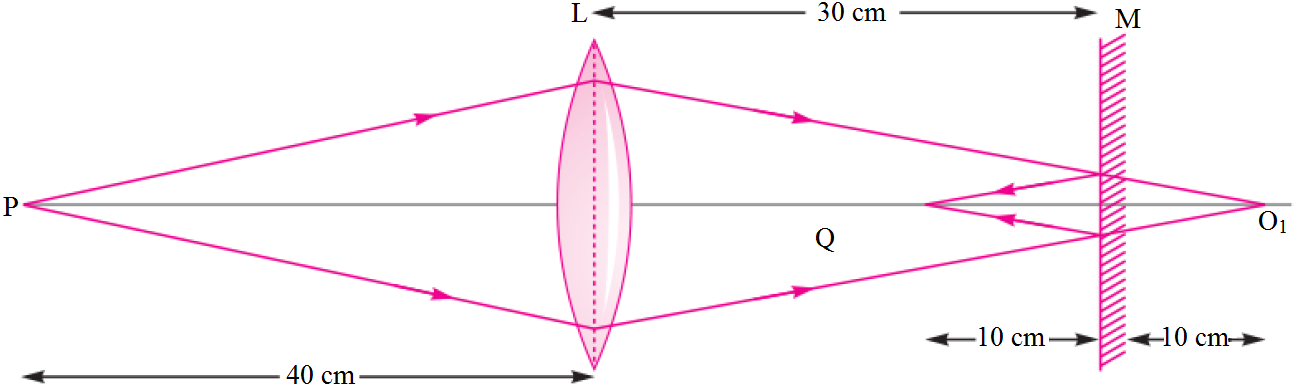
A convex lens, of focal length 20cm, has a point object placed on its principle axis at distance of 40cm from it. A plane mirror is placed 30cm behind the convex lens. Locate the position of image formed by this combination.
Answer
We first consider the effect of the lens. For the lens, we have u = -40cm and f = +20cm.
$\frac{1}{\text{v}}-\frac{1}{(-140)}=\frac{1}{20}$
$\Rightarrow \mathrm{v}+40 \mathrm{~cm}$ Had there been the lens only the image would have been formed at $\mathrm{Q}_1$. The plane mirror M is at a distance of 30 cm from the lens $L$. We can, therefore, think of a $Q_1$ as a virtual object, located at a distance of 10 cm , behind the plane mirror $M$. The plane mirror therefore forms a real image (of this virtual object $Q_1$ ) at $Q,10 \mathrm{~cm}$ in front of it. This is show in the figure.
View full question & answer
Question 773 Marks
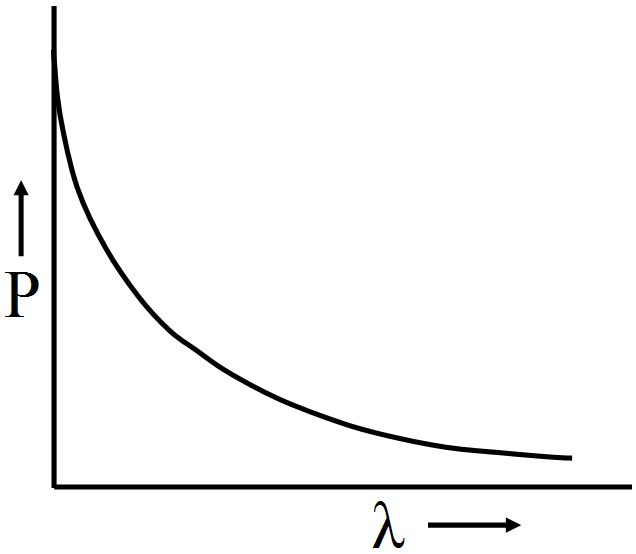
Draw a plot showing the variation of power of a lens with the wavelength of the incident light.
Answer
Refractive index $=\text{A}+\frac{\text{B}}{\lambda^2},$ where $\lambda$ is the wavelength. Power of a lens $\text{P}=\frac{1}{\text{f}}=(\text{n}_{\text{g}-1})\Big(\frac{1}{\text{R}_1}-\frac{1}{\text{R}_2}\Big)$ Clearly, power of a lens $\propto(\text{n}_{\text{g}}-1).$ This implies that the power of a lens. decreases with increase of wavelength $\big(\text{P}\propto\frac{1}{\lambda^2}\text{nearly}\Big).$ The plot is shown in fig. alongside.
View full question & answer
Question 783 Marks
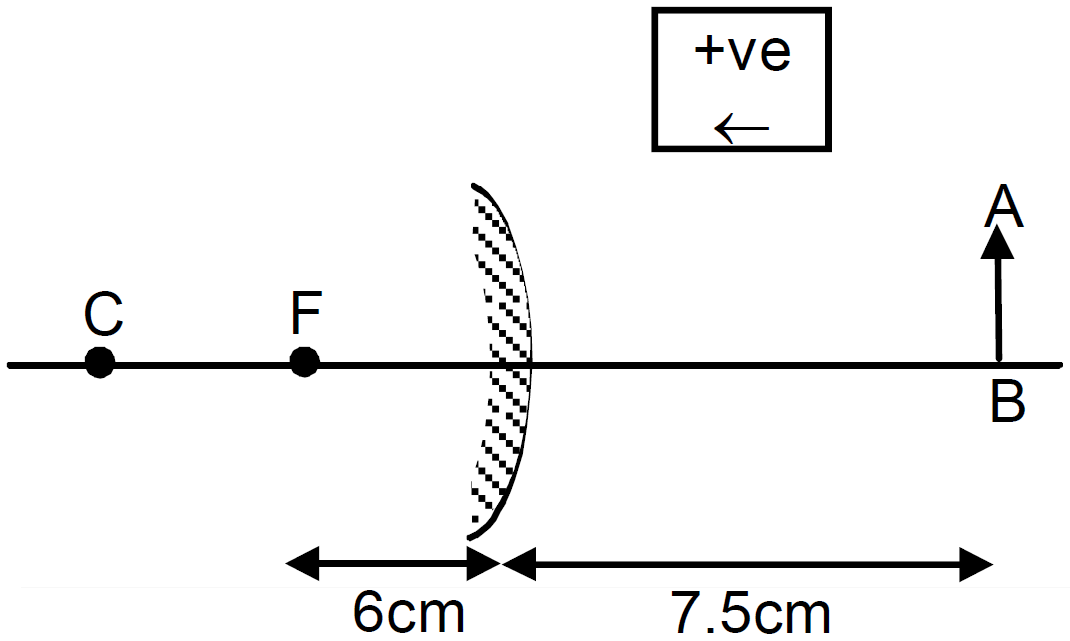
A 3cm tall object is placed at a distance of 7.5cm from a convex mirror of focal length 6cm. Find the location, size and nature of the image.
Answer

Given AB = 3cm, u = -7.5cm, f = 6cm.
Using $\Rightarrow\frac{1}{\text{v}}+\frac{1}{\text{u}}=\frac{1}{\text{f}}\Rightarrow\frac{1}{\text{v}}=\frac{1}{\text{f}}-\frac{1}{\text{u}}$
Putting values according to sign conventions,
$\frac{1}{\text{v}}=\frac{1}{6}-\frac{1}{-7.5}=\frac{3}{10}$
$\Rightarrow\text{v}=\frac{10}{3}\text{cm}$
$\therefore$ magnification $=\text{m}=-\frac{\text{v}}{\text{u}}=\frac{10}{7.5\times3}$
$\Rightarrow\frac{\text{A}'\text{B}'}{\text{A}\text{B}}=\frac{10}{7.5\times3}\Rightarrow\text{A}'\text{B}'=\frac{100}{72}=\frac{4}{3}=1.33\text{cm}$
$\therefore$ Image will form at a distance of $\frac{10}{3}\text{cm}$ From the pole and image is 1.33cm (virtual and erect).
View full question & answer
Question 793 Marks
An object is to be seen through a simple microscope of focal length 12cm. Where should the object be placed so as to produce maximum angular magnification? The least distance for clear vision is 25cm.
Answer
For the given simple microscope, f = 12cm and D = 25cm For maximum angular magnification, the image should be produced at least distance of clear vision. So, v = -D = -25cm Now, $\frac{1}{\text{v}}-\frac{1}{\text{u}}=\frac{1}{\text{f}}$ $\Rightarrow \frac{1}{\text{u}}=\frac{1}{\text{v}}-\frac{1}{\text{f}}=\frac{1}{-25}-\frac{1}{12}=-\frac{37}{300}$ $\Rightarrow \text{u}=-8.1\text{cm}$So, the object should be placed 8.1cm away from the lens.
View full question & answer
Question 803 Marks
The critical angle for a given piece of glass is 45°. Calculate the polarising angle for it. Also calculate the angle of refraction when light is incident on this glass at an angle of incidence equal to $i_p.$
Answer
We know $\sin\text{i}_{\text{c}}=\frac{1}{\mu}$
$\mu=\frac{1}{\sin{\text{i}_{\text{c}}}}=\frac{1}{\sin45^\circ}=\sqrt{2}$
According to Brewster' s law
$\tan\text{i}_{\text{p}}=\mu=\sqrt{2}$
$\Rightarrow\text{i}_{\text{p}}=\tan^{-1}\sqrt{2}=(1.414)\cong51^\circ40^\circ$
When light is incident at an angle $i_p$ the corresponding angle of refraction 'r' is givan by
$\text{i}_{\text{p}}+\text{r}=90^\circ$
$\therefore\text{r}=90^\circ-(51^\circ40^\circ)=(38^\circ20^\circ)$
View full question & answer
Question 813 Marks
An equiconvex lens of focal length ‘f’ is cut into two identical plane convex lenses. How will the power of each part be related to the focal length of the original lens?A double convex lens of +5D is made of glass of refractive index 1.55 with both faces of equal radii of curvature. Find the value of its radius of curvature.
Answer
Power of a lens, $\text{P}=\frac{1}{\text{f}(\text{in metre})}$
After cutting, the power of each part will be half of the power of original lens. Therefore, focal length = 2f
$\therefore$ power of each part, $\text{P}'=\frac{1}{2\text{f}}$
$=\text{P}=\frac{1}{\text{f}}$
$\Rightarrow5=\frac{1}{\text{f}}$
$\text{f}=\frac{1}{5}\text{m}=20\text{m}$
Now, $\frac{1}{\text{f}}=(\mu-1)\Big(\frac{1}{\text{R}_1}-\frac{1}{\text{R}_2}\Big)$
Since $R_1= + R$ and $R_2 = -R$
$\therefore\frac{1}{\text{f}}=(\mu-1)\Big(\frac{1}{\text{R}_1}-\frac{1}{\text{R}_2}\Big)$
$\frac{1}{20}=(1.5-1)\times\frac{2}{\text{R}}$
$\text{R}=20\text{m}.$
View full question & answer
Question 823 Marks
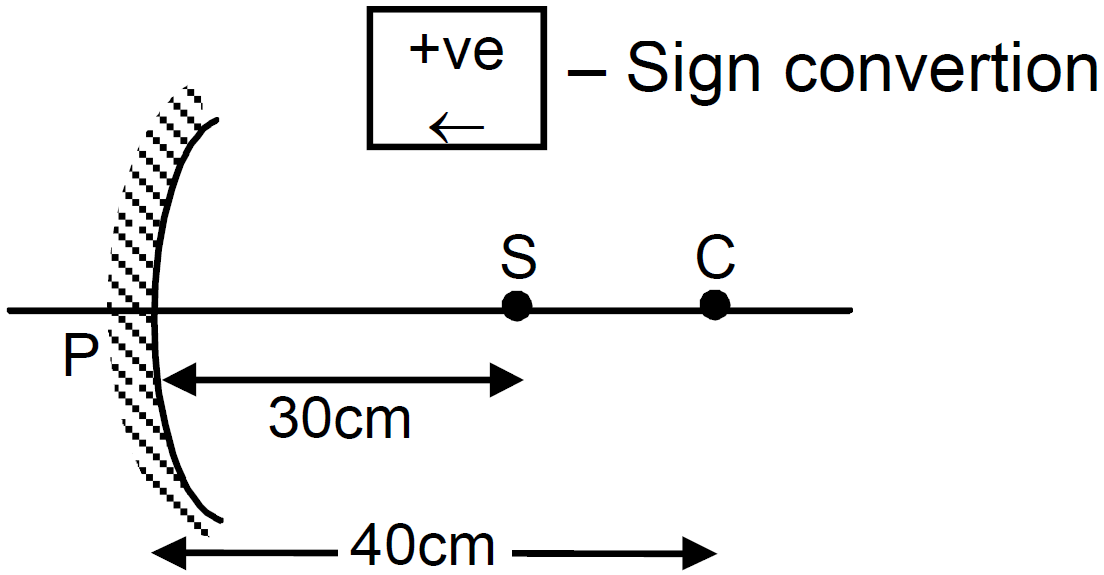
A concave mirror having a radius of curvature 40cm is placed in front of an illuminated point source at a distance of 30cm from it. Find the location of the image.
Answer

u = -30cm, R = -40cm
From the mirror equation,
$\frac{1}{\text{v}}+\frac{1}{\text{u}}=\frac{2}{\text{R}}$
$\Rightarrow \frac{1}{\text{v}}=\frac{2}{\text{R}}-\frac{1}{\text{u}}=\frac{2}{-30}-\frac{1}{-30}=-\frac{1}{60}$
or, v = -60cm
So, the image will be formed at a distance of 60cm in front of the mirror.
View full question & answer
Question 833 Marks
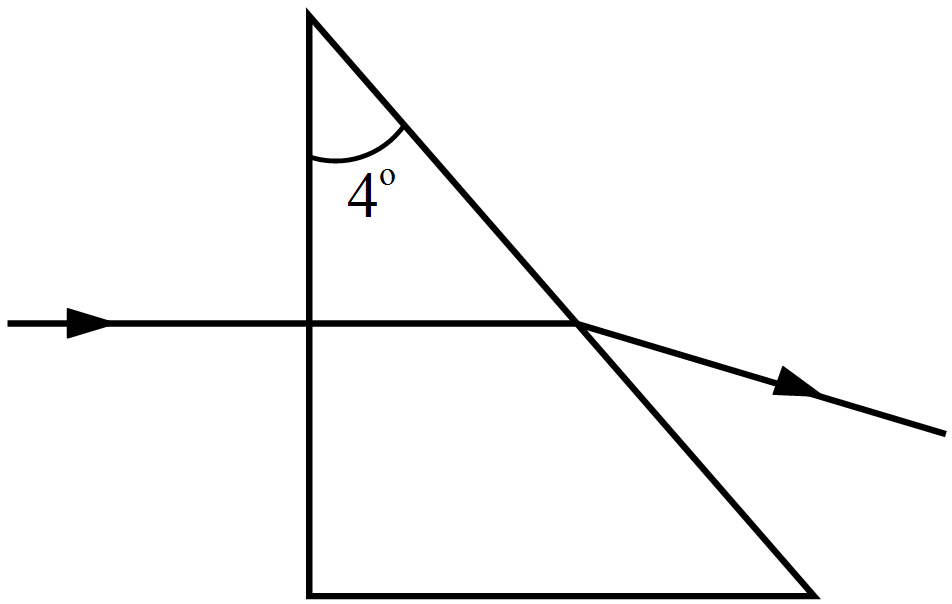
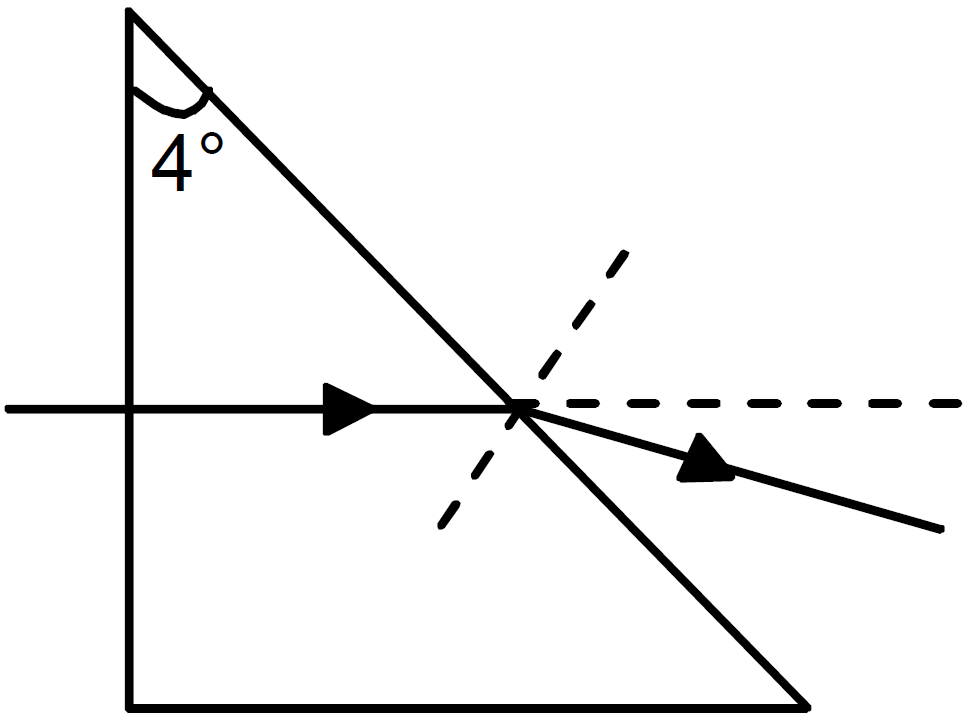
Find the angle of deviation suffered by the light ray shown in figure. The refractive index $\mu=1.5$ for the prism material.
Answer

Given, $\mu=1.5$
And angle of prism $=4^{\circ}$
$\therefore \ \mu=\frac{\sin\big(\frac{\text{A}+\delta_{\text{m}}}{2}\big)}{\frac{\sin\text{A}}{2}}=\frac{\big(\frac{\text{A}+\delta_{\text{m}}}{2}\big)}{\big(\frac{\text{A}}{2}\big)}$ $\big($for small angle $\sin\theta=\theta\big)$
$\Rightarrow\mu=\frac{\text{A}+\delta_{\text{m}}}{2}\Rightarrow1.5=\frac{4^{\circ}+\delta_{\text{m}}}{4^{\circ}}$
$\Rightarrow\delta_{\text{m}}=4^{\circ}\times(1.5)-4^{\circ}=2^{\circ}$
View full question & answer
Question 843 Marks
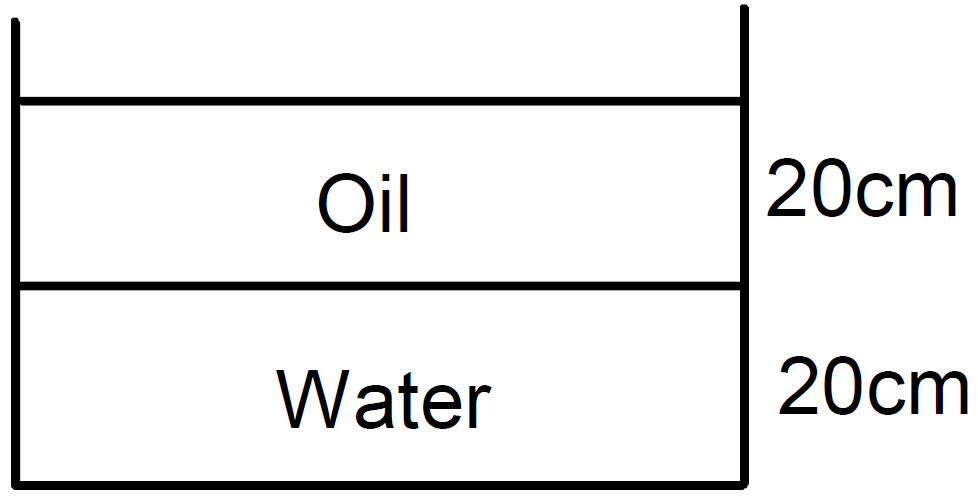
A vessel contains water upto a height of 20cm and above it an oil upto another 20cm. The refractive indices of the water and the oil are 1.33 and 1.30 respectively. Find the apparent depth of the vessel when viewed from above.
Answer

Shift due to water $\Delta\text{t}_\text{w}=\Big(1-\frac{1}{\mu}\Big)\text{d}\Big(1-\frac{1}{1.33}\Big)20=5\text{cm}$
Shift due to oil, $\Delta\text{t}_0=\Big(1-\frac{1}{1.33}\Big)20=4.6\text{cm}$
Total shift $\Delta\text{t}=5+4.6=9.6\text{cm}$
Apparent depth = 40 - (9.6) = 30.4cm below the surface.
View full question & answer
Question 853 Marks
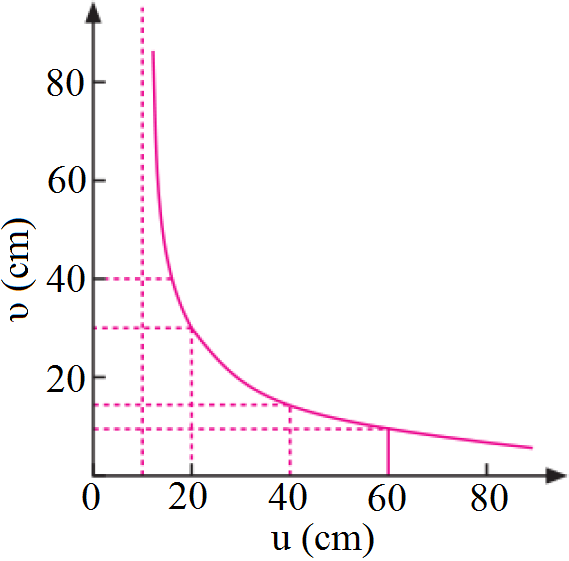
A lens forms a real image of an object. The distance from the object to the lens is u cm and the distance of the image from the lens is v cm. The given graphs shows variation of v with u.
  1. What is the nature of the lens?
  2. Using the graph, find the focal length of this lens.
Answer

The lens is convex because image formed by the lens is real.
Focal length: From graph when u = -40cm, v = 15cm.


$\therefore \frac{1}{\text{f}}=\frac{1}{\text{v}}-\frac{1}{\text{u}}$ (for a lens)
$=\frac{1}{15}+\frac{1}{40}=\frac{40+15}{40\times15}$
$\text{f}=\frac{40\times15}{55}=\frac{120}{11}\approx11\text{cm.}$
View full question & answer
Question 863 Marks
Does focal length of a lens depend on the colour of the light used? Does focal length of a mirror depend on the colour?
Answer
Yes, the focal length of a lens depends on the colour of light.
According to lens-maker's formula,
$\frac{1}{\text{f}}=(\mu-1)\Big(\frac{1}{\text{R}_1}-\frac{1}{\text{R}_2}\Big)$
Here, f is the focal length, $\mu$ is the refractive index, R is the radius of curvature of lens.
The refractive index $(\mu)$ depends on the inverse of square of wavelength.
The focal length of a mirror is independent of the colour of light.
View full question & answer
Question 873 Marks
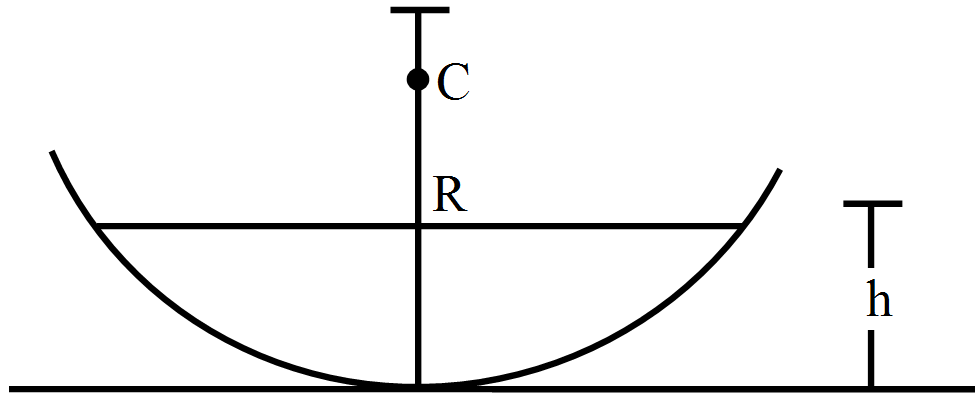
A concave mirror of radius R is kept on a horizontal. Water $\big($refractive index $=\mu\big)$ is poured into it upto a height h. Where should an object be placed so that its image is formed on itself?
Answer

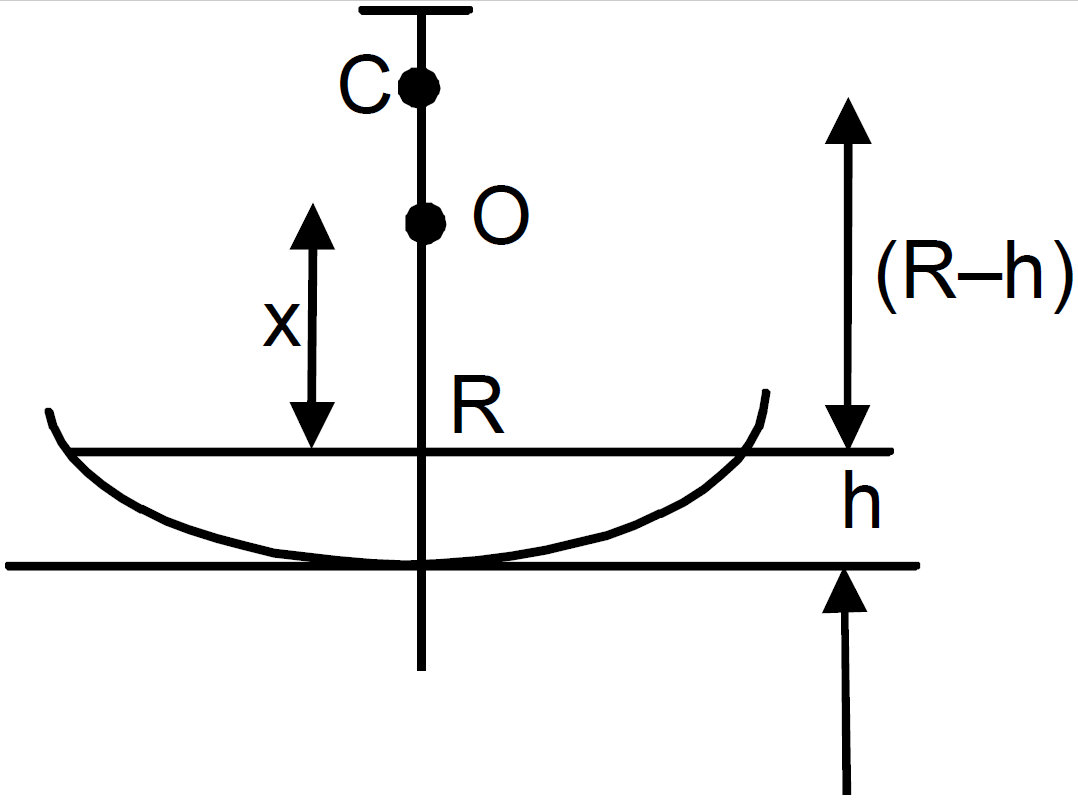
Let the object be placed at a height x above the surface of the water.
The apparent position of the object with respect to mirror should be at the centre of curvature so that the image is formed at the same position.
Since, $\frac{\text{Real depth}}{\text{Apparent depth}}=\frac{1}{\mu}$ (with respect to mirror)
Now, $\frac{\text{x}}{\text{R}-\text{h}}=\frac{1}{\mu}$
$\Rightarrow\text{x}=\frac{\text{R}-\text{h}}{\mu}$
View full question & answer
Question 883 Marks
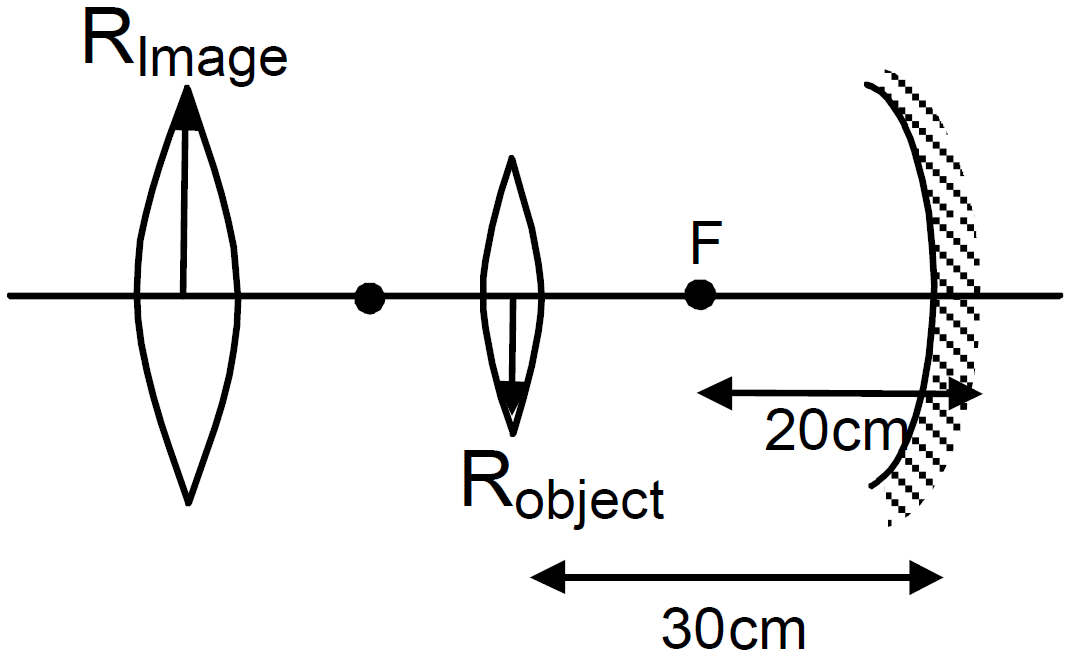
A particle goes in a circle of radius 2.0cm. A concave mirror of focal length 20cm is placed with its principal axis passing through the centre of the circle and perpendicular to its plane. The distance between the pole of the mirror and the centre of the circle is 30cm. Calculate the radius of the circle formed by the image.
Answer

$\text{u}=-30\text{cm}, \ \text{f}=-20\text{cm}$
We know, $\frac{1}{\text{v}}+\frac{1}{\text{u}}=\frac{1}{\text{f}}$
$\Rightarrow\frac{1}{\text{v}}+\Big(-\frac{1}{30}\Big)=\Big(-\frac{1}{20}\Big)\Rightarrow\text{v}=-60\text{cm}$
Image of the circle is formed at a distance 60cm in front of the mirror.
$\therefore \ \text{m}=-\frac{\text{v}}{\text{u}}=\frac{\text{R}_{\text{image}}}{\text{R}_{\text{object}}}\Rightarrow\frac{-60}{-30}=\frac{\text{R}_{\text{image}}}{2}$
$\Rightarrow\text{R}_{\text{image}}=4\text{cm}$
Radius of image of the circle is 4cm.
View full question & answer
Question 893 Marks
A simple microscope has a magnifying power of 3.0 when the image is formed at the near point (25cm) of a normal eye.
  1. What is its focal length?
  2. What will be its magnifying power if the image is formed at infinity?
Answer
The simple microscope has, m = 3, when image is formed at D = 25cm
  1. $\text{m}=1+\frac{\text{D}}{\text{f}}\Rightarrow3=1+\frac{25}{\text{f}}$
$\Rightarrow\text{f}=\frac{25}{2}=12.5\text{cm}$
  1. When the image is formed at infinity (normal adjustment)
Magnifying power $=\frac{\text{D}}{\text{f}}=\frac{25}{12.5}= 2.0$
View full question & answer
Question 903 Marks
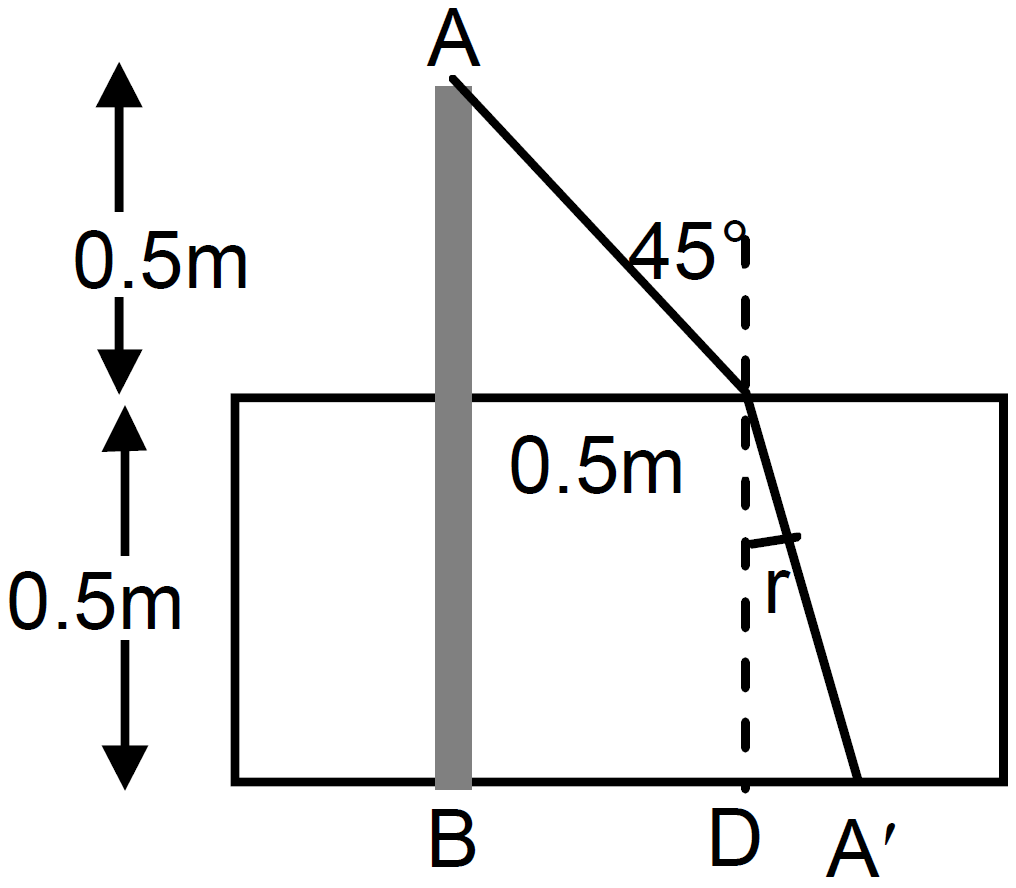
A pole of length 1.00m stands half dipped in a swimming pool with water level 50.0 cm higher than the bed. The refractive index of water is 1.33 and sunlight is coming at an angle of 45° with the vertical. Find the length of the shadow of the pole on the bed.
Answer

Shadow length $= \text{BA}' = \text{BD} + \text{A}'\text{D} = 0.5 + 0.5 \tan \text{r}$
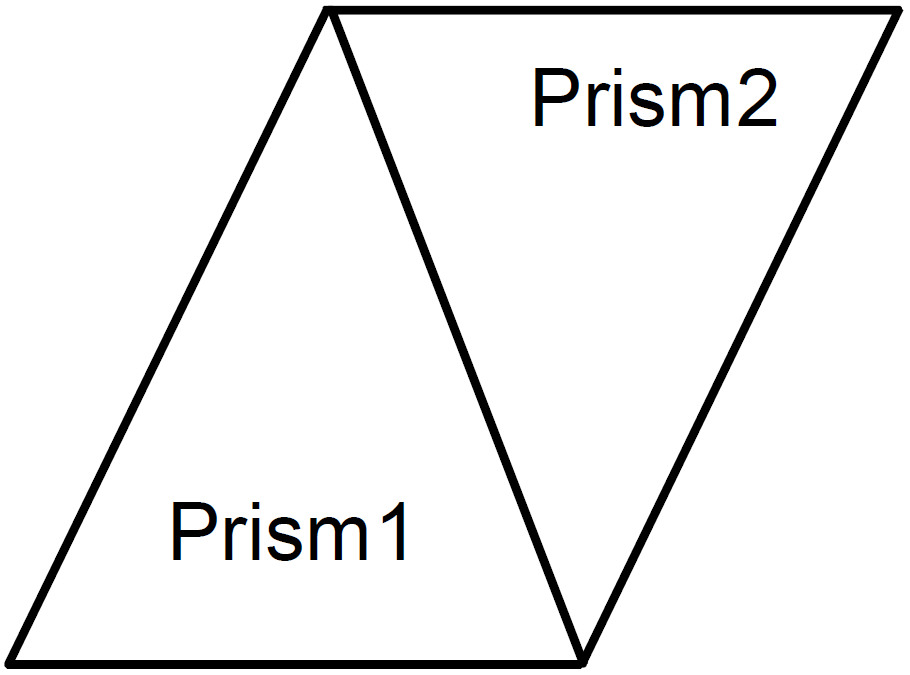
Now, $1.33=\frac{\sin45^{\circ}}{\sin\text{r}}\Rightarrow\sin\text{r}=0.53$
$\Rightarrow\cos\text{r}=\sqrt{1-\sin^2\text{r}}=\sqrt{1-(0.53)^2}=0.85$
So, $\tan \text{r} = 0.6235$
So, shadow length = (0.5)(1 + 0.6235) = 81.2cm
View full question & answer
Question 913 Marks
An object P is focused by a microscope M. A glass slab of thickness 2.1cm is introduced between P and M. If the refractive index of the slab is 1.5, by what distance should the microscope be shifted to focus the object again?
Answer
The thickness of the glass is $\text{d} = 2.1\text{cm}$ and $\mu=1.5$ Shift due to the glass slab
$\Delta\text{T}=\Big(1-\frac{1}{\mu}\Big)\text{d}$
$=\frac{1}{3}(2.1)=0.7\text{cm}$
So, the microscope should be shifted 0.70cm to focus the object again.
View full question & answer
Question 923 Marks
Two prisms of identical geometrical shape are combined with their refracting angles oppositely directed. The materials of the prisms have refractive indices 1.52 and 1.62 for violet light. A violet ray is deviated by 1.0° when passes symmetrically through this combination. What is the angle of the prisms?
Answer
Two prisms of identical geometrical shape are combined.
Let A = Angle of the prisms

$\mu'_\text{v}=1.52$ and $\mu_\text{v}=1.62,\delta_\text{v}=1^\circ$
$\delta_\text{v}=(\mu_\text{v}-1)\text{A}-(\mu'_\text{v}-1)\text{A}$ [Since A = A']
$\Rightarrow\delta_\text{v}=(\mu_\text{v}-\mu'_\text{v})\text{A}$
$\Rightarrow\text{A}=\frac{\delta_\text{v}}{\mu_\text{v}-\mu'_\text{v}}=\frac{1}{1.62-1.52}=10^\circ$
View full question & answer
Question 933 Marks
A point object is placed on the principal axis of a convex lens (f = 15cm) at a distance of 30cm from it. A glass plate $(\mu=1.50)$ of thickness 1cm is placed on the other side of the lens perpendicular to the axis. Locate the image of the point object.
Answer


For the lens, f = 15cm, u = 30cm
From lens formula $\frac{1}{\text{v}}-\frac{1}{\text{u}}=\frac{1}{\text{f}}$
$\Rightarrow\frac{1}{\text{v}}=\frac{1}{15}-\frac{1}{30}=\frac{1}{30}\Rightarrow\text{v}=30\text{cm}$
The image is formed at 30cm of right side due to lens only.
Again, shift due to glass slab is,
$=\Delta\text{t}=\Big(1-\frac{1}{15}\Big)1 \ \big[\text{Since,} \ \mu_{\text{g}=1.5 \ \text{and} \ \text{t}=1\text{cm}}\big]$
$=1-\Big(\frac{2}{3}\Big)=0.33\text{cm}$
$\therefore$ The image will be formed at 30 + 0.33 = 30.33cm from the lens on right side.
View full question & answer
Question 943 Marks
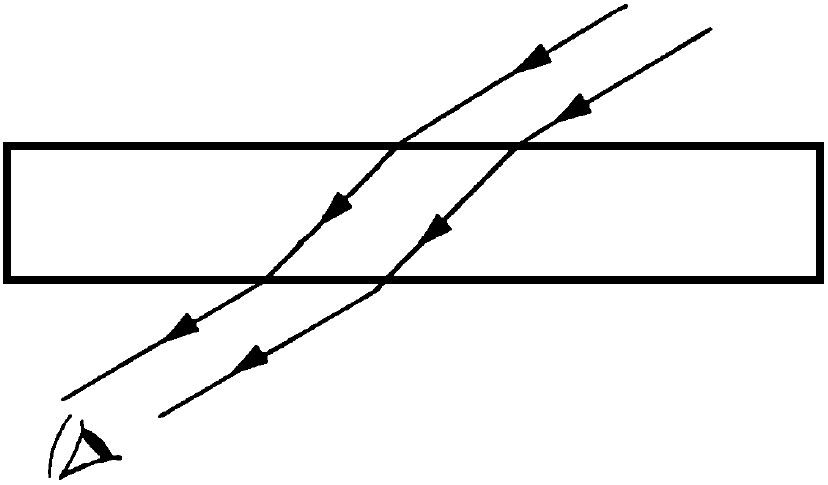
A narrow beam of light passes through a slab obliquely and is then received by an eye. The index of refraction of the material in the slab fluctuates slowly with time. How will it appear to the eye? The twinkling of stars has a similar explanation.
Answer
The image position shifts because of variation in refractive index. Thus it appears to be twinkling to the eyes. When $\mu$ changes $\alpha$ changes and also x changes so ray appear to come from different position.
View full question & answer
Question 953 Marks
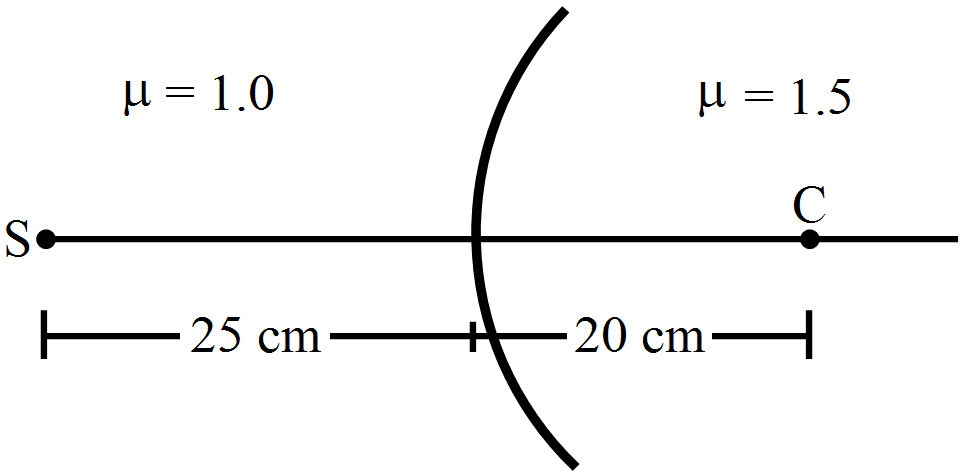
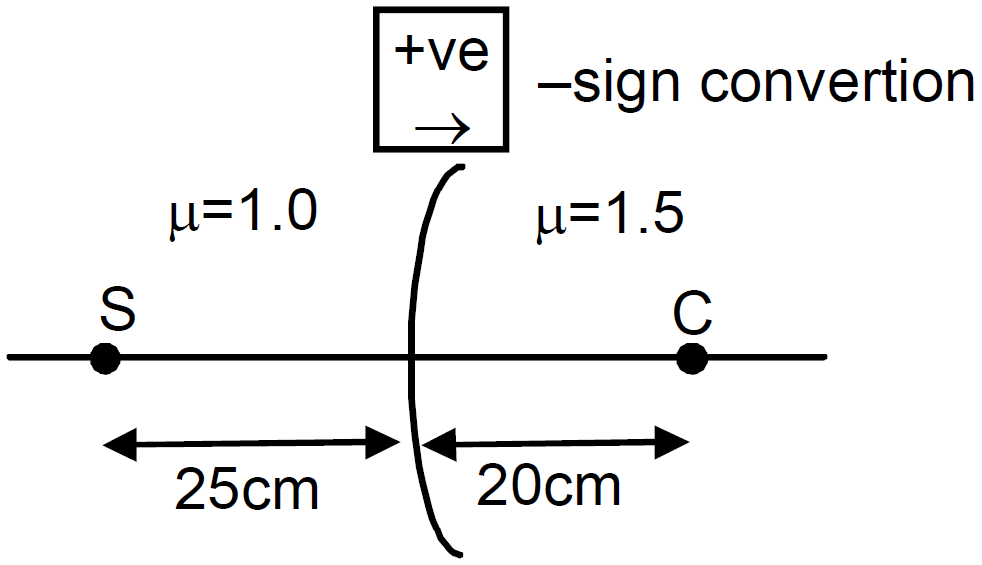
Locate the image formed by refraction in the situation shown in figure.
Answer

$\mu_1=1, \ \mu_2=1.5,$
R = 20cm (Radius of curvature), u = -25cm
$\therefore \ \frac{\mu_2}{\text{v}}-\frac{\mu_1}{\text{u}}=\frac{\mu_2-\mu_1}{\text{R}}$
$\Rightarrow\frac{1.5}{\text{v}}=\frac{0.5}{20}-\frac{1}{25}=\frac{1}{40}-\frac{1}{25}=\frac{-3}{200}$
$\Rightarrow \ \text{v}=200\times0.5=-100\text{cm}.$
So, the image is 100cm from (P) the surface on the side of S.
View full question & answer
Question 963 Marks
The near vision of an average person is 25cm. To view an object with an angular magnification of 10, what should be the power of the microscope?
Answer
We know that, $\text{m}=\frac{\text{v}}{\text{u}}=\frac{\text{D}}{\text{f}}$
$\Rightarrow\ \text{f}=\frac{\text{D}}{\text{m}}$
We are given that, v = D = 25cm and u = f
Substituting D = 25cm and m = 10, we get
$\Rightarrow\ \text{f}=\frac{25}{10}=2.0.225\text{m}$
Now, $\text{P}=\frac{1}{0.025}=40\text{D}$
View full question & answer
Question 973 Marks
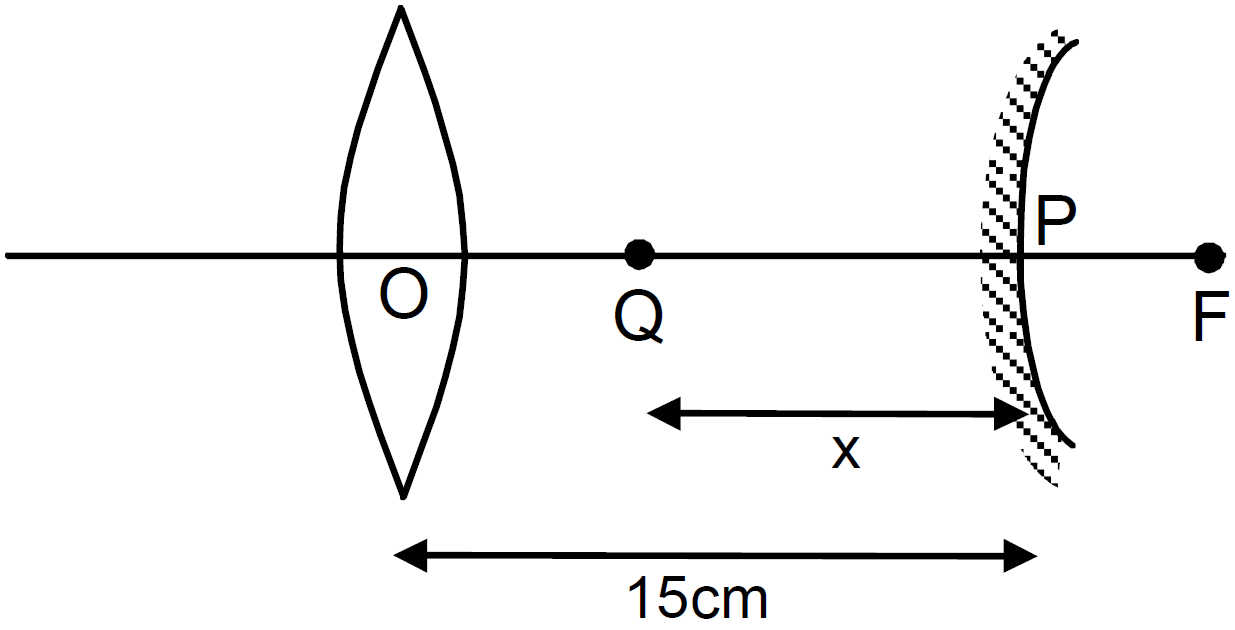
A converging lens and a diverging mirror are placed at a separation of 15cm. The focal length of the lens is 25cm and that of the mirror is 40cm. Where should a point source be placed between the lens and the mirror so that the light, after getting reflected by the mirror and then getting transmitted by the lens, comes out parallel to the principal axis?
Answer

If the image in the mirror will form at the focus of the converging lens, then after transmission through the lens the rays of light will go parallel.
Let the object is at a distance x cm from the mirror
$\therefore$ u = -x cm; v = 25 - 15 = 10cm (because focal length of lens = 25cm)
f = 40cm
$\Rightarrow\frac{1}{\text{v}}+\frac{1}{\text{u}}=\frac{1}{\text{f}}\Rightarrow\frac{1}{\text{x}}=\frac{1}{10}-\frac{1}{40}$
$\Rightarrow\text{x}=\frac{400}{30}=\frac{40}{3}$
$\therefore$ The object is at distance $\Big(15-\frac{40}{3}\Big)=\frac{5}{3}=1.67\text{cm}$ from the lens.
View full question & answer
Question 983 Marks
A thin prism is made of a material having refractive indices 1.61 and 1.65 for red and violet light. The dispersive power of the material is 0.07. It is found that a beam of yellow light passing through the prism suffers a minimum deviation of 4.0° in favourable conditions. Calculate the angle of the prism.
Answer
Given that, $\mu_\text{r}=1.61,\mu_\text{v}=1.65,\omega=0.07\ \text{and}\ \delta_\text{y}=4^\circ$
Now, $\omega=\frac{\mu_\text{v}-\mu_\text{r}}{\mu_\text{y}-1}$
$\Rightarrow0.07=\frac{1.65-1.61}{\mu_\text{y}-1}$
$\Rightarrow\mu_\text{y}-1=\frac{0.04}{0.07}=\frac{4}{7}$
Again,$\delta=(\mu-1)\text{A}$
$\Rightarrow\text{A}=\frac{\delta_\text{y}}{\mu_\text{y}-1}=\frac{4}{\Big(\frac{4}{7}\Big)}=7^\circ$
View full question & answer
Question 993 Marks
A candle flame 1.6cm high is imaged in a ball bearing of diameter 0.4cm. If the ball bearing is 20cm away from the flame, find the location and the height of the image.
Answer

Height of the object AB = 1.6cm
Diameter of the ball bearing = d = 0.4cm
⇒ R = 0.2cm
Given, u = 20cm
We know, $\frac{1}{\text{u}}+\frac{1}{\text{v}}=\frac{2}{\text{R}}$
Putting the values according to sign conventions $\frac{1}{-20}+\frac{1}{\text{v}}=\frac{2}{0.2}$
$\Rightarrow\frac{1}{\text{v}}=\frac{1}{20}+10=\frac{201}{20}\Rightarrow\text{v}=0.1\text{cm}=1\text{mm}$ inside the ball bearing.
Magnification $=\text{m}=\frac{\text{A}'\text{B}'}{\text{AB}}=-\frac{\text{v}}{\text{u}}=-\frac{0.1}{-20}=\frac{1}{200}$
$\Rightarrow\text{A}'\text{B}'=\frac{\text{A}\text{B}}{200}=\frac{16}{200}=+0.008\text{cm}=+0.8\text{mm}.$
View full question & answer
Question 1003 Marks
A certain material has refractive indices 1.56, 1.60 and 1.68 for red, yellow and violet light respectively.
  1. Calculate the dispersive power.
  2. Find the angular dispersion produced by a thin prism of angle 6° made of this material.
Answer
Given that,
$\mu_\text{r}=1.56,\mu_\text{y}=1.60,\ \text{and}\ \mu_\text{v}=1.68$
  1. Dispersive power $=\omega=\frac{\mu_\text{v}-\mu_\text{r}}{\mu_\text{y}-1}=\frac{1.68-1.56}{1.60-1}$
$=\frac{0.12}{0.60}=0.2$​​​​​​​
  1. Angular dispersion $=(\mu_\text{v}-\mu_\text{r})\text{A}=0.12\times6^\circ=7.2^\circ$
View full question & answer
3 Marks Question - Page 2 - Physics STD 12 Science Questions - Vidyadip