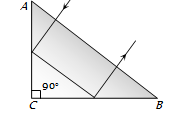
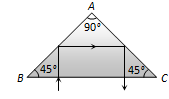
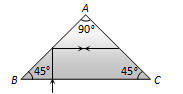
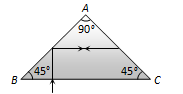
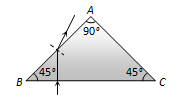
A ray of light incident normally on an isosceles right angled prism travels as shown in the figure. The least value of the refractive index of the prism must be
Angle of prism is $A$ and its one surface is silvered. Light rays falling at an angle of incidence 2 A on first surface return back through the same path after suffering reflection at second silvered surface. Refractive index of the material of prism is
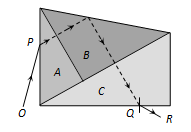
Three glass prisms A, B and C of same refractive index are placed in contact with each other as shown in figure, with no air gap between the prisms. Monochromatic ray of light OP passes through the prism assembly and emerges as QR. The conditions of minimum deviation is satisfied in the prisms
A ray of monochromatic light is incident on one refracting face of a prism of angle $75^{\circ}$. It passes through the prism and is incident on the other face at the critical angle. If the refractive index of the material of the prism is $\sqrt{2}$, the angle of incidence on the first face of the prism is
For a material, the refractive indices for red, violet and yellow colour light are respectively 1.52, 1.64 and 1.60. The dispersive power of the material is
Angle of a prism is $30^{\circ}$ and its refractive index is $\sqrt{2}$ and one of the surface is silvered. At what angle of incidence, a ray should be incident on one surface so that after reflection from the silvered surface, it retraces its path
An achromatic prism is made by combining two prisms $p_1\left(\mu_v=1.523, \mu_r=1.515\right)$ and $p_2\left(\mu_v=1.666, \mu_r=1.650\right)$; where $\mu$ represents the refractive index. If the angle of the prism $p_1$ is $10^{\circ}$, then the angle of the prism $P _2$ will be
A thin prism $P_1$ with angle $4^\circ$ and made from glass of refractive index $1.54$ is combined with another thin prism $P_2$ made from glass of refractive index $1.72$ to produce dispersion without deviation. The angle of prism $P_2$ is
Minimum deviation is observed with a prism having angle of prism A, angle of deviation δ, angle of incidence i and angle of emergence e. We then have generally
The minimum deviation produced by a hollow prism filled with a certain liquid is found to be 30°. The light ray is also found to be refracted at angle of 30°. The refractive index of the liquid is
The refractive index of a material of a prism of angles 45°– 45° – 90° is 1.5. The path of the ray of light incident normally on the hypotenuse side is shown in
If the refractive indices of a prism for red, yellow and violet colours be $1.61,1.63$ and $1.65$ respectively, then the dispersive power of the prism will be
A circular disc of which 2/3 part is coated with yellow and 1/3 part is with blue. It is rotated about its central axis with high velocity, then it will be seen as
Flint glass prism is joined by a crown glass prism to produce dispersion without deviation. The refractive indices of these for mean rays are 1.602 and 1.500 respectively. Angle of prism of flint prism is 10°, then the angle of prism for crown prism will be
If the refractive indices of crown glass for red, yellow and violet colours are 1.5140, 1.5170 and 1.5318 respectively and for flint glass these are 1.6434, 1.6499 and 1.6852 respectively, then the dispersive powers for crown and flint glass are respectively
Light rays from a source are incident on a glass prism of index of refraction μ and angle of prism α. At near normal incidence, the angle of deviation of the emerging rays is
A parallel beam of monochromatic light is incident at one surface of a equilateral prism. Angle of incidence is 55° and angle of emergence is 46°. The angle of minimum deviation will be
A light ray is incident by grazing one of the face of a prism and after refraction ray does not emerge out, what should be the angle of prism while critical angle is C
The refractive index of a prism for a monochromatic wave is $\sqrt{2}$ and its refracting angle is $60^{\circ}$. For minimum deviation, the angle of incidence will be
The power of an achromatic convergent lens of two lenses is + 2D. The power of convex lens is + 5D. The ratio of dispersive power of convex and concave lens will be