A man suffering from myopia can read a book placed at 10 cm distance. For reading the book at a distance of 60 cm with relaxed vision, focal length of the lens required will be
A man can see the objects upto a distance of one metre from his eyes. For correcting his eye sight so that he can see an object at infinity, he requires a lens whose power is
When light of wavelength λ is incident on an equilateral prism kept in its minimum deviation position, it is found that the angle of deviation equals the angle of the prism itself. The refractive index of the material of the prism for the wavelength λ is, then
A source emits light of wavelength 4700Å, 5400 Å and 6500 Å. The light passes through red glass before being tested by a spectrometer. Which wavelength is seen in the spectrum
A thin prism $P_1$ with angle 6° and made from glass of refractive index 1.54 is combined with another thin prism $P_2$ of refractive index 1.72 to produce dispersion without deviation. The angle of prism $P_2$ will be
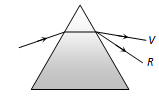
White light is passed through a prism whose angle is 5°. If the refractive indices for rays of red and blue colour are respectively 1.64 and 1.66, the angle of deviation between the two colours will be
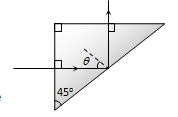
A triangular prism of glass is shown in the figure. A ray incident normally to one face is totally reflected, if θ = 45° . The index of refraction of glass is
A person cannot see distinctly at the distance less than one metre. Calculate the power of the lens that he should use to read a book at a distance of 25 cm
The refractive index of flint glass for blue F line is 1.6333 and red C line is 1.6161. If the refractive index for yellow D line is 1.622, the dispersive power of the glass is
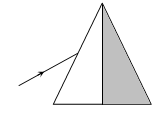
A light ray is incident upon a prism in minimum deviation position and suffers a deviation of 34°. If the shaded half of the prism is knocked off, the ray will
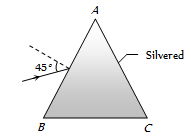
A prism ABC of angle 30° has its face AC silvered. A ray of light incident at an angle of 45° at the face AB retraces its path after refraction at face AB and reflection at face AC. The refractive index of the material of the prism is
A ray of light passes through an equilateral glass prism in such a manner that the angle of incidence is equal to the angle of emergence and each of these angles is equal to 3/4 of the angle of the prism. The angle of deviation is
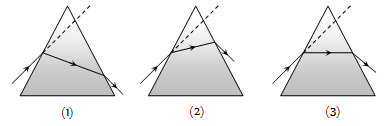
A ray of light is incident at an angle of 60° on one face of a prism of angle 30°. The ray emerging out of the prism makes an angle of 30° with the incident ray. The emergent ray is
✓
Normal to the face through which it emerges
B
Inclined at 30° to the face through which it emerges
C
Inclined at 60° to the face through which it emerges