Questions · Page 2 of 2

5 Marks Questions

Question 515 Marks

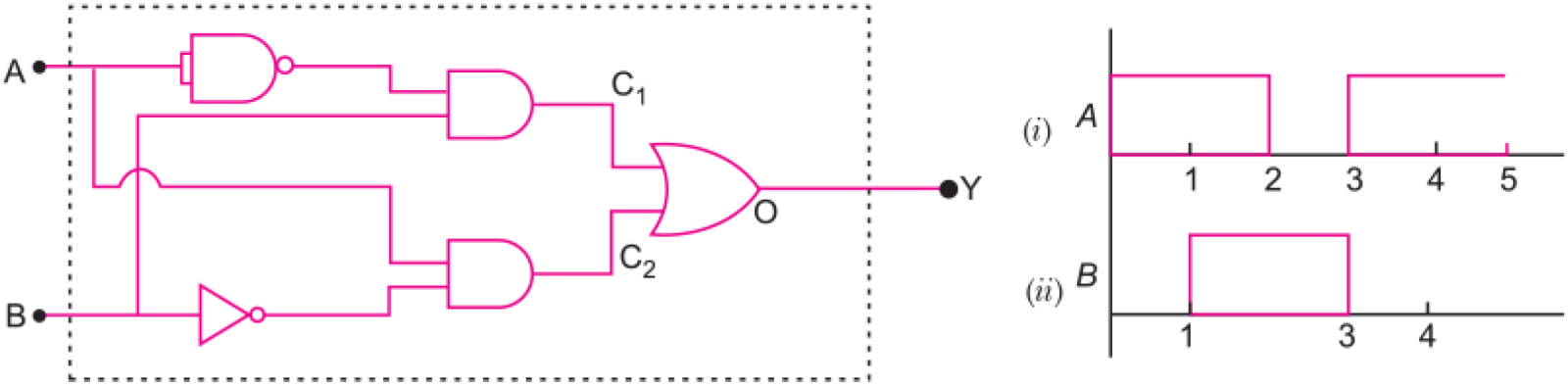
Input signals A and B are applied to the input terminals of the ‘dotted box’ set-up shown here. Let Y be the final output signal from the box.
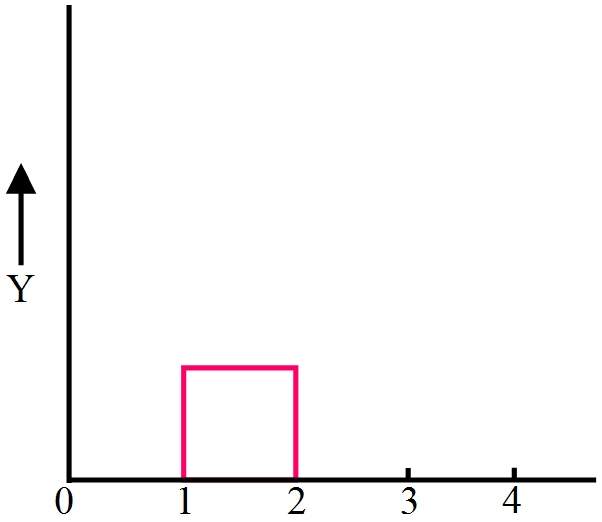
Draw the wave forms of the signals labelled as $C_1$ and $C_2$ within the box, giving (in brief) the reasons for getting these wave forms. Hence draw the wave form of the final output signal Y. Give reasons for your choice.
What can we state (in words) as the relation between the final output signal Y and the input signals A and B?
Answer

$\text{C}_1=\bar{\text{A}}\cdot\text{B},\text{C}_2=\text{A}\cdot\bar{\text{B}}$
$\text{Y}=\text{C}_1\bar+\text{C}_2=\bar{\text{A}}\text{B}\bar+\bar{\text{B}}\text{A}$
This is Boolean expression for NOT XOR gate.
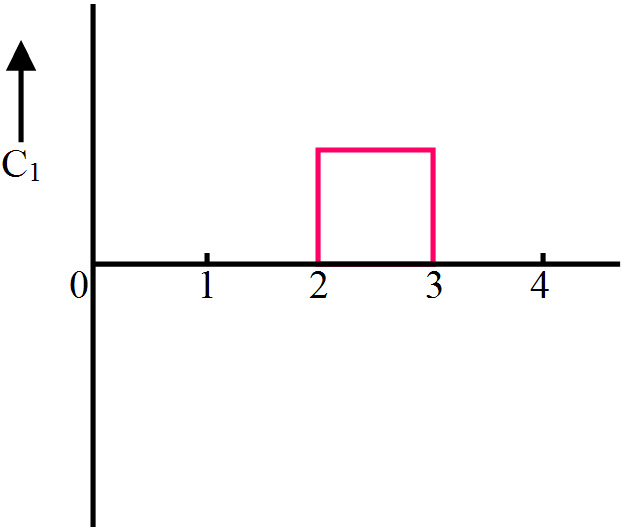
$\text{C}_1=\bar{\text{A}}\cdot\text{B}$
 
A
B
$\text{C}_1=\bar{\text{A}}\cdot\text{B}$
From 0 to 1
1
0
0
From 1 to 2
1
1
0
From 2 to 3
0
1
1
From 3 to 4
1
0
0
From 4 onwards
1
0
0

$\text{C}_2=\text{A}\cdot\bar{\text{B}}$
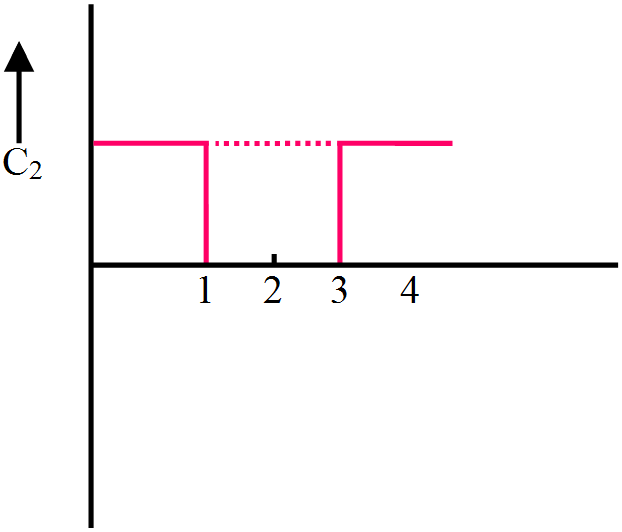
 
A
B
$\text{C}_2=\bar{\text{B}}\cdot{\text{A}}$
From 0 to 1
1
0
1
From 1 to 2
1
1
0
From 2 to 3
0
1
0
From 3 to 4
1
0
1
From 4 onwards
1
0
1

$\text{Y}=\text{C}_1\bar+\text{C}_2$
 
A
B
$\text{Y}=\text{C}_1\bar+\text{C}_2$
From 0 to 1
0
1
0
From 1 to 2
0
0
1
From 2 to 3
1
0
0
From 3 to 4
0
1
0
From 4 onwards
0
1
0

The gate shown in circuit is NOT XOR gate. According to definition the output Y is obtained only if either both signals are 0 or 1.
View full question & answer
Question 525 Marks
Consider a box with three terminals on top of it as shown in Fig (a):

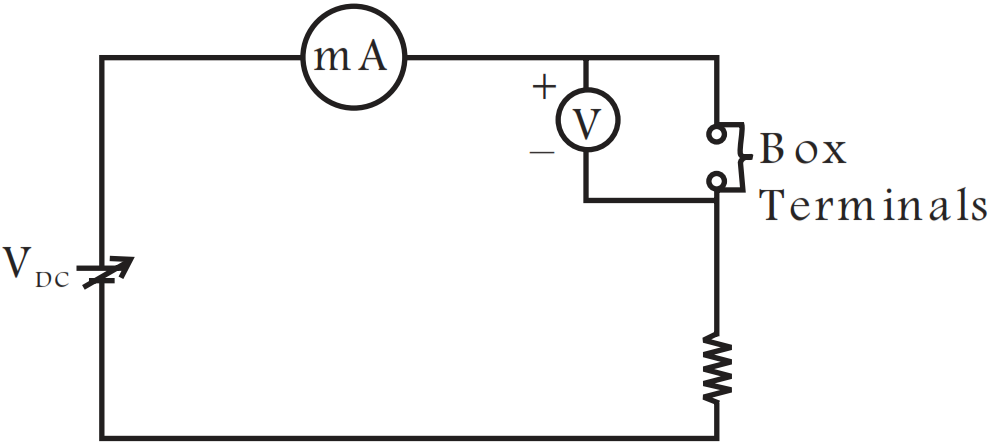
Three components namely, two germanium diodes and one resistor are connected across these three terminals in some arrangement. A student performs an experiment in which any two of these three terminals are connected in the circuit shown in Fig. (b).

The student obtains graphs of current-voltage characteristics for unknown combination of components between the two terminals connected in the circuit. The graphs are
  1. When A is positive and B is negative,
  1. When A is negative and B is positive,
  1. When B is negative and C is positive,
  1. When B is positive and C is negative,
  1. When A is positive and C is negative,
  1. When A is negative and C is positive,

From these graphs of current - voltage characteristic shown in Fig. (c) to (h), determine the arrangement of components between A, B and C.
Answer
The V-I characteristics of these graph is discussed in points:
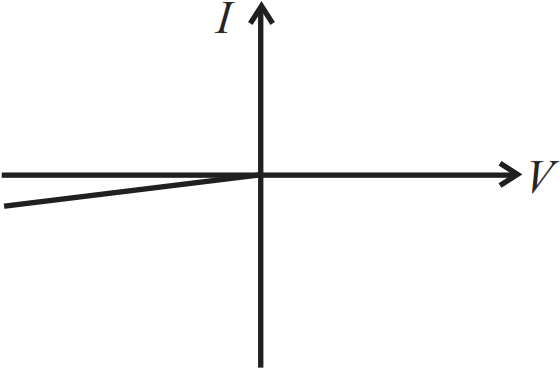
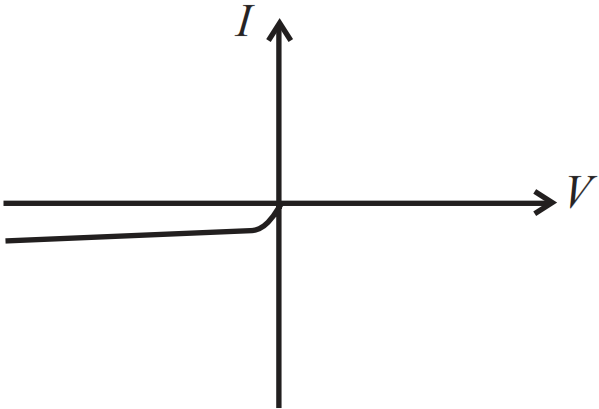
  1. In V-I graph of condition (i), a reverse characteristics is shown in fig. (c).
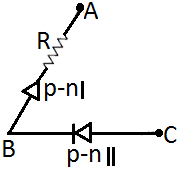
Here A is connected to n-side of p-n junction I and B is connected top-side of p-n junction I with a resistance in series.
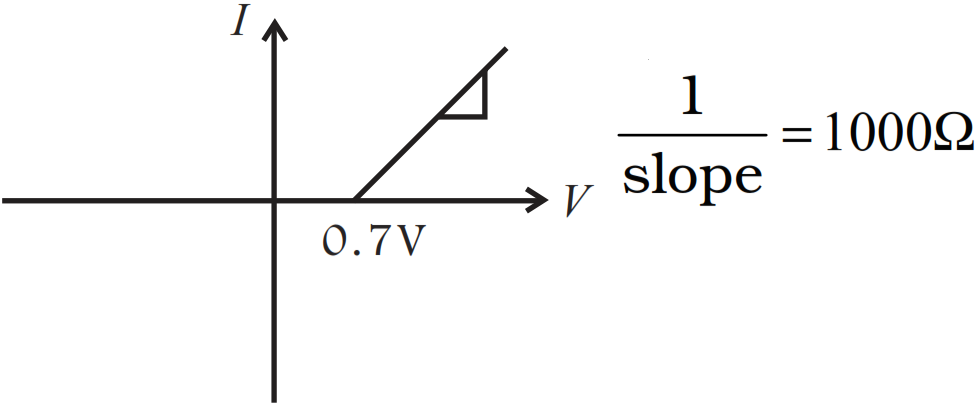
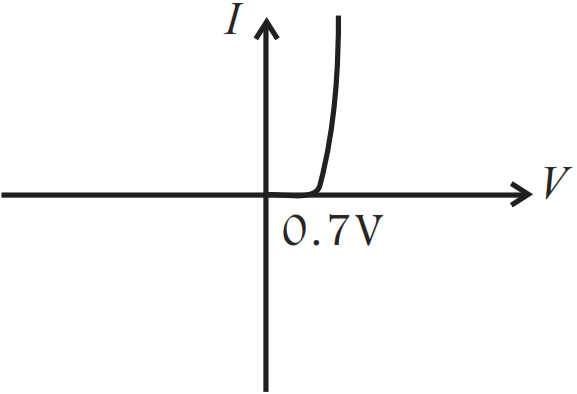
  1. In V-I graph of condition (ii), a forward characteristics is shown in fig. (d), where 0.7 V is the knee voltage of p-n junction I. 1/slope = (1/1000)Ω.
It means A is connected to n-side of p-n junction I and B is connected to p-side of p-n junction I and resistance R is in series of p-n junction I between A and B.
  1. In V-I graph of condition (iii), a forward characteristics is shown in figure (e) , where 0.7 V is the knee voltage. In this case p-side of p-n junction II is connected to C and n-side of p-n junction II to B.
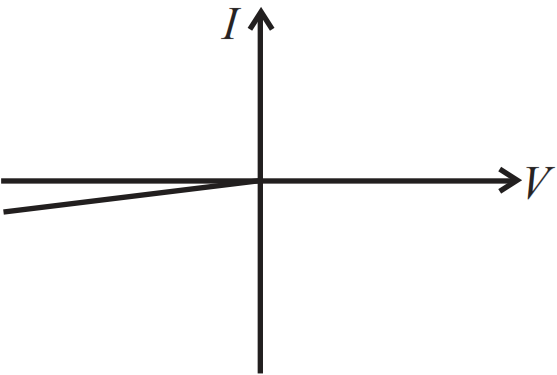
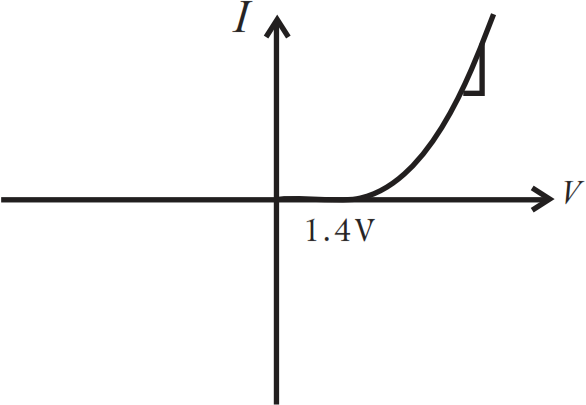
  2. In V-I graphs of conditions (iv), (v), (vi) also concludes the above connection of p-n junctions I and II along with a resistance R.
Thus, the arrangement of p-n I, p-n II and resistance R between A, B and C will be as shown in the figure.
View full question & answer
Question 535 Marks
Draw a labelled circuit diagram of a common emitter amplifier using a p-n-p transistor. Define the term voltage gain and write an expression for it. Explain how the input and output voltages are out of phase by 180° for a common-emitter transistor amplifiers.
Answer

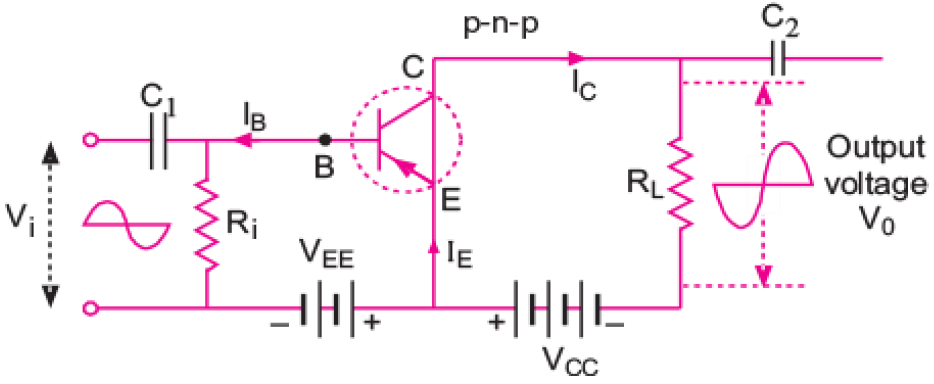
Common-Emitter Transistor Amplifier: Given below is the circuit for a p-n-p transistor. In this circuit, the emitter is common to both the input (emitter-base) and output (collector-emitter) circuits and is grounded. The emitter-base circuit is forward biased and the base-collector circuit is reverse biased.
In a common-emitter circuit, the collector-current is controlled by the base-current rather than the emitter-current. Since in a transistor, when input signal is applied to base, a very small change in base-current provides a much larger change in collector-current and thus extremely large current gains are possible.

When positive half cycle is fed to the input circuit, it opposes the forward bias of the circuit which causes the collector current to decrease. It decreases the voltage drop across load RL and thus makes collector voltage more negative. Thus, when input cycle varies through a positive half cycle, the output voltage developed at the collector varies through a negative half cycle and vice versa. Thus, the output voltage in common-emitter amplifier is in antiphase with the input signal or the output and input voltages are 180° out of phase.
Current Gain. The ratio of change in collector current $(\Delta\text{I}_\text{C})$ to the change in base current $(\Delta\text{I}_\text{B})$ is called the alternating current gain denoted by $\beta$ Thus,
$\beta(\text{ac})=\frac{\Delta\text{I}_\text{C}}{\Delta\text{I}_\text{B}}$
$\beta$ has positive values and is generally greater than 20. Voltage Gain. The voltage gain of common- emitter transistor amplifier is given by,
$\text{A}_\text{v}=\frac{\Delta\text{V}_\text{out}}{\Delta\text{ V}_\text{in}}$
$=\frac{\text{R}_\text{L}\Delta\text{I}_\text{C}}{\text{R}_\text{i} \Delta\text{I}_\text{b}}$
$=\Big(\frac{\Delta\text{I}_\text{C}}{\Delta\text{I}_\text{b}}\Big)\cdot\frac{\text{R}_\text{L}}{\text{R}_\text{i}}$
$\Rightarrow\text{A}_\text{V}=\beta=\frac{\text{R}_\text{L}}{\text{R}_\text{i}}$
View full question & answer
5 Marks Questions - Page 2 - Physics STD 12 Science Questions - Vidyadip