Question types

Specific Heat Capacities of Gases question types

62 questions across 5 question groups — pick any mix to generate a Physics paper with step-by-step answer keys.

62
Questions
5
Question groups
5
Question types
Sample Questions

Specific Heat Capacities of Gases questions

One sample from each question group in this chapter. Select any group above to see the full set with answer keys.

Let $C_v$ and $C_p$  denote the molar heat capacities of an ideal gas at constant volume and constant pressure respectively. Which of the following is a universal constant?
  • A
    $\frac{\text{C}_\text{P}}{\text{C}_\text{V}}$
  • B
    $\text{C}_\text{P}\text{C}_\text{V}$
  • $\text{C}_\text{P}-\text{C}_\text{V}$
  • D
    $\text{C}_\text{P}+\text{C}_\text{V}$

Answer: C.

View full solution
A rigid container of negligible heat capacity contains one mole of an ideal gas. The temperature of the gas increases by $1^\circ C$ if $3.0$ cal of heat is added to it. The gas may be:
  • A
    Helium.
  • Argon.
  • C
    Oxygen.
  • D
    Carbon dioxide.

Answer: B.

View full solution
Let $T_a$ and $T_b$ be the final temperatures of the samples $A$ and $B$, respectively, in the previous question.
  • $T_a < T_b$
  • B
    $T_a=T_b$
  • C
    $T_a > T_b$
  • D
    The relation between $T_a$ and $T_b$ cannot be deduced.

Answer: A.

View full solution
Four cylinders contain equal number of moles of argon, hydrogen, nitrogen and carbon dioxide at the same temperature. The energy is minimum in:
  • Argon.
  • B
    Hydrogen.
  • C
    Nitrogen.
  • D
    Carbon dioxide.

Answer: A.

View full solution
Let $Q$ and $W$ denote the amount of heat given to an ideal gas and the work done by it in an adiabatic process.
  • $Q = 0$
  • B
    $W = 0$
  • C
    $Q = W$
  • D
    $Q ≠ W$

Answer: A.

View full solution
In a real gas the internal energy depends on temperature and also on volume. The energy increases when the gas expands isothermally. Looking into the derivation of $C_p-C_v=R$, find whether $C_p-C_v$ will be more than $R$, less than $R$ or equal to $R$ for a real gas.
View full solution
Q 153 Marks Question3 Marks
A vessel containing one mole of a monatomic ideal gas $($molecular weight $= 20gmol^{-1})$ is moving on a floor at a speed of $50ms^{-1}.$ The vessel is stopped suddenly. Assuming that the mechanical energy lost has gone into the internal energy of the gas, find the rise in its temperature.
View full solution
Q 163 Marks Question3 Marks
An ideal gas expands from $100cm^3$ to $200cm^3$ at a constant pressure of $2.0 \times 10^5$ Pa when 50J of heat is supplied to it. Calculate,
  1. The change in internal energy of the gas.
  2. The number of moles in the gas if the initial temperature is 300K.
  3. The molar heat capacity $C_p$ at constant pressure.
  4. The molar heat capacity $C_v$ at constant volume.
View full solution
Q 173 Marks Question3 Marks
An ideal gas $\Big(\frac{\text{C}_\text{P}}{\text{C}_\text{V}}=\gamma\Big)$ is taken through a process in which the pressure and the volume vary as $p = aV^b$. Find the value of b for which the specific heat capacity in the process is zero.
View full solution
Q 183 Marks Question3 Marks
In Joly's differential steam calorimeter, 3g of an ideal gas is contained in a rigid closed sphere at 20°C. The sphere is heated by steam at 100°C and it is found that an extra 0.095g of steam has condensed into water as the temperature of the gas becomes constant. Calculate the specific heat capacity of the gas in $Jg^{-1}\  K^{-1}.$ The latent heat of vaporisation of water $= 540cal-g^{-1}.$
View full solution
Q 193 Marks Question3 Marks
An amount Q of heat is added to a monatomic ideal gas in a process in which the gas performs a work $\frac{\text{Q}}{2}$ on its surrounding. Find the molar heat capacity for the process.
View full solution
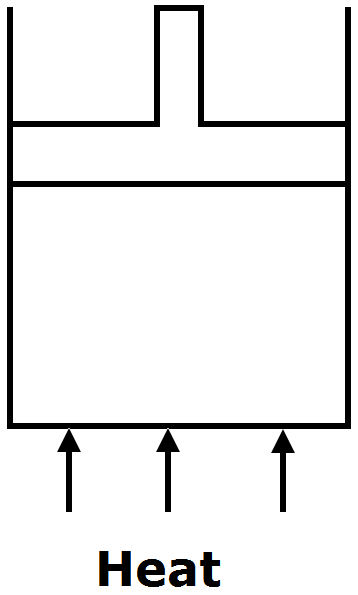
The figure shows a cylindrical container containing oxygen $(\gamma=1.4)$ and closed by a 50kg frictionless piston. The area of cross section is $100cm^2$, atmospheric pressure is 100kPa and g is $10m-s^{−2}$. The cylinder is slowly heated for some time. Find the amount of heat supplied to the gas if the piston moves out through a distance of 20cm.
View full solution
The initial pressure and volume of a given mass of a gas $\Big(\frac{\text{C}_\text{P}}{\text{C}_\text{V}}=\gamma\Big)$ are $P_0$ and $V_0$. The gas can exchange heat with the surrounding.
  1. It is slowly compressed to a volume $\frac{\text{V}_0}{2}$ and then suddenly compressed to $\frac{\text{V}_0}{4}.$ Find the final pressure.
  2. If the gas is suddenly compressed from the volume $V_0$ to $\frac{\text{V}_0}{2}$ and then slowly compressed to $\frac{\text{V}_0}{4},$ what will be the final pressure?
View full solution
The volume of an ideal gas $(\gamma=1.5)$ is changed adiabatically from 4.00 litres to 3.00 litres. Find the ratio of,
  1. The final pressure to the initial pressure.
  2. The final temperature to the initial temperature.
View full solution
A gas is enclosed in a cylindrical can fitted with a piston. The walls of the can and the piston are adiabatic. The initial pressure, volume and temperature of the gas are 100kPa, $400cm^3$ and 300K, respectively. The ratio of the specific heat capacities of the gas is $\frac{\text{C}_\text{P}}{\text{C}_\text{V}}=1.5.$ Find the pressure and the temperature of the gas if it is,
  1. Suddenly compressed.
  2. Slowly compressed to $100cm^3.$
View full solution
Standing waves of frequency 5.0kHz are produced in a tube filled with oxygen at 300K. The separation between the consecutive nodes is 3.3cm. Calculate the specific heat capacities $C_p$ and $C_v$ of the gas.
View full solution

Generate a Specific Heat Capacities of Gases paper free

Pick question groups from the list above, set marks and difficulty, and export a branded PDF with step-by-step answer keys. First 3 chapters free — no signup.

Download App