Questions · Page 2 of 2

2 Marks Questions

Question 512 Marks
If we put a cardboard (say 20cm × 20cm) between a light source and our eyes, we can't see the light. But when we put the same cardboard between a sound source and our ear, we hear the sound almost clearly. Explain.
Answer
Light waves have the property of travelling in a straight line, unlike sound waves. When we put a cardboard between the light source and our eyes, the light waves are obstructed by the cardboard and cannot reach our eyes, which doesn't happen when the cardboard is inserted between sound source and our ear.
View full question & answer
Question 522 Marks
State the importance of coherent sources in the phenomenon of interference.
Answer
If coherent sources are not taken, the phase difference between two interfering waves, meeting at any point will change continuously and a sustained interference pattern will not be obtained. Thus, coherent sources provide sustained interference pattern.
View full question & answer
Question 532 Marks
A convex lens of diameter 8.0cm is used to focus a parallel beam of light of wavelength 620nm. If the light be focused at a distance of 20cm from the lens, what would be the radius of the central bright spot formed?
Answer
$\lambda=620\text{nm}=620\times10^{-9}\text{m},$
$\text{D}=20\text{cm}=20\times10^{-2}\text{m},\text{b}=8\text{cm}=8\times10^{-2}\text{m}$
$\therefore\text{R}=1.22\times\frac{620\times10^{-4}\times20\times10^{-2}}{8\times10^{-2}}$ $=1891\times10^{-9}=1.9\times10^{-6}\text{m}$
So, diameter $=2\text{R}=3.8\times10^{-6}\text{m}$
View full question & answer
Question 542 Marks
In a Young's double slit experiment $\lambda=500\text{nm},$ d = 1.0mm and D = 1.0m. Find the minimum distance from the central maximum for which the intensity is half of the maximum intensity.
Answer
Given that, $D = 1m, d = 1mm = 10^{-3}m,$ $\lambda=500\text{nm}=5\times10^{-7}\text{m}$
For intensity to be half the maximum intensity.
$\text{y}=\frac{\lambda\text{D}}{4\text{d}}$
$\Rightarrow\text{y}=\frac{5\times10^{-7}\times1}{4\times10^{-3}}\Rightarrow\text{y}=1.25\times10^{-4}\text{m}.$
View full question & answer
Question 552 Marks
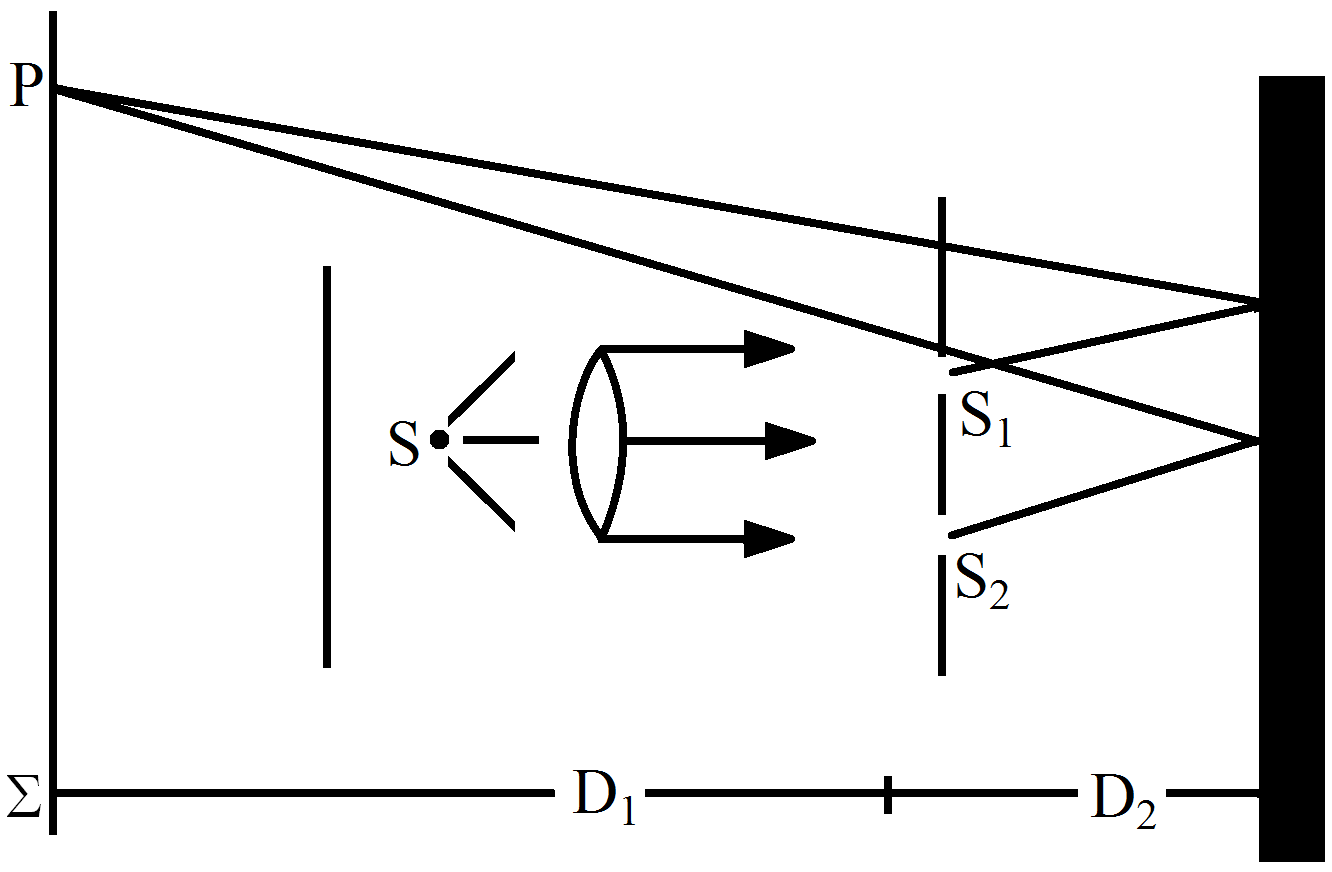
A double slit $S_1-S_2$ is illuminated by a coherent light of wavelength $\lambda$. The slits are separated by a distance $d$. A plane mirror is placed in front of the double slit at a distance $D_1$ from it and a screen $\sum$ is placed behind the double slit at a distance $D_2$ from it (figure $17-E_2$ ). The screen E receives only the light reflected by the mirror. Find the fringe-width of the interference pattern on the screen.
Answer
It can be seen from the figure that, the apparent distance of the screen from the slits is,
$D = 2D_1+ D_2$
So, Fringe width $=\frac{\text{D}\lambda}{\text{d}}=\frac{(2\text{D}_1+\text{D}_2)\lambda}{\text{d}}$
View full question & answer
Question 562 Marks
Whether the diffraction effects from a slit will be more clearly visible or less clearly, if the slit-width is increased?
Answer
The width of the central band is inversely proportional to the slit Width. So, as the width of the slit is increased, the central band will become less wider and further bands will start merging in them. Hence, diffraction effects will be visible less clearly.
View full question & answer
Question 572 Marks
The wavelength of light in a medium is $\lambda=\frac{\lambda_0}{\mu},$ where $\lambda$ is the wavelength in vacuum. A beam of red light $(\lambda_0=720\text{nm})$ enters into water. The wavelength in water is $\lambda=\frac{\lambda_0}{\mu}=540\text{nm}.$ To a person under water does this light appear green?
Answer
Colour of light will depend only on the frequency of light and not on the wavelength of the light. So, light will appear red to an observer under water.
View full question & answer
Question 582 Marks
A soap film of thickness 0.0011mm appears dark when seen by the reflected light of wavelength 580nm. What is the index of refraction of the soap solution, if it is known to be between 1.2 and 1.5?
Answer
Given, $\text{d}=0.0011\times10^{-3}\text{m}$
For minimum reflection of light, $2\mu\text{d}=\text{n}\lambda$
$\Rightarrow\mu=\frac{\text{n}\lambda}{2\text{d}}=\frac{2\text{n}\lambda}{4\text{d}}=\frac{580\times10^{-9}\times2\text{n}}{4\times11\times10^{-7}}$ $=\frac{5.8}{44}(2\text{n})=0.132(2\text{n})$
Given that, $\mu$ has a value in between 1.2 and 1.5.
⇒ When, $\text{n}=5,\mu=0.132\times10=1.32.$
View full question & answer
Question 592 Marks
Light of wavelength 560nm goes through a pinhole of diameter 0.20mm and falls on a wall at a distance of 2.00m. What will be the radius of the central bright spot formed on the wall?
Answer
$\lambda=560\text{nm}=560\times10^{-9}\text{m},$ $\text{b}=0.20\text{mm}=2\times10^{-4}\text{m},\text{D}=2\text{m}$
Since, $\text{R}=1.22\frac{\lambda\text{D}}{\text{b}}=1.22\times\frac{560\times10^{-9}\times2}{2\times10^{-4}}$ $=6.832\times10^{-3}\text{M}=0.683\text{cm}.$
So, diameter $=2\text{R}=1.37\text{cm}.$
View full question & answer
Question 602 Marks
A long narrow horizontal slit is placed 1mm above a horizontal plane mirror. The interference between the light coming directly from the slit and that after reflection is seen on a screen 1.0m away from the slit. Find the fringe-width if the light used has a wavelength of 700nm.
Answer
Given that, D = 1m, $\lambda=700\text{nm}=700\times10^{-9}\text{m}$
Since, $a = 2mm, d = 2a = 2mm = 2 × 10^{-3}m$ (L loyd’s mirror experiment)
Fringe width $=\frac{\lambda\text{D}}{\text{d}}=\frac{700\times10^{-9}\text{m}\times1\text{m}}{2\times10^{-3}\text{m}}=0.35\text{mm}.$
View full question & answer
Question 612 Marks
Two transparent slabs having equal thickness but different refractive indices $\mu_1$ and $\mu_2$ are pasted side by side to form a composite slab. This slab is placed just after the double slit in a Young's experiment so that the light from one slit goes through one material and the light from the other slit goes through the other material. What should be the minimum thickness of the slab so that there is a minimum at the point $P_0$ which is equidistant from the slits?
Answer
The change in path difference due to the two slabs is $(\mu_1-\mu_2)\text{t}$ (as in problem no. 16).
For having a minimum at $P_0$, the path difference should change by $\frac{\lambda}{2}.$
So, $\Rightarrow\frac{\lambda}{2}=(\mu_1-\mu_2)\text{t}\Rightarrow\text{t}=\frac{\lambda}{2(\mu_1-\mu_2)}.$
View full question & answer
Question 622 Marks
A Young's double slit apparatus has slits separated by 0.28mm and a screen 48cm away from the slits. The whole apparatus is immersed in water and the slits are illuminated by the red light ($\lambda=700\text{nm}$ in vacuum). Find the fringe-width of the pattern formed on the screen.
Answer
Given that, $d = 0.28mm = 0.28 × 10^{-3}m, D = 48cm = 0.48m, \lambda_\text{a}=700\text{nm}$ in vacuum
Let, $\lambda_\text{w}$ = wavelength of red light in water
Since, the fringe width of the pattern is given by,
$\beta=\frac{\lambda_\text{w}\text{D}}{\text{d}}$
$=\frac{525\times10^{-9}\times0.48}{0.28\times10^{-3}}=9\times10^{-4}\text{m}=0.90\text{mm}.$
View full question & answer
Question 632 Marks
Discuss the intensity of transmitted light when a polaroid sheet is rotated between two crossed polaroids?
Answer
Let $I_0$ be the intensity of polarised light after passing through the first polariser $P_1$. Then the intensity of light after passing through second polariser $P_2$ will be
$
I=I_0 \cos ^2 \theta \text {, }
$
where $\theta$ is the angle between pass axes of $P_1$ and $P_2$. Since $P_1$ and $P_3$ are crossed the angle between the pass axes of $P_2$ and $P_3$ will be $(\pi / 2-\theta)$. Hence the intensity of light emerging from $P_3$ will be
$
\begin{aligned}
I & =I_0 \cos ^2 \theta \cos ^2\left(\frac{\pi}{2}-\theta\right) \\
& =I_0 \cos ^2 \theta \sin ^2 \theta=\left(I_0 / 4\right) \sin ^2 2 \theta
\end{aligned}
$
Therefore, the transmitted intensity will be maximum when $\theta=\pi / 4$.
View full question & answer
Question 642 Marks
(a) When monochromatic light is incident on a surface separating two media, the reflected and refracted light both have the same frequency as the incident frequency. Explain why?
(b) When light travels from a rarer to a denser medium, the speed decreases. Does the reduction in speed imply a reduction in the energy carried by the light wave?
(c) In the wave picture of light, intensity of light is determined by the square of the amplitude of the wave. What determines the intensity of light in the photon picture of light.
Answer
(a) Reflection and refraction arise through interaction of incident light with the atomic constituents of matter. Atoms may be viewed as oscillators, which take up the frequency of the external agency (light) causing forced oscillations. The frequency of light emitted by a charged oscillator equals its frequency of oscillation. Thus, the frequency of scattered light equals the frequency of incident light.
(b) No. Energy carried by a wave depends on the amplitude of the wave, not on the speed of wave propagation.
(c) For a given frequency, intensity of light in the photon picture is determined by the number of photons crossing an unit area per unit time.
View full question & answer