Questions · Page 7 of 8

M.C.Q (1 Marks)

MCQ 3011 Mark
Select the right option in the following
  • A
     Christian Huygens a contemporary of Newton established the wave theory of light by assuming that light waves were transverse
  • Maxwell provided the compelling theoretical evidence that light is transverse wave
  • C
    Thomas Young experimentally proved the wave behaviour of light and Huygens assumption
  • D
     All the statements give above, correctly answers the question “what is light”
Answer
Correct option: B.
Maxwell provided the compelling theoretical evidence that light is transverse wave
View full question & answer
MCQ 3021 Mark
A thin mica sheet of thickness $2 \times 10^{-6} m$ and refractive index μ = 1.5 is introduced in the path of the first wave. The wavelength of the wave used is 5000 Å. The central bright maximum will shift
  • 2 fringes upward
  • B
    2 fringes downward
  • C
    10 fringes upward
  • D
    None of these
Answer
Correct option: A.
2 fringes upward
(a) 2 fringes upward
View full question & answer
MCQ 3031 Mark
The slits in a Young's double slit experiment have equal widths and the source is placed symmetrically relative to the slits. The intensity at the central fringes is $I_0$. If one of the slits is closed, the intensity at this point will be
  • A
    $I_0$
  • $I_0 / 4$
  • C
    $I_0/ 2$
  • D
    $4I_0$
Answer
Correct option: B.
$I_0 / 4$
$I_0 / 4$
View full question & answer
MCQ 3041 Mark
In a biprism experiment, by using light of wavelength 5000 Å, 5 mm wide fringes are obtained on a screen 1.0 m away from the coherent sources. The separation between the two coherent sources is
  • A
    1.0 mm
  • 0.1 mm
  • C
    0.05 mm
  • D
    0.01 mm
Answer
Correct option: B.
0.1 mm
0.1 mm
View full question & answer
MCQ 3051 Mark
In Young's experiment, one slit is covered with a blue filter and the other (slit) with a yellow filter. Then the interference pattern
  • A
    Will be blue
  • B
    Will be yellow
  • C
    Will be green
  • Will not be formed
Answer
Correct option: D.
Will not be formed
Will not be formed
View full question & answer
MCQ 3061 Mark
In an interference experiment, the spacing between successive maxima or minima is (Where the symbols have their usual meanings)
  • A
    $\frac{\lambda d}{D}$
  • $\frac{\lambda D}{d}$
  • C
    $\frac{dD}{\lambda}$
  • D
    $\frac{\lambda d}{4D}$
Answer
Correct option: B.
$\frac{\lambda D}{d}$
(b) $\frac{\lambda D}{d}$
View full question & answer
MCQ 3071 Mark
In a Young's double slit experiment, the central point on the screen is
  • Bright
  • B
    Dark
  • C
    First bright and then dark
  • D
    First dark and then bright
Answer
Correct option: A.
Bright
Bright
View full question & answer
MCQ 3081 Mark
In Young's double slit experiment, if L is the distance between the slits and the screen upon which interference pattern is observed, x is the average distance between the adjacent fringes and d being the slit separation. The wavelength of light is given by
  • $\frac{xd}{L}$
  • B
    $\frac{xL}{d}$
  • C
    $\frac{Ld}{x}$
  • D
    $\frac{1}{Ldx}$
Answer
Correct option: A.
$\frac{xd}{L}$
(a) $\frac{xd}{L}$
View full question & answer
MCQ 3091 Mark
The Young's experiment is performed with the lights of blue (λ = 4360 Å) and green colour (λ = 5460 Å), If the distance of the 4th fringe from the centre is x, then
  • A
    x (Blue) = x (Green)
  • B
    x (Blue) > x (Green)
  • x (Blue) < x (Green)
  • D
    $\frac{x \text { (Blue) }}{x \text { (Green) }}=\frac{5460}{4360}$
Answer
Correct option: C.
x (Blue) < x (Green)
(c) x (Blue) < x (Green)
View full question & answer
MCQ 3101 Mark
An oil flowing on water seems coloured due to interference. For observing this effect, the approximate thickness of the oil film should be
  • A
    100 Å
  •  10000 Å
  • C
    1 mm
  • D
     1 cm
Answer
Correct option: B.
 10000 Å
10000 Å
View full question & answer
MCQ 3111 Mark
In the Young's double slit experiment, the ratio of intensities of bright and dark fringes is 9. This means that
  • A
    The intensities of individual sources are 5 and 4 units respectively
  • B
    The intensities of individual sources are 4 and 1 units respectively
  • C
    The ratio of their amplitudes is 2
  • b, c
Answer
Correct option: D.
b, c
b, c
View full question & answer
MCQ 3121 Mark
The maximum intensity of fringes in Young's experiment is I. If one of the slit is closed, then the intensity at that place becomes $I_o$. Which of the following relation is true ?
  • A
    $I = I_o$
  • B
    $I = 2I_o$
  • $I = 4I_o$
  • D
    There is no relation between $I$ and $I_o$
Answer
Correct option: C.
$I = 4I_o$
$I = 4I_o$
View full question & answer
MCQ 3131 Mark
In Young's experiment, the distance between the slits is reduced to half and the distance between the slit and screen is doubled, then the fringe width
  • A
    Will not change
  • B
     Will become half
  • C
     Will be doubled
  •  Will become four times
Answer
Correct option: D.
 Will become four times
Will become four times
View full question & answer
MCQ 3141 Mark
In Young's double slit experiment, a glass plate is placed before a slit which absorbs half the intensity of light. Under this case
  • A
     The brightness of fringes decreases
  • B
     The fringe width decreases
  • C
     No fringes will be observed
  • The bright fringes become fainter and the dark fringes have finite light intensity
Answer
Correct option: D.
The bright fringes become fainter and the dark fringes have finite light intensity
View full question & answer
MCQ 3151 Mark
In Young's double slit experiment, if one of the slit is closed fully, then in the interference pattern
  • A bright slit will be observed, no interference pattern will exist
  • B
    The bright fringes will become more bright
  • C
    The bright fringes will become fainter
  • D
    None of the above
Answer
Correct option: A.
A bright slit will be observed, no interference pattern will exist
 A bright slit will be observed, no interference pattern will exist
View full question & answer
MCQ 3161 Mark
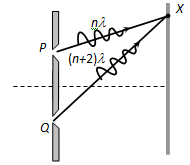
The figure shows a double slit experiment P and Q are the slits. The path lengths PX and QX are nλ and (n+2)λ respectively, where n is a whole number and λ is the wavelength. Taking the central fringe as zero, what is formed at X

  • A
    First brigh
  • B
    First dark
  • Second bright
  • D
    Second dark
Answer
Correct option: C.
Second bright
(c) Second bright
View full question & answer
MCQ 3171 Mark
Coherent sources are those sources for which
  • A
    Phase difference remain constant
  • B
    Frequency remains constant
  • Both phase difference and frequency remains constant
  • D
    None of these
Answer
Correct option: C.
Both phase difference and frequency remains constant
 Both phase difference and frequency remains constant
View full question & answer
MCQ 3181 Mark
Two beams of light having intensities I and 4I interfere to produce a fringe pattern on a screen. The phase difference between the beams is $\frac{\pi}{2}$ at point A and p at point B. Then the difference between the resultant intensities at A and B is 
  • A
    2l
  • 4l
  • C
    5l
  • D
    7l
Answer
Correct option: B.
4l
(b) 4I
View full question & answer
MCQ 3191 Mark
The dual nature of light is exhibited by
  • A
     Photoelectric effect
  • B
    Refraction and interference
  • C
    Diffraction and reflection
  • Diffraction and photoelectric effect
Answer
Correct option: D.
Diffraction and photoelectric effect
View full question & answer
MCQ 3201 Mark
Newton postulated his corpuscular theory on the basis of
  • A
    Newton’s rings
  • B
    Colours of thin films
  • Rectilinear propagation of light
  • D
    Dispersion of white light
Answer
Correct option: C.
Rectilinear propagation of light
View full question & answer
MCQ 3211 Mark
Two coherent sources of intensities, $\mathrm{I}_1$ and $\mathrm{I}_2$ produce an interference pattern. The maximum intensity in the interference pattern will be
  • A
    $I_1+I_2$
  • B
    ${I_1}^2+{I_2}^2$
  • C
    $\left(I_1+I_2\right)^2$
  • $\left(\sqrt{I_1}+{\sqrt{I_2}}^2\right)^2$
Answer
Correct option: D.
$\left(\sqrt{I_1}+{\sqrt{I_2}}^2\right)^2$
(d) $\left(\sqrt{I_1}+{\sqrt{I_2}}^2\right)^2$
View full question & answer
MCQ 3221 Mark
What causes changes in the colours of the soap or oil films for the given beam of light
  • A
    Angle of incidence
  • B
    Angle of reflection
  • Thickness of film
  • D
     None of these
Answer
Correct option: C.
Thickness of film
Thickness of film
View full question & answer
MCQ 3231 Mark
Which of the following phenomena can explain quantum nature of light
  • Photoelectric effect
  • B
     Interference
  • C
     Diffraction
  • D
     Polarisation
Answer
Correct option: A.
Photoelectric effect
 Photoelectric effect
View full question & answer
MCQ 3241 Mark
In double slit experiment, the angular width of the fringes is $0.20^\circ$ for the sodium light $(\lambda =5890 \mathring A )$. In order to increase the angular width of the fringes by $10\%$, the necessary change in the wavelength is
  • Increase of $589 \mathring A$
  • B
    Decrease of $589 \mathring A$
  • C
    Increase of $6479 \mathring A$
  • D
    Zero
Answer
Correct option: A.
Increase of $589 \mathring A$
View full question & answer
MCQ 3251 Mark
Two sources give interference pattern which is observed on a screen, D distance apart from the sources. The fringe width is 2w. If the distance D is now doubled, the fringe width will
  • A
    Become w/2
  • B
    Remain the same
  • C
    Become w
  • Become 4w
Answer
Correct option: D.
Become 4w
Become 4w
View full question & answer
MCQ 3261 Mark
The phase difference between incident wave and reflected wave is 180° when light ray
  •  Enters into glass from air
  • B
    Enters into air from glass
  • C
     Enters into glass from diamond
  • D
     Enters into water from glass
Answer
Correct option: A.
 Enters into glass from air
Enters into glass from air
View full question & answer
MCQ 3271 Mark
In Young's double slit experiment, the fringe width is $ 1 \times 10^{-4} m$ if the distance between the slit and screen is doubled and the distance between the two slit is reduced to half and wavelength is changed from $6.4 \times 10^{7} m$ to ,$4.0 \times 10^{-7} m$, the value of new fringe width will be
  • A
    $0.15 \times 10^{-4} m$
  • B
    $2.0 \times 10^{-4} m$
  • C
    $1.25 \times 10^{-4} m$
  • $2.5 \times 10^{-4} m$
Answer
Correct option: D.
$2.5 \times 10^{-4} m$
(d) $2.5 \times 10^{-4} m$
View full question & answer
MCQ 3281 Mark
If yellow light in the Young's double slit experiment is replaced by red light, the fringe width will
  • A
    Decrease
  • B
    Remain unaffected
  • Increase
  • D
    First increase and then decrease
Answer
Correct option: C.
Increase
Increase
View full question & answer
MCQ 3291 Mark
Huygen wave theory allows us to know
  • A
    The wavelength of the wave
  • B
     The velocity of the wave
  • C
     The amplitude of the wave
  • The propagation of wave fronts
Answer
Correct option: D.
The propagation of wave fronts
View full question & answer
MCQ 3301 Mark
In two separate set - ups of the Young's double slit experiment, fringes of equal width are observed when lights of wavelengths in the ratio 1 : 2 are used. If the ratio of the slit separation in the two cases is 2 : 1, the ratio of the distances between the plane of the slits and the screen in the two set - ups is
  •  4 : 1
  • B
     1 : 1
  • C
     1 : 4
  • D
     2 : 1
Answer
Correct option: A.
 4 : 1
 4 : 1
View full question & answer
MCQ 3311 Mark
In Young's double slit experiment when wavelength used is 6000 Å and the screen is 40 cm from the slits, the fringes are 0.012 cm wide. What is the distance between the slits
  • A
     0.024 cm
  • B
    2.4 cm
  • C
    0.24 cm
  • 0.2 cm
Answer
Correct option: D.
0.2 cm
0.2 cm
View full question & answer
MCQ 3321 Mark
In Young's double slit experiment, if the widths of the slits are in the ratio 4 : 9, the ratio of the intensity at maxima to the intensity at minima will be
  • A
    169 : 25
  • B
    81 : 16
  •  25 : 1
  • D
     9 : 4
Answer
Correct option: C.
 25 : 1
25 : 1
View full question & answer
MCQ 3331 Mark
In Young's double slit experiment, the phase difference between the light waves reaching third bright fringe from the central fringe will be (λ =6000 Å )
  • A
    Zero
  • B
  • C
    4 π
  • 6 π
Answer
Correct option: D.
6 π
 6 π
View full question & answer
MCQ 3341 Mark
In Young's experiment, light of wavelength 4000 Å is used to produce bright fringes of width 0.6 mm, at a distance of 2 meters. If the whole apparatus is dipped in a liquid of refractive index 1.5, then fringe width will be
  • A
    0.2 mm
  • B
    0.3 mm
  • 0.4 mm
  • D
    1.2 mm
Answer
Correct option: C.
0.4 mm
0.4 mm
View full question & answer
MCQ 3351 Mark
In double slits experiment, for light of which colour the fringe width will be minimum
  • Violet
  • B
    Red
  • C
    Green
  • D
    Yellow
Answer
Correct option: A.
Violet
 Violet
View full question & answer
MCQ 3361 Mark
Young's experiment is performed in air and then performed in water, the fringe width
  • A
    Will remain same
  • Will decrease
  • C
    Will increase
  • D
    Will be infinite
Answer
Correct option: B.
Will decrease
Will decrease
View full question & answer
MCQ 3371 Mark
In a Young's double slit experiment, the fringe width is found to be 0.4 mm. If the whole apparatus is immersed in water of refractive index 4/3 without disturbing the geometrical arrangement, the new fringe width will be
  • 0.30 mm
  • B
    0.40 mm
  • C
    0.53 mm
  • D
    450 micron
Answer
Correct option: A.
0.30 mm
0.30 mm
View full question & answer
MCQ 3381 Mark
If the distance between a point source and screen is doubled, then intensity of light on the screen will become
  • A
    Four times
  • B
    Double
  • C
    Half
  • One-fourth
Answer
Correct option: D.
One-fourth
One-fourth
View full question & answer
MCQ 3391 Mark
As a result of interference of two coherent sources of light, energy is
  • A
     Increased
  • Redistributed and the distribution does not vary with time
  • C
    Decreased
  • D
    Redistributed and the distribution changes with time
Answer
Correct option: B.
Redistributed and the distribution does not vary with time
View full question & answer
MCQ 3401 Mark
In the Young's double slit experiment, the spacing between two slits is 0.1 mm. If the screen is kept at a distance of 1.0 m from the slits and the wavelength of light is 5000 Å, then the fringe width is
  • A
     1.0 cm
  • B
    1.5 cm
  • 0.5 cm
  • D
    2.0 cm
Answer
Correct option: C.
0.5 cm
0.5 cm
View full question & answer
MCQ 3411 Mark
If an interference pattern have maximum and minimum intensities in 36 : 1 ratio then what will be the ratio of amplitudes
  • A
    5 : 7
  • B
    7 : 4
  • C
    4 : 7
  • 7 : 5
Answer
Correct option: D.
7 : 5
7 : 5
View full question & answer
MCQ 3421 Mark
What is the path difference of destructive interference
  • A
    nl
  • B
    n(λ + 1)
  • C
    $\frac{(n+1) \lambda}{2}$
  • $\frac{(2 n+1) \lambda}{2}$
Answer
Correct option: D.
$\frac{(2 n+1) \lambda}{2}$
(d) $\frac{(2 n+1) \lambda}{2}$
View full question & answer
MCQ 3431 Mark
Huygen’s principle of secondary wavelets may be used to
  • A
     Find the velocity of light in vacuum
  • B
     Explain the particle behaviour of light
  • Find the new position of the wavefront
  • D
    Explain photoelectric effect
Answer
Correct option: C.
Find the new position of the wavefront
 Find the new position of the wavefront
View full question & answer
MCQ 3441 Mark
Two waves have their amplitudes in the ratio 1 : 9. The maximum and minimum intensities when they interfere are in the ratio 
  • $\frac{25}{16}$
  • B
    $\frac{16}{25}$
  • C
    $\frac{1}{9}$
  • D
    $\frac{9}{1}$
Answer
Correct option: A.
$\frac{25}{16}$
(a) $\frac{25}{16}$
View full question & answer
MCQ 3451 Mark
The frequency of light ray having the wavelength $3000 \mathring A$ is
  • A
    $9 \times 10^{13}$ cycles $/ \mathrm{sec}$
  • $10^{15}$ cycles $/ \mathrm{sec}$
  • C
    $90$ cycles $/ \mathrm{sec}$
  • D
    $3000$ cycles $/ \mathrm{sec}$
Answer
Correct option: B.
$10^{15}$ cycles $/ \mathrm{sec}$
View full question & answer
MCQ 3461 Mark
Two coherent sources of different intensities send waves which interfere. The ratio of maximum intensity to the minimum intensity is 25. The intensities of the sources are in the ratio
  • A
    25 : 1
  • B
    5 : 1
  • 9 : 4
  • D
    25 : 16
Answer
Correct option: C.
9 : 4
 9 : 4
View full question & answer
MCQ 3471 Mark
Laser beams are used to measure long distance because
  • A
    They are monochromatic
  • B
    They are highly polarised
  • C
    They are coherent
  • They have high degree of parallelism
Answer
Correct option: D.
They have high degree of parallelism
View full question & answer
MCQ 3481 Mark
Light waves producing interference have their amplitudes in the ratio 3 : 2. The intensity ratio of maximum and minimum of interference fringes is
  • A
     36 : 1
  • B
    9 : 4
  • 25 : 1
  • D
    6 : 4
Answer
Correct option: C.
25 : 1
25 : 1
View full question & answer
MCQ 3491 Mark
Two coherent light sources $S_1$ and $S_2\ (l= 6000\ \mathring A )$ are $1mm$ apart from each other. The screen is placed at a distance of $25 \ cm$ from the sources. The width of the fringes on the screen should be
  • $0.015 \ cm$
  • B
    $0.025 \ cm$
  • C
    $0.010 \ cm$
  • D
    $0.030 \ cm$
Answer
Correct option: A.
$0.015 \ cm$
$0.015 \ cm$
View full question & answer
MCQ 3501 Mark
In a certain double slit experimental arrangement interference fringes of width 1.0 mm each are observed when light of wavelength 5000 Å is used. Keeping the set up unaltered, if the source is replaced by another source of wavelength 6000 Å, the fringe width will be
  • A
    0.5 mm
  • B
    1.0 mm
  • 1.2 mm
  • D
    1.5 mm
Answer
Correct option: C.
1.2 mm
1.2 mm
View full question & answer
M.C.Q (1 Marks) - Page 7 - Physics STD 12 Science Questions - Vidyadip