Questions · Page 6 of 8

M.C.Q (1 Marks)

MCQ 2511 Mark
What happens to the fringe pattern when the Young’s double slit experiment is performed in water instead or air then fringe width
  • Shrinks
  • B
    Disappear
  • C
    Unchanged
  • D
    Enlarged
Answer
Correct option: A.
Shrinks
Shrinks
View full question & answer
MCQ 2521 Mark
What is the effect on Fresnel’s biprism experiment when the use of white light is made
  • A
     Fringe are affected
  • B
     Diffraction pattern is spread more
  • Central fringe is white and all are coloured
  • D
     None of these
Answer
Correct option: C.
Central fringe is white and all are coloured
View full question & answer
MCQ 2531 Mark
If Fresnel’s biprism experiment as held in water inspite of air, then what will be the effect on fringe width
  •  Decrease
  • B
     Increase
  • C
     No effect
  • D
     None of these
Answer
Correct option: A.
 Decrease
Decrease
View full question & answer
MCQ 2541 Mark
In Young’s double slit experiment, the distance between the two slits is made half, then the fringe width will become
  • A
    Half
  • Double
  • C
    One fourth
  • D
     Unchanged
Answer
Correct option: B.
Double
 Double
View full question & answer
MCQ 2551 Mark
In the Young’s double slit experiment with sodium light. The slits are 0.589 m a part. The angular separation of the third maximum from the central maximum will be (given ? = 589 mm) 
  • A
    $\sin ^{-1}\left(0.33 \times 10^8\right)$
  • B
    $\sin ^{-1}\left(0.33 \times 10^{-6}\right)$
  • C
    $\sin ^{-1}\left(3 \times 10^{-8}\right)$
  • $\sin ^{-1}\left(3 \times 10^{-6}\right)$
Answer
Correct option: D.
$\sin ^{-1}\left(3 \times 10^{-6}\right)$
(d) $\sin ^{-1}\left(3 \times 10^{-6}\right)$
View full question & answer
MCQ 2561 Mark
In a Young’s double slit experiment, 12 fringes are observed to be formed in a certain segment of the screen when light of wavelength 600 nm is used. If the wavelength of light is changed to 400 nm, number of fringes observed in the same segment of the screen is given by
  • A
     12
  •  18
  • C
    24
  • D
     30
Answer
Correct option: B.
 18
18
View full question & answer
MCQ 2571 Mark
If a white light is used in Young’s double slit experiments then a very large number of coloured fringes can be seen
  • A
    With first order violet fringes being closer to the central white fringes
  • B
     First order red fringes being closer to the central white fringes
  •  With a central white fringe
  • D
     With a central black fringe
Answer
Correct option: C.
 With a central white fringe
 With a central white fringe
View full question & answer
MCQ 2581 Mark
An interference pattern was made by using red light. If the red light changes with blue light, the fringes will become
  • A
     Wider
  • Narrower
  • C
    Fainter
  • D
    Brighter
Answer
Correct option: B.
Narrower
 Narrower
View full question & answer
MCQ 2591 Mark
In Young’s double slit experiment, distance between two sources is 0.1 mm. The distance of screen from the sources is 20 cm. Wavelength of light used is 5460 Å. Then angular position of the first dark fringe is
  • A
     0.08°
  • B
     0.16°
  • C
    0.20°
  •  0.313°
Answer
Correct option: D.
 0.313°
 0.313°
View full question & answer
MCQ 2601 Mark
In Young’s double slit experiment the amplitudes of two sources are 3a and a respectively. The ratio of intensities of bright and dark fringes will be
  • A
    3 : 1
  • 4 : 1
  • C
    2 : 1
  • D
    9 : 1
Answer
Correct option: B.
4 : 1
4 : 1
View full question & answer
MCQ 2611 Mark
Two coherent sources of intensity ratio 1 : 4 produce an interference pattern. The fringe visibility will be
  • A
     1
  • 0.8
  • C
     0.4
  • D
     0.6
Answer
Correct option: B.
0.8
0.8
View full question & answer
MCQ 2621 Mark
The two slits at a distance of 1 mm are illuminated by the light of wavelength $6.5 \times 10^{-7} m$. The interference fringes are observed on a screen placed at a distance of 1m. The distance between third dark fringe and fifth bright fringe will be
  • A
    0.65 mm
  • 1.63 mm
  • C
    3.25 mm
  • D
    4.88 mm
Answer
Correct option: B.
1.63 mm
(b) 1.63 mm
View full question & answer
MCQ 2631 Mark
A double slit experiment is performed with light of wavelength 500 nm. A thin film of thickness 2 mm and refractive index 1.5 is introduced in the path of the upper beam. The location of the central maximum will
  • A
    Remain unshifted
  • B
    Shift downward by nearly two fringes
  • Shift upward by nearly two fringes
  • D
     Shift downward by 10 fringes
Answer
Correct option: C.
Shift upward by nearly two fringes
View full question & answer
MCQ 2641 Mark
If the separation between slits in Young’s double slit experiment is reduced to $\frac{1}{3}$rd, the fringe width becomes n times. The value of n is
  • 3
  • B
    $\frac{1}{3}$
  • C
    9
  • D
    $\frac{1}{9}$
Answer
Correct option: A.
3
(a) 3
View full question & answer
MCQ 2651 Mark
In an interference experiment, third bright fringe is obtained at a point on the screen with a light of 700 nm. What should be the wavelength of the light source in order to obtain 5th bright fringe at the same point
  • A
     500 nm
  • B
     630 nm
  • C
     750 nm
  •  420 nm
Answer
Correct option: D.
 420 nm
 420 nm
View full question & answer
MCQ 2661 Mark
In a Young’s double slit experiment, the slit separation is 1 mm and the screen is 1 m from the slit. For a monochromatic light of wavelength 500 nm, the distance of 3rd minima from the central maxima is
  • A
    0.50 mm
  • 1.25 mm
  • C
    1.50 mm
  • D
    1.75 mm
Answer
Correct option: B.
1.25 mm
1.25 mm
View full question & answer
MCQ 2671 Mark
In Young’s double-slit experiment, an interference pattern is obtained on a screen by a light of wavelength $6000 \mathring A$ , coming from the coherent sources $S_1$ and $S_2$. At certain point $P$ on the screen third dark fringe is formed. Then the path difference $S_1 P-S_2 P$ in microns is
  • A
    $0.75$
  • $1.5$
  • C
    $3.0$
  • D
    $4.5$
Answer
Correct option: B.
$1.5$
$1.5$
View full question & answer
MCQ 2681 Mark
When a thin transparent plate of thickness t and refractive index m is placed in the path of one of the two interfering waves of light, then the path difference changes by 
  • A
    (m + 1)t
  • (m – 1)t
  • C
    $\frac{(\mu+1)}{t}$
  • D
    $\frac{(\mu-1)}{t}$
Answer
Correct option: B.
(m – 1)t
(b) (m – 1)t
View full question & answer
MCQ 2691 Mark
In Young’s double slit experiment the wavelength of light was changed from 7000 Å to 3500 Å. While doubling the separation between the slits which of the following is not true for this experiment
  • A
    The width of the fringes changes
  • B
    The colour of bright fringes changes
  • C
    The separation between successive bright fringes changes
  • The separation between successive dark fringes remains unchanged
Answer
Correct option: D.
The separation between successive dark fringes remains unchanged
View full question & answer
MCQ 2701 Mark
In Young’s double slit experiment, the intensity of light coming from the first slit is double the intensity from the second slit. The ratio of the maximum intensity to the minimum intensity on the interference fringe pattern observed is
  • 34
  • B
    40
  • C
    25
  • D
    38
Answer
Correct option: A.
34
34
View full question & answer
MCQ 2711 Mark
In a Young’s double slit experiment, the source illuminating the slits is changed from blue to violet. The width of the fringes
  • A
     Increases
  •  Decreases
  • C
     Becomes unequal
  • D
     Remains constant
Answer
Correct option: B.
 Decreases
 Decreases
View full question & answer
MCQ 2721 Mark
In Young’s double slit experiment, the wavelength of the light used is doubled and distance between two slits is half of initial distance, the resultant fringe width becomes
  • A
    2 times
  • B
    3 times
  • 4 times
  • D
     1/2 times
Answer
Correct option: C.
4 times
4 times
View full question & answer
MCQ 2731 Mark
In Young’s double slit experiment, the central bright fringe can be identified
  •  By using white light instead of monochromatic light
  • B
     As it is narrower than other bright fringes
  • C
     As it is wider than other bright fringes
  • D
     As it has a greater intensity than the other bright fringes
Answer
Correct option: A.
 By using white light instead of monochromatic light
 By using white light instead of monochromatic light
View full question & answer
MCQ 2741 Mark
In Young's double slit experiment, the distance between the slits is 1 mm and that between slit and screen is 1 meter and 10th fringe is 5 mm away from the central bright fringe, then wavelength of light used will be
  • 5000 Å
  • B
    6000 Å
  • C
     7000 Å
  • D
     8000 Å
Answer
Correct option: A.
5000 Å
5000 Å
View full question & answer
MCQ 2751 Mark
In Young's double slit experiment, angular width of fringes is $0.20^\circ$ for sodium light of wavelength $5890 \mathring A$ . If complete system is dipped in water, then angular width of fringes becomes
  • A
    $ 0.11^{\circ}$
  • $ 0.15^{\circ}$
  • C
    $ 0.22^{\circ}$
  • D
    $ 0.30^{\circ}$
Answer
Correct option: B.
$ 0.15^{\circ}$
$ 0.15^{\circ}$
View full question & answer
MCQ 2761 Mark
In Young’s experiment, the ratio of maximum to minimum intensities of the fringe system is 4 : 1. The amplitudes of the coherent sources are in the ratio
  • A
     4 : 1
  • 3 : 1
  • C
    2 : 1
  • D
    1 : 1
Answer
Correct option: B.
3 : 1
 3 : 1
View full question & answer
MCQ 2771 Mark
Young’s double slit experiment is performed with light of wavelength 550 nm. The separation between the slits is 1.10 mm and screen is placed at distance of 1 m. What is the distance between the consecutive bright or dark fringes
  • A
    1.5 mm
  • B
     1.0 mm
  •  0.5 mm
  • D
     None of these
Answer
Correct option: C.
 0.5 mm
0.5 mm
View full question & answer
MCQ 2781 Mark
In a Young’s double slit experiment, the separation of the two slits is doubled. To keep the same spacing of fringes, the distance D of the screen from the slits should be made 
  • A
    $\frac{D}{2}$
  • B
    $\frac{D}{\sqrt 2}$
  • 2D
  • D
    4D
Answer
Correct option: C.
2D
(c) 2D
View full question & answer
MCQ 2791 Mark
In the Young’s double slit experiment, for which colour the fringe width is least
  • A
     Red
  • B
    Green
  • Blue
  • D
    Yellow
Answer
Correct option: C.
Blue
 Blue
View full question & answer
MCQ 2801 Mark
Two slits, 4 mm apart, are illuminated by light of wavelength 6000 Å. What will be the fringe width on a screen placed 2m from the slits
  • A
    0.12 mm
  • 0.3 mm
  • C
    3.0 mm
  • D
    4.0 mm
Answer
Correct option: B.
0.3 mm
 0.3 mm
View full question & answer
MCQ 2811 Mark
In a double slit experiment, instead of taking slits of equal widths, one slit is made twice as wide as the other. Then in the interference pattern
  •  The intensities of both the maxima and the minima increase
  • B
     The intensity of maxima increases and the minima has zero intensity
  • C
     The intensity of maxima decreases and that of the minima increases
  • D
     The intensity of maxima decreases and the minima has zero intensity
Answer
Correct option: A.
 The intensities of both the maxima and the minima increase
The intensities of both the maxima and the minima increase
View full question & answer
MCQ 2821 Mark
The fringe width in Young’s double slit experiment increases when
  • Wavelength increases
  • B
    Distance between the slits increases
  • C
    Distance between the source and screen decreases
  • D
    The width of the slits increases
Answer
Correct option: A.
Wavelength increases
View full question & answer
MCQ 2831 Mark
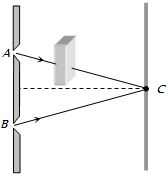
In Young’s experiment, monochromatic light is used to illuminate the two slits A and B. Interference fringes are observed on a screen placed in front of the slits. Now if a thin glass plate is placed normally in the path of the beam coming from the slit

  • A
    The fringes will disappear
  • B
    The fringe width will increase
  • C
    The fringe width will increase
  • There will be no change in the fringe width but the pattern shifts
Answer
Correct option: D.
There will be no change in the fringe width but the pattern shifts
(d) There will be no change in the fringe width but the pattern shifts
View full question & answer
MCQ 2841 Mark
If a transparent medium of refractive index $m = 1.5$ and thickness $t = 2.5 \times 10^{-5}$ m is inserted in front of one of the slits of Young’s Double Slit experiment, how much will be the shift in the interference pattern? The distance between the slits is $0.5 \ mm$ and that between slits and screen is $100 \ cm$
  • A
    $5 \ cm$
  • $2.5 \ cm$
  • C
    $0.25 \ cm$
  • D
    $0.1 \ cm$
Answer
Correct option: B.
$2.5 \ cm$
$2.5 \ cm$
View full question & answer
MCQ 2851 Mark
Two parallel slits 0.6 mm apart are illuminated by light source of wavelength 6000 Å. The distance between two consecutive dark fringes on a screen 1 m away from the slits is
  • 1 mm
  • B
    0.01 mm
  • C
    0.1 m
  • D
     10 m
Answer
Correct option: A.
1 mm
1 mm
View full question & answer
MCQ 2861 Mark
In Young’s experiment, the distance between slits is 0.28 mm and distance between slits and screen is 1.4 m. Distance between central bright fringe and third bright fringe is 0.9 cm. What is the wavelength of used light
  • A
    5000 Å
  •  6000 Å
  • C
    7000 Å
  • D
    9000 Å
Answer
Correct option: B.
 6000 Å
6000 Å
View full question & answer
MCQ 2871 Mark
When a thin metal plate is placed in the path of one of the interfering beams of light
  • A
     Fringe width increases
  •  Fringes disappear
  • C
     Fringes become brighter
  • D
     Fringes becomes blurred
Answer
Correct option: B.
 Fringes disappear
Fringes disappear
View full question & answer
MCQ 2881 Mark
If a torch is used in place of monochromatic light in Young’s experiment what will happens
  • A
     Fringe will appear for a moment then it will disappear
  • B
     Fringes will occur as from monochromatic light
  • C
    Only bright fringes will appear
  • No fringes will appear
Answer
Correct option: D.
No fringes will appear
View full question & answer
MCQ 2891 Mark
In Young's double slit experiment using sodium light (λ = 5898 Å), 92 fringes are seen. If given colour (λ = 5461 Å) is used, how many fringes will be seen
  • A
    62
  • B
    67
  • C
    85
  • 99
Answer
Correct option: D.
99
99
View full question & answer
MCQ 2901 Mark
In Young's double slit experiment, the distance between sources is 1 mm and distance between the screen and source is 1 m. If the fringe width on the screen is 0.06 cm, then λ =
  •  6000 Å
  • B
    4000 Å
  • C
    1200 Å
  • D
     2400 Å
Answer
Correct option: A.
 6000 Å
6000 Å
View full question & answer
MCQ 2911 Mark
In Young's double slit experiment, the distance between the two slits is 0.1 mm and the wavelength of light used is $4\times 10^{-7} m$ . If the width of the fringe on the screen is 4 mm, the distance between screen and slit is 
  • A
    0.1 mm
  • B
    1 cm
  • C
    0.1 cm
  • 1 m
Answer
Correct option: D.
1 m
(d) 1 m
View full question & answer
MCQ 2921 Mark
In a Young's experiment, two coherent sources are placed 0.90 mm apart and the fringes are observed one metre away. If it produces the second dark fringe at a distance of 1 mm from the central fringe, the wavelength of monochromatic light used would be
  • A
    $60 \times 10^{-4}$ cm
  • B
    $10 \times 10^{-4}$ cm
  • C
    $10 \times 10^{-5}$ cm
  • $6 \times 10^{-5}$ cm
Answer
Correct option: D.
$6 \times 10^{-5}$ cm
(d) $6 \times 10^{-5}$ cm
View full question & answer
MCQ 2931 Mark
In Young's double slit experiment, carried out with light of wavelength l = 5000 Å, the distance between the slits is 0.2 mm and the screen is at 200 cm from the slits. The central maximum is at x = 0. The third maximum (taking the central maximum as zeroth maximum) will be at x equal to
  • A
    1.67 cm
  • 1.5 cm
  • C
    0.5 cm
  • D
    5.0 cm
Answer
Correct option: B.
1.5 cm
1.5 cm
View full question & answer
MCQ 2941 Mark
In Young's double slit experiment, 62 fringes are seen in visible region for sodium light of wavelength 5893 Å. If violet light of wavelength 4358 Å is used in place of sodium light, then number of fringes seen will be
  • A
     54
  • B
     64
  • C
     74
  •  84
Answer
Correct option: D.
 84
84
View full question & answer
MCQ 2951 Mark
In Young's double slit experiment, the slits are 0.5 mm apart and interference pattern is observed on a screen placed at a distance of 1.0 m from the plane containing the slits. If wavelength of the incident light is 6000 Å, then the separation between the third bright fringe and the central maxima is
  • A
    4.0 mm
  • 3.5 mm
  • C
     3.0 mm
  • D
    2.5 mm
Answer
Correct option: B.
3.5 mm
3.5 mm
View full question & answer
MCQ 2961 Mark
In Young's double slit interference experiment, the slit separation is made 3 fold. The fringe width becomes
  •  1/3 times
  • B
     1/9 times
  • C
    3 times
  • D
     9 times
Answer
Correct option: A.
 1/3 times
1/3 times
View full question & answer
MCQ 2971 Mark
In Young's double slit experiment, if the slit widths are in the ratio 1 : 9, then the ratio of the intensity at minima to that at maxima will be
  • A
     1
  • B
    1/9
  • 1/4
  • D
    1/3
Answer
Correct option: C.
1/4
1/4
View full question & answer
MCQ 2981 Mark
Monochromatic green light of wavelength $5 \times 10^{-7} m$ illuminates a pair of slits 1 mm apart. The separation of bright lines on the interference pattern formed on a screen 2 m away is
  • A
    0.25 mm
  • B
    0.1 mm
  • 1.0 mm
  • D
    0.01 mm
Answer
Correct option: C.
1.0 mm
(c) 1.0 mm
View full question & answer
MCQ 2991 Mark
In the interference pattern, energy is
  • A
    Created at the position of maxima
  • B
     Destroyed at the position of minima
  • Conserved but is redistributed
  • D
    None of the above
Answer
Correct option: C.
Conserved but is redistributed
 Conserved but is redistributed
View full question & answer
MCQ 3001 Mark
In a Young's double slit experiment, the fringe width will remain same, if (D = distance between screen and plane of slits, d = separation between two slits and λ = wavelength of light used)
  • A
     Both λ and D are doubled
  • Both d and D are doubled
  • C
    D is doubled but d is halved
  • D
     λ is doubled but d is halved
Answer
Correct option: B.
Both d and D are doubled
View full question & answer
M.C.Q (1 Marks) - Page 6 - Physics STD 12 Science Questions - Vidyadip