Questions

5 Marks Questions

Take a timed test

21 questions · self-marked practice — reveal the answer and mark yourself.

Question 15 Marks
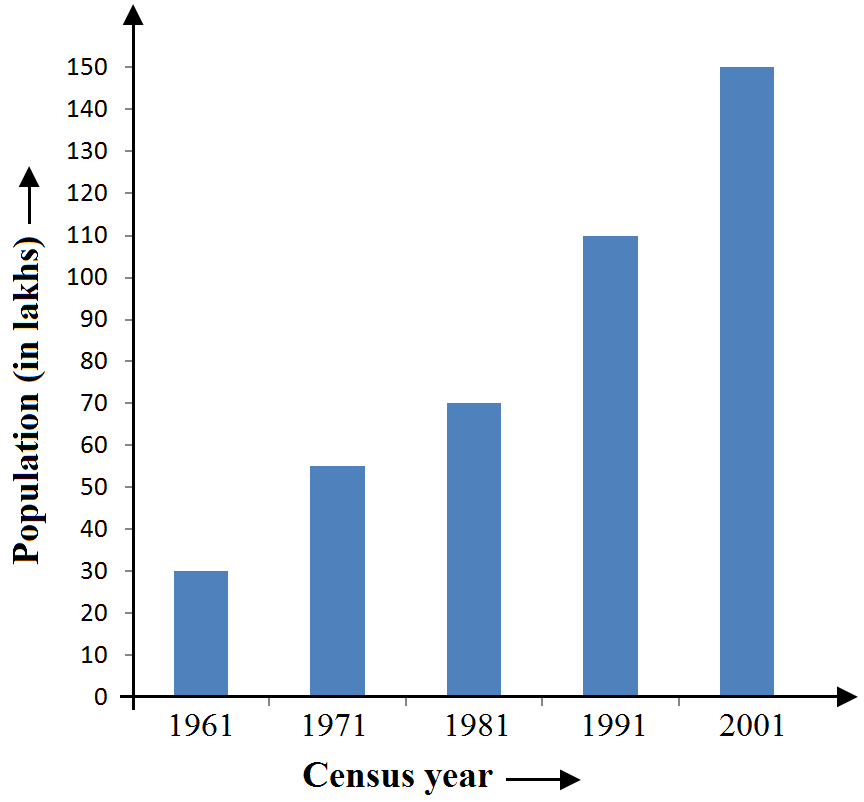
The population of Delhi State in different census years is as given below:
Census year
$1961$
$1971$
$1981$
$1991$
$2001$
Cars Sold
$30$
$55$
$70$
$110$
$150$
Represent the above information with the help of a bar graph.
Answer
To represent the given data on a bar graph, we should first draw a horizontal and a vertical line.
Here, the horizontal line will show the census year and the vertical line will show represent the population.
Since $5$ values or data are given, we mark $5$ points on the horizontal axis at equal distances and will erect rectangles of the same width with their heights proportional to the given data.
Also, on the vertical axis, each difference of $10$ will represent a population of $10$ lakhs.
View full question & answer
Question 25 Marks
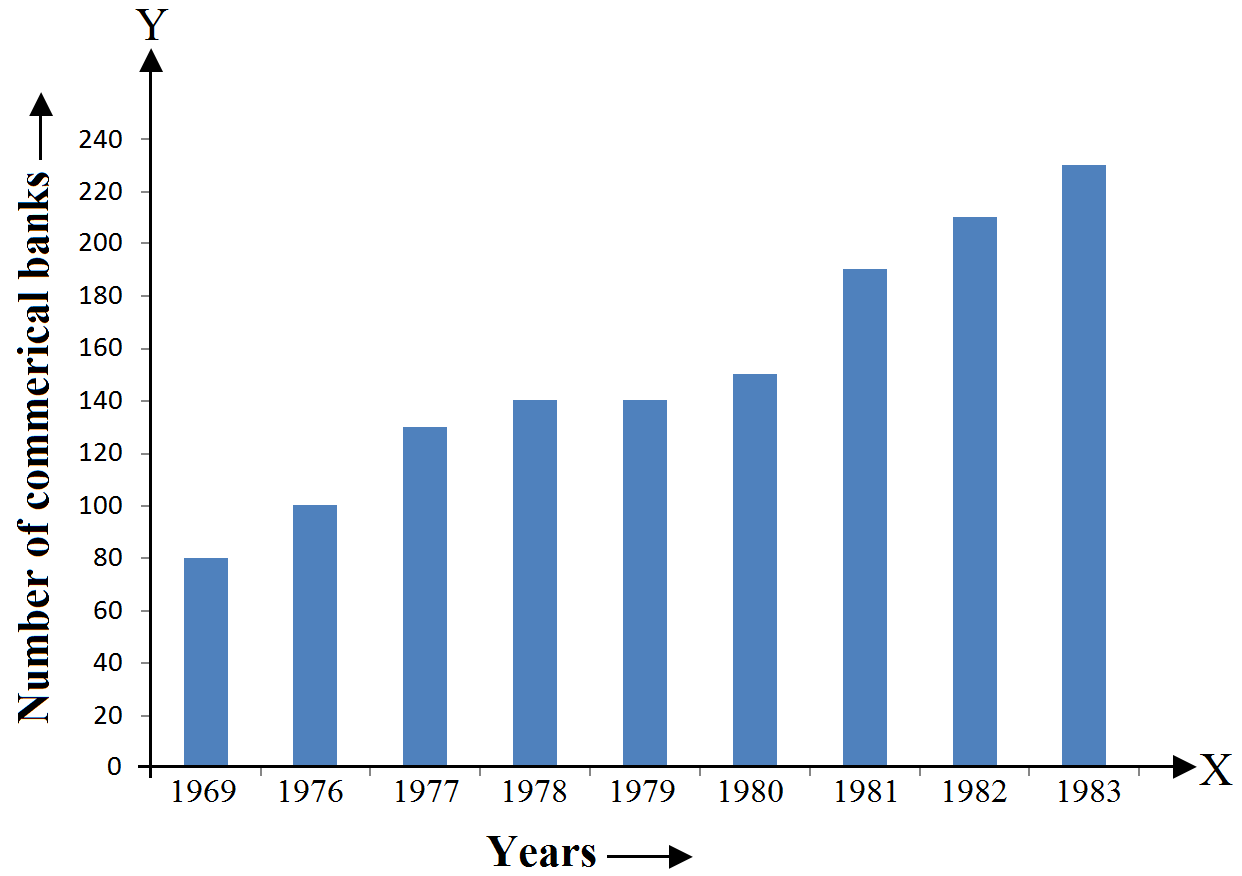
Study the bar graph representing the number of persons in various age groups in a town shown in Fig. Observe the bar grouph and answer the following questions:
$i.\ $What is the information given by the bar graph?
$ii.\ $What was the number of commercial banks in $1977$?
$iii.\ $What is the ratio of the number of commercial bank in $1969$ to that in $1980$?
$iv.\ $State whether true or false:
The number of commercial banks in $1983$ in less than double the number of commercial banks in $1969.$
Bar group of the number of commercial banks in india during some years
Answer
$i.\ $The bar graph represents the number of commercial banks in India during the respective years.
$ii.\ $In $1977$, there were $130$ commercial banks.
Explanation:
The height of the rectangle against the year $1977$ is up to $130$ units.
$iii.\ $Number of commercial banks in $1969 = 90$
Number of commercial banks in $1980 = 150$
Therefore, Ratio of the number of commercial banks in $1969$ to that in $1980=\frac{90}{150}=\frac{3}{5}=3:5$
$iv.\ $False.
Explanation:
Number of commercial banks in $1983 = 230$
Number of commercial banks in $1969 = 90$
Therefore,$2 \times 90 = 180$
As $230$ is greater than $180$, the number of commercial banks in $1983$ is not less than double the number of commercial banks in $1969.$
View full question & answer
Question 35 Marks
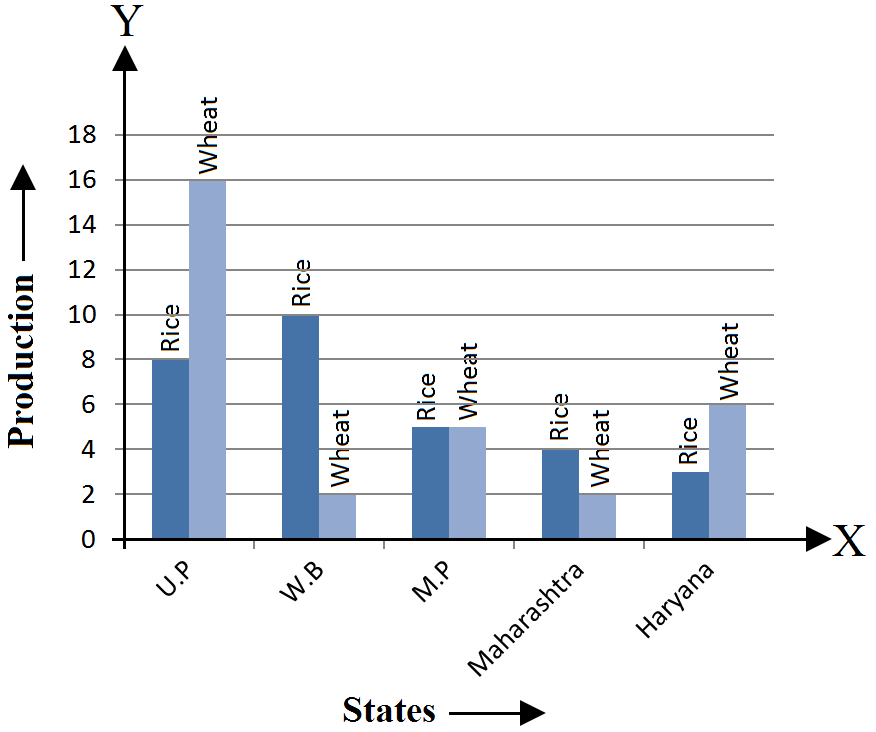
Read the following bar group and answer the following questions:

$i.\ $What information is given by the bar group?
$ii.\ $Which state is the largest producer of rice?
$iii.\ $What state is the largest producer of wheat?
$iv.\ $Which state has total production of rice and wheat as its maximum?
$v.\ $Which state has the total production of wheat and eice minimum?
Answer
Let’s draw a chart using the data from the above bar graph:
States
Rice Production
Wheat Production
Total Production
$U.P$
$8$
$16$
$24$
$W.B$
$10$
$2$
$12$
$M.P$
$5$
$5$
$10$
Maharashtra
$4$
$2$
$6$
Haryana
$3$
$6$
$9$
$i.\ $The above bar graph provides information on the production of rice and wheat in various states of India.
$ii.\ W.B.$ is the largest producer of rice.
Explanation:
The height of the rectangle representing rice production in $W.B.$ is up to $10$ units, i.e., the highest compared to those in the other states.
$iii.\ U.P.$ is the largest producer of wheat.
Explanation:
The height of the rectangle representing wheat production in $U.P.$ is up to $16$ units, i.e., the highest compared to those in the other states.
$iv.\ U.P.$ has the total production of rice and wheat as its maximum.
Explanation:
From the bar graph we can say that $U.P.$ exceeds the other states in the total production of rice and wheat, i.e., $16$ units wheat $+ 8$ units of rice $= 24$ units.
$v.\ $Maharashtra has the total production of rice and wheat as its minimum.
Explanation:
From the bar graph we can say that the total production of rice and wheat in Maharashtra is the minimum, i.e., $4$ units rice $ + 2$ units of wheat $= 6$ units.
View full question & answer
Question 45 Marks
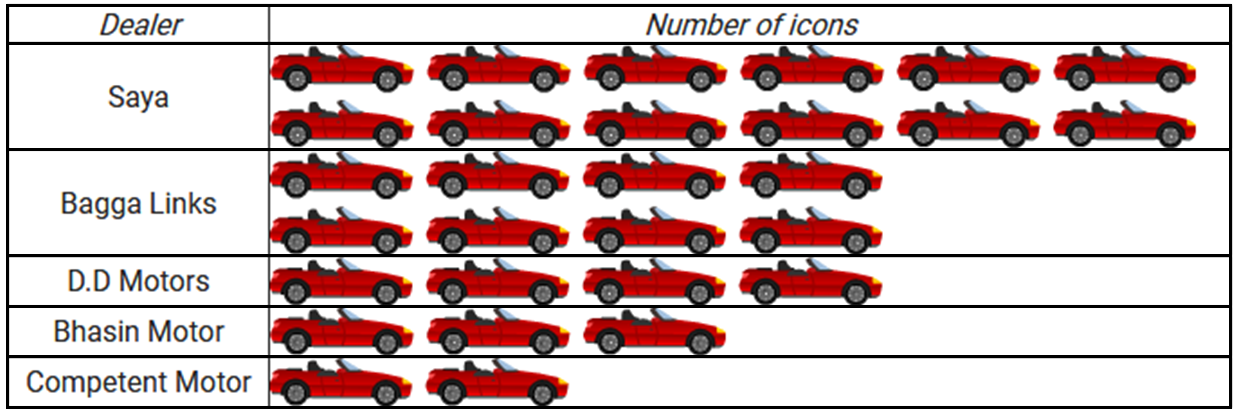
The following table shows the number of maruti cars sold by five dealers in a particular month:
Dealer
Saya
Bagga Links
$D.D$ Motors
Bhasin Motor
Competent Motors
Cars Sold
$60$
$40$
$20$
$15$
$10$
Represent the above information by a pictograph.
Answer
Let one car icon represent $5$ Maruti cars. Then, the numbers of icons sold by the five dealers in a particular month are as follows:
Dealer Number of icons
Saya $\frac{60}{5}=12$
Bagga links $\frac{40}{5}=18$
$D.D$ Motors $\frac{20}{5}=4$
Bhasin Motor $\frac{15}{5}=3$
Competent motor $\frac{10}{5}=3$
The pictograph representing the above data is as follows:
View full question & answer
Question 55 Marks
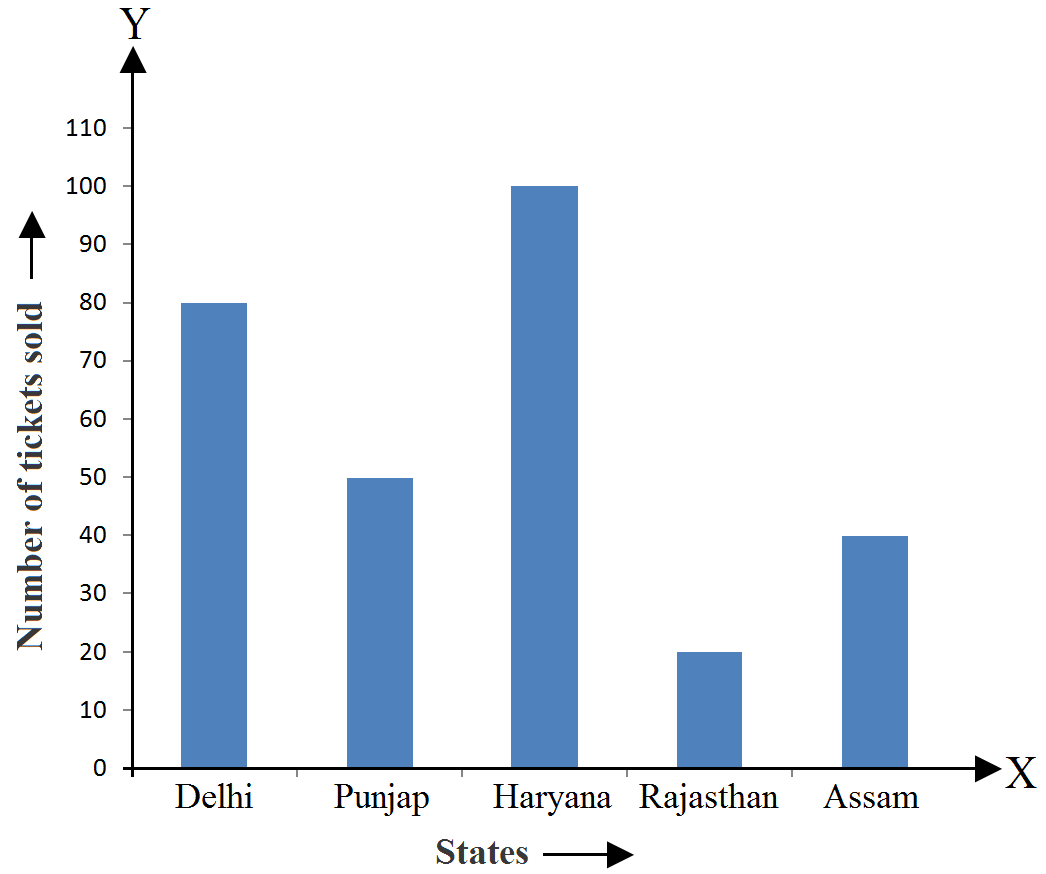
Read the bar graph shown in Fig and answer the following questions:

$i.\ $What is the information given by the bar graph?
$ii.\ $How many tickets of Assam State Lottery were sold by the agent?
$iii.\ $Of which state, were the maximum number of tickets sold?
$iv.\ $State whether true or false.
The maximum number of tickets sold is threetimes the mlnimum number of tickets sold.
$v.\ $Of which state were the minimum number of tickets sold?
Answer
$i.\ $The bar graph represents the number of tickets of different states lotteries sold by an agent on a single day.
$ii.\ $The agent sold $40$ tickets of Assam state lottery.
Explanation:
The vertical height of the rectangle against Assam, on the bar graph, has ended on the $40^{th}$ mark against the vertical axis.
$iii.\ $Haryana
Explanation:
The vertical height of the rectangle against Haryana. I the maximum compared to those against the other states.
$iv.\ $False.
Explanation:
Maximum vertical length $($against the state of Haryana$) = 100$ units
Minimum vertical length $($against the state of Rajasthan$) = 20$ units
Therefore, Maximum number of lottery sold for one state $= 100$ tickets
Minimum number of lottery tickets sold for one state $= 20$ tickets
$v.\ $Rajasthan.
Explanation:
From the bar graph we can say that the Rajasthan State Lottery tickets were sold the minimum i.e. only $20$ tickets.
 
View full question & answer
Question 65 Marks
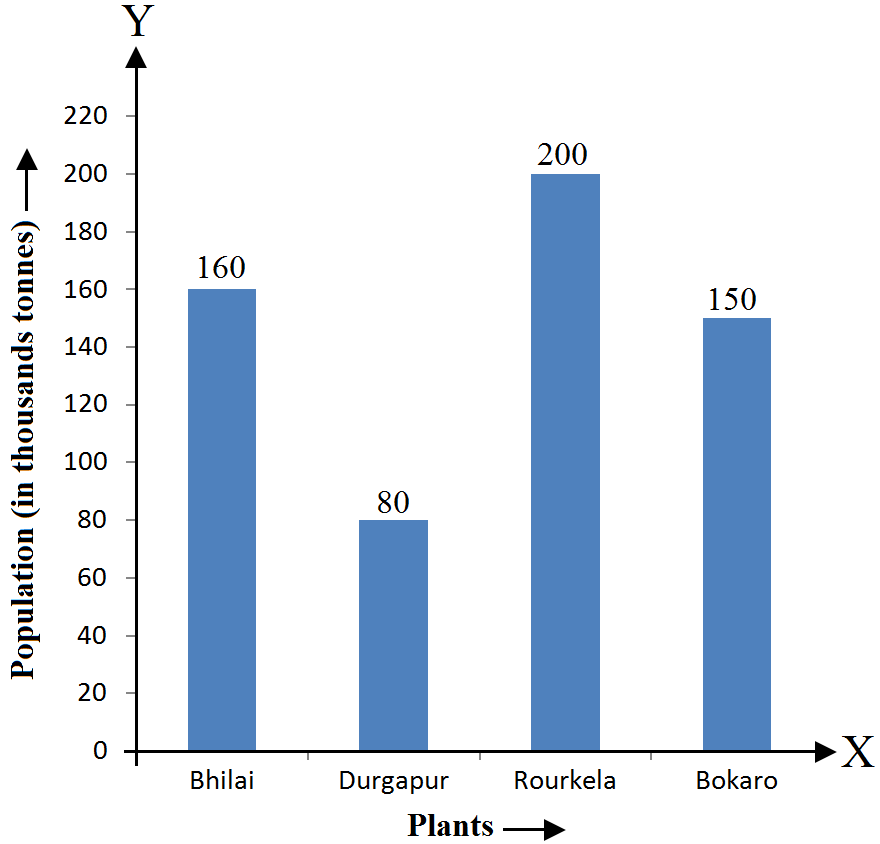
The production of saleable steel in some of the steel plants of our country during $1999$ is given below:
Plant
Bhilai
Durgapur
Rourkela
Bokaro
Production (in thousand tonnes)
$160$
$80$
$200$
$150$
Construct a bar graph to represent the above data on a graph paper by using the scale $1$ big divisions $= 20$ thousand tonnes.
Answer
Let’s draw two mutually perpendicular lines $OX$ and $OY.$
 Along the horizontal line $OX$, let’s mark plants, and along the vertical line $OY$, let’s mark the production.
Along the axis $OX$, let’s measure an equal width for each bar, the gap between the bars being the same.
We will now choose a suitable scale to determine the heights of the bar.
Here, let’s choose $1$ big division $= 20$ thousand tons Therefore, the heights of the bars as follows:
Height of the bar against Bhilai $=\frac{160}{20}=8\text{units}$
Height of the bar against Durgapur $=\frac{80}{20}=4\text{units}$
Height of the bar against Rourkela $=\frac{200}{20}=10\text{units}$
Height of the bar against Bokaro $=\frac{150}{20}=7.5\text{units}$
Now, based on the above calculation the graph is as follows:
View full question & answer
Question 75 Marks
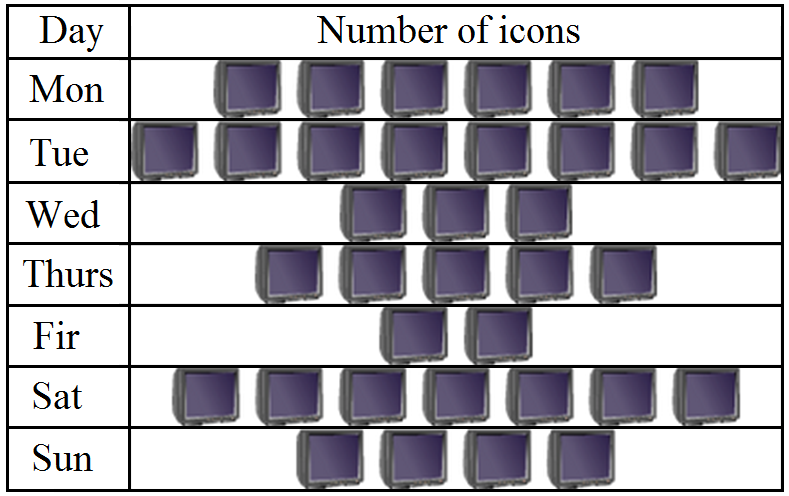
The following table shows the daily production of $T.V.$ sets in an industry for $7$ days of a week:
Day
Mon
Tue
Wed
Thurs
Fri
Sat
Sun
Number of T.V. Sets
$300$
$400$
$150$
$250$
$100$
$350$
$200$
Represent the above information by a pictograph.
Answer
Let an icon of a $T.V$ represent $50$ $T.Vs$. Then, the number of icons produced by the industry on different days of a week is as follows:
Days Number of icons
Mon $\frac{300}{50}=6$
Tue $\frac{400}{50}=8$
Wed $\frac{150}{50}=3$
Thurs $\frac{250}{50}=5$
Fri $\frac{100}{50}=5$
Sat $\frac{350}{50}=7$
Sun $\frac{200}{50}=4$
The pictograph representing the above data is as follows:
View full question & answer
Question 85 Marks
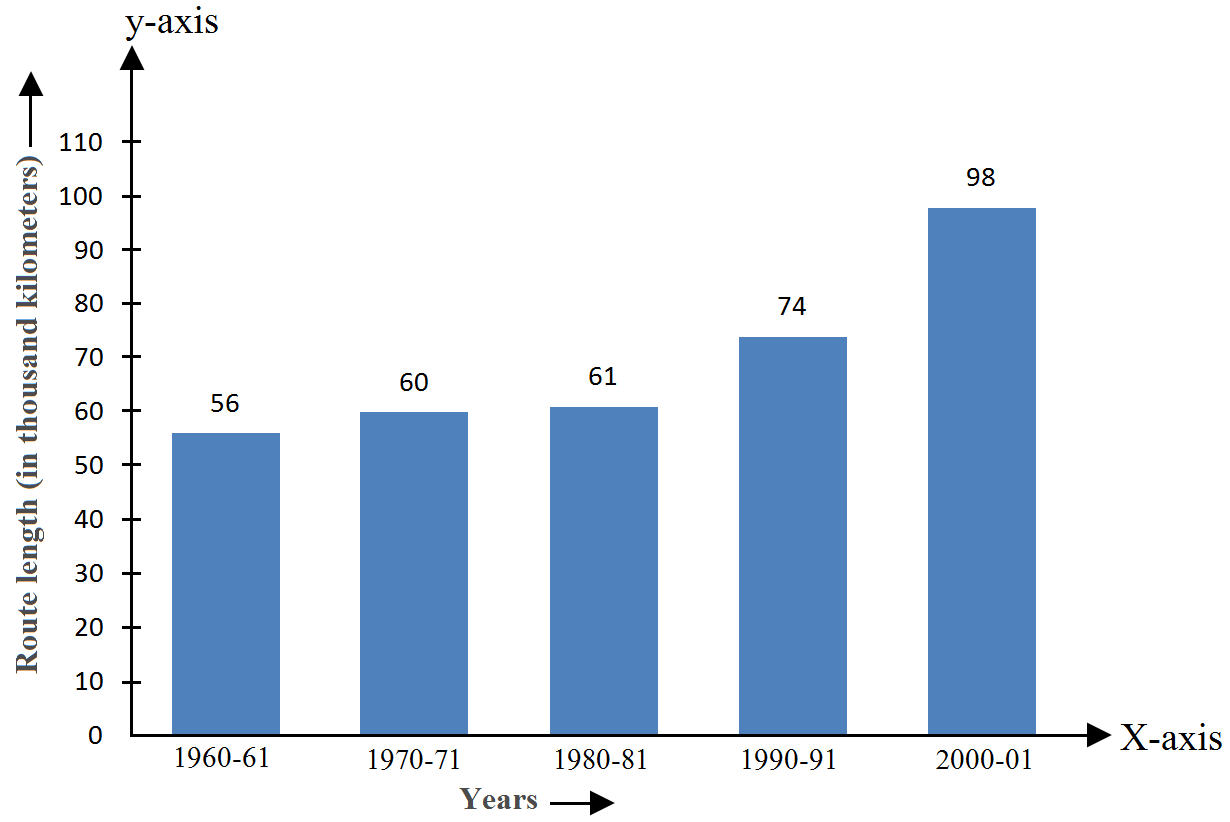
The following table gives the route length (in thousand kilometers) of the Indian Railways in some of the years:
Year
$1960-61$
$1970-71$
$1980-81$
$1990-91$
$2000-01$
Route length (in thousand kilometres)
$56$
$60$
$61$
$74$
$98$
Represent the above data with the help of a bar graph.
Answer
Let’s draw two mutually perpendicular lines $OX$ and $OY.$
Along the horizontal line $OX$, let’s mark years; and along the vertical line $OY,$ let’s mark the route length.
Along the axis $OX$, let’s choose a suitable width for each bar, the gap between the bars is the same.
We will now choose a suitable scale to determine the heights of the bars.
Here, let’s take $1$ big division $= 10$ thousand kilometres Therefore, heights of the various bar are as follows:
Height of the bar against $1960-61$ $=\frac{56}{10}=5.6\text{ units}$
Height of the bar against $1970-71$ $=\frac{60}{10}=6.0\text{ units}$
Height of the bar against $1980-81$ $=\frac{61}{10}=6.1\text{ units}$
Height of the bar against $1990-91$ $=\frac{74}{10}=7.4\text{ units}$
Height of the bar against $2000-2001$ $=9810=9.8\text{ units}$
Based on the above calculation, the bar graph is as follows:
View full question & answer
Question 95 Marks
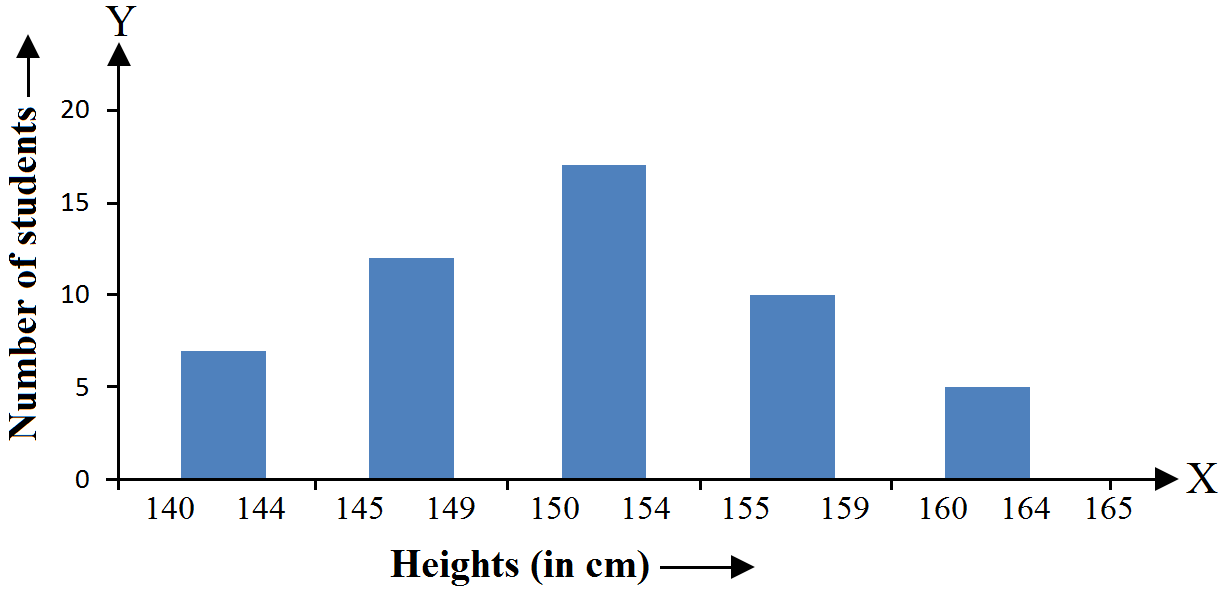
The following bar graph represent the heights $($in $cm)$ of $50$ students of Class $XI$ of a particular school. Study the graph and answer the following questions:

$i.\ $What percentage of the total number of students have their heights more than $149\ cm$?
$ii.\ $How many students in the class are in the range of maximum height of the class?
$iii.\ $The school wants to provide a particular type of tonic to each student below the height of $150\ cm$ to improve his height. If the cost of the tonic for each student comes out to be ₛ $55$, how much amount of money is required?
$iv.\ $How many students are in the range of shortest height of the class?
$v.\ $State whether true or false:
$a.\ $There are $9$ students in the class whose heights are in the range of $155-159\ cm.$
$b.\ $Maximum height $($in $cm)$ of a student in the class is $17.$
$c.\ $There are $29$ students in the class whose heights are in the range of $145-154\ cm.$
$d.\ $Minimum height $($in $cm)$ of a student is the class is in the range of $140-144\ cm.$
$e.\ $The number of students in the class having their heights less than $150\ cm$ is $12$.
$f.\ $There are $14$ students each of whom has height more than $154\ cm.$
Answer
Let’s draw a chart based on the above bar graph:
Heights $($in $\ cm)$ Number of students
$140-144$ $7$
$145-149$ $12$
$150-154$ $17$
$155-159$ $9$
$160-164$ $5$
$i.\ $Number of students whose height is more than $149\ cm = 17 + 9 + 5 = 31$
Total number of students $= 50$
Percentage of students whose height is more than $149\text{cm}=\frac{31}{50\%}=31\times2\%=62\%$
$ii.\ $The maximum height$-$range of the class is $160-164$. Number of students in this range $= 5$
$iii.\ $Number of students measuring less than $150 \ cm = 7 + 12 = 19$
Required amount of money to be spent for the tonic $= 19 \times ₹ 55 = ₹ 1045$
$iv.\ $The minimum height-range of the class is $140-144$ Number of students in this range $= 7$
$v.\ $
$a.\ $True.
Explanation:
From the above chart we can say that the number of students in the height$-$range $155-159$ is $9$
$b.\ $False.
Explanation:
$17$ is the number of students found in the maximum height$-$range, i.e., $160-164$
$c.\ $True.
Explanation:
Number of students in the class whose heights are in the range of $145-154\ cm =$ Number of students in the class whose heights are in the range of $145-149 +$ Number of students in the class whose heights are in the range of $150-154 = 12 + 17 = 29$
$d.\ $True.
Explanation:
The minimum height$-$range of the students in the class is $140-144\ cm$
$e.\ $False.
Explanation:
Number of students measuring less than $150\ cm = 7 + 12 = 19$​​​​​​​
$f.\ $True.
Explanation:
Number of students measuring more than $154\ cm = 9 + 5 = 14$
View full question & answer
Question 105 Marks
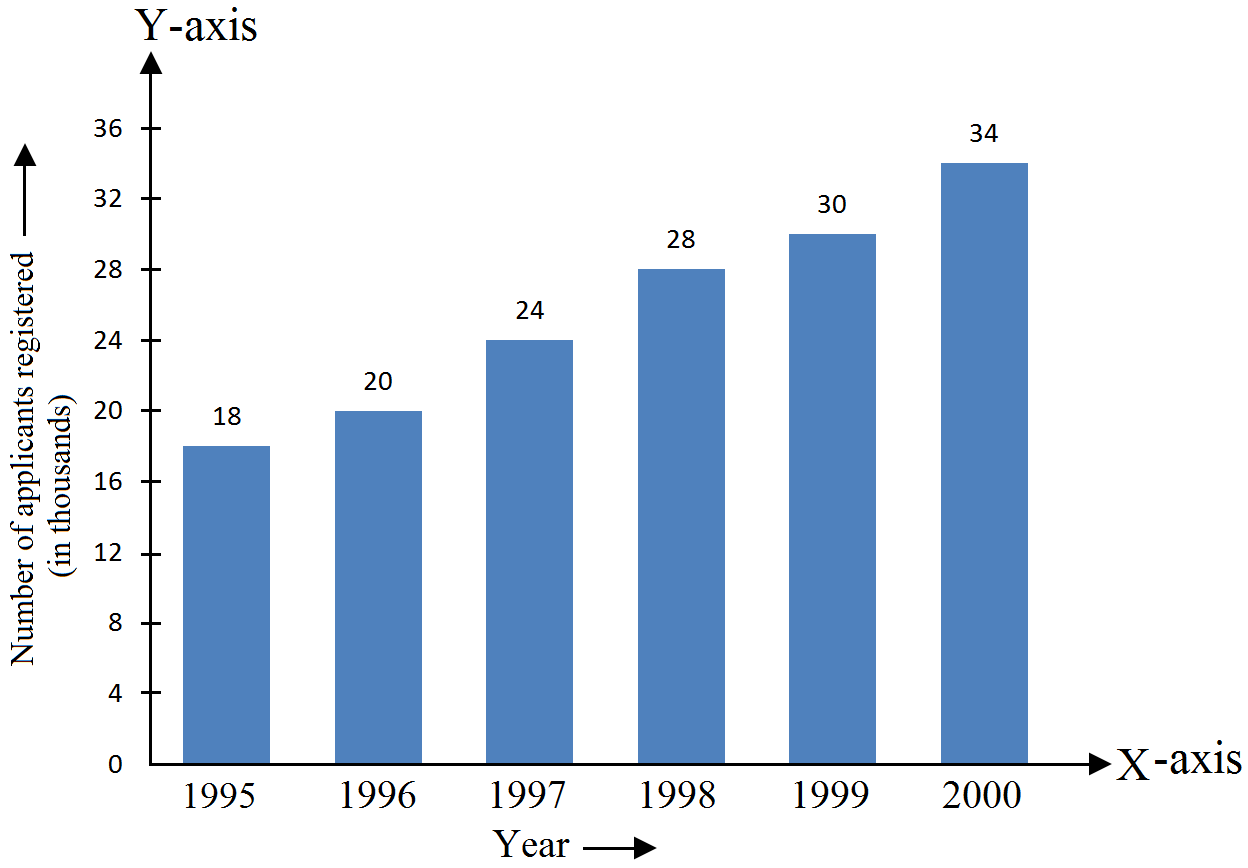
The following data gives the number (in thousands) of applicants registered with a divisions $= 20$ thousand tonnes.
Year
$1995$
$1996$
$1997$
$1998$
$1999$
$2000$
Number of applicants registered (in thousands)
$18$
$20$
$24$
$28$
$30$
$34$
Construct a bar graph to represent the above data.
Answer
Let’s draw two mutually perpendicular lines $OX$ and $OY$.
Along the horizontal line $OX$, let’s mark years; and along the vertical line $OY$, let’s mark the number of applicants registered. Along the axis $OX$, let’s choose a suitable width for each bar, the gap between the bars is the same.
We will now choose a suitable scale to determine the heights of the bars.
Here, let’s choose $1$ big division $= 4$ thousand, applicants Therefore, the heights of the bars are as follow:
Height of the bar against the year $1995$ $=\frac{18}{4}=4.5\text{units}$
Height of the bar against the year $1996$ $=\frac{20}{4}=5\text{units}$
Height of the bar against the year $1997$ $=\frac{24}{4}=6\text{units}$
Height of the bar against the year $1998$ $=\frac{28}{4}=7\text{units}$
Height of the bar against the year $1999$ $=\frac{30}{4}=7.5\text{units}$
Height of the bar against the year $2000$ $=\frac{34}{4}=8.5\text{units}$
Based on the above calculation, the bar graph is as follows:
View full question & answer
Question 115 Marks
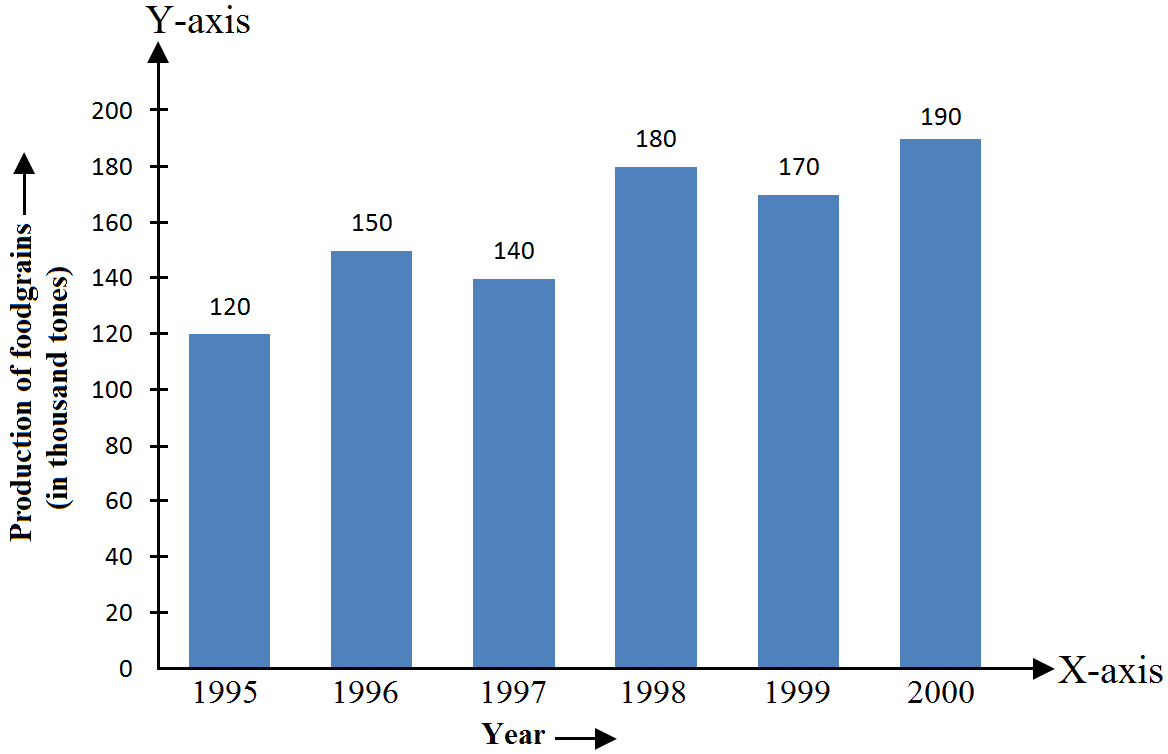
The following data gives the production of food grains (in thousand tones) for some years:
Years
$1995$
$1996$
$1997$
$1998$
$1999$
$2000$
Production (in thousand tonnes)
$120$
$150$
$140$
$180$
$170$
$190$
Represent the above data with the help of a bar graph.
Answer
Let’s draw two mutually perpendicular lines $OX$ and $OY$.
Along the horizontal line $OX$, let’s mark the years, and along the vertical line $OY$, let’s mark the production of food grains in tons.
Along the axis $OX$, let’s choose an equal width for each bar, keeping the gap between the bars the same.
We will now choose a suitable scale to determine the heights of the bar Here, let’s consider $1$ big division $= 20$ thousand tons.
Therefore, the heights of the various bars are as follows:
 Height of the bar against the year $1995$ $=\frac{120}{20}=6\text{ units}$
Height of the bar against the year $1996$ $=\frac{150}{20}=7.5\text{ units}$
Height of the bar against the year $1997$ $=\frac{140}{20}=7\text{ units}$
Height of the bar against the year $1998$ $=\frac{180}{20}=9\text{ units}$
Height of the bar against the year $1999$ $=\frac{170}{20}=8.5\text{ units}$
Height of the bar against the year $2000$ $=\frac{190}{20}=9.5\text{ units}$
Based on the above calculations, the bar graph is as follows:
View full question & answer
Question 125 Marks
 
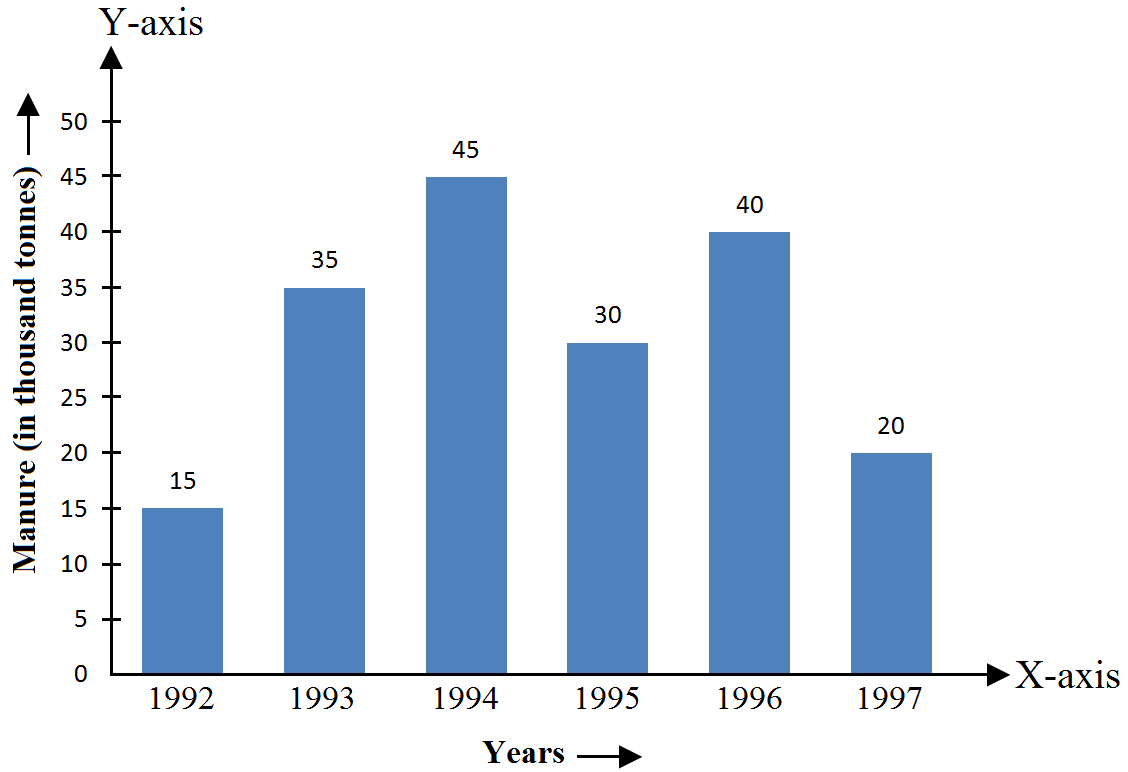
The following data gives the amount of mature (in thousand tones) manufactured by a company during some years:
Year $1992$ $1993$ $1994$ $1995$ $1996$ $1997$
Manure (in thousand tonnes) $15$ $35$ $45$ $30$ $40$ $20$
$i.\ $Represent the above data with the help of a bar graph.
$ii.\ $Indicate will the help of the bar graph the year in which the amount of manure manufactured by the company was maximum.
$iii.\ $Choose the correct alternative.
The consecutive years during which there was a maximum decrease in manure production are:
$a.\ 1994$ and $1995$
$b.\ 1992$ and $1993$
$c.\ 1996$ and $1997$
$d.\ 1995$ and $1996$
 
Answer
$i.$ Let’s draw two mutually perpendicular lines $OX$ and $OY.$
Along the horizontal line $OX$, let’s mark the years, and along the vertical line $OY$, let’s mark the amount of manure in tons.
Along the axis $OX$, let’s choose an equal width of each bar, keeping the gap between the bars the same.
We will now choose a suitable scale to determine the heights of the bars.
Here, let’s consider $1$ big division $= 5$ thousand tons of manure
Therefore, the heights of the various bars are as follows:
Height of the bar against the year $1992$ $=\frac{15}{5}=3\text{ units}$
Height of the bar against the year $1993$ $=\frac{35}{5}=7\text{ units}$
Height of the bar against the year $1994$ $=\frac{45}{5}=9\text{ units}$
Height of the bar against the year $1995$ $=\frac{30}{5}=6\text{ units}$
Height of the bar against the year $1996$ $=\frac{40}{5}=8\text{ units}$
Height of the bar against the year $1997$ $=\frac{20}{5}=4\text{ units}$
Based on the above calculation, the bar graph is as follows:

$ii.$ The amount of manure manufactured in the year $1994$ was the maximum.
$iii.\ (C)$ $1996$ and $1997$
Explanation:
The production decreased by $15$ thousand tons from the year $1994$ to $1995$, and from $1996$ and $1997$ the production of manure decreased by $20$ thousand tons.
View full question & answer
Question 135 Marks
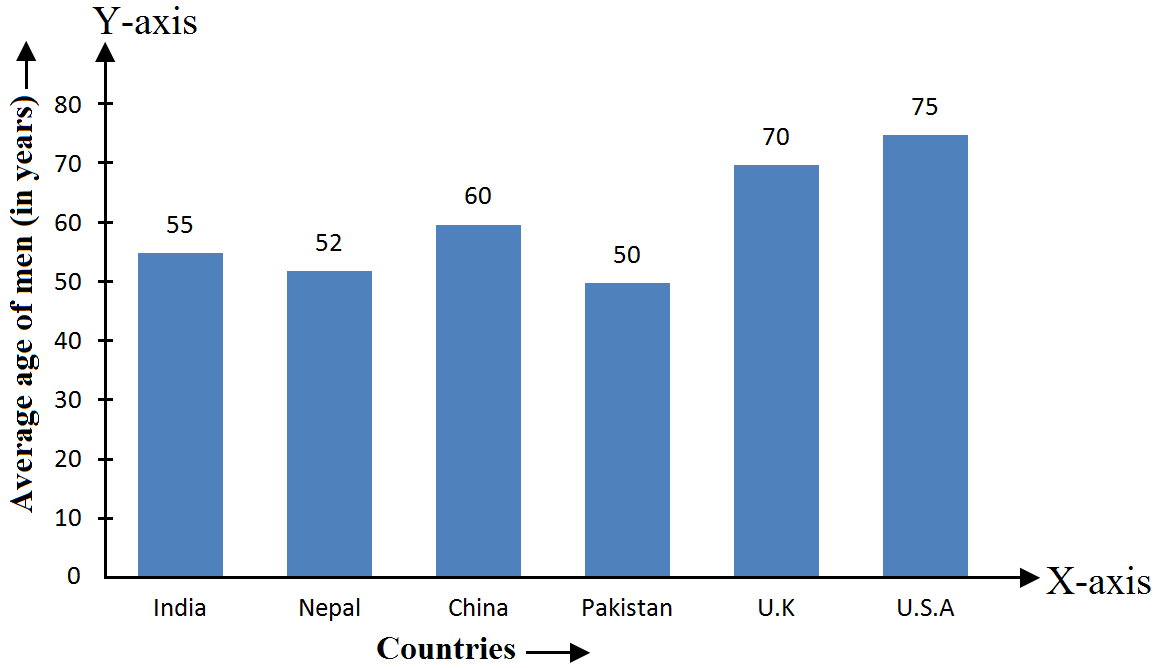
The following data shows the average age of men in various countries in a certain year.
Country
India
Nepal
China
Pakistan
$U.K$
$U.S.A$
Average age (in years)
$55$
$52$
$60$
$50$
$70$
$75$
Represent the above information by a bar graph.
Answer
Let’s draw two mutually perpendicular lines $OX$ and $OY$.
Along the horizontal line $OX$, let’s mark the countries; and along the vertical line $OY$, let’s mark the average age for men.
Along the axis $OX$, we will choose a suitable width for each bar, keeping the gap between the bars the same.
We will now choose a suitable scale to determine the heights of the bars.
Here, let’s consider $1$ big division $= 10$ years Therefore, the heights of the various bars are as follows:
Height of the bar against India $=\frac{55}{10}=5.5\text{ units}$
Height of the bar against Nepal $=\frac{52}{10}=5.2\text{ units}$
Height of the bar against China $=\frac{60}{10}=6.0\text{ units}$
Height of the bar against Pakistan $=\frac{50}{10}=5.0\text{ units}$
Height of the bar against $U.K.$ $=\frac{70}{10}=7.0\text{ units}$
Height of the bar against $U.S.A$. $=\frac{75}{10}=7.5\text{ units}$
Based on the above calculation, the bar graph is as follows:
View full question & answer
Question 145 Marks
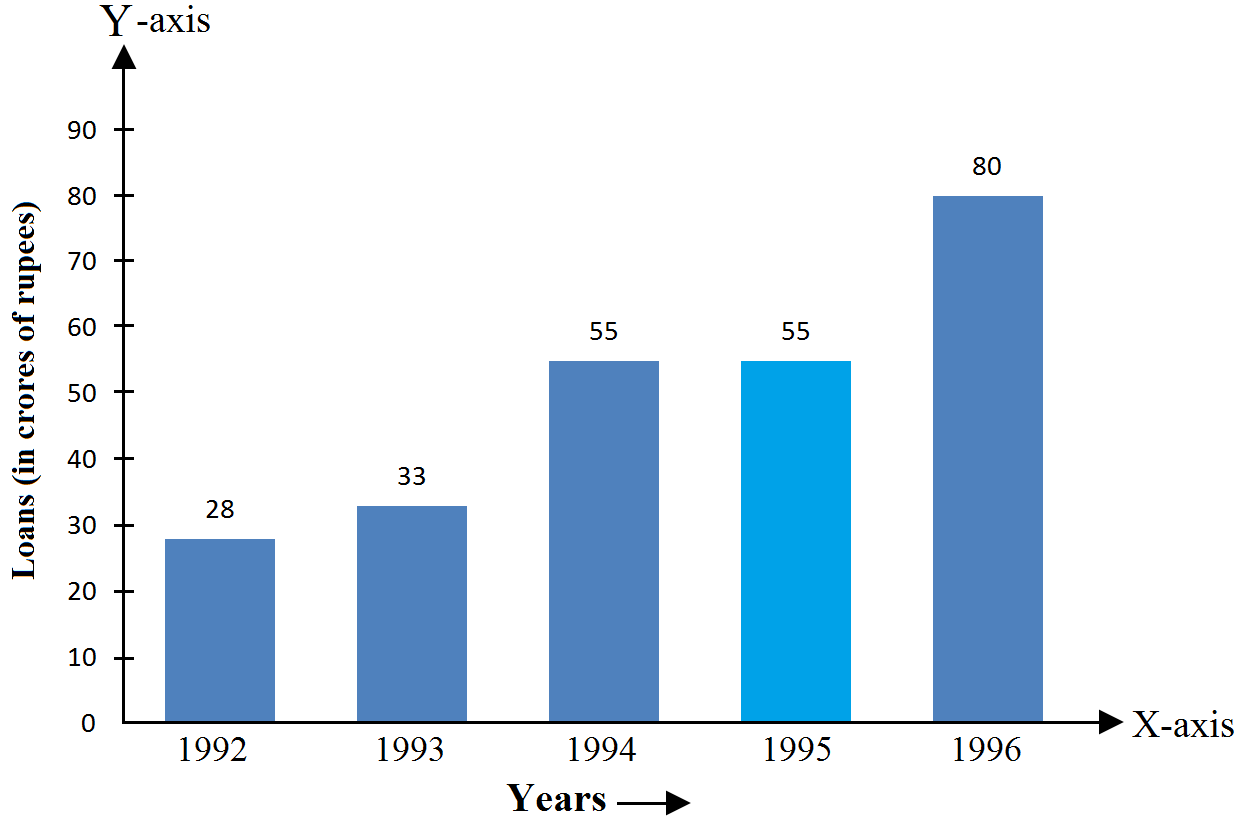
The following data gives the amount of loans (in crores of rupees) disbursed by a bank during some years:
Year
$1992$
$1993$
$1994$
$1995$
$1996$
Loan (in crores of rupees)
$28$
$33$
$55$
$55$
$80$
$i.\ $Represent the above data with the help of a bar graph.
$ii.\ $With the help of the bar graph, indicate the year in which amount of loan is not increased over that of the preceding year.
Answer
$i.$ Let’s draw two mutually perpendicular lines $OX$ and $OY.$
Along the horizontal line $OX$, let’s mark years; and along the vertical line $OY$, let’s mark loans in crores.
Along the axis $OX$, let’s choose a suitable width for each bar, keeping the gap between the bars the same.
We will now choose a suitable scale to determine the heights of the bars.
Here, let’s consider $1$ big division $= 10$ crores of loan
Therefore, the heights of the various bars are as follows:
Height of the bar against the year $1992$ $=\frac{28}{10}=2.8\text{ units}$
Heights of the bar against the year $1993$ $=\frac{33}{10}=3.3\text{ units}$
Heights of the bar against the year $1994$ $=\frac{55}{10}=5.5\text{ units}$
Heights of the bar against the year $1995$ $=\frac{55}{10}=5.5\text{ units}$
Heights of the bar against the year $1996$ $=\frac{80}{10}=8.0\text{ units}$
Based on the above calculation, the bar graph is as follows:

$ii.\ $The year in which the loan amount has not increased than its previous year is $1995.$
Explanation:
In the year $1994, 55$ crore rupees of loan was disbursed by the bank. Also, in the year $1995, 55$ crore rupees of loan was disbursed by the bank.
View full question & answer
Question 155 Marks
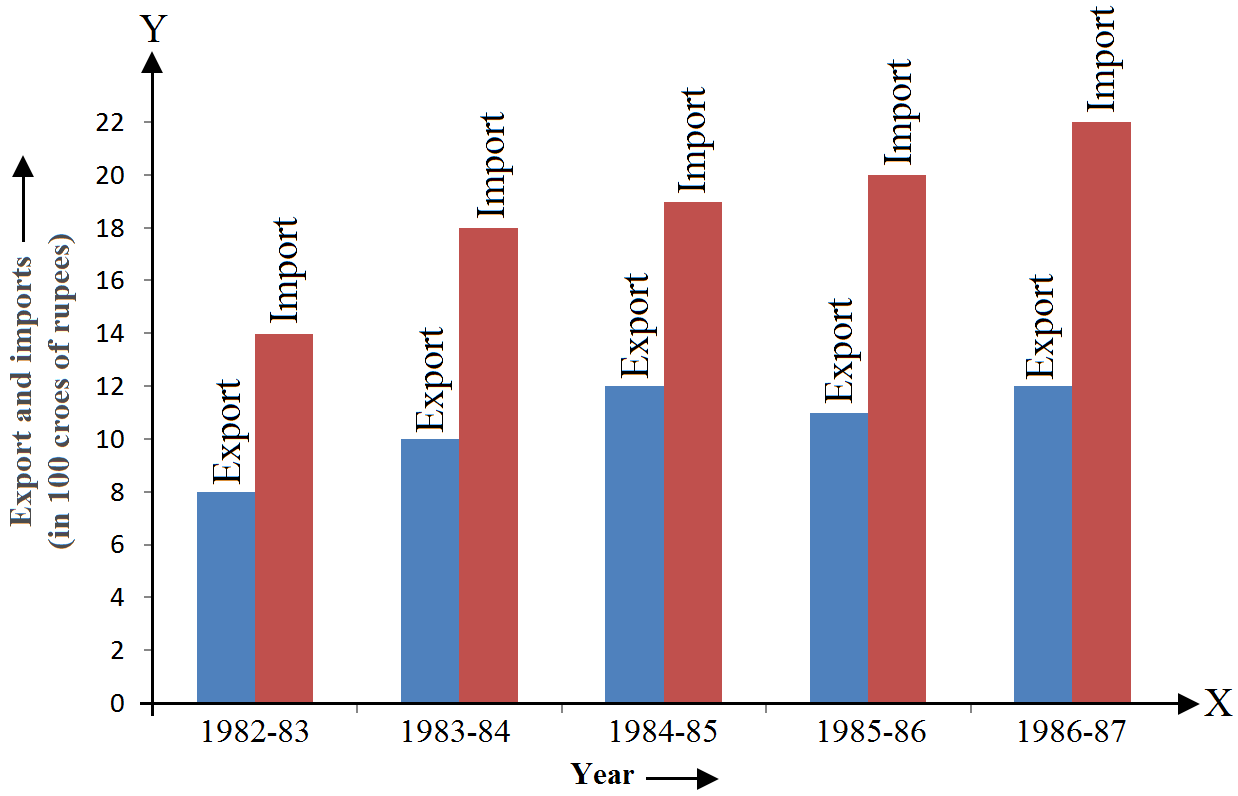
Read the following bar graph and answer the following questions:

$i.\ $What information is given by the bar graph?
$ii.\ $In which year the export is minimum?
$iii.\ $In which year the import is maximum?
$iv.\ $In which year the difference of the value of export and import is maximum?
Answer
Let’s draw a chart using the information from the above bar graph:
Years Export $($in $100$ crores of ₛ$)$ Imports $($in $100$ crores of ₛ$)$ Difference of import and export $($in $100$ crores of ₛ$)$
$1982-83$ $8$ $14$ $6$
$1983-84$ $10$ $18$ $8$
$1984-85$ $12$ $19$ $7$
$1985-86$ $11$ $20$ $9$
$1986-87$ $12$ $22$ $10$
$i.\ $It provides us the information on the total amount of imports and exports in different years between $1982$ and $1987.$
$ii.\ $In the year $1982-83$, the export is at its lowest.
Explanation:
In the year $1982-83$, exports amounted to $800$ crores rupees, i.e., the lowest from all other years.
$iii.\ $In the year $1986-87,$ the import is at its maximum.
Explanation:
In the year $1986-87,$ imports amounted to $22,000$ crores rupees, i.e., the highest from all other years.
$iv.\ $In the year $1986-87$, the difference in the amount of exports and imports is the maximum.
Explanation:
In the year $1986-87,$ the difference in the values of export and import is $1000$ corers rupees.
View full question & answer
Question 165 Marks
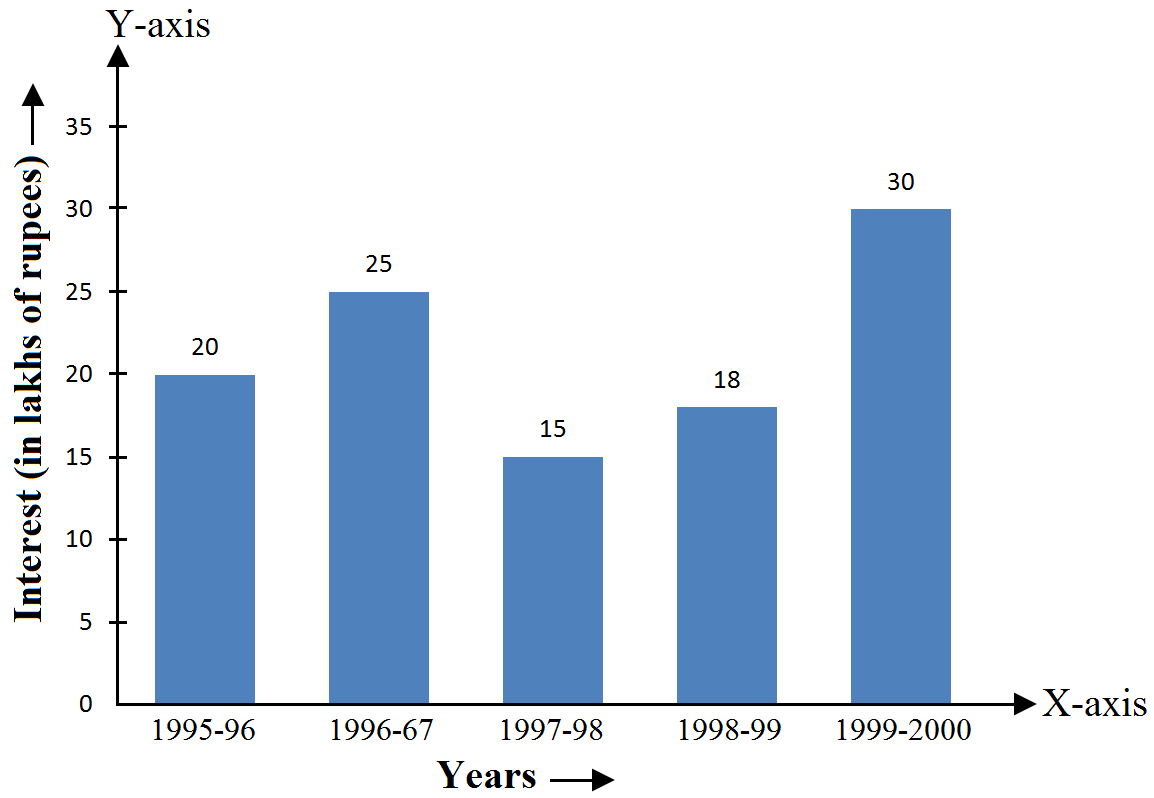
The following table shows the interest paid by a company (in lakhs):
Year
$1995-96$
$1996-97$
$1997-98$
$1998-99$
$1999-2000$
Interest (in lakhs of rupees)
$20$
$25$
$15$
$18$
$30$
Draw the bar graph to represent the above information.
Answer
Let’s draw two mutually perpendicular lines $OX$ and $OY.$
Along the horizontal line $OX$, let’s mark years, and along the vertical line $OY$, let’s mark the amount of interest paid by the company.
Along the axis $OX$, let’s choose a suitable with for each bar, keeping the gap between the bars the same.
We will now choose a suitable scale to determine the heights of the bars.
Here, let’s consider $1$ big division $= 5$ lakhs of rupees paid as interest by the company Therefore,
the heights of the various bars are as follows:
Height of the bar against the year $1995-96$ $=\frac{20}{5}=4\text{ units}$
Height of the bar against the year $1996-97$ $=\frac{25}{5}=5\text{ units}$
Height of the bar against the year $1997-98$ $=\frac{15}{5}=3\text{ units}$
Height of the bar against the year $1998-99$ $=\frac{18}{5}=3.6\text{ units}$
Height of the bar against the year $1999-2000$ $=\frac{30}{5}=6\text{ units}$
Based on the above calculation, the bar graph is as follows:
View full question & answer
Question 175 Marks
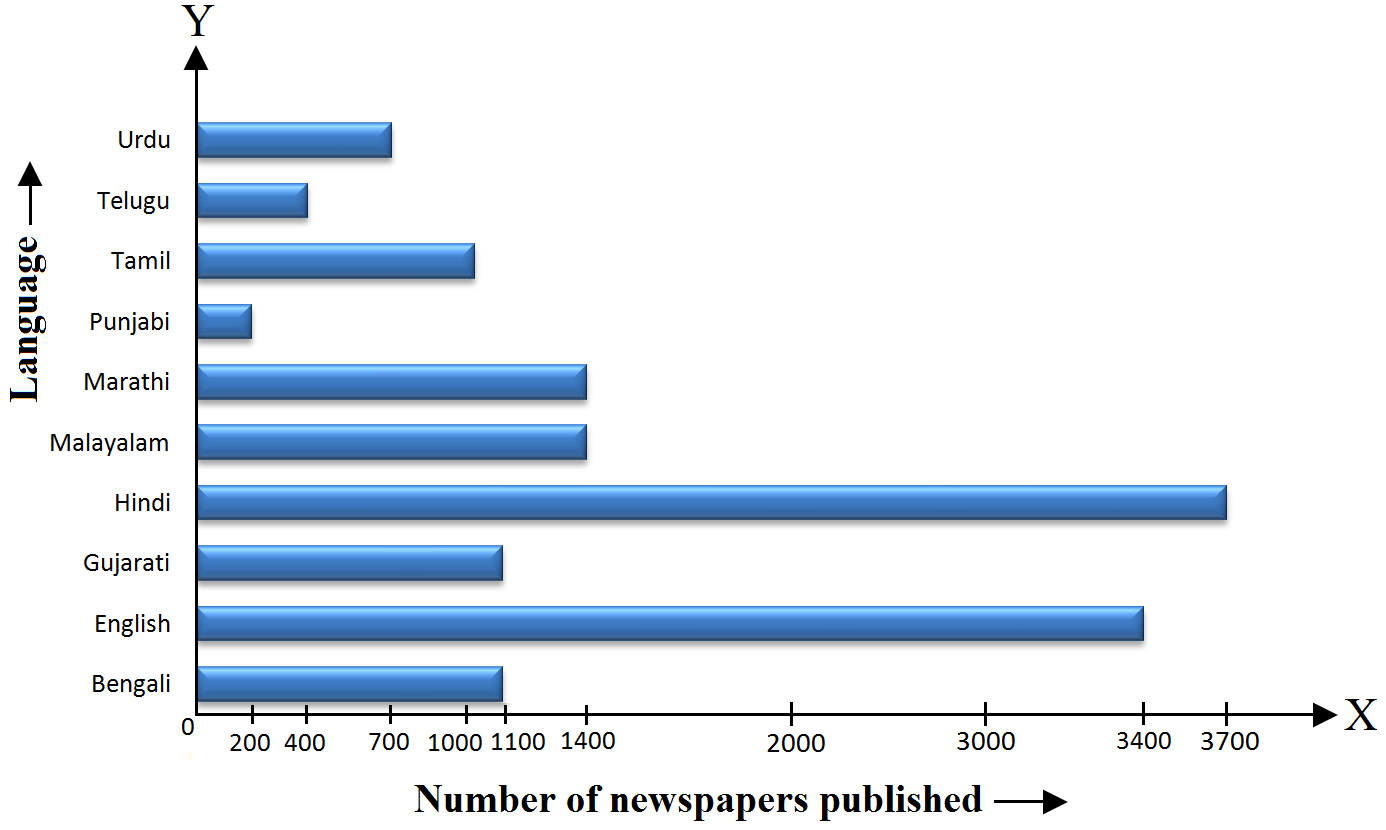
The bar graph shown in represents the circulation of newspapers in $10$ languages. Study the graph and answer the following questions:
$i.\ $What is the total number of newspapers published in Hindi, English, Urdu, Punjabi, and Bengali?
$ii.\ $What percent is the number of newspapers published in Hindi of the total number of newspapers?
$iii.\ $Find the excess of the number of newspapers published in English over those published in Urdu.
$iv.\ $Name two pairs of languages which publish the same number of newspapers.
$v.\ $State the language, in which the smallest number of newspapers is published,
$vi.\ $State the language in which the largest number of newspapers is published.
$vii.\ $State the language in which the number of newspapers published is between $2500$ and $3500.$
$viii.\ $State whether true or false:
$a.\ $The number of newspapers published in Malayalam and Marathi together is less than those published in English.
$b.\ $The number of newspapers published in Telugu is more than those published in Tamil.
Answer
Let’s draw a chart using the information from the above bar graph:
Language Number of newspapers published
Urdu $700$
Telugu $400$
Tamil $1000$
Punjabi $200$
Marathi $1400$
Malayalam $1400$
Hindi $3700$
Gujarati $1100$
English $3400$
Bengali $1100$
$i.\ $Total number of newspapers published in Hindi, English, Urdu, Punjabi and Bengali $= 3700 + 3400 + 700 + 200 + 1100 = 9100$
$ii.\ $Number of newspaper published in Hindi $= 3700$
Total number of newspapers published $= 700 + 400 + 1000 + 200 + 1400 + 1400 + 3700 + 1100 + 3400 + 1100 = 14400$
Therefore, Percentage of Hindi newspaper published $=\frac{3700}{14400\times100\%}$
$= 25.69\%$
$= 25.7\%$
$iii.\ $Number of newspapers published in English $= 3400$
Number of newspapers published in Urdu $= 700$
Therefore, Excess number of the newspapers published in English over Urdu $= 3400-700 = 2700$
$iv.\ $“Marathi” "Malayalam” and “Gujarati Bengali" are the two pairs of languages in which same number of newspapers are published.
Explanation:
Newspapers published in Marathi = Newspapers published in Malayalam $= 1400$
Newspapers published in Gujarati = Newspapers published in Bengali $= 1100$
$v.\ $Punjabi is the language in which the least number of newspapers are published.
Explanation:
In Punjabi, only $200$ newspapers are published.
$vi.\ $Hindi is the language in which the maximum numbers of newspapers are published.
Explanation:
In Hindi, $3700$ newspapers are published.
$vii.\ $The number of English newspapers published is between $2500$ and $3500.$
Explanation:
In English, $3400$ newspapers are published.
$viii.$
$a.\ $True.
Explanation:
Total number of newspapers published in Malayalam and Marathi $= 1400 + 1400 = 2800$
The number of newspapers published in English are $3400$, which is more than the total numbers of Malayalam and Marathi newspapers.
$b.\ $False.
Explanation: Number of newspapers published in Telugu $= 400$
Number of newspapers published in Tamil $= 1000$
View full question & answer
Question 185 Marks
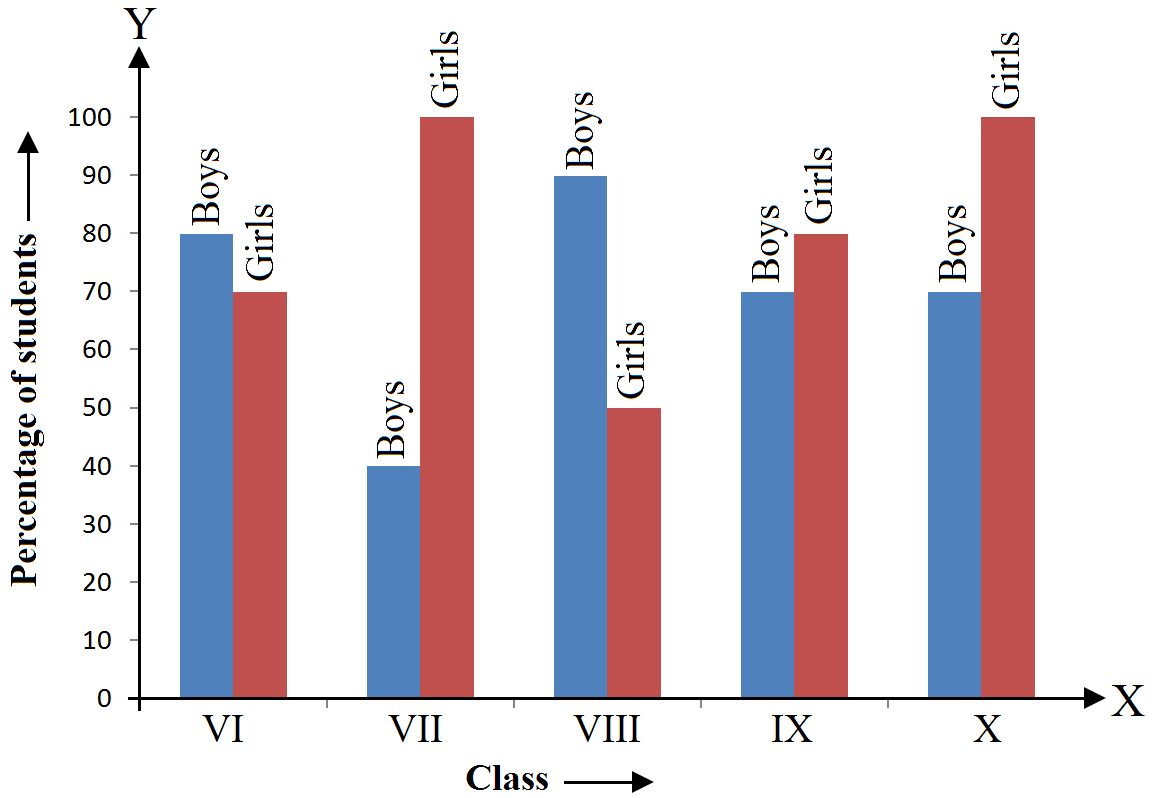
The following bar graph shows the results of an annual examination in a secondary school. Read the bar graph and choose the correct option in each of the following.
$i.\ $The pair of classes in which the results of boys and girls are inversely proportional are:
$a.\ VI, VIII$
$b.\ VI, IX$
$c.\ VIII, IX$
$d.\ VIII, X$
$ii.\ $The class having the lowest faliure rate of girls is:
$a.\ VII$
$b.\ X$
$c.\ IX$
$d.\ VIII$

$iii.\ $The class having the lowest pass rate of student is:
$a.\ VI$
$b.\ VII$
$c.\ VIII$
$d.\ IX$
 
Answer
 
Let’s draw a chart using the information from the above bar graph.
Class Percentage of boys Percentage of girls
$VI$ $80$ $70$
$VII$ $40$ $100$
$VIII$ $90$ $50$
$IX$ $70$ $80$
$X$ $70$ $90$
$i.\ (b) VI, IX$
Explanation:
In Class $VI,$ the percentage of boys $= 80$
In Class $IX,$ the percentage of girls $= 80$
In Class $VI$, the percentage of girls $= 70$
In class $IX$, the percentage of boys $= 70$
$ii.\ (a) \ VII$
Explanation:
In class $VII,$ the passing percentage of girls is at its peak i.e. $100\%.$
In this class, $0\%$ of girls failed.
$iii.\ (b) VII$ and $(c) VIII$
Explanation:
In class $VII$ and $VIII$, the sum of vertical heights of the percentage of boys and girls in the given bar graph is same and that is $140$ units. And this sum of heights is the least compared to all other classes.
 
View full question & answer
Question 195 Marks
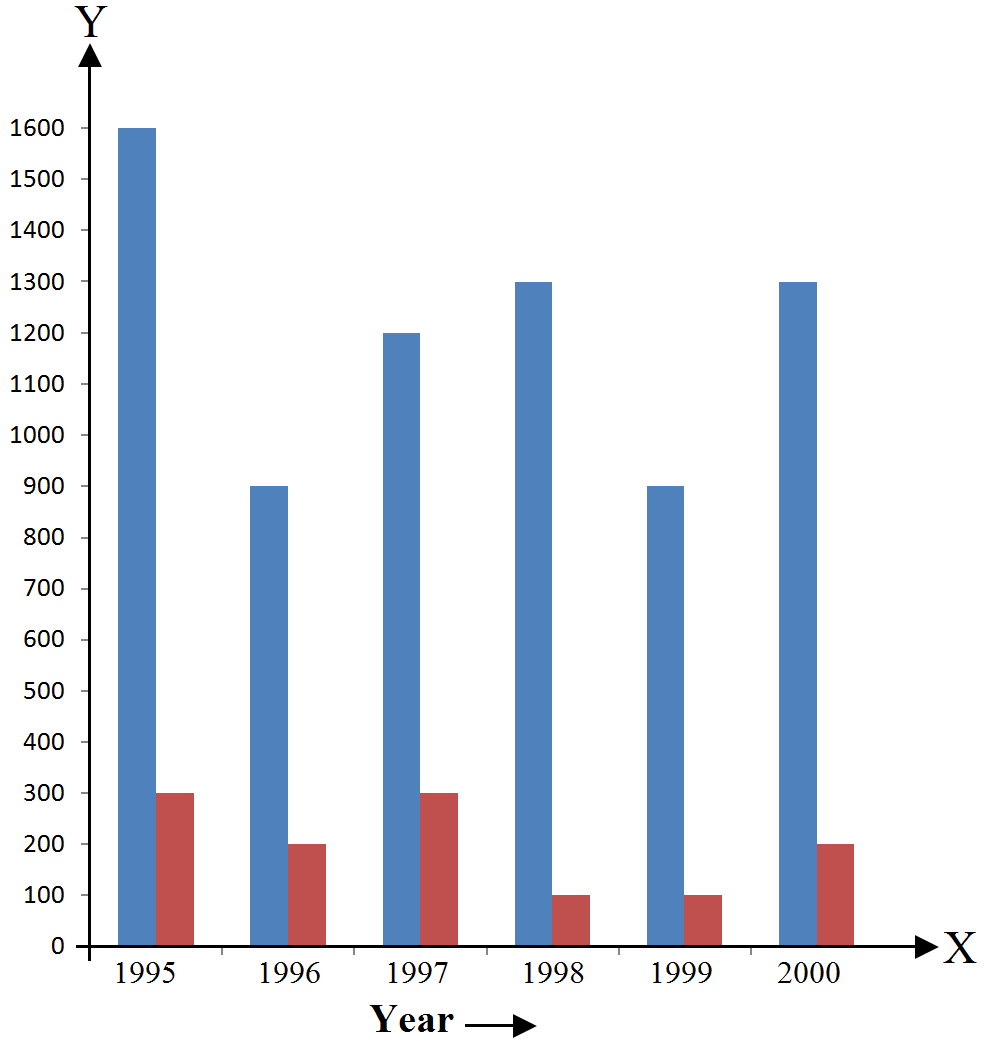
The following bar graph shows the number of persons killed in industrial accidents in a country for some years.
Read the bar graph and choose the correct alternative in each of the following:
$i.\ $The year which shows the maximum percentage increase in the number of persons killed in coal mines over the precending year is:
$a.\1996$
$b.\ 1997$
$c.\ 1999$
$d.\ 2000$
$ii.\ $The year which shows the maximum decrease in the number of persons killed in industrial accidents over the precending year is:
$a.\ 1996$
$b.\ 1997$
$c.\ 1998$
$d.\ 1999$
$iii.\ $The year in which the maximum number of persons were killed in industrial accidents other than those killed in coal mines is:
$a.\ 1995$
$b.\ 1997$
$c.\ 1998$
$d.\ 1999$
Answer
Let’s draw a chart using the information from the above bar graph.
Year
Persons killed in industries accidents
Persons killed in coal mines
$1995$
$1600$
$300$
$1996$
$900$
$200$
$1997$
$1200$
$300$
$1998$
$1300$
$100$
$1999$
$900$
$100$
$2000$
$1300$
$200$
$i.\ (d) 2000$
Explanation:
In $1997$, the death increased to $300$ from $200$, and in $2000$, the death increased to $200$ from $100.$
Therefore, percentage increase in the amount of death in coal mines in the year $1997$
$\Rightarrow $ From $200$ to $300$
$\Rightarrow 50\%$ increase
Therefore, percentage increase in the amount of death in coal mines in the year $2000$
$\Rightarrow $ From $100$ to $200$
$\Rightarrow 100\%$ increase
$ii.\ (a) 1996$
Explanation:
Both the years, $1996$ and in $1999$, show a decrease in the amount of persons killed by industrial accidents.
Therefore, percentage decrease in the amount of death due to industrial accidents in the year $1996$
$\Rightarrow $ From $1600$ to $900 = 43.75\%$
Therefore, percentage decrease in the amount of death due to industrial accidents in the year $1999$
$\Rightarrow $ From $1300$ to $1900 = 30.77\%$
$iii.\ (a) 1995$
Explanation:
In the year $1995, 1600$ persons were killed by industrial accidents, which is the highest compared to the other years.
View full question & answer
Question 205 Marks
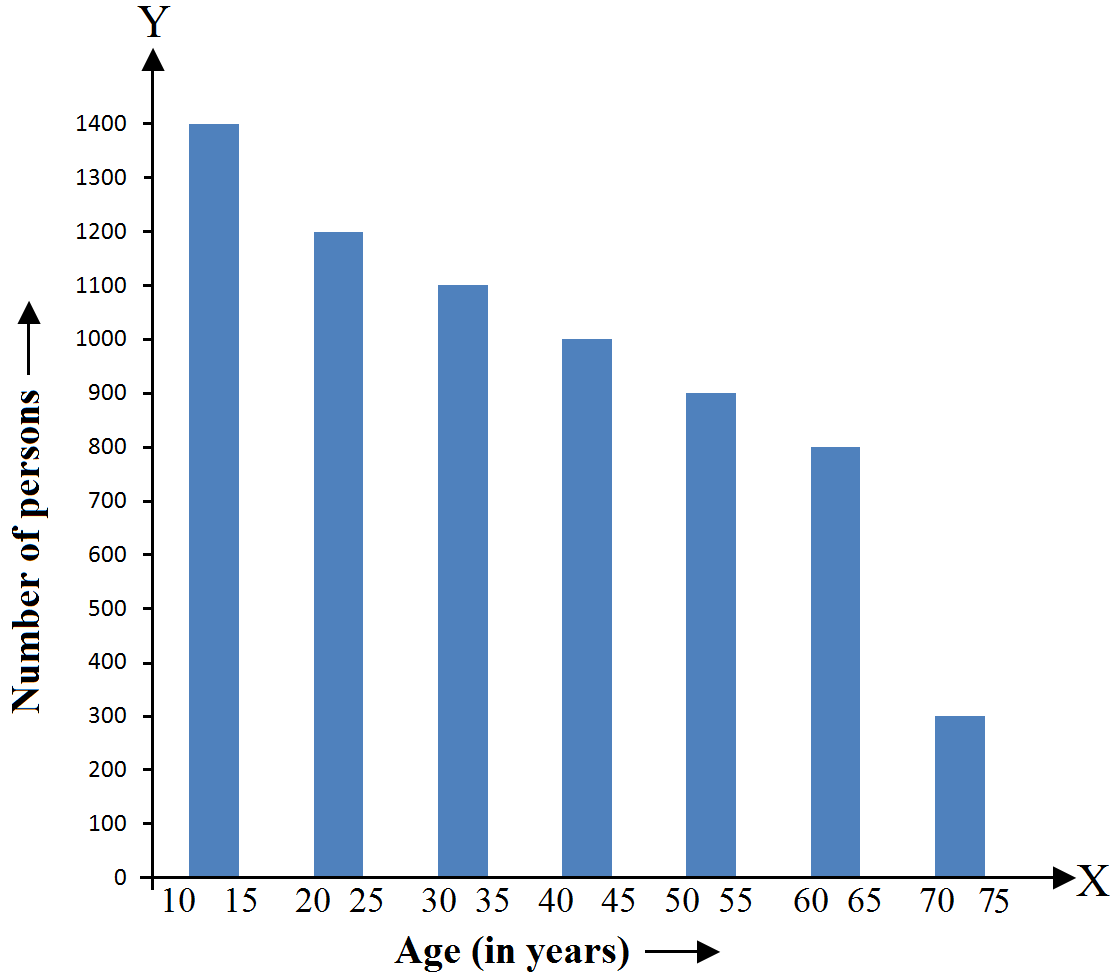
Study the bar graph representing the number of persons in various age groups in a town shown in Observe the bar graph and answer the following questions:

$i.\ $What if the percentage of the youngest age$-$group persons over those in the oldest age group?
$ii.\ $What is the total population of the town?
$iii.\ $What is the number of persons in the age$-$group $60$-$65$?
$iv.\ $How many persons are more in the age$-$group $10$-$15$ than in the age group $30$-$35$?
$v.\ $What is the age$-$group of exactiy $1200$ persons living in the town?
$vi.\ $What is the total number of persons living in the town in the age$-$group $50$-$55$?
$vii.\ $What is the total muner of persons living in the town in the age$-$groups $10$-$15$ and $60$-$65$?
$viii.\ $Whether the population in general increases, decreases or remains constant with the increase in the age$-$group.
Answer
 
 
$i.\ $The youngest age group is $10-15$ years.
Number of persons in the youngest age group $= 1400$
The oldest age group is $70-75$ years.
Number of persons in the oldest age group $= 300$
Difference in the number of people in the youngest age oldest age group $= 1400-300 = 1100$
Therefore, The youngest group has $1100$ more people than the oldest group.
Therefore, $\%$ of the youngest group over oldest group.
$=\frac{1100}{300}\times100\%$
$=\frac{1100}{3}\%=366\frac{2}{3}\%$
$ii.\ $Total population of the town.
$=$ Total number of people from all age groups.
$= 1400 + 1200 + 1100 + 1000 + 900 + 800 + 300 = 6700.$
$iii.\ $There are $800$ persons in the age group $60-65$ years.
Explanation:
The vertical length of the rectangle against the age group $60-65$ is up to $800$ units.
$iv.\ $Number of persons in the age group $10-15 = 1400$
Number of persons in the age group $30-35 = 1100$
Therefore, number of more persons in the age group $10-15$ as compared to that in the age group $30-35 = 1400 - 1100 = 300.$
$v.\ $The age-group of exactly $1200$ people living in the town is $20-25$ years.
Explanation:
Looking at the bar graph we can say that the vertical length of the rectangle against the age group $20-25$ is up to $1200$ units.
$vi.\ $The number of people of the age group $50-55$ years is $900.$
Explanation:
The vertical length of the rectangle against the age group $50-55$ years is up to $900$ units.
$vii.\ $The number of persons in the age group $10-15$ years is $1400$, and that in the age group $60-65$ years is $800.$
Therefore, Total number of persons in the age group $10-15$ years and $60-65$ years
$= 1400 + 800 = 2200$
$viii.\ $With the increase in the age group, the population decreases.
Explanation:
As the age group increases, the heights of the rectangle start falling.
 
View full question & answer
Question 215 Marks
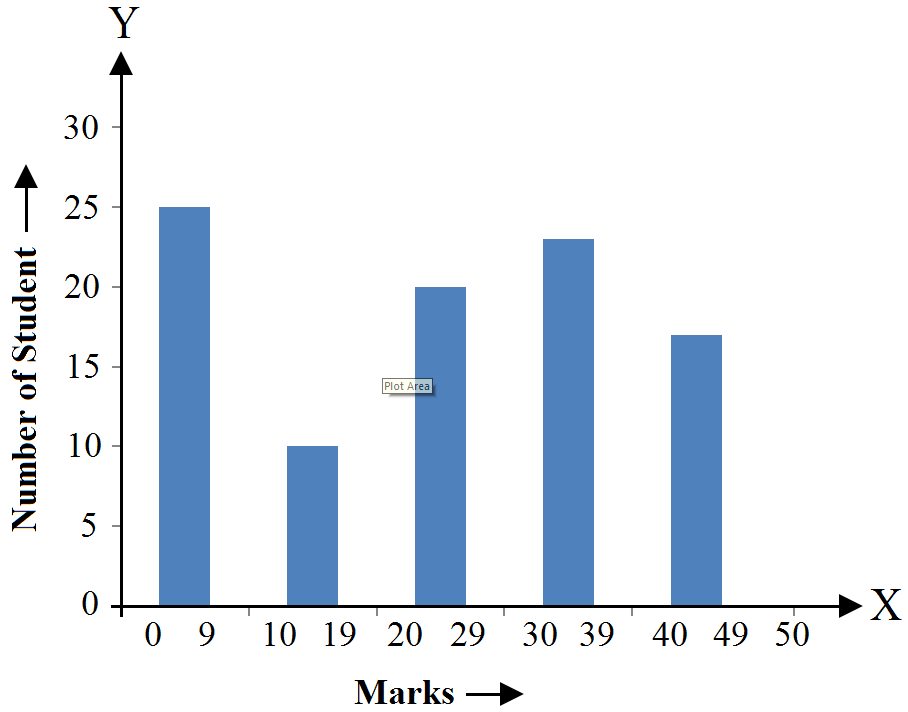
Given below is the bar graph indicating the marks obtained out of $50$ in mathematics paper by $100$ students. Read the bar graph and answer the following questions:

$i.\ $It is decidec to distribute work books on mathematics to the students obtaining less than $20$ marks, giving one workbook to each of such students. If a work book costs $₹ 5$, what sum is required to buy the work books?
$ii.\ $Every student belonging to the highest mark group is entitled to get a prize of $₹ 10$. How much amount of money is required for distributing the prize money?
$iii.\ $Every student belonging to the lowest mark-group has to solve $5$ problems per day. How many problems, in all, will be solved by the students of this group per day?
$iv.\ $State whether true or false.
$a.\ 17\%$ students have obtained marks ranging from $40$ to $49.$
$b.\ 59$ students have obtained marks ranging from $10$ to $29$.
$v.\ $What is the number of students getting less than $20$ marks?
$vi.\ $What is the number of students getting more than $29$ marks?
$vii.\ $What is the number of students getting marks between $9$ and $40$?
$viii.\ $What is the number, of students belonging to the highest mark group?
$ix.\ $What is the number of students obtaining more than $19$ marks?
Answer
 
Let us prepare a chart of the $100$ students using the data from the bar graph.
Marks Number of students
$0-9$ $27$
$10-19$ $12$
$20-29$ $20$
$30-39$ $24$
$40-49$ $17$
$i.\ $Number of students with less than $20$ marks $= 27 + 12 = 39$
Therefore, Required sum to buy the workbooks $= ₹ 5 \times 39 = ₹ 195.$
$ii.\ $Highest marks group $= 40-49$
Number of students in this marks group $= 17$
Therefore, Required money to distribute the prize $= ₹ 10 × 17 = ₹ 170.$
$iii.\ $Lowest marks group $= 0-9$
Number of students in this marks group $= 27$
Therefore, Number of problems that will be solved by the students per day $= 5 \times  27 = 135.$
$iv.\ (a)$ True, $(b)$ False
$v.\ $Number of students scoring less than $20$ marks.
$=$ Number of students in the marks group $0-9 +$ Number of students in the marks group $10-19 = 27 + 12 = 39$
$vi.\ $Number of students scoring more than $29$ marks
$=$ Number of students in the marks group $30-39 +$ number of students in the marks group $40-49 = 24 + 17 = 41$
$vii.\ $Number of students scoring between $9$ and $40$
$=$ Number of students in the marks group $10-19 +$ Number of students in the marks group $20-29 +$ Number of students in the marks group $30-39$
$= 12 + 30 + 24 = 56$
$viii.\ $The highest marks group is $40-49.$
Number of students in this marks group $= 17$
$ix.\ $Number of students scoring more than $19$ marks
Number of students in the marks group $20-29 +$ Number of students in the marks group $30-39 +$ Number of students in the marks group $40-49$
$= 20 + 24 + 17 = 61$
 
View full question & answer