MCQ 1011 Mark
The first basic Roman numeral is:
MCQ 1021 Mark
Convert $745\ cm$ into decimeters:
- A
$745\ dm$
- B
$0\ dm\ 745\ cm$
- C
$7\ dm\ 45\ cm$
- ✓
$74\ dm\ 5\ cm$
AnswerCorrect option: D. $74\ dm\ 5\ cm$
We know that, $1$ decimeter $=10\ cm,$
$1\text{cm}=\frac{1}{10}\text{dm}$
$ 745\text{cm}=\frac{1}{10}\times745\text{dm}$
$=\frac{745}{10}\text{dm}$
$= 74.5$ decimeter $= 74\ dm \ 5\ cm$
View full question & answer→MCQ 1031 Mark
$10.5$ litres is equal to how many milliliters:
- ✓
$10500$
- B
$10005$
- C
$10050$
- D
$15000$
AnswerCorrect option: A. $10500$
$10.5$ litres can be written as $10.5 \times 1000 = 10500\ ml.$
View full question & answer→MCQ 1041 Mark
$9849475825$ is witten with commas as (International System)
- A
$9, 84, 94, 75, 825$
- ✓
$9, 849, 475, 825$
- C
$9849, 475, 82, 5$
- D
$9, 8, 4, 9, 4, 7, 5, 8, 2, 5$
AnswerCorrect option: B. $9, 849, 475, 825$
In International System commas are introduced after every $3$ digits starting from right to left sideIn Indian System commas are introduced after $3$ digits for one time and then after $2$ digits starting from right to left side.
given the number $9849475825$
International System:
$9849475825 = 9,894,475,825$
Indian System:
$9849475825 = 9,84,94,75,825$
View full question & answer→MCQ 1051 Mark
The least two digit composite number is:
AnswerWe know that-If a number has more than $2$ factors then it is a composite number. $11$ is a prime number
$\therefore$ it has only $2$ factors $12$ is a composite number
$\therefore$ it has more than $2$ factors $10$ is a composite number
$\therefore$ it has more than $2$ factors $16$ is a composite number
$\therefore$ it has more than $2$ factors $10, 12,16$
$\therefore$ are composite numbers.The least composite number is $10$
View full question & answer→MCQ 1061 Mark
Mark the correct alternative in the following:
The largest three digit number formed by the digits $8, 5, 9$ is:
Answer largest number is formed by writing the digits in descending order.
View full question & answer→MCQ 1071 Mark
Smallest $6-$digit number that can be formed by the digits $9, 6, 0, 5, 8, 1$ is:
- A
$015,689$
- ✓
$1,05,689$
- C
$5,01,689$
- D
$9,86,510$
AnswerCorrect option: B. $1,05,689$
$\Rightarrow $ The given numbers are $9,6,0,5,8$
$\Rightarrow $ To form smallest $6-$digit number,
we have to start number with smallest digit and end with largest digit.
$\Rightarrow $ Here, we can not use 0 as first digit because then number will becomes $5$ digit.
The smallest $6-$digit number $= 1,05,689$
View full question & answer→MCQ 1081 Mark
Name of the number $90,08,00,700$ is:
- ✓
Ninety crore eight lakhs seven hundred.
- B
Nine crore eight lakhs seven hundred.
- C
Nine crore eighty lakhs seven hundred.
- D
Ninety crore eighty lakhs seven hundred.
AnswerCorrect option: A. Ninety crore eight lakhs seven hundred.
The given number is $90,08,00,700$
$90,08,00,700 = 90 \times 1,00,00,000 + 08 \times 1,00,000 + 7 \times 100$
So, the name is "Ninety crore eight lakh seven hundred".
View full question & answer→MCQ 1091 Mark
Convert the following :
$27\ km\ 241\ m\ 319\ m$ into $m:$
- ✓
$27241. 319m$
- B
$27000. 319m$
- C
$27219. 241m$
- D
$27319. 241m$
AnswerCorrect option: A. $27241. 319m$
We have, $27\ km\ 241\ m\ 319\ mm$
We know that $1\ km = 1000\ m\ 1\ mm={10}-^{3}\text{m}$
$⇒ 27 \times{10}^{3}\ m + 241\ m + 319 × {10}-^{3}\text{m}$
$⇒ 27000\ m + 241\ m + 0.319\ m$
$⇒ 27241.319\ m$
View full question & answer→MCQ 1101 Mark
If number read $34$ Ten thousand eight hundred six $34$ Find missing digit.
$1\_,806:$
Answer Number reads Ten thousand eight hundred six. $1$ is at ten thousands place, $0$ at thousands place,
$8$ at hundreds place, $0$ at tens place and $6$ at ones place.
This written in numeral is $10,806$
Missing digit is $0$ in thousands place
View full question & answer→MCQ 1111 Mark
Which of the following are the three digit numbers that can be formed by using $0, 1$ and $2$ only once.
AnswerThree digit numbers that can be formed from $0, 1$ and $2$ are $102$ and $201.$
View full question & answer→MCQ 1121 Mark
The product of the place values of two $2’s$ in $428721$ is:
- A
$4$
- B
$40000$
- ✓
$400000$
- D
$40000000$
AnswerCorrect option: C. $400000$
The given number is $428721.$
According to the question,
The place value of first $2 = 2 \times 10 = 20 [$it is at ten’s place$]$
and the place value of second $2 = 2 \times 10000 = 20000 [$it is at ten thousand’s place$]$
Their product $= 20 \times 20000 = 400000$
Hence, the product of the place values of two $2’s$ in $428721$ is $400000.$
View full question & answer→MCQ 1131 Mark
Mark $(\checkmark)$ against the correct answer in the following:
Which of the following Roman numerals is correct$?$
Answer$X$ can be subtracted from $L$ and $C$ only.
i.e., $XC = (100 - 10) = 90$
View full question & answer→MCQ 1141 Mark
$648340021$ is written with commas as (International System).
- ✓
$648,340,021$
- B
$6,4,8,3,4,0,0,2,1$
- C
$64,83,40,02,1$
- D
AnswerCorrect option: A. $648,340,021$
In International System commas are introduced after every $3$ digits starting from right to left side
In Indian System commas are introduced after $3$ digits for one time and then after $2$ digits starting from right to left side.
given the number $648340021$
International System:
$648340021 = 648,340,021$
Indian System :
$648340021 = 64,83,40,021$
View full question & answer→MCQ 1151 Mark
Million period consists of the places __________.
- A
$M, TM$
- ✓
$M, TM, HM$
- C
$TTH,HTH, M$
- D
$O, T, M$
AnswerCorrect option: B. $M, TM, HM$
Million Period consists of places: Million, Hundred Millions, Thousand Millions
$→ M, HM, TM$
View full question & answer→MCQ 1161 Mark
Mark the correct alternative in the following:
The greatest number which when rounded off to the nearest thousand as $7000,$ is:
- A
$6500$
- B
$6549$
- ✓
$7499$
- D
$6499$
AnswerCorrect option: C. $7499$
All numbers from $6,500$ to $7,499$ are rounded off to the nearest thousand as $7,000.$ Therefore, the greatest number is $7,499.$
View full question & answer→MCQ 1171 Mark
Difference of $1000$ and $400($in roman number$)$ is:
View full question & answer→MCQ 1181 Mark
Compare: $31505,31550.$
Answer$ 31505 < 31550$
$\therefore$ at tens places number $31550$ has $5$ where as same place number $31505$ has $0$ and $0 < 5.$
View full question & answer→MCQ 1191 Mark
$\frac{1}{5}$ of $10\ km = ...........m$
AnswerCorrect option: D. $2000$
We know that $1km = 1000m \rightarrow 10 km = 10 \times 1000m = 10000m$
$\therefore \frac{1}{5}$ of $10km$
$\frac{1}{5}$ of $10000m = \frac{1}{5}\times 10000 = 2000m$ Hence,
View full question & answer→MCQ 1201 Mark
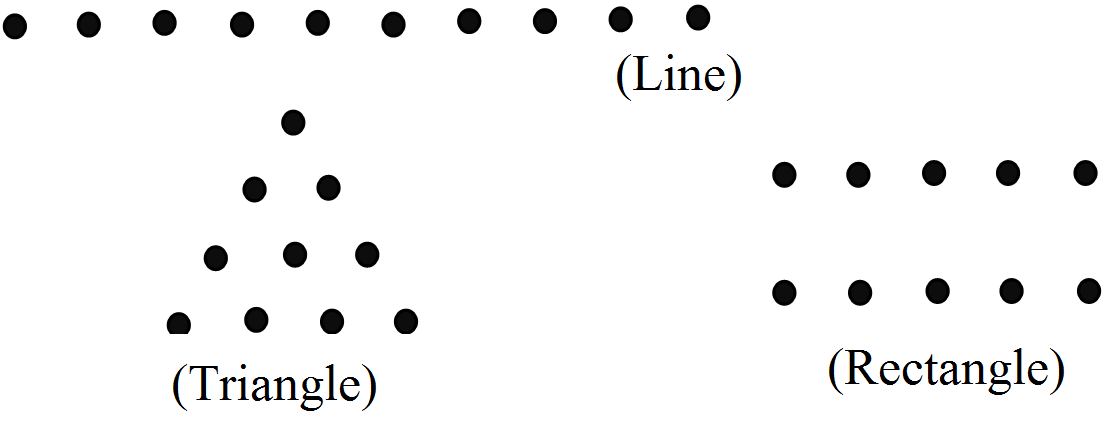
By using dot (.) patterns, which of the following numbers can be arranged in all the three ways, namely a line, a triangle and rectangle?
AnswerBy using $10$ dots, we can make a line, a triangle and a rectangle.
View full question & answer→MCQ 1211 Mark
Write in numerals:
Ninety thousand nine hundred nine.
- A
$90,0009$
- B
$90,879$
- ✓
$90,909$
- D
$90,000$
AnswerCorrect option: C. $90,909$
Ninety thousand nine hundred nineThis written in numerals gives $90,909$
$9$ is at ten thousands place, $0$ at thousands place, $9$ at hundreds place and so on.
View full question & answer→MCQ 1221 Mark
The greatest $8$ digit number is:
- ✓
$99999999$
- B
$10000000$
- C
$99999999$
- D
$88888888$
AnswerCorrect option: A. $99999999$
Greatest n digits number is a number with all of its digits equal to $9.$
Because the next greater number will have $′n+1′$ digits. So, greatest 8 digits number is $99999999$
View full question & answer→MCQ 1231 Mark
The number of distinct prime factors of the largest $4-$digit number is:
AnswerWe know that, largest $4-$digit number $= 9999$
Prime factors of $9999$
$\begin{array}{c|c}3&9999\\ \hline3&3333\\ \hline11&1111\\ \hline101&101\\ \hline&1\end{array}$
i.e. $9999 = 3^2 \times 11 \times 101$
Hence, the number of distinct prime factors of the largest $4-$digit number is $3.$
View full question & answer→MCQ 1241 Mark
Which of the following is not true$?$
- A
$(7 + 8) + 9 = 7 + (8 + 9)$
- B
$(7 \times 8) \times 9 = 7 \times (8 \times 9)$
- ✓
$7 + 8 \times 9 = (7 + 8) \times (7 + 9)$
- D
$7 \times (8 + 9) = (7 \times 8) + (7 \times 9)$
AnswerCorrect option: C. $7 + 8 \times 9 = (7 + 8) \times (7 + 9)$
$a.$ We have, $(7 + 8) + 9 = 7 + (8 + 9)$
$\text{LHS} = (7 + 8) + 9 = 15 + 9 =24$
$\text{RHS} = 7 + (8 + 9) = 7 + 17=24$
$\text{LHS} = \text{RHS}$ So, it is true.
$b.$ We have, $(7 \times 8) \times 9 = 7 \times (8 \times 9)$
$\text{LHS} = (7 \times 8) \times 9= 56 \times 9 = 504$
$\text{RHS} = 7 \times (8 \times 9)= 7 \times 72 = 504$
$\text{LHS} = \text{RHS}$ So, it is true.
$c.$ We have, $7 + 8 \times 9 = (7 + 8) \times (7 + 9)$
$\text{LHS} = 7 + 8 \times 9 = 7 + 72 = 79$
$\text{RHS} = (7 + 8) \times (7 + 9)=15 \times 16 = 240$
$\therefore 79 \neq 240$
$\therefore \text{LHS} \neq \text{RHS}$ So, it is false.
$d.$ We have, $7 \times (8 + 9) = (7 \times 8) + (7 \times 9)$
$\text{LHS} = 7 \times (8 + 9)=7 \times 17 = 119$
$\text{RHS} = (7 \times 8) + (7 \times 9) = 56 + 63=119$
$\therefore \text{LHS} = \text{RHS}$ So, it is true.
View full question & answer→MCQ 1251 Mark
Mark the correct alternative in the following:
One trillion equals:
- A
$100$ billion
- B
$10$ billion
- ✓
$1000$ billion
- D
AnswerCorrect option: C. $1000$ billion
We know $1$ trillion $= 1000$ billions
Hence, the correct answer is option $(c).$
View full question & answer→MCQ 1261 Mark
Bobby's date of birth is $19th$ September. Express the date in Roman system.
- A
$XXI$
- B
$XIXX$
- C
$IIX$
- ✓
$XIX$
View full question & answer→MCQ 1271 Mark
The largest $5-$digit number having three different digits is:
- A
$98978$
- B
$99897$
- ✓
$99987$
- D
$98799$
AnswerCorrect option: C. $99987$
For greatest number, we write the digits in descending order.
So, the greatest $5-$digit number having three different digits is $99987.$
View full question & answer→MCQ 1281 Mark
Mark the correct alternative in the following:
The difference between the greatest and smallest numbers which when rounded off a number to the nearest hundred as $6700,$ is:
Answer$6,749$ is the greatest number that when rounded off to the nearest hundred will become $6,700.$
$6,650$ is the least number that when rounded off to the nearest hundred will become $6,700.$
$\therefore$ Difference $= 6,749 - 6,650 = 99$
View full question & answer→MCQ 1291 Mark
$LCM$ of $10, 15$ and $20$ is:
AnswerPrime factorization of $10,15$ and $20$
$\begin{array}{c|c}2&10,15,20\\\hline2&5,15,10\\\hline3&5,15,5\\\hline5&5,5,5\\\hline&1,1,1,\end{array}$
$LCM$ of $10, 15$ and $20 = 22 \times 3 \times 5 = 60$
View full question & answer→MCQ 1301 Mark
Which of the following pairs is not coprime$?$
- ✓
$8, 10$
- B
$11, 12$
- C
$1, 3$
- D
$31, 33$
AnswerCorrect option: A. $8, 10$
We know that, if $HCF$ of a pair of numbers is $1,$ then they are called coprimes.
So, $8$ and $10$ are not coprimes.
View full question & answer→MCQ 1311 Mark
Mark $(\checkmark)$ against the correct answer:
Which of the following is not meaningful?
AnswerI can be subtracted from $V$ and $X$ only. Thus, $IC$ is wrong.
View full question & answer→MCQ 1321 Mark
If $1$ is added to the greatest $7-$digit number, it will be equal to:
- A
$10$ thousands
- B
$1$ lakh
- C
$10$ lakh
- ✓
$1$ crore
AnswerCorrect option: D. $1$ crore
The greatest $7-$digit number $= 99,99,999$
$\therefore 1 $ added to $99,99,999 = 99,99,999 + 1 = 1,00,00,000$
View full question & answer→MCQ 1331 Mark
$9798745995$ is written with periods in international system as __________.
- A
$97.98,74,59,95$
- B
$9,79,87.45,995$
- ✓
$9,798,745,995$
- D
$979,874,599,5$
AnswerCorrect option: C. $9,798,745,995$
The given number is $9798745995.$
As per the international place value system, the number can be written as: $9,798,745,995$
Hence, $9798745995$ is written with periods in international system as $9,798,745,995.$
View full question & answer→MCQ 1341 Mark
Mark the correct alternative in the following:
The product of the place values of two three in $53432$ is:
- A
$9000$
- ✓
$90000$
- C
$10000$
- D
$99000$
AnswerCorrect option: B. $90000$
The $3$ in the second place from right is at tens place.
Therefore, the place value of $3$ at tens place $= 30.$
The $3$ in the fourth place from right is at thousands place.
Therefore, the place value of $3$ at thousands place $= 3,000.$
The product of the place values of two $3's = 3,000 \times 30 = 90,000.$
View full question & answer→MCQ 1351 Mark
The largest $4-$digit number, using any one digit twice from digits $5, 9, 2$ and $6,$ is:
- A
$9652$
- B
$9562$
- C
$9659$
- ✓
$9965$
AnswerCorrect option: D. $9965$
Given digits are $5, 9, 2$ and $6.$
Descending order of the given digits is $9, 6, 5, 2.$
Since, we can use any one digit twice, so the required largest $4-$digit number is $9965$
View full question & answer→MCQ 1361 Mark
$a,b,c (a > c)$ are three digits from left to right, of a three digits number. If the number with these digits reversed is subtracted from the original number, the resulting number has the digits $4$ in its unit place. The other two digits from left to right are:
- A
$5$ and $4$
- ✓
$5$ and $9$
- C
$4$ and $5$
- D
$9$ and $5$
AnswerCorrect option: B. $5$ and $9$
$5$ and $9$
View full question & answer→MCQ 1371 Mark
A conical cup $36\ cm$ high has diameter of base $28\ cm$ It is full of water. the water was poured into a cylindrical jar of radius of base $10\ cm.$
the height of water in the vessel is:
- ✓
$23.52\ cm$
- B
$16.92\ cm$
- C
$11.76\ cm$
- D
$13.65\ cm$
AnswerCorrect option: A. $23.52\ cm$
Vol. of cylinder $=$ Vol. of cone
$\Rightarrow \pi \times{10}^{2}\times\text{h}=\frac{1}{3}\pi{14}^{2}\times{36}$
$\Rightarrow \text{h}=23.52\text{cm}$
View full question & answer→MCQ 1381 Mark
Greatest five digit number that can be formed using $7, 9, 0, 5, 2$ is ________.
- A
$79052$
- B
$90752$
- ✓
$97520$
- D
$97052$
AnswerCorrect option: C. $97520$
To form the greatest $5$ digit number we write the given numbers in descending order.
The number we form is $97520.$
View full question & answer→MCQ 1391 Mark
$3 \times 10000 + 7 \times 1000 + 9 \times 100 + 0 \times 10 + 4$ is the same a:
- A
$3794$
- B
$37940$
- ✓
$37904$
- D
$379409$
AnswerCorrect option: C. $37904$
We have,
$3 \times 10000 + 7 \times 1000 + 9 \times 100 + 0 \times 10 + 4 [$by simplification$]$
$= 30000 + 7000 + 900 + 0 + 4 = 37904$
View full question & answer→MCQ 1401 Mark
The sum of two number is $10$ and their positive difference is $2.$ The bigger number is :.....................
Answer Let $x$ and $y$ be two numbers such that $x > y$
Then $x + y = 10......$
$(i)$ and $x - y = 2......$
$(ii)$ Solving them $2 = 12$
$\Rightarrow x = 6 and 4 + y = 0$
$\Rightarrow y = 4$
Thus, the bigger number is $6.$
View full question & answer→MCQ 1411 Mark
$5$ When rounded off to nearest thousands, the number $85642$ is:
- A
$85600$
- B
$85700$
- C
$85000$
- ✓
$86000$
AnswerCorrect option: D. $86000$
$ 85642$ rounded off to nearest thousands $= 86000$
View full question & answer→MCQ 1421 Mark
Sum of the numbers of primes between $16$ to $80$ and $90$ to $100$ is:
Answer Since, prime numbers between $16$ to $80$ are $17,19, 23, 29, 31, 37, 41,43, 47, 53, 59, 61,67, 71,73$ and $79.$
Total prime numbers between $16$ to $80 = 16$
And prime numbers between $90$ to $100 = 97$
Total number of prime numbers between $90$ to $100 = 1$
Sum of the numbers of primes between $16$ to $80$ and $90$ to $100 = 16 + 1 = 17$
View full question & answer→MCQ 1431 Mark
If the number $7254 * 98$ is divisible by $22,$ then the digit at $*$ is:
Answer We know that, if a number is divisible by two coprime numbers, then it is divisible by their product also.
If $7254 * 98$ is divisible by $22,$ then it must be divisible by $2$ and $11$ both.
Since, the last digit is $8,$ so it is divisible by $2.$ Now, for divisibility by $11,$ the difference of sum of digits on even and odd places must be either zero or divisible by $11.$
Sum of digits at even places $= 9 + 4 + 2 = 15$
Sum of digits at odd places $= 8 + * + 5 + 7 = 20 + *$
Required difference $= (20 + *) - 15 = 5 + *$
For divisibility by $11, 5 + * = 11 * = 6$
Hence, the digit at $*$ is $6.$
View full question & answer→MCQ 1441 Mark
Which of the following fractions is greater than $\frac{3}{4}$ and less than$\frac{5}{6}$:
- A
$\frac{1}{2}$
- B
$\frac{2}{3}$
- ✓
$\frac{4}{5}$
- D
$\frac{9}{10}$
AnswerCorrect option: C. $\frac{4}{5}$
$\frac{3}{4}=0.75, \frac{5}{6}=0.833,$
$\frac{1}{2}=0.5,$$\frac{2}{3}=0.66,$
$\frac{4}{5}=0.8,\frac{9}{10}=0.9.$
Clearly, $0.8$ lies between $0.75$ and $0.833$
$\frac{4}{5}$ lies between$\frac{3}{4}$and $\frac{5}{6}$
View full question & answer→MCQ 1451 Mark
Mark the correct alternative in the following:
The smallest counting number is:
AnswerThe smallest digit is 0, but the smallest counting number is $1.$
View full question & answer→MCQ 1461 Mark
Read the number:
$7, 88, 789$
- A
Seventy eight thousand eight hundred seven eighty nine.
- B
Seventy eight thousand eight hundred eighty nine.
- ✓
Seven lakh eighty eight thousand seven hundred eighty nine.
- D
Seven lakh eight hundred and eighty seven thousand eighty nine.
AnswerCorrect option: C. Seven lakh eighty eight thousand seven hundred eighty nine.
$7$ is at lakhs place followed by $8$ at ten thousands place, $8$ at thousands place, $7$ at hundreds place, $8$ at tens place and $9$ at ones place.
so$ 7, 88,789$ is read as seven lakh eighty eight thousand seven hundred eighty nine.
View full question & answer→MCQ 1471 Mark
Convert $1$ feet into meters:
- A
$0.30m$
- ✓
$0.3048m$
- C
$0.3059m$
- D
$0.3067m$
AnswerCorrect option: B. $0.3048m$
View full question & answer→MCQ 1481 Mark
Convert $4000\ mm\ 400\ cm$ into meters:
AnswerWe know that, $1$ centimeter $= 10\ mm, 1$ meter $= 100\ cm\ 1$ meter $= 1000$
mm or $1\ mm =\frac{1}{10}\text{cm} \text { or}1\text{ mm}=\frac{1}{1000}\text{m}$
To convert $4000\ mm\ 400\ cm$ to meters
$4000\ mm \ 400\ cm = 4000\ mm + 400\ cm$
Now, $4000\ mm =\frac{1}{1000}\times{4000}\text{m}=4\text{m }{ 400}\text{cm}=\frac{1}{100}\times{400}\text{m} =4\text{m}$
$4000\ mm\ 400\ cm = 4000\ mm + 400 \ cm = (4+4)\ m = 8\ m$
View full question & answer→MCQ 1491 Mark
Mark the correct alternative in the following:
Which of the following numbers is equal to $1$ billion$?$
- A
$10$ lakh
- B
$1$ crore
- C
$100$ lakh
- ✓
$100$ crore
AnswerCorrect option: D. $100$ crore
$100$ crore
View full question & answer→MCQ 1501 Mark
Mark the correct alternative in the following:
$1827$ when rounded off to the nearest hundred is:
- A
$1900$
- B
$1820$
- C
$1850$
- ✓
$1800$
AnswerCorrect option: D. $1800$
In $1827$ the last two digits i.e., $27$ is less than $50.$
Hence, the $3rd$ last digit will remain same and the last two digits become zero
Hence, $1827$ when rounded off to the nearest hundred is $1800$
Hence, the correct answer is option $(d).$
View full question & answer→