MCQ 511 Mark
If two sides of a triangle are $6\ cm$ and $8\ cm$ then the length of the third side is:
AnswerCorrect option: C. greater than $2 \ cm$ and less than $14 \ cm$
greater than $2 \ cm$ and less than $14 \ cm$
View full question & answer→MCQ 521 Mark
Mark $(\checkmark)$ against the correct answer in the following:
The cost of fencing a rectangular field at $Rs. 30$ per meter is $Rs. 2400$. If the length of the field is $24m$, then its breadth is:
AnswerTotal cost of fencing $= Rs. 2400$
Rate $= Rs. 30$ per m
Perimeter of the rectangular field $=\frac{2400}{30}$
$= 80m$
$\therefore$ Length + breadth $=\frac{80}{2}$
$= 40m$
Length of field $= 24m$
$\therefore$ Breadth $= 40 - 24$
$= 16m$
View full question & answer→MCQ 531 Mark
The breadth of a rectangle is $w$ cm and the length is $5$ times as long as its breadth. What is the perimeter of the rectangle:
- A
$5w^2\ cm$
- ✓
$12w \ cm$
- C
$(10 + 2w) \ cm$
- D
$(25 + w^2) \ cm$
AnswerCorrect option: B. $12w \ cm$
Given, breadth of a rectangle $= w \ cm$
length of a rectangle $= 5w \ cm$
therefore, perimeter of rectangle $= 2(5w + w)$
$= 2 \times 6w$
$= 12w\ \ cm$
View full question & answer→MCQ 541 Mark
A rectangular carpet has area $120m^2$ and perimeter $46$ metres. The length of its diagonal is:
AnswerArea of the rectangle $= 120m^2$
Perimeter $= 46m$
Let the sides of the rectangle be l and b.
Therefore,
Area = lb
$= 120m^2 …(1)$
Perimeter $= 2(l + b) = 46$
Or, $(l + b)$
$=\frac{46}{2}$
$=23m …(2)$
Now, length of the diagonal of the rectangle $= l^2 + b^2$
So, we first find the value of $(l^2 + b^2)$
Using identity:
$(l^2 + b^2) = (l + b)^2 - 2(lb)$ [From $(1)$ and $(2)$]
Therefore,
$(l2 + b2) = (23)2 - 2(120)$
$= 529 - 240$
$= 289$
Thus, length of the diagonal of the rectangle $= l^2 + b^2 = 289$
$= 17m$ View full question & answer→MCQ 551 Mark
If the ratio between the length and the perimeter of a rectangular plot is $1 : 3$, then the ratio between the length and breadth of the plot is:
- A
$1 : 2$
- ✓
$2 : 1$
- C
$3 : 2$
- D
$2 : 3$
AnswerCorrect option: B. $2 : 1$
It is given that, $\frac{\text{Length of the rectangle}}{\text{Perimeter of the rectangle}}=\frac{1}{3}$
$\Rightarrow\frac{\text{l}}{(2\text{l}+2\text{b})}=\frac{1}{3}$
After cross multiplying, we get:
$3\text{l}=2\text{l}+2\text{b}$
$\Rightarrow\text{l}=2\text{b}$
$\Rightarrow\frac{\text{l}}{\text{b}}=\frac{2}{1}$
Thus, the ratio of the length and the breadth is $2 : 1.$ View full question & answer→MCQ 561 Mark
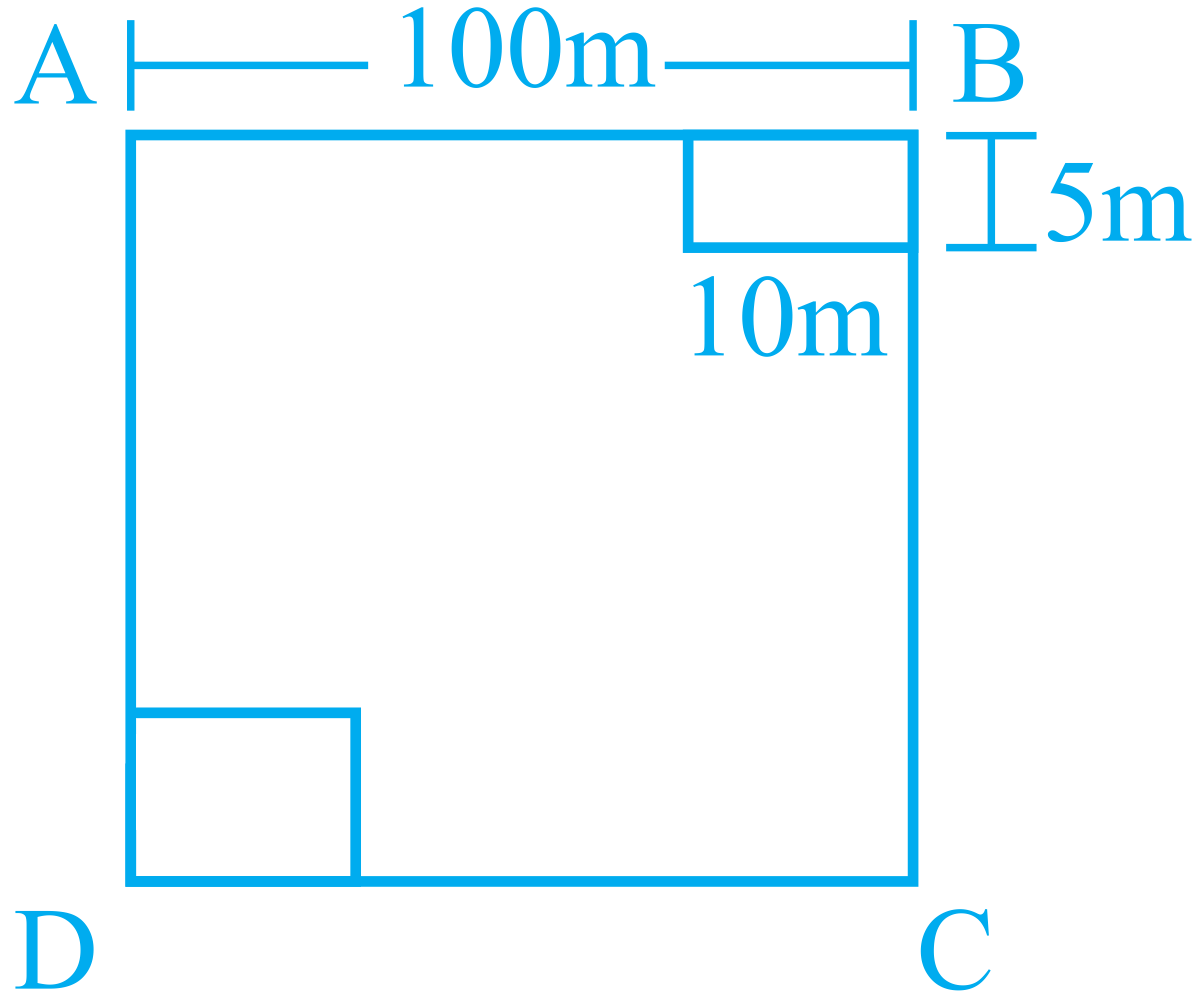
A square shaped park $ABCD$ of side $100m$ has two equal rectangular flower beds each of size $10m \times 5m$ Length of the boundary of the remaining park is:
- A
$360m$
- ✓
$400m$
- C
$340m$
- D
$460m$
AnswerCorrect option: B. $400m$
In order to find the length of the boundary of the remaining park, we add two flower beds each of length 10m and breadth $5m$, then remaining park is shown below:
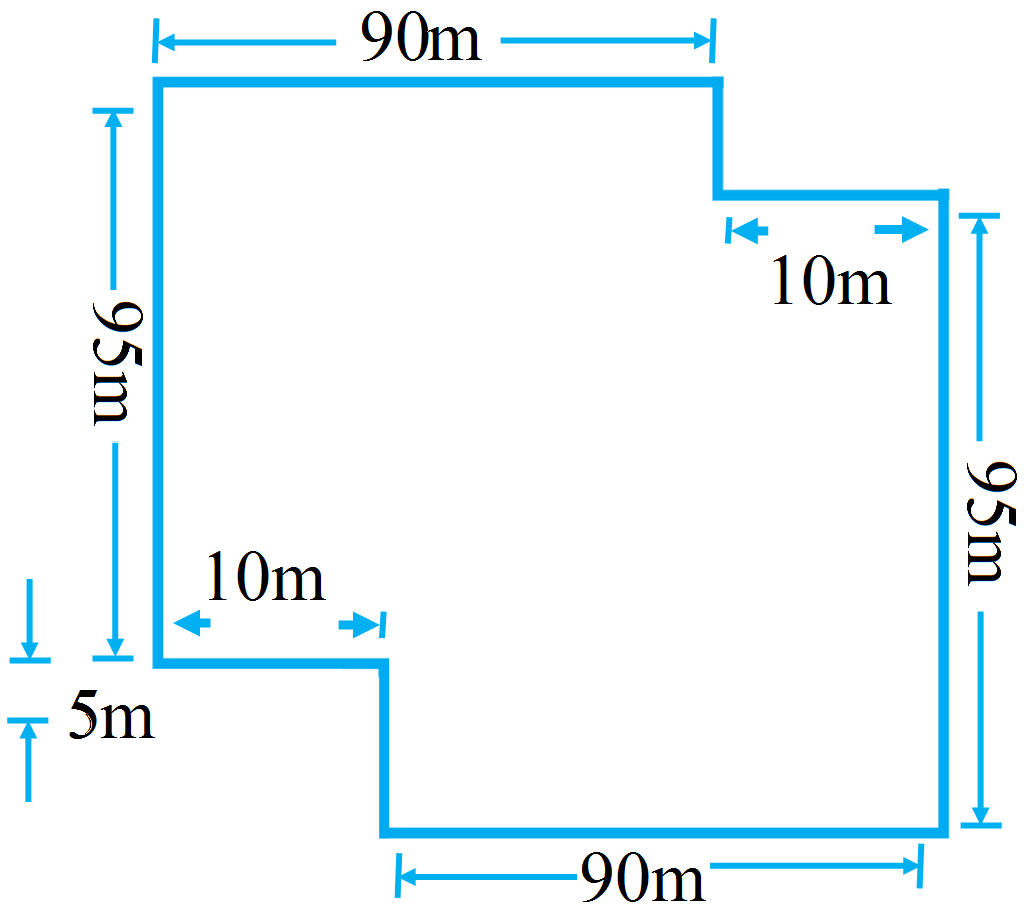
Now, length of the boundary of the remaining park = Perimeter of remaining park $= (90 + 5 + 10 + 95 + 90 + 5 + 10 + 95)m = 400m$
View full question & answer→MCQ 571 Mark
The ....... of any polygon is the sum of the lengths of all the sides:
AnswerThe perimeter of any polygon is the sum of the lengths of all the sides.
Example: In a square whose side is given as $2m$, square has $4$ sides.
Perimeter $= 2 + 2 + 2 + 2 = 8m$
View full question & answer→MCQ 581 Mark
The total boundary length of a closed figure is called:
AnswerBoundary length of a closed figure is called its perimeter.
View full question & answer→MCQ 591 Mark
What is the perimeter of a rectangle with length $= 4\ cm$ and breadth $= 2\ cm?$
- A
$6\ cm$
- ✓
$12\ cm$
- C
$32\ cm^2$
- D
$8\ cm^2$
AnswerCorrect option: B. $12\ cm$
The perimeter of a rectangle is $2(l + b)$
the measurements of given rectangle are $l = 4\ cm b = 2\ cm$
Perimeter of Given rectangle $= 2(4 + 2)cm = 12\ cm$
View full question & answer→MCQ 601 Mark
A rectangular field has its length and breadth in the ratio $5 : 3$ Its area is $3.75$ hectares the cost of fending it at $Rs 5$ per metre is:
- A
$Rs\ 400$
- ✓
$Rs\ 4000$
- C
$Rs\ 1000$
- D
$Rs\ 500$
AnswerCorrect option: B. $Rs\ 4000$
Let the length and breadth be $5x$ and $3x$ Area $= 3.75$ hectares $= 3.75 \times 10000 = 37500.00sq.meter$
$\therefore 3x$
$\times$
$5x = 37500$
$\Rightarrow 15x^2= 37500$
$\Rightarrow 15x^2= 37500$
$\Rightarrow x^2= 2500$
$\Rightarrow x= 2500$
$\Rightarrow x = 50$
$\therefore$ length $= 5 \times 50 = 250m$ Breadth $= 3 \times 50 = 150m$ Perimeter of the field $= 2(l + b) = 2(250 + 150) \Rightarrow 2(250 + 150) \Rightarrow 2 \times 400 = 800m$
$\therefore$ Cost of fancing $=800 \times 5 = Rs. 4000$
View full question & answer→MCQ 611 Mark
Expenses of painting a wall from one side at the rate of $35 $per square metre are $Rs. 21000$. If the breadth of the wall is two-third of its length, what is the perimeter?
- A
$140m$
- ✓
$100m$
- C
$240m$
- D
$120m$
AnswerCorrect option: B. $100m$
$\text{Area of wall} = \frac{\text{Total expenses}}{\text{ Rate}} = \frac{21000}{35}$
$= {600}\text{sq}.\text{m}$
$\text{Now}\text{ B} = \frac{2}{3} \text{L}$ $\text{and} \text{ L}\times\text{B} = {600}\text{m}^{2}$
$\Rightarrow\text{L}\times\frac{2}{3}\text{ L} = {600}$ $\text{L}^{2} = \frac{600\times}{2}{3} = {600}\text{m}^{2}$
$\Rightarrow \text{L} = {30} \text{m} \Rightarrow\text{B} = {20}\text{m}$
$\Rightarrow \text{perimeter} = {2}(\text{L+B})$
$\Rightarrow\text{perimeter} = {2} \big({30 + 20}\big)\text{m} = {100}\text{m}$
View full question & answer→MCQ 621 Mark
Latika wants to put a border around her bedsheet of length 10m and breadth $5m 60\ cm.$ Find the total cost of the border required at the rate of $Rs 90$ per metre:
- ✓
$Rs 2808$
- B
$Rs 2505$
- C
$Rs 2408$
- D
$Rs 2605$
AnswerCorrect option: A. $Rs 2808$
Length of bedsheet $= 10m$
Breadth of bedsheet $= 5m 60\ cm = 5.6m$
Perimeter of bedsheet $= 2(10 + 5.6)$
$2 \times (15.6) = 31.2m$
Cost of 1m border $= Rs 90$
$\therefore$ total cost $= Rs (90 \times 31.2) = Rs 2808$
View full question & answer→MCQ 631 Mark
The perimeter of a square $S_1$ is $12m$ more than the perimeter of the square $S_2.$ If the area of $S_1$equals three times the area of $S_2$ minus $11,$ then what is the perimeter of $S_1?$
View full question & answer→MCQ 641 Mark
Mark $(\checkmark)$ against the correct answer in the following:
The diameter of a circle is $7\ cm$, its circumference is:
- A
$44\ cm$
- ✓
$22\ cm$
- C
$28\ cm$
- D
$14\ cm$
AnswerCorrect option: B. $22\ cm$
Circumference $=\pi \text{d}$
$=\frac{22}{7}\times 7$
$=22\text{cm}$a
View full question & answer→MCQ 651 Mark
Mark $(\checkmark)$ against the correct answer in the following:
The sides of a rectangle are in the ratio $7 : 5$ and its perimeter is $96\ cm$. The length of the rectangle is:
- A
$21\ cm$
- ✓
$28\ cm$
- C
$35\ cm$
- D
$14\ cm$
AnswerCorrect option: B. $28\ cm$
Ratio in the sides of a rectangle $= 7 : 5$
and perimeter $= 96\ cm$
$\therefore $ Length + Breadth $=\frac{96}{2}=48\text{cm}$
Let length $= 7x$
Then breadth $= 5x$
$\therefore $
$7x + 5x = 48$
$\Rightarrow 12x = 48$
$\Rightarrow \text{x}=\frac{48}{12}$
$= 4$
Length of the rectangle =$ 7x$
$= 7 \times 4$
$= 28\ cm$
View full question & answer→MCQ 661 Mark
The ratio of the areas of two squares, one having its diagonal double than the other, is:
- A
$1 : 2$
- B
$2 : 3$
- C
$3 : 1$
- ✓
$4 : 1$
AnswerCorrect option: D. $4 : 1$
Let the two squares be $ABCD$ and $PQRS$. Further, the diagonal of square $PQRS$ is twice the diagonal of square $ABCD.$
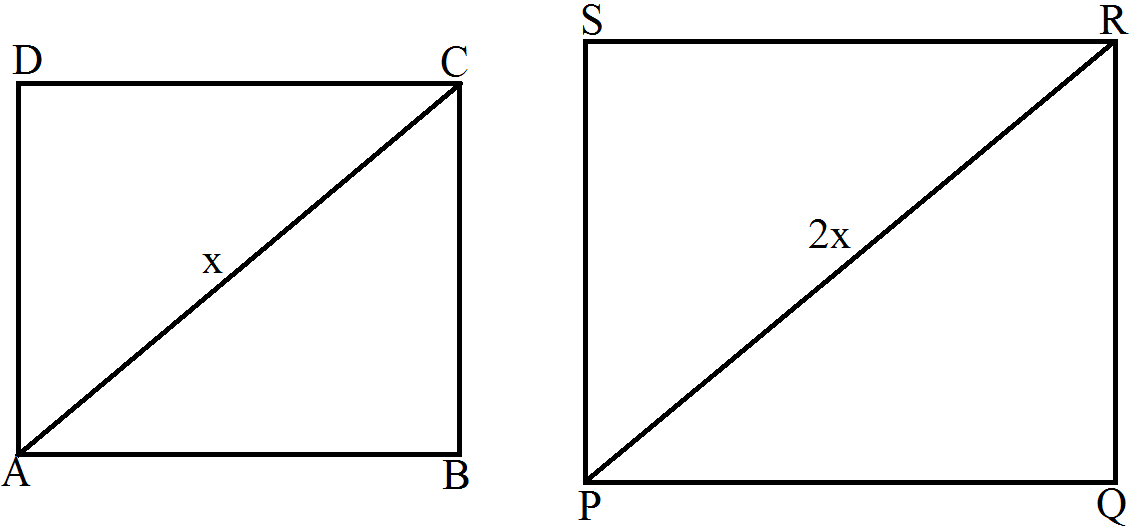
$PR = 2AC$
Now, area of the square $=\frac{(\text{diagonal})^{2}}{2}$
Area of $PQRS =\frac{(\text{PR})^{2}}{2}$
Similarly, area of $ABCD =\frac{(\text{AC})^{2}}{2}$
According to the question:
If $AC = x$ units, then, $PR = 2x$ units
Therefore, $\frac{\text{Area of PQRS}}{\text{Area of ABCD}}=\frac{(\text{PR})^{2}\times2}{2\times(\text{AC})^{2}}$
$=\frac{(\text{PR})^{2}}{(\text{AC})^{2}}=\frac{(2\text{x})^{2}}{(1\text{x})^{2}}=\frac{4}{1}$
$=4:1$
Thus, the ratio of the areas of squares $PQRS$ and $ABCD = 4 : 1$
View full question & answer→MCQ 671 Mark
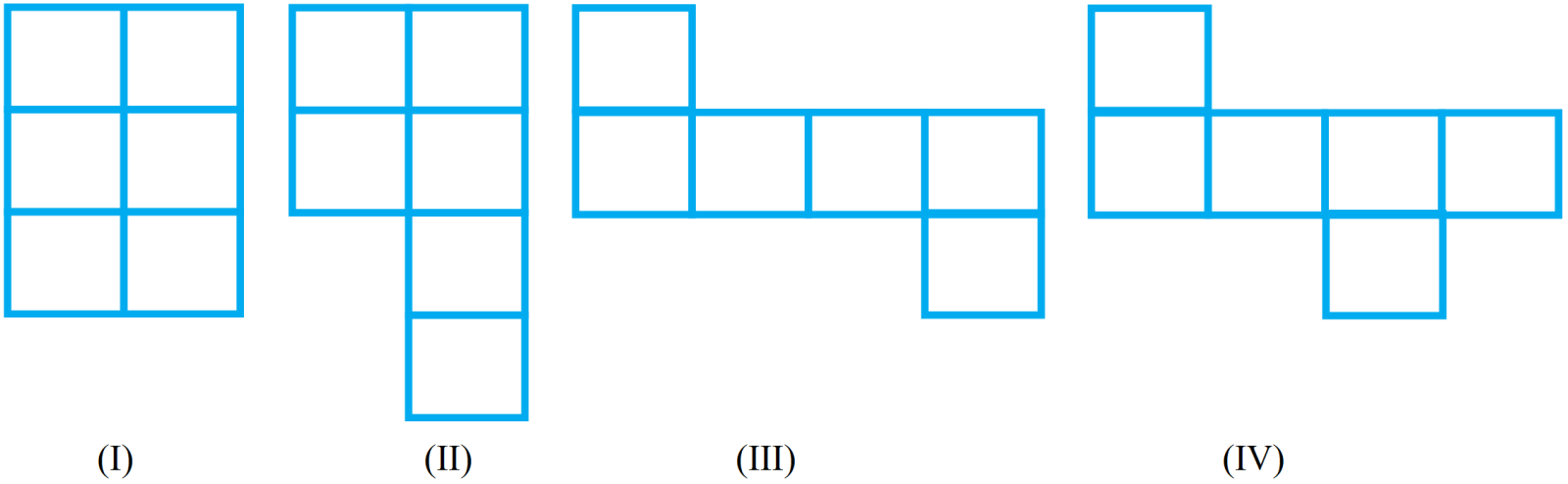
Following figures are formed by joining six unit squares. Which figure has the smallest perimeter in Fig.?
- A
$(ii)$
- B
$(iii)$
- C
$(iv)$
- ✓
$(i)$
AnswerLet the square $\Box = 1$ unit
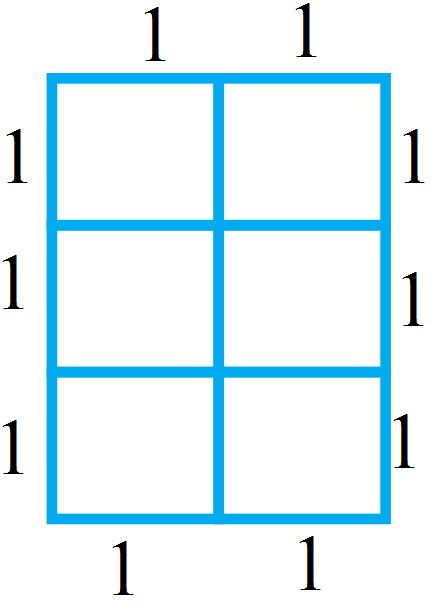
Then, perimeter = Sum of all sides
$= 1 + 1 + 1 + 1 + 1 + 1 + 1 + 1 + 1 + 1$
$= 10$ units
$ii.\ $Perimeter $=$ Sum of all sides
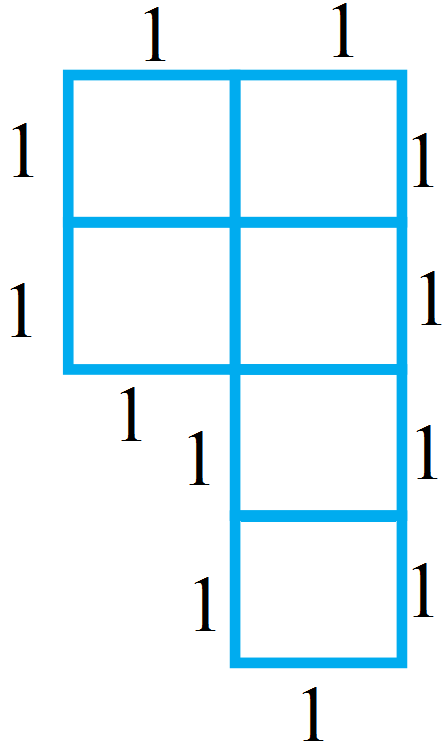
$= 1 + 1 + 1 + 1 + 1 + 1 + 1 + 1 + 1 + 1 + 1 + 1$
$= 12$ units
$iii.\ $Perimeter $=$ Sum of all sides
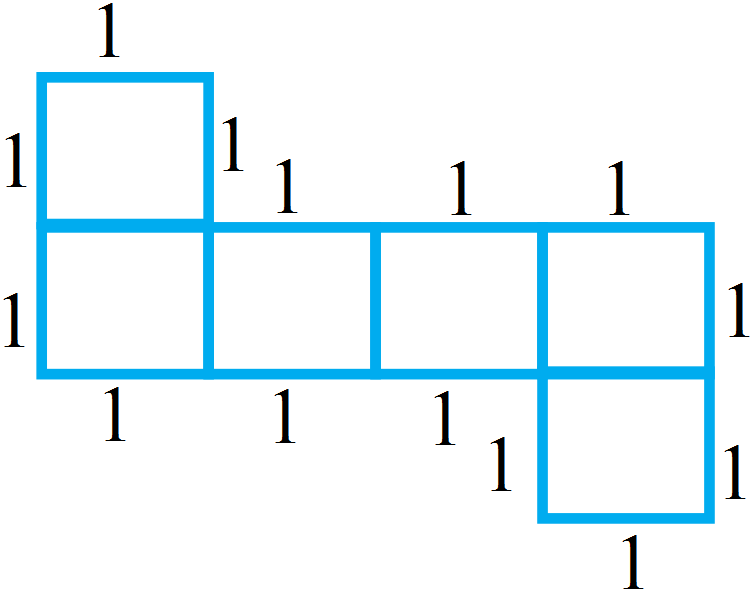
$= 1 + 1 + 1 + 1 + 1 + 1 + 1 + 1 + 1 + 1+ 1 + 1 + 1 + 1$
$= 14$ units
$iv\ $ Perimeter $=$ Sum of all sides
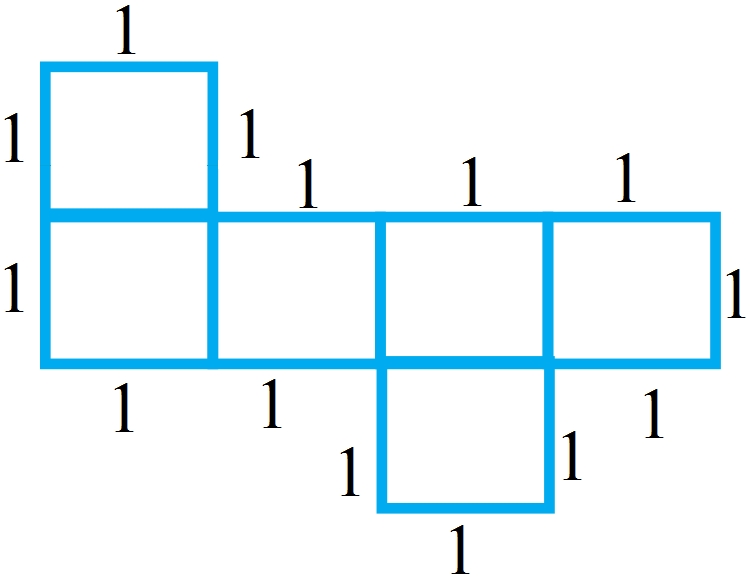
$= 1 + 1 + 1 + 1 + 1 + 1 + 1 + 1 + 1 + 1+ 1 + 1 + 1 + 1$
$= 14$ units
Hence, smallest perimeter $= 10$ units
which is the perimeter of figure $(i).$ View full question & answer→MCQ 681 Mark
The perimeter of a rectangular plot whose length is $75m$ and breadth is $50m$ is .......
- A
$125m$
- B
$250m^2$
- C
$25m$
- ✓
$250m$
AnswerCorrect option: D. $250m$
The perimeter of the rectangular plot $= 2 \times $ (length + breadth) $= 2 \times (75 + 70) = 250m$
View full question & answer→MCQ 691 Mark
What will be the perimeter of a rectangle if its length is $3$ times its width and the length of the diagonal is ${8}\sqrt{10}\text{cm}$?
- A
${16}\sqrt{10}\text{cm}$
- B
${15}\sqrt{10}\text{cm}$
- ✓
${64}\text{cm}$
- D
${24}\sqrt{10}\text{cm}$
AnswerCorrect option: C. ${64}\text{cm}$
Let length $= lcm$, width $= bcm$
$\Rightarrow l = 3b,$ Diagonal $ = {8}\sqrt{10}\text{cm}$
now, $l^2+ b^2= d^2$
$\Rightarrow (3b)^2+ b^2$ $= {8}\sqrt{10}^{2}$
$\Rightarrow 10b^2 = 640$
$\Rightarrow b^2 = 64$
$\Rightarrow b = 64 $
$\Rightarrow b =$
$\sqrt{64}$
$8\ cm l = 3b = 3 \times 6 = 24\ cm$ Perimeter $= 2(l + b) = 2(24 + 8) = 64\ cm$
View full question & answer→MCQ 701 Mark
80 students of the same height stand with both hands stretched all along the sides of a rectangular garden each student covering a length of $1.75m$.Then what is the perimeter of the garden?
- A
$1400m$
- ✓
$140m$
- C
$14m$
- D
$1400\ km$
AnswerCorrect option: B. $140m$
Perimeter $= 80 \times 1.75 = 14000 = 140m$
View full question & answer→MCQ 711 Mark
Mark the correct alternative in the following question:
The length and breadth of a rectangle of area $A$ are doubled. The area of the new rectangle is:
AnswerLet the length and breadth of the given rectangle be $l$ and $b$, respectively.
We have,
$A = lb ...(i)$
Also,
the length of the new rectangle, $l = 2l$
the breadth of the new rectangle,$b' = 2b$
Now, the area of the new rectangle $= l × b'$
$= (2l) × (2b)$
$= 4lb$
$= 4A $[Using $(i)$] View full question & answer→MCQ 721 Mark
The ratio between the length and perimeter of a rectangular plot is $1 : 3$ what is the ratio between the length and breadth of the plot?
- A
$1 : 2$
- ✓
$2 : 1$
- C
$3 : 2$
- D
$1 : 3$
AnswerCorrect option: B. $2 : 1$
let length of rectangle be lm, breadth be bm.
$\frac{1}{\text{p}} = \frac{1}{3}$
$\frac{1}{2}\big({1+\text{b}}\big) = \frac{1}{3}$
${31}={21} + {2}\text{b}$
${1} = {2}\text{b}$
$\therefore \frac{1}{\text{b}}=\frac{2}{1}$
$\therefore\text{required}\text{ ratio}: {2:1}$
View full question & answer→MCQ 731 Mark
The two adjacent sides of a rectangle are $5x^2 − 3y^2$ and $x^2 + 2xy.$ Find the perimeter:
- A
$12x^2 + 5xy + 9y^2$
- ✓
$12x^2- 6y_2+ 4xy$
- C
$7x^2 - 3y^2 + 4xy$
- D
$8x^2 - 8y^2 + 3xy$
AnswerCorrect option: B. $12x^2- 6y_2+ 4xy$
Given adjacent sides of a rectangle are $5x^2 - 3y^2$and $x^2 + 2xy$
we know that the perimeter of a rectangle with adjacent sides a and b is $2 \times (a + b)$
Perimeter $= 2((5x^2 - 3y^2) + (x^2+ 2xy))$
$= 2(6x^2 - 3y^2 + 2xy)$
$= 12x^2- 6y^2+ 4xy$
$= 12x^2- 6y^2+ 4xy$
$\therefore$ Perimeter $= 12x^2− 6y^2+ 4xy$
View full question & answer→MCQ 741 Mark
Mark $(\checkmark)$ against the correct answer in the following:
The circumference of a circle is $88 \ cm$. Its diameter is:
- ✓
$28\ cm$
- B
$42\ cm$
- C
$56\ cm$
- D
AnswerCorrect option: A. $28\ cm$
Diameter $=\frac{\text{Circumference}}{\pi}$
$=\frac{88\times7}{22}$
$=28\text{cm}$
View full question & answer→MCQ 751 Mark
In $\triangle A B C$ points $P$ and $Q$ trisect side $A B$ points $T$ and $U$ trisect side $A C$ and points $R$ and $S$ trisect side $B C$. Then perimeter of hexagon $PQRSTU$ is how many times of the perimeter of $\triangle A B C$ ?
- A
$\frac{1}{3}\text{times}$
- ✓
$\frac{2}{3}\text{times}$
- C
$\frac{1}{6}\text{times}$
- D
$\frac{1}{2}\text{times}$
AnswerCorrect option: B. $\frac{2}{3}\text{times}$
Let $AB$ be $x$
$\therefore AQ = QP = BP = \frac{\text{x}}{3}$
Let $BC$ be $y$
$\therefore BR = RS = SC = \frac{\text{y}}{3}$
Let $AC = z$
$AT = TU = UC = \frac{\text{z}}{3}$
Opposite sides of Hexagon are equal
$\therefore$ Perimeter of Hexagon $= PQ + QT + TU + US + RS + PR$
$ = \Big(\frac{\text{x}}{3} + \frac{\text{y}}{3} + \frac{\text{z}}{3}\Big) \times{2}$
$\therefore\frac{2}{3}$ Perimeter of hexagon is $\frac{2}{3}$ times the perimeter of $△ABC.$
View full question & answer→MCQ 761 Mark
The length of a rectangle is three times the width and the length of its diagonal is ${6}\sqrt{10}\text{cm}$ the perimeter of the rectangle is:
- ✓
$48\ cm$
- B
$36\ cm$
- C
$24\ cm$
- D
${24}\sqrt{10}\text{cm}$
AnswerCorrect option: A. $48\ cm$
Let $x$ be the width of the rectangle So its length will be $3x$
$\text{Diagonal} = {6}\sqrt{10}\text{cm} = \sqrt{{1}^{2} + \text{b}^{2}}$
$\therefore (3x)^2+ (x)^2$
$= \big({6}\sqrt{10}\big)^{2}$
$9x^2 + x^2 = 360$
$10x^2 = 360$
$\text{x}^{2} = \frac{360}{10}$
$x^2 = 36$
$x^2 = (6)^2$
$x = 6\ cm$
$\therefore$ Perimeter $= 2(l + b)$
$= 2(3x + x)$
$= 2(4x)$
$= 8x = 8 \times 6$
$= 48\ cm$
View full question & answer→MCQ 771 Mark
Perimeter of a square, whose length measures $y$ units is:
AnswerPerimeter of square $a + a + a + a = 4a$ where a is side of square.Here side of square is $y$ hence perimeter is $4y$ hence,
View full question & answer→MCQ 781 Mark
Mark the correct alternative in the following question:
How many envelopes can be made out of a sheet of paper $72\ cm$ by $48\ cm,$ if each envelope requires a paper of size $18\ cm$ by $12\ cm?$
AnswerWe have,
length of the sheet of the paper $= 72\ cm$
breadth of the sheet of the paper $= 48\ cm$
length of the envelope $= 18\ cm$
breadth of the enveolope $= 12\ cm$
The area of the sheet of the paper $= length \times breadth$
$= (18 \times 12)cm^2$
Now, the number of envelope that can be made out $=\frac{\text{Area of the sheet of the paper}}{\text{Area of the envelope}}$
$=\frac{(72\times48)}{(18\times12)}$
$=4\times4$
$=16$ View full question & answer→MCQ 791 Mark
Perimeter of a square whose side measures $4m$ is:
- ✓
$16m$
- B
$16\ cm$
- C
$4m$
- D
$12m$
AnswerPerimeter of a square $= 4 \times $ side
$= 4 \times 4 = 16m$
View full question & answer→MCQ 801 Mark
$36$ unit squares are joined to form a rectangle with the least perimeter. Perimeter of the rectangle is:
- A
$12$ units
- ✓
$26$ units
- C
$24$ units
- D
$36$ units
AnswerCorrect option: B. $26$ units
Area of rectangle is $36$ units we have,
$\Rightarrow 36 = 6 \times 6$
$= 2 \times 3 \times 3 \times 2$
$= 4 \times 9$
the sides of a rectangle are $4\ cm$ and $9\ cm$
Perimeter $= 2(l + b)$
$= 2(4 + 9)$
$= 13 \times 2$
$= 26$ units
View full question & answer→MCQ 811 Mark
If a square and a circle have the same perimeter then:
AnswerCorrect option: A. The area of the circle is greater than that of square.
Let the perimeter of circle and square is $1$Then perimeter of circle $={2}\pi\text{r}$
$= 1$ (wherer is redius of circle) $\Rightarrow\text{r}=\frac{1}{2\pi}$
Then area of circle $ = \pi\text{r}^{2} = \pi(\frac{1}{2\pi})^{2} = \frac{1}{4\pi} = 0.0789$
perimeter of square $= 4l = 1$ then l $= \frac{1}{4}$ (where l id the side of square)
Then area of square $=\frac{1}{4}\times\frac{1}{4} = \frac{1}{16} = 0.0625$
Then area of circle is greater then that of squre
View full question & answer→MCQ 821 Mark
If a regular hexagon is inscribed in a circle of radius r, then its perimeter is:
AnswerAngle subtended by each side of hexagon at centre of circle is $60^\circ0.$
Thus six equilateral triangles form and each side is of length r and so perimeter$ = 6r.$
View full question & answer→MCQ 831 Mark
The cost of ploughing a field at $Rs. 9$ per square metre is $Rs. 1872$. If the breadth of the field is $13m$, then its length is.............
AnswerTotal cost $= Rs.1872$
Cost of ploughing $1sq$. $m = Rs. 9$
$\therefore$ Area of field$ = 1872 ÷ 9 = 208sq. m.$
$\Rightarrow $ Length $\times Breadth = 208sq. m.$
$\Rightarrow $ Length $\times 13m = 208sq. m$.
$\Rightarrow $ Length $= 208 ÷ 13 = 16m.$
View full question & answer→MCQ 841 Mark
The length of a rectangle is $\frac{6}{5}$ the of its breadth. If its perimeter is $132m,$ its area will be .................
- ✓
$1,080m^2$
- B
$640m^2$
- C
$1,620m^2$
- D
$2,160m^2$
AnswerCorrect option: A. $1,080m^2$
$1=\frac{6}{5}\text{b}$
$\text{perimeter}={132}$
$2\big( \frac{6}{5}\text{b}+\text{b}\big)={132}$
$\frac{11\text{b}}{5}=\frac{132}{2}$
$\text{b}={30}\text{m}$
$\text{Area} = {1}\times\text{b} = {36} \times {30}$
$1=\frac{6}{5}\times30=36\text{m}$
$\text{Area} = {1}\times\text{b} = {36} \times {30}$
$= 1,080\text{m}^{2}$
View full question & answer→MCQ 851 Mark
The length of a rectangle is $6m$ less than three times its breadth. The length and breadth of the rectangle, if its perimeter is $148m,$ is ..............
- ✓
$54m, 20m$
- B
$50m, 30m$
- C
$40m, 25m$
- D
$30m, 20m$
AnswerCorrect option: A. $54m, 20m$
Let the length and breadth of rectangle be $l$ and $b .$
Given that length is 6m less than three times its breadth $\Rightarrow l = 3b − 6 ............................ (i)$
Given its perimeter is 148m.we k.n.t perimeter of a rectangle is $2(l + b) \Rightarrow 2(l + b)$
$=148\Rightarrow(1+\text{b})=\frac{148}{2}={74}............\text{(ii)}$
Substitute $(i)$ in $(ii) l + b = (3b - 6) + b = 744b$
$= 74 + 6$
$={80}\text{b}=\frac{80}{4}=20$
substituting value of $b$ in $(i) l = 3b - 6 = 3(20) - 6 = 60 - 6 = 54$
thus, length and breadth of given rectangle are $54m, 20m$
View full question & answer→MCQ 861 Mark
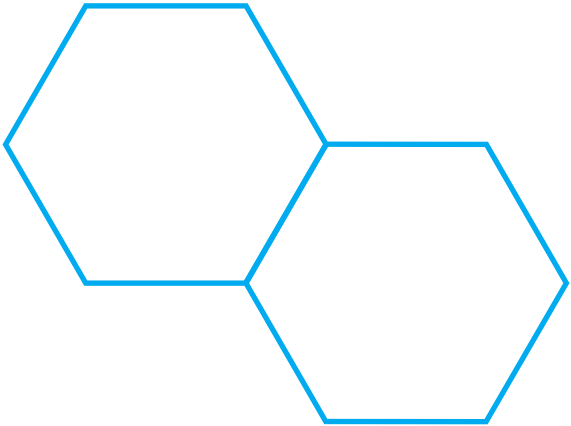
Two regular Hexagons of perimeter $30\ cm$ each are joined as shown in Fig. The perimeter of the new figure is:
- A
$65\ cm$
- B
$60\ cm$
- C
$55\ cm$
- ✓
$50\ cm$
AnswerCorrect option: D. $50\ cm$
Given, perimeter of hexagon $= 30\ cm$
and number of sides in hexagon $= 6$
$\therefore$ Length of one side $=\frac{\text{Perimeter of hexagon}}{\text{Total number of sides}}$
$=\frac{30}{6}$
$=5\text{cm}$
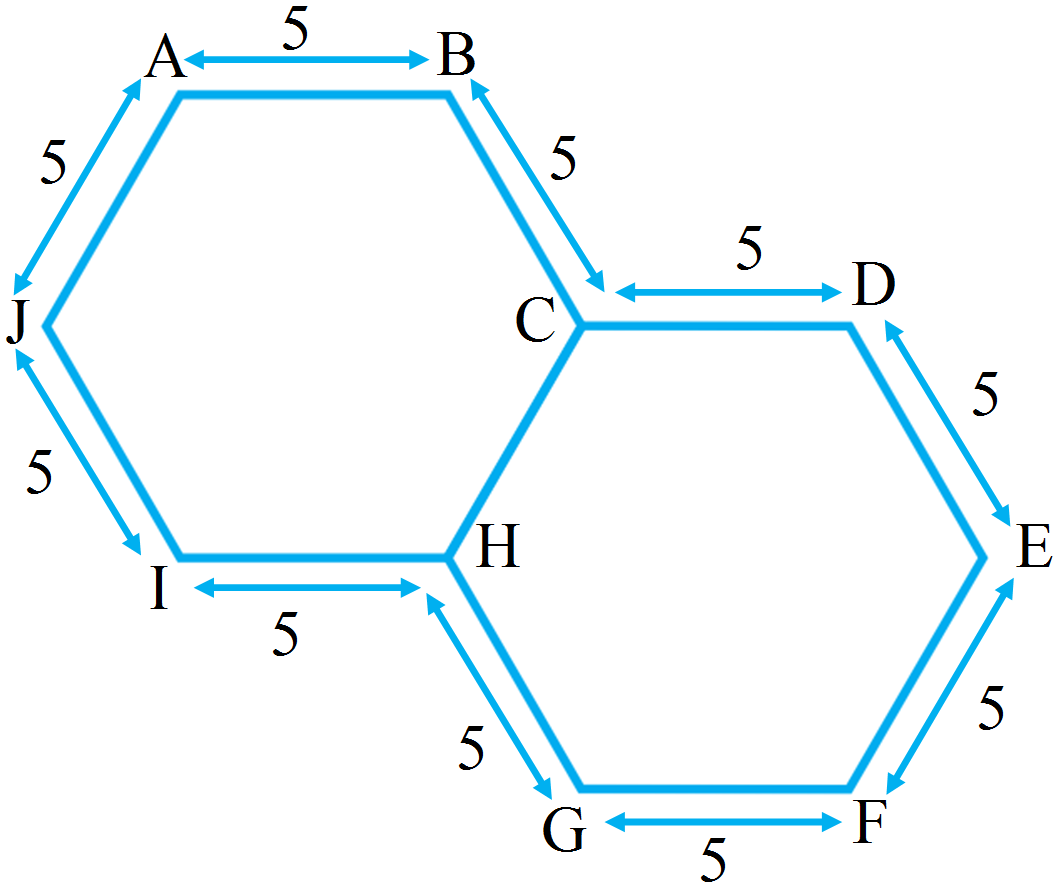
Now, two hexagons are joined then perimeter = Sum of all sides
$= AB + BC + CD + DE + EF + FG + GH + HI + IJ + JA$
$= 5 + 5 + 5 + 5 + 5 + 5 + 5 + 5 + 5 + 5$
$= 50\ cm$ View full question & answer→MCQ 871 Mark
Mark $(\checkmark )$ against the correct answer in the following:
Perimeter of a square of side $16\ cm$ is:
- A
$256\ cm$
- ✓
$64\ cm$
- C
$32\ cm$
- D
$48\ cm$
AnswerCorrect option: B. $64\ cm$
Side of the square $= 16\ cm$
Perimeter of the square$ = (4 \times $ side)
$= (4 \times 16)cm$
$= 64\ cm$
View full question & answer→MCQ 881 Mark
The length of a rectangular field is thrice its breadth. Its perimeter is $400$ metres. Find its length and breadth:
- A
$250m$ and $50m$
- B
$150m$ and $40m$
- C
$100m$ and $50m$
- ✓
$150m$ and $50m$
AnswerCorrect option: D. $150m$ and $50m$
Breadth $= x$
Length $= 3x$
Perimeter$ = 2$(length + breadth)
Perimeter $\Rightarrow 2(x + 3x) = 400$
$\Rightarrow 2(4x) = 400$
$\Rightarrow x = 50$
Length $= 3x = 150m$
Breadth $= x = 50m$
View full question & answer→MCQ 891 Mark
The perimeter of a scalene triangle and isosceles triangle and an equilateral triangle are equal Which triangle can have more area?
AnswerAs per the property of triangles, when triangles have the same perimeter, an equilateral triangle has the greatest area.
View full question & answer→MCQ 901 Mark
Mark $(\checkmark)$ against the correct answer in the following:
The length of a rectangle is three times its width and the length of its diagonal is $6\ cm$. The perimeter of the rectangle is:
- ✓
$48\ cm$
- B
$36\ cm$
- C
$24\ cm$
- D
$24\sqrt{10}\text{cm}$
AnswerCorrect option: A. $48\ cm$
Let width of a rectangle $= x$
Then length $= 3x$
and diagonal $6\sqrt{10}\text{cm}$
$\therefore(3\text{x})^2+(\text{x})^2$
$=(6\sqrt{10})^2$
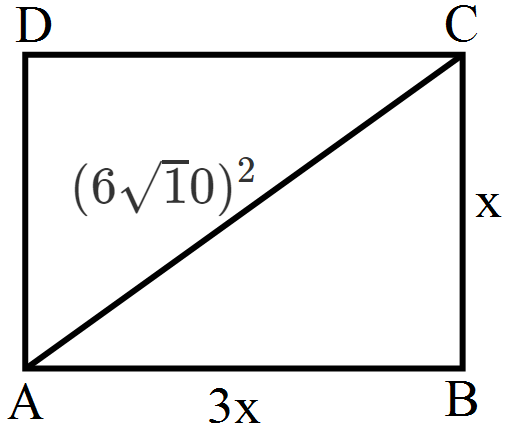
$9\text{x}^2+\text{x}^2=360$
$\Rightarrow 10\text{x}^2=360$
$\Rightarrow \text{x}^2=\frac{360}{10}$
$=36=(6)^2$
$\therefore$ Perimeter $= 2(l + b)$
$= 2(3x + x)$
$= 2 \times 4x = 8x$
$= 8 \times 6 = 48m$ View full question & answer→MCQ 911 Mark
The length of the wooden strip required to frame a photograph of length and breadth $39.5\ cm$ and $31\ cm$ respectively, is:
- A
$79\ cm$
- B
$1224.5\ cm$
- ✓
$141\ cm$
- D
$70.5\ cm$
AnswerCorrect option: C. $141\ cm$
Length of photograph $= 39.5\ cm$
Breadth of photograph $= 31\ cm$
$\therefore$ Required length of the wooden strip
= Perimeter of photograph
$= 2(39.5 + 31) = 2(70.5) = 141\ cm$
View full question & answer→MCQ 921 Mark
The perimeter of the rectangle whose length$ = 25\ cm$, breadth $= 15\ cm$ is .................. cm.
AnswerPerimeter of a rectangle $= 2 \times $ (length $+$ breadth) Perimeter $= 2 \times (25 + 15) = 80\ cm$
View full question & answer→MCQ 931 Mark
In a square shaped park whose side measures $28m$ a rectangular pond is located at the centre with dimension $3m$ and $2m$ the area of the park excluding the pond is:
- A
$784sq m$
- B
$6sq m$
- ✓
$778sq m$
- D
$708sq m$
AnswerCorrect option: C. $778sq m$
Area of pond $= 3m \times 2m = 6sq m$
area of park $= 28 \times 28$
$= 784sq m$
area of the park excluding the pond$= 784 - 6$
$= 778sq m$
View full question & answer→MCQ 941 Mark
Niharika walks thrice around a square field of side $22m.$ Girish walks twice around a rectangular field with length $10m$. and breadth $12m$. Who covers more distance and by how much?
- A
Girish, $20m$
- B
Niharika, $200m$
- C
Girish, $176m$
- ✓
Niharika, $176m$
AnswerCorrect option: D. Niharika, $176m$
Side of square field $= 22m$
Perimeter of square field $= 4 \times 22 = 88m$
Length of rectangular field $= 10m$
Breadth of rectangular field $= 12m$
Perimeter of rectangular field $= 2(10 + 12) = 2(22) = 44m$
$\therefore$ distance covered by Niharika $= 3 \times 88 = 264m$
And distance covered by Girish $= 2 \times 44 = 88m$
So, Niharika covers more distance than Girish and by $(264 - 88)m = 176m$
View full question & answer→MCQ 951 Mark
A rectangular playground which is $250m$ long and $20m$ broad is to be fenced with wire.How much wire needed?
AnswerCorrect option: C. $540m$
Wire needed would be perimeter of the playground : we know, Perimeter of rectangle :$ 2(l + b) 250 + 20 + 250 + 20 = 540m$
View full question & answer→MCQ 961 Mark
The perimeter of a square is $144m$, then the side of the square is ......
AnswerPerimeter of square $= 4 × s = 144$
Hence s$= 144 ÷ 4 = 36m$
View full question & answer→MCQ 971 Mark
Mark $(\checkmark)$ against the correct answer in the following:
A room is $5m \ 40\ cm$ long and $4m \ 50\ cm$ broad, its area is:
- A
$23.4m^2$
- ✓
$24.3m^2$
- C
$25m^2$
- D
$98.01m^2$
AnswerCorrect option: B. $24.3m^2$
Length of a rectangular room $(l) = 5m 40\ cm = 5.4m$
and breadth$ (b) = 4m 50\ cm$
$= 4.5m$
Area$ = l \times b$
$= 5.4 \times 4.5m^2$
$= 24.3m^2$
View full question & answer→MCQ 981 Mark
Mark $(\checkmark)$ against the correct answer in the following:
How many envelopes can be made out of a sheet of paper $72\ cm$ by $48\ cm$, if each envelope requires a paper of size $18\ cm$ by $12\ cm?$
AnswerLength of a sheet $(l) = 72 \ cm$
and breadth $(b) = 48 \ cm$
Area $= l x b = 72 \times 48 \ cm^2$
Area of paper for one envelope $= 18 \times 12\ cm^2$
No. of envelopes $=\frac{72\times 48}{18\times 12}=16$
View full question & answer→MCQ 991 Mark
If the ratio of areas of two squares is $225 : 256$, then the ratio of their perimeters is:
- A
$225 : 256$
- B
$256 : 225$
- ✓
$15 : 16$
- D
$16 : 15$
AnswerCorrect option: C. $15 : 16$
Let the two squares be $ABCD$ and $PQRS$.
Further, let the lengths of each side of $ABCD$ and $PQRS$ be $x$ and $y$, respectively.
Therefore, $\frac{\text{Area of square ABCD}}{\text{Area of square PQRS}}=\frac{\text{x}^{2}}{\text{y}^{2}}$
$=\frac{225}{256}$
Taking square roots on both sides, we get:
$\frac{\text{x}}{\text{y}}=\frac{15}{16}$
Now, the ratio of their perimeters:
$\frac{\text{Perimeter of square ABCD}}{\text{Perimeter of square PQRS}}$
$\frac{4\times\text{side of square ABCD}}{4\times\text{side of square PQRS}}=\frac{4\text{x}}{4\text{y}}$
$\frac{\text{Perimeter of square ABCD}}{\text{Perimeter of square PQRS}}=\text{x}:\text{y}$
$\frac{\text{Perimeter of square ABCD}}{\text{Perimeter of square PQRS}}=\frac{15}{16}$
Thus, the ratio of their perimeters $= 15 : 16$
View full question & answer→MCQ 1001 Mark
Mark the correct alternative in the following question:
The maximum length of the side of a square sheet that can be cut off from a rectangular sheet of size $8m \times 3m$ is:
AnswerThe maximum length of the side of a square sheet that can be cut off from a rectangular sheet of size $8m \times 3m$ is $3m.$
View full question & answer→