Questions · Page 2 of 2

2 Marks Questions

Question 512 Marks
Using divisibility tests, determine if the number $2150$ is divisible by
$a.\ 4$
$b.\ 8$
Answer
 
$i.$ Divisibility by $4.$
The number formed by last two digits $= 50$
$4)50(12$
    $\underline {4}$
   $10$
    $\underline{8}$
    $2$
$\because$ Remainder is not $0.$
$\therefore$ $50$ is not divisible by $4.$
$\therefore$ $2150$ is not divisible by $4$ because a no. is divisible by $4$ only if the no. formed by its last two digits $($i.e ones and tens $)$ is divisible by $4.$
$ii.$ Divisibility by $8.$
The number formed by last three digits $= 150$
$8)150(18$
    $\underline {8}$
    $70$
    $\underline{64}$
    $6$
$\because$ Remainder is not $0.$
$\therefore$ $150$ is not divisible by $8.$
$\therefore$ $2150$ is not divisible by $8$ because a no. is divisible by $8$ only if the no. formed by its last three digits is divisible by $8.$
 
View full question & answer
Question 522 Marks
Using divisibility tests, determine if the number $572$ is divisible by
$a.\ 4$
$b.\ 8$
 
Answer
$572$
$i.$ Divisibility by $4.$
The number formed by last two digits $= 72$
$4)72(18$
$    \underline {4}$
$    32$
$    \underline{32}$
$    0$
$\because$ Remainder is $0.$
$\therefore 72$ is divisible by $4.$
$\therefore 572$ is divisible by $4$ because a no. is divisible by $4$ if the no. formed by its last two digits $($i.e ones and tens $)$ is divisible by $4.$
$ii.$ Divisibility by $8.$
The number is $572$
$8)572(71$
$    \underline {56}$
$    12$
$     \underline{8}$
$     4$
$\because$ Remainder is not $0.$
$\therefore 572$ is not divisible by $8.$
View full question & answer
Question 532 Marks
Is $26$ a prime or not.
Answer
Here,
$26 = 1 \times 26$
$26 = 13 \times 2$
$26 = 2 \times 13$
$26 = 26 \times 1$
Clearly, $26$ has four factors $1, 2, 13,$ and $26.$ So, it’s not a prime number and hence it is a composite number.
View full question & answer
Question 542 Marks
Is $37$ a prime or not.
Answer
Here,
$37 = 1 \times 37$
Prime numbers are the numbers that can be divided by $1$ and by the number itself.
Here, $37$ has only two factors $1$ and $37.$ So, it is a prime number.
View full question & answer
Question 552 Marks
Is $51$ a prime number or not$?$
Answer
Here,
$51 = 1 \times 51$
$51 = 3 \times 17$
$51 = 17 \times 3$
$51 = 51 \times 1$
Since $51$ has four factors $1, 3, 17$, and $51.$ Therefore it is a composite number and not a prime number.
View full question & answer
Question 562 Marks
Is $23$ a prime number or not$?$
Answer
$2$ $63, 70, 77$
$3$ $63, 35, 77$
$3$ $21, 35, 77$
$5$ $7, 35, 77$
$7$ $7, 7, 77$
$11$ $1, 1, 1, 1$
  $1, 1, 1$

$\therefore L.C.M.$ of $63, 70$ and $77 = 2 \times 3 \times 3 \times 5 \times 7 \times 11$
$= 6930$
Hence, the minimum distance each should cover so that all cover the distance in complete steps is $6930\ cm.$
View full question & answer
Question 572 Marks
Find all the multiples of $9$ upto $100.$
Answer
The multiples of $9$ are
$9 \times 1 = 9$
$9 \times 2 = 18$
$9 \times 3 = 27$
$9 \times 4 = 36$
$9 \times 5 = 45$
$9 \times 6 = 54$
$9 \times 7 = 63$
$9 \times 8 = 72$
$9 \times 9 = 81$
$9 \times 10 = 90$
$9 \times 11 = 99$
$9 \times 12 = 108$
Since $108$ is greater than $100$ therefore all the multiples of $9$ upto $100$ are $9, 18, 27, 36, 45, 54, 63, 72, 81, 90$ and $99.$
View full question & answer
Question 582 Marks
Match the items in column $1$ with the items in column $2.$
Column 1 Column 2
$(i) 35$ $(a)$ Multiple of $8$
$(ii) 15$ $(b)$ Multiple of $7$
$(iii) 16$ $(c)$ Multiple of $70$
$(iv) 20$ $(d)$ Factor of $30$
$(v) 25$ $(e)$ Factor of $50$
  $(f)$ Factor of $20$
Answer
self-learning
View full question & answer
Question 592 Marks
Write first five multiples of $9.$
Answer
First five multiplies of $9$ are obtained as follows;
$1 \times 9 = 9$
$2 \times 9 = 18$
$3 \times 9 = 27$
$4 \times 9 = 36$
$5 \times 9 = 45$
So,
First five multiplies are $9, 18, 27, 36$ and $45.$
View full question & answer
Question 602 Marks
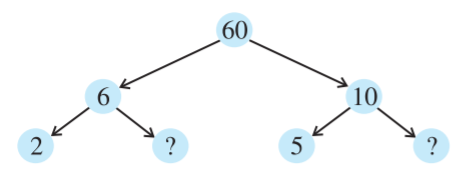
Here are two different factor trees for $60.$ Write the missing numbers.
Answer
First five multiplies of $8$ are obtained as follows;
$1 \times 8 = 8$
$2 \times 8 = 16$
$3 \times 8 = 24$
$4 \times 8 = 32$
$5 \times 8 = 40$
So,
The first five multiplies of $8$ are, $8, 16, 24, 32$ and $40.$
View full question & answer
Question 612 Marks
Write all the prime numbers less than $15.$
Answer
By observing the Sieve Method, we can easily get the required prime numbers as: $2, 3, 5, 7, 11$ and $13$
View full question & answer
Question 622 Marks
Write first five multiples of $6$
Answer
The required multiples of $6$ are: $6 \times 1 = 6, 6 \times 2 = 12, 6 \times 3 = 18, 6 \times 4 = 24, 6 \times 5 = 30$ i.e. $6, 12, 18, 24$ and $30$
View full question & answer
Question 632 Marks
In a morning walk, three persons step off together. Their steps measure $80 \ cm, 85 \ cm$ and $90 \ cm$ respectively. What is the minimum distance each should walk so that all can cover the same distance in complete steps$?$
Answer
Since, the distance covered by each one of the persons is required to be the same as well as minimum. So, for the required minimum distance, each should walk the lowest common multiple of the measures of their steps. Thus, we have to find find the $LCM$ of $80, 85$ and $90.$
The $LCM$ of $80, 85$ and 90 is $12240.$
The required minimum distance is $12240 \ cm.$
View full question & answer
Question 642 Marks
Find the $LCM$ of $20, 25$ and $30.$
Answer
We can find the $LCM$ as follows:
$2$ $20$ $25$ $30$
$2$ $10$ $25$ $15$
$3$ $5$ $25$ $15$
$5$ $5$ $25$ $5$
$5$ $1$ $5$ $1$
  $1$ $1$ $1$
So, $LCM = 2 \times 2 \times 3 \times 5 \times 5 = 300$
View full question & answer